
7
This chapter presents an extended case study to illustrate the theme of pragmatism in the construction of operational approaches discussed in Chapter 6. From the British perspective, the Borneo campaign is usually regarded (incorrectly) as an appendix of the Malayan Emergency 1948–60. The conflict, termed from the British perspective either the ‘Borneo Confrontation’ or the ‘Indonesian Confrontation’, provides an independent and valuable example of the utility of a pragmatic mentality in the construction and application of strategy. British strategy understood the problem on its own terms: both policy and operational approaches were adjusted relative to one another to formulate, and continuously review, a coherent campaign plan.
Throughout this case study the term British, for simplicity, is used to refer generally to all of the Commonwealth troops who fought in the campaign. Australian, New Zealand and Malaysian troops played an important role. Their respective governments were also actors in their own right. There is not space here for a full narrative, and the emphasis of this case study is on the quality of pragmatism in British strategic thinking. To that end the Commonwealth dimension of the conflict is significantly simplified.1 I have also used evidence to support my account of combat on the ground largely from the history of my own regiment. This is simply because I have had better access to ex-Gurkhas who served in Borneo and the relevant records from the Gurkha Museum. I do not mean in any way to sideline the role played by other units, British and Commonwealth, and indeed Indonesian, in the campaign.
British Secretary of Defence Denis Healey’s verdict to the House of Commons upon the successful conclusion of the Indonesian Confrontation was that ‘in the history books it will be recorded as one of the most efficient uses of military force in the history of the world’.2 Between 1962 and 1966 British and Commonwealth forces had been engaged in an armed confrontation against Indonesia, fought for the most part deep inside the jungles of Borneo. By 1964, 30,000 troops were committed in what was a major British combat operation. Yet contrary to Lord Healey’s prediction, and despite some excellent specialist works, their exploits have been largely forgotten, failing to emerge from below the jungle canopy into the light of general knowledge. A short narrative is necessary.
For the British government, the Confrontation had its origins in the context of decolonisation and Cold War. Malaya had been granted independence in 1957 and Singapore in 1959. In colonial terms, Britain still retained interests on the island of Borneo in Sarawak, North Borneo (Sabah) and Brunei. The British plan was to federate these entities with Malaya and Singapore as ‘Malaysia’. In the event Brunei did not join. Malaysia was born in September 1963, but Singapore left in 1965. In Cold War terms, Britain wanted to retain basing rights in Malaysia, particularly in Singapore. Britain had commitments to the region as a member of the anti-communist South East Asia Treaty Organisation (SEATO), which had been set up in 1955 following the Geneva Conference and Manila Pact in 1954.
The Indonesian President Ahmed Sukarno was hostile to both the ‘imperialist’ British presence in South East Asia and the concept of Malaysia. He hoped to assimilate the whole of Borneo into Indonesia (the other, much larger, territory of the Island of Borneo, Kalimantan, was already part of Indonesia). This was to be achieved by a policy of Konfrontasi. J. A. C. Mackie in Konfrontasi: The Indonesia-Malaysia Dispute 1963–1966 (1974) states that at this stage the meaning of the policy was uncertain. The term had been coined at a press conference on 20 January 1963 by the Indonesian Foreign Minister Dr Subandrio who, when asked what it meant, stated: ‘Confrontation does not include war, because it can be carried on without war’.3
Michael Leifer in Indonesia’s Foreign Policy (1982) describes Konfrontasi in terms of ‘coercive diplomacy’, which had worked in the earlier Indonesian assimilation of West Irian (also known as West New Guinea, West Papua, or Irian Jaya), a remnant of the Dutch East Indies, in 1961–2. Sukarno played on US fears of alienating Indonesia and losing it to communism. The result was a UN settlement that demanded Dutch withdrawal. Leifer also stresses the other, equally important, purpose of Konfrontasi: it was a means for President Sukarno to stabilise his political position by binding together ‘in adverse partnership’ the two potentially antagonistic elements of his power base: the army and the Indonesian Communist Party (the PKI).4
The pattern of the Confrontation falls into four phases. In the first phase, Indonesia provided aid to the rebels who led the Brunei revolt of December 1962, although this was soon suppressed by British troops flown in from Singapore. In the second phase, from April 1963, Indonesian regular army officers led guerrilla ‘volunteers’ from Kalimantan on raids across the border, mainly into Sarawak. While lethal, these raids remained few and generally involved small numbers of less than platoon size. Their purpose was to back up Indonesia’s negotiating position in the spring and summer of 1963, which opposed the formation of Malaysia. This period involved a rather complex series of events which will not be discussed here, but which involved the UK trying to establish Malaysia against Indonesian pressure, with other key actors involved, including the US and the UN.5
The conflict proper began in the following third phase, when the formation of Malaysia on 16 September 1963 triggered a violent Indonesian response. Symbolically, a mob smashed the British Embassy in Jakarta on that day.6 More seriously, from late September, much bigger and more aggressive raids were conducted by Indonesian regular forces into Sarawak and Sabah. Indonesia began limited (and unsuccessful) sea and airborne raids on peninsular Malaysia in August 1964 that were conducted intermittently until March 1965. The fourth and final phase opened in October 1965. A successful Indonesian army counter-coup against an attempted PKI coup brought General Suharto to power. This resulted in the Confrontation winding down to the old pattern of guerrilla raids. Secret peace feelers were sent to Kuala Lumpur in March 1966, which resulted in the Confrontation formally ending on 11 August 1966.
In diplomatic terms, the central problem the British faced from the outset of the Confrontation was to convince the United States that British policy was not a self-serving colonial construct, but supported the fight against communism in Southeast Asia. The US was worried that Indonesia, with a population of 100 million, and with the PKI as the third largest communist party in the world, would become communist.
Matthew Jones in Conflict and Confrontation in South East Asia, 1961–65 (2002) notes the powerful effect on President Kennedy of First Secretary Khrushchev’s famous January 1961 speech encouraging anti-colonial revolutions in Africa and Asia. The effect in relation to the Indonesian situation was underscored by the fact that the Indonesian Army Chief of Staff, General Nasution, and the Foreign Minister, Dr Subandrio, were at that very time in Moscow to sign a $400 million contract for military hardware.7 Jones also notes how by 1963 Indonesia’s relationship with China, advertised by the visit of the People’s Republic of China (PRC) Chairman, Liu Shaoqi, to Jakarta in April of that year, also became a pressing US concern, especially in the Southeast Asian regional context, in which several countries (not least Vietnam, Laos and Cambodia) appeared under threat.8
Britain’s international position at the outset of the Confrontation was difficult, caught between Commonwealth and Cold War interests. Britain simply could not ignore Kennedy’s position which was that, in defeating Indonesia militarily, Sukarno would lose face and the Indonesian Army might lose its political power, leaving the PKI dominant.
British policy-makers approached the problem with a pragmatic mindset. This was not pragmatism as a formal strategic approach; there is no evidence of that. Nor was it pragmatism in terms of trying to find the answer through a conscious notion of ‘common sense’, which is often associated with being pragmatic, because contradictory views on policy could legitimately claim to be based on common sense. Thus there were significant private disagreements on policy in 1963 between senior British officials. The key seam was formed between those who advocated negotiating a settlement with Indonesia (such as Peter Thorneycroft, the Minister of Defence) and those who wanted to hold the line militarily (such as Rab Butler, the Foreign Secretary). Both points of view were not particularly ideological; they were both anchored in practical ‘common sense’ considerations. The credibility of these views is reflected in the nature of Cabinet discussions, which entertained both seriously. Nor were more genuinely ideological ideas seen as suspect. The Cold War ‘domino theory’ played a significant role in shaping British policy. So what then was pragmatic?
Pragmatism can be identified as the mentality by which the coterie of senior British policy-makers, civil servants and soldiers involved in the Borneo Confrontation dealt with the problem on its own terms. They recognised ideological and doctrinal lenses through which to understand the issue, but were not slaves to them; they modified or discarded ideological positions when they did not suit the government’s perception of its national interests. In this way the issue was dealt with not generically, but in terms particular to itself.
In January 1964 Butler presented the Cabinet with a major policy paper on Indonesia that reviewed possible options.9 As this was the British government’s key policy document in the conflict, it merits particular attention. The paper was acutely sensitive to how the conflict should be conceptually configured in relation to various target audiences. This had two benefits. First, the strategic narrative was formally considered at the highest level of government, which set definite and clear parameters within which the armed forces, the diplomatic service and other agencies could develop operational plans. Second, the government was clear in its own mind about which audiences were priorities, and evaluated various courses of action against the degree of purchase they would have in relation to those strategic audiences (the term ‘strategic audience’ was not actually used, but the sense was the same, of an audience against whom a policy aim was defined).
The first option was offensive military action. Butler recalled the Dutch failure to check Indonesian guerrillas during the war of Indonesian independence (1945–9); this was despite the fact that they were technologically superior and had twice inflicted major defeats on the Indonesians (even capturing Sukarno himself at one point): ‘The importance of this is that no military action we contemplate could make it militarily impossible for the Indonesians to continue and even intensify guerrilla activity’. A military offensive could only succeed by breaking the will of the Indonesian government or their authority over their people. Yet, ‘in the light of past experience it seems unlikely that military action on our part could achieve this, unless such action were of so drastic a character (i.e. nuclear bombing) that it would invite retaliation from, for instance, the Soviet Union’. Moreover, overt military action would probably hinder Britain’s international position ‘because international opinion generally does not regard fomenting a rebellion in someone else’s country (which is all the Indonesians admit to doing) as justifying the victim in openly carrying the war into his tormentor’s country’.
The second option was an appeal to the UN, which would bring the currently ‘undeclared’ conflict into the open and put pressure on Indonesia. While Malaysia had more support there than Indonesia, there was little support in the wider international community for the United Kingdom’s military presence in Southeast Asia. Approaching the UN, argued Butler, would probably lead to either a vote of sympathy for Malaysia without sanctions against Indonesia, or a demand that Malaysia and Indonesia resume negotiations, but almost certainly not under the conditions demanded by Malaysia.
Even if the UN could be persuaded to send peace-keepers or observers, they would hamper the operations of British regular forces more than Indonesian infiltration and subversion. Essentially, the more the UN intervened, the more Malaysia would be subjected to international pressure to find a negotiated settlement: ‘and once negotiations are internationalised, Malaysia will be subjected to pressure, as the price of peace with Indonesia, to abandon her defence agreement with us [the Anglo-Malaysian Defence Agreement of 1957] and to deprive us of the Singapore base’.10 On balance, recourse to the UN would ‘not significantly assist to end the Indonesian Confrontation on acceptable terms’.
All of these options would bring the conflict into the open. However, the benefits of this would be limited to Commonwealth and US public opinion. Elsewhere it would probably encourage a resumption of negotiations rather than support for Malaysia and Britain:
Its greatest disadvantage [bringing the conflict into the open] would be to diminish the range of options available to us. As long as our conflict with Indonesia remains unofficial and bilateral, we retain the initiative. We can choose either to intensify it or to seek a settlement. Once we either internationalise it or turn it into a war (declared or undeclared) against a wicked aggressor, Her Majesty’s Government will be restricted in their freedom of action by both public opinion at home and by international pressure.11
Hence the policy paper advanced that bringing the conflict into the open would cause other problems, as the ambiguous conflict would evolve into a situation where neither side could withdraw without admitting defeat: ‘the Indonesian Government, whose pretence that they are only giving limited help to an indigenous resistance movement, however irritating in its mendacity, does at least leave the possibility (which we should be careful not to destroy) of withdrawing from the Confrontation without intolerable loss of prestige’. The paper also stressed the limitation of information to avoid the British public perceiving that the military had been committed to an interminable conflict.
The course of action recommended by Butler was accepted, acted upon, and remained the basis of British policy during the Confrontation. This entailed: ‘a prolonged but restricted struggle to protect Malaysia against Indonesia’.12 This was not an ideal policy, namely because it sought to manage and contain the issue, rather than to offer a more definite solution. The plan was essentially to make Indonesia weary of the struggle, especially under the pressure of internal, especially economic, stresses. Indonesian weariness was to be expedited by soliciting international diplomatic and economic pressure.
Butler’s policy paper steered a course between a set of bad options. It dealt with the problem in its particular terms, in the sense that each policy option was evaluated in terms of how given strategic audiences would react, namely: the UN, the US, the Indonesian army, the Indonesian communist party, President Sukarno, the new Malaysian state, Commonwealth allies and the British public. The utility of a pragmatic mentality realised itself when, by deliberately having retained flexibility in the presentation of the conflict, which in this particular context made sense, Britain was able to remain agile in terms of its strategic narrative.
With regard to the Indonesian Confrontation, the British government advantageously adapted its strategic narrative to what it perceived to be the British national interest as the international situation evolved. Two key moments of evolution can be identified.
The first, which Matthew Jones emphasises in his diplomatic account, followed Lyndon Johnson’s assumption of the presidency after President Kennedy’s death. In parallel, and in the forefront of US foreign policy, was the significant escalation in the US commitment to Vietnam. The British government deliberately altered its strategic narrative in late 1963/early 1964 by equating the US engagement in Vietnam with the British fighting in Borneo. This required a narrative that presented both conflicts as part of a larger fight over ‘Western interests’ in Southeast Asia. One of the key British arguments was that retention of British military bases in Malaysia, particularly in Singapore, would support this. John Subritzky in Confronting Sukarno (2000) stresses the significance of the Australian and New Zealand influence in the repackaging of the Commonwealth position.13
The new narrative was put forward at quadripartite talks in February 1964 between the US, Britain, Australia and New Zealand, which were followed by a separate meeting between Prime Minister Sir Alec Douglas-Home and President Johnson. The result of this last meeting was that, despite the endurance of US concerns as to Indonesia’s internal political stability, the US gave its tacit political support to Britain in Borneo. In return, the US received British political support for its commitment to Vietnam.14 This turned out to be a significant diplomatic achievement for the British government. Yet, as Subritzky argues, the actual linkage between the conflicts was ‘not substantial’.15
The second key evolution in the British strategic narrative occurred shortly after fighting in the Borneo Confrontation had ended. While the Vietnam War was reaching its climax, the British government in 1967 announced that it would withdraw all forces from Malaysia and Singapore by the mid 1970s, and in January 1968 accelerated this to 1971. The British government’s rapid jettisoning of the concept of ‘Western interests’ in Southeast Asia illustrates the pragmatic quality of British strategic thought: financial imperatives were prioritised in the face of the huge expense of maintaining forces east of Suez, and British troops were kept out of Vietnam. However, it also shows the limits of pragmatism. Britain did not follow through on the commitments to its US, Australian and New Zealand allies (who were all militarily involved in Vietnam) that stemmed from a strategic concept of a unified Western position in Southeast Asia which Britain had itself previously pushed for. Pragmatism may be the most effective way to associate strategic actions with the national interest, but its value in more general philosophical terms evidently depends on how the national interest is defined in a given case.
This is exemplified in a powerful vignette that Matthew Jones presents to illustrate the official US reaction to Britain’s announcement of withdrawal east of Suez. In January 1968 Dean Rusk, the US Secretary of State (1961–9), said to an American colleague how he could not believe that the British viewed that ‘free aspirin and false teeth were more important than Britain’s role in the world’.16 Rusk’s argument would be divisive in Britain today, and illustrates that the utility of pragmatism in the case of British strategy in the Borneo Confrontation was as a mentality used to formulate strategy, which is to be distinguished from the ideological values that inform a given policy position.
To this point the case study has examined the theme of pragmatism above the jungle canopy, in the diplomatic arena. But a pragmatic mindset was also a feature below the canopy where the fighting actually took place, to which we shall now turn.
In line with Cabinet policy set out above, the armed forces were to contain the Indonesian threat until Sukarno desisted: the Commander of British Forces in Borneo, Major General Walter Walker, was ordered to ‘contain Indonesian aggression without escalation to open war’.17 The Cabinet policy of restricted conflict was based on the assessment of the British Chiefs of Staff that without heightened military action ‘short of full-scale war’, Confrontation could not be won by military means alone.18
To understand how government policy was translated into an operational approach, we have to examine the situation below the jungle canopy which faced the British military. The first Indonesian raid came on 12 April 1963, against a police station at Tebedu in Sarawak. It was conducted by Indonesian-trained guerrillas led by Indonesian army officers. The Indonesian raids became far more serious from 28 September 1963, when a force of 200 well-trained regular Indonesian soldiers attacked a remote British army outpost at Long Jawai. Throughout the Confrontation, Indonesia also supported the Chinese Communist Organisation (CCO), who conducted sabotage in Sarawak and Sabah.
The Indonesian threat was not small: at the start of the Confrontation, British Intelligence estimated that there might be some 24,000 Chinese sympathisers in Sarawak, while along the border were 10,000 Indonesian troops, supported by an unknown number of volunteer guerrillas.19 Throughout Confrontation, Indonesian forces employed the tactics of guerrilla warfare: they would attempt raids against military, police or government targets inside Malaysian Borneo, which were frequently remote outposts.
The thick jungle terrain appeared to favour the Indonesians, as they could approach unseen, attack, and then melt back into the rainforest. The border itself was 970 miles long, and the sea coast considerably longer. The aboriginal inland populations (mainly Ibans) lived in kampongs (longhouse villages), many of which were inaccessible except by air, or river followed by a long trek. These kampongs were scattered all over the jungle, making it impossible to supervise each one. The terrain thus made the civilian population vulnerable to the Indonesians. To cover this huge area General Walker’s forces stood at only 13 battalions (10,000 men) and 15 helicopters; this was increased by January 1965 to 16 battalions and 80 helicopters. Nonetheless, his four brigade frontages remained seriously overextended, standing at 181, 442, 267 and 81 miles.
The Indonesian Confrontation was for the British armed forces a peculiar conflict. It had elements of a counter-insurgency campaign: the Indonesians used guerrilla methods and sponsored the CCO. Yet by late 1963 the Confrontation could also be seen as a small conventional war, as British troops were directly fighting the regular Indonesian army.
Rather than trying to shoehorn the problem into a pre-existing doctrinal template of counter-insurgency or conventional war (the two types of conflict that British forces of the 1960s were oriented towards), the operational approach drew on both concepts to create a unique concept tailored to that particular situation. Two men were chiefly responsible for its development. The Commander-in-Chief Far East, Admiral Sir Varyl Begg, was responsible for all army, air and naval forces in the area. He delegated to the Commander of British Forces in Borneo, Major General Walker, who ran ground operations on a daily basis.
A light infantry man commissioned into the Indian Army in 1933, Walker had served on the North-West Frontier, Burma in 1942–5, and as a brigade commander in the Malayan Emergency. As the Director of the Malaya Jungle Warfare School, he had himself written the army manual for counter-insurgency operations in the jungle, stressing the need for platoon and company patrols and ambushes as being superior to big brigade clearance operations.20 Walker’s experience reinforces the fact that he had been sent to Borneo on account of his extensive operational experience in the jungle.21 In this sense the conflict was from the start recognised as one which required specialists in this type of terrain, rather than being a conventional small war which happened to be in the jungle.
Walker used many concepts from the Malayan Emergency. He was by his own account ‘tremendously influenced’ by Field Marshal Sir Gerald Templer.22 The imperative of getting the civilian population on side was directly transplanted from Malaya to Borneo. Army-civilian-police committees were established at each level of command, as well as a campaign to win over people in the remote villages. Yet the Confrontation was not a re-run of Malaya, and Walker recognised this. Walker’s task was not to put down an indigenous guerrilla movement, but to defend the local population from the Indonesian incursions while avoiding pushing Sukarno into open war. Neither was Walker’s thinking limited to counter-insurgency; in Burma he had led a Gurkha battalion in some of the most savage conventional battles the British army experienced in the Second World War.
When Duncan Sandys, the Secretary of State for Commonwealth Relations, visited Malaysia in September 1963, he told Walker that: ‘it is not the policy of Her Majesty’s Government to become caught up in a war … try to stop it from escalating. Do everything you can to stop it’. Walker thought this attitude smacked of defensive thinking.23 He believed that the war having already started, the emphasis should be on ending it by winning: ‘offensive action is the very essence of successful military operations when faced with guerrilla or terrorist forces’.24 Indeed, while Sandys was thinking about Confrontation from above the jungle canopy (note how at this time British policy-makers were still very sensitive to the Kennedy White House’s scepticism towards British military action in Borneo), Walker was thinking about the conflict from the ground upwards.
Walker saw that a defensive strategy would not work on the ground: the terrain made it impossible for the British to guard against Indonesian infiltration in such a large area: ‘the Indonesians held the initiative because they could operate from safe bases in Kalimantan … they knew the bases were safe from attack because there had been no official declaration of war’.25 As policy-makers can sometimes forget, an armed conflict has to succeed on the ground as well as in terms of international politics. Let us examine Walker’s plan in that context.
Walker’s approach was based on an understanding of the terrain on its own terms. Bear in mind that the average contact distance with the enemy in the Confrontation was only 5–10 metres, which is the normal limit of visibility for infantry moving in that type of jungle.26 Guerrillas could appear unseen and unheard, attack, and then vanish into the rainforest. Walker believed that unless commanders took a firm stand, they could very soon have all their forces tied down defending their bases. The only way to beat them was to make them feel insecure in the jungle by taking control of it. Walker notes that, as in counter-insurgency operations, there was no ‘rear’ area; every man in uniform had to be a potential front-line infantry soldier.
Patrol bases were designed to be defended by a third of their occupants, be it a section in a platoon base, or a platoon in a company base. The other two-thirds of the unit were out on patrol, dominating the jungle in an offensive role. Walker stressed that ‘results could not be achieved by attacking and shooting the enemy then returning to base. He had to be played at his own game by living out in the jungle for weeks on end… The jungle has got to belong to you; you must own it; you must control and dominate it’.27 Troops spent a very high proportion of time out on patrol. One Gurkha ambush stood for 40 days before the enemy arrived.28 The domination of the jungle, in conjunction with hearts and minds, was intended to take advantage of the vast and intimidating jungle by taking control of the physical and political terrain.
Through colonial experience, a principle of ‘minimum force’ had developed to deal with civil disturbances and colonial insurrections. The principle was to apply the least force necessary to maintain order. Yet it would have made no sense to apply minimum force, a defining principle of the Malayan campaign, at the tactical level. Practically, commanders clearly could not order troops to spare enemy lives as far as possible if a contact occurred, especially since the enemy was the aggressive and professional Indonesian infantry, not the communist guerrillas of the Malayan Emergency who usually fled when attacked; it would just have seemed like incompetence.29
Walker pragmatically raised the level at which minimum force was applied from the tactical to the operational level. He intended to use minimum force within an offensive approach to dominate the jungle. In practice, this led to the development of operations codenamed ‘Claret’, which started in April 1964. These were top secret clandestine raids across the border into Indonesia, which regained the initiative from the Indonesians by making the Indonesians feel insecure everywhere. Claret operations, although used against regular troops, were an extension of the approach of psychological domination of the opponent by appearing to be everywhere at once. This is very close to the way insurgents normally operate. Improvised explosive devices (IEDs), for example, try to make soldiers feel nervous everywhere, even though there may only be a few devices in a big area. Walker had coined the phrase ‘to out guerrilla the guerrillas’ as a brigade commander in Malaya; he now used this pragmatically in a different context.30
Walker kept a tight control over the direction of Claret raids so as to limit Indonesian casualties in the theatre as a whole and thus avoid escalation of the conflict by not provoking Sukarno. He devised a set of seven “Golden Rules” to that end: he, as Director of Operations, would personally authorise every operation; only trained and tested troops were to be used; the penetration depth was to be limited, attacks being only to thwart enemy offensive action, never in retribution of one’s casualties, and civilian casualties were never to be risked; there was to be no air support, except in extreme emergency; operations were to be planned and rehearsed for at least two weeks; every operation was to be planned and executed with maximum security, cover plans made, code names for each operation used, and soldiers sworn to secrecy, with no details to be discussed over radio or telephone, no ID disks worn and no identifiable material to be left in Kalimantan; and no soldiers were to be captured alive or dead.31
Hence Walker was using the jungle terrain to his advantage: instead of trying to fight a conventional war against the Indonesian guerrilla tactics, he fought them in the jungle using light infantry who beat them at their own game. The terrain was central to this approach: by keeping the conflict below the jungle canopy, Walker was able to raise the application of minimum force to the operational level, as the world could not see anything of what happened on the ground.
Claret operations connected to political objectives primarily by undermining the Indonesian army’s morale for Sukarno’s enterprise. A succession of extensions of the distance across the border for Claret operations were authorised in 1964 and 1965 in line with political conditions. For example, Secretary of Defence Denis Healey in November 1964 authorised an extension in response to Indonesian parachute landings in peninsular Malaysia.32
Soon after Major General George Lea took over from Walker as Director of Operations in March 1965, the Indonesian Army became more aggressive. On 27 April 1965 the Indonesians launched a full battalion-sized attack on a company base manned by British Paratroopers at Plaman Mapu in Sarawak, which was only just beaten off. In response Lea attempted to establish a no-man’s-land 10,000 yards inside Kalimantan by an intensive series of Claret operations ‘to make absolutely clear to the Indonesians that their proper place was behind their own frontier’.33 While a battalion in 1964 conducted an average of two Claret operations per month to ambush Indonesians, by mid-1965 eight per month was normal.34
2/10th Gurkha Rifles, for example, arrived in Sarawak in March 1965 and launched operation ‘Super Shell’ in August and ‘High Hurdle’ in September.35 These were multi-company operations which involved simultaneous attacks on an Indonesian camp and the River Koemba that supplied it. This approach achieved its aim, as most of the fighting was confined to the Indonesian side of the border. In one instance, an Indonesian commander even sent a note to his British opposite number from 2/2nd Gurkha Rifles saying that he was retreating and wanted to be left alone.36 These more daring operations did not provoke an Indonesian public response, even though it was evident that Commonwealth troops had violated the border. This was probably because the Indonesians did not want to lose face by admitting to military defeats.
One of the most gripping first-person narratives of Claret operations is Brigadier (then Captain) Christopher Bullock’s Journeys Hazardous: Gurkha Clandestine Operations in Borneo 1965 (1994). He emphasises the relentless tempo of cross-border operations that his company carried out. What is remarkable in his account is how particularly arduous these operations were, and the level of jungle experience required to beat the Indonesian regular forces, who were themselves a skilled enemy. This experience had been built up over years of regimental experience in the jungles of Malaya during the Emergency. Just as Walter Walker was a jungle specialist, so were many of his troops.37
Cross-border operations were regulated to suit the political dialogue at the international level. The authorisation for ‘hot pursuit’ across the border requested in 1964 was suspended until after the meetings of foreign ministers of Afro-Asian countries, the South East Asia Treaty Organisation (SEATO) ministerial meetings, and the Malaysian elections, in order to minimise the likely political fallout resulting from such operations. Lea started what was known as a ‘be nice to Indonesians’ period in October and December 1965 in response to events (the PKI coup and Indonesian Army counter-coup), which meant that all Claret operations were suspended. As the Indonesian Army started to fight the communists in late 1965, it was assured that the British would not exploit the situation. Hence the tempo and nature of cross-border operations were regulated at the operational level to ensure that the principle of minimum force was being applied.
British strategy also drew on ideas associated with Cold War doctrine, and intertwined them pragmatically with the counter-insurgency theory and jungle warfare that Walker was fusing on the ground. The British Ministry of Defence was created in 1964 from an amalgamation of the Admiralty, the War Office, the Air Ministry, the Ministry of Aviation and the old Ministry of Defence itself. The concept of joint command sought to fight a more effective Cold War battle by using each service to its greatest advantages, working in conjunction with the other services rather than encouraging doctrines that favoured only one service. Cold War doctrine was employed more obviously with regard to the role of air and naval power. Bombers and warships were based in Singapore under the command of Admiral Begg to remind Sukarno not to escalate the Confrontation himself, as Indonesia would suffer massive retaliation if it came to open war.
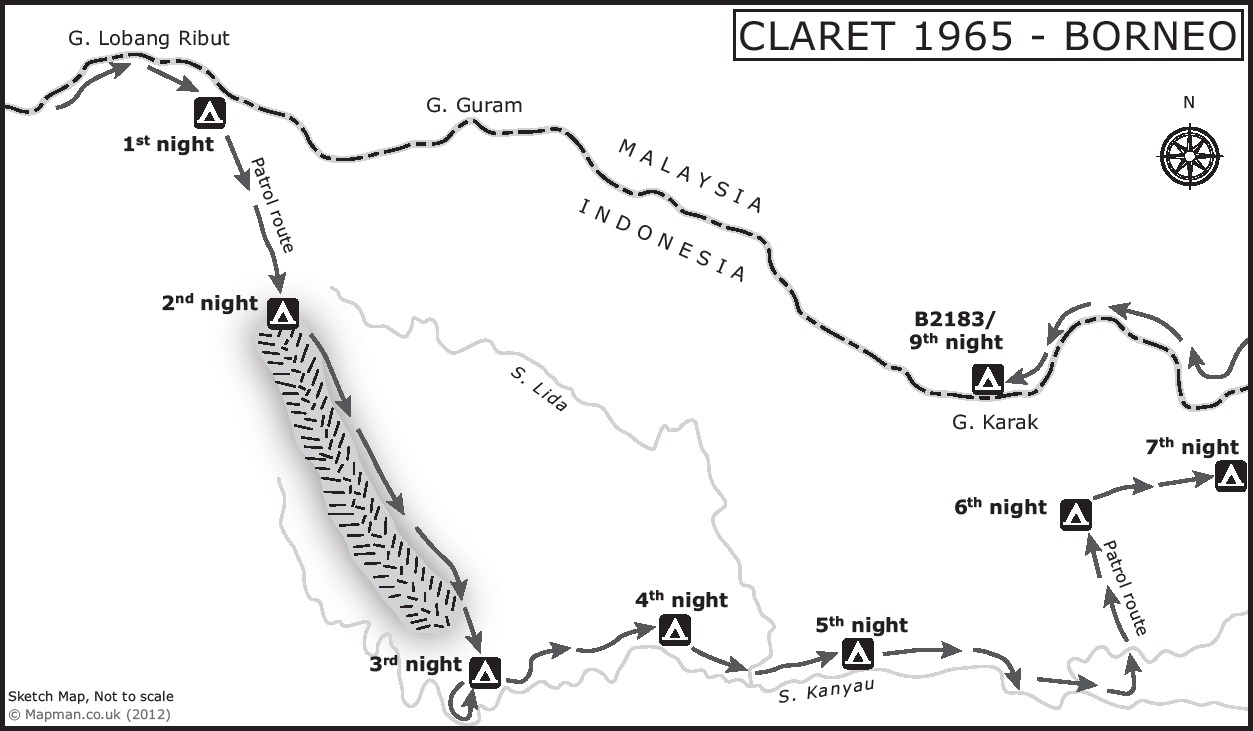
Figure 12: This map depicts the route taken by 2/2 Gurkha Rifles on a Claret operation in 1965. The ambush took place on the river at the loop depicted at the 3rd night location. The map indicates the level of risk that these operations involved, given the time spent in Indonesia and the difficulty of extraction in the jungle (which places in relief the significantly different and typically more nervous attitude towards taking risk today).38
When Confrontation escalated in 1964 after Indonesian parachute landings on mainland Malaysia, the British Chiefs of Staff Committee agreed upon the requirement ‘to convince Sukarno that should he turn aggressor we have the determination and capability to retaliate immediately and effectively’.39 Britain sent a squadron of Vulcan jet bombers and Javelin jet fighters to Singapore, and more warships were sent to Malaysian waters. These were assets which could project a huge amount of firepower and were normally associated with Cold War deterrence. They were effectively used in that role: as a deterrent to remind Sukarno that escalation on his part would be lethal.
The language used in discussions concerning the deployment of bombers to Singapore is indicative of the facility with which the concepts of Cold War deterrence were interwoven into the operation: ‘The best deterrent to the possibility of Indonesian air attack on Malaysia is the maintenance of a clear ability to destroy their air force by counter-air operations. Should the Indonesian air force nonetheless attack, our strike forces must be capable of immediate retaliation… Such a force might also deter Sukarno from resorting to other forms of overt aggression’.40 In terms of what this book has described as the language of war, British strategy was successful in the sense that President Sukarno understood the threat in the terms desired by that strategy; nor was this a coincidence: the whole plan was carefully orchestrated around the theme of audiences and persuasion, as Butler’s policy paper illustrates.
By the end of 1964, the British Far East Fleet comprised more than eighty warships, the largest naval presence in East Asia since the Korean War. The combined air and naval forces conducted numerous well-publicised exercises around Singapore as a demonstration of strength. For instance, a note from the Secretary of State for Defence to the Foreign Office of October 1964 affirmed that a squadron of 8 Canberra bombers would be sent over from Germany to Singapore for two weeks; a naval exercise in the South China Sea involving eight warships, including one Australian and one New Zealand vessel, would take place; and information was to be planted in Indonesian intelligence of a commando landing exercise on the north Malaysian coast. These measures were deemed to be ‘adequate for the political purpose desired’.41 This desired show of force reached its height when the British carrier HMS Victorious sailed through the international waters of the Lombok Straits east of Bali, which was to be taken as a strong signal of Commonwealth self-confidence.
Although Commonwealth air and naval power were never used in retaliation, the contingency plans illustrate how the operational approach was intimately associated with the political context in which it was to be applied. In 1963 plan ‘Addington’ was developed to be implemented as an immediate response to an overt Indonesian assault. It envisaged large-scale air attacks on Indonesian military targets. In 1964 plan ‘Mason’ was devised as a possible measured response to continued Indonesian attacks on the Malaysian peninsula.42 Although similar to Addington, Mason was never carried out: it would have involved raids on Indonesian bases in the Rhio Archipelago (south of Singapore) and Sumatra from where the Indonesians launched their attacks on west Malaysia.
Addington and Mason were contingency plans geared primarily to deliver a political effect, since militarily they would not in themselves stop the Indonesians. For both plans procedures were worked out for the Malaysian government to get to the UN Security Council before the Indonesians did, in order to complain under Article 51 of the UN Charter that they were victims of aggression and were acting with the support of allies in self-defence.43 By framing the deterrence within a framework which only authorised action in response to Indonesian aggression, the British hoped to make best use of their advantage in firepower without compromising in the wider international community the image that Indonesia was at fault. Commenting upon this procedure, a Foreign Office document outlining plan Mason notes that ‘we have been much influenced by the importance of avoiding anything which would damage the international image of Malaysia as the injured party’.44 While the actual plans were highly classified, Sukarno clearly knew about such a possibility. In November 1964, Tunku Abdul Rahman advertised the threat of the Royal Air Force (RAF) ‘hitting back’ in a direct threat to Sukarno at a widely reported press conference.45
British strategy, as noted in the discussion of Rab Butler’s January 1964 policy paper above, played on the fact that it suited both sides to keep the conflict unofficial and bilateral as far as possible (although Matthew Jones indicates accurately how it was never literally bilateral, since even actors on the same side acted independently of each other, not least the sovereign Malaysian government).46 The presentation of the conflict to the outside world was therefore crucial. The terrain was the single most important factor in determining how Confrontation could be presented. British strategy had to be attuned mainly to four target audiences: the Indonesian government; the Malaysian civilian population (especially the indigenous tribes in Borneo); domestic opinion; and international opinion. The hearts and minds campaign was effectively how the Confrontation was presented to the indigenous tribes deep in the jungle. The tribes did not have much contact with the outside world, so the British forces could retain a monopoly on flows of information from inside the jungle to the outside world. As most of the fighting occurred in remote jungle, its only witnesses were usually soldiers themselves.
While Sukarno made speeches about the national quest to crush Malaysia, the Indonesians never admitted sending regular troops across the border. They claimed that the incursions were conducted by guerrillas, whose cause they nonetheless supported. Nor did the Indonesians make propaganda out of British cross-border incursions. The Indonesians were unlikely to publicise incursions for prestige reasons, as they had consistently shown themselves unwilling to admit the extent of casualties they suffered in the jungle. The British could not risk locking Sukarno into a situation from which he could not withdraw without loss of face, and so did not themselves publicise the conflict.
The role of the press was limited because reporters could only go to military bases to which the army took them. The official secrecy surrounding military operations prevented information coming out of unofficial channels, especially since troops were not allowed to go to towns and bars while on operational tour. The importance of managing the press can be brought into relief by comparison with the situation of the British counter-insurgency operation in Aden and South Arabia, which was going on concurrently. Here, journalists were far more exposed to the front-line troops. Mismanagement of this aspect of the campaign contributed to the British government announcing its intention to withdraw from the region while troops were still engaged in operations. Intelligence from local sources dried up immediately once locals realised that it was not worth endangering themselves for the British, who would shortly leave them to fend for themselves.
To summarise, a pragmatic mentality in the construction of British strategy in the Indonesian Confrontation was a key factor in its success: the conflict was understood on its own terms; there was proper dialogue between desire and possibility; the operational approach drew on existing concepts and tailored them to a particular situation, rather than applying them as an abstract template; the outcome of the campaign was understood in political terms, specifically in terms of responses from various strategic audiences. It was implicitly understood that strategy had two interrelated functions: to shape the political context in order to give meaning to actions (effectively the construction of an interpretive structure through the strategic narrative); and the selection of an operational approach. Strategy was not thought of as the application of actions based on inflexible ideological agendas. The decisive moment in the construction of strategic narrative occurred when the United States administration (albeit reluctantly) was persuaded to see the conflict in terms of an overall Western interest in Southeast Asia, where Britain’s commitment to Malaysia equated to the US commitment to South Vietnam.
The British operational approach worked because, instead of trying to work round the terrain (both the physical and cultural terrain), it worked with it, in both political and military terms. The political and military elements of the campaign were not artificially separated. The texture of the Confrontation on the ground was understood in political terms. This encouraged a strategy that recognised the need to work both at the international level and in terms of combat below the jungle canopy.
Hence, political constraints having been satisfied, British strategy was largely able to contain the Confrontation to a pattern of conflict which took place on the jungle floor, and then decisively beat the Indonesians militarily in this arena by applying light infantry concepts that suited the British army’s superior experience in jungle warfare at the time (following Burma and Malaya). ‘Claret’ operations succeeded in extending the principle of domination of the jungle from a defensive concept inside Malaysian Borneo to an offensive concept by delimiting a no-man’s-land just inside the Indonesian border where most of the fighting took place. When the Indonesians tried to break out of this pattern, such as landing in west Malaysia, Cold War-type escalatory threats were brought to bear to bring them back into line. British forces did not attempt to fight a Cold War battle or a counter-insurgency campaign, but understood the conflict for what it was on the ground, and formulated a novel strategy that had elements of both doctrines which suited the particular nature of the conflict.
In 1969 General Walker, by then Commander of NATO’s northern flank in Denmark, wrote an article at Denis Healey’s request on ‘How Borneo Was Won’.47 It described the Indonesian Confrontation as a ‘Limited War’. In one sense, this was merely a descriptive term which referred to conflicts which were not total war. In another sense, in 1969 ‘Limited War’ was a conceptual term, which was at the time more obviously associated with the Vietnam War and the Cold War. The most influential Cold War political scientist to deal with this concept was Robert Osgood, who published the book Limited War in 1957.48 Osgood’s argument was that conventional ‘proxy’ wars between the superpowers, in which political aims and military means were deliberately limited, was the way to confront the spread of communism without escalation to a nuclear exchange. This was the type of war that America was attempting to wage in Vietnam.
In his article, Walker uses Vietnam as a counterpoint to Borneo. Although ‘Limited War’ as defined in the Indonesian Confrontation had developed organically in response to the Indonesian threat, Walker was now setting up Borneo as a paradigm of Limited War. This, however, was misguided. Britain succeeded in Borneo because an abstract template had not been imposed on the conflict.
Walker was really getting above himself in retrospectively describing the conceptual approach to the conflict in a way that had not actually been used at the time. He was trying to present his plan as the true articulation of Limited War, which the Americans were getting wrong in Vietnam. In reality, Vietnam was a far more complex conflict than Borneo, and of a completely different scale; the comparison was illegitimate. Later on Walker was effectively sacked from his NATO command. He had made a fetish of aggressive defence, a concept that had worked in Borneo but would have been catastrophic in a nuclear war context. The irony is that Walker the pragmatist had perhaps been intoxicated by his success and had become the ideologue.
Luck also played a major role. Lord Healey’s account implies a linear narrative from military action to political outcome: ‘a textbook demonstration of how to apply economy of force, under political guidance, for political ends’. As Christopher Tuck has argued, in his work on conflict termination in the context of the Borneo conflict, the ‘end’ that resulted was not as deliberate a goal as Lord Healey’s retrospective view might imply.49 Indeed, the Indonesian Army counter-coup in October-November 1965 was preceded by the PKI’s coup, which might well have been successful.
Strategy, even when properly conducted, involves an element of luck, as conflict is unpredictable. After all, the same British government failed in the other major action which involved British troops at the time in South Arabia and Aden. The understandable hubris associated with entirely rational and linear retrospective narratives of why particular approaches succeed, often proposed by the victors, tend in many cases, as here in the case of Borneo, to overplay the role of any operational approach and to underplay the role of luck. This can encourage the mistaken notion that there genuinely exist certain approaches that work in any context.
Finally, although not actually part of the Confrontation, it must be mentioned that the Indonesian military counter-coup, which secured General Suharto’s position, triggered the killing of around 500,000 Indonesian ‘communists’ in 1965–6. This is a separate story for which there is not space here to do justice, but it must be taken into consideration in any evaluation of the aftermath of the conflict.
The Indonesian Confrontation is an example of successful strategy that was able to control the narrative by understanding the language of force. The case study is an example primarily of the utility of a pragmatic mindset. The actual British operational approach that was developed to deal with Borneo was a product of its time, and cannot be transplanted to the present day. Moreover, the Borneo case study is an example of a strategy that was intimately attuned to the importance of information and audiences; operational thought needs to be constructed within a conception of strategy that recognises that strategy is not just the orchestration of tactical actions themselves (the use of force), but also the construction of an interpretive structure, the strategic narrative, which gives meaning to those actions.
One could well argue that a campaign such as the Indonesian Confrontation would be impossible for Britain today, in a far more open and complex information environment. That would probably be correct. (Of course there is an argument that if a conflict, or more typically, a behaviour within a conflict, is successfully kept secret it is not known about, which creates a circular argument. The extent to which covert operations are publicly known about is a separate theme which is not the concern of this book). How then can the strategist today retain the utility of a pragmatic mindset in a more complex and fragmented political and information environment? This is the subject of the next two chapters, which look at strategic narrative: the tool which seeks to achieve cognitive coherence between an operational approach and its political context.