
War From The Ground Up presents a discussion of the concept of war in its contemporary context, specifically in terms of the conflict in Afghanistan. The tension that animates the argument throughout the book is the distinction between these practices: first, the use of armed force within a military domain that seeks to establish military conditions for a political solution, a practice traditionally associated with the concept of war; second, the use of armed force that directly seeks political, as opposed to specifically military, outcomes, which lies beyond the scope of war in its traditional paradigm.
These two practices are often not clear-cut in reality: they are not mutually exclusive in terms of a conflict’s definition, as force can be used in alternative ways by different actors in the same conflict; neither can individual actors always be identified exclusively in terms of using one practice or the other, as the same actor can use force in both modes at different moments. However, my central proposition is that in order to clarify what is happening on the ground in contemporary armed conflict, there is a requirement to make the distinction between these two applications of armed force.
Conflicts that approximate to war in its traditional sense still exist, and will continue to do so. These are conflicts in which the military outcome does effectively force a political result. The military destruction of the Tamil Tigers in the Sri Lankan civil war is a recent example. However, the general tendency is a movement away from situations in which the armed forces set military conditions for a political solution: in many contemporary conflicts, while the activity of armed forces often remains crucial to achieving a political result, military activity is not clearly distinguishable from political activity. The outcomes of contemporary conflicts are often better understood as constant evolutions of how power is configured, in relation to various audiences, and how that configuration is adjusted through the application of a variety of means, both violent and non-violent. This is distinct from the notion that war is the ultimate political act: decisive, finite, and primarily defined against one audience, the enemy. In correlation with this trend is the increasing departure from the traditional, sequential notion that diplomatic and military means set diplomatic and military conditions for one another through the lifetime of a conflict, but are essentially distinct both as means and conceptual boundaries, towards circumstances in which both are used simultaneously within conceptual domains that are not clearly military or political; neither war nor peace.
War From The Ground Up is not an academic account of the conflict in Afghanistan, nor is it a personal narrative. Yet in the three tours I have served in Afghanistan as a British infantry officer, it has struck me that this ‘war’ is really not what war is typically understood to be. This informs my analytical perspective, from the ground up, of the concept of war. This is a distinctive viewpoint: while most accounts of war look down at the battlefield from an academic perspective, or across it as a personal narrative, I draw instead on personal experience to look up from the battlefield and consider the concepts that put me there, and how those concepts played out on the ground.
The dynamics of the Afghan conflict as I have experienced them are encapsulated by the political posture displayed by an Afghan district governor I knew. He did not see most of the local insurgents as a problem. Was he actually on their side? No. He was from the provincial urban landowning class. Many of the local insurgents were the sons of their rural tenants. They did not represent a threat to his personal interests. He did, however, have a problem with other insurgents, namely the out-of-area Afghan fighters and foreign jihadists. Moreover, the governor was far more concerned about a group of the local police who were controlled by one of his political rivals. Against this background were powerful tribal and criminal dynamics which also cut across a polarised ‘Afghan government versus Taliban’ conception of the conflict. Such dynamics were not an anomaly. Most people in the Afghan conflict are really actors in their own right, and act according to their own interests, as opposed to that of a given side.
War is usually understood as a polarised contest. The concept of polarity is inherent in the idea that war is fought between sides. There are normally two sides in this concept of war. Even if the war involves several parties, they are typically separated and aligned as two sets of allies. This polarity is necessary for war as traditionally understood to perform its basic function as a political instrument: to provide a military outcome that sets conditions for a political solution. The distinction between one’s own side and the enemy allows war to provide a see-saw-like, mutually exclusive outcome: defeat for one side is victory for the other. Even if the outcome of war is not absolute, the overall success or failure of a side in war is relative to an enemy.
The outcomes of many contemporary conflicts, however, are not exclusively defined against an enemy. In Afghanistan the defeat of the Taliban fades every year as a strategic priority relative to the stabilisation of the Afghan state, even if that means the endurance of a latent insurgency. Definition of the outcome of the Afghan conflict for the international coalition extends into the perceptions of audiences well beyond the insurgency. The Afghan people are deemed to be a central audience. Beyond Afghanistan the perception of the conflict’s outcome within the Muslim world, and particularly in Pakistan, for instance, is a key factor. Moreover, the outcome in Afghanistan has global implications in terms of the credibility of the North Atlantic Treaty Organization (NATO), not least in terms of Chinese audiences.
This challenges the see-saw model of victory and defeat that is central to war as traditionally conceived. One can apply military pressure against the enemy in the Taliban, and more broadly to the insurgency. However, the defeat of insurgents in the military sense may assist in, but does not translate into, victory for the coalition because the interpretation of the conflict in terms of military metrics may well be a frame of reference to which most audiences do not subscribe. For example, the drone strikes in Pakistan are effective against the enemy in a military sense, but to argue that they contribute to a sense of coalition success among audiences other than the enemy is to ignore the widespread protests against them.
In war as traditionally conceived, military action is understood, and planned, in terms of its effect against the enemy. This is a fairly stable basis from which to determine a conflict’s outcome, which is in the last analysis based on death and destruction, or its threat. However, when a conflict’s outcome comes to be defined against audiences other than the enemy, strategy must adjust to the audience rather than assume that the application of force will be universally understood in terms of its effect against the enemy.
Thus in the traditional concept of war an audience other than the enemy (which is therefore beyond the range of armed force) is still considered to understand the conflict’s outcome according to the military verdict of the battlefield between the sides actually fighting. When they do not, the military outcome does not provide a stable basis upon which to define a conflict’s outcome. In such circumstances, should these audiences beyond the enemy matter to the strategist in terms of the conflict’s outcome, strategy needs to consider military actions in terms of their likely political interpretations by these various audiences. This in turn leads to military action within war becoming highly politicised: the boundary between military and political activity is blurred. The use of force moves towards being simply an extension of policy the more it aims directly at political aims. This is distinct from the established idea, set out by Carl von Clausewitz (1780–1831), that the use of force in war is an extension of policy by other means. In the Clausewitzian sense, activity within the military domain ultimately seeks a political result, but via a specifically military outcome that sets conditions for it.
The blurring of military and political activity, common in contemporary conflict, can be elucidated by analogy to domestic politics in liberal democracies. In domestic politics, there is an animating tension between, say, two parties (like political parties and their various constituencies in liberal democracies, in the Afghan conflict the Afghan government and the insurgency can both be characterised as franchise movements which have an ideological core, beyond which people have subscribed to the franchise primarily to further their own interests). In the context of UK domestic politics, the other party may be an ‘enemy’ of sorts, but a party’s success is only partly defined by popularity ratings relative to the other party.
Neither is the outcome a party has within a term in office defined in terms of ‘victory’ or ‘defeat’ (apart from in a general election, in which the result is, precisely, defined directly against the other ‘enemy’ party). Rather, the outcome that a party in government is recognised to have had is gauged: first, in relation to the audiences who are the objects of government policy; second, in terms of the effect it has, perhaps successful, perhaps not, along given policy lines. Both of these are subjective, and liable to evolve over time.
To produce and maintain its ambitions on given policy lines, the party needs to keep in balance an evolving constellation of political constituencies, deciding whose support to maintain, whose to win over, and whose to take risk on. This requires sustaining the loyalty of the ‘home base’ of more ideological supporters while simultaneously appealing to other audiences, many of whom will interpret political rhetoric foremost in relation to their own self-interest as opposed to strongly identifying with a political agenda. Success or failure will depend on how far a party can get this diverse set of audiences to subscribe to its political narrative.
Domestic politics take place in a fragmented, kaleidoscopic environment, in which sections of the electorate are thinking about their own interests, effectively competing vis-à-vis one another. While war is not usually understood through such a lens, the conflict in Afghanistan is precisely characterised by such a politically kaleidoscopic battlespace. The similarity between domestic politics and contemporary conflict is emphasised by the practice of counter-insurgency in Afghanistan: an approach that seeks to match actions and words so as to influence target audiences to subscribe to a given narrative. Moreover, just as in a general election, where parties need to configure their national narratives to find resonance in local issues, so too in many contemporary conflicts do big ideas need to be attuned to local circumstances.
The analogy with domestic politics in liberal democracies indicates how politically nuanced approaches, even down to the tactical level, are required to have effect in highly politicised, kaleidoscopic conflict environments. This approach contrasts with the default association of the application of armed forces in violent combat with a polarised conception of conflict as ‘war’. The indiscriminate association of an aggressive and violent enemy with the traditional concept of war can frustrate more politically nuanced approaches. Hence a politician planning to have political effect may consult a geographical map to plan his or her campaign based on the distribution of voters. Yet the implication is that a political estimate has preceded decisions about where physically to allocate resources.
The military, however, tends by instinct to gravitate towards locations of violence to find and take on the enemy. In counter-insurgency, to intervene in a fight without first having anticipated the political risks and opportunities of such an action is in most cases (outside self-defence situations) to misunderstand the nature of such highly politicised conflict. The outcome of an action is usually better gauged by the chat at the bazaar the next day, and its equivalent higher up the political food chain, than body counts. The control of political space is as important, if not more important, than controlling physical space.
Strategic confusion can result when conflicts characterised by competition between many actors in a fragmented political environment are shoehorned into a traditional concept of war, with its two polarised sides. This fragmented competition may involve organised violence on a large scale, but is fundamentally different from war in the traditional sense: in many contemporary conflicts armed force seeks to have a direct political effect on audiences rather than setting conditions for a political solution through military effect against the enemy. In Afghanistan, activity (both violent and non-violent) by coalition forces and insurgents is frequently considered primarily in terms of the effect it will have on the local political situation, rather than thinking about the problem strictly in terms of the defeat of an enemy.
Whereas political considerations in war as traditionally conceived usually take place at the highest levels of military and civilian command, political considerations now drive operations even at the lowest level of command: the military dimension of war is pierced by political considerations at the tactical level. The fact that the military now tends to speak about ‘battlespaces’ rather than ‘battlefields’ acknowledges the expansion of the traditional, apolitical, military domain beyond the physical clash of armed forces to include its political, social and economic context even at the local level.
This trend is exaggerated when, as in Afghanistan, liberal powers and their armed forces conduct many actions through non-violent means, often termed ‘non-kinetic’ in military jargon. These have significantly expanded in the first decade of this century, not least due to the possibilities of the Internet and the proliferation of mobile phones, but also any number of other information media.
The ‘information revolution’ is as much a feature of the poorest countries in the world as the richest. This was brought home to me in an operation in rural Kandahar Province, South Afghanistan, in December 2007, when I caught up with a team of Afghan soldiers who were hunched over a mobile phone they had confiscated from a peasant in a remote mud compound, only to find them avidly debating the latest features of this new model, which was more advanced than the one I owned in the UK. This was not surreal, it was normal. The information revolution that is currently going on irreversibly accelerates and expands the information dimension of modern conflict right down to the tactical level.
In terms of the role of the information domain in contemporary conflict more broadly, as David Kilcullen has argued, successful insurgents, and now successful counter-insurgents, seek to persuade an audience in such a way that the political message delivered is an end in itself; this effectively reverses the role of information in conventional warfare, which tends to be about the explanation of actions.1 The composition of forces at the tactical level, where civilian diplomats and development advisers, among others, often pursue the same local political goals as their military counterparts, reflects this fusion of the violent and the non-violent. Figure 1 is taken from a UK manual on stabilisation operations, which tend to be defined as operations of a lower intensity than conventional war that aim to have a given political effect in failing states. The diagram illustrates how people’s perceptions are the object of the commander’s activity; it also shows that he has many means, violent and non-violent, at his disposal to achieve this.
In summary, contemporary conflict tends to exaggerate this distinction: first, the use of armed force for directly political outcomes, outside the traditional concept of war; second, the use of force within a traditional concept of war, in which the military seeks a distinctly military outcome which then sets conditions for a political solution.
To re-emphasise the point, this distinction is not always clear on the ground. Commanders (in the context of Afghanistan, both coalition and insurgent commanders) will differ in their approaches. Should a commander ignore the political dimension of the conflict, and focus exclusively on killing those whom he perceives to be his enemies, then he is not using force for a directly political outcome; in reality few commanders will do this, but some have come close. By contrast, others, including the vast majority of coalition commanders in Afghanistan today, will be very closely attuned to political effect, be they at the tactical level, or higher up, and consider all their actions, violent and non-violent, in these terms. What results is therefore a complex patchwork, which is why this distinction can be hard to perceive in actuality.
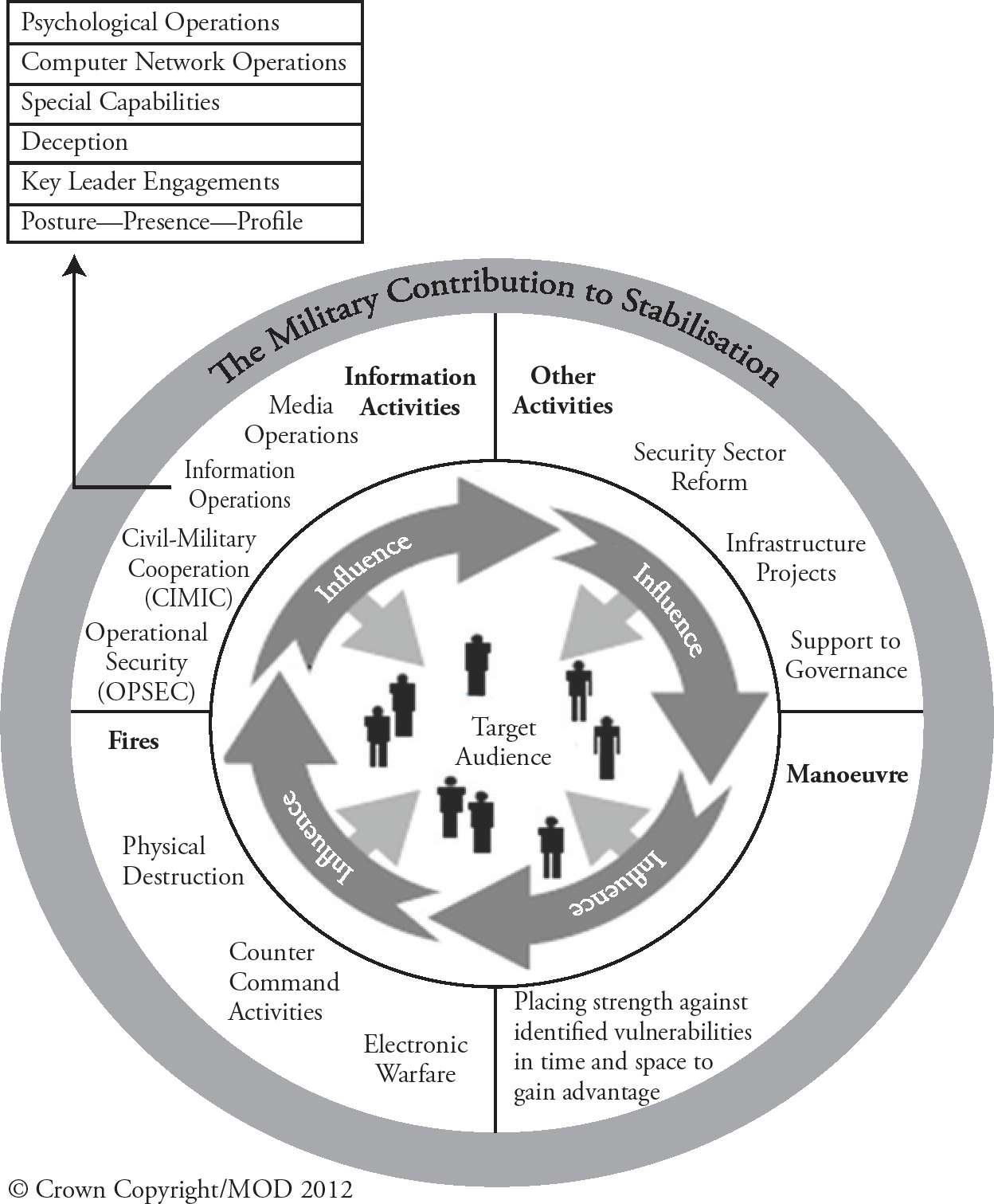
Figure 1: The Commander’s Influence Tools: Aligning Actions, Words, and Images in Time and Space. From UK Joint Doctrine Publication 3–40: Security and Stabilisation, The Military Contribution, p. 3–15.
To develop this distinction requires an assessment of political and military activity not only in terms of the difference between political and military resources, but also in terms of what these activities seek to achieve: their aims.2 In contemporary conflict resources remain a relatively stable axis of difference between military and political activity. Despite the use by armed forces of non-violent resources, whether organised violence has been applied or threatened, remains a central distinction between military and non-military activity (though this is increasingly complicated by activities such as cyber-threats). The difference between political and military aims, however, does not provide a clear distinction: how can military activity be distinct from political activity if, in seeking directly political rather than military outcomes, organised violence is a direct extension of policy?
When liberal democracies use force as a direct extension of political activity, the boundaries between war and peace become confused. There is no logical spatial, or chronological, limit to the ‘War on Terror’. The ‘War on Terror’ as a phenomenon has been relabelled in various ways. One contemporary term is the ‘Long War’. This is apt: the term implicitly makes an association between its objective, which, though ill-defined, can be understood partly in terms of a continuous effort to shape worldwide political perceptions according to the West’s security interests, and its consequent lack of a clear end point, as perceptions continuously evolve.
What liberal powers do by blurring the conceptual boundaries between war and peace is often to militarise in a polarised manner preestablished patterns of political activity, which might otherwise not be part of the wider conflict. Robert Haddick wrote in 2008 that ‘the Long War, characterised by tribal and ethnic conflicts, is a reality’.3 That is indeed the case, but tribal and ethnic conflicts have been a reality for thousands of years; they pre-dated the Long War.
To frame political tensions, which have long existed, as part of a larger ‘war’ is a deliberate policy choice. That is, those tribal and ethnic conflicts were generally not a security problem for liberal powers until they were incorporated into a broader conception of a global conflict. The linkage of local and regional conflicts into a global conflict is not necessarily wrong in itself; there is a requirement to explain how conflicts, disputes and insurrections in different parts of the world affect one another. However, the consequence has been, and will continue to be, that liberal powers are pressured to take sides and invest military credibility in conflicts that may have no clear military solution within the terms of war as traditionally understood.
This interplay is clear on the ground in Afghanistan, where preexisting patterns of political activity, be they tribal, narco, religious, sectarian, or many other possible factors, become issues which come to have a bearing on the political affiliations of Afghan audiences to either of the sides that compete for that affiliation in the Afghan conflict (usually understood as the government of Afghanistan and international coalition on the one hand, and the insurgency or the Taliban on the other). Yet in absorbing these pre-existing political tensions, the sides in the Afghan conflict themselves become less distinct, and become franchise movements, as a complex web of cross-cutting motivations compromise the neat polarised conception of conflict.
A book published by the Council for Emerging National Security Affairs (CENSA), a US think tank, in February 2011 was entitled Hybrid Warfare and Transnational Threats: Perspectives for an Era of Persistent Conflict.4 Hybrid war is prominent in contemporary military thought, and I agree with many of its themes. Yet the conception of war as continuous conflict realised by the Long War subverts this traditional conception: that war is the ultimate form of decisiveness, which evidently requires an end point. The continuous conflict idea implicitly challenges the utility of war as a decisive political instrument.
This problem underlies the current debate as to the value of counterinsurgency as an approach to contemporary conflict. The Long War has been characterised as a ‘global counter-insurgency’. This form of global counter-insurgency has been criticised on the basis that it is not as effective as conventional war, which Western militaries are better suited to fighting. The argument has sometimes been characterised as between ‘crusaders’, who advocate extending counter-insurgency-type thinking to defence policy beyond Afghanistan, and ‘conservatives’, who want the US to fight, and decisively win, conventional wars.5
The question might be framed as a choice: do liberal powers choose only to fight wars in their traditional form, typically by conventional means, and win them, or do they use military force outside the traditional conception of war, as a direct extension of political activity?
In operational terms, the latter option may be the more effective operational approach in politically fragmented, kaleidoscopic, conflict environments. Yet counter-insurgency can be expensive in blood and treasure.
In strategic terms, preference for war in its traditional form might appear to be a more sensible option, as it presents a clear boundary between war and peace, which compartmentalises, and thus contains, violence in the world. Moreover, it usually allows Western military forces, when used, to win decisively in conventional military terms, rather than commit to conflicts which may lack a clear end point. However, there are evident problems with such a strategic approach. A policy decision only to fight wars with clear military solutions would mean to decline involvement in several situations in which enemies, especially non-state actors, refuse to engage in conventional battle against Western military forces. If there were legitimate Western security interests at stake, to refuse to fight anything but conventional battles might in reality mean not fighting at all, and thus to accept risk on those security concerns.
The use of armed force within a traditional conception of war on the one hand, and outside war, as ‘armed politics’ in a direct extension of policy, on the other, is an important distinction in the abstract. They are in theory fundamentally different modes of prosecuting conflict. However, because they are often hard to perceive on the ground, the failure to make such a distinction is understandable. The failure to distinguish, however, carries with it a risk of liberal powers potentially getting the worst of both parts: engagement in permanent conflicts in whose operational prosecution they are unskilled.
The reality may not be a choice between such stark alternatives. First, isolation of the alternatives implies that there is currently a choice. However, future conflicts may not provide the luxury of such choice; an enemy can force one to fight on his terms. That is a central tenet of hybrid war theory, and makes sense.6 Counter-insurgency is likely to remain the more effective operational approach to deal with an enemy who wants to fight in an irregular manner. As this book argues, however, counter-insurgency is not a fixed but a highly flexible set of ideas, and does not necessarily need to be associated with expensive and drawn-out nation building. Counter-insurgency has often been a particularly resource efficient approach; yet the popularised historical record is partial because successful, resource efficient counter-insurgency campaigns have by their nature tended to be low profile precisely because they dealt with the issue discretely and with political sensitivity: how many people today have heard of the Dhofar campaign?
Second, the notion that future conflict in a world being so dramatically re-shaped by the information revolution can revert to traditional conventional war must be qualified. Short of absolute war, in which the primary goal is the annihilation of the enemy, the outcome of any more limited conflict will involve the perceptions of multiple strategic audiences who are unaligned to either side; how those audiences interpret the use of force politically will probably be essential to any military planning. This is likely to exclude the possibility that any future conventional war of a limited nature will take place in an apolitical military bubble whose outcome is defined exclusively against the enemy.
Third, contemporary conflict’s conceptual boundaries are hard to define. The Sri Lankan civil war, for example, demonstrated a spectrum of means from low-intensity combat to high-intensity conventional battle on land and sea; only one side was a state actor (which evidently could not claim to represent the whole state), with the fighting being interspersed with periods of peace. The Chinese military aid to the Sri Lankan government in the final stage of the war, which tied into Chinese naval ambitions in the Indian Ocean, further complicates the categorisation of this conflict. Moreover, the conflict is not over in many ways. There remains a possibility of war crimes prosecutions in the future, should the political ground shift, and the governability of the Tamil population may well prove difficult in the longer term. Difficulty in categorising conflict, and making a distinction between war and peace, is frequent, not anomalous, in contemporary conflict.
These three caveats to the nature of this choice suggest that the distinction offered by such a choice does not impose a requirement to make a binary decision between two forms of conflict. Indeed to perform effectively in contemporary conflict, liberal powers do not need to make an absolute distinction between ‘crusader’ and ‘conservative’ positions.
To my mind, to have effect in a fragmented political environment, in which force is used as a direct extension of policy, counter-insurgency is usually a more effective operational approach than methods associated with conventional war. Counter-insurgency makes sense in theatres such as Afghanistan as an operational approach to achieve current policy goals. For a start, conventional war requires a clear enemy, which international coalitions do not have in Afghanistan or in the Long War. There is the option to use conventional force against insurgents, which has been used by Russia in Chechnya and by the Sri Lankan government against the Tamil Tigers. In both cases such methods were successful in a narrow sense. However, by engaging in such methods, which are typically associated with large-scale human rights violations, liberal powers compromise their own values.
The apparent choice between these two modes in which armed force can be applied is more usefully understood as a practical analytical tool, which operates in a dialectical manner. In terms of contemporary conflict, the analytical distinction between the use of force in war and in ‘armed politics’ outside war should in particular be made when liberal powers are tempted to elevate counter-insurgency from an operational approach within defined theatres to a global strategic approach. This is mistaken. The two are profoundly different propositions, even though they are already blurred to an extent in the Long War.
Counter-insurgency as the doctrinal basis of a national strategy is radically distinct from being the doctrinal basis of an operational approach. To conceptualise a national strategy as a type of global counter-insurgency is effectively to remove limitations on the conceptual expansion of the conflict, as an expanding multitude of different political issues are militarised in terms of their association with this concept. One consequence of the removal of limitation concerns the challenge to liberal democracies posed by Islamic fundamentalism. The liberal tradition, in the broad sense of the values that animate liberal democracies, is threatened by its use of a very broad and unstable concept of ‘war’ to deal with Islamic fundamentalist terrorism, an initially anomalous practice that seems now to have evolved into normality.
Moreover, there is today a particular urgency to investigate how to be effective in more limited, and typically more politicised, conflicts; for should strategists deem the use of force within more limited forms of armed conflict, and more moderate operational approaches such as counter-insurgency, to be ineffective, there may arise a temptation to apply military force in an unrestrained, absolute sense, because it ‘works’ more reliably in achieving a policy goal. That is, for the methods that decisively ended the Sri Lankan civil war to be understood as ‘effective’ is not only a profoundly dangerous attitude in terms of wider international stability, but represents the other side of the coin of failing effectively to prosecute armed conflicts using more limited and moderate operational approaches.
Finally, as the issue of how to define war rarely extends beyond specialist discussion, the public have not been much involved; yet the public’s will and taxes must ultimately sustain strategic choices. The question of whether to commit to a ‘generational war’, to accept an ‘era of persistent conflict’, without a clear end-state, or, conversely, not to engage in countries in which there are genuine security concerns, should surely be an issue of public discussion, as the West seems to be sleepwalking into such a period of global generational conflict.
The first half of this book, Chapters 1 to 3, defines the problem and sets out the difficulty of employing a traditional paradigm of war in contemporary conflicts that tend to be characterised by fragmented, rather than polarised, political dynamics. Chapter 1 defines how war operates as a conceptual construct that seeks to connect armed force to political utility. Chapters 2 and 3 examine the evolution of war as a mechanism; in particular how war, as defined so influentially by Carl von Clausewitz, is today often misunderstood as a concept and has been misapplied in contemporary conflicts such as Afghanistan.
The second half of the book, Chapters 4 to 9, from three pairs that move on from the problems of the misapplication of the traditional paradigm of war to investigate possible solutions. Chapters 4 and 5 argue that strategy needs to be understood as a dialogue between the desire of policy and what is realistically achievable on the ground, rather than as a one-way relationship between policy and unquestioning tactical execution. This is necessary to construct a political context that enables any operational approach to be effective. Chapters 6 and 7 examine the construction of operational approaches, and argue for the utility of a pragmatic mindset in this context, using the Borneo Confrontation 1962–6 as an extended case study. Chapters 8 and 9 look at strategic narrative, the vital membrane that connects operational activity to its political context, a critical feature of contemporary conflict. They argue that the construction of strategic narrative resembles the art of persuasion, or rhetoric, as classically defined. The Conclusion considers contemporary strategic thought.
Strategy for liberal democracies involves all three parts of the state at war: the government, the people and the military. I have tried to write in a style that is not technical to acknowledge that all three need to be involved in strategy.