
1
Military activity has two possible connotations: the first is the actual use of organised violence, typically by armed forces; the second is the way in which this force is understood by an audience, particularly the enemy. Antulio J. Echevarria II has argued that ‘while the US military remains eloquent in the vernacular of battle, it is still developing fluency in the language of war’.1 If the ‘vernacular of battle’ is technical military proficiency, the language of war is what links the use of force to political meaning. The language of war in this sense is not war poetry or its equivalent; it describes the interpretive structure that ‘war’ provides to give meaning to the use of force, just as an actual language gives particular meaning to a given sound or script. This chapter argues that it is the language of war that gives wider meaning to the vernacular of battle; the strategist must harmonise them both for war to have utility as an instrument of policy.
War as an interpretive structure
The following passage is an account of the first moments of a battle fought by the Gurkha battlegroup I was part of in a mountain valley of Uruzgan Province, South Afghanistan in October 2007, during a two-week operation named Spin Ghar (White Mountain).2 I wrote it up in 2008 after I returned to the UK, to document a personal experience before it was forgotten, with a view to it perhaps forming part of a regimental history later on. Re-reading it today, it is clear that this account has rough edges. However, I will reproduce it largely un-edited to attempt to transmit that experience, and show that for soldiers to be fixated with the enemy is normal, in the sense that when actually closing with the enemy in battle, any other way of understanding the situation goes against the emotional grain of the situation; for the protagonist to understand combat as anything other than an intensely polarised confrontation is in reality very difficult.
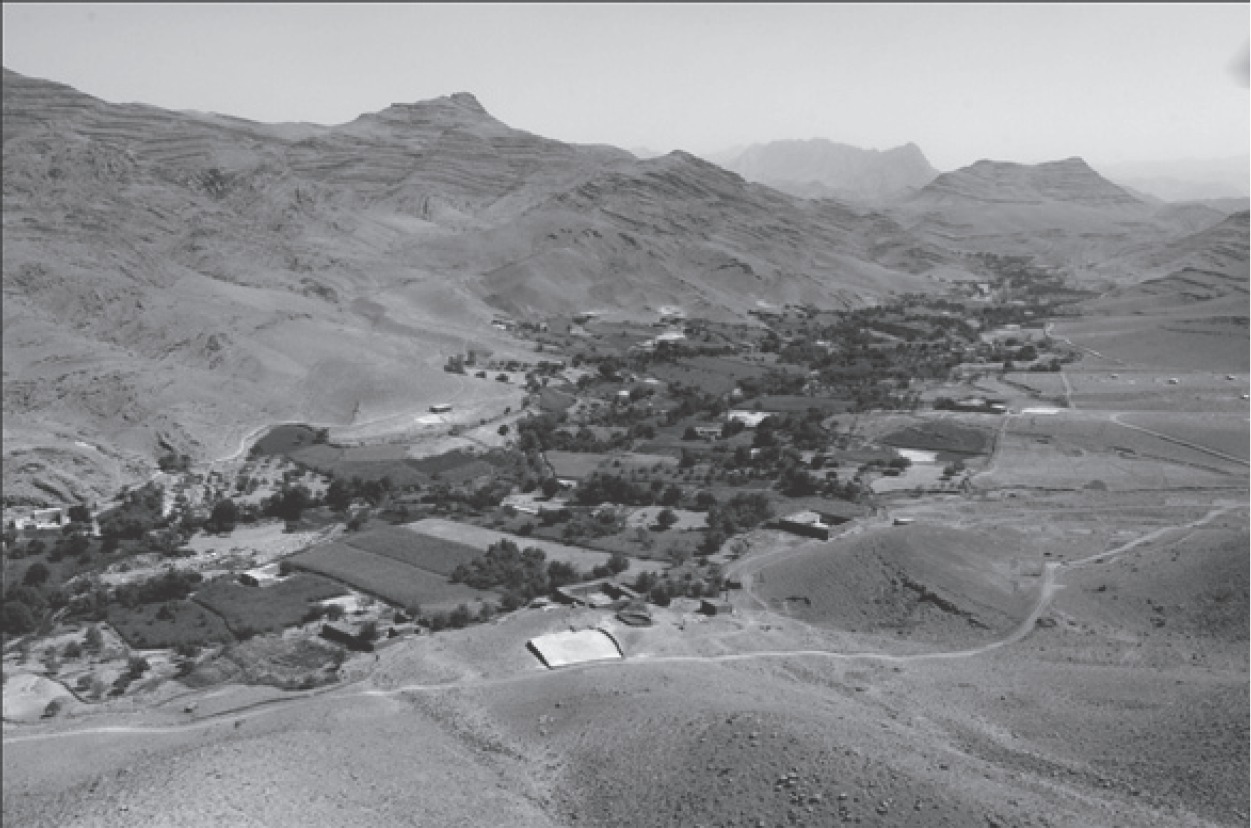
Figure 2: Detail of the narrow northern section of the Baluchi Valley, Uruzgan Province, South Afghanistan.
There is nothing more impressive than a company of Gurkhas in full assault order at night on the eve of battle. The three platoons and headquarters were arranged into five ‘chalks’, each sitting twenty metres apart on the tarmac runway, a surface which still felt hot after midnight. These were further divided into two ‘sticks’ of roughly fifteen men sitting behind one another; each of these would embark onto the designated side of their chalk’s twin-bladed Chinook helicopter. My team (8 Platoon) had an air of confidence, aggression, and the residual apprehension which inevitably accompanies anticipation of close-quarter battle.
C Company was to lead the assault into the Baluchi Valley. This was an insurgent stronghold deep in the mountainous area of Uruzgan Province. There had been no international coalition troops here for over a year, since an Australian operation had successfully cleared the valley in a vicious fight, although the Taliban had since reoccupied it.
I had three hours sleep then woke up at 2300, had a shower, and got my combat gear on: desert combats; body armour; helmet; belt and pouches; twenty-two magazines worth of ammunition (one in my rifle, five in my belt, another emergency one in my rucksack, and fifteen in bandoliers which formed part of the platoon reserve); radio and spare batteries; night vision (helmet-mounted infra-red, weapon-mounted thermal sights); grenades (high explosive, smoke, red phosphorus); three litres of water; rations; bayonet; maps; and air photos of my platoon’s first objective.
The platoon had rehearsed helicopter exit drills to the last detail. Every man understood the orders, and knew his part in the first phase of the operation to gain a foothold right in the enemy’s command centre. What more was there to do at this stage?
The night was mild but dark, and the soldiers’ faces, blackened with camouflage cream, glimmered in the half-light of the runway lights. I had a quick chat to Charlie Crowe, the company commander, who was walking around the company; he wanted everyone to be ready for a fight. This is the moment when at Sandhurst I would have imagined giving an inspiring pre-battle speech; in the event I delivered nothing of the sort. When I stood up to speak to the guys in the near dark I was looking at thirty professional soldiers whom I knew I could trust with my life and felt safe with. They were not superhuman, and many were quite young. Individually, some were probably braver than others, but as a platoon, each of them was a Gurkha soldier, not an individual. The self-perception of this status, and the ethos that underwrites it, or Gurkha kaida, meant that they would fight for one another, all get through it, and get through the enemy. In the end the platoon huddled together and my platoon sergeant, my three corporals (the section commanders) and I said a few brief words. I said something like ‘All right lads, I have full confidence in you. Just do your job, pass on information, and make sure you account for your battle-buddy. We’ll get in there and hammer them’. Anyone who has heard a group of Gurkhas acknowledge you with a resounding, short, and aggressive ‘Yes, Saheb!’ is filled with pride and confidence.
We had to wait two hours until ‘Y-Hour’ (take-off). I spent most of the time chatting to a group of my younger soldiers. Their chief topic of interest on that occasion was the secret method to chatting up ‘European girls’. This continued in a series of ripostes, typical of banter with Gurkhas: ‘Just tell them you’re a Gurkha soldier’. ‘But we are shorter than them, Saheb!’ (Laughter from the rest of the section.) ‘Well just impress them with exaggerated war stories’. ‘But they will be afraid, Saheb’. And so it drifted on. The Chinook crew who came over to wish us good luck shook us back to the real world.
The rear ramp was down, and I sat behind the tail gunner. The seats were up for the assault landing, so all of my men sat facing each other on the metal deck. The rotor blades make conversation impossible except through headsets. I was given one as the chalk commander, so listened in to the chat between the pilots and the tail gunner. I watched the four other Chinooks and two Apache escort helicopter silhouettes fly in formation, all lights off, tearing across the dasht (desert) at low level, the lights of Kandahar city itself in the distance the only obvious reference point as we headed north towards the mountains. It was both amusing and nerve calming to have the pilots’ game of hangman and I spy over the headset as the commentary which accompanied the visual spectacle.
Everyone re-focused as the aircraft climbed steeply then banked round a mountain range, and the air got a lot colder. I knew that ‘L-Hour’ (landing) was imminent. Would the small advance team be in position to secure the landing site? Would we be attacked on landing? What were the ‘actions on’ if we took casualties as soon as we stepped off the ship? All these questions raced through my head, but we had planned thoroughly and rehearsed all of these scenarios. In uncertainty, thorough knowledge of the plan is what one’s immediate doubts fall back on. Hence the importance of the confidence we had in the plan and the Battalion Commanding Officer, who had planned the operation meticulously with his staff. He would be landing thirty minutes after us with A Company and Battalion Tactical Headquarters.
The tail gunner gave us five minutes. We all shook each other. ‘one minute!’ Everyone stood up and held onto the rail as the pilot descended steeply. Sharp landing. Everyone buckles to absorb the impact, especially with the amount of weight we are carrying. Ramp fully down: go. Nothing is actually said, we all knew what we were doing. I jumped out, sank slightly into the soft ploughed field and looked up at the large mountain to my right as I ran. Good, that was East and I knew where I was from the air-photo engraved in my head. I ran forward 10 metres, made eye contact with my Corporal next to me, giving the signal to turn right. Another 10 metres, down on one knee, scanned the ground with my thermal sight for threats. The lads had piled out of the helicopter in seconds and the ship was already taking off by the time my Platoon Sergeant, Bel Gurung, had done the headcount—he gave me the ‘all in’ and we moved off. The grouped figures of the five chalks were visible in the other corners of the field as white heat signatures against a black background through my sight. The fainting ‘chug chug chug’ of the Chinook rotor blades gave way to total silence. We took off the plastic bin bags we had used to cover our weapons from the helicopter dust off.
I led the platoon to the designated rendezvous with the rest of the company. Everything was going to plan, and the worst scenario of contact on landing was now thankfully redundant. Out of the darkness came the guide: ‘All right mate, how’s it going? Basically, the Taliban’s over there, and we’re going to take you to the line of departure down this creek here, mate’. Things are far less stressful when you’re actually on the ground and the ‘Op’ has started, and started well. A winding 300m in a stream to the start line and we would meet our intended H-Hour (start of the attack).
John Jeffcoat’s Seven Platoon went in first on time at 0400. The sound of the bar mine used to blow the hole in the wall ripped through the night. Seven Platoon wrapped up their objective efficiently without firing a shot. They found a few men with AK-47s and ammunition whom they had taken well and truly by surprise. Quick chat with JJ on the radio net to gain situational awareness and confirmation that he was secure, and my lads moved to the next target. Now everyone was awake, we had to move fast. Confirm with lead Corporal that the imposing wall ahead of us is the right compound. Flank protection in position. Fire base in position. Assault teams in position. Engineers prep bar mine. Engineers plus two Gurkhas approach wall, bar mine in place. Get on the radio: ‘Bar mine in twenty seconds’. Get down. Nothing, wait another minute to make sure it is not a delayed fuse. Dud. Engineers go up again, another bar mine. Bang. Feel the pressure of two bar mines go off from our position twenty metres away behind cover. Get up, use weapon-mounted torches to penetrate the dust that has been kicked up. This is the most dangerous part of the assault, and my job is to get the platoon forward. A neat compound clearance by two four-man ‘bricks’, over-watched by the roof team, who had clambered up as soon as the blast went off. Don’t need to commit my reserve because there is no resistance. Compound clear. Rabindra’s 9 Platoon echelon through us to take the next objective. My platoon is now the company reserve and we can settle a bit.
As dawn breaks there is a ghost town feel to the small hamlet that comprises ‘Objective Churchill’. After a brief pause to re-balance the company, Charlie Crowe got his platoon commanders together and sent us out to clear the area. The insurgents had been playing their usual game of watching us and declining to fight at night, where our technology counted against them.
At around 8 a.m. my platoon was contacted from the right at a distance of 100 metres with a machine gun burst. One of my riflemen was hit just above his eye, probably by a ricochet. ‘Man down!’ Displaying routine bravery, one of my Lance Corporals, Bharat, ran out in the middle of this fire-fight to drag him into cover. My men dart for cover and fire back in the enemy’s direction. Furious staccato shouting in Nepali-English mixture against a backdrop of automatic fire, ours and the enemy’s: target indications from the riflemen who have spotted the dushman: ‘najik ko ruck oooh bata, hoina, hoina…tyahan cha! Moving left to right! Aundai cha! Duita dushman, hoina tinjana’. [Two/three enemy popping out intermittently by a tree.] Translated into fire control orders from the section commanders: ‘dushman half left najik ko ruck 100m bata section y-rapiiiiiid fire’. After pushing out flank protection, I leave the corporals to direct the shooting. I’m lying on my belt buckle with my radio operator getting an exact GPS grid for myself and telling Charlie where I think the enemy is and what they’re doing. Casualty status from the Platoon Sergeant to tell me the casualty was safely back with the Company Sergeant Major. Sergeant Bel is invaluable; I know that he will square everything away so I can focus on the battle.
My platoon was not the only one in contact; in fact, we were at the periphery of the main battle. The insurgents were probing the company from several directions. The most intense fighting was going on to my flank, where there had been a serious casualty. JJ’s 7 Platoon did very well and repelled the insurgents through sheer aggression, extracting the casualty under fire [two Military Crosses were subsequently awarded in relation to that action].
Charlie Crowe got on the radio net to give a reverse SITREP (situation report) and told us that we were now fighting a company defensive battle. The Apache helicopters circling overhead, and our snipers on the ground, were detecting and engaging insurgent teams in depth too. This was the opening of a three-day battle of frequent small skirmishes against a probing enemy.
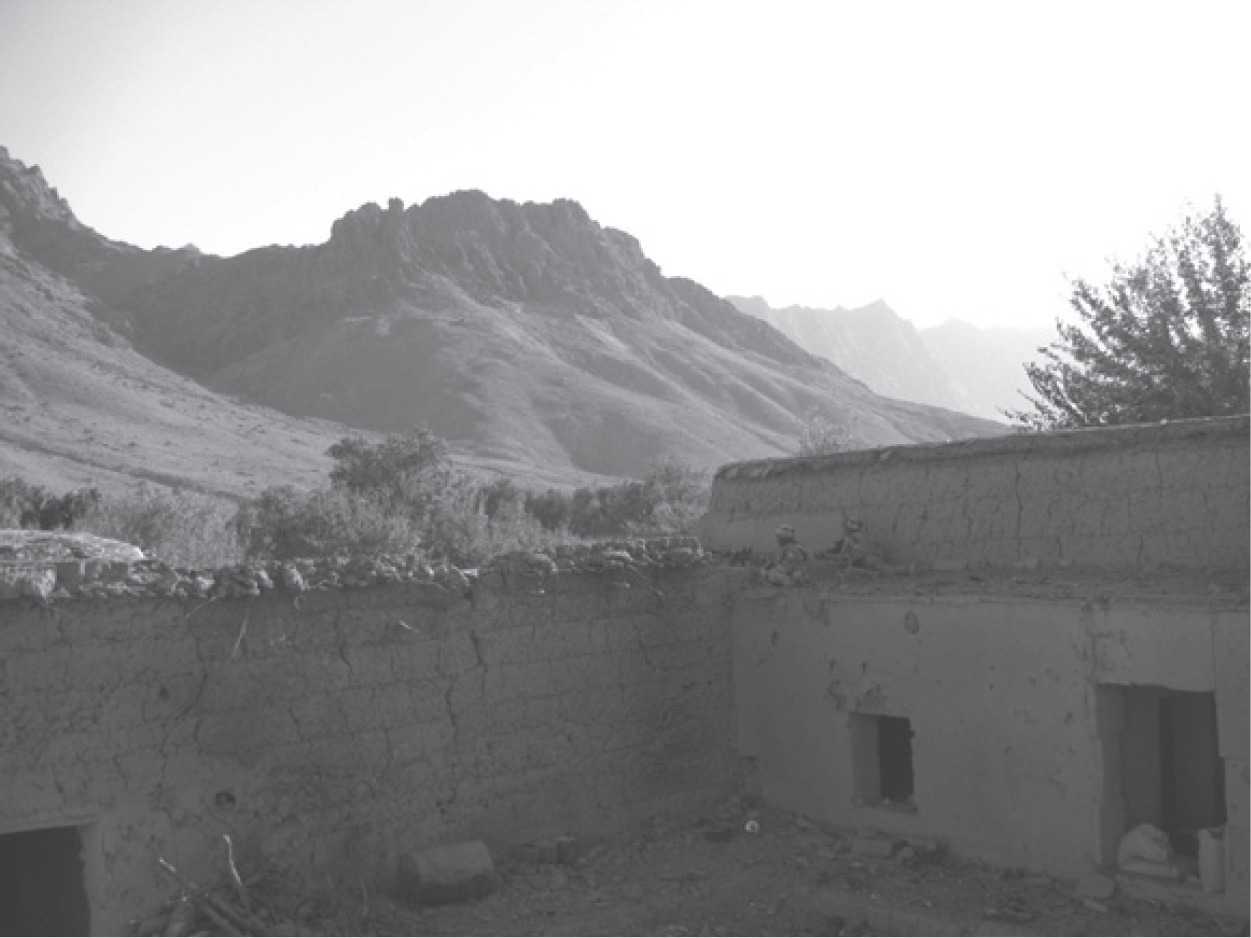
Figure 3: Compound in Baluchi Valley immediately after fighting. Two Gurkhas on the roof scan the ground for the enemy.
How do we understand this event? On the one hand, we can see it through the concept of battle: one company did this, another company did that, and the enemy responded in a particular way. Within this military frame of reference, the outcome of the battle is an evolution of the military situation: success or failure is judged according to one’s position relative to the enemy. If one asks a commander what is going on during a battle, the typical response will be a briefing, describing arrows on a map illustrating friendly and enemy forces. In this sense the concept of battle allocates a rational meaning to events. What could be seen as several men fighting somewhat chaotically is rationalised as the articulation of a military plan that gives meaning to the actions of individuals.
Yet battle is as much this rational phenomenon as a set of personal experiences for those involved. While this may be common sense, we typically distinguish personal experiences from the military outcome. Banter on the tarmac may be part of how a solider remembers the battle, but has nothing to do with its military outcome. Yet in the West’s contemporary conflicts people’s reception of events, including battles, through the lens of their personal experience does matter to the conflict’s outcome.
In Afghanistan today the support of the people is vital to the outcome of the conflict for all sides. However, the peasants of the Baluchi Valley would not have seen the battle in terms of arrows on maps. For them it is not a ‘company clearance of an objective as part of a wider battlegroup operation’, which it was for us; they would not have known what that was. The discourse of battle we use to understand the phenomenon we are in makes little sense to them. From their homes they see snapshots of the battle between us and the Taliban and hear about other incidents from their friends. Their primary interest is the safety and property of themselves and their fellow villagers, usually far more so than the wider political struggle between the Taliban and the government.
In this case gaining the support of the people of the Baluchi Valley was not the primary objective of the operation. The objective was to clear out entrenched insurgent positions which were protecting their resupply route and to clear the way for an Australian reconstruction task force to hold the area. In a different part of the operation, Dutch troops were to clear the valley from the other end. This turned out to be problematic at the Dutch government level. There were thus several lenses available to view the operation, depending on one’s point of view.
This has important ramifications for how we think about war and armed conflict more generally. If our strategy attempts to persuade people to subscribe to a particular political position (in Afghanistan essentially the rule of the Afghan government), we need to think about how those people will interpret our actions in political terms. To an extent, the concepts of battle, and war, do not need explaining; people are familiar with the concept of two sides fighting. However, to use this as an exclusive interpretive framework to judge success or failure in battle or war is a very narrow basis for understanding, as it does not incorporate the possibility of a personal response being the basis for a political viewpoint.
We may well have ‘won’ the battle in our own definition of the event, but members of the audience will have had their own political interpretation of the event, be it apathy, anger, satisfaction, or disappointment, that the insurgents have been cleared out, or something else: whatever it is, there will have been a political response as locals understand us on their terms. To borrow a term from social science, we ‘cannot not communicate’.3 Once we acknowledge that people’s political views matter to our own definition of success or failure, an exclusively military definition of success or failure relative to the enemy in battle is insufficient.
At the political level it is perhaps too easy to assume that local actors understand the conflict in the same way. Conrad Crane, who edited the US Counterinsurgency Field Manual, has argued that this is, however, a common mistake that Westerners have tended to make in Iraq and Afghanistan. In both cases, local politicians at all levels of government simultaneously have a longer and shorter political viewpoint than does the coalition: while they will have to deal with the situation when the coalition leaves, they also need to survive the next political crisis.4
Time matters in interpretation of conflict. To use an analogy from the world of finance, that an investor making a long-term investment does not expect decisive short-term gains is the norm. However, war as a concept tends to associate the battlefield with brutal, finite outcomes whose results are immediately apparent (there are evidently exceptions, but the issue here is one of general public perceptions more than historical reality). The quick victories in the Gulf War, in 2001 in Afghanistan, and in 2003 in Iraq could legitimately promote such attitudes, since the Gulf War was a genuine war, and in their early stages these last two conflicts were genuinely wars too. One problem of extending the idea of war beyond the stage where that concept can legitimately be applied is that the association of battlefield activity with decisive outcomes is maintained. Yet in Iraq and Afghanistan the investment on the battlefield has often proved to be realised on a longer-term basis.
A good example of this was Operation Moshtarak, to secure key parts of Central Helmand that were held by insurgents in 2010, specifically in Marjah and Nad-Ali. The operation was also intended to have effect beyond Central Helmand, in presenting a clear defeat of the Taliban narrative to the Afghan people and wider international audiences. The initial clearance was successful. However, properly securing the area, gaining the people’s confidence and establishing a basic level of governance have taken longer. Only around two years later, in late 2011, did it become clear that the insurgency had been marginalised there to the point where the Afghan government could legitimately be said to control those areas: a long-term success.
Counter-insurgency is a long-term investment. The effort has only been properly resourced in Afghanistan from 2009, and since then it has borne fruit. However, by applying a construction of war to the Afghan conflict, a counter-insurgent’s successes are often masked because the bandwagon, which according to the traditional paradigm of war only really pays attention during periods of intense battlefield activity, has left by the time the gap between initial costliness and eventual success is closed.
The way in which people’s perceptions are influenced by the presence or absence of interpretive structures such as war is essential to understanding contemporary conflict, but is sometimes neglected by strategy. To analyse the evolution of war as a military interpretive structure, we need to examine the relationship between war and strategy, and how this has evolved in the West’s contemporary conflicts.
The function of war
What is war good for? War can provide an existential justification for its participants on an individual level, who may see their participation as an end in itself. Yet in terms of its political actors, typically states, war is usually understood as a political act. What defines ‘political’ has been contested. Policy can be defined narrowly as state policy; this suggests a degree of political calculation. Policy can, however, be defined more broadly. Carl von Clausewitz (1780–1831), for instance, understood policy as war’s animating idea.
There is perhaps a temptation, particularly for liberal powers, to see war as an instrument of policy which is used ‘rationally’ for legitimate ends. Clausewitz’s point is that all war has some kind of rationale (‘policy’) because it is a human phenomenon, but that rationale need not be ‘rational’ in the liberal sense. Indeed Clausewitz lived at the juncture of the Enlightenment, with its advocacy of reason, and Romanticism, with its penchant for emotional instinct. However one defines policy within the conception of war as a political instrument, the essential point is that war’s justification, and thus its basic logic, lies beyond itself. This was famously summarised by Clausewitz: ‘war…is a continuation of political intercourse, carried on with other means’.5
Two concepts are contained within the term ‘means’ in this dictum. The first concept is that war can be understood to be the phenomenon by which the clash of organised violence in time and space is identified. Clausewitz himself understood the essence of war to be the violent clash: ‘essentially war is fighting’.6 Ultimately wars are phenomena which are external to everyone; that is, wars go beyond the boundaries of any individual experience because they are defined by the aggregated activity of a multitude of people. However, what unifies individual experiences into ‘war’ is their association with the clash of organised violence. In this sense, while policy intentions of either side will shape war, war has its own independent existence, formed through reciprocal violent clash.
Even within a war, soldiers may feel well removed from ‘the war’, when pulled back from the line, where the violence is. There is a striking moment of self-realisation in Quartered Safe Out Here (1992) by George MacDonald Fraser, his autobiographical account of his experience as a soldier in the Burma campaign during the Second World War.7 He is told by his Platoon Sergeant that he is the point man of his Platoon, which is at the head of the Battalion, which is itself the point Battalion of the point Division leading the 14th Army on its advance towards Rangoon; at this point the war seems far more immediate to Fraser than it would to a soldier marching in a column to the rear! Indeed for soldiers it is the experience of violence which tends to be the aspect of war most firmly imprinted on the mind.
Even for civilian leaders, who usually do not experience actual violence, the responsibility of the direction of violence through war invests war with a particular significance. While military preparations and diplomatic activity may anticipate a conflict, a war is typically understood to have ‘started’ when troops cross their line of departure in the expectation of combat. The opening stage of the Second World War for Britain illustrates the popular association of war and violence; it has come to be known as the ‘Phoney War’ because of the absence of serious violence.
The ‘means’ referred to in Clausewitz’s dictum that war is an extension of policy by other means can therefore be understood in this first sense as the organised violence itself, typically the use of armed force.
The second sense in which the ‘means’ in Clausewitz’s dictum can be understood is less obvious, but equally important. It relates to the notion that war itself as a phenomenon is a political instrument, not just the actual use of force within war. For example, British strategy in 1939–40 envisaged a long-haul strategy in which maritime economic blockade would play a central role, which was the policy adopted from the outset. To see the early period of Britain’s part in the war as ‘phoney’ thus exemplifies both the fixation of associating war with violence on land and the analytical limitations of such a narrow conception of war.8
The limitations of a concept that only recognises war to be the actual use of organised violence—armed force—suggests a requirement for a broader analysis. War as an analytical unit can comprehend long periods of non-violence. The Napoleonic Wars, for example, actually involved relatively long periods of peace. At the time, it was uncertain if that peace would last, but it was not war. Retrospectively to impose the term ‘Napoleonic Wars’ suggests a broader analytical understanding, but that was not necessarily available at the time.
War’s logic can to an extent operate in times of peace too, typically when there is a possibility of war if violence is threatened: arms races, for example, are driven by an anticipation of violence. Moreover, the political, social and economic dynamics that precede wars, and cause them, continue to operate in war; any analysis which only recognises periods of actual violence as ‘war’ will be limited in its conceptual boundaries. The proxy wars of the Cold War, for instance, cannot be understood outside the context of the possibility of an escalation to nuclear war.9 War therefore needs to be understood as an analytical framework as much as an empirical phenomenon. Where to draw the line will vary in each case.
The second concept available in the ‘means’ of Clausewitz’s dictum expanded the concept of war beyond the clash of organised violence to encompass its role as an analytical framework: ‘war’ itself was understood to be an instrument of policy distinct from the use of force within it. Clausewitz emphasised how war was a particular framework to resolve some kind of contested decision. For Clausewitz, war in this capacity was a type of trial.10 Like a legal trial, war was a structure with a recognised form that provided a decision between opponents: ‘by committing to this gigantic duel…both sides initiate a major decision’.11
To understand war as a means (an instrument) of policy in the context of Clausewitz’s dictum therefore has two designations. The use of force is an instrument, but war itself is equally an instrument in terms of the analytical framework it provides for armed force to reach a decision—the war’s outcome.
What reconciles these two ‘instruments’ within a single conception of war as an instrument of policy is the idea that force is simply another way to communicate meaning, another language. If force is a ‘language’, war is the interpreter who acts as a medium between the speaker and the listener. Clausewitz himself argued that force was simply another means to communicate a political intention; this supported his argument that war is a continuation of political intercourse by other means, not something entirely different. Thus political relations are not suspended when ‘diplomatic notes are no longer exchanged’, as war is ‘just another expression of their [a people’s] thoughts, another form of speech or writing’. Therefore ‘the main lines along which military events progress, and to which they are restricted, are political lines that continue throughout the war into the subsequent peace’.12
Once seen as a form of language, force assumes the same properties as language in terms of the capacity to transmit meaning. The critical convergence of language and the use of force is that the ‘meaning’ of an action, including violent actions—like the meaning of the spoken or written word—is not self-contained. Meaning has to be interpreted by a human agent. The meaning of an action in war (the outcome of a battle, for example) may be mutually recognised, just as two people may well agree on the meaning of a text or a speech. Equally, two people may interpret differently the meaning of the same text, speech or action in accordance with their own prejudices. The same applies to the use of force.
The entire practice of deception, which is as old as war itself, is premised on the idea that force can be interpreted differently. William the Conqueror feigned a retreat at the Battle of Hastings which successfully lured King Harold’s Anglo-Saxon army out of formation in pursuit of what they thought was a fleeing rabble, only to be defeated by a Norman counter-attack. In Afghanistan today there is huge competition between the insurgency and the Afghan government/coalition to present the meaning of actions in different ways. The ‘outcomes’ of skirmishes and battles in Afghanistan are rarely agreed upon.
As an infantry platoon commander in 2007, my first operation was the clearance of the Upper Gereshk Valley, Helmand, in a brigade-level operation. The insurgents were engaged, cleared out, and the mission was achieved. Yet the insurgents would also have claimed it as a victory because they had inflicted some casualties on us, and we did not stay to hold the ground we had cleared. The outcome of the operation in the longer term is debatable since several similar operations in the same area have been mounted since then.13 Moreover, the ‘meaning’ of the battle for local people was most likely nothing to do with who ‘won’. They would be far more concerned with the battle in terms of their own safety and property.
The importance of the visual deed and the instability of its interpretation in contemporary conflict extend to non-military actions too. For example, the video deliberately released online in April 2009 by a militant group linked to the Pakistani Taliban of a man whipping a young girl thirty-four times for being publicly seen with a married man was intended to gain approval for the implementation of Sharia law in the Swat Valley. The video actually provoked widespread criticism from the Pakistani public and increased support for their army’s actions against militants.14
Once actions in war (both violent and non-violent) are seen as a form of language used to communicate meaning in the context of an argument, there is a possibility of being misunderstood. In order to use war successfully as an instrument of policy, one’s actions in war ultimately need to be interpreted in accordance with the intent of one’s policy. Thus strategy in relation to war seeks to link the meaning of tactical actions with the intent of policy to deliver the desired policy end-state. To do this, strategy seeks to invest actions in war with their desired meaning. Hence strategy has to harmonise both of the ‘instruments’ that are contained in the idea of war as an extension of policy by other means. Strategy does not merely need to orchestrate tactical actions (the use of force), but also construct the interpretive structure which gives them meaning and links them to the end of policy.
The imperative to have a stable interpretive structure in order to convert actions into a desired meaning can be illustrated through a theological analogy.15 In this analogy the interpretation of the Biblical text (as a form of language) is taken to be analogous to the interpretation of tactical actions (as another form of language), typically the use of force, in armed conflict. The Catholic tradition has a certain view of the Bible’s meaning. However, it does not place sole authority for the interpretation of the Bible in the Bible itself. That would open up the interpretation of the Bible to individual interpretation, which could be different from that of the Church. Therefore the Catholic Church requires Catholics to observe the authority of the Church in the interpretation of the Bible and in the determination of which texts make up the Biblical canon. The doctrine of the Catholic Church therefore serves as a structure to interpret the Bible.
The necessity of this interpretive structure for the Catholic tradition to preserve coherence of meaning has been exemplified in theological debates when Church authority has been ignored and scripture interpreted in an alternative way. The theological clashes and religious wars between Catholics and Protestants during the Reformation are just one prominent example of how politically significant interpretive differences can be.
In some branches of the Protestant tradition, which typically recognises only the authority of the Biblical text, the interpretive structure provided by the Church is removed. This opens up the possibility for widespread differences in interpretation, as individuals interpret meaning in accordance with their own beliefs and prejudices. The manifold theological differences between the Catholic and Protestant traditions exemplify this. One assumption that has justified the investiture of sole authority in the Biblical text itself is that the Bible has a ‘literal’ meaning which is self-contained. The multitude of branches within the Protestant tradition which claim a unique theological position based on a particular Biblical interpretation bears witness to the fact that there is no such thing as the literal interpretation of a text: a text interpreted literally is in fact a text read according to a personal interpretive structure.16 Where people make up their own minds about the meaning of a text, rather than subscribe to a stable interpretive structure, the result is a fragmentation of meaning.
The meaning of any action, speech or text is not therefore self-contained; meaning is what is interpreted, and can vary in accordance with the pre-existing prejudices of the interpreter. This applies universally, not just in war. War as an abstract concept performs a similar function to Catholic Church doctrine in our theological analogy: it offers the strategist a template for the language of force to be interpreted in a way which invests it with military, and ultimately political, meaning.
War provides an interpretive hierarchy to give meaning to events within itself, typically a sequence of violent actions. A group of people killing each other in an apparently chaotic fight can provide all sorts of meanings for the participants and the onlookers. Yet war calls this event a battle. Battles are mechanisms which produce a meaning (an outcome) within the context of the wider war: a defeat, a victory, a stalemate. In accordance with the interpretive hierarchy of war, the significance of the outcome is relative to its impact on the wider war. In many cases the meaning of a battle is uncertain precisely because its effect on the outcome of the war as a whole is hard to gauge.
War, like a legal trial, or a boxing match, invests its internal actions with a particular meaning: actions in war, like the barrister’s words in court, or punches in a boxing match, have a particular significance within that context. Clausewitz stressed that an action in war (such as the capture of a fortress, for example) has no value in itself. He used a metaphor from business: a single transaction only makes sense in terms of a businessman’s overall balance; the advantages and disadvantages of a single action in war also only make sense in terms of the final balance.17 The final balance is the outcome of the war, its verdict; this has a political meaning. War thus provides an interpretive mechanism that gives force political utility. This is political utility in the broad sense. Fear and the desire for self-preservation, for example, may not qualify as political motivations in a narrow sense, but are political in the broad sense of articulating the communities’ intentions.
To summarise thus far, there are two symbiotic possibilities inherent in the proposition that war is an extension of policy by other means. The first is the use of organised violence to achieve an objective of policy. The second, often ignored, is the notion that war itself is an instrument in the sense that it provides an interpretive template which strategy uses to give a particular meaning to that organised violence. For strategy to be able to utilise war as an instrument of policy, it must be cognisant of both of these possibilities and harmonise them in accordance with the intention of policy.
The exploitation of interpretive difference: strategic asymmetry
We must make an important distinction between war in the abstract and war in reality. The instrument, or interpretive template, provided by war is different in theory and in practice. War in reality offers a fixed, universally recognised, interpretive template only in a narrow sense: ultimately, complete physical destruction of the enemy permanently remains a possibility in war. The physical imprint of force, namely its capacity to kill and destroy and literally force a behavioural change in the enemy, has always been a regular feature of human behaviour. This represents in a narrow sense a distinct and universally recognised military sphere: the historically enduring idea that if two sides fight, the winner and loser are distinguished in terms of who comes off best in physical terms.
However, in a broader sense, beyond physical destruction, war in practice does not provide a stable interpretive construct. While the physical imprint of violence may be permanent, the way in which that physical component of war is perceived in political terms is what gives force political utility. This is true in any conflict which ends with anything less than the total destruction of the enemy, as the ‘defeat’ of those who remain alive is by logic defined in terms that go beyond physical destruction: the meaning of defeat for the remaining enemy is a perceived state. For war’s outcome to have purchase on people, they need to accept its meaning; if they do not, they may well see things differently. Beyond physical destruction, war does not therefore provide the strategist with an apolitical military domain whose rules are fixed, within which the use of force relative to the enemy is the only variable which influences the outcome of war.
A war’s military outcome is not a stable concept beyond the narrow physical sense, as it requires the people upon whom that outcome is supposed to have meaning to interpret events in the same way as the strategist who seeks that outcome. Thus if one uses war as an instrument to achieve a political outcome, one must align actions with an understanding of how the recipient will interpret them. Put more formally, that understanding can be described as an interpretive framework that invests the actions that it bounds with a meaning that people accept. Thus strategy cannot think about the use of force as an instrument of policy which operates exclusively in a fixed military interpretive environment provided by war should people not see events through this lens (a circumstance frequent in contemporary conflict). Strategy must in reality configure the abstract template of war to provide an interpretive structure that has purchase on its audiences. In short, war is a malleable interpretive concept which needs be adjusted to invest force with the meaning desired by policy.
Strategy’s ability to adjust war’s interpretive concept, and mould it to its advantage, is premised on the assumption that war is a flexible, rather than a fixed, interpretive structure. That assumption is in turn premised on the fact that war is not a single, objectively definable, event.
War in practice is not a single phenomenon. A war’s boundaries tend to be defined by fighting. The idea that there is, or was, ‘a war’ relates only to the idea that both sides acknowledge to be in the same fight in a geographical and chronological sense. Yet if war is a continuation of policy, the limits of ‘a’ war even in time and space can be contested. For some of the insurgents in the current conflict in Afghanistan, their war is part of a wider war against the West. For others, it is a war limited to Afghanistan. For the majority, it is about local issues.
The coalition shows the same lack of definition: some of the junior partners see their primary interests in terms of the diplomatic benefits of supporting the coalition; for others it is a wider regional conflict; for various constituencies of coalition domestic populations, the conflict is part of a thematic struggle in relation to fundamentalism, drugs, women’s rights, or other factors and combinations; for others still, the conflict now has no clear aim other than to get out with some credibility. Some coalition partners are on a ‘reconstruction mission’ and resist the notion, for perfectly legitimate reasons, that they are involved in a war. The first reference by the German Chancellor to German forces being in a war was made only in September 2009, despite involvement in the same coalition command structure since 2001.18 In reality, among insurgents and the coalition alike, the boundaries between these definitions, like ‘the’ war’s own boundaries, are confused and evolve.
The coalition campaign in Afghanistan will focus on transition to Afghan security forces until, on current plans, the process is complete by 2015, even though a smaller coalition force will likely endure. This process will draw out any differences in the interpretive structures through which the government of Afghanistan and coalition forces understand the conflict. Geographically, there may well be areas on the periphery that the Afghan government are not overly concerned about securing, yet in which coalition forces have invested significant credibility, and lost many lives, to that end. The Afghan government is also likely to have a far more nuanced view of which entities, groups or individuals should be targeted on the basis of their affiliation to the insurgency. The powerful criminal patronage networks which operate in Afghanistan may be a coalition target, but unless they pose an existential threat to the Afghan state, they may well not bother the government, especially since these networks typically have strong government connections.
Many wars are not fought over the same political goal, which makes the notion that war provides a single ‘decision’ redundant. Hew Strachan argues in an article on ‘Strategy and the Limitation of War’ (2008) that in retrospect wars are often seen, mistakenly, as single units.19 He uses the two World Wars as examples. The very term ‘First World War’ implies a single phenomenon. Yet individual states understood the function of that war in particular terms. Japan seized the German colony of Tsingtao in China. This foothold on the Shantung peninsula was the start point for subsequent Japanese imperialism in China and the Pacific. Turkey also joined the war for regional objectives. The Young Turks saw an opportunity for the Ottoman Empire to throw off the yoke of Great Power domination. Strachan argues that ‘three Balkan states entered the war to advance local ambitions, not to promote the broader claims of the Great Powers, the values of German Kultur, the rule of law, or the rights of small nations’.20 Indeed, through the eyes of small powers, Strachan states that the First World War started as a Balkan war, the third since 1912, and it continued as one beyond 1918. As a war of Turkish independence, it continued until 1922. Therefore ‘to understand the First World War as a global war, we have first to disaggregate it into a series of regional conflicts’.21 Strachan’s argument illustrates the concept that war does not provide a single, universal, interpretive structure. Each actor fought its own ‘war’ for its own ends. This was primarily defined in terms of difference in political aims.
General Sir Rupert Smith identified this in his experience of coalition warfare in the late twentieth century: ‘the glue that holds a coalition together is a common enemy, not a common desired political outcome’.22 In the context of the ‘Long War’ and the war in Afghanistan, the idea of a common enemy to hold together coalitions is so powerful that it distorts strategy, as insurgencies which are actually composed of a multitude of different actors tend incorrectly to be categorised as homogeneous enemies. Conversely, it also distorts the Taliban leadership’s political agenda, as their superficial coherence with the wider insurgency is based partly on the presence of an enemy against whom they can unite; yet if that enemy does leave, they may well fracture and lose power. The label of war, when used to package a historical, or an ongoing phenomenon, can ignore critical nuances; the term ‘the First World War’, like the ‘war in Afghanistan’ are labels that suggest a degree of coherence to the war’s spatial and chronological boundaries which were, or are, in fact unique to each participant.
Yet the time and space argument does not extend to all wars; some wars were essentially a single phenomenon in a physical sense. The Falklands War of 1982, for example, was for the most part the same in time and space for both sides.23 The time and space argument in itself is therefore insufficient to challenge the idea that war can provide a single, fixed, interpretive structure. In cases such as the Falklands, it is tempting to argue that war did, more or less, provide just that (although the tensions between Britain and Argentina over the Falklands at the time of writing this book in February 2012 indicate that even the well-defined period of actual fighting was only part of a broader and ongoing confrontation).
However, in any war, regardless of how close it comes to being understood as a single entity in time and space, ‘war’ cannot be a single interpretive structure because war does not have independent authority to adjudicate its own outcome.
‘War’ does not decide who wins and loses. The idea that ‘war’ provides a verdict implies that both sides have relinquished authority to decide the war’s verdict to ‘war’ itself, as if ‘war’ is an independent judge who lies beyond human agency. That ‘war’ is such a judge is necessarily an (erroneously) implied proposition when military activity is incorrectly understood through the lens of a disconnected and self-referencing military domain, in which armed forces fight each other subject only to the verdict of ‘war’. Clausewitz’s comparison of war with a legal trial is ill-founded in the sense that in a court of law there is indeed an independent judge. The legal trial is a single, legally defined, interpretive structure into which both sides enter and receive an independent verdict. War is a contest, which may resemble a trial, but with a key difference: each side is its own judge. This can be taken to extremes, especially in a context in which international law is not upheld. Desperate measures in war are often proportional to perceived loss.
Clausewitz correctly described war as a ‘clash of wills’. If the military verdict of the battlefield is mutually recognised, this is not because both sides have accepted the verdict of some abstract God of War: one side has forced its will over the other. War is a competition to impose meaning on people, as much emotional as rational, in which one’s enemy is usually the key target audience. Defeat is not a ‘verdict’ handed out by an independent arbitrator of war; defeat is a perceived state which typically is violently forced (or successfully threatened) by one side upon the other. If a war is in progress, by logic neither side has yet given up: each side is still trying to impose its verdict, its judgement, on the other (or at least to mitigate the sentence of the other). Defeat occurs when one side accepts the verdict given by the other side, is destroyed, or becomes no longer relevant. The political compromises that have settled most wars are indicative of the difficulty of ever fully imposing a verdict on the other side.
The central deduction for strategic thought is that war is not a military ‘boxing ring’ that both sides enter into with a fixed set of rules (a single interpretive structure), from which a verdict is independently adjudicated purely on the basis of the fighting. War is a street fight. Each party fights for its own reasons, and by its own rules. Any ‘verdict’ from a street fight is entirely subjective beyond the physical impact, and possibly death; if one wants one’s opponent to accept one’s ‘verdict’, that meaning needs to be forced upon them. There may be a crowd watching, in which case to be seen to ‘win’, if one cares for their opinion, one’s rules need broadly to align with theirs (we will deal with the issue of audiences in the next chapter).
The fact that each side plays by its own rules need not preclude a common interpretation of a particular action in war. Interpretation of international law may condition responses to the extent that they are similar. Moreover, several battles throughout history have been mutually acknowledged as a defeat for one and a victory for the other. For instance in the year 9 CE, three Roman legions under Publius Quinctilius Varus were totally destroyed in the Teutoburg Forest in Germania (near present-day Osnabrück). This was hailed as a major victory by the Germanic chief Arminius, who sent Varus’ head to other Germanic chiefs to try to form an anti-Roman alliance. The Emperor Augustus clearly acknowledged the defeat, reportedly shouting from his palace walls, ‘Quinctilius Varus, give me back my legions!’ This definite identification of defeat was confirmed when Roman historians subsequently referred to the battle as the clades Variana (the Varian disaster).24 However, one must not confuse a mutual acknowledgement of a battle’s meaning with the idea that war in these cases provides a single interpretive structure.
What we have in such cases is not both sides submitting to the ‘rules’ of war in the abstract; instead both sides still have their own set of rules, but they are symmetrical. That is, when war does provide a common interpretive structure, it is because both sides are using an identical interpretive template of war. This can create an illusion that war is a single interpretive structure, but it is only an illusion. The exception to this is the concept of absolute war, which is rarely found in reality. In such a circumstance, where complete physical destruction of the enemy is the only goal, war is perhaps a universal cognitive concept (and nor should we lose sight of this possibility in an era of nuclear weapons).
In some situations the key variable is the extent to which the war is fought over the same issue. The more there is a disparity between the combatants’ respective policy aims, the greater will be the degree of asymmetry in their application of the interpretive structure provided by war. However, strategy can also exploit asymmetry when the conflict is essentially fought over the same goal. In this latter case the emphasis will be primarily on having a flexible understanding of the military utility of armed force on the battlefield.
When symmetry is lost, what we have are asymmetric interpretive structures. The Vietnam War is perhaps the classic example of this in the twentieth century. In April 1975 in Hanoi, a week before the fall of Saigon, Colonel Harry Summers of the US army told his North Vietnamese counterpart Colonel Tu, ‘You never beat us on the battlefield’, to which Tu replied, ‘That may be so, but it is also irrelevant’. The North Vietnamese may have not beaten the United States ‘on the battlefield’ in the sense of the physical destruction of the enemy, but a week later they did effectively beat the South Vietnamese by a conventional invasion, having outlasted the US political will to fight. Interviewed in 1996 Colonel Summers stated: ‘We were caught up in this business of counter-insurgency, winning hearts and minds, the whole business of a social revolution rather than a war. North Vietnam was playing by the old rules. They saw it as the Second Indochina War’.25
This vignette exemplifies how war is a personalised interpretive structure for each actor (normally each ‘side’) in war, but can also vary within an organisation, such as the US military in the case of Vietnam. The interpretive structure each side possesses will depend on how the template of war in the abstract is applied to reality. In cases where the meaning of battle is mutually recognised, both sides have effectively applied the same template. However, one side can deliberately move away from an interpretive structure that is symmetrical to the enemy’s in order to achieve an advantage. This emphasises how the application and adjustment of the interpretive template of war when used in reality is as much an instrument of war as the use of force within it.
As war’s most conspicuous feature is combat, it is easy to become preoccupied with the notion that battles define the meaning of wars, normally in terms of victory and defeat. Colonel Tu’s response encapsulates the argument that battles are only what define wars and their outcomes if, for the participants, battles define wars and their outcomes. This idea becomes progressively more important the further one moves away from the battlefield and towards the strategic level (that is, one would not want to forget that for the soldier on the battlefield, the brutal exchange of violence will always be the central feature of combat experience, and will remain very influential in how he personally gauges a battle’s outcome).
Colonel Summers, in his interview, highlights the fact that modes of understanding war as a cognitive unit can vary, and that this has profound strategic significance. In his analysis of Vietnam, while both sides in a physical sense fought the same war, their interpretive concepts of the war differed significantly, and allocated different meanings to the same actions. This is what is communicated by Colonel Summers’ metaphor of the United States and the Vietnamese having played by different rules.
Vietnam is an example to show that strategy has to comprehend war as an interpretive construct. While there were tensions in US strategy making, and several actors who saw things differently, mainstream US strategy during the period of US escalation in Vietnam assumed that war was an essentially stable interpretive construct. Indeed this assumption had not been significantly challenged in the Second World War or Korea, where many of the senior US officers in Vietnam had cut their teeth. General Westmoreland’s emphasis on destruction of the enemy within a limited war context (a concept familiar in military theory associated with a traditional, Clausewitzian, paradigm of war) did not achieve sufficient purchase on the North Vietnamese political leadership during his tenure to give the apparent tactical victories political utility.
Strategy has the ability to define war itself as an interpretive template in its interests. This can be taken to extremes by the calculating political leader, who can totally invert the normal association between military victory and a successful political outcome. For example, in 1973 Egypt could be thought to have been militarily defeated by Israel in the Yom Kippur War. However, Anwar Sadat, from one perspective, very much achieved his intent, which was primarily a re-negotiation of the Suez Canal issue at the UN in his favour.
Asymmetric warfare has two connotations. It operates in a different sense within both of the instruments of war implied in the means of Clausewitz’s dictum that war is an extension of policy by other means.
In terms of the first instrument, the use of force, asymmetry is common sense. It means that one gains an advantage by fighting differently: attacking with overwhelming force, using airpower against people on the ground, attacking at night, not wearing uniform, the use of roadside bombs. All tactical actions seek an asymmetric advantage over the opponent.
In terms of the second instrument, the interpretive structure provided by war itself, asymmetry means that the actors in war, normally ‘sides’, possess a different interpretive template of war. To return to the metaphor of war as a trial in which each side is its own judge, it may well be the case that both judges are using the same—symmetrical—criteria for judging the case; in this case there is an illusion that there is a single set of rules provided by war. Yet the discerning strategist may see that this is an illusion, and change his rules to his advantage. This is asymmetry in the strategic sense. By logic, once one side opts for strategic asymmetry, the other side is no longer symmetric either. Both sides are now in competition to construct more appealing strategic narratives of what the conflict is about. Strategy becomes increasingly similar to rhetoric, the art of persuasion (which is the subject of Chapters 8 and 9).
This chapter has sought to describe the language of war in terms of an additional, and often unrecognised, possibility in terms of how we understand the ‘means’ in Clausewitz’s dictum of war being an extension of policy by other means. The actual use of armed force for political ends is the more obvious interpretation of the dictum. However, without harmonisation with the interpretive structure provided by war, the less obvious interpretation of the dictum, armed force may fail to have political utility because it is misunderstood.
The two means available in Clausewitz’s dictum do not compete with one another; they are symbiotic. Force does possess a universal interpretive quality in the specific and extreme sense of physical destruction. Dead people cannot interpret anything. If force is used in this manner, typically in the context of unrestrained war, force does have a universally recognised literal sense. Although, even then, those still alive will interpret those deaths. The abuses that often accompany the absolute use of force may restrain an actor who looks beyond the fighting to its consequences. The International Criminal Court may, or may not, play an important role in this regard in the future.
The majority of conflicts, however, do not approach absolute states; their outcomes are defined in more subjective political terms. Because the utility of force in terms of its perceived outcomes is not wholly subject to literal interpretation, the strategist in war has to combine the physical and the perceived, the two possibilities of Clausewitz’s dictum; their interaction is how the strategist achieves the goal of policy, which is the subject of the next chapter.