
3
For war in its Clausewitzian paradigm to function properly, two conditions are presupposed: polarity between sides (to define an enemy), and the association of strategic audiences with either side (to define the war’s outcome against the enemy). In this traditional conception of war, the use of force provides a military outcome which sets conditions for a political solution. When these prerequisites are compromised, so too is war’s ability to provide an outcome: if both sides can go to war and legitimately claim victory, war is largely redundant as a political instrument to achieve a decision.
Polarity, and the subsequent association of strategic audiences with either side, encourages a stable interpretive environment, which allows war’s mechanism to function; when polarity gives way to politically kaleidoscopic, fragmentary conflict dynamics, which create unstable interpretive environments, war’s functionality is compromised.
However, a clear distinction between polarised and non-polarised conflicts is simplistic. Strategic audiences beyond the enemy have always existed; concerns by a war’s participants about the reactions of wider international audiences, or audiences within a state who do not identify with it, are not new. By ‘beyond the enemy’ I mean that there exist audiences who are particularly relevant to the war’s outcome (from a given strategic perspective) who are not part of either side. Globalisation, which is strongly associated with such concerns, is not new either. Exclusively polarised, or non-polarised, conflicts are therefore abstract poles; they are rarely, if ever, attained in reality. All conflicts have some form of polarity, however weak; conversely, even the outcomes of the most polarised conflicts are rarely sealed off from the responses of audiences unaligned to either side.
However, the extent and speed of inter-connectivity associated with contemporary globalisation can unhinge classical strategy. Contemporary globalisation challenges the two prerequisites of war in the Clausewitzian paradigm: first, in the proliferation of strategic audiences beyond the enemy; second, in the tendency for conflicts in general to be drawn further away from the pole of ‘pure polarity’ as strategy tends increasingly to be sensitive to the opinions of global audiences. The consequence is the erosion of the distinction between military and political activity.
Military outcomes in politically fragmented conflicts
War is not a single, fixed, interpretive construct because audiences can understand war in their own way. If we return to the metaphor of war as a street fight without any set rules, ‘victory’ and ‘defeat’ are often perceived states which are subjective, and have to be imposed on an opponent. War does not provide an independent ‘judge’ to hand out a verdict mutually recognised by the fighters themselves and the crowd. Unlike in a boxing match, or a legal trial, each side is its own judge. War is a competition to violently force the opponent to agree with one’s judgement. The street fight may have an audience. If one of the fighters wants to impose a verdict on them too, things become far more complex. First, the audience are not in the fight (even if they can accidentally be hurt), so one cannot literally force them to subscribe to one’s verdict, which one can do with the enemy. Second, the members of the audience are judges in their own right.
Strategy has a problem when war is used by the strategist to influence a non-combatant audience who does not subscribe to the same conception of the conflict as war, and so do not interpret the use of force in the manner desired by the strategist. The first line of General Sir Rupert Smith’s seminal book The Utility of Force (2005) is: ‘War no longer exists’.1 He goes on in the paragraph to qualify this: ‘War as cognitively known to most non-combatants, as war in a field between men and machinery, war as a massive deciding event in a dispute in international affairs: such war no longer exists’. He suggests a paradigm of ‘war among the people’ to replace the ‘paradigm of inter-state war’ in terms of how the use of force should be understood to give it political utility. The main inference of the mode of thought posited by General Smith is that, if the audience does not understand an action in military terms, the action effectively has a direct, and possibly unintended, political effect. The argument that in war military force sets conditions for a political settlement which is exclusively reached on the basis of the war’s military outcome is untenable in such circumstances.
Today even relatively conventional wars are not fought entirely within a sealed military domain. The means of war are not just combat. While this has always been the case to some extent, it is accentuated by contemporary globalisation. The Russian-Georgian War in 2009, for example, was fought in front of a global audience. Russia enjoyed overwhelming military superiority. The Russian offensive stopped for political reasons. Whether Russia achieved its aims is debatable. Russia may deliberately have stopped where it did, although it did not achieve its aim of forcing the anti-Russian Georgian President Saakashvili from power. Strategic audiences outside the Russian-Georgian states mattered to the war’s outcome, and Russian strategy was influenced, to an extent, by audiences such as the North Atlantic Treaty Organization (NATO) and the European Union (EU).
While the concept of outside alliances influencing wars is not new, globalisation in its contemporary form catalyses the importance of strategic audiences who are external to one’s state or the enemy’s state (or ‘side’ if the term state is inappropriate) in the definition of success in any war. Indeed there is a credible argument that Russia’s main purpose was in fact to assert its displeasure over two issues: the NATO campaign in Kosovo, which Russia claimed had violated Serbian sovereignty without UN backing, and the eastwards expansion of NATO. The degree to which Russia effectively made this point to NATO countries is up for debate, and not our current subject. However, the fact that the war was for Russia broader than merely strategic audiences within Georgia is clear.
The 2006 war in Lebanon between Israel and Hezbollah is an alternative case study of the critical relationship between polarity and war’s ability to provide a decisive outcome. As Patrick Porter has argued in Military Orientalism (2009), Israel’s war objectives, which were not defined consistently, ranged from the local to the regional.2 Certain Israeli war aims were defined against a polarised opponent—the enemy—in Hezbollah itself: the return of two Israeli soldiers abducted by Hezbollah; halting the firing of rockets against Israel; destroying Hezbollah as a military organisation.
However, other war aims were defined against audiences who were not part of the enemy, namely the Lebanese people and government: to show them the costs of allowing Hezbollah to operate from their soil; to create a zone cleared of Hezbollah forces that Lebanese or international forces could then occupy; and to turn Lebanese mainstream opinion against militants. To an extent Israeli aims were defined beyond Hezbollah and Lebanese audiences. As Porter notes, an Israeli foreign ministry spokesman after the war defined it as a ‘blow to all extremist jihadist forces in the region’.
Porter’s account emphasises how Hezbollah, on the other hand, kept things simple. Hezbollah’s Sheik Hassan Nasrallah claimed that survival would be victory: ‘he set a realistic goal, to pose as the vanguard of a Lebanese national resistance, who withstood Israel’s coercion’.3 In the event, Israel successfully destroyed many of Hezbollah’s long-range missiles. Israel claimed to have killed a quarter of Hezbollah’s fighters, roughly 530. Israel also killed at least 1,000 Lebanese civilians and caused widespread wreckage in the suburbs of Beirut.4 Hezbollah was reasonably able to claim to have succeeded in its aim not to be destroyed; its reputation was in many ways enhanced. Israel’s aims that were defined against the enemy, Hezbollah, could also legitimately be said to have partly succeeded, given the amount of physical damage to the organisation.
Yet the 2006 war was generally seen as a failure for Israel at the time. Although Israel did succeed in some ways against the enemy, its aims that were defined against audiences other than the enemy were not achieved. Israel’s objective had been to send the intended political message to these wider audiences through a military defeat of Hezbollah. Israel’s critical assumption was, therefore, that its actions in war would be interpreted by these other audiences in military terms: these audiences would form a political opinion based on the relative military balance of Israel and Hezbollah. In reality these audiences did not interpret Israel’s actions in war in military terms.
Israel’s actions in war were not interpreted by the Lebanese people and government, a key strategic audience, in accordance with Israel’s interpretive structure of war. Thus what for Israel was part of a battle in Beirut was for the Lebanese the death of family or friends. The capture of a military objective for Israel was seen by various constituencies, particularly in parts of the Muslim world, as a heroic fight by Hezbollah for Palestinians in Gaza and Islamic militants generally.
Nor did the Lebanese people and government reserve their political interpretation of events until the war had produced a military decision. The residents of Beirut would not have subscribed to Israel’s argument that the destruction in the city was an unfortunate military necessity; the world witnessed anger and mass civilian protests in Lebanon during the war. The direct political effect of Israel’s actions had far more significance in terms of Lebanese perception than the military outcome of the fight with Hezbollah.
The 2006 war suggests that the meaning of military action is not self-contained if the audience subscribes to an alternative, non-military, frame of reference. This issue is illustrated in microcosm in a 2001 article written by General Dan Halutz, the Israeli Defence Force Chief of Staff during the war (who subsequently stepped down), which argued in 2001 that ‘victory is a matter of consciousness’.5 He advocated the value of air power, because it could ‘influence consciousness in a meaningful fashion’, implicitly assuming that air power has a permanent cognitive quality.6 In Afghanistan today, the British military make the same assumptions. For example a ‘show of force’ can be requested to deter any enemy actions; this involves a jet screaming overhead at very low altitude. This is normally effective in deterring any potential enemy, who will interpret that action in military terms. Yet the Afghan population, who are also a strategic audience, may not see it as a ‘show of force’ within a military context; in my experience, especially in the countryside, they are usually worried and frightened by this bizarre event.
The Iraq War in 2003 exposed the problems of an operational approach focused on military success on the battlefield over political consequences after the initial high-intensity combat. ‘Shock and Awe’ was meant to shock and awe the enemy: to shatter the will of Baathist Iraq. ‘Shock and Awe’ worked very well in the initial phase of war between the US and Iraqi armies. However, ‘Shock and Awe’ was not compartmentalised within the first phase of the war against Saddam Hussein’s regular forces. The Iraqi people were a critical strategic audience in a war fought for democracy, among other things.
‘Shock and Awe’ was now a problem, because it had indeed shocked and awed the Iraqi people, but presumably not always in the way intended. The Iraqi people interpreted it in their own terms: some supported coalition troops, others fought them. The phases of war by which the military plans and distinguishes between high intensity combat and less violent postures are an irrelevance for the civilian who lives through them and sees the whole as one experience. In Iraq, people mattered to the coalition’s own definition of the war’s success; democracy, for one, would have required popular consent. While there were entirely legitimate considerations that clearly were military, such as defeating the Iraqi army, the activity of coalition armed forces in terms of its reception by target audiences went beyond the traditional notion of a compartmentalised military cognitive sphere.
In terms of military jargon, one has to distinguish between ‘means’ and ‘effects’. Any action, whether in war or not, has an ‘effect’. The axiom that ‘one cannot not communicate’ posits that any behaviour is a form of communication, whether intended or not. The ‘effect’ of an action (from the highest to the lowest level of war, and indeed the war itself as an action) is thus its meaning as interpreted by an audience, whether that was the intended meaning of the actor or not.
The mistake is to assume that ‘effects’ are contained within the ‘means’, the action itself: assuming that an aerial ‘show of force’, for example, will always be understood to have been a ‘show of force’—it is actually a low pass by a military jet—while the effect is how that is interpreted, which will vary. Israel assumed that its war in 2006 would ‘send a message’; in the event it sent messages, only some of which were the ones intended.7 The 2003 war in Iraq was intended, at least in part, to be seen as an intervention that would be understood by the Iraqi people as a signal to embrace freedom and democracy. The error of confusing means and effects can be witnessed in terms of the unintended consequences of an action: the angry Afghan villager after a show of force; the Israeli alienation of many Lebanese people after the 2006 war; and the actual Iraqi responses to the war in Iraq.
The confusion between means and effects relates directly to the interpretation of Clausewitz’s dictum of war being an extension of policy by other means. The narrow interpretation of this dictum recognises only the actual use of force as the ‘instrument’ that war provides to policy. However, war itself as the interpretive structure which gives meaning to that force is equally an instrument. If the strategist fails to understand this, strategy will associate a ‘message’ with a given means; that confusion of means and effects is intrinsically associated with a conception of war as a fixed, single, interpretive structure, in which the actions of armed forces will be interpreted in terms of their military significance.
Strategy can get away with the confusion of means and effects if the parties to a conflict have an essentially symmetrical understanding of the conflict, as was discussed in Chapter 1. If the fighters and the audience of our street fight all interpret the fight according to the same rules, the idea that there is a mutually recognised military outcome is sustainable. In these circumstances war can act as a mechanism in which the armed forces provide a military outcome which sets conditions for a political solution.
However, we have seen that not only can the enemy use an alternative interpretive structure, as the North Vietnamese did in Vietnam; so too can audiences beyond the enemy see the war in their own terms. In this case, if one wants to persuade that audience in accordance with one’s policy aims, one needs to think in terms of how they will interpret the action. This is compounded by the fact that in many contemporary conflicts insurgents are also part of the civilian population. This informs the paradox in counter-insurgency that the ‘best weapons don’t shoot’.8 The death of an insurgent can create many more insurgents from his family and friends. Lieutenant General Sir Graeme Lamb states in his guidance for commanders engaged in counter-insurgency:
If you think you are doing well then think again: for it’s not what you think, it’s what they think that matters. If they think you are doing badly then you probably are. Review your progress from your own front line, from domestic and international perspectives, then reverse the telescope and look at it from the insurgent, the local, Arab [this quotation is related to the context of Iraq] and regional point of view. Always weigh in favour of the latter and not your own assessment of the success of the plan.9
General Lamb’s succinct guidance perhaps seeks to militate against the fact that war as a cognitive unit as it is employed today often fails to achieve purchase on a strategic audience because it seeks to allocate military meaning to situations in which force actually has a direct political effect on that audience.
Armed force has frequently in the past been used outside war for direct political effect; but these cases are not understood in terms of war, or a military outcome. This has often been the case with what is publicly known of direct political action sponsored by intelligence agencies. Even if direct political action is used within war, it is usually kept secret precisely because it is different from normal military action. The key point is that this direct political use of armed force has not employed the cognitive construct of war.
Where force has direct political significance, but is used within an interpretive construct of war in the Clausewitzian, or inter-state paradigm, war’s mechanism is compromised. Clausewitzian paradigms of war stop working when they cannot invest the use of armed force with military significance. To use an analogy, the market is an interpretive structure whose function is to impose a specific type of meaning, a price, on a product. When the market cannot allocate a price (which is one of its basic functions), its mechanism breaks down and it loses utility. This happened in the financial crisis of 2008, when many derivatives were so complex that the market could not price them. The market seized up as its basic mechanism stopped working. When an action in war can be interpreted in a multitude of different ways depending on the prejudice of the audience, it is very hard to make armed force have political utility in a Clausewitzian conception of war: for a military outcome to set conditions for a political solution it needs to be recognised as such.
In summary, the extent and speed of inter-connectivity associated with contemporary globalisation has great potential to unhinge classical strategy because of the proliferation of audiences beyond the enemy. Just as Clausewitz emphasised that social forces were primarily what transformed war after the French Revolution, so too does globalisation in its contemporary form, as a social force, change war again.
Contemporary globalisation undermines the two pillars of war in the Clausewitzian paradigm: first, the assumption that strategic audiences are contained within the state; second, the principle of polarity. In an inter-connected world there is a massive extension of the size of potential strategic audiences beyond one’s side/state and the enemy’s, which strategy will struggle not to recognise as relevant. The fact that they are all very unlikely to see the war in the same way means that a notion of definite ‘victory’ is significantly diluted; we speak instead more about ‘success’.
While the term ‘success’ may indicate a middle ground between victory and defeat, the term is more revealing in the sense that it shares common ground with the language usually used to describe domestic politics. A party in office is not ‘victorious’ but ‘successful’ if it achieves its goals while balancing the interests of the government’s various constituencies. This is not coincidental, but reflective of the politicisation of many contemporary conflicts down to the tactical level; indeed, more familiar political problems, such as the economy, are often continuously managed rather than having finite and definite solutions. If we now return to Afghanistan, it is clear that the dynamics that characterise contemporary conflict there, in which the ‘war’ is better understood as a direct extension of political activity—the attempt to convince a set of audiences of a given political ‘narrative’—are not anomalous.
Afghanistan and the trajectory of contemporary conflict
The political fragmentation that characterises the Afghan conflict is likely to point to the future of contemporary conflict rather than prove to be an anomaly. In Afghanistan the coalition, in partnership with the Afghan government, has to convince a disparate group of people, including insurgents, to accept its strategic narrative. In one sense this strategic narrative is in competition with the strategic narrative of ‘the enemy’ in the insurgency. However, the conflict in Afghanistan cannot be described exclusively in terms of a polarised competition. A victory for one side is not necessarily a defeat for the other, particularly because there are not two clear sides. Rather than two polarised ‘sides’ there are endless ‘actors’ and ‘audiences’, which often overlap. These can be individuals or groups. The conflict in Afghanistan is far more of a game of political musical chairs than a two-way fight.
In terms of the ‘enemy’ there are broadly three groups against whom the coalition fights: the Taliban, associated more with southern Afghanistan and the city of Quetta; the Haqqani Network; and Hizb-i-Islami Gulbuddin (HiG), associated more with the east and the cities of Peshawar/Miram Shah. Beyond this are a number of syndicates who may operate in Afghanistan but whose focus is primarily in Pakistan or in central Asian states.10 The al-Qaeda presence is very small.
However, the insurgency in Afghanistan, at the time of writing, can be broken down further into endless sub-groups who fight for different reasons. Many are insurgents with a legitimate grievance, many of whom see themselves as defending their land rather than fighting for any wider motive, as Kilcullen’s concept of the ‘accidental guerrilla’ posits.11 The official Afghan government language promoting the reintegration of insurgent fighters refers to them as ‘lost brothers’, or ‘angry brothers’ (in many cases legitimately) who need to be brought back on side. This confuses the idea of polarised sides. Other insurgent motivations vary widely: crime, drugs, money, a certain interpretation of Islam, revenge, excitement, war against the foreigner. The list goes on and motivations are usually found in combination. Having questioned captured insurgents myself, many are unclear in their own mind of their motivations; their self-identification as ‘Mujahideen’, which is one of the common features of most insurgents, belies a large range of possible meanings.
Self-interest, rather than commitment to a wider movement, is the predominant motivation of many of the Taliban’s field commanders in southern Afghanistan. They obey Quetta’s direction when it suits them. At the tactical level, Taliban fighting groups frequently fail to come to one another’s support in battle; such selfishness is rational in the sense that they do not strongly identify with one another. To try to understand the tactical actions of the Taliban in terms of a wider ‘operational intent’ is thus usually wrong. Only rarely can the Taliban actually achieve this level of coordination when a particularly influential commander can temporarily unite different groups. When they do, it can be effective and catch coalition forces off guard; the fact that really serious insurgent ambushes or deliberate attacks are actually quite rare are the exceptions that prove the general rule.
For instance, in August 2010 a platoon-sized group of insurgents tried to overrun one of the checkpoints in our battle-group area in a coordinated operation which involved a preliminary diversionary attack and proper fire support; this led to an intense fight lasting well into the night. A handful of soldiers from the Mercian Regiment, attached to the Gurkha Battlegroup, successfully fought off insurgents on their perimeter, with the assistance of considerable fire support, after all the Afghan soldiers in their checkpoint had been wounded. Yet this was a highly anomalous event which had been coordinated by an unusually dynamic insurgent commander. Most Taliban ‘operational’ commanders actually struggle to coordinate the actions of ‘their’ fighting groups, who often only agree to a plan when it suits them.
The counter-argument would be that there does seem to be clear intent behind much of what ‘the’ insurgency does in terms of deliberate operations. The suicide bombings and assassinations, for example, are against carefully selected political targets. Many of the ‘spectacular’ attacks are designed to humiliate the Afghan government politically at particular points, such as during the visit of VIPs, or to coincide with international conferences. I would agree with such a line of argument. The Taliban senior leadership and the other groups associated with the insurgency do clearly have a capability to translate a political intent formulated by the senior leadership into actions on the ground. However, spectacular attacks do not require many people; they are much easier to coordinate than the day-to-day activity of all insurgent groups in a district, let alone across the country. In many ways the Taliban leadership’s spectacular attacks are just as much about the encouragement of an idea that has themselves at the head of an organised movement, and thus legitimise their own position, as about the political impact against their enemies.
The Taliban fail to define themselves. In one study by Martine van Bijlert of Uruzgan Province (published in 2009) the term ‘Taliban’ had many different senses: Taliban-e jangi or Taliban-e shuri (fighting or insurgent Taliban) as opposed to Taliban-e darsi (madrassa students), some of whom may exclusively be students and not fight; Taliban-e alsi (the real Taliban) or Taliban-e pak (the clean Taliban) which referred to the honest Taliban committed to Islamic principles of justice as opposed to opportunistic Taliban, and sometimes opposed to Taliban-e Pakistani, who do Pakistan’s bidding; Taliban-e duzd (the thief Taliban), who were local bandits; Taliban-e mahali (local Taliban), as opposed to outsiders (van Bijlert notes that the local Taliban were not always seen as less violent to the civilian population than outsiders); some were previously known as zalem (cruel) or badmash (no-good); Taliban-e khana-neshin (Taliban sitting at home) who are generally those associated with the 1990s Taliban, who are not currently active, but may have taken refuge in places such as Quetta, Helmand or Kandahar.
Van Bijlert also writes that such descriptions are often associated with concepts such as majbur (forced) and naraz (dissatisfied) to nuance the explanation of the behaviour of leaders associated with the Taliban. Majbur implies that the individual was persecuted by local authorities or international forces for associations with the original Taliban and now had no option but to fight for the new Taliban.12 Naraz implies that the individual has been humiliated in some way, perhaps as a result of not having been offered any government role, or not being treated in accordance with his social standing. Van Bijlert argues that in both cases loss of face in front of their tribe or constituency has been the key driver of the rise of the Taliban in Uruzgan. Van Bijlert points out that a conceptual framework that recognises that the Taliban is not a unified organisation could legitimately be used to describe the original Taliban of the 1990s; she acknowledges the enduring validity of Bernt Glatzer’s description of the original Taliban as ‘a caravan to which different people attached themselves for various reasons’.13
The Taliban, when the term is used as a label to describe the whole insurgency rather than just its leadership, is better understood as a franchise than as a unified, centrally controlled movement. There are several audiences among the insurgency, whose political stances are frequently different from one another; what convinces one actor to stop fighting may not persuade another.
That the Taliban insurgency is a franchise movement is part of the problem with trying to negotiate a political solution with the Taliban leadership. When the Taliban leadership takes credit for the actions of those in the franchise, they may seem to exert real control over the movement, which in reality they do not. If the leadership were to negotiate a political solution only to have it ignored by the groups it claims to control, it would lose all credibility. The Taliban leadership possibly knows this, and understands that a deal might result in their political marginalisation. That does not mean it is not in their interests to negotiate, for while they do so, they increase the legitimacy of their claim to represent the movement and gain power. The coalition’s application of a polarised model of war ironically gives the leadership of the insurgency more credibility than it really has. A distinct, but related, point is that the difficulties inherent in the coalition achieving decisive top-down solutions make the case for attempting bottom-up solutions; this in turn requires a close understanding of the conflict on its own terms at the local political level.
A further complication to a political settlement is the perception among some insurgents that reconciliation with the Afghan government essentially equates to honourable surrender. In Northern Ireland, the Good Friday Agreement was based on the existence of opposing parties who could provide a political channel for insurgent grievances. One of the key issues with Irish Republican Army (IRA) weapons decommissioning was the possibility that it would be perceived as the IRA apologising for having fought. The political approach to reconciliation in Afghanistan is different from a model in which the appeal to insurgents is to resolve their problems through non-violent political means. No party in the Afghan government represents the Taliban.
Adam Holloway MP sagely argued in 2009 that what he terms the ‘patriotic’ elements of the Taliban, who have legitimate political grievances, ‘must be allowed to claim much of the success in local areas for reducing the presence of international forces and the establishment of order’.14 As Daniel Marston writes in his chapter on Afghanistan in Counterinsurgency in Modern Warfare (2010): ‘it is critical to remember that today’s so-called enemy is likely to be part of tomorrow’s solution. This has always been true, throughout the history of counterinsurgency’.15
The Afghan government is as much a franchise as the insurgency. The self-interest of the majority of the key players is more in evidence than a sense of ideological commitment to the government. Ahmed Wali Karzai, the President’s half-brother, was the key government figure in Kandahar until his assassination in July 2011. The majority of coalition security contracts, a huge sum of money, went through his businesses, or those owned by his relatives. His allegedly close connections to powerful narcotics factions, inside and outside the government, were widely known. The government was very profitable for him. Ahmed Rashid, a leading authority on the insurgency in Afghanistan and Pakistan, writes that Tajik and Uzbek warlords in the north of the country are reported to have become so ‘rich and powerful that they barely listen to [President] Karzai’. He adds that governors of northern provinces have created their own fiefdoms that are left alone by NATO forces based there because removing them would create further instability.16
The Afghan Army also exhibits characteristics of a franchise. In some areas they are very effective. The most obvious example of this is in close quarter combat, where their warriors (the Afghan National Army term for private soldier) have consistently shown themselves to be very brave. One domain where the franchise factor does come into play is in their logistics. The notion that army resources belong to the state, not to the individual officer, still finds significant resistance in many quarters. This may be an unfair criticism. To expect the Afghan National Army to model its logistic arrangements on a Western system is perhaps to go against the grain of how armed forces can operate reasonably effectively through a patronage-based system. Where a common conception of loyalty to the state cannot be assumed, other mechanisms of maintaining unity could perhaps be seen as the more pragmatic option.17
Nor are the government and insurgent franchises exclusive. Family, social, business and political connections cut across the government-insurgent divide. Many of the Taliban, particularly at the local level, are literally the relatives of those on the government side. For many Afghan district governors, or Afghans of the urban landowning class, to have friends in the Taliban is entirely common (and probably, in their own mind, sensible). Many are old Mujahideen fighting companions of the 1980s now on different sides of the fence, but still friends. For example, the Afghan government district governor of Musa Qala, Mullah Saalam, in 2007 said that a major Taliban commander called Abdul Bari ‘is our friend’; to understand such comments as unusual would be to misunderstand the dynamics of the conflict.18
Other actors in the political kaleidoscope of the Afghan conflict have real power, but are not clearly identifiable with the government or the insurgency. Antonio Giustozzi, in the article, ‘Armed Politics and Political Competition in Afghanistan’ (2011), analyses in far more depth than is offered here the dynamics of armed political competition by non-state actors that have been extensive in post-2001 Afghanistan.19 Several militia groups which were officially disbanded in 2005 continue to hold real power, often within the Afghan police. Moreover, the old Mujahideen parties endure as important political constituencies. Giustozzi makes particularly evocative use of political maps (see Figures 5 and 6) to show the extent of affiliation of various Afghan provincial governors and MPs to the two main branches of Afghanistan’s Islamic movement: Jamiat-i Islami, formerly led by Ahmed Shah Masood, who were the core of the Northern Alliance of 2001; Hizb-i Islami, the movement whose part led by Gulbudin Hekmatyar now forms the core of the insurgency in eastern Afghanistan, but who have a legal identity as a legitimate political movement within Afghanistan, which disassociates itself from Hekmatyar.
We have to understand the conflict in Afghanistan on its own terms. In a personal example, diluted for security, an Afghan district governor I knew explained that certain elements of the insurgency in his district were not of great concern to him personally. He and his peer group were landlords, and these elements of the insurgency were mostly the sons of some of their tenants. These ‘Taliban’ represent only a limited threat to them, although the out of area insurgent fighters were a genuine concern. This governor was on a day-to-day basis more concerned about a large militia that was on the government side, but he did not see it as being on his side. The militia was tied into a faction based on the Barakzai tribe which competed for power in Gereshk; the governor was not from that faction. He could not have effectively exercised authority without ISAF being there as a counter-balance to the militia’s authority. Therefore the governor and the militia were both on the ISAF side, but not on each other’s sides. The governor’s main concern was to position himself politically for the future. He and the man commanding the militia were actors in their own right, affiliated more to themselves than to their side. These examples are not anomalies; they are the norm. There are endless examples of linkages between those on the ‘Taliban’ side and those on the ‘government’ side. This is illogical in a strictly polarised conception of conflict, but makes sense when understood in terms of a politically kaleidoscopic frame.
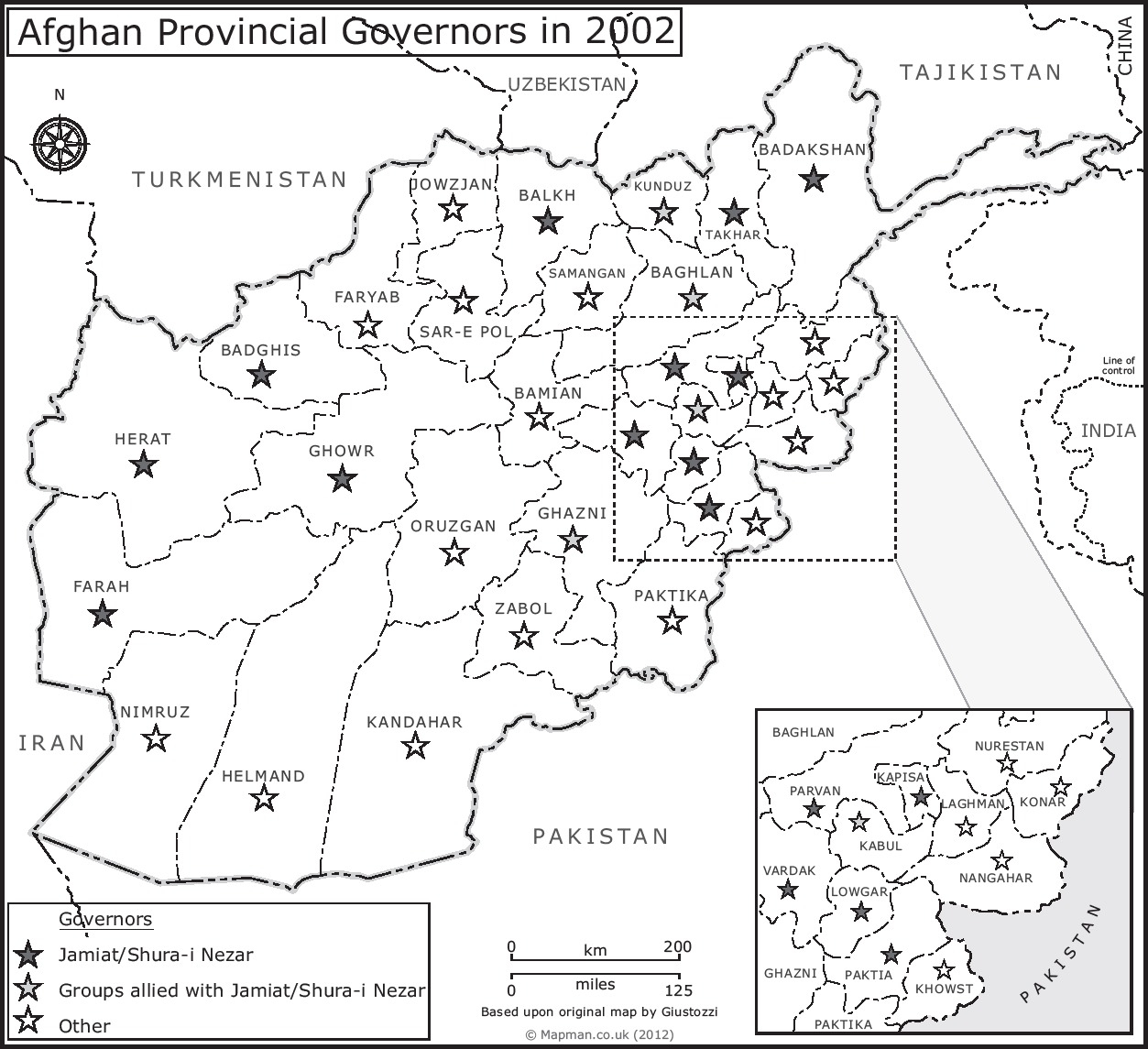
Figure 5: Giustozzi’s map of governorship positions in 2002, by affiliation.20
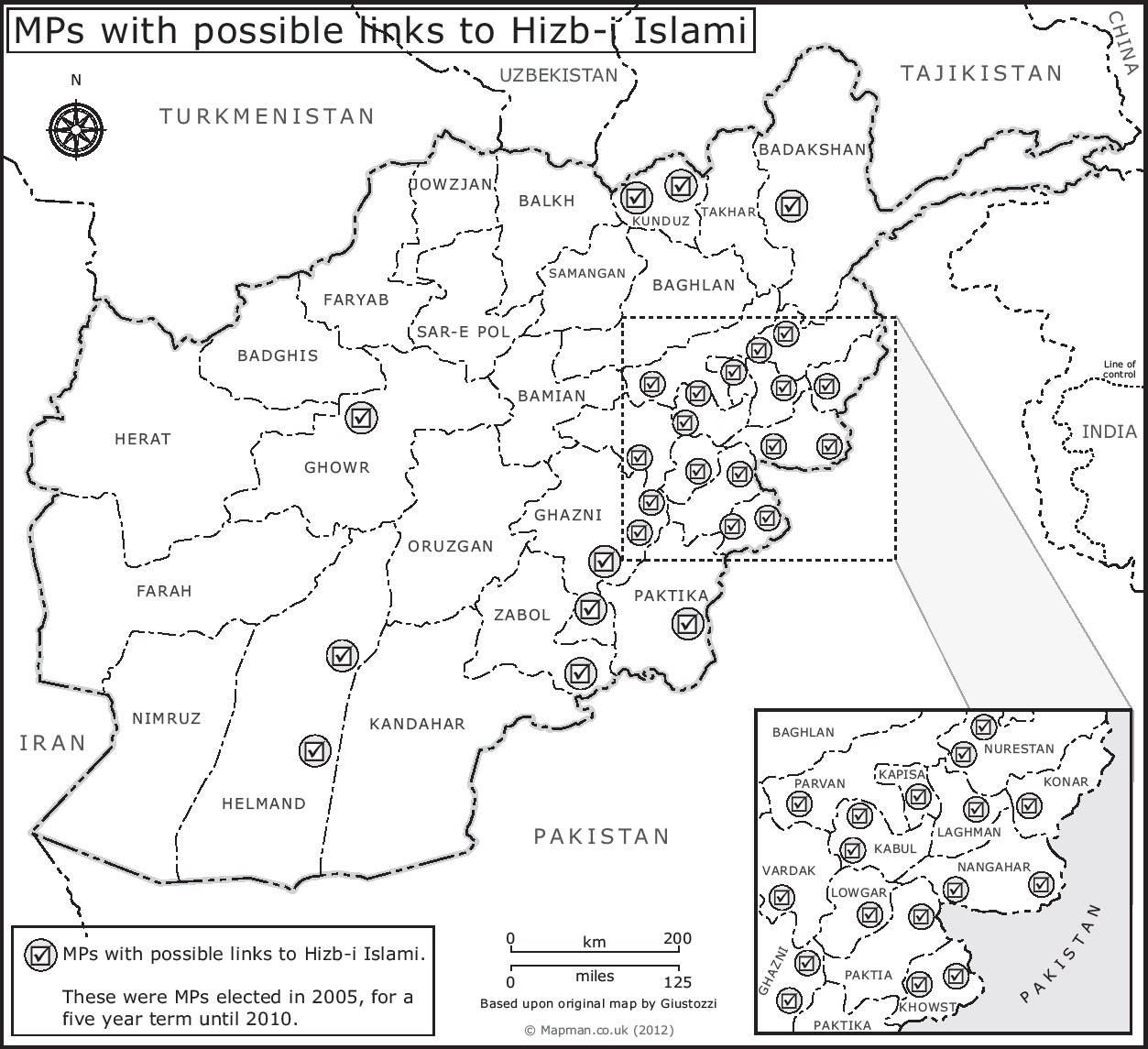
Figure 6: Giustozzi’s map of MPs (members of the Wolesi Jirga) with possible links to Hizb-i Islami. These were MPs elected in 2005, for a five-year term until 2010.21
The 1980s Afghan conflict exhibited similar political dynamics. The two-way fight between the Mujahideen and the government was the most visible dynamic during the conflict. Yet the government side was continuously fractured between different interest groups, most obviously the two factions of the Communist People’s Democratic Party of Afghanistan (Parcham and Khalq). Moreover, any assumption that there was an underlying two-way ideological polarity which defined friend and enemy would have to contend with what happened in the subsequent ‘Mujahideen’ period of the early 1990s. The Mujahideen fought one another. Many changed sides and backed what was left of the Afghan government side; the original Taliban then fought the Mujahideen, most of whom merged into the new Taliban. A polarised conception of war cannot comprehend situations in which force is used directly in the interplay of normal, untidy, political intercourse.
The political loyalties of the Afghan people are complicated. The majority of civilians in Afghanistan do not want to be ruled by the radical elements among the Taliban; that is consistently clear in private conversation, even if Afghans will rarely say so publicly. The north of Afghanistan in particular generally has strong antipathy towards the Taliban. That does not, however, necessarily translate into support for the government of Afghanistan, against which many civilians have legitimate grievances. Often the problem for coalition efforts is that locals often want ISAF, whom they essentially trust, and whose presence they want, but are more wary of parts of the Afghan security forces. Yet the same people that plead for coalition troops not to leave will enthusiastically rehearse the somewhat enervating rumours of secret foreign plots to occupy Afghanistan, which are ubiquitous. One of the most common rumours is that America and Britain are secretly backing the Taliban to facilitate a Pakistani takeover. The fact that such a ludicrous proposition is genuinely so widespread is an indication of how vulnerable people are to superstitious nonsense after thirty years of violence.
At the local level the most important motivation for the inhabitants is self-preservation. The people have been in war, more or less, since 1979; if they were not good at survival they would probably already be dead. In light of self-preservation, the relative benefits of life under either side proposed by the competing narratives are peripheral: people become actors in their own right. For locals to have family associations to both the Taliban and the Afghan government, sometimes with a son in both, is not uncommon, and is logical from their point of view. As one Afghan village elder once put it to Major Shaun Chandler, in a quintessentially memorable expression: ‘everyone holds two watermelons in their hands’.
Finally, conflict evolves. The conflict in Afghanistan I have described here is only its present state. There are several variables which can significantly change the dynamics. If the Pakistani state, for example, should amplify its support for the insurgency after coalition forces have left, the conflict might move closer to being a more genuine war. Pakistani state support was a key factor in the original Taliban’s success at taking power in 1994–6. Whether this scenario will be repeated is perhaps a ‘known unknown’.
Strategic thought tends to reject the idea that ‘gang warfare’ is really war. Gangs and criminals use force for direct advantage rather than within a mechanism that provides a military decision on which a political outcome is based. This is political advantage in the broad sense of an adjustment of circumstances in one’s favour, as opposed to just describing competition for state offices. Yet this is close to the way in which force is used by many actors in the war in Afghanistan, although it does not make the use of violence any less lethal.
In the Clausewitzian paradigm of war, the enemy is coerced into subscription to one’s strategic narrative: he dies, or becomes no longer relevant. This makes the translation of force into political meaning relatively simple. Even if the enemy utilises a different interpretive structure, one can ultimately force an outcome upon him. While armed conflict continues to be at its core a clash of organised violence, the Clausewitzian notion that attack is the ‘positive’ and defence the ‘negative’ component of translating force into political meaning, a war’s ‘decision’, is compromised in Afghanistan. Ultimately the more fragmented a political environment, the more actions are interpreted individually in directly political terms rather than as part of the military balance in the scale of a conflict’s military outcome. The proliferation of strategic audiences beyond the enemy means that force no longer has a clear target: one cannot ‘force’ an outcome on a strategic audience that is not the enemy; they may well be free to ignore the war’s military outcome.
The effect of violence in fragmented political environments
Clausewitz saw three elements at play in war: policy, passion and war’s uncertain dynamics, ‘the play of chance and probability’. He referred to this as the ‘trinity’ of war, in that these three elements formed the ‘one’, which was war. These three elements of war were for Clausewitz represented in his conception of the state at war. Reason (or policy) was represented by the government (bearing in mind that Clausewitz’s Prussia was a monarchy) and passion by the people. The army did not strictly represent war’s dynamics, but was the component of the state that had to confront the uncertainty inherent in combat.22
The nature of war was for Clausewitz constant, even though its character evolved. By situating war’s nature in terms of the interaction of three variables, his definition remains flexible. While the Afghan conflict is not war in an inter-state sense, its basic nature can still be comprehended in terms of an interaction of these three elements. However, unlike in conventional inter-state war (in which policy tends to be the dominant characteristic), as there are a multitude of political actors, the role of human passion, and the unpredictable, potentially explosive, dynamics of violent clash, increasingly infrom the conflict’s basic definition.
The consequence of the use of violence in war is often that fighting generates an antagonism of its own that distances people from their political common ground. Clausewitz acknowledged this: ‘even where there is no national hatred and no animosity to start with, the fighting itself will stir up hostile feelings’.23 Clausewitz understood violence to be an explosive, reciprocal force. The idea that ‘violence begets violence’ has always been part of human conflict; as Tacitus put it: ‘once killing starts, it is difficult to draw the line’.24 However, while the Clausewitzian paradigm recognises that violence may accentuate, or entirely generate, emotional antagonism, that antagonism is delimited by the strategic audiences’ location within two polarised constituencies, typically the state parties to a conflict.
Where force is used within a fragmented political environment, it creates new enemies, who are not necessarily linked to any state. The essential feature of such an environment is that violence is not bound within the bilateral, polarised conception of two states at war; it has unpredictable, and often tragic, political outputs. The sectarian violence following the break-up of Yugoslavia, and in Iraq, occurred between communities who had previously co-existed, but were torn apart by the reciprocal hatred which violence causes.
This dynamic would appear to run in parallel with what Stathis N. Kalyvas has so persuasively argued in The Logic of Violence in Civil War (2006).25 He posits that the mainstream narratives of most civil wars tend to locate violence in terms of macro-level emotions, ideologies or cultures. However, the empirical evidence points to a far more complex and fragmented analysis. What can be incorrectly labelled as ‘madness’ (i.e. complex, fragmented and irregular patterns of violence) actually has logic, but this is often to be found at the micro, not the macro level: ‘because of the domination of national-level cleavages, grassroots dynamics are often perceived merely as their local manifestations. Likewise, local actors are only seen as local replicas of central actors’.26 Violence at the local level is often produced by actors trying to avoid the worst and taking opportunities:
For many people who are not naturally bloodthirsty and abhor direct involvement in violence, civil war offers irresistible opportunities to harm everyday enemies… Rather than just politicizing private life, civil war works the other way around as well: it privatises politics. Civil War often transforms local and personal grievances into lethal violence; once it occurs, this violence becomes endowed with a political meaning that may be quickly naturalised into new and enduring identities. Typically, the trivial origins of these new identities are lost in the fog of memory or reconstructed according to the new politics fostered by the war.27
Kalyvas argues that agency in the violence of civil wars is partly a function of ‘alliance’ between the centre and the periphery in that both use the other to their advantage. This allows for multiple, not unitary actors. He recognises that ‘master-narratives’ can legitimately identify the ‘master-cleavage’ in a civil war, but it is usually accorded too much significance post-conflict in the desire to ‘simplify, streamline, and ultimately erase the war’s complexities, contradiction and ambiguities’. Hence:
Actions in civil war, including ‘political violence’, are not necessarily political, and do not always reflect deep ideological polarisation … an approach positing unitary actors, inferring the dynamics of identity and action exclusively from the master-cleavage, and framing civil wars in binary terms is misleading… Civil war fosters a process of interaction between actors with distinct identities and interests. It is the convergence between local motives and supralocal that endows civil war with its intimate character and leads to joint violence that straddles the divide between the political and the private, the collective and the individual.28
When the interpretive framework of Clausewitzian war is dragged into a situation which is closer to being a direct extension of policy through ‘armed politics’, be it in civil war as analysed by Kalyvas, or in the current politically kaleidoscopic Afghan conflict, serious strategic confusion can occur. The key difference being that the interpretive framework of war in the Clausewitzian tradition presupposes a bilateral polarity which channels violence and a stability of association between strategic audiences and their state. Thus violence may well escalate hostilities, but it exaggerates them rather than creating new ones.
The use of political violence for a prolonged period of time outside of the interpretive framework of ‘war’ is not a new phenomenon. The British attempt to keep in check the Pathan (now known as Pashtun) tribes on India’s North-West Frontier with Afghanistan saw virtually not a single year pass between 1849 and 1947 without one or more military campaigns in the region (there were 60 campaigns pre-1900 alone). David Loyn in Butcher and Bolt (2008) has described this as ‘an intensity of conflict unique in the world’.29 The 1897 General Uprising against the British led to the deployment of an army 44,000 strong in the Tirah Campaign of 1897–98; this was the largest force ever deployed by the British in Asia to that point, and even then, it was outnumbered by the tribesmen.30 Each campaign was intended to reach some kind of political settlement with the various tribes; force was used with an admixture of money and threats to maintain a delicate political balance for almost a century.
While this approach can legitimately be seen as successful from one perspective, the long-term fusion of military and political activity had destabilising consequences. British policy on the North-West Frontier provided an ideological counter-point for the radicalisation of people into Islamic extremists. David Loyn documents how the Wahabbiinspired Deobandi strand of Islamic thought produced militants who sought to integrate themselves with the Pathan tribes. By 1849, for example, militants controlled the Swat Valley. The Ambeyla campaign in 1863 to eject them cost the British over 800 dead; prototype ‘bomb factories’ were found by the troops that cleared their base. Twelve-thousand-five-hundred men were needed five years later to dislodge militants who had made common cause with tribesmen in Sittana. Fanatical militants, called ‘ghazis’, used to fight alongside the Pathan tribes under the green banner of Islam as distinct units, travelling to conduct jihad.31
David Loyn states that the first recorded attempt at a suicide attack on British troops in Afghanistan was in Kandahar on 17 January 1880: a man calling himself a Talib-ul-ulm ran up to a British Engineer Sergeant and tried to kill him but was stopped.32 In 1895 Mullah Powindah, a fundamentalist mystic, led his network of militants into the Swat Valley and joined forces with the Wahabists there under Mullah Sadhullah. Their call for jihad against the British was backed by the Afghan king, Abdur Rahman. Loyn notes how Abdur Rahman quoted the same passages from the Koran as Osama Bin Laden later used.33 This Islamic narrative was inter-twined with the Pathan General Uprising of 1897. After their defeat in the Tirah campaign, the militants moved to an even more remote area and even started to publish a newspaper called Mujaheed.34
Loyn’s remarkable account of this century of political violence, which can only be summarised in its most basic form here, illustrates the unstable and unpredictable consequences of the use of force outside the interpretive structure of war in the Clausewitzian sense. Loyn’s argument is perhaps encapsulated by his assertion that the same villages in Waziristan that were the first to rise up against Great Britain and back the ghazis, later backed the Mujahideen, and now back Al Qaeda.
A counter-point to the rather austere radicalising trends at play during the century Loyn describes is provided by John Masters, a Gurkha officer who describes his experience living and fighting on the North-West Frontier, particularly from 1936–7, in the first of his autobiographical books, Bugles and a Tiger (1956). He recounts, for instance, that after each campaigning season ‘scores of Pathans’ who had been fighting against the British Indian army would earnestly apply to their British political agent for the Frontier Medal (the medal more typically awarded to soldiers of the British Indian army rather than to the ‘enemy’!) with the appropriate clasp; after all, in their view they had valiantly fought in the same actions.35 Masters’ retrospective account of the texture of the British Empire’s interaction with the peoples of the North-West Frontier at its twilight is a reminder that there were more subtle narratives at play in that period too: the notion of the politically kaleidoscopic battle-space is a long-standing feature of conflict that the contemporary context merely exaggerates.
To this point War From the Ground Up has sought to draw attention to what characterises the concept of war in contemporary conflict, in particular to identify the continuities, evolutions, or breaks with war as more traditionally defined in its inter-state paradigm; the concept as posited by Clausewitz being the primary point of comparison. Clausewitz wrote about war shortly after its transformation by Napoleon; war today is again being transformed by the information revolution, which forces liberal powers to reconsider strategic thought in relation to their use of armed force. The remainder of the book examines how the West can operate in the politically fragmented, and interpretively unstable, environments which tend to characterise contemporary conflicts.