
4
When in contemporary conflict the application of force moves towards being a direct extension of policy, but is shoehorned into the interpretive structure of war in its more traditional, Clausewitzian sense, armed force frequently fails to connect to political utility. The following three pairs of chapters examine possible responses to this problem by liberal powers. Three themes are developed: the construction of the political context of conflict through strategic dialogue (Chapters 4 and 5); the construction of operational approaches (Chapters 6 and 7); and the construction of strategic narratives, which connect operational approaches to their political context (Chapters 8 and 9).
Strategic dialogue is the reciprocal interaction between policy, in the sense of the political decisions and intentions of the state, and how policy is articulated as actual operations: the interaction between what is desired and what is possible. I make a distinction between the organisation of strategic dialogue, in terms of the procedural configuration of how strategy is made within the state, and the substantive output that dialogue produces: the strategy itself. This chapter considers strategic dialogue in terms of what political choice means in contemporary conflict. The next chapter considers how well liberal powers, particularly in terms of their civil-military structures, are configured to conduct effective strategic dialogue.
When tactical actions are highly politicised, strategy needs to ensure that policy is politically coherent down to the tactical level; this is consistent with the role of strategy in armed conflict as a bridge between political and operational activity. Yet when liberal powers do not understand a problem on its own terms, applying instead a distorting paradigm of war, proper strategic dialogue is frustrated. This is primarily because conventional war is often understood as a decisive, finite, event; the flow of direction is one way, from policy through various levels to tactical execution; the military execute, but do not question policy. Moreover, strategic dialogue is blocked the other way too: when a default association is made between the action of armed forces taking place within the military domain of ‘war’, the traditional view is that civilian politicians, once their policy direction has been given, should ‘stay out’ of military activity. That view is misguided; policy makers should be as close as possible, realistically, in a vicarious sense, to the political pulse of the conflict on the ground.
The strategic ‘level’ in contemporary conflict
Strategy links deliberate action to political outcomes. In the Clausewitzian paradigm, while the lines of policy continue into war and drive military action, actions within war seek intermediate military, not directly political, objectives. In this context the strategic ‘level’ can legitimately be understood to be at the juncture of military and political activity, the boundary perhaps between war and international politics; this would normally be defined procedurally in terms of the interaction of politicians and generals. Below that level is the domain of operational military planning that ultimately serves a political end, but is itself military. In this context, for the policy-maker to consult ‘ground truth’ means to consult generals, not the soldiers below them, about the feasibility of achieving a given policy.
In the Second World War, for example, the experience of the common solider was clearly ground truth of a sort, but not the kind that mattered to policy. The interaction between military action and policy—strategic dialogue—occurred much higher in the chain of command. This made sense as the juncture of military and political actions was usually at the level of whole corps and army groups. For instance, General Patton’s push into Czechoslovakia with his Third Army Group in the dying days of the war in 1945 was primarily driven by political factors in terms of the race against Soviet occupation rather than the German military threat.
There is an important distinction to be made between two possible significations of what the ‘strategic level’ means in the context of armed conflict. First, it means a location of strategic authority, in the sense that a person, usually of very senior military or diplomatic rank, makes decisions that formulate and adjust the strategic basis of operational plans in light of policy, and potentially makes recommendations to policy-makers to adjust policy in light of operational reality. Second, the strategic level can be understood as a domain in which an action has a political quality.
In traditionally defined conventional war there tends to be an overlap between the location of strategic authority and the location at which people make decisions that have a political quality, as in the example of General Patton above. In contemporary conflicts, however, the tendency is for there not to be a neat overlap, but an expansion of the strategic domain. This domain includes, but also goes far beyond, those who have strategic authority, like one circle expanding beyond another. Relatively junior commanders find themselves making decisions which although nowhere near as significant in scale as ‘strategic’ decisions made by those who have strategic authority, nonetheless have a directly political quality, however insignificant those actions in themselves may be, and so are also, in an alternative sense, ‘strategic’.
This creates something of a mismatch, and can change the role of the commander with strategic authority, especially in emphasising his or her co-ordaining function across several tactical sub-units/agencies, military and civilian, relative to the function more traditionally associated with the strategic commander, of delivering decisive blows to the enemy.
In contemporary conflict, tactical action frequently does have directly political significance. This is not just when a tactical event is picked up by the global media, but also on a routine basis. The political outcome of a conflict is the accumulated outcome of innumerable individual actions as opposed to decisive blows against the enemy. This type of cumulative campaign has been described in the context of Iraq and Afghanistan by Dr Conrad Crane as a ‘mosaic’ conflict.1 This term encapsulates the idea that the war is best represented by the accumulated effect of a multitude of sub-narratives, none of which is decisive in itself. In this context, strategy looks to brigades, battlegroups and companies, and their respective civilian equivalents and host nation partners, to deliver political results. Each may be pursuing very different activities, ranging from high-intensity combat to humanitarian work, even within a small physical space. Figures 7 and 8 exemplify mosaic conflict in the context of the coalition effort in Iraq in 2004.2
In such circumstances strategic considerations have to inform tactical action, in order to link tactical actions to political purpose. There may still be a ‘strategic level’ in the sense that it denotes a particular grade of civilian/military authority, but this should not be confused with the location of strategic effect, that is, the strategic domain. Strategic effect in many contemporary conflicts, including Afghanistan, is fragmentary: ‘in counter-insurgency, the levels of war are all flattened’.3
The problem of how to have strategic effect in a fragmented conflict environment was considered in 1967 by Admiral J. C. Wylie, who distinguished between ‘sequential’ and ‘cumulative’ strategies.4 Sequential strategies were linear. To achieve the goal of policy, step A led to B, led to C. He uses General MacArthur’s island-hopping campaign in the Pacific during the Second World War as an example. Decisiveness, traditionally the feature by which an action has been defined as ‘strategic’ (rather than ‘tactical’), is stamped on history with every step taken along a single path to the ultimate objective.
Cumulative strategies could be just as decisive, but far less perceptibly so. The US navy’s wider contribution to the war in the Pacific is used as an example. The cumulative effect of each Japanese naval and merchant ship sunk, for instance, gradually choked the Japanese economy, a critical component of the US Pacific war effort. For Admiral Wylie these strategies were not mutually exclusive, as their unity in the overall Pacific campaign makes clear. In some ways Wylie’s ‘cumulative’ strategy is about how to conceptualise an attritional strategy: the final result may be decisive, but the distance from the destination may not be signposted as clearly as an outcome arrived at through a series of decisive battles.
In Afghanistan, Wylie’s argument is equally applicable. Decisive, sequential, strategic actions may legitimately be pursued, such as some form of negotiated settlement with the Taliban. Certain military actions may also have decisive strategic effect in themselves: the 2011 Osama Bin Laden raid being an example. However, in parallel with sequential approaches, the coalition is pursuing a cumulative campaign gradually to reconfigure the political landscape, namely by attempting to connect people to the Afghan government.
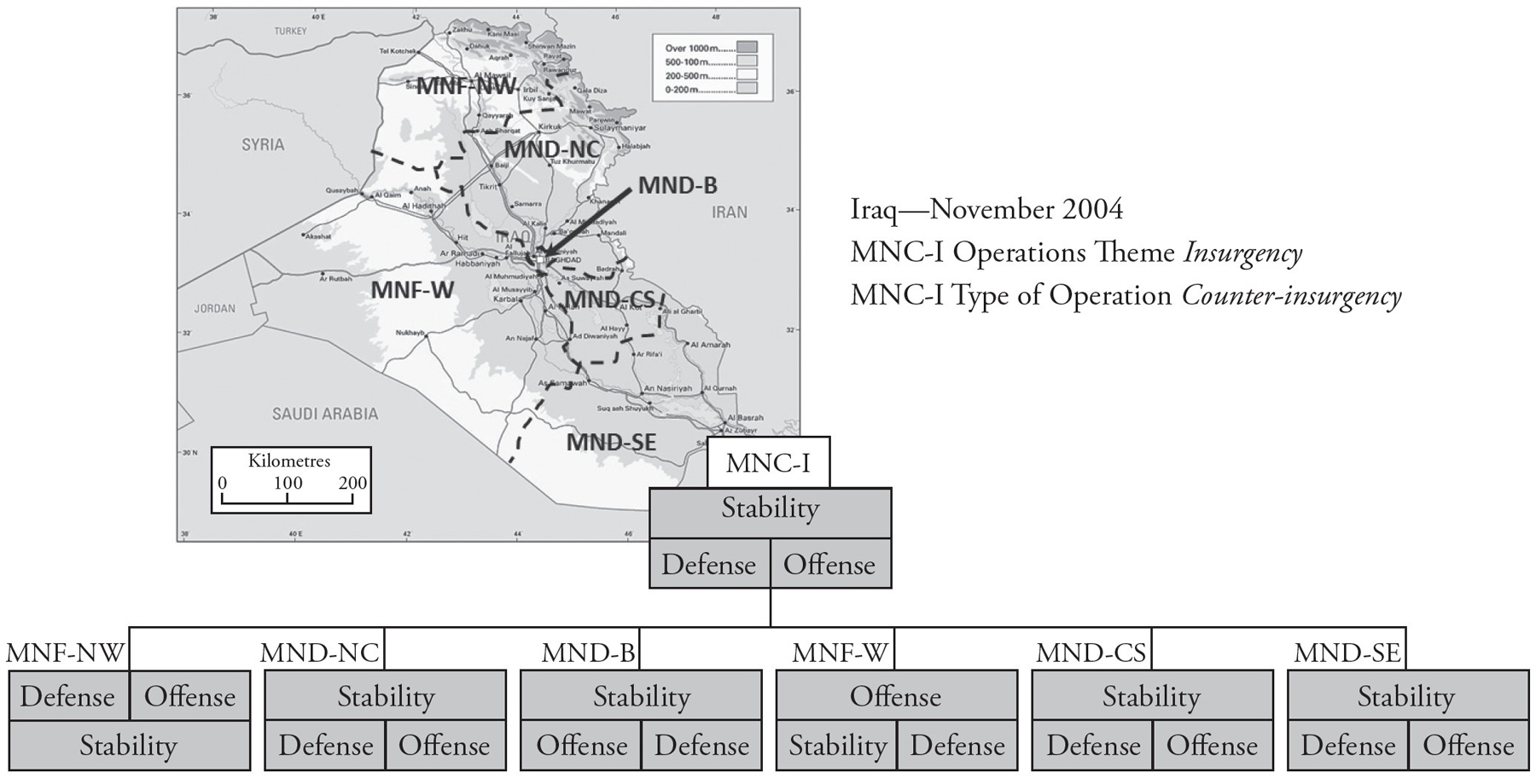
Figure 7: The ‘mosaic’ nature of US operations in Iraq in 2004. Each box refers in relation to its sub-divisions to the ratio of mission types that the formation was conducting. (MNC-I is Multi National Corps Iraq, MNF is Multi National Force, MND is Multi National Division, with a corresponding geographic orientation direction, or ‘B’ for Baghdad).
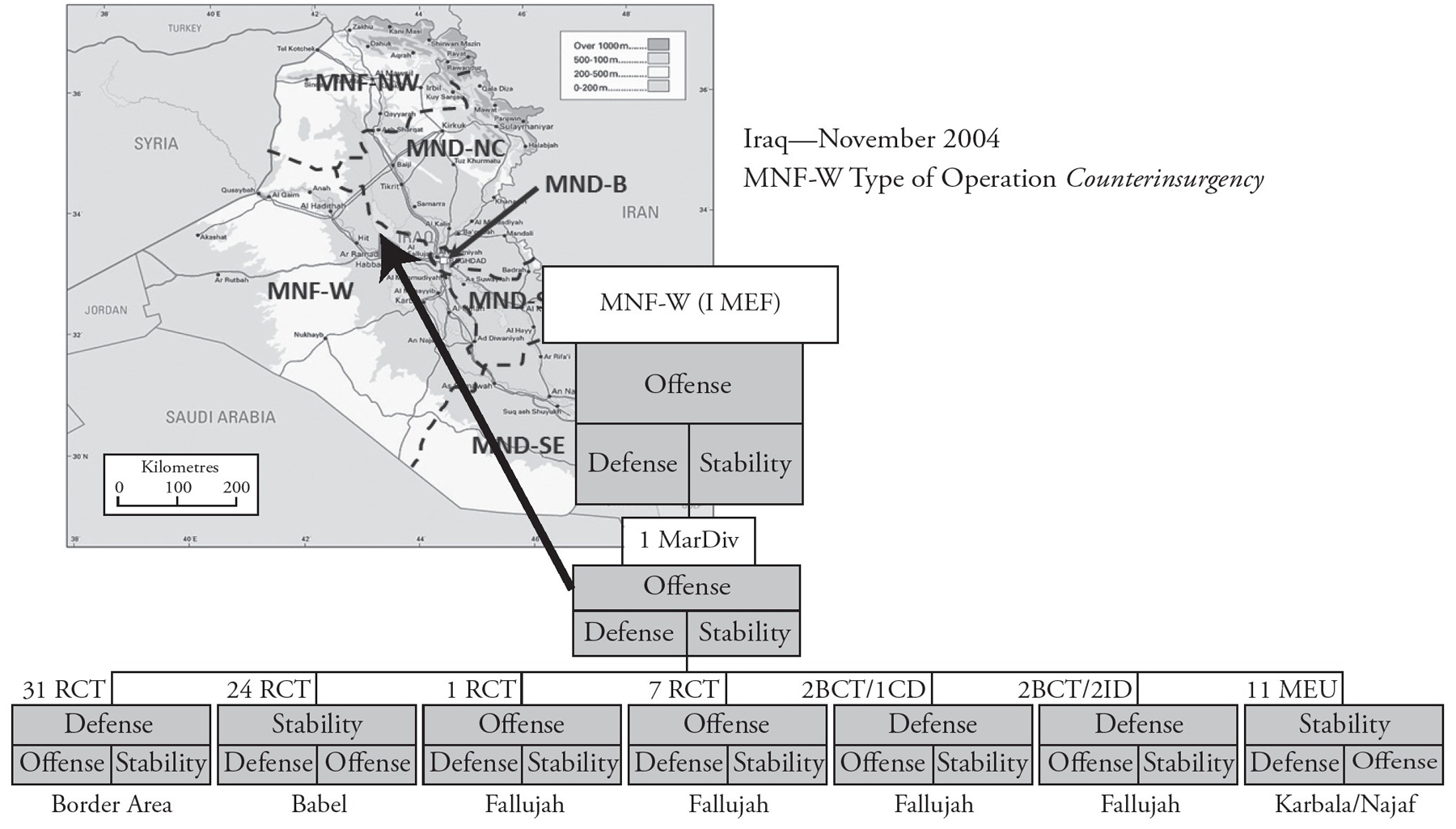
Figure 8: This illustration amplifies the situation in Multi National Force West, which was at the time held by 1 MEF (Marine Expeditionary Force). The mosaic nature of conflict is replicated within each of its RCTs and BCTs (Regimental/Brigade Combat Teams) and the MEU (Marine Expeditionary Unit).
To use a phrase from the world of political theory: ‘all politics is local’. For armed force to be of political utility in mosaic conflicts, tactical actions often need to be considered primarily in terms of their local political effect, even if in their own right, such political effect is very small. This is different from situations in which armed forces only need to think about their actions in military terms. For instance, a decision to attack one group, or support another, whether desired or not (one may not know the affiliation of the insurgents one fights, or be able to avoid the fact that most projects empower some groups over others), will attract some realignment in the local political situation; that needs to fit in with one’s broader strategy, or one’s actions will politically be incoherent, like a politician who takes contradictory positions vis-à-vis the constituencies that he seeks to keep in balance. The critical implication is that political choices constantly need to be made at the tactical level.
As President Abraham Lincoln famously stated, ‘you cannot please all the people all of the time’; this being the case, one cannot avoid making political choices. The key is how far they are planned and coherent, because one recognises the political quality of the action, or unplanned and incoherent, because one does not.
Contemporary conflict through the lens of domestic politics
The dynamics of the conflict in Afghanistan, like many other contemporary conflicts, are in many ways analogous to that of domestic politics in liberal democracies: strategy has to operate within a complex political environment that nobody can ever fully understand. Within this environment actors tend to act in a kaleidoscopic manner on the basis of self-interest.
The British army Jungle Warfare Advisor Course teaches that the ‘jungle is neutral’, after the famous book by F. Spencer Chapman.5 This environment may be complex and intimidating, but has no favourites. To reject this complexity because one is unaccustomed to operating within it is a mistake. As in jungle warfare, one has an advantage once one accepts complexity and stops trying to fight against it by forcing it into the more straightforward polarised concept of war. The endless foliage of the jungle, like the infinite complexity of human societies, stops being an exhausting barrier to progress once one relaxes in that environment and comes to see its advantages, since its demanding texture is the same for everyone: most political environments are complex; that is normal.
The following vignette is from an exchange reported by Bob Woodward in his book Obama’s Wars (2010) between General Stanley McChrystal and President Obama in 2009:
McChrystal presented a map of Kandahar and its suburbs that attempted to lay out the tribal dynamics. It was a crazy quilt of overlapping colors that resembled a piece of modern art… A spaghetti soup of dotted lines, dashed-dotted lines and double-dotted lines reflected what were believed to be the relationships and tribal loyalties. Some are Barakzais, others such as Karzai are Popalzais, and on and on. Some of the narcotics kingpins were listed…The President reflected on the Kandahar map and the power broker chart. ‘This reminds me of Chicago politics’, Obama said. ‘You’re asking me to understand the interrelationships and interconnections between ward bosses and district chiefs and the tribes of Chicago like the tribes of Kandahar. And I’ve got to tell you, I’ve lived in Chicago for a long time, and I don’t understand that’.6
For Woodward, a highly experienced political journalist, to describe such complexity as ‘crazy’ in a military context is noteworthy. President Obama’s reaction to this diagram reveals that he would be familiar with this way of conceptualising a problem in the context of domestic politics; and presumably, in a domestic political context, so would a political analyst of such skill as Woodward. A US political consultant, in the context of an election, would think about strategy precisely in terms of how to achieve political effect, in terms of overall public opinion, through the cumulative effects of fragmented local actions. The complexity of this diagram may appear unnerving as a military problem; yet the political environment it represents is very similar to the competition between a multitude of actors and interest groups in normal, messy, domestic politics.
General McChrystal’s subsequent response to President Obama in Woodward’s book is ‘if it were Chicago we’d need far more troops!’ While funny, there is some irony in the fact that the President has intuitively and immediately seen the problem in its own terms. That line of thought is, however, seen as a funny quirk, since this is not Chicago, it is ‘war’. The President does not appear to see it as a legitimate line of thought with which to interrogate a policy problem.
Professional politicians have to be comfortable operating in uncertainty; nobody can ever fully understand any political environment, because human societies are so complex. Yet political theory exists that has successfully figured out how, broadly, to have effect in such an environment. US political marketing is perhaps the best example of this. Through detailed analysis of interest groups, one selects target audiences. Political messages, both in terms of actions and words, are carefully nuanced to achieve a change of perception among target audiences, and draw them towards one’s narrative. While liberal democracies are entirely familiar with the application of such theory in the context of domestic politics, when it comes to war, or armed conflict, even when the dynamics are broadly analogous, to reject such complexity in favour of a simplified polarised narrative is the norm.
Admittedly, one will never have a complete political picture; that is impossible. One can always find out more about a society. In many ways the longer one spends in conflict environments such as Afghanistan, the more one realises how much one does not know. Yet to reduce what complexity one does acknowledge to a simple insurgent versus government model, just because one has an incomplete picture, is misguided. Reduction of complexity to black and white encourages the very type of anti-intellectualism that prevents strategy from understanding a problem on its own terms: we need to embrace complexity and deal with it, not reject it.
The conceptual crux of the problem is that Western liberal democracies often assume that military action consists of one concept when in fact it consists of two: military action means the use of armed force itself; it also refers to a military interpretive structure in which the application of armed force sets conditions for a political solution. In the Clausewitzian paradigm these concepts are symbiotic, as was set out in Chapter 1. When armed force is employed as a direct extension of policy in contemporary conflict, military action largely, and frequently unconsciously, leaves behind the accompanying interpretive structure of war as a military domain. Problems occur when the conceptualisation of the enemy in such circumstances has not evolved, and still presumes a military interpretive context that may not exist.
The relationship of a strategist to the ‘enemy’ in normal domestic political activity is significantly different from the enemy in the paradigm of inter-state war. For in the paradigm of inter-state war the enemy is also the strategic audience against whom one’s actions seek to have an effect. In domestic politics an individual, or a target audience, may support the opposition, but that person or audience are not themselves the enemy. A politician in an election ideally would win over all of the electorate to his point of view. This may involve defeating the enemy, the opposition party, but one does not seek to defeat the electorate itself. In the same way a group of ‘accidental guerrillas’ may support the Taliban, but one should not be seeking their defeat; rather one should be seeking to pull them out from the sway of the Taliban.
There is a big difference between thinking about counter-insurgency in terms of the defeat of insurgents (i.e. actual people), and the defeat of an insurgency, which is ultimately an idea, or a group of ideas.
The International Security and Assistance Force (ISAF) campaign plan, redrawn in 2009, was based on the notion that the Afghan population was the ‘strategic centre of gravity’; that is, their perceptions were judged to be the most important variable to campaign success, and the campaign was therefore planned with the primary objective of gaining their support for the Afghan government. In presentations that I have attended, this was usually the first step of the argument. The next step was usually that Kandahar city was the Taliban’s centre of gravity. The third step was then that the control of the population in Kandahar city was therefore to be the ISAF campaign main effort. This was presented as a linear argument whose deductions lead into one another. While this may well have been the best course of action, to present it as a linear argument is problematic.
Focusing the campaign’s main effort on the perceptions of the population in Kandahar city sought to achieve a decisive blow against the insurgency. Such a move indeed resembles the purpose of defining a centre of gravity in conventional warfare, to identify where to concentrate for the decisive blow to knock out the enemy. How does this concept translate in terms of Afghan counter-insurgency? In political terms, to have identified Kandahar city as the decisive point was a bold move; however, for a political consultant in a US Presidential election, it would be like the Democratic Party investing massive resources in trying to win Texas, or the Republicans California, seeking a knock-out of the other party rather than a victory on points. To continue such an analogy, massive investment of resources to take on the opponent’s home base means taking risk on the support of one’s own home base, and in more marginal areas. As this analogy suggests, if the defeat of the enemy is a means to an end (as in an election), rather than an end in itself, one does not necessarily need to capture the enemy’s home base; that is only one course of action.
This is encapsulated by General Sir Graeme Lamb, who worked with General Stanley McChrystal in 2009 when the latter was commander of ISAF. In his evidence to the House of Commons Defence Select Committee, General Lamb states that he briefed General McChrystal in 2009: ‘we [ISAF/the coalition] had, for seven or eight years, asked the question, “Where is the enemy?” The question we should have asked was, “Where should we be?”’7
Plans are not made in retrospect, and I emphatically do not seek to second-guess decisions made in 2009, which might well have been the best course of action. The point is, however, that if we take as a starting point the deduction that the population’s political affiliations are the campaign centre of gravity, what we have is a problem with which a political consultant would be familiar in the context of an election. The defeat of the Taliban, like the defeat of one party by another in an election, is a means to an end if one has defined one’s end as the will of the people. Thus while the decision to take on the Taliban in Kandahar as the centrepiece of the campaign may have been the best option, the linear three-step argument that is usually presented to justify it does seem to present a tension between the conception of a centre of gravity in conventional war and in Afghan counter-insurgency; the key variable being the difference of what the ‘enemy’ represents in either case.
This confusion of concepts gives rise to a paradox in the coalition approach to conflict in Afghanistan and the ‘Long War’ more generally. On the one hand, the liberal powers involved recognise that they are in a political war for perception and ideas on a global scale. However, when liberal powers are tempted to think about war in essentially inter-state terms, this assumption is insufficiently challenged: that military activity sets conditions for a political solution, but is itself apolitical. This can encourage liberal powers to think of military outcomes in absolute terms of ‘winning’ and ‘losing’, absolute standards of success or failure that are rarely evidenced in domestic politics. Every time the question ‘are we winning in Afghanistan?’ is asked, is the latent fixation with all armed conflict being understood implicitly in terms of inter-state war revealed.
Armed politics: understanding and shaping the environment in political terms
David Kilcullen has characterised counter-insurgency as an ‘armed variant of domestic politics’.8 Antonio Giustozzi has used the term ‘armed politics’ to describe ‘the distortion caused by the presence of non-state armed groups on the competitiveness of an otherwise open political system’.9 Both of these definitions capture the essence of the problem: in such conflicts armed forces are required to have effect in an environment in which actors use an eclectic range of means, violent and non-violent, to compete vis-à-vis one another for political advantage (in the broad sense of power rather than just political advantage within state structures).
When one is fixated with the interpretation of any organised violence through the prism of inter-state war, whoever shoots at you becomes ‘the enemy’. This encourages a mentality in which the enemy is treated as a unified political entity, and an assumption of a reasonable degree of coherence in their agenda, which confuses strategic planning. The last chapter argued this point in the context of Afghanistan. Yet neither does the ‘terrorist’ enemy of the Long War act with a single rationale. Application of a Clausewitzian paradigm distorts the situation. As Lieutenant General Sir Graeme Lamb, when the Commander of the Field Army, wrote on the front page of his Counter-Insurgency Commander’s Guidance (2009): ‘an insurgent fights for change, for the freedoms he believes in and a better life. You fight for change, for the freedoms you believe in and for a better life. What’s the difference?’10
In the summer of 2010 the 1st Battalion Royal Gurkha Rifles (1 RGR) was based in central Helmand. While our purposes remained distinct, at one point the local insurgents started to build a road in imitation of a road we were building for the people. Conversely, the fact that the apparently efficient, if brutal, justice system offered by the Taliban is quite popular is a major incentive for the coalition to improve the Afghan justice system. These are but two of a number of examples of how, while we vilify one another, we can imitate one another in competition. This operates in the tactical domain too. While we seek to ‘outguerrilla the guerrilla’, they copy some of our tactical methods. Patrick Porter, who looks at the theme of cultural mirror-imaging in Military Orientalism, cites a rather amusing quotation from the 2002 al-Qaeda ‘newsletter’: ‘the time has come for the Islamic movements facing a general crusader offensive to internalise the rules of fourth-generation warfare’. Porter notes the irony of the fact that this concept was coined by Bill Lind, an American cultural conservative, in the US Marine Corps Gazette of 1989.11
The idea that many wars have resulted from political misunderstanding is well established. Neil Sheehan stresses this in Bright Shining Lie (1989), his account of the Vietnam War.12 America saw Ho Chi Minh’s forces as part of a wider communist threat rather than as a nationalist movement which used communism as a vehicle: ‘anti-communism contributed to it [the Vietnam War] in the sense that because of their mindset, they [US leaders] wanted to see the world in black and white, they didn’t want to see any shades of gray, and so you got a simple-minded anti-communism … their instincts led them to look for simple-minded solutions and they then followed those simple-minded solutions to our grief’.13
The essential deduction is that, if force is to have political utility, one needs to understand the nature of the problem on its own terms, not through dogmatically applied ideological or doctrinal lenses. In contemporary conflict, if actions at the tactical level have direct political effect, they need to be planned with that in mind. Sheehan portrays Lieutenant Colonel John Paul Vann, the protagonist through which he often views the Vietnam War, stating: ‘this is a political war, and it calls for discrimination in killing’.14 The measures of such campaigns are the political opinions of target audiences. For Vann, the Hamlet Evaluation System, which graded each village in terms of its political sympathies, would become ‘the body count of pacification’.15
If one fails to understand one’s environment in its own political terms, one does not know what political effect one will have. Military action gains an element of lottery; one may arrest or kill insurgents because they are part of the ‘enemy’, but not know who they are in political terms. The political effect may be beneficial or hugely damaging: one simply does not know in advance. In wars of ideas, and battles for perception, merely to attack ‘the enemy’ in such a context is to push political buttons in the dark. As General Sir Frank Kitson wrote in Low Intensity Operations (1971), there is a need for both ‘political intelligence’ and ‘operational intelligence’ in these types of conflicts. This lesson, like many others in General Kitson’s incisive book, has had to be relearned by the coalition forces in Iraq and Afghanistan.16
In response to this problem, one approach to counter-insurgency, used by 1 RGR in Afghanistan, sought to understand and shape the operating environment to have political effect, and to prosecute what might be termed ‘legitimacy-centric counter-insurgency’, in line with General McChrystal’s direction at the time: to define how actors within the political environment subscribed to the narrative of the government of Afghanistan, and attempt to draw them towards it. Once one has some form of political understanding, one can tailor the strategic narrative to each audience. The chart at Figure 9 shows the different political affiliations of a fictional society based on an Afghan district. This particular model is not complicated, and one can clearly come up with more sophisticated political models. Simplicity, however, has a utility of its own so long as it distils rather than distorts a political environment. The real utility is the creation of a common political operating picture that can be mutually understood by coalition soldiers, civilian counterparts and Afghan partners.
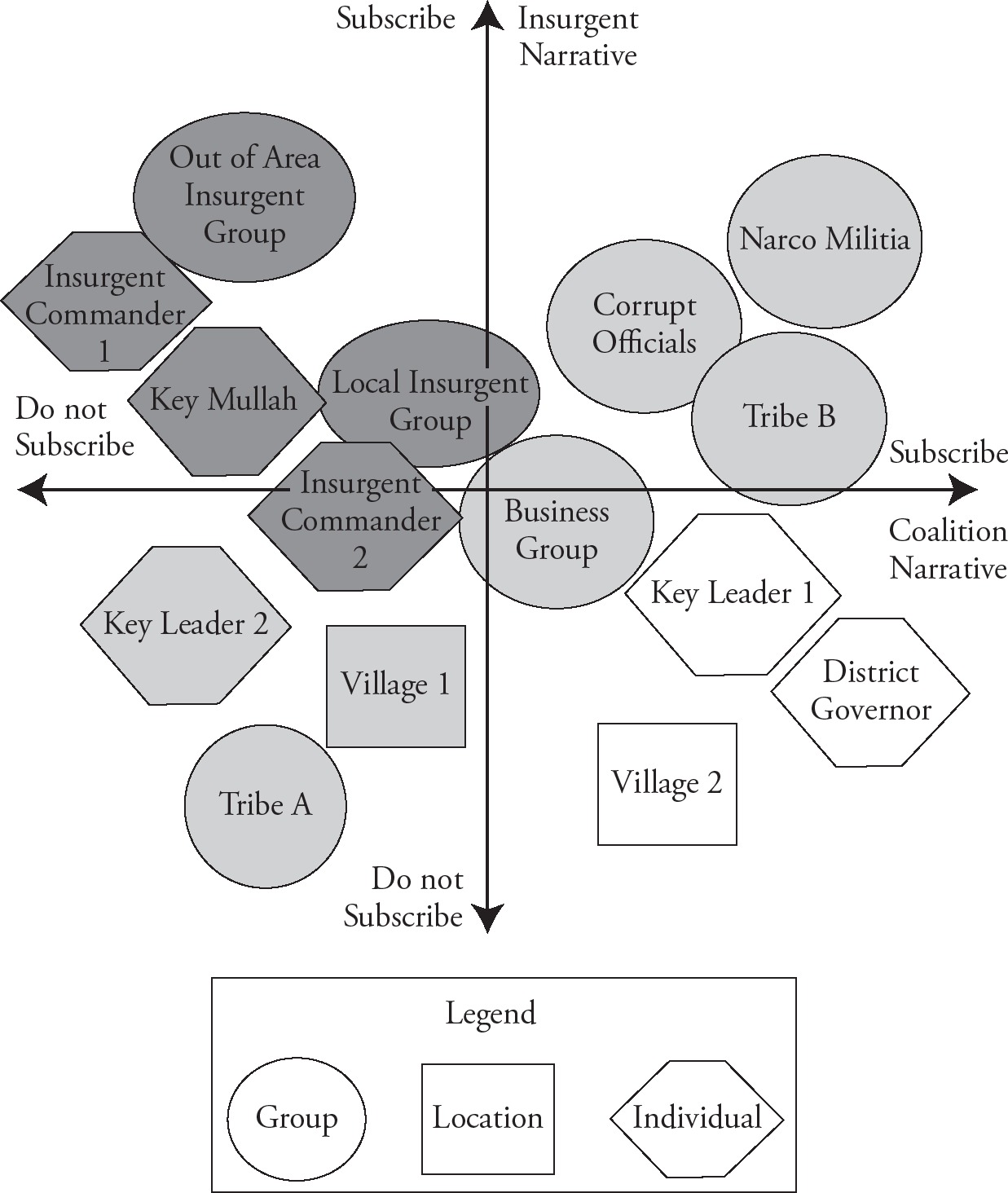
Figure 9: Basic target audience analysis chart (fictional).
The model breaks down a society into target audiences in much the same way as a politician in a domestic political environment would do. The colouring of these audiences is in relation to their proximity to the Afghan government narrative, ranging from white, meaning they generally subscribe, to grey denoting ambivalence, to black, for those who reject it. In the bottom right-hand corner are those who support the Afghan government narrative but not the insurgent narrative. In the top left-hand corner are those who support the insurgent narrative but not the Afghan government’s. In the bottom left we have those who are alienated from both sides; the majority of people in the Afghan conflict will be found here, be they ‘accidental guerrillas’ or disenfranchised farmers. In the top right we have those who back both narratives to gain personal advantage, such as big narco-militias and warlords. These people usually have connections to the insurgency and the government.
The essential deduction this model presents is that to have political effect, one needs to make political choices at the tactical level to tailor the overall narrative to have purchase in one’s operating environment; or potentially, to show that the overall narrative really does not work in one’s own area and requires adjustment higher up.
Can the moderate insurgents be broken off from the hardcore? If so, how do we configure our operations to make sure we are putting pressure on the hardcore without alienating the moderates? How does one deal with the audiences in the top right? An overly aggressive posture risks inflating the size of the insurgency; not dealing with them risks losing credibility among the bottom left groups. Does one use resources to bolster the position of those in the bottom right, who already support the narrative, or reach out to less committed constituencies, potentially alienating one’s home base? These are examples of any number of questions one could ask. They have to be asked when one decides how to attack an insurgent base area, where to build a road, where the local police force should recruit, and to whom one should award contracts. Without such information, or where there is not a common political picture across time and space, a circumstance all too common, actions will be politically incoherent.
The approach also dispenses with the notion of an isolated enemy picture; that is, a picture which only presents the insurgency, often in the form of tree diagrams, in terms of its operational set-up. While such charts are obviously vital, political context is essential: who are these insurgents in social and political terms? Without that information, one can attack a network, and even destroy it, but the political effects of doing so, both in terms of positive and negative outcomes, will be uncertain.
One needs to locate the insurgency in its political context before one can even start to think about how to deal with it. Are they fighting because of genuine ideological attachment to the Taliban? Perhaps they are fighting because they are marginalised in local politics, and want greater power locally; perhaps they are criminals, perhaps they are ‘accidental guerrillas’ who see themselves as defending their land against foreign forces, but do not have a problem with Afghan government forces.
An insurgent commander in Afghanistan may also be the relative of a prominent local political figure. His death or arrest may alienate that political figure from the Afghan government. The military benefits of attacking the insurgent network may well be outweighed by the political consequences of the action. Alternatively, if that political figure is corrupt, one may use the threat of arrest against his insurgent relative as leverage to stop his corrupt practices. Yet if one does not configure one’s information so as to situate insurgents within their ‘civilian’ environment, these links will not be visible, precluding the possibility of anticipating risks and opportunities in the first place.
The identification of political leaders who are marginalised, be they insurgents or not, is also vital. This is an important counter-balance to the preoccupation with ‘key leaders’ that tends to dominate ISAF political engagement at all levels. If ISAF is only seen to engage with leaders who are already in power, the appeal to a narrow political base is exaggerated, and may well alienate marginalised communities.
In summary, as counter-insurgency involves armed politics, it requires making real political choices, even at the tactical level. If one company secures an area by empowering one tribe, and the adjacent company empowers another in their area, an illusion of stability may be created that falls apart as soon as the coalition have left should it turn out that the two groups are hostile to one another. One cannot refuse to engage in political activity: the empowerment or marginalising of individuals and groups will occur through coalition actions, whether deliberate or not.
The difficulty that having to make real political choices on the ground presents can be illustrated with reference to the British experience in Afghanistan. On the one hand, the British military and its civilian counterparts are fighting for ‘a better life for the Afghan people’. However, the British effort is also premised on a narrative that emphasises British national security. This depends on the denial of the Afghan state for terrorist use. The desire for a stable Afghanistan to safeguard regional security, especially given the insurgency in Pakistan, is also perhaps considered in rational terms to be more important than a just and democratic Afghanistan. The problem with this is as follows: if the tactical actions that strategy orchestrates cannot satisfy all of it political aims, a political choice must be made between courses of action; if that choice is not made, tactical actions are pulled in different directions and will not be coherent.
The anti-narcotics policy goal in Helmand, for example, might be said to frustrate other policy goals, and pulls the effort there in different directions. The idea that destroying poppy removes the insurgency’s main income may be true; yet it also removes the income of the rest of the population, as it is the basis of the economy. In this respect a blanket ban on poppy may appeal to domestic political sensitivities, but it does not help to win anyone’s support in Helmand. If poppy were destroyed selectively as a form of political pressure (a means rather than an end) it would be a very effective tool. Yet that is not possible if one subscribes to a blanket ban. On the other side of the argument is the belief that drugs fuel corruption, and the West should not tolerate drug dealers given its own domestic stance on the issue.
While there are legitimate arguments on both sides, the approach is currently in limbo as the need to avoid pushing peasants towards the insurgency by burning their crops is usually the more pragmatic choice. The question here is not the policy itself, but how the absence of proper strategic dialogue has led to stagnation.
On 1 December 2007 C Company 1 RGR, in which I served, fought its most successful battle of the tour in the village of Siah Choy, in a combined operation with Canadian infantry and armour on the banks of the Arghandab River, west of Kandahar city. We caught the insurgents by surprise and routed them. One memorable feature of the battle was the fact that one of the contacts found my platoon running around village streets that were full of drying marijuana, which was both surreal and an indication of the huge scale necessary for any undertaking to eradicate the crop. Properly resourced and prosecuted, it is possible (poppy was successfully eradicated from some districts of Helmand, such as Nawa). However, there is no comparable crop with which to replace people’s livelihoods. This remains the case today. For anyone on the ground, the need to establish some coherence in the approach, while recognising that there are legitimate views on either side of the argument, is plain to see.
This is not a point about narcotics; that is just one example of a much wider problem that realistic policy cannot be made unless there is frank official debate and willingness to actually confront very hard policy choices and ultimately make those choices. This is further complicated by the nature of coalition operations, and the difficulty of establishing coherent strategic dialogue with so many actors on the Afghan government-ISAF side alone. The anti-narcotics policy is just one example of the difficulties of wanting to eat one’s own cake. The coalition wants to satisfy several audiences, which include both the domestic public and the Helmandi public, among others. This is the equivalent of a politician in domestic politics trying to win an election by refusing to commit decisively to an issue and thus have broad appeal. This approach may gain support for a while, but will come to grief when actual choices need to be made, especially since most of the real power in Helmand is held not by the Taliban but by tribal factions dependent on narcotics, who will simply not back anyone whose official policy is anti-poppy.
As transition takes place to full Afghan government control there, the coalition will need to make hard choices between different agendas; yet the likelihood of those hard choices actually being made is very low. Failure to make real policy choices will simply result in the coalition being overtaken by reality on the ground.
The next chapter considers how well liberal powers are configured to conduct strategic dialogue in order to make such political choices, to tailor what is desired in the light of what is possible.