
The two core zones of civilization in the ancient Near East, Mesopotamia and Egypt, were surrounded by peripheral regions which had their own cultures, but which were tied in various cultural, political, and economic ways to the great agricultural river valleys. One of the most important of these, with the closest cultural and political ties to Mesopotamia, was Syria,1 which, for the purposes of this study, will be defined as the modern countries of Syria and Lebanon. The geography and ecology of this region is quite complex, ranging from narrow coastal plains to high forested mountains, rain-fed agricultural highland valleys, the upper Euphrates river basin, steppe, desert, and oases, all interlocking in complex patterns creating a number of separate micro-environments with distinctly different agricultural or pastoral potential (M = EDS 35).
Practically speaking, this area is geographically divided into four zones:
1. the coastal plains, or Phoenician zone;
2. the inland valleys;
3. the middle Euphrates basin; and
4. the steppe and desert fringe to the south and east.
Each of these zones created different styles of human social organization. Each of the first three zones was home to city-states. The Phoenician coastal zone was additionally home to the world's first great maritime civilization, best documented in the Early and Middle Bronze ages at Byblos and Ugarit. The fourth zone, the steppe and desert, was generally inhabited by nomadic and semi-nomadic pastoralists, who often played an important military role in Syrian and Mesopotamian city-states, either as raiders or as allies of sedentary armies.
The archaeological periodization of Syria (Table 9.1)2 is not as precisely defined as that of Egypt or Mesopotamia. In broad terms Syrian archaeological periods parallel those of Canaan, but there are important distinctions, and different scholarly interpreters arrange things differently.
The earliest written texts from Syria appear at Ebla around 2500. Before that we are dependent for our knowledge of Syrian military history solely upon archaeology or incidental references to Syria in Mesopotamian sources. The military history of Syria in the Neolithic period has been discussed in Chapter One.
|
Table 9.1 Simplified archaeological chronology of Syria |
|||
|
Period |
Phase |
Date |
Alternate names |
|
Epi-Paleolithic/Mesolithic |
16,000–10,000 |
||
|
Early “Pre-Pottery” |
10,000–8700 |
Pre-Pottery Neolithic A |
|
|
Neolithic |
8700–6800 |
Pre-Pottery Neolithic B |
|
|
Neolithic |
6800–6500 |
Early Pottery |
|
|
Neolithic |
|||
|
6500–5900 |
Pre-Halaf |
||
|
Late Neolithic |
5900–5200 |
Halaf |
|
|
5200–4000 |
Ubaid |
||
|
Chalcolithic |
4400–3500 |
Uruk |
|
|
Protohistoric |
3500–3000 |
||
|
Early Bronze |
3000–2000 |
||
|
Middle Bronze |
Middle Bronze I |
2000–1800 |
Old Syrian |
|
Middle Bronze II |
1800–1600 |
Period |
|
|
Late Bronze |
1600–1200 |
Middle Syrian Period |
|
Chalcolithic {4400–3000}3
The Chalcolithic period in Syria is characterized by the rise and spread of copper working for ornamentation, statues, tools, and weapons. City fortifications also make their first appearance in Syria during the Chalcolithic. Culturally, another significant development is the closer cultural and economic integration of Syria with southern Mesopotamia, with Syria increasingly sharing forms of pottery, cylinder seals, architecture, writing, and cultural institutions; this phenomenon is sometimes called the “Uruk expansion” (AS 181–4, 190–7; HE1 14–18), which naturally included an exchange of military technologies and practices – most apparent in fortifications and weapons.
While all archaeologists agree that there are significant parallels in material culture between Syria and Mesopotamia during this “Uruk expansion”, they disagree as to the extent to which this integration came about by actual migration and colonization of eastern and central Syria by people from southern Mesopotamia as opposed to the influence of merchant colonies or indirect influence.4 The Sumerian perspective of this phenomenon has been discussed in Chapter Three. Here we will look at the issue from the perspective of the Syrians.
The Sumerians seem to have tried to create a chain of towns and markets to connect them with areas containing resources crucial to the new forms of urban social organization that were developing in Mesopotamia, such as metal, building timber, stone, and precious stones such as lapis lazuli. In Syria, the major trade route passed up the middle Euphrates, thence branching into western Syria, the Mediterranean and Anatolia. A major Sumerian colony in Syria was Habuba Kabira (Tell Qannas, Jebel Aruda) {c. 3500–3200}, which was protected by three-meter-thick mud-brick walls with numerous projecting square towers and at least two fortified gates. The city had strong cultural links with southern Mesopotamia, and is frequently described as a Sumerian colony (AS 190–7; EDS 81–6; EA 2:446–8; DANE 135–6). Many surrounding sites also exhibit, to a greater or lesser degree, close parallels in their material culture to the Sumerian city-states over several centuries (AS 195–7). Smaller Sumerian outposts, such as the fortress at Mashnaqa, have also been discovered (AS 200–1). The fact that the Sumerian colonies in Syria have some of the first major fortifications known in Syria points to two important military facts. First, the colonies were not entirely peaceful and economic in nature, but felt sufficiently threatened by surrounding non-Sumerian peoples that they needed to fortify their cities. Second, the process of Sumerian colonization necessarily included a transfer of military technology and techniques from the Sumerians to the Syrians.
The occupation of Habuba lasted less than 200 years, after which it was abandoned. The precise reason for the disappearance of Habuba and related sites is unknown. The city was not destroyed, but there could certainly have been a significant military threat contributing to the decision of the Sumerian colonists to abandon the city. Phoenican city-states were also involved in the rising militarism of the late fourth millennium; city walls have been found at Dakermann in Lebanon (MW 1:187). Weapon burials in elite graves at Byblos indicate the beginning of the rise of a military elite (MW 1:187).
The precise political and military relationship between the northern Mesopotamian “colonies” and the Sumerian city-states of the south is unclear. Given the current evidence, it is probably premature to speak of an empire, where southern cities had direct control over their colonies in the north. Rather, it is more appropriate to think of the relationship between Greek city-states and their colonies in the sixth century BC, where close cultural, economic, political, and military ties existed, but without direct control by the mother city (AS 204–5). Some sites, like Habuba Kabira, seem to have been entirely new foundations created by Sumerian colonists. Others, like Tell Brak, show a mixture of indigenous Syrian material culture with significant Sumerian influences (AS 185–90; EDS 86–9; DANE 58–9). Such sites may represent Sumerian elites ruling local peoples, or local Syrian elites allying themselves with the Sumerians and adopting Sumerian culture.
What is clear, however, is that the period of the spread of the “Uruk world system” also witnessed the spread of militarism; military threat increased during the mid-to-late fourth millennium, leading to the beginning of fortification in Syria, derived from models originating earlier in Mesopotamia. Unfortunately, lack of texts from this period prevent us from understanding any of the details of warfare during the late Uruk age, but it is presumed that competition for resources and control of trade routes was an important factor.
Whatever the nature of the military component of the “Uruk expansion”, it came to a relatively abrupt halt around 3000. Some of the Uruk sites, such as Habuba Kabira, were simply abandoned with few signs of military conflict or destruction. Other Sumerian sites, however, such as Jebel Aruda and Sheikh Hassan, do have destruction layers probably caused by war (AS 208). Still other sites continued in use, but without the distinctive Uruk-style pottery and artifacts. It is assumed that the Sumerian “colonists” either were driven from these sites or withdrew on their own accord under some type of pressure. Many Sumerian colonists probably merged with the local Syrian population, losing their distinctive identity, at least in terms of material culture identifiable to archaeologists. We are uncertain as to the causes of the collapse of the “Uruk expansion”; there were probably a number of contributing factors, and a military component should not be excluded.
The Early Bronze Age in Syria {3000–2100}5
After the decline of the initial impulse of city building in Syria during the Uruk expansion {3400–3000}, Syria experienced a decrease in the scale and complexity of urbanization for several centuries {3000–2600}. Although small towns and villages remained widespread in Syria, there is little evidence of large-scale urbanization until the twenty-sixth century (AS 233–5, 268–7). Thereafter a number of sites give evidence of rapid expansion in size and population. The largest of these reached up to 100 hectares in size, with populations possibly approaching 30,000, probably representing the maximum potential population of an ancient Syrian city given the ecological, agricultural, technological and transportation limitations of the age. For the military historian, two developments of the Early Bronze Age are most important: increased use of copper and later bronze for weapons – tin-bronze becoming common only during the late third millennium; and the nearly universal spread of fortifications for cities, after the halting beginnings during the Uruk expansion in the late Chalcolithic (AS 250–1, 268–9). Martial themes also begin to appear in royal art. This triple combination of weapons, fortification, and martial art is a sure sign of the crossing of the warfare threshold.
As with southern Mesopotamia and Egypt, the most striking military feature of Early Bronze Age Syria is the widespread appearance of massive mud-brick city fortifications at a number of sites, probably based on earlier southern Mesopotamian models and technologies. Major fortified cities of Early Bronze Age Syria include: Ebla, Mari, Qatna (Tel Mishrife), Hama (ancient Amad), Aleppo (ancient Yamkhad), Ugarit (Ras Shamra), and Damascus.6 Each seems to have been the center of a major independent city-state (AS 244–6). In north-eastern Syria, in a region known as the “Khabur triangle” encompassing the tributaries of the Khabur River, there were three main strongly fortified city-states by the middle of the third millennium (AS 259–62): Nagar (Tell Brak; EA 1:355–6), Urkesh (Tell Mozan; EA 4:60–3) and Shekhna (Tell Leilan; EA 3:341–7), each of which controlled surrounding towns and villages. Nagar seems to have been the dominant city-state in the region. The surviving fortifications of Shekhna (Leilan) are particularly impressive, with two concentric brick walls, the largest ten meters wide and fifteen meters high, with a circumference of 3.5 kilometers (AS 262; EDS 129). North-east Syria also contained a unique form of fortification consisting of huge circular mud-brick walls and ditches known as kranzhügel (“wreath-mounds”) by archaeologists; the outer city walls were often supplemented by inner citadel fortifications around the temple and palace complexes on the acropolis (AS 256–9).
Ebla (Tell Mardikh) {c. 2550–2300}7
The two major city-states of Early Bronze Age Syria were Ebla and Mari, both of which were culturally integrated in many ways with Sumerian civilization in southern Mesopotamia. The remarkable discovery of a huge archive of 17,000 clay tablets at Ebla in 1974–76 has made it the best-documented city in Early Bronze Syria, with the earliest extensive written corpus in any Semitic language (AS 239). Unfortunately for the military historian, the vast majority of the texts at Ebla were written by its extensive and highly centralized economic and administrative bureaucracy. None the less, enough military information can be extracted to provide us with an important glimpse into military affairs in the twenty-fourth century. Before the discovery of the Ebla archive, “no inscriptions prior to the second quarter of the second millennium were found in any of the north Syrian archaeological sites” (HE1 3; AS 235); until this discovery it had been presumed that writing was unknown in Early Bronze Age Syria. This provides an important cautionary tale: our understanding of ancient Near Eastern military history is always tentative and subject to sometimes radical reorientation by new discoveries.
Ebla was first settled around 3500. In the following centuries it grew in size, becoming the predominant town in the region, supported by numerous surrounding satellite agricultural villages. Ebla's significance was in part linked to its role as an entrepot of growing international trade, probably beginning with increased demand for wool in Sumer. At its height, Ebla reached a size of 60 hectares, and a population of from 10,000 to 20,000. Archaeological and textual evidence shows Ebla as a nexus of trade eastward with Mesopotamia and south-westward with Byblos, and hence indirectly with Egypt.
Although for the most part details are not known, a tentative list of rulers (Sumerian: en; Akkadian malikum) of Ebla up until the destruction of the city-state by Sargon (?) in c. 23008 can be reconstructed from the texts (HE1 19–26; SHP 27; CANE 2:1222). These, include, with very rough chronological estimates assuming a 20-year generation:
· Rumanu {c. 2740}
· Namanu {c. 2720}
· Da […]{c. 2700}
· Sagishu {c. 2680}
· Dane'um {c. 2660}
· Ibbini-Lim {c. 2640}
· Ishrut-Damu {c. 2620}
· Isidu {c. 2600}
· Isrut-Halam {c. 2580}
· Iksud {c. 2560}
· Talda-Lim {c. 2540}
· Abur-Lim {c. 2520}
· Agur-Lim {c. 2500}
· Ibbi-Damu {c.2480}
· Baga-Damu {c.2460}
· Enar-Damu {c. 2440}
· Ishar-Malik {c. 2420}
· Kum-Damu {c. 2400}
· Adub-Damu {c. 2380}
· Igrish-Halam {c. 2360}
· Irkab-Damu {c. 2340}
· Ish'ar-Damu {c. 2320}
This list implies that the beginning of the dynasty coincided with the building of the first royal palace (G2) on the acropolis at about 2700, with the dynasty lasting until the destruction of that palace complex around 2300; it was through this destruction that the Ebla archive was inadvertently preserved. However, most of the Ebla tablets come from the period of the last three rulers on this list – roughly the late twenty-fourth century; the earlier rulers are little more than mere names.
Based on a careful study of the political implications of economic and administrative texts, Ebla should probably be seen as a hegemonic state, the major economic and military power in inland Syria during the Early Bronze Age (HE1 5169). At its greatest extent the kingdom occupied an area roughly half the size of the modern state of Syria. Ebla ruled over two dozen or so large cities, and many other towns and villages. About half of the kingdom of Ebla was under the direct rule of the king, administered by governors (lugal); the other half of the cities were vassal states which retained their own kings (en), who provided tribute, supplies, military equipment, troop levees, and work crews to Ebla.9 Smaller towns and villages were ruled by overseers (ugula) who were appointed by the king (HE1 34). The king also sent agents (mashkim), collectors (ur) and messengers (kas) to oversee royal affairs and interests (HE1 51–2). Members of the extended royal family often served in major positions of power or as rulers of subsidiary cities, while daughters of the king were made high priestesses (dam-dingir, “wife of the god”) in temples in different cities (HE1 53). Some of these client kings had their own sub-client rulers; the king of Burman, for example, was a vassal of Ebla, but was himself overlord of his own vassals in the towns of Shada and Arisum (HE1 33). Many of the smaller towns and villages were treated as property, which was traded between kings, client-kings, vassals, governors, nobles, and temple-hierarchies (HE1 34, 45–9). With variations in detail, this basic pattern of political organization would continue in Syria for the next thousand years.
The royal administration included departments for the collection and distribution of metals (e-am, “house of metal”), textiles (e-siki, “house of textiles”), and chariots and draft animals (e-gigir, “house of chariots”) (HE1 53). Ebla could be called a tribute-state, whose power was based on wealth derived from tribute collected from vassals and allies. At the height of its power the king of Ebla received annually an average of 357 kg of silver, 10 kg of gold, and 490 kg of copper, with a royal flock totaling 670,000 sheep (CANE 2:1125–6). Vassal cities were also required to supply the army of Ebla with weapons, including spearheads, arrows, and daggers.
Supplies for soldiers were also part of the vassal tribute system, including clothing, animals, wine and food, and men for labor or combat (HE1 40–1, 45–6); the small town of Armi, for example, provided 120 soldiers, while the town of Abatum mobilized 180 (HE1 44). At full mobilization the army of Ebla was thus a composite force of each of its vassal city-states; nomadic clients of the king of Ebla were also required to send troops and supplies. The Ebla texts also describe brisk river traffic on the Euphrates, including wooden and reed boats (HE1 60–1); a number of different types of boats are described, including: boats (ma), large boats (ma-gal), and deep draft cargo boats (ma-gur) (HE1 60–2); these boats were presumably commandeered and used during military campaigns to provide logistical and transportation support for armies marching up and down the Euphrates.
Some city-states in the region were Eblaite allies, bound together by mutual interest and marriage. Diplomatically, Irkab-Damu {c. 2340} sealed an alliance with the vassal city of Emar, through the marriage of his daughter to the king of Emar (SHP 28–9). Although the details are lacking, it is clear that there was ongoing intrigue and tension between Ebla and rival city states, creating frequently unstable and shifting patterns of alliances. Diplomatic intrigue focused on the ongoing struggle between the two main military powers of Syria in the middle Euphrates, Mari and Ebla, for hegemony over the city-states lying between them. The ruler of a city-state called Adu was lured away by Mari, apparently under some duress, from its former alliance with Ebla: “the friendship [alliance] of Ebla is not good, better to establish good friendship with Mari” (SHP 29). Tactics in this struggle included marriage alliances and diplomatic intrigue, as well as outright war – two of the year-names in the Ebla texts mention defeat of the armies of Mari (SHP 29; HE1 43).
The most important military texts describe a struggle between Ebla and its greatest rival, Mari, which lasted off and on for nearly a century.10 Our information comes in the form of a rather laconic and formulaic combat report from the Eblaite general Enna-Dagan to an unnamed king of Ebla, perhaps Irkab-Damu {c. 2340}, describing a sequence of campaigns over the course of three generations. Here is an example of the combat report formula: “Iblul-Il [king of Mari] defeated Shada, Addalini, and Arisum, [vassal] countries of Burman at Sugurum, and raised a [burial] mound [over a pile of enemy corpses]” (HE1 29–30).
It appears that for three generations Mari had been incrementally encroaching up the Euphrates until it had reached the Eblaite vassal city-state of Emar at the great bend, forcing Ebla to pay tribute (HE1 38–9) totaling 1000 kg of silver and 60 kg of gold over the course of perhaps forty years (CANE 2:1226). At that point Ebla dispatched an army under general Enna-Dagan, who launched a triumphant counterattack. The specifics are vague, but the overall picture is clear. Enna-Dagan was victorious, retaking the cities on the middle Euphrates that had been captured by Mari. The scale of the conflict is reflected in reports of 3600 dead at a battle at Darashum and another 3200 dead at Badanu and Masanu – though it is not clear if these numbers included civilian and military casualties (HE1 43). Enna-Dagan then proceeded south-east down the Euphrates, defeating the armies of Mari and its allies several more times, culminating in the capture of Mari itself, after which general Enna-Dagan was established as the new king (en) of Mari; it is not certain if he had been a vassal of the king of Ebla, but he seems to have become essentially independent. Thereafter the boundary between Ebla was established at Halabit, with that important fortress in Ebla's hands (HE1 49–50).
Early Bronze Age Mari (Tell Hariri) {2600–2300}11
The remarkable archaeological discovers at Ebla, and our consequent knowledge of that site, overshadow the achievements of Early Bronze Mari. However, most evidence points to Mari rather than Ebla as the dominant city-state on the middle Euphrates. It was nearly twice as large as Ebla (100-plus hectares versus 60 hectares), and contained from 20,000 to 30,000 people (AS 263). Its double circular mud-brick fortifications measured 1920 meters in diameter, with gates protected by large projecting towers (EA 3:414; AFC 135). As noted above, Mari also seemed to be militarily predominant over Ebla during much of the twenty-fourth century, until the great victories of the Eblaite general Enna-Dagan {c. 2340}.
We are able to reconstruct a king-list for the Early Bronze Age Mari, which unfortunately is little more than names, with very rough dates for their rule.12
1. Ilshu {c. 2550–2520}
2. Lamgi-Mari {c. 2520–2503}
3. Ikun-Shamash {c. 2503–2473}
4. Ikun Shamagan {c. 2473–2453}
5. Ishqi-Mari {c. 2453–2423}
6. Anubu {c. 2423–2416}
o Sa'umu {c. 2416–2400}
o Ishtup-Ishar {c. 2400}
o Iblul-Il {c. 2380}
o Nizi {c. 2360}
o Enna-Dagan (conqueror from Mari) {c. 2340}
o Ikun-Ishar {c. 2320}
o Hida'ar {c. 2300}
Mari's predominance was brought to an end by the campaigns of general Enna-Daga of Ebla, as we have seen, who defeated the armies of Mari and captured the city, installing himself as king (HE1 26–51). Little is known of Enna-Dagan's successors, and by around 2300 the city was conquered by Sargon of Akkad.
Terqa (EA 5:188–90; AS 267)
Another powerful Early Bronze Age city-state on the middle Euphrates was Terqa (Tell Ashara), with some of the most massive brick fortifications of the period – three concentric walls totaling twenty meters in thickness. The first of the three walls was built about 2900, and the next two at roughly hundred-year intervals. The walls were maintained and repaired over the course of the next thousand years, indicating an early perception of increasing military threat throughout most of the Early Bronze. It seems likely that Terqa was politically dependant on Mari in some way, and served as a major bastion for the defense of that kingdom.
Warriors of Early Bronze Syria
An analysis of archaeological and artistic evidence gives us a fair idea of the armament of the Syrian warrior of the Early Bronze Age. It is important to emphasize that the term “Early Bronze” in reference to the weapons technology of the third millennium is something of a misnomer. For example, although bronze arrowheads are known, most Early Bronze arrowheads continued to be made of flint (AS 272); in general, flint or obsidian weapons remained common. Even when metal weapons were used, throughout the first half of the Early Bronze Age most weapons were actually cast from arsenic-copper. True tin-bronze was relatively rare because of the scarcity of tin sources in the Near East. Tin, along with lapis lazuli, was imported over 3000 miles from Afghanistan; city-state bureaucracies tried carefully to control the importation and distribution of tin. Only in the later Early Bronze Age had tin supplies become large and reliable enough to allow tin-bronze to become the predominant metal for weapon making. The term “Early Bronze Age” refers to the first appearance of tin-bronze weapons, not to the period of their universal adoption. Thus, Early Bronze Age weapons industries were dependent on access to the scarce resource of tin; the ruler with the best and most reliable access to tin could arm more soldiers more heavily with bronze weapons.
Perhaps the earliest martial art from Syria was erected by an unknown Early Bronze king near Jebelet el-Beidha, showing a bearded king wearing a (sheepskin?) kilt and sash on his left shoulder, holding a mace in his right hand. One of his two followers holds an axe; the weapon of the other is lost (AS 273). This stele was erected on a prominent plateau as some sort of victory monument, pointing to the rise of royal martial ideology. Other details are uncertain.
A major source for Syrian warrior armament is armed god figurines. Throughout the Levant and Syria during Early Bronze III {2300–2000} and the Middle Bronze Age {2000–1600}, a religious tradition developed centered on the offering of copper or bronze votive statuettes to temples. Hundreds of these statuettes have been preserved. Many of them represent armed warrior gods, and hence provide for us an invaluable record of the changing dress and armament of Bronze Age Syrian and Canaanite warriors.13 It must be emphasized that these figures are intended to represent divinities, and hence their weapons tend to reflect the weapons of the elite warriors rather than the common soldiers, but this is generally true of all Bronze Age martial art.
Several EB III {2300–2000} figurines were found at Tell el-Judeideh (SAF 8). These depict bearded nude warriors wearing an eight-inch wide leather belt around the waist, armed with a short thrusting spear or javelin and a round-headed mace. They wear a torque around the neck, and have a conical helmet, either of copper or leather (SAF §1–2). Since other contemporary art shows warriors generally wearing kilts, the lack of clothing on several of these figures in this and subsequent periods may reflect religious concerns related to fertility, or an attempt to indicate if the votive figure is a god or goddess, rather than an actual tradition of fighting in the nude, though that cannot be discounted (SAF 133–4).
Another major collection of bronze figurines comes from the mountains of Lebanon and dates to roughly the end of the Early Bronze Age {2100–1900} (SAF 15). These depict the warrior-god wearing a knee-length kilt and an eight-inch wide leather belt at the waist; some have long braided ropes hanging from the belt or wear a torque or necklace. The figures have full beards and shoulder-length braided hair. Unfortunately the weapons for these figures were cast separately and are missing from most of the figures, but those remaining include a man-length broad-headed thrusting spear and a mace or club (SAF §3–9). The helmets worn by the earlier Early Bronze III figures from Tell el-Judeideh are not present. These two sources point to the mace and thrusting spear as the standard Early Bronze III armament in Syria.
Our understanding of the arms and armor of Syria during the Ebla age {c. 2500–2300} is greatly enhanced by fragments from military murals from the palaces of the kings of Ebla (AFC 175–7) and Mari (AFC 157–60), which complement related martial art from contemporary Mesopotamia in Early Dynastic III {2650–2300} from Girsu (AFC 190–1) and Ur (AFC 97–9), which was discussed on pp. 59–60. Fragments of a palace military mural from Ebla, sometimes known as the “Standard of Ebla”, give us a good view of Syrian warriors of the twenty-fourth century (AFC 175–7). Most of the surviving fragments of the martial murals from the palace at Ebla seem to be post-combat scenes related to prisoners. The first shows a soldier from Ebla wearing a leather cape as armor, typical of the Early Dynastic period found on the Standard of Ur. This warrior also has a helmet, probably of leather, and carries a short javelin which he is thrusting into the neck of a prostrate captured enemy lying bound at his feet (AFC 176). The second shows a soldier in a leather (or sheepskin) kilt, which is cut into strips at the knee to facilitate movement; this soldier has no helmet. He has a pole on his shoulder from which hangs something which looks like fabric, and has been interpreted as a banner, a battle net, or a pouch to carry equipment or booty. The pole may in fact be an axe or a javelin – there are other scenes showing weapons carried on shoulders from which other equipment or banners are hung.14 In his right hand he carries two severed enemy heads, perhaps hoping to obtain a bounty from the king (AFC 176). The third vignette shows a man dressed precisely like the warrior in the second, but here he is grappling with a naked enemy prisoner (AFC 177). The final scene shows a man in the same type of kilt also grappling with an enemy. The warrior has a large bronze dagger in his right hand, with a “distinctive crescent-shaped pommel and ridged blade”, which he is thrusting into the eye of a fallen enemy. The enemy lies on his back, holding his attacker by the knees with his right hand, using his left hand trying to hold back the dagger (AFC 177). Other fragments from the mural show an archer and a bound prisoner being escorted by a soldier (AS 241). A contemporary statue of a king of Ebla shows him holding the typical Sumerian Early Dynastic narrow-bladed axe (AFC 171).
The martial art from Early Bronze Age Mari15 shows very close parallels to that of Ebla and Ur, indicating there was essentially a single shared military system extending from Sumer up the middle Euphrates into eastern Syria – or alternatively that they shared the same art style and craftsmen. Weapons depicted include the narrow-headed axe (AS 264; AW 1:137–9), javelin (AFC 157), spear (AFC 158; AW 1:138), and bow (AFC 158). Most of the soldiers wear leather (or metal) helmets, fastened by a strap under the chin (AFC 158); some have beret-like caps (AS 264; AW 1:139). One of the warriors carries aloft a tall pole topped by a bull-emblem – presumably a regimental standard (AW 1:138). Most of the soldiers wear knee or ankle-length kilts with fringed hems. Most also have a long, wide sash over their right shoulders, extending down to their knees in both front and back; it is marked by two rows of evenly spaced circles (AFC 157–8; AW 1:138); this sash seems to be unique to soldiers from Mari from this period. It has been interpreted as a leopard skin – though the circles seem far too evenly spaced – or studded leather (AFC 157); it may simply be a colored fabric sash used at Mari as some type of heraldic uniform. Prisoners are shown with their arms tied to their waists and pinioned behind their backs at the elbows (AFC 157; AS 264; AW 1:138). The standard Early Bronze Sumerian-style war-cart – four solid wheels, drawn by equids, with a driver and warrior with multiple javelins – is found in the Mari murals (AFC 159–60; AW 1:139). A detailed discussion of the Sumerian war-cart is found in Chapter Five, but here it should be noted that war-cart technology had spread to the middle Euphrates by at least the twenty-fourth century.
Militarily the most interesting scene at Mari is a shell plaque depicting two warriors in typical Mari military dress and a sprawling dead enemy (Figure 5c, p. 219).16 The first soldier holds a long thrusting spear underhand in his left hand. His right hand supports a huge reed shield, with the reeds bound in leather in four evenly spaced places. The shield appears to be about two meters tall, and is strongly arched backward in its upper portion; it seems too big and bulky to be maneuvered easily in battle. Behind this shield bearer is an archer, shooting an arrow upward over the top of the curved shield. It is difficult to resist the interpretation that this scene represents a siege, in which one warrior holds a large shield for the protection of the archer. The fact that the shield is curved backward indicates the threat of missiles from above – this could occur either from missiles shot from walls or from high trajectory arrows or sling stones shot from the ground. The archer shooting his arrow upward indicates a probable target on a wall. The bulkiness of the shield would make it unwieldy in mobile combat, but it is an ideal field fortification for static siege combat. In broad terms this shield is similar to the large body-shields of Sumerian warriors discussed in pages 55–9; the same type of siege shield remained in use in Mesopotamia until Assyrian times {930–612} (AW 2:407–9, 418–19, 424, 435).
Archaeologically, weapon finds from tombs confirm the standard Early Bronze Age panoply found in Syria, including spears, javelins, maces, axes, arrow-heads, and daggers (MW; AS 270–1). The most important sites of weapon finds include Qatna (south of modern Hama), where over 100 copper/bronze weapons were discovered in tombs (MW; EA 4:35–6; AS 245); Til-Barsib (Tell Ahmar), where nearly three dozen weapons were found in local tombs (MW; EA 5:209–10; AS 249); and the tombs at Jerablus Tahtani, near Carchemish (MW; EA 1:423–4; AS 250). These weapons are mainly of arsenic-copper, with tin-bronze appearing by the end of the Early Bronze Age. Surviving weapons include narrow-bladed axes, broad spearheads, javelin heads, arrowheads, thin daggers, and broad, leaf-shaped daggers.17
In summary, complementary evidence from written, artistic, and archaeological sources give us a fairly good picture of Syrian warriors of the Early Bronze period. There were two overlapping military traditions in Syria. The first could be called the indigenous Syrian system, with warriors in kilts and broad leather belts armed with a combination of spear, javelin, mace, axe, and bronze dagger, probably supplemented by the bow. The second Syrian military system, found at Mari, Ebla and probably other major cities on the middle Euphrates, could probably be considered an extension or variation on the contemporary Sumerian military system. The basic dress is a leather (or sheepskin?) kilt extending from the waist to the knees. The leather is cut into strips for about six inches above the knees to facilitate movement. This basic gear is often supplemented by heavy infantry equipment consisting of a long leather cape or cloak extending from the shoulders to below the knees, and a leather or metal helmet. The weapons shown include the standard Early Bronze bow, javelin, spear, large dagger, and axe. Other than helmets, no metal armor has been found from the Early Bronze Age; it is likely that almost all armor depicted in the martial art was leather. Metal helmets have been found in the Royal Tombs of Ur, indicating that they were used at least by the warrior elites.18
Akkadian Empire in Syria {c. 2300–2200}19
The long-lasting, bi-polar military struggle between Ebla and Mari on the middle Euphrates was overthrown by the intervention of the Akkadians around 2300. The widespread destruction layers at many Early Bronze sites in Syria are generally attributed to the Akkadian conquest (AS 277–82). The major campaigns of the two greatest Akkadian warlords Sargon {2334–2279} and Naram-Sin {2255–2218} have been discussed in Chapter Three. Among the claimed conquests of Sargon are Mari, Yarmuti, and Ebla, then westward to the Mediterranean (R 2:12, 15, 28–31). We have no precise chronology for Sargon's reign, but this campaign presumably occurred rather late in his reign after he had firmly secured Mesopotamia, perhaps around 2300. His army, presumably supported by a river fleet, marched up the Euphrates to the city-state Tuttal, which submitted. There Sargon consulted the oracle of the god Dagon, “who gave him, from that time on, the Upper Country [of Syria, including the city-states of] Mari, Yarmuti, and Ebla, as far as the Forest of Cedars [Lebanon] and the [Taurus] Mountain of Silver” (C1/2:322). With the god Dagon's approval, Sargon continued his march north-westward, sacking Mari, and reaching the Mediterranean Sea. Sargon's motive for his invasion is clear; he was seeking direct access to the “Forest of Cedars and the Mountains of Silver” – in other words, he was searching for building timber and metal, both of which were in short supply in Mesopotamia itself. Archaeology confirms that Mari was destroyed about this time, a destruction generally attributed to Sargon. Many other sites in Syria show destruction layers datable to this period (AS 278). Some were rebuilt and continued as urban centers under Akkadian rule; others were never reinhabited, initiating the urban decline in Syria which would reach crisis proportions from 2200 to 2000 (AS 281–7).
The interpretation of the archaeological evidence for direct Akkadian domination of Syria is somewhat controversial (AS 278–9). Maximalists argue for a period of direct Akkadian control of Syria in the twenty-second century, interspersed with rebellions and a period of independence between Sargon and Naram-Sin, requiring a strong campaign to reassert Akkadian authority by Naram-Sin (R 2:132–5). They point to the Akkadian palaces of Naram-Sin at Nagar (Tell Brak) and Shekhna (Tell Leilan) as exemplars of Akkadian direct rule (EA 3:343–4; AS 279–81). Minimalists see the claims of the Akkadian warlords as exaggerated and their dominion limited. Some type of hegemony must have been exercised by the Akkadians; after his conquests Naram-sin was able to install two of his daughters as priestesses at Mari, and to build a palace with bricks stamped with his name; an inscription of Rimush was also found at Mari (C1/2:331–2). In either case, Akkadian intervention in Syria created a major power shift in the old political order of Early Bronze Syrian city-states. Ebla was also destroyed by the Akkadians; although it was quickly rebuilt and remained an important economic center in subsequent centuries – as attested by references to it in trading texts – it never again regained its earlier role of regional military predominance.
Crisis at the end of the Early Bronze Age {2200–2000}20
The defining characteristic of the end of the Early Bronze Age is a region-wide crisis reflected in widespread ecological decay, dynastic collapse, urban disintegration, and tribal migration. Similar patterns of crisis are found in Egypt, Canaan, Syria, Cyprus, Anatolia, the Aegean, Mesopotamia, and Iran during this same period. Since similar patterns of decline have been discovered throughout the Near East, some scholars have searched for region-wide factors contributing to this crisis. One theory posits that increasing aridity initiated a crisis for both farmers and herders. An extended drought reduced both annual crop yields and the overall carrying capacity of nomadic grazing grounds. An alternative, or perhaps complementary theory posits human-caused environmental deterioration through over-grazing, soil depletion, salinization, deforestation, and other forms of ecological degradation. The impact of either or both of these developments was decreasing productivity, increasing social stress, competition for resources, and population displacement through migration and war. Given that the legitimation of most Early Bronze dynasties was intimately connected to temple ideologies of divinely sanctioned kingship and promises of fertility from the gods, drought and decreasing productivity with subsequent famine, war, and chaos would have served to undermine the legitimacy of reigning dynasts, contributing to the collapse of their power and authority. The cumulative result was a period of political disintegration, war, anarchy, social upheaval, and migration.
Although the precise cause of the urban collapse at the end of the Bronze Age is uncertain, the results are clear in both the archaeological and the historical record. The major centers of urban civilization and military power in both Mesopotamia and Egypt underwent serious decline and even collapse, resulting in the fragmentation of power and a sequence of wars. At the same time, nomadic or semi-nomadic peoples from the periphery of the urbanized regions – Amorites, Canaanites, Hurrians and Gutians – migrated from their pastoral homelands, either under ecological pressure or because military weakness of the collapsing central authority in the great urban centers created an inviting target. These peoples migrated first into the fringes of the urban areas, eventually usurping power in the major city-states throughout much of the Near East. In Egypt this infiltration of Canaanite semi-nomads occurred mainly in the eastern delta, but the internal fragmentation of Egypt in the First Intermediate Period occurred throughout the entire Nile Valley. The specific military results of this region-wide transformation will be examined in the chapters associated with each region.
The two centuries following the collapse of the Akkadian empire {2200–2000} are very poorly documented in Syria. In addition to the resurrected Ebla, the major city-states of the twenty-second and twenty-first centuries included Aleppo, Alalakh, Urshu, Tuttul, Byblos, Carchemish, and Qatna;21 there were, of course, numerous smaller towns and unfortified farming villages which were generally dependent on the larger city-states. By the twenty-first century the city-state of Ebla ruled a mere skeleton of its former empire (HE2 101–33). If Astour's reconstruction of events and synchronisms are correct, Ebla was destroyed by Hurrian invaders around 2030 (HE2 133–71). Unfortunately, we have almost no contemporary indigenous records describing the military relations between the city-states during this period. The only other textual example we have of post-Akkadian Mesopotamian military intervention into Syria comes from the reign of Shusin of Ur {2037–2029}, who campaigned up the Euphrates to the “land where cedars are cut” (R 3/2:191; SHP 36). On the other hand, archaeological excavations often discover “burn layers” which indicate destruction by fire, frequently assumed to have been caused by war: “an unchronicled episode in the never-ending drama of warfare between neighbours that was characteristic of Syria's early history” (C1/2:339). Such burn layers can only be roughly dated by stratigraphy; furthermore, it is impossible to know for certain who destroyed the city, or why. But their existence does point to ongoing serious wars resulting in frequent sieges, capture, and the destruction of cities.
Amorites in Syria22
In Syria the late Early Bronze crisis witnessed widespread urban collapse, population decline, decentralization, and devastation (HE2 164–71). Some sites, like Mari under the shakkanakku (descendants of the Akkadian installed “governors”) {2250–1900}, survived the crisis relatively unscathed, and indeed, seem to have prospered (AS 286–7). Many sites were destroyed and never reinhabited. Others, like Ebla, were burned and “reduced to minuscule, short-lived villages” (AS 283) inhabited by impoverished squatters (AS 294). Some cities, however, like Nagar (Tell Brak) and Urkesh (Tell Mozan) managed to survive the crisis, though often with reduced population, wealth, and power. Overall twenty major cities in Syria are known to have been destroyed during this period (HE2 164–71).
Many cities which survived in one form or another experienced major dynastic shifts, with new Amorite elites rising to power. Thus, by the twentieth century Amorite warlords had come to power in most of the major city-states in Syria. They were rivaled in the Khabur triangle in north-eastern Syria by Hurrians, migrants from Anatolia who slowly became the dominant ethnic group (see pp. 303–7). The shift from the Early to the Middle Bronze in Syria is clearly marked in the material culture of ceramics, figurines, and house and town planning (AS 291).
Middle Bronze Age Syria {2000–1600}23
By the twentieth century the crisis which had resulted in the decline of urban civilization in the Near East had largely played itself out. Changing ecological, social, and political conditions apparently again favored urbanization; major city-states reappeared, while older surviving sites grew in size and power. The transition from Early to Middle Bronze is characterized by many new archaeological typologies, including pottery styles, other forms of material culture, weapons, fortification styles, art, and language. The Middle Bronze Age is a period of the revival of urban life; one way in which this is manifest is by increasing military competition between expanding city-states. Though still woefully fragmentary and inadequate, the range, quantity, and quality of our sources for military history improve dramatically in Middle Bronze II (SHP 39–40, 44–9), especially in relationship to the late Middle Bronze archive at Mari.
Nearly all of the known names of Syrian rulers in the Middle Bronze period are linguistically Amorite; the exceptions are those of north-eastern Syria, which are predominantly Hurrian (see Chapter Eleven). Amorite-dominated dynasties were established in most major cities by the beginning of the Middle Bronze period. Some of these dynasties, such as Byblos and Ugarit, proved quite stable and long-lasting, in contrast to the political anarchy and dynastic instability characterizing the end of the Early Bronze Age. Most of the city-states of Syria shared a related military system which can be reconstructed in broad strokes from surviving artistic and archaeological sources.
Warriors of Middle Bronze Age Syria (MM 25–31; MK 148–50)
As with most of the ancient Near East, our major source of information for arms and armor in Middle Bronze Age Syria comes from archaeology and art, supplemented by important scattered references to weapons in the Mari archive and other texts. Archaeologically, we are fortunate that the massive collections of votive objects found at the temples at Byblos included a large number of actual weapons, which allows us to make a precise one-to-one correlation between the weapons seen in art and those found in the temple-offering hordes (SAF §120–30; MW; AW 1:174–5; WM 153–6). These include dagger blades (patrum, MM 30), javelin and spearheads, both socketed and riveted, the “duckbill” and “eye” axes, and narrow socketed axes with chisel-like heads.24 Bronze spears (šinnum) are the most commonly mentioned weapon in the Mari archive (L 195, 239, 383, 446, 516); some of them were poisoned (L 385). One force consisted of 2000 spearmen (L 195). Javelins are also mentioned at Mari (L 467, 497, 516). Some of these were ornamental weapons of pure gold designed for ceremonies rather than fighting (AW 1:170–1). Such ornamental weapons were presumably for officers, elite soldiers, or troops on parade. One text from Mari mentions “ten gold-plated bronze spears, forty silver-plated bronze spears and 250 bronze spears” (L 324).
There are several significant transitions from the Early to Middle Bronze ages, such as shields, axes, socketed weapons and sickle-swords. In the Middle Bronze Age, although the mace (kakkum) continued in use for ceremonial purposes, such as the example found at Ebla (EDS 236, 239–40), the mace as a practical weapon essentially disappeared, being replaced by the axe (hassinnum) (MM 28–9; MW; AFC 76). Increasingly weapons were made with a socket which into which the wooden haft was inserted. This permitted the head of the weapon to be much more securely fastened to the haft, thereby decreasing breakage.
The tradition of making figurines of armed warrior-gods that began in the Early Bronze Age continued throughout the Middle Bronze as well. One collection comes from northern Syria around the beginning of the Middle Bronze Age {2100–1900} (SAF 15, §10–18). Each figure in this style once held two weapons, one in each hand. Unfortunately many of the weapons of the figurines are missing; of the forty-one figures from this period, all but ten lack weapons. The early figures in this collection are very crudely done, with the quality of the later figures improving. Many figures are nude, but others wear the standard Syrian-Canaanite kilt with a broad leather belt. The most frequent weapon is the javelin or short thrusting spear. Six figures have a type of baldric around their right shoulders with bronze daggers attached, which hang about halfway down the front of the chest; two others have daggers on their belts. Three figures hold what seem to be early sickle-swords, which were probably elite weapons. Two figurines from Ugarit have torques, and are armed with maces (SAF §18).
The figures associated with the Orontes Valley from Syria are found throughout the Middle Bronze Age {2000–1600} (SAF 15, §19–27), and contain a number of military innovations which might be associated with the Amorites. There are, none the less, a number of points of continuity with earlier warriors. The standard dress continues to be a knee-length kilt with a broad leather belt. However, the fabric of the kilt is often ornamented with lines and patterns. Headdress also becomes ostentatious, with tall, pointed conical hats (divine crowns), and sometimes fan-like flourishes which may be feathers (SAF §24–5). Several figures also have torques around their necks. The dagger becomes more prominent, again generally hung in mid-chest from a shoulder baldric (SAF §19), though sometimes placed in the belt (SAF §21). Most figures have two other weapons in addition to their sheathed dagger. The spear, dagger, mace combination of the Early Bronze Age is replaced by spear, dagger and one of two types of axe: the “eye” or the “duck-bill” axe (SAF §19; AW 1:166–8).
Another innovation of this period is the shield and axe combination (SAF §94, 97, 98). Shields are mentioned in the Mari texts (L 239). From the figurines they seem to be of typical Canaanite style, shown in several Egyptian depictions of Canaanite warriors (see Chapter Seventeen). The Canaanite shield is rectangular in shape with small triangles cut out of the top and bottom; they appear to be made from animal skins with the pointed projections on the four corners being the four shoulders. If proportional, the shields held by the Orontes figurines are quite small – almost bucklers – perhaps 35 cm long and 20 cm wide. Egyptian depictions of the same Canaanite shields show them much larger, capable of protecting most of the upper torso. Seeden believes that the sculpters were forced to make unusually small shields for the figurines due to the limitations of the casting process (SAF 144); it is likely that the actual size of the shield depicted by the Egyptians is more accurate.
The latest and largest archaeological find of armed god figurines comes from Byblos, where several hundred have been found, again covering the entire Middle Bronze period. Most of these are small, poorly made, and with no surviving weapons; they seem to have been mass produced as inexpensively and quickly as possible. Some, however, preserve a number of military details. Some have a long, broad-headed thrusting spear in the left hand, a long-hafted semi-circular axe in the right, and a dagger thrust in the broad belt (SAF #195, 774, 1107). The axe is the most prominent among surviving weapons (SAF #228, 231). Another has a small shield, axe and dagger thrust in his belt (SAF #281). The Early Bronze baldric has disappeared; the daggers of the Byblos figurines are invariably tucked in the broad belt, either at the front or the left side (SAF #769–73). Though the weapons are usually missing, by comparing poses and the empty sockets of weaponless figurines with similar figures whose weapons remain, it is possible to extrapolate that the spear–axe or shield–axe combinations are by far the most common (SAF §34, #307, 511–16). The widespread use of the dagger–axe–spear/javelin combination is confirmed by both archaeological and Egyptian artistic sources. A few figures are armed with two spears, perhaps one a javelin for throwing and the other a thrusting spear, or, alternatively, two javelins (SAF #732–4, 1502). Many of the figures seem to have tall conical hats which are probably divine crowns; some, however, may be helmets (SAF #1129–30). Helmets (qurpissum) (L 205) are occasionally mentioned in the Mari texts, but body armor is rare.25 One warrior may have a bow, though this may simply be a bent spear or even a walking stick (SAF #1406); other than this one possibility, none of the Middle Bronze figurines carries a bow, though this may be because of the technical difficulties of casting such a weapon (SAF 144).
A ritual votive basin from nineteenth-century Ebla is ornamented with a number of warriors; all of them are bearded, with no headdress, wearing shoulder-to-knee robes with patterns and fringes (AANE §448–53; AS 303; EDS 242). In one panel three soldiers flanking an enthroned king all carry broad-headed thrusting spears overhand, and sickle-swords in their left hand (AANE §448). In another panel an enthroned king is guarded by warriors with man-size spears held upright and resting on the floor (AANE §450). A hunting scene shows one man with an axe on his shoulder and another with a bow and quiver (AANE §451).
Archery is relatively rare in Middle Bronze Syrian and Mesopotamian art, archaeology and texts. There are two types of bows mentioned in the Mari archive: the tilpānum and the qaštum. The tilpānum was once thought to have been a “throwing-stick”, but recent research has confirmed it is probably the composite bow (MK 148; MM 25); qaštum is a more generic term for bow. These bows are mentioned occasionally in Mari texts (ARM 2.116, 7.24, 10.19), but in relatively small numbers. Zimri-Lim ordered six tilpānum (ARM 18.21); another text describes thirty being sent to the palace (ARM 9.102). Arrows (ussum) are ordered in greater quantity, but still in relatively small numbers. Shamshi-Adad ordered 10,000 bronze arrowheads (samrūtum) of six shekels each (about 50 grams), but was forced to reduce his order to 5000 because of lack of tin to make the bronze. At twenty arrows per archer, 10,000 arrows could equip 500 archers; the 5000 arrows he actually got would only equip 250 archers. Another order of arrowheads included a number of different weights, presumably for different types of archery: “Have made 50 bronze arrowheads of 5 shekels weight (40 grams) each, 50 arrowheads of 3 shekels weight each, 100 arrowheads of 2 shekels weight each, and 200 arrowheads of 1 shekel weight each” (ARM 18.5; MK 63). The lighter arrowheads, with greater range but less penetrating power – and also less expensive – were more popular. Even so a total of 400 arrows ordered for a siege would only equip twenty archers with twenty arrows each.
The price was one silver shekel for twenty arrowheads; it is not clear if this is just the price of the arrowhead, or if it includes the wood, feathers, and labor cost of the arrow as well (ARM 1.38; MM 26). When we remember that ten ordinary soldiers were paid 2–3 shekels for campaign service (one month? three months?) (L 499–500; pp. 196–7), we begin to see how expensive arrowheads were. Assuming the highest pay for the lowest period of service, we get a third of a shekel per soldier per month, which would equate to the value of six or seven arrowheads.26 The third of a shekel per soldier does not represent his entire wages; he received food, housing, equipment, and booty as well. Nonetheless, in modern terms, an arrowhead would probably cost the equivalent of one or two hundred dollars. One possible reason for the relative lack of archery is simply the expense of bronze arrowheads. At the same period an axehead required 650 grams of bronze, the equivalent in weight of seven arrowheads. But the axe could be used over and over again, while there was a good likelihood that a bronze arrowhead would be lost once shot. Bronze arrow ammunition was simply too expensive in the Middle Bronze Age. This expense may have contributed to the popularity of the sling (waspum), of which 500 are mentioned in one text (MM 26; MK 148).
The royal palace of Middle Bronze Mari was sacked by Hammurabi in 1759, preserving a unique set of color frescoes on the palace wall, some of which have military aspects. The overall theme of the murals is the ceremonial investiture of the king before the gods, who are sometimes armed. I am here assuming that the weapons of the gods reflect the actual weapons used by Mari soldiers from the period – an assumption generally confirmed by archaeology and other artistic sources. The largest mural shows the war-goddess Ishtar investing king Zimri-Lim with royal authority. Ishtar holds a proto-sickle-sword in her right hand, and has a number of other weapons (axe and mace?) in a quiver on her back (SDA 279). The weapons in the back quiver are more clearly depicted in another scene showing a god seated on a throne receiving offerings. Here again the weapons, which protrude at an angle over the left shoulder (presumably held in a quiver on the back), are the axe, mace, and proto-sickle-sword (SDA 282–3). Two common soldiers are also depicted in the murals (SDA 275, 282). Both warriors are bare-chested, wearing white knee-length kilts with elaborate fringes. Both have yellow, knee-length capes tied on their shoulders with a white sash. One is beardless, with a white turban-like hat that is wrapped under his chin; a sculpted head of a soldier also shows this same head-gear.27 This warrior seems to have two arrows or javelins protruding from his back or side; perhaps they are lodged in his cape. Despite his wounds he is brandishing a javelin in his right hand, ready to throw. Much of this painting is destroyed, but the warrior seems to be leaning slightly backward with his left arm extended forward at waist level. My impression is that he might be holding on to a chariot frame with his left hand, and leaning backward to throw a javelin behind him with his right hand. The other warrior is bearded, without head-gear, and is carrying a bundle over his shoulder on an axe or javelin (SDA 275, 282).
A final artistic source for Syrian Middle Bronze warfare is martial scenes in glyptic art (cylinder seals). Many scenes show the king (or hero, or god) armed with a mace (FI §220, 790), or double-armed with mace and dagger (FI §545, 789) and possibly mace and axe (FI §220). One warrior is shown carrying what seems to be an axe, accompanied by another with a bow (FI §686). Another weapon which appears occasionally in glyptic art is the sickle-sword (FI §872; see pp. 66–71). The warriors are generally depicted wearing kilts and turbans, or some type of horned helmet which is generally associated with mythic depictions of the gods (FI §220, 545, 789, 790).
Two late Middle Bronze cylinder seals from Syria are some of our earliest examples of the war-chariot, depicting the light, two-wheeled, horse-drawn chariot with spoked wheels riding over defeated enemies (Figure 4e, p. 133).28 One warrior has a quiver on his back, indicating the use of the bow from the chariot; he is also followed by four infantry “runners” or support troops for the chariot (FI §729). Another Middle Bronze scene shows people riding what seems to be a two-humped Bactrian camel (FI §738), the earliest extant depiction of camel-riding, which, in the long run, would create a military revolution in the Near East and northern Africa, ultimately facilitating the rise of the medieval Islamic world empire and West African Berber empires. In the Middle Bronze Age, however, there is no evidence for the military use of the camel, though nomads were probably beginning to use it for transport and logistics in the desert fringes of the Near East (EA 1:407–8).
Maritime power29
Unfortunately, due to very limited artistic, textual, and archaeological data, little can be said about maritime warfare in the Bronze Age Levant. Only in the Late Bronze does the evidence become sufficient to provide details. The two most important Early and Middle Bronze maritime cities were Ugarit and Byblos, though there were half-a-dozen other major Early Bronze maritime city-states,30 a number that expanded to nearly two dozen during the Middle Bronze.31 All of these sites were heavily fortified during the Middle Bronze Age. Archaeological evidence makes it clear that during the Middle Bronze Age maritime trade was occurring between Syria and Egypt, Cyprus, and the Aegean. It can be assumed that competition for trade routes would have led to some type of conflict, if only piracy, but no specifics are known.
The Great city-states of Syria in Middle Bronze II {1800–1600}
Syria during the Middle Bronze Age was divided into about a dozen major city-states, often engaged in fierce military competition. The major Middle Bronze Syrian city-states included Alalakh, Aleppo (Yamkhad), Byblos, Carchemish, Damascus, Ebla, Hama (Amad), Khana (Terqa, Tell Ashara), Mari, Nagar (Tell Brak), Qatna (Tel Mishrife), Shekhna (Tell Leilan), Ugarit (Ras Shamra), and Urkesh (Tell Mozan).32 In addition, the city-states of Hazor (EA 3:1–5) and Megiddo (EA 3:460–9) in northern Canaan were in many ways part of the citystate military system of Middle Bronze Syria. Generally speaking, political and military power in Syria during the Middle Bronze Age was divided among these city-states in a rather unstable system of balance of power, shifting alliances, and attempts at hegemonic domination. Overall, Aleppo was the predominant military power of Syria, with Mari a close second.
From the fragmentary textual and archaeological evidence we can establish a skeletal history of these city-states and their military interrelationships. Middle Bronze I {2000–1800} is rather poorly documented (SHP 39–40), but after 1800 the archival cuneiform sources from Alalakh, Hattusis, Shekhna (Leilan), and especially Mari become quite rich by Bronze Age standards (SHP 44–9). The three dominant city-states in Syria during Middle Bronze II were Aleppo, Mari, and Qatna. After the destruction of Mari by Hammurabi {1759} – a destruction which ironically preserved the greatest surviving archive of the age, a crucial source for military history – Aleppo remained the predominant power for a century-and-a-half until defeated and destroyed by the Hittites around 1600. The great campaigns of Mursili in Syria and Babylon {1600–1595}, discussed in Chapter Eleven, brought an end to the Middle Bronze period, inaugurating the subsequent three-way struggle for control of Syria between the Hittites, Mitanni, and Egyptians during the Late Bronze Age {1600–1200}. Our information for the military history of each of the major Middle Bronze Syrian city-states is rather limited, but a skeletal outline of military history can be obtained.
Aleppo (Yamkhad, Halpa, Halab)33
Although Aleppo was the most powerful Syrian kingdom during the Middle Bronze period, it has yielded only limited archaeological data and no textual archive because of modern occupation over the ancient site. Enough data survives to tell us that, like most other Middle Bronze city-states, Aleppo was defended by a double wall – an outer earthen rampart surrounding the entire city, with large fortified chambered gateways and circular towers. There was also an inner citadel, now covered by the magnificent medieval Islamic citadel (AS 303). Because of the lack of texts from Aleppo, we are left largely with incidental references to Aleppo in the records of rival states to reconstruct its military history.
During much of Middle Bronze II Aleppo was one of the greatest powers of the Near East. According to the Itur-Asdu letter {c. 1775}: “There is no king who is strong by himself: 10 or 15 kings follow Hammurabi of Babylon, as many follow Rim-Sin of Larsa, Ibalpiel of Eshnunna and Amutpiel of Qatna, while twenty kings follow Yarim-Lim [king] of Aleppo” (ANE 1:99). In other words, of the six major powers in Mesopotamia and Syria around 1775 – Mari, Babylon, Larsa, Eshnunna, Qatna, and Aleppo – Aleppo was the most powerful. The “twenty kings” who were allies and vassals of states of Aleppo included, at various times, the rulers of the major city-states of Emar, Alalakh, Ugarit, and Carchemish. They also maintained an on–off vassal relationship with two nomadic tribes in Syria, the Rabbeans and Ubrabeans (SHP 52), who sometimes served as mercenary allies of Aleppo. In the late seventeenth century Hittite rulers referred to the king of Aleppo as a “great king”, hence he was the diplomatic equal of the Hittite king.
From various historical sources we can reconstruct a king-list for imperial Aleppo, up to the time of the Hittite conquest in c. 1600, with approximate dates of the rulers (CANE 2:1202):
· Sumu-Epuh {1810–1780} (SHP 51–4)
· Yarim-Lim I {1780–1764} (SHP 54–8)
· Hammu-rabi I {1764–1750} (SHP 58–9)
· Abba'el I {1750–1720} (SHP 60–1)
· Yarim-Lim II {1720–1700} (SHP 62)
· Niqmepukh {c. 1700–1675} (SHP 62)
· Irkabtum {c. 1675–1650} (SHP 63)
· Yarim-Lim III {c. 1650–1625} (SHP 63–4)
· Hammu-rabi II {c. 1625–1600} (SHP 64)
The written military history of Aleppo begins around 1805 with a campaign by Yahdun-Lim, king of Mari {1820–1798}, who marched from the Euphrates to the Mediterranean in search of cedar and other building timber; he claims to have subdued the peoples of the area, forcing them to pay tribute. As a result of this invasion Sumu-Epuh of Aleppo {1810–1790}, in alliance with a number of surrounding city-states and nomadic tribes, marched against Yahdun-Lim, who claims to have defeated the coalition (SHP 50). Shortly thereafter, however, Yahdun Lim was attacked from the east by Ilakabkabu, father of Shamshi-Adad; Mari entered a life-or-death struggle with the rising power of Shamshi-Adad (see pp. 168–71), culminating in the fall of Mari around 1796. In the last few years before the fall of Mari, its king Sumu-Yamam {1800–1796} attempted to organize an alliance with his former enemy of Aleppo against the rising Assyrians, but failed to save his city (SHP 52). On the other hand, Sumu-Epah of Aleppo seems to have welcomed the refugee dynasts of Mari – some would say legitimate kings – to Aleppo, invoking the ire of Shamshi-Adad.
The subsequent power vacuum in Syria was ultimately filled by Sumu-Epuh of Aleppo {1810–1780}, who in the two decades following the fall of Mari rose to prominence in the region, becoming a major enemy of the rising Shamshi-Adad of Assyria. During the last years of Sumu-Epuh of Aleppo, Shamshi-Adad and his son Yasmah-Adad {1796–1776}, who had been installed as client king of Mari upon its conquest by the Assyrians, allied with Qatna, the major Syrian kingdom on Aleppo's southern border, sealing the alliance with a dynastic marriage. The smaller independent city-states to the north – Carchemish and Urshu – both joined the anti-Aleppo alliance, leaving Sumu-Epuh surrounded and basically without allies (ARM 1.24; SHP 53–4). Unfortunately, no surviving text describes the outcome of this contest, but somehow Sumu-Epuh managed to forestall conquest by Shamshi-Adad, probably by allegiance with Shamshi-Adad's enemies in Mesopotamia.
This military crisis was inherited by Sumu-Epuh's son and successor Yarim-Lim I {1780–1764} (SHP 54–8), who during his reign engineered a dramatic reversal of fortune. He overcame the crisis by a deft alliance with Shamshi-Adad's other enemies Ibalpi-el of Eshnunna {1779–1765} and Hammurabi of Babylon {1792–1750}; Shamshi-Adad was thus surrounded by enemies on the east, south, and west. During this alliance Yarim-Lim is credited with having “saved the city of Babylon” (SHP 55), presumably by attacking the Assyrians in the rear while they were engaged in one of their attacks against Babylon.
Yarim-Lim also had at his court a political wild-card, Zimri-Lim, grandson of Sumu-Yamam, former king of Mari (L 42), whom many at Mari would have considered the legitimate heir to the throne of Mari instead of the usurper and Assyrian imperialist Yasmah-Adad, son of the warlord Shamshi-Adad (SHP 55). With his protégé Zimri-Lim, Yarim-Lim captured the strategic fortress-city of Tuttul on the confluence of the Balikh and the Euphrates in 1777, where Zimri-Lim was installed as king (L 41). Fortuitously, Shamshi-Adad died the next year {1776}, creating succession tensions which were exploited by Yarim-Lim and Zimri-Lim who marched on Mari, defeating and ousting Yasmah-Addu and restoring Zimri-Lim to the throne of his ancestors as an ally-vassal of Aleppo (L 41–2). Yarim-Lim cemented the alliance by the marriage of his daughter Shibtu to Zimri-Lim, insuring that his grandsons would rule Mari (SHP 56). The triumphant wedding was attended by the “kings of the whole land” (ARM 26.11). Relations with Mari remained strong until the city fell to Hammurabi in 1761. In the last years of his reign Yarim-Lim consolidated his hold on Syria, bringing a number of city-states and kings into alliance or vassalage. The important and rich trading city of Ugarit was probably a vassal of Aleppo in this period (SHP 56–7). By his death in 1764, Yarim-Lim, with his twenty vassals and allied kings (ANE 1:99), was the mightiest ruler in the Near East outside of Egypt.
The reign of Yarim-Lim's son Hammu-rabi I {1764–1750} (SHP 58–9) was generally peaceful, with Aleppo maintaining good relations with most of its neighbors. The city of Carchemish seems to have come under Aleppan domination during this period (SHP 59). An expeditionary force was sent from Aleppo to aid Babylon, including both regular Aleppan troops and Yamanite tribal contingents (SHP 59). His reign coincided with the last phase of Hammurabi of Babylon's imperialism and the sack of his brother-in-law's city of Mari, but Hammu-rabi of Aleppo seemed unwilling to be drawn into the war with Babylon.
Abba-el {1750–1720} (SHP 60–1) also ruled over a fairly peaceful period for Aleppo, maintaining good relations with Hammurabi's successors in Babylon. The major recorded military event of his reign was a rebellion of Zitraddu, governor Irridi and some other vassals in upper Mesopotamia:
Zitraddu, the governor of Irridi, revolted against Yarim-Lim [brother of Abba-el, king of Aleppo] and led robber bands and brought them to Irridi, his city. He incited the whole land to rebel against Abba-el [the king of Aleppo]. The mighty weapon [of the gods, which was decorated] with silver, gold, lapis lazuli, [and] the great weapon of the Storm God [were raised against the rebels by the king of Aleppo]. As for Abba-el, he seized Irridi and captured the enemy [robber] bands. To Aleppo he returned in peace.
(CS 2:369–70)
The rebellion was thus suppressed and the rebel city was destroyed. Yarim-Lim, Abba-el's brother, who had been client-king of Irridi before its rebellion, was given the city of Alalakh as compensation, where his descendants ruled as client-allies of Aleppo for the next century (see pp. 264–5) (SHP 61).
The reigns of the subsequent kings of Aleppo are only sparsely documented in military affairs. Niqmepukh {c. 1700–1680} conquered the city of Arazik near Carchemish (AT §7; SHP 62). Irkabtum {c. 1680–1660} campaigned in the region of Nashtarbi, east of the Euphrates (AT §33), probably against the expanding power of Hurrian princes in north-eastern Syria (SHP 63). Yarim-Lim III {c. 1660–1640} fought a war against Qatna to the south (SHP 63). Unfortunately, no details are known of any of these events.
Under Hammu-rabi II {c. 1640–1620}, Aleppo faced its greatest military challenge since the war with Shamshi-Adad 150 years earlier. This threat came from a new unexpected direction, the rising Hittite kingdom to the north under Hattusilis I {1650–1620} (SHP 64). Although we have no Aleppan records of this war, it is clear that Hammu-rabi II was outmatched by the Hittites. Nonetheless, through an alliance with the Hurrians, Hammu-rabi II was able to resist ongoing Hittite aggression for over two decades, at one point apparently killing the son of Hattusilis and heir to the throne in a victorious battle (KH 102). A few texts mention an Aleppan general Zukrasi, “overseer of the army”, who commanded the resistance to the Hittite invaders (KH 76; CS 2:369b). In the end, however, Mursilis I {c. 1620–1590} crushed the Aleppan army, sacking the capital and destroying the kingdom around 1600 (see Chapter Eleven).
Mari34
From the perspective of military history Mari is the most important city-state in ancient Syria. This is in part because of its important role as a major political and military power of the day, but more because of the huge archive of 20,000 cuneiform tablets discovered at its palace, which contain hundreds of letters describing military affairs. The military system described in the Mari letters has been discussed in detail in Chapter Seven. Here I will outline the basic political history of Mari during the early Middle Bronze Age.
Geographically Mari is located on the Euphrates river at a strategic juncture between four ecological, cultural, and political zones: Babylon and Sumer to the south-east, Asshur to the north-east, Syria to the north-west, and the nomadic steppe and desert to the south-west. Its strategic location was both a blessing and a curse; it brought wealth as a trading center, but also frequent invasion as a crossroad between Mesopotamia and Syria. In classical times the strategic and economic functions of Mari were transferred to the nearby Roman city of Dura-Europos, which served as a major Roman frontier fortress against the Persians until it was destroyed by a siege of the Sasanid king Shapur in 256 CE (EA 2:173–8).
As noted above, Mari had been conquered by the Akkadians, where they installed a military governor. As Akkadian power collapsed, the governors of Mari, known as the shakkanakku, siezed virtual independence and formed a dynasty. Throughout the Ur III period Mari was governed by seven rulers, although little is know about their military activities (R3/2:439–50). Under the fifth ruler, Puzur-Eshtar, a contemporary of Amarsin of Ur {2046–2038}, Mari apparently became independent, with its subsequent two rulers taking the title of king. Sometime around 2000, however, it was conquered by Amorites, who thereafter ruled the city as a new dynasty.
Little is known of the kings of Mari in the early twentieth century. For the nineteenth century, however, we are much better informed. The precise details of the rise of Yagid-Lim {c 1830–1820} to power in Mari are obscure; he may have begun as ruler of nearby Suprum. At some point he gained power over Mari and proclaimed himself independent king. His son Yahdun-Lim {c. 1820–1800} was a contemporary of the great warlord Shamshi-Adad of Assyria. He undertook a successful military career, transforming Mari into a significant military power in Mesopotamia, and a major rival of Assyria. His two martial inscriptions provide interesting details of his campaigns. After securing Mari he campaigned down the Euphrates, conquering the regions to the south-west.
Yahdun-Lim, son of Yaggid-Lim, king of Mari, Tuttul, and the land of Khana [on the Euphrates south-east of Mari], mighty king, who controls the banks of the Euphrates – the god Dagan proclaimed my kingship and gave to me a mighty weapon that fells my royal enemies. Seven kings, leaders of Khana who had fought against me, I defeated. I annexed their lands.… I built the wall of Mari and dug its moat. I built the wall of [the conquered city of] Terqa and dug its moat. Now in a waste, a land of thirst, in which from days of old no king had built a city, I took pleasure in building a city. I dug its moat and called it Dur-Yahdun-Lim [“Fortress of Yahdun-Lim”].… I enlarged my land, established the foundations of Mari and my land, and established my fame until distant days.
(E4:602–3)
These victories brought Mari into contact with both Babylon to the south-east and Assyria to the north-east, inaugurating a decades-long struggle for supremacy in Mesopotamia that would be concluded fifty years later under Hammurabi.
Yahdun-Lim next turned his attention westward, towards Syria and the Mediterranean coast.
When the god Shamash agreed to his supplications and listened to his [Yahdun-Lim's] words; the god Shamash quickly came and went at the side of Yahdun-Lim [in battle]. From distant days when the god El built Mari, no king resident in Mari reached the sea, reached the mountains of cedar and boxwood, the great mountains, and cut down their trees, [but] Yahdun-Lim, son of Yaggid-Lim, powerful king, wild bull of kings, by means of his strength and overpowering might went to the shore of the [Mediterranean] sea, and made a great offering [befitting] his kingship to the Sea. His troops bathed themselves in the Sea.… He made that land on the shore of the Sea submit, made it subject to his decree, and made it follow him [as vassals]. Having imposed a permanent tribute on them, they now bring their tribute to him.
(E4:605–6)
The details of this campaign are a bit obscure – no specific city-names are mentioned – and his supremacy in Syria was certainly not unchallenged by Aleppo. It is likely that Aleppo ruled northern Syria, Mari had vassals in the middle, and Qatna dominated the south.
As with all Mesopotamian warlords, Yahdun-Lim's victories did not go unchallenged. His invasion of Syria was a cause for concern for Sumu-Epuh, king of Aleppo, who orchestrated a revolt against Mari:
In that same year [as the campaign to the Mediterranean Sea] – Laum, King of Samanum and the land of the Ubrabium, Bahlukullim, king of Tuttul and the land of the Amnanum, Aialum, king of Abattum and the land of the Rabbum – these [three] kings rebelled against [Yahdun-Lim]. The troops of Sumu-Epukh of the land of Aleppo came as auxiliary troops [to aid the rebel kings] and in the city of Samanum the tribes gathered together against [Yahdun-Lim]. But by means of [his] mighty weapon he defeated these three [rebel] kings. […] He vanquished their troops and their [Aleppan] auxiliaries and inflicted a defeat on them. He heaped up their dead bodies. He tore down the walls [of their cities] and made them into mounds of rubble. The city of Khaman, of the [nomad] tribe of Haneans, which all the leaders of [the tribe of] Hana had built, he destroyed and made into mounds of rubble. Now, he defeated their king, Kasuri-Khala. Having taken away their population [Yahdun-Lim] controlled the banks of the Euphrates.… May the god Shamash, who lives in that temple, grant to Yahdun-Lim, the builder of his temple, the king beloved of his heart, a mighty weapon which overwhelms the enemies (and) a long reign of happiness and years of joyous abundance, forever.… [Concluding curse on enemies:] May the god Nergal, the lord of the weapon, smash his [Yahdun-Lim's enemy's] weapon in order that he not [be able to] confront [the] warriors [of Mari].… May the god Bunene, the great vizier of the god Shamash, cut the throat [of Yahdun-Lim's enemies].
(E4:607–8)
Yahdun-Lim's victories in Syria, however, were occurring under the shadow of the rising power of Shamshi-Adad in Assyria, who soon came into conflict with Mari. Yahdun-Lim's son and successor Sumu-Yamam {1800–1796} was unable to maintain his father's military success against the power of Assyria. In 1796 Mari was conquered by Shamshi-Adad, who made the city a vassal kingdom under his son Yasmah-Adad, who ruled Mari from 1796–1776 (E4:615–22). At the death of Shamshi-Adad, Zimri-Lim, probably a grandson of the former king Sumu-Yamam, was able to retake the city with the help of the king of Aleppo. During his brief fifteen-year reign {1776–1761} he brought Mari to the height of cultural glory and political power as the staunchest ally of Hammurabi of Babylon. In the end, however, relations broke down between the two allies, leading to war and culminating in the conquest of Mari by Hammurabi in 1761 {Y33}. Two years later {1759} the city was sacked and utterly destroyed, and left essentially uninhabited (ANET 270b). The military details of these events are discussed in Chapter Six.
Thereafter, the geopolitical role of Mari as the major city of the middle Euphrates was taken by Terqa (Tell Ashara) (EDS 217–22), the capital of the kingdom of Khana. Terqa remained a vassal kingdom of the Babylonians for the next century and a half until the fall of Babylon to the Hittites in 1595. Thereafter a dynasty of Hurrian kings was installed, who were integrated into the empire of Mitanni sometime during the sixteenth century.
Qatna (Tell Mishrife near Hama)35
Qatna was the third most powerful state in Middle Bronze Syria, and often a major regional rival to Aleppo. The city covered about 100 hectares, with a possible population of 25,000. As with most Middle Bronze Syrian cities, it was defended by a huge earthen rampart, 15 meters high, with at least four chambered gates. Qatna served as a major emporium for trade routes from Mesopotamia through Mari to the Mediterranean, Canaan and, indirectly, Egypt.
The first known ruler of Qatna was Ishhi-Adad {c. 1795–1775}. As noted above, a serious military rivalry existed between Aleppo and the house of Shamshi-Adad of Assyria. Qatna was therefore cultivated as an ally by Shamshi-Adad; an alliance-marriage was arranged between his son Yasmah-Adad, viceroy of Mari, and Beltum, daughter of Ishhi-Adad (ARM 1.46, 77; SHP 65). This alliance was intended to create a military coalition against Aleppo, which had been raiding the villages and flocks of Qatna (ARM 5.17). Assyria and Mari sent troops to Qatna to organize a unified attack, but the results are unknown (SHP 54, 66); since Aleppo survived and expanded after the death of Shamshi-Adad, it is clear that the alliance was ultimately unsuccessful.
Amutpi'el {c. 1775–1755} succeeded his father to the throne; the Mari archives describe him as the equal of Hammurabi of Babylon and Rim-Sin of Larsa, each king having “ten or fifteen [vassal and allied] kings” who “follow” them (ANE 1:99; SHP 68). Following the death of Shamshi-Adad {1776} and the collapse of Assyrian imperialism, there was reconciliation between Aleppo and Qatna (SHP 69). Qatna was occasionally involved in sending auxiliary allied troops to aid Mari (ARM 14.69), and was known for breeding fine horses (ARM 14.88). With the end of the Mari archive {1761} our knowledge of the military history of Qatna essentially ends, other than the notice of a war between Qatna and Aleppo {c. 1640?} (AT §6; SHP 60).
Alalakh36
Alalakh was a second-tier military power, generally the vassal of Aleppo. The excavations of the site have discovered signs of the standard rampart, fortified gates and citadel of Middle Bronze Syrian defensive architecture (EA 1:57).
In Middle Bronze II it was ruled by a subsidiary line of the Aleppan royal family after Abba-el of Aleppo {c. 1750–1720} installed his brother Yarim-Lim as vassal king of Alalakh.
When the allies [of the vassal city-state of Irridi] rebelled against Abba-el [king of Aleppo], their [rightful] lord, Abba-el, the king, with the help of the gods Hadad, Khepat, and the spear of Ishtar, went to [the city of] Irridi, captured Irridi, and defeated its troops. At that time Abba-el, in exchange for Irridi which his father had granted [to his brother], gave Alalakh of his own free will [to his brother Yarim-Lim].
(R4:799; AT 2; CS 2:329, 369–70)
The text describing the transfer of the city to Yarim-Lim includes a vassal oath, indicative of the obligations and ritual curses associated with vassalage.
Abba-el [the king of Aleppo] swore the oath [to give the city of Alalakh] to Yarim-Lim, saying: “If I take back [the city] that I have given you, may I be cursed.” If ever in the future Yarim-Lim sins against Abba-el, or if he gives away Abba-el's secrets to another king, or if he lets go of the hem of Abbalel's garment [as a ritual gesture of vassalage] and grasps the hem of another king's garments [thus becoming the vassal of the other king], his towns and lands he shall forfeit.
(CS 2:370)
This branch of the Aleppan royal family ruled Alalakh as vassal-allies of Aleppo for the next several generations, including Yarim-Lim {c. 1740–1720}, his son Ammi-taqumma {1720–1700}, and his grandson Irkabtum {1700–1680}. It is occasionally mentioned in the affairs of state of Aleppo. Alalakh is noted for the preservation of roughly 175 tablets from the eighteenth century (level VII) and another 300 from the fifteenth century (level IV) (AT; EA 1:59–61), which highlight a few military matters of the period (AT §2). Alalakh was destroyed during the wars of Hattusilis the Hittite around 1640, but later rebuilt.
During the reign of Irkabtum {1700–1680}, the king was said to have “made peace with [the warlord] Shemuba and his Habiru[-warriors]” (AT §58). These Habiru (Hapiru, Apiru) were “fugitive” bands of nomads, mercenaries, brigands, outlaws, or robbers; similar robber bands have intermittently infested parts of the Near East throughout its history, most recently in the form of insurgents in Iraq. They are occasionally mentioned as serving as mercenaries in armies in the Mari age.37 The Habiru became quite widespread in the Late Bronze Age, when they were frequently mentioned both as mercenaries and as independent raiders.38 An example of Habiru activities is found in the fifteenth-century story of Idrimi, a Robin Hood-like dispossessed citizen of Aleppo who fled to the wilderness and became a Habiru, eventually returning to capture Alalakh and become its king (CS 1:479–80).
Ugarit (Ras Shamra)39
Ugarit, an important Early Bronze kingdom, was destroyed in the twenty-second century in the anarchy at the end of the Early Bronze period. It was rebuilt around 2000 by Amorite warlords, whose martial tombs contain an important collection of copper/bronze duckbill axeheads, socketed spearheads, daggers, and torques – the standard axe–spear–dagger Middle Bronze armament (AS 296; MW). Molds for casting bronze weapons were also found in the city. A stele from Ugarit of the storm/war-god Baal from the end of the Middle Bronze reflects the armament of the age. Baal, with flowing shoulder-length hair and beard, wearing a kilt and (metal?) helmet, is armed with a mace, a dagger, and a long, broad-headed thrusting spear (AANE §74; EA 5:261). The city was strongly fortified by a massive rampart wall with a remarkable surviving gate complex including a stone glacis, narrow stone gate, hidden entry ramp, large square stone tower and postern gate (EA 5:258–9).
Ugarit, along with Byblos, was one of the most important Levantine maritime powers of the age, maintaining extensive trade connections with Cyprus, the Minoans of Crete, the Aegean, and Egypt. They were especially noted for their role of transshipping tin across the Mediterranean (SHP 77). Unfortunately, unlike the Late Bronze period when Ugarit's archive is one of our most important historical sources (EA 5:262–6), the Middle Bronze period at Ugarit is poorly documented. An incomplete ancestral king-list of Ugarit mentions fourteen Middle Bronze kings with Amorite names, beginning with Yaqaru, the presumed founder of the Amorite dynasty at Ugarit around 2000.40 The kings of Ugarit were either vassals or close allies of Aleppo during most of Middle Bronze II. No details of their military history are known.
Byblos (Gubla, Gebal, Jubayl)41
The Phoenician coast lacked the great agricultural resources of Mesopotamia and Egypt, but was instead blessed with access to huge forests of cedar and other hard woods, some metal resources, and, most importantly, a long coastline with several natural harbors. One of the most ancient and important coastal settlements was Byblos, which during the Bronze Age was the greatest trading and maritime city in the Levant. Byblos had been settled in the Neolithic period by at least the fifth millennium, as a small village near a perennial spring, slowly developing into a full city. The earliest cultural influences, like those of all Syrian and Lebanese cities, came from Mesopotamia, but by at least the reign of Khasekhemwy {2714–2687} of Egypt, Egyptian trade and cultural influences began steadily to grow. By the Middle Kingdom, Byblos was a large and fantastically wealthy city with strong and friendly ties to Egypt.
Byblos was destroyed by war in around 2800, after which it was rebuilt with a magnificent fortification system including massive stone walls, two known gates and a glacis. The city was again destroyed sometime around 2300–2100 by an Amorite invasion; Amorite princes ruled Byblos in the subsequent centuries, including the kings buried in the nine royal sarcophagi. In the fourth millennium the primary weapon found in burials is the pear-shaped macehead, common also in Mesopotamia and Egypt (C1/2:344). This gave way in the Early Bronze Age to the standard Bronze Age arsenal of large spearheads, daggers, and axes of several different styles (MW). Some were highly ornamented ceremonial weapons, such as a gold dagger sheath (AANE §72).
As with so much of the Near East outside of Mesopotamia and Egypt, the lack of surviving historical records does not permit the reconstruction of the military history of Byblos.42 The names of a number of the Amorite kings of Byblos have been discovered, largely from the Middle Bronze period, allowing us to reconstruct a tentative king-list.43 The name of the first known Middle Bronze I king of Byblos, Ibdadi {c. 2000}, is linguistically Amorite (LMB 103; SHP 40); he is often thought to be the founder of the new Amorite dynasty there.
Carchemish (Karkamish; Jerablus)44
Militarily Carchemish was a second-level city-state. Its importance lay in its strategic location on the upper Euphrates for the trade routes to Anatolia; the strategic resource tin came from Mari to Carchemish in exchange for wine and Anatolian horses – another strategic commodity for the rising importance of chariots in warfare (SHP 72). A Mari letter from around 1765 describes some of the Anatolian horse trade of the king of Carchemish:
I [the merchant ambassador from Mari] spoke to him [the king of Carchemish] in the matter of the white horses, and he said: “No white chariot horses are available. I will give orders that they lead white horses to me where they are available. In the meantime, I will have them bring some red Harsamna horses.”
(EEH 121a; L 406)
The mention of specific breeds and colors of horses indicates that horse breeding was already fairly developed by this time {1765}, and the search for a matched set of white horses, presumably for the king, points to the importance of pageantry in chariotry.
Like most Middle Bronze cities, Carchemish was defended by outer walls and an inner citadel. Little is known of its Middle Bronze history except for a few references in the Mari Archive in the early eighteenth century. Three kings of Carchemish are known from this period: Aplahanda {1786–1766} (SHP 54, 70–2), and his sons Yatar'ami {1766–1764} and Yahdul-Lim {1764–1745} (SHP 73–4). Aplahanda was a strong ally of Shamshi-Adad in his unsuccessful war against Aleppo (SHP 71), but after his death the city seems to have become a client or even a vassal to the kings of Aleppo (SHP 72). Upon the death of Aplahanda he was briefly succeeded by his son Yatar'ami {1766–1764}, who may have been a vassal of Mari. He was followed by Yahdul-Lim {1764–1745}, who seems to have returned to the fold of the Aleppan alliance after the fall of Mari to Hammurabi {1761}. Thereafter the military history of Carchemish is unknown other than its participation as an ally-vassal of Aleppo in the defense of the city of Ursha against a siege by Hattusilis in the 1620s (SHP 74–7; see pp. 298–300).
Ebla (Tel Mardikh IIIA and IIIB)45
During the Middle Bronze period Ebla never achieved its former greatness or regional predominance, and little is known of its military history. The best-documented ruler was Mekum, the king (ensi) of Ebla, whose name is mentioned in an inscription of one of his governors, Ibbit-Lim {c. 2030}.46
As with many other cities in Syria, Ebla was conquered and destroyed at the end of the Early Bronze Age {c. 2000}, but was re-established as a major military center by the conquerors, who were either Amorites or Hurrians (HE 2:142–64; see Chapter Eleven). The new dynasty at Ebla built a massive system of fortifications, some of the most spectacular of the period, with an earthen rampart 22 meters high and 45 meters thick, supported by a stone foundation and revetment. Small six-roomed tower-forts were built at regular intervals along the ramparts. The inner citadel and palace complex were also fortified and could be defended separately. A fine gate survives on the south-west of Ebla with angular entry multiple chambers faced with large stone slabs (orthostats) (AS 295, 298–9; EDS 214).
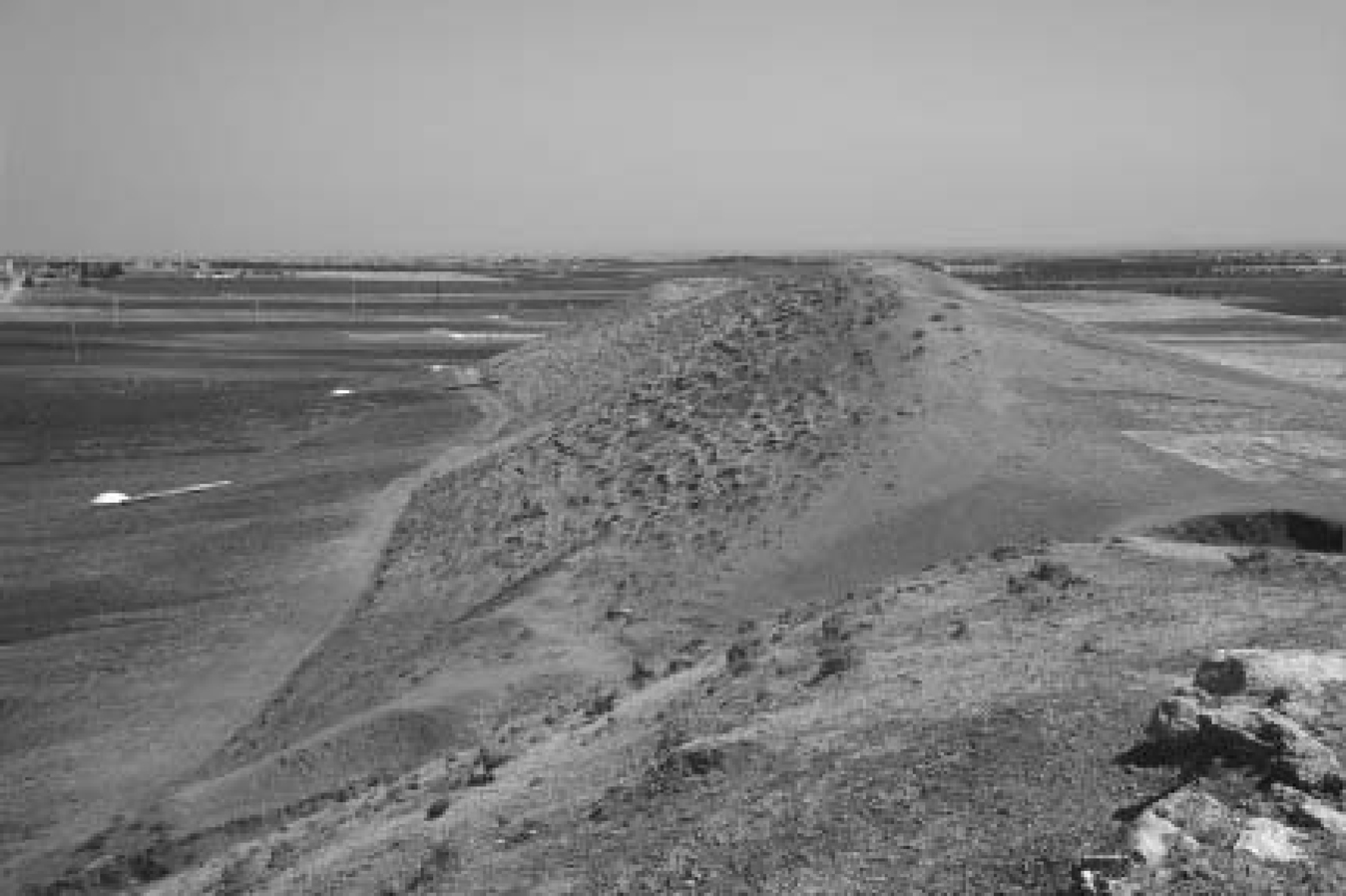 Figure 6 Ramparts of Middle Bronze Age Ebla, Syria {c. 2000–1800}. These earthen ramparts were originally surmounted by mud-brick walls and towers which have collapsed and eroded Source: Photograph by William Hamblin.
Few military details are known of the history of Ebla during this period. Ebla's importance in the early Middle Bronze seems to have declined. It became a vassal of Aleppo in the wake of the imperialism of Shamshi-Adad {1776}, after which it played a minor role in Near Eastern military affairs. We know of an Indilimgur ruling around 1725, and a dynastic marriage of the daughter of the ruler of Ebla with the son of Ammi-taqumma of Alalakh. The city was destroyed in the Hittite invasions of the kingdom of Aleppo by Mursilis in the late seventeenth century (see Chapter Eleven).