
In the eleventh century, the Byzantine Empire faced a new crisis on its eastern frontiers with the emergence of a new and dangerous convert to Islam, the Seljuk Turks. The Seljuks, like the Parthians before them, relied on light cavalry horse archers as their primary weapon system. These Turks proved irresistible on the battlefield, conquering the Muslim states in what had been the north-west corner of the Sassanid Persian Empire and continuing their traditions of raids into and warfare with the Eastern Roman Empire. This conflict between the Byzantine army and Seljuk invaders culminated in one of the most important battles in western civilization, the battle of Manzikert in 1071, the results of which would forever weaken a great empire and become a casus belli for the crusades.
The Byzantines were very familiar with the tactics of steppe light cavalry. With very little or no body armour and carrying only a curved sabre and sometimes a javelin, the Turkish warrior relied on his short composite bow, a quiver of thirty to fifty arrows, and the mobility provided by his horse. His short powerful bow was recurved in shape and constructed in three parts: a thin central stave of wood (often maple, cornus or mulberry) laminated with sinew on the back and horn on the belly. This composite construction gave the Turkish bow a powerful draw weight, while the short recurve design allowed the steppe warrior to shoot the arrow quickly, in any direction and at great distance. Furthermore, his archery skill was assisted by his novel equipment and riding position. Central Asian warriors used a short stirrup or ‘forward seat’, putting the rider’s weight over the horse’s shoulder instead of square on its back. This riding stance was very comfortable over rough terrain and facilitated archery from horseback. Seljuk warriors rode a hardy breed of steppe ponies. These mounts possessed a combination of excellent qualities, including strength, stamina and the ability to subsist on very little food.
Like the Parthians before them, the Seljuk Turks relied on hit-and-run attacks from horseback, striking from a distance with their powerful bows, and seldom mixing with the enemy in hand-to-hand combat. The Turkish horse archers were adept at the tactic of hovering just within bowshot of their enemy, then taking flight when their enemy offered battle, twisting their torsos and firing arrows backward at their pursuers in what is now called the ‘Parthian shot’. If the pursuers seemed vulnerable in any way, the fleeing Turks would suddenly counter-attack, swarming their enemy and killing both men and horses. One Byzantine commentator and chronicler of the First Crusade, Princess Anna Comnena (the daughter of Emperor Alexius I Comnenus), described her father’s respect for Seljuk tactics:
He [Alexius Comnenus] knew from long experience that the Turkish battle-line differs from that of other peoples … but their right and left wings and their center formed separate groups with the ranks cut off, as it were, from one another; whenever an attack was made on right or left, the center leapt into action and all the rest of the army behind, in a whirlwind onslaught that threw into confusion the accepted tradition of battle. As for weapons they use in war, unlike the Kelts [Franks] they do not fight with lances, but completely surround the enemy and shoot him with arrows; they also defend themselves with arrows from a distance. In hot pursuit the Turk makes prisoners by using his bow; in flight he overwhelms his pursuer with the same weapon and when he shoots, the arrow in its course strikes either rider or horse, fired with such a tremendous force that it passes clean through the body. So skilled are the Turkish archers.
The Seljuks excelled in the feigned retreat. Sometimes, their retreats lasted many days, designed both to wear down their enemies and draw them away from their bases and towards a larger body of steppe warriors. Once their enemy tired, the Turks would wheel and strike or spring the trap.
To cope with the mobility and firepower of steppe horse archers, Byzantine doctrine prescribed always keeping light infantry bowmen near the cavalry, never fighting with uncovered flanks or rear, and never permitting an army to disperse. ‘They were like flies that could be beaten off, but not driven away.’ The Byzantines long understood the importance of effective combined-arms co-operation when dealing with enemy light cavalry. But the overall decline of the Byzantine army also affected the quality of Byzantine generalship, leading to the military debacle in Armenia at the battle of Manzikert in 1071.
From the late 1050s, Seljuk nomadic parties were making raids deep into Byzantine Armenia. The Seljuk Turks, who took their name from a successful chieftain (Seljuk, sometimes Saljuk), separated from a larger Turkish tribe known as the Oghuz in what is today modern Kazakhstan and struck south-westward into eastern Persia in the 1040s, converting to Sunni Islam along the way. By 1055 the Seljuks had taken the Abbasid capital at Baghdad, forcing the Muslim caliph to bestow upon the Seljuk sultan, Tughril-bey, the title of ‘king of the East and the West’. The Seljuks now controlled Transoxiana and all of Persia, but continued to press westward where their presence alarmed both the Byzantine Empire, with interests in Armenia, and the powerful Muslim Fatimid dynasty (909–1171) centred in Egypt. The Fatimids, who practised the rival Shia form of Islam, possessed land in the Levant stretching from the Nile delta to Syria. To complicate things for the invading Turks, the Fatimids and Byzantines maintained an uneasy truce, allowing the Greeks to deal with threats in Italy and the Balkans, while the Egyptians became rich controlling the lucrative trade coming into the eastern Mediterranean. This balance of power would change with the arrival of the Turks.
By the late 1060s Seljuk Turks were migrating into Anatolia proper. As they moved past the borders and into Byzantine territory, they forced their sultan, Alp Arslan (Turkish for ‘Lion’), to intervene in the region. This provoked a Byzantine military response. In early 1071 Alp Arslan (r. 1063–1072) set out to consolidate his frontier, attacking several Byzantine towns and capturing the fortress of Manzikert along the way (Map 1.6). The sultan was very familiar with Byzantine tactics, having suffered defeat at the hands of the Eastern Romans three times, and was well aware of their capabilities.
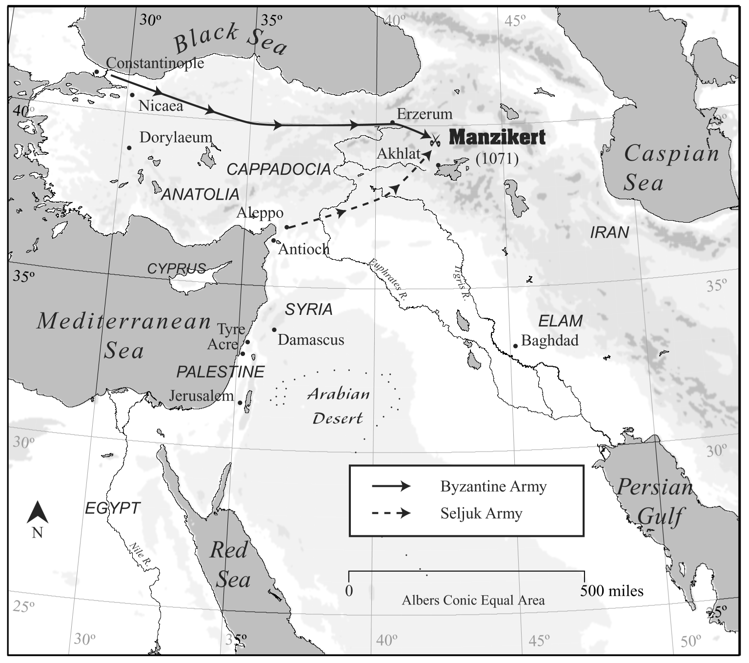
Map 1.6. Approaches to Manzikert, 1071.
The new Byzantine emperor, Romanus IV Diogenes (r. 1068–1071), inherited a difficult strategic position. In the west, the Normans threatened Byzantine possessions in Italy and the Balkans, while in the east, Turkish raiding into Byzantine Armenia and eastern Anatolia forced the emperor to organize punitive expeditions against the marauders. In both 1068 and 1069 Romanus campaigned against the Turks, surprising them at Sebastea (modern Sivas) and clearing them out of the western province of Cappadocia, before being forced to retreat after a defeat near Akhlat, close to Lake Van. In 1070 Romanus was forced to deal with Norman incursions in the west, leaving his nephew, Manuel Comnenus, in charge of his forces in the east. But Manuel was taken prisoner by Alp Arslan’s own brother-in-law, Arisiaghi, who began to hatch a plot with his captive to overthrow the sultan. Manuel convinced Arisiaghi to go to Constantinople, where the duplicitous Turk agreed to an alliance. When Alp Arslan asked for the traitor’s extradition and was refused, the sultan prepared for war.
The Byzantine emperor welcomed the prospect of war. Believing the Turkish sultan to be in Persia in the summer of 1071, Romanus, an able general who had already tasted victory against the Turks earlier in his reign (twice against Arslan), assembled an army of perhaps 30,000 men at Erzerum, some 80 miles from Manzikert in Armenia, with the intention of retaking the city and neighbouring Akhlat and using them as bases of operation for a campaign against Alp Arslan in Persia. Romanus used his infantry to reduce captured cities in the borderlands, while employing his cavalry to search for the sultan’s forces. Arslan learned of the Byzantine emperor’s advance on Armenia as the Turkish army encamped at Aleppo in northern Syria. The sultan immediately turned his army around and headed for the Armenian frontier.
In mid-August 1071 an advance portion of the Seljuk Turkish army met the main Byzantine army and skirmished near Lake Van. The Byzantine emperor retook Manzikert from the Turks, and hearing that the advance guard of Arslan’s army was in the area, dispatched an army of allied Cuman or Russian heavy cavalry to meet them. The Turkish commander, seeing that numbers were now on the side of the Byzantines, withdrew. Whether this withdrawal was a feigned flight will never be known for certain, but the pursuing Byzantines were caught in the signature horse nomad ambush, a sudden counter-attack by light cavalry horse archers that captured the Byzantine commander and forced the remaining Byzantine army to retreat in disarray.
By the time Romanus’ main army arrived on 18 August, the Turkish advance army, in true Seljuk fashion, was nowhere to be found. The main Byzantine army then returned to camp, where during the night the Seljuks, joined now by Alp Arslan’s main army, returned in force, setting up their own camp 3 miles away. Seeing that Romanus possessed the larger army, the following morning the sultan offered a peace embassy to the emperor, who bluntly rejected it. Romanus wanted to settle the Turkish problem with a decisive military victory, understanding that raising another army to meet the Seljuk threat would be both difficult and expensive.
After the failed parley between the two rulers, Romanus advanced against the Seljuk Turks at midday on 19 August with his armoured and mounted army arrayed in a single line on a broad front, backed by a strong rearguard (Map 1.7(a)). The front line consisted of heavy cavalry from the various themes, with Romanus himself commanding from the centre. The second line consisted of foreign mercenary cavalry from Germany, Normans from Italy, and troops from eastern frontiers. The second line was commanded by Andronicus Ducas, a relation of Romanus’ predecessor, Constantine X Ducas (r. 1059–1067). The Byzantine army was without any significant light infantry because Romanus committed this arm to a siege elsewhere. The absence of archers to support his cavalry units violated the central canon of warfare against steppe light cavalry.
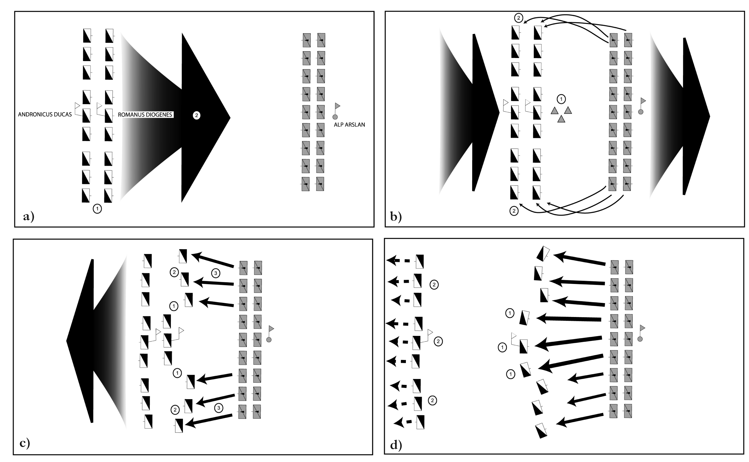
Map 1.7. The Battle of Manzikert, 1071. (a) Phase I: Romanus forms his army in two lines, the first under his personal control and the second under Andronicus Ducas (1). He orders his heavy cavalry force forward against the Seljuk horse archers to his front (2). (b) Phase II: The pursuit continues for several hours, sweeping through and continuing beyond the abandoned Seljuk camp (1). Alp Arslan’s mounted bowmen easily keep the heavier Byzantine horsemen at a distance while continuously harassing Romanus’ flanks (2). (c) Phase III: His army tiring and nightfall approaching, Romanus orders his army to break off the pursuit and return to camp; however, the order is late in reaching the wings, which continue to advance, separating them from the rest of the army (1). When they finally receive the order and begin to pull back, their formations are loose and gaps are apparent in their lines (2). The Turks quickly seize this opportunity and intensify their attacks (3). (d) Phase IV: Recognizing the precarious position of his wings, Romanus orders his army to face about and attack the enemy. The units under his immediate command obey (1), but the emperor is betrayed by Andronicus, who spreads a rumour that Romanus has been killed. The traitor leads the second line back to camp (2), abandoning his erstwhile comrades to their fate.
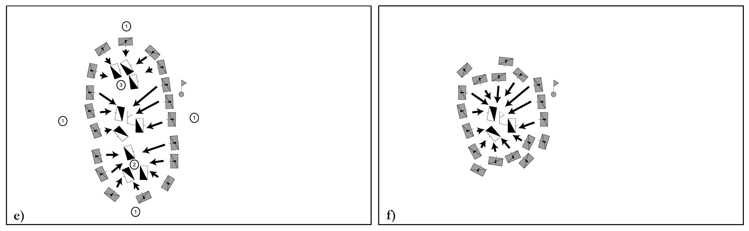
(e) Phase V: Alp Arslan takes advantage of the sudden departure of half of his opponent’s forces and the approach of nightfall to surround the Byzantines (1). The right wing falls first, attempting to face two sides at once (2). The left wing, separated from Romanus and the units from the Byzantine centre, fights courageously, but finally breaks under the hail of arrows arcing out of the deepening gloom (3). (f) Phase VI: The Turks press closer, encircling the remnants of the Byzantine centre. Romanus, surrounded by his Varangian Guard, is overpowered and captured. The survivors fleeing the field are pursued through the night, and by dawn the professional core of the Byzantine army has been destroyed.
In the face of the Byzantine heavy cavalry advance, the Turkish centre retreated, easily keeping their distance on their lightly burdened mounts. On the wings, the Turks attacked the Byzantine flanks, showering the Greek cavalry with arrows. Although Turkish missiles probably did not kill many of the armoured riders, the horses did suffer and many riders lost their mounts. Moreover, Byzantine cataphracts no longer possessed the skill of mounted archery present in earlier centuries, and proved no match for the more experienced Turkish light cavalry horse archers.
The Byzantine advance went on for several hours, overrunning the abandoned Seljuk camp (Map 1.7(b)). But as evening approached, Romanus commanded his tired army to turn around and return to camp. The Byzantine centre obeyed, but the wings did not receive the order in time, and when they did, failed to keep a tight formation. With breaks appearing in the line, the Turkish horse archers pressed their attack (Map 1.7(c)). Romanus countered by ordering the first line to turn around again and threaten the harassing bowmen. But the second line, commanded by Ducas, refused to stop and face the enemy as ordered. After spreading a rumour that Romanus had been killed, Ducas led the second line back to camp, abandoning the emperor and half the Byzantine army to its fate (Map 1.7(d)).
As darkness fell on the battlefield, the Seljuk Turks took full advantage of the reserve’s disappearance to surround those who remained. Enveloped by the Seljuk horse archers, Romanus’ right wing tried to face both ways, but disintegrated under a hail of arrows. The left wing, now isolated from the centre, fought bravely, but finally broke (Map 1.7(e)). The Turks then concentrated on the centre. Here, Romanus, surrounded by his Varangian Guard, was finally overpowered and captured (Map 1.7(f)). The remaining Byzantine units fled the battlefield, followed by a close and bloody pursuit that continued throughout the night. By dawn, the Turks had destroyed the flower of the Byzantine professional army.
Although the Byzantine defeat can be attributed in large part to the political infighting of the Byzantine nobility, one major factor was Romanus’ frantic attempt at engaging the Turks in a pitched battle. The Turks continued to retreat and pull back in the face of the numerically superior Byzantines until they became spread out and unorganized. This thinning of the Byzantine formations allowed the Turks to successfully envelop Romanus’ army.
The battle of Manzikert demonstrated what the Byzantines had long known, that heavy cavalry could not cope with light cavalry without light infantry support. Although light cavalry did not have a great margin of superiority in mobility, its modest advantage enabled it to refuse battle while still employing its bows against the slower heavy cavalry. Just as Greek light infantry peltasts avoided shock combat with heavy infantry hoplites while wounding and killing them with missiles, so the Turkish horse archers had defeated Byzantine heavy cavalry. When Romanus offered battle against the Turks without light infantry support, he was ignoring 500 years of Byzantine doctrine, and sending his army to its destruction. The defeat at Manzikert marked the end of the traditional Byzantine army, an army already in serious decline. With the destruction of Romanus’ first line came the destruction of the tagmata regiments and eastern themae, forcing later emperors to rely even more on mercenaries to supplement their manpower needs.
The sultan later released Romanus for a healthy ransom to be paid over fifty years and a treaty ceding the border region from Antioch in Syria to Manzikert. But the emperor’s enemies seized power in Constantinople in his absence. Romanus was captured and blinded in the ensuing civil war, his wounds mortal. The new Byzantine emperor, Constantine X’s son Michael VII, proved unable to stem the massive migration of Seljuk Turks into Anatolia – the traditional conscription lands for the Byzantine army. Anatolia would be lost forever to the Greeks. The Eastern Roman Empire, now practically defenceless, feared for its very existence. Desperate times called for desperate measures, and in 1095 Emperor Alexius I Comnenus (r. 1081–1118) appealed to Urban II (pope 1088–1099) for western assistance. This appeal led directly to the formation of the First Crusade in 1095.
In the wake of losing nearly half the Byzantine army at Manzikert, the Seljuk Turks seized much of Anatolia and the Levant, including the cities of Antioch, Damascus and Jerusalem. Alp Arslan was killed in 1072 while campaigning in Transoxiana. He was succeeded by his seventeen-year-old son Malikshah, a capable leader who ruled for twenty years. Malikshah finished what his father had begun, pressing deeper into Anatolia, destroying cities and ethnically cleansing or enslaving hundreds of thousands of Byzantine citizens. Despite these advances, the Seljuk Empire was already in decline. After Malikshah’s death in 1092, Seljuk nobles fought among themselves. It was this fragmentation that allowed the Roman Catholic crusaders to establish themselves in the Levant.
The Byzantine army, deprived of the territory from which it drew much of its manpower and horses for its cavalry, continued its decline. Though Byzantine appeals in the late eleventh century to the west for military assistance helped initiate the crusades, even these allies turned against the Eastern Roman Empire’s long-term interests. In 1204 the Venetians, backed by a crusader army, conquered Constantinople, installing their own candidate on the throne. The result of the Fourth Crusade was the Latin kingdom of Constantinople that stretched from Greece to Asia Minor. Even when Byzantine rule was re-established in 1261, the empire remained weak for another two centuries until the Ottoman Turks finally captured Constantinople in 1453, ending a thousand years of Byzantine civilization.