
On July 17, only two weeks before the Warsaw Uprising was to break out; Warsaw was still a long way behind the Eastern front, which was some 200 kilometres distant. The Polish capital city lay to the rear of the German 2nd Army under the command of General Walther Wieß. At that point in time, troops from this Army began to leave southwest Belorussia flanked to the north by enemy forces under the command of General Rokossovskij. Directly east of General Weiß’s forces, General Pavel Bjelov’s 61st Army began to exert pressure while the following three armies drew forward in the general direction of Hajnówka: General Romanjenko’s 48th Army, General Batov’s 65th Army, and General Lutjinskij’s 28th Army, along with two tank corps, a mechanised corps and a cavalry corps (the 1st Tank Guards Corps, 9th Tank Corps, 1st Mechanised Corps, and the 4th Cavalry Guards Corp). The Germans tried to set up a new defensive position along the Grodno – Hajnówka – Brest line, but on July 17, the opposition wrecked this plan by attacking and breaking through the front in the area around the Białowieża forest. The German command, which already controlled the situation between Kaunas and Brest, had planned to nullify this breach by initiating a number of counterattacks, but the offensive that was launched on the following day from the 1st Belorussian Front’s left flank, totally laid waste to these plans.
It might appear that Marshal Rokossovskij during the fighting up to this point had already made use of the greater part of his combat strength. But in actuality, this was the first time the Soviet forces had set all their reserves into action. The make up of the 1st Belorussian Front’s left flank, which was located along the Prypeć – marsh area – Kovel line, included General Vasil Popov’s 70th Army, General Nikolaj Gusiev’s 47th Army, General Vasil Tjujkov’s 8th Army Guard, Genral Siemjon Bogdanov’s 2nd Tank Army, General Zygmunt Berling’s, 1st Polish Army, General Jusjtjuk’s 11 th Tank Corps, General Krjukov’s 2nd Cavalry Guards Corps and General Konstantinov’s 7th Cavalry Guards Corps. All told, these forces mounted to a total of some 416,000 soldiers, 8,355 artillery pieces, mortar and rocket launching ramps, and 1,748 armoured vehicles, (of which 665 were tanks, and 145 tracked artillery vehicles from the 2nd Tank Army). The offensive was supported from the air by 1,465 combat planes from General Fjodor Polunin’s 6th Air Army.
On July 18, the Soviet Marshal launched the attack south of Brest with the 8th Army Guard and the 47th and 69th Armies. The assault was aimed at the VIII Army-Corps’ sector within the 4th Panzer-Army. This corps was composed only of three divisions, one of which was a Hungarian reserve division. As a result, the troops of the VIII Army-Corps were quickly cut down. By July 20, the attackers had already seized two tactical bridge positions along the Bug and had soon dispatched the 11th Tank Corps and 2nd Cavalry Guards Corps to these locations; In addition, during the course of the attack, the 69th Army had defeated the LVI Panzer-Corps of the 4th Panzer-Army (the 26th, 253rd. and 342nd Infantry Divisions and the 1st Schijäger-Division). Here, the Soviets also met with success in driving their weakened enemy back across the river. At that very moment, the entire German front with the 4th Panzer-Army began to collapse, since the 1st Ukrainian Front, whose offensive had been underway for five days, was now able to link up with the 4th Belorussian Army’s left flank which, in turn, had now also begun to be active. At the same time, which is to say, on July 20, an assassination attempt was made on Hitler which led to a state of complete chaos within the German High Command.
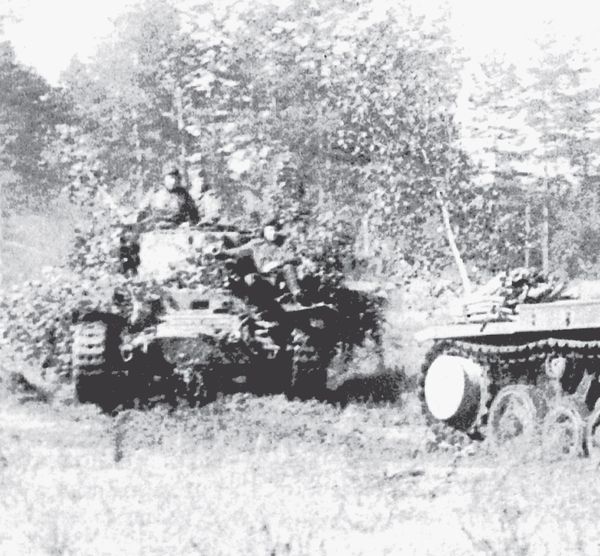
”Valentine” tanks, model Mk IX, from the 5th Tank Army in Belorussia, July 1944. (RGAKFD)
In the situation that now prevailed, the 2nd Army was the only German combat force with any room to manoeuvre. It had been able to retain much of its combat strength. When the Soviet forces, now in the forests surrounding Lublin, began their attack operations, so too began the 4th Panzer-Division, under the 2nd Army, and the 5th SS-Panzer-division “Wiking” supported by the 102nd Infantry-Division and the 541st Grenadier-Division, to launch intensive counter-attacks outside Czermecha.
But this concentration of strength north of Brest actually suited the commander of the 1st Belorussian Front perfectly, because his command’s main assault forces were just then crossing the Bug River between Włoda and Chełm. Marshal Rokossovskij’s plan, after broadening the bridge emplacements, was to bring the 2nd Tank Army into the fighting and order it to attack in the direction of Siedlce. In this way, his front’s left flank, with two corps from the 4th Panzer Army having been beaten down, could strike against the rear units of the 2nd Army. Then, after the planned consolidation of the attacking armies from the right flank outside Hajnówka, a large portion of General Weiß’s army would then be encircled outside Brest. Wholly unexpected, on July 21, Stalin ordered that General Bogdanovitj’s tanks were not to roll on towards Siedlce, as per east of Warsaw. the elegant plan that had been drawn up before the summer offensive, but instead, towards Lublin. The dictator wanted, as quickly as possible, to control the largest city on ethnically Polish territory, since it was there he had thought to create the marionette-like Polish Committee for National Independence (PKWN). STAVKA therefore issued an order to Rokossovskij to capture Lublin no later than July 27, as “the political situation and the democratic independent interests of Poland acutely required this.” Given such an order, behind which was hidden a power struggle between the communists and the Polish “London-government,” the commander of the 1st Belorussian Front didn’t dare to polemise. The road to Siedlce was instead cut off by General Krjukov’s newly organised rapid-response forces (the 11th Tank Corps and the 2nd Cavalry Guard Corps). This, of course, meant a weakening of the attack against the 2nd Army.
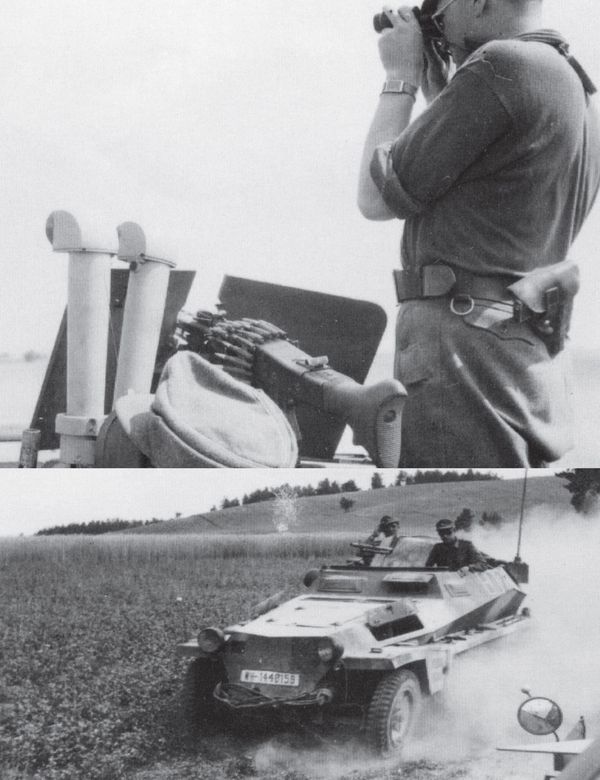
Two soldiers from the 4th Panzer-Division’s armoured reconnaissance units observe the enemy from an appropriate distance. The vehicle they are operating from is either an Sd Kfz 250 or a 251, the man on the right is using an artillery observation scope. The picture is taken in July 1944, from an area east of Warsaw
On July 22, the most vital Soviet forces had crossed the Bug and begun aggressive operations within the defence zone of the 4th Panzer Army. In the situation that now prevailed, the Germans were not capable of creating a new frontline down in the province of Lublin, not least because large contingents of the Polish Home Army had begun to swing into action against the German rear-guard. That same day, two units from the 2nd Tank Army, together with the 7th Cavalry Guards Corps, seized the town of Chełm, which led Moscow-Radio to announce that the PKWN had now been established in the city. In reality, the committee had been established two days earlier, in Moscow. Now Stalin was able to inform the Western powers that at last he had a partner with whom he could discuss Poland’s future. On July 23, he confirmed in a dispatch to Churchill:
An Sd Kfz 250/3 from Aufklärungs-Abteilung 4 advancing toward the enemy. The picture is taken in July 1944,
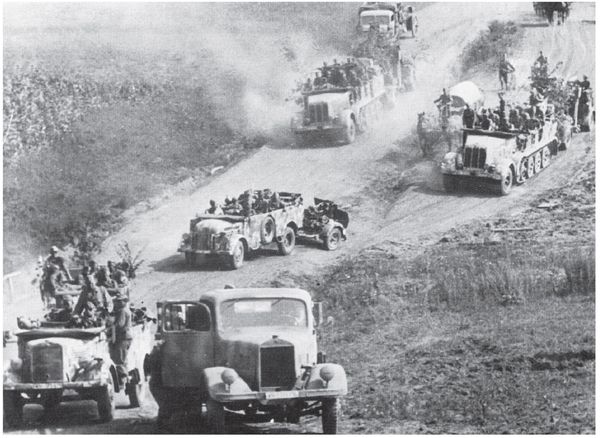
Elements of SS-Flak-Abteilung 3 on the march. One can see two 88s with tow-vehicles, a 2cm Flak 30 with a tow vehicle as well as several other vehicles in Eastern Poland, in July 1944. (All pictures: Leandoer & Ekholm archive).
“The PKWN intend to build up their administration on Polish territory and I hope that this will succeed. We have not found any other forces in Poland capable of putting a Polish administration on its feet. The so-called underground organisations which are controlled by the Polish Government in London have been shown to be short- lived entities, wholly lacking in influence.”
At the very moment the British Prime Minister was reading these words, Polish Home-Army units, along with the 2nd Tank Army’s frontline troops, commenced the storming of Lublin. The battle for the city began in the morning of July 23 and was already decided only two days later, on July 25, as a complete success for the attacking troops. And despite the establishment of a provincial delegation in Lublin for the Polish government, this seemingly legal government administration could not survive within the PKWN ‘s sphere of power. On July 26, this political body undersigned an agreement with representatives of the Soviet Army where it was stipulated that: “all decision-making powers and complete responsibility for all questions related to the prosecution of the war within Polish territory where armed conflict is taking place as a result of the invasion of Soviet troops […] shall reside with the Soviet Forces’ highest commander.” The same pattern of events soon unfolded in Lublin province as had taken place in Volynien and in the Vilnius area. Partisan units were cleverly disarmed by the NKVD (the forerunner of the KGB) or were forced at gun point to lay down their weapons. Officers and political delegates were arrested, while non-commissioned officers and common soldiers in the Home Army were incorporated into General Berling’s army. Some of the representatives of this underground government went back to their secret operations.
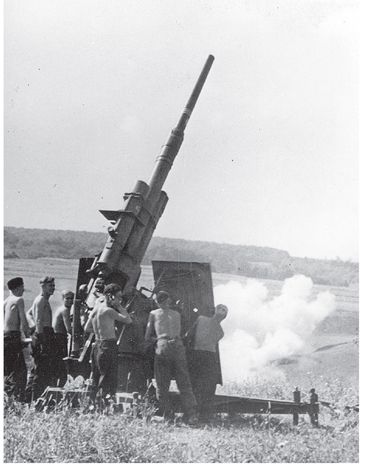
An anti-aircraft gun, model 8.8cm Flak 41, in a firing position in the Warsaw region, July 1944. (CAW)
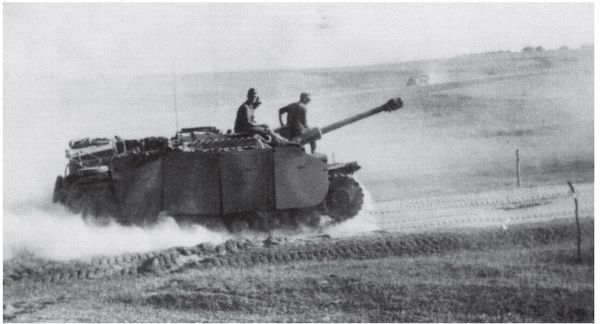
A StuG 40 Sd Kfz 142/1 ausf G advancing toward the Soviets! The vehicle hails from Sturmgeschütz-Brigade 904, during July of 1944 in eastern Poland. (Leandoer & Ekholm archive)
At the same time, events at the front became increasingly intense. The 2nd Tank Army had reached Lublin even sooner than the headquarters’ directive had planned. But during the fighting outside of Bystrzyca on the night spanning July 23-24, General Bogdanov was seriously wounded. His command was taken over by the tank army’s chief of staff, General Aleksiej Radzjijevskij. On July 24, the 1st Belorussia Front’s left flank, together with 3rd Guards Army from the 1st Ukrainian Front, crushed the German 4th Panzer-Army. The defeated divisions from the VIII Army-Corps retreated in chaos to the outskirts of Biała Podlaska to the rearguard area of the 2nd Army. The decimated LVI Panzer-Corps, on the other hand, escaped by fleeing across the Wisła opposite Lublin. In this way, a 70 kilometre wide gap was opened up in the German lines between Puławay and Łuków. This gap was filled by the 2nd Tank Army, the 8th Guards Army, the 47th Army and the 7th Cavalry Guards Corps. When Radzjijevskij took over command, there were no enemy forces worthy of mention standing between his armoured corps and Warsaw.
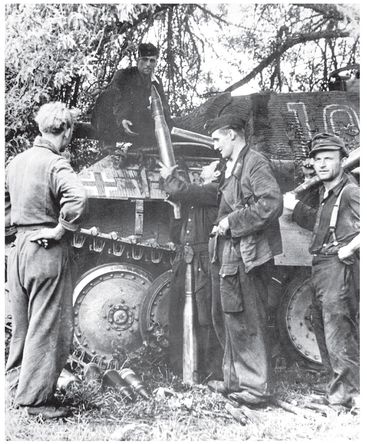
A crew loading ammunition onto a PzKpfw V Sd Kfz 171 “Panther” tank, Eastern Front, July 1944. (CAW)
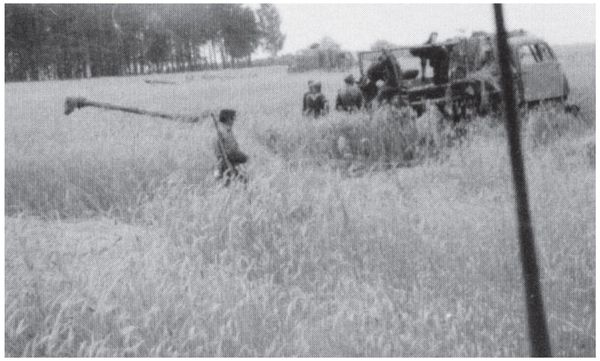
An RSO with a 7.5 cm Pak 40 on a trailer parked in a corn field, July 1944. Behind it, three other units can be seen. All three hail from Panzer-jäger- Abteilung 49/4th Panzer-Division. (Leandoer & Ekholm Archive)
However, the situation outside of Siedlce was more complicated. On July 24, General Krjukov’s rapid response forces approached the city. Seizing Siedlce and cutting off the road between Warsaw and Brest was a vital component of the plan to encircle the German 2nd Army. The defeated VI11 Army-Corps’ retreat in an easterly direction towards Biała Podlaska, suited Soviet plans “hand in glove.” Soon, however, the 11 th Tank Corps’ frontline troops were subjected to heavy attack from the Luftwaffe. Aircraft from the German 6th Luftflotte carried out concentrated carpet and dive-bombing attacks on the stretched-out mechanised columns. General Weiß made the decision to try and hold Siedlce at any price. He gave the order to call in the 3rd SS-Panzer-Division “Totenkopf ” and the 5th SS-Panzer-Division “Wiking,” which until then had been fighting north of Brest, in preparation for the battle. Transporting the whole of both divisions at such short notice was an impossibility (as late as July 17 the forces of the 3rd SS-Panzer-Division “Totenkopf” had been defending the isolated Grodno area), and therefore an improvised Kamfgruppe was sent south. The 5th SS-Panzer-division “Wiking” – for example – was split up with support from the grenadier regiment. And while Kamfgruppe “Westland” (SS-Panzer-Regiment 10 “Westland”, the 1st Battalion from SS-Panzer-Regiment 5 and elements of the SS-Panzer-Artillery-Regiment 5) remained at the north front in the vicinity of the Bug River, other units began to slowly wend their way south. Holding the overland road toward Siedlce was a key concern for the 2nd Army’s right flank, because on July 22 the Soviet 65th and 28th Armies had reached the Bug River close by Siemiatycze. This meant that now the defenders of Brest – the XX Army-Corps and the VIII Arm-Corps, who had also been transported there – could only retreat to the west through Siedlce and the nearby Sokołow Podlaski.
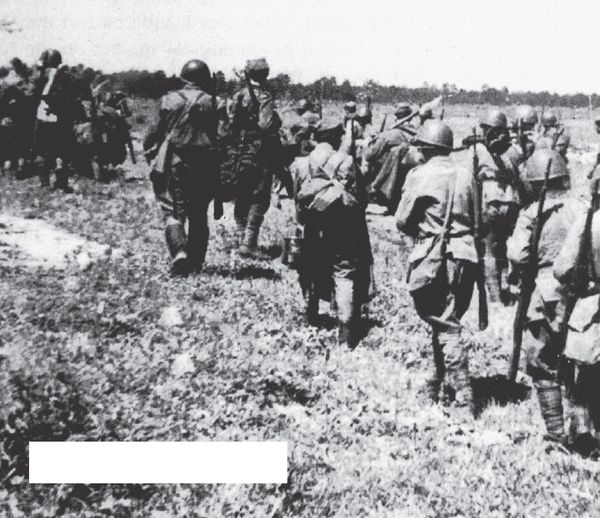
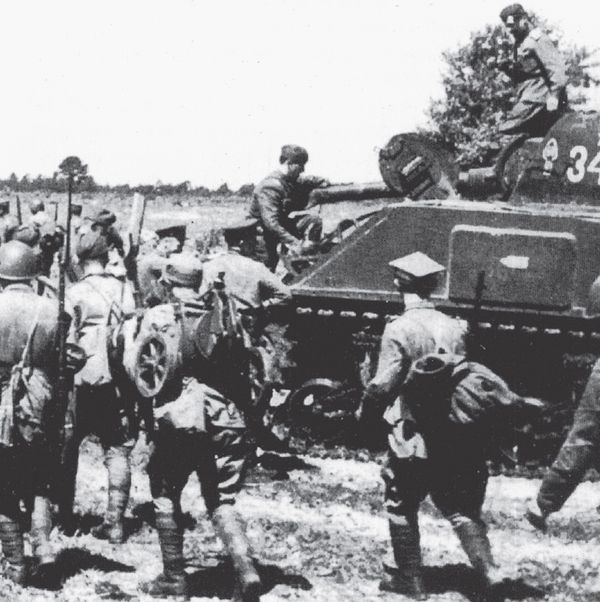
Soviet tanks of model M4A2 “Sherman” probably from the 8th Tank Guards Corps, along with a Polish infantry column, July 1944.” (RGAKFD)
Now that troops from Heeresgruppe “Mitte” and those from “Nord Ukraine” had been isolated from one another, OKH made the decision to redraw the operational boundaries for the armies fighting at the front. The 4th Panzer-Army received orders to hold the line along the Wisła south of Radom, while operational responsibility for the terrain north of this town fell on the shoulders of Heeresgruppe “Mitte.” In this way the VIII Army-Corps came to be incorporated into the 2nd Army. However, this army did not have sufficient troops to man the Warsaw defence line. The army command, with a great deal of difficulty, managed to organise the defence of Siedlce with its rearguard troops, but any chance of sending troops 70 km west towards Warsaw was out of the question! For this reason OKH handed over responsibility for the defence of the Wisła River’s central portion and of Warsaw to the reorganized 9th Army. General Nicolaus von Vormann, who had command of this army, received orders to hold the front from Pulawy to Minsk Mazowiecki, where his left flank would establish contact with General Weiß’s forces.
General von Vormann was an experienced commander, but it seemed that the mission he had been handed was impossible to carry out. On July 25, when he reported to Heeresgruppe “Mitte” that his staff had taken up their duties, there was not a single German division between Puławy and Siedlce. The road to Warsaw, as with the frontline along the Wisła north of Dęblin, was not manned by even a single German soldier. To plug this enormous gap, OKH earmarked the 9th Army Parachute-Panzer-Division “Hermann Göring” which was still on route via rail from Italy, plus the 17th and the 73rd Infantry-Divisions as well as the 174th Ersatz-Division. The Ersatz-Division had, up to this point, been engaged with carrying out missions in the occupied General-government, so that it could, in principle, be directly sent into battle between Dęblin and Puławy. Immediately following which, it could then be supported by the 17th Infantry-Division. Meanwhile, the 73rd Infantry-Division together with Parachute-Panzer-Division “Herman Göring” were despatched to Warsaw’s outskirts. The 60 kilometres that separated these two forces stood, for all practical purposes, completely undefended.
The following four pictures show Panther tanks from the 1 st Panzer-Regiment 35, 4th Panzer-Division, July 1944 east of Warsaw in the war zone.
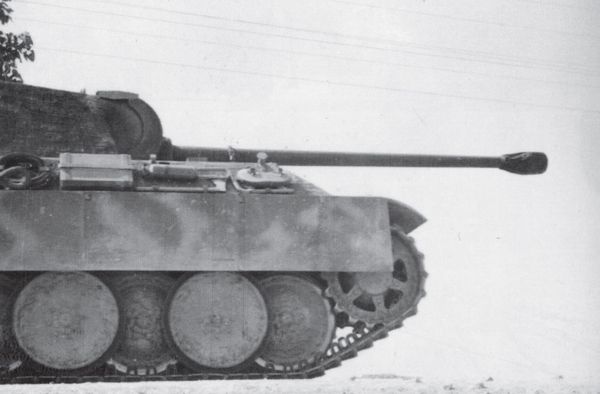
A Panther from a ground perspective.
A Panther climbing over a ditch.
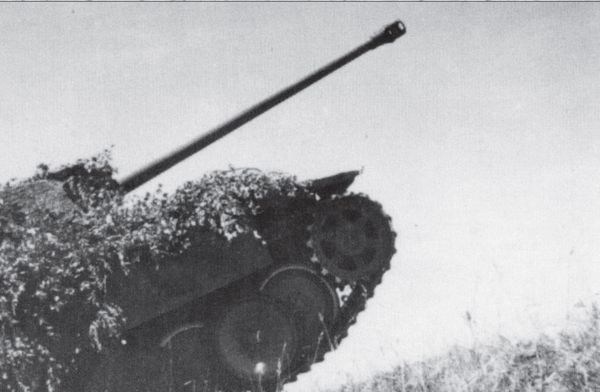
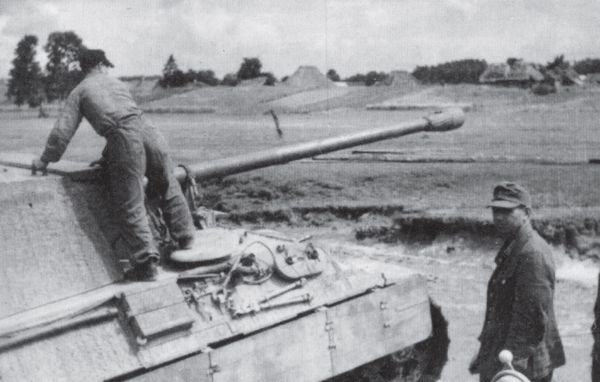
A Panther wades across a waterway.
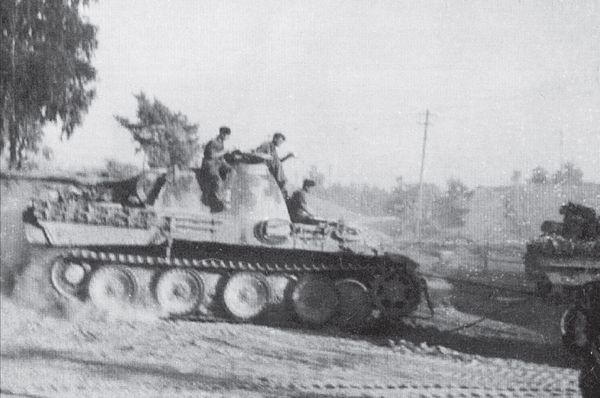
A Panther behind the frontline, note the reversed turret. (All pictures Leandoer & Ekholm Archive)
On July 25, the 2nd Tank Army’s frontline troops reached the Wisła having taken Dęblin and Puławy. An attempt to cross the river failed due to the determined resistance of the 174th Ersatz-Division. While awaiting the arrival of larger infantry units, General Radzjijevskij had held a part of the 16th Armoured Corps there, but gave the 3rd Armoured Corps and the 8th Armoured Guards Corps the mission of continuing attacks along the Wisła in a northerly direction. On July 26, Soviet tanks set off at speed towards Garwolin. Following with them was the 8th Army’s Infantry Guards Corps. This was the 1st Polish Army – renamed on July 27, the 1st Polish Volunteer Army – which had the mission of manning the frontline outside Dęblin.
At the same time that the two armoured corps from 2nd Tank Army pressed on, without pause, towards Garwolin, the battle for Brest in the east was being decided. The Germans, making use of components out of the 102nd Infantry-Division and the 3rd SS-Panzer-Division “Totenkopf,” succeeded in manning Siedlce in time and General Krjukov’s rapid response force’s first attack on the city on July 24 was thrown back in bloody fighting. In short, the 11th Tank Corps and the 2nd Cavalry Brigade Corps got tied down in intense fighting and were not able to defeat the enemy by themselves, who had rather unexpectedly and in significant force made use of air attacks. As a result, the attackers were forced to await the arrival of the 47th Army. General Weiß had been successful in holding on to Siedlce, but the situation outside Brest by the Bug River had become critical. With the Soviet 28th Army having reached the Bug River near Siemiatycze, the city’s garrison – the XX and the VIII Army Corps – was now under threat of encirclement. Sometime on or about July 23, the commander of the 2nd Army ordered both corps to leave the city, and in all haste make towards Siedlce and Sokołów (at this time, the VIII Army-Corps was about to be split up: both units were actually already under the command of the XX Army-Corps’ staff). A consequence of this sizable German retreat towards the west was that it worked to enhance the German troop strength protecting the Siedlce road. Brest itself was defended by the weakened Tactical Group “E” under the command of General Felzmann. This group had been built up from the bones of 203rd Sicherungs-Division.
A battery of tracked vehicle howitzers 15 cm sIG 33/1 auf Fgst PzKpfw 38 (t) Ausf. H “Grille” from Panzer-Grenadier-Regiment 12, 4th Panzer-Division, Eastern Front 1944. (MWP)
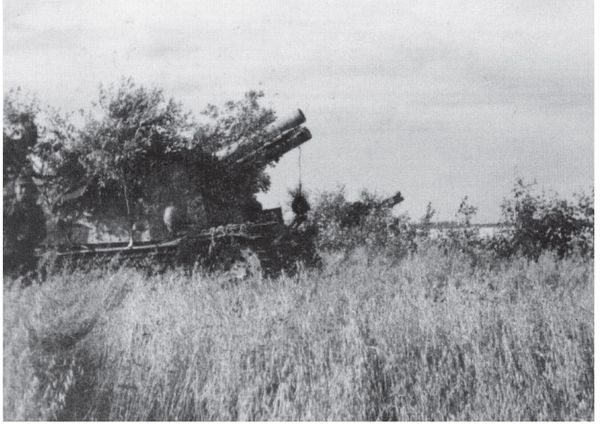
The Commandant for the installation was General Scheller.
On July 25, immediately following the XX Army-Corps’ retreat, the 20th Rifle Corps, from the 28th Army under General Sjvarjev, attacked Brest from the north, while the 9th Rifle Guards Corps under General Khaluzin from the 61st Army attacked from the east, and the 114th Rifle Corps under General Rjabysjev from the 70th Army attacked from the south. Prior to July 27, the German defenders of the city were surrounded and cut off from the rest of the 2nd Army. During the night of July 27, General Felzmann gave the order to breakthrough towards the west. As a result, the Soviet units on the following morning were able occupy the abandoned city of Brest and, at the same time, encircle the fleeing Tactical Unit “E’” yet again, about ten kilometres east of Janów Podlaski. Given the prospect of General Felzmann’s entire force being annihilated, a rescue operation was carried out and an improvised Kampfgruppe from the 102nd Infantry-Division was sent in, strengthened by a number of companies from the 5th SS-Panzer-Division “Wiking.” Despite this, the Germans came to suffer considerable losses during the retreat and lose nearly all of their heavy battlefield equipment. General Scheller, among others, was captured.
A Soviet M4A2 “Sherman” from the 8th Tank Guards Corps, in Lublin, July 1944. (RGAKFD)
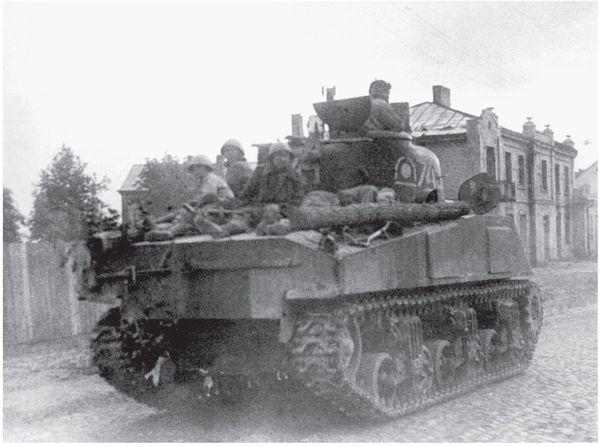
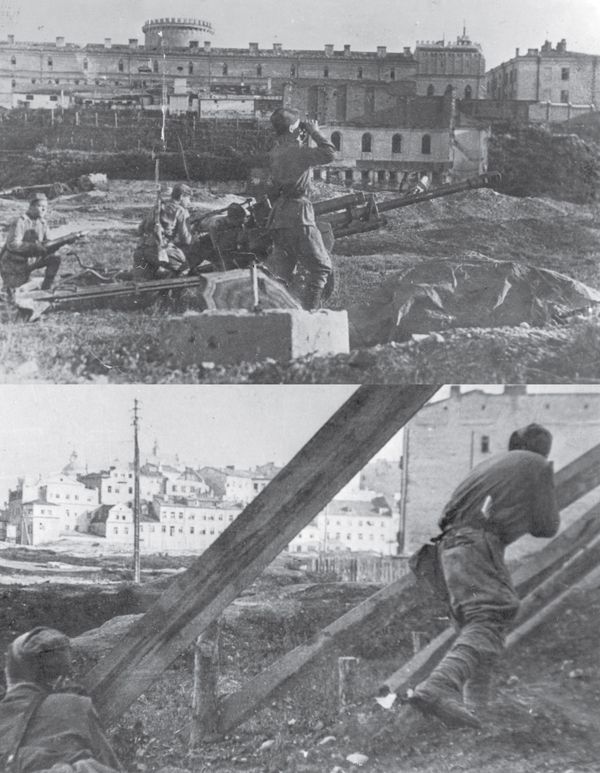
An artillery gun, model ZiS-3, and Soviet infantry during fighting in Lublin, July 1944. (WAF)
At the same time, on July 28, after the battle for Brest had ebbed out and while intensive fighting for Siedlce raged on; STAVKA issued new orders to Marshal Rokossowski. Order nr. 220162 read as follows:
“After the seizure of Brest and Siedlce the attacks on the front’s right flank are to be expanded in the direction of Warsaw and the mission is to, no later than the 5th – 8th of August, seize Praga and occupy the bridge emplacement on the Narew’s western bank in the area around Pułtusk and Serock.
On the front’s left flank, the bridge emplacement on the Wisła’s western bank is to be seized in the area around Dęblin-Zwoleń-Solec. The seized bridge emplacements shall be used for attacking in a north-westerly direction and thereby neutralise the enemy’s resistance along the Narew and Wisła and thus guarantee the successful crossing of the Narew by the 2nd Belorussian Front’s left flank and likewise over the Wisla by those armies which are concentrated at the front’s central section. Thereafter, attacks shall be planned in the direction of Torún and Łódź.”
Given the situation which had arisen at the front during the last days of July, this was not an especially precise and/or logical order. Rokossovskij wanted to annihilate the 2nd Army sooner, namely, east of the Wisła’s central area, and the order to attack Warsaw with the right flank (the 28th Army) and, at the same time, seize the bridge emplacements along the Narew (the 48th and 65th Armies) sapped his enthusiasm. But as though this were not enough, in a couple of additional coded telegrams from Headquarters, he was ordered to withdraw from the front, and to send the 61st and 62nd Armies north. The headquarter staff of the 1st Belorussian Front sharply objected, not only to the suggested direction the attack would be launched in, but also from the perspective of having just these two particular Armies designated to carry out this order. Marshal Rokossovskij’s reasoning held that if two entire infantry armies were taken from him, his front would be dangerously weakened. In addition, the 2nd Tank Army’s left flank could not cross over the Wicca south of Warsaw as there was a shortage of transport possibilities for the tanks.
Tanks of model PzKpfw V “Panther” from SS-Panzer-Regiment 5 “Wiking”; a transport vehicle Sd Kfz 251 and a Schwimmwagen (amphibious vehicle) from SS-Panzergrenadier-Regiment 9 “Germania”, July 1944.
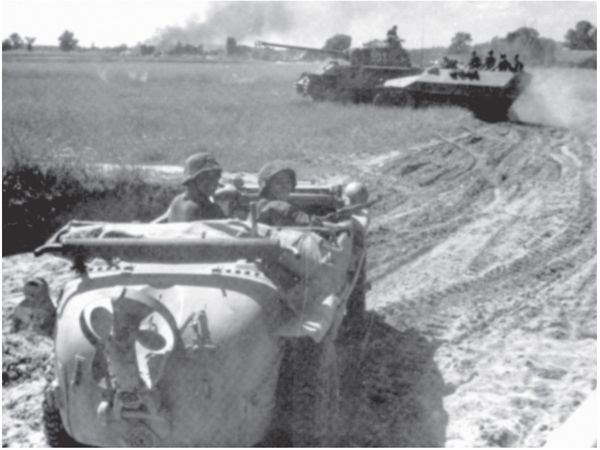
In this situation, Marshal Zjukov, who was responsible for co-ordinating operations between the 1st Belorussian Front and the 1st Ukrainian Front, carried out a number of medium-scale changes in the original order while still retaining its main intent. Firstly, the 70th Army would remain under the existing command structure. To the north, with respect to the planned new offensive against Latvia, only the 61st Army was sent. Secondly, the 2nd Tank Army was to continue on towards Warsaw, particularly looking to send its armoured corps against the rearguard of the German 2nd Army. On having reached the join of the Bug and Narew rivers, they would then operate as the western jaw of a pincer movement. Praga would be stormed, providing it was clear that the enemy’s defences were sufficiently weak. If the Germans managed to reinforce that part of the capital city with a larger numbers of troops, Radzjijevskij should await infantry reinforcements from the 47th Army. The most vital import of the directive from July 28 thus remained unchanged. The primary mission of the 1st Belorussian Front was to seize the two operational bridges north and south of Poland’s capital. It was exactly from this location that the coming offensives should be launched; offensives that would ultimately destroy the German defence along the Wisła and Narew rivers.
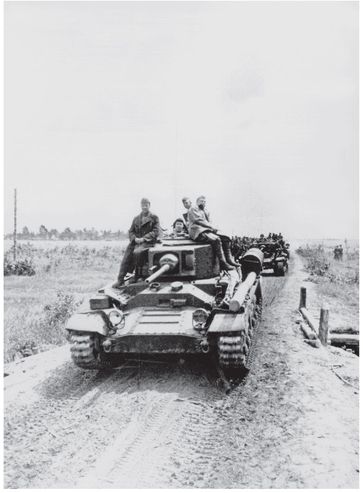
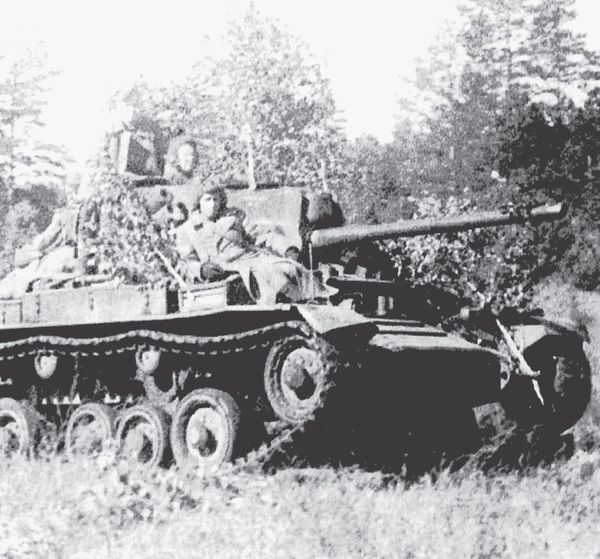
The “Valentine” Mk IX from the 2nd Tank Army in Poland, July 1944. (RGAKFD)
The picture depicts an Sd Kfz 250/1 Neu from Aufklärungs.Abteilung 4. 4th Panzer-Division, on the move east of Warsaw in July 1944. (Leandoer & Ekholm Archive)
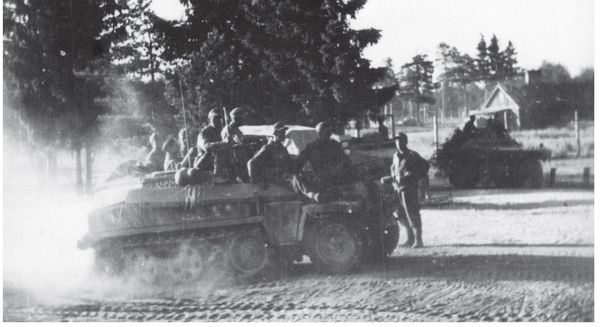
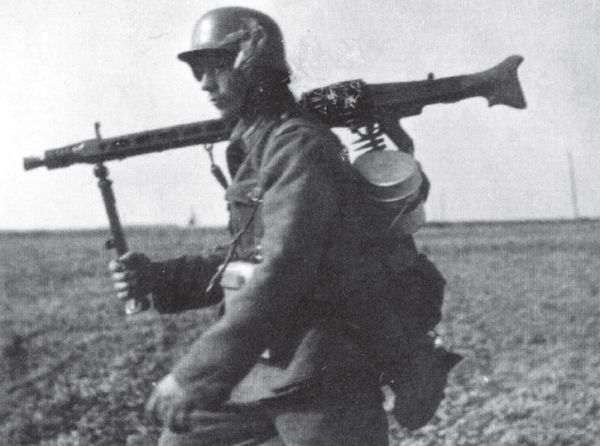
An excellent picture of a MG42 weighing approximately 12kgs. A burdensome weight if one was forced to bear it for a whole day! (Leandoer & Ekholm Archive)
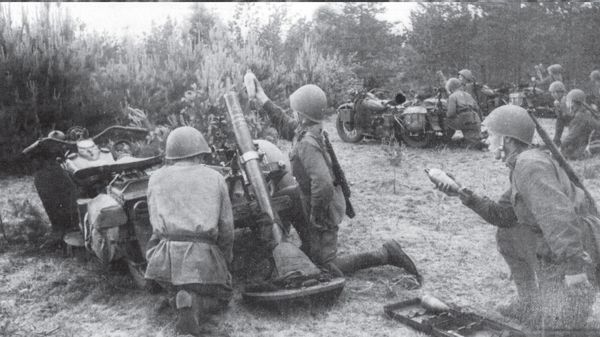
A Soviet mortar of calibre 8.2 cm which was transported on a motor cycle, July 1944 somewhere in eastern Poland. (Leandoer & Ekholm Archive)
Zjukov knew that the Soviet summer offensive along the central sector of the eastern front would soon have to be slowed down. This was quite simply a requirement for implementing the masterly plan to launch the assault on not one, but rather several fronts, along with the incredible losses sustained in the fighting thus far. By the end of July, the Germans had already strengthened their positions in western Lithuania and across the Podlaski lowlands, and no reinforcements had subsequently arrived in the Baltic republics. Stalin demanded results on the front’s flanks – but, for the moment, was primarily concerned with the situation to the south, where the large-scale offensive against Rumania was to begin in about three weeks time. Not even the powerful Soviet Army could handle two such broadly pursued and geographically divided strategic offensives simultaneously (the problem was not rooted in the number of soldiers available but in the system which controlled how the soldiers were deployed and how provisions and equipment were distributed.) It was with these circumstances in mind that Zjukov ordered Rokossovskij to first seize the well-defended bridge emplacements on the banks of the Wisła and Narew Rivers. Konev also received a similar order. If the defenders resistance proved to be weak, both Marshals could press the attack further towards the Kraków – Łódź – Toruń line. But STAVKA, in fact, didn’t really expect all that much. It was typical of headquarters to issue orders that were somewhat overstated. In February 1943 for example, an order was issued to the effect that the enemy was to be driven across the Dnieper (in reality, the Germans crossed the river for the first time in October), and in the Autumn of 1943, headquarters ordered that Riga should be occupied before the end of the year (Latvia’s capital city was, in fact, taken in October ...1944).
Zjukov and the other officers at headquarters had another plan. For them, it was the bridge emplacements that were vital. After the success in the Balkans, it was around these strategic locations that they wanted to assemble the main Soviet combat strength and focus on a decisive offensive against Berlin. This concept originated in the summer of 1944 and became a reality by the winter of 1945. As it turned out, Warsaw played a subordinate role in the Soviet military plans. Gaining control of the city’s Praga sector was viewed as a high priority objective that should be accomplished as soon as possible, which is to say, during the first week of August. It was quite obvious that the chances of gaining control over the bridge emplacements were nearly non-existent. The Germans had mined them, and the approach roads to the bridges were covered by 88 mm guns and machine-guns hidden in concrete bunkers. The Soviets had gotten this intelligence toward the end of July from its agents and air-reconnaissance. Storming city sectors west of the river with frontline troops using Praga as a jump-off location was completely dismissed for tactical reasons. All of those cities built around rivers, like Kiev and Budapest, were seized through outflanking manoeuvres this also proved to be the case at Warsaw when it finally fell in January of 1945. Zjukov intimated to Rokossovskij that the city would be captured from the bridge abutments south of the Polish capital. In which case, the 8th Guards Army would be able to carry it out.
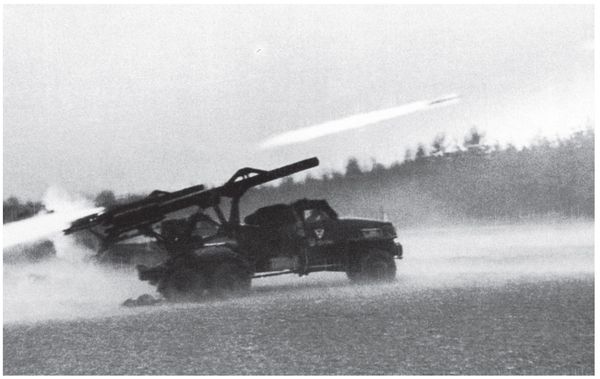
Katyusha BM 13-16 launching rockets against the Germans in July 1944 in Eastern Poland. (Leandoer & Ekholm Archive)
The political question remained however, and it presented a particularly sticky problem. Stalin was concerned about the Home Army’s troops in Warsaw, not from a military perspective but for propaganda reasons. Any attempt to disarm the Polish resistance movement in the capital city naturally threatened to awaken violent conflict to life. It appears – with respect to this matter, no documentation has been saved – as if the Soviet dictator awaited the outcome of the assault and was counting on a rapid seizure of Warsaw. The radio station “Kościuszko” which was controlled by the communists, encouraged the Uprising. This kind of appeal was standard Soviet operating procedure when a need was seen to dilute the ferment of concern in the resistance movement’s backers. Fighting in the city would work to facilitate Soviet troop operations. In Warsaw, not only had the home-army remained combat ready, along with the organizations that co-operated with it, but also the so-called “People’s-Army.” Much depended on the precise time point the Uprising took place.
Stalin must have known, with a fair degree of certainty, that the 2nd Tank Army which was due to attack Praga with only one tank corps (the other two were designated to cut off the German 2nd Army) would not be strong enough to seize Warsaw‘s central sectors west of the river. The regular infantry armies could carry this out. But these forces wouldn’t arrive at the city until a couple of days later, and unless there was a state of total chaos on the German side or an uprising, nothing could guarantee a successful crossing of the Wisła in an urban setting. What the Soviet dictator actually planned, we’ll never know. Perhaps he had counted on the fighting breaking out in the city prematurely. His perception was that the Germans would pacify the city within a couple of days and destroy the Home Army, after which the 8th Guards Army could enter the Polish capital from the south. It’s also possible, as has already been mentioned, that Stalin shelved decisions concerning Warsaw until later and, in effect, let them be decided based on what resulted from the frontline attacks east of Poland’s capital.
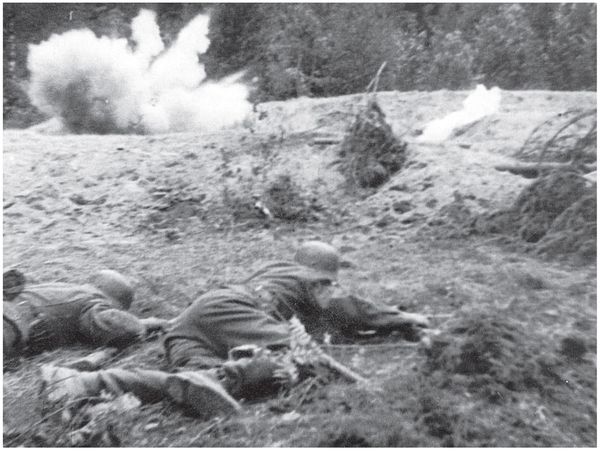
German infantry under fire outside of Warsaw in July 1944. (Leandoer & Ekholm Archive)
Towards the end of July, military operations began to directly take in Praga’s south-eastern suburbs. On July 27, brigades with frontline troops from the 2nd Tank Army began a series of debilitating battles over a 40km stretch and took possession of the Garowlin-area. At that moment, the German 9th Army’s command of the approaches into Warsaw rested solely on General Fritz Frank’s 73rd Infantry-Division (the 70th, 170th and 186th Infantry-Regiments, and Artillery-Regiment 173) along with smaller units drawn from General Wilhem Schmalz’s division “Herman Göring” (Aufklärungs-Abteilung and a portion of Flak -Regiment). General von Vormann deployed, rashly enough, these weakened forces (Gruppe “Frank”) to the south with the mission of impeding the pace of the Soviet advance. In fighting with two Soviet tank corps over July 27-28, the 73rd Infantry-Division suffered heavy losses and was driven back to the Otwock – Minsk Mazowiecki line. General Frank was taken prisoner and a portion of the units from his division escaped in tatters to the other side of the Wisła.
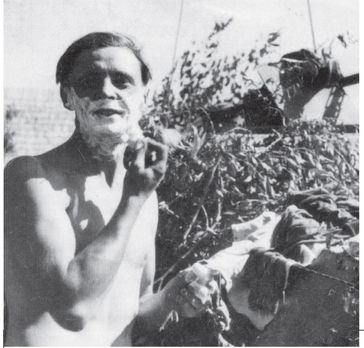
“If only there was time…”
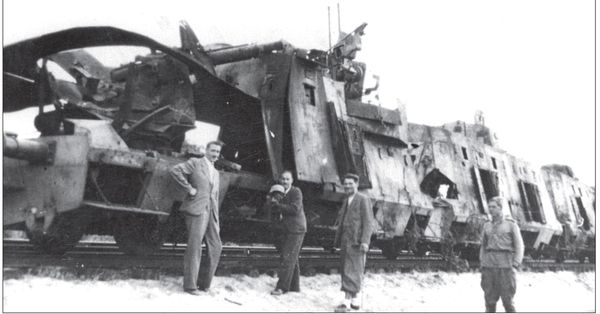
The destroyed German armoured train no. 74, in the Otwock-region, July 194
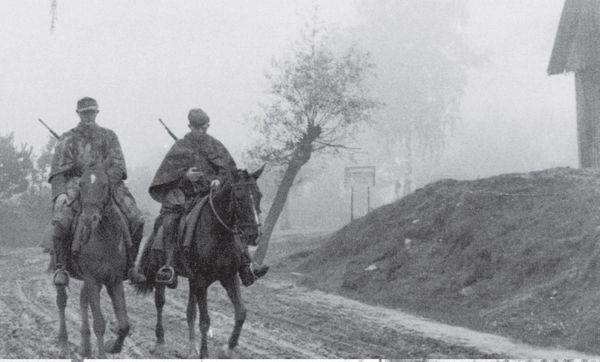
A mounted reconnaissance patrol from an infantry unit, one early morning outside Warsaw, July 1944.
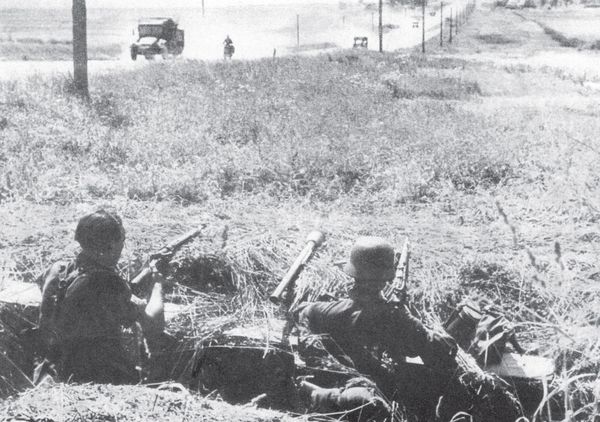
Forward at the frontline! German fixed positions at the furthermost point along the frontline. Retreating units race by the two entrenched soldiers in July 1944 outside Warsaw. Note the Panzerfaust!
(All pictures: Leandoer & Ekholm archive)
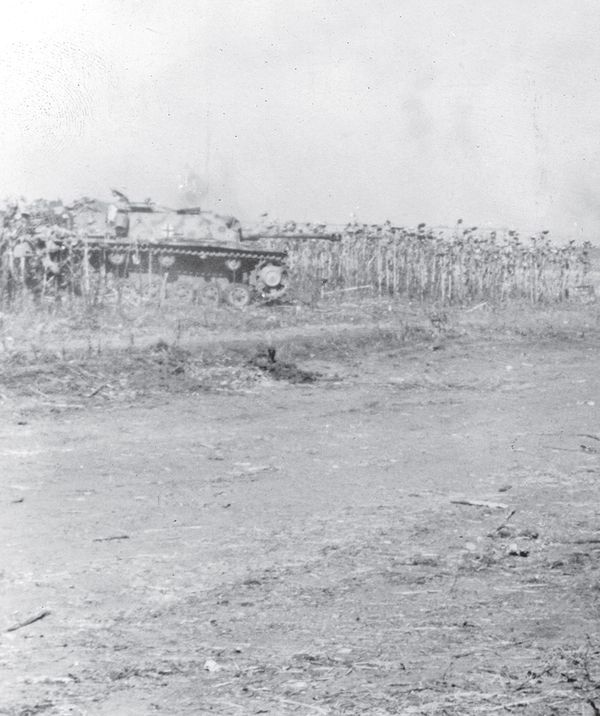
An assault-gun StuG 40 Sd Kfz 142/1 Ausf. G and an anti-tank 5 cm Pak 38 from a Waffen-SS unit lying in ambush on the eastern front, summer 1944. (CAW)
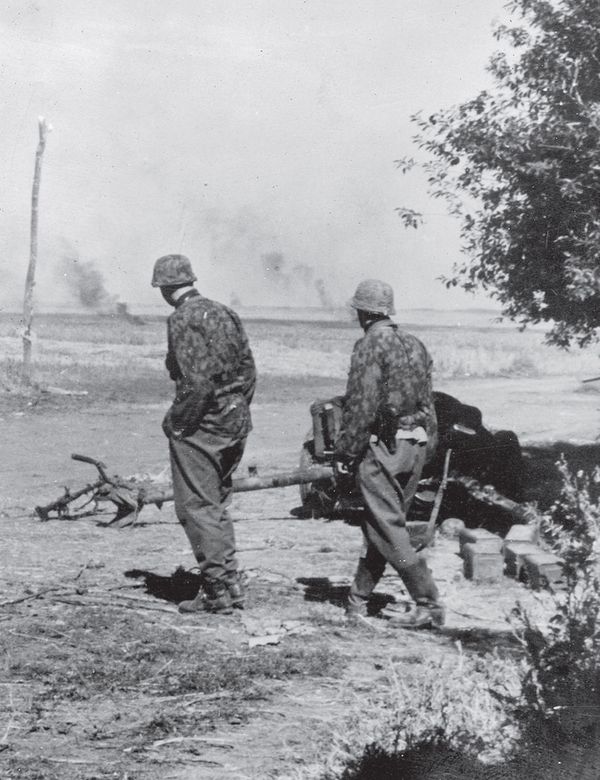
In this situation, the status of the 9th Army became critical. On July 27, Hitler appointed General Reiner Stahel as commander of the entire Warsaw military district. He was regarded as an expert in urban warfare. Actually, Stahel was an officer in the Luftwaffe, but had already been posted as commandant over Rome and Vilnius in 1944. Hitler ordered Stahel to defend the city “at any price.” The Germans knew about the plans for an uprising and therefore prepared their troops for fighting on two fronts. The troop strength at the city’s outposts was reinforced and soldiers from Pionier-Bataillon 654 awaited orders to blow up the bridges. Model wanted to stop the 2nd Tank Army with a sudden counter-attack east of the Praga district, and at the same time, protect Warsaw with division “Herman Göring “ and the 73rd Infantry-Division. He also got the all-clear to redeploy 19th Tank-Division from the north to the Warsaw region and placed it on combat-ready status.
On the other side of the front, General Radzjijevskij’s two tank corps approached Praga on July 28. The third, the 16th Tank Corps, remained a little in the background, but quickly tried to link up with the rest of the army by attacking directly along the Wisła’s eastern shore – behind them, trailed rifle divisions from the 8th Guards Army. General Vasilij Tjujkov received orders to cross the river south of the capital (the order was formally issued on July 29, 1944). At the same time, in the area around Kazimierz Dolny, the 69th Army had already begun to cross the river and the 1st Polish Volunteer Army stood outside Dęblin. At Siedlce, the rapid response force and the 47th Army, which had just arrived in the area, were engaged in heavy fighting. After taking Brest, the 70th Army relentlessly drove a fortification garrison westwards, while the 61st Army had just begun to withdraw from the 1st Belorussian Front.
The 2nd Tank Army’s resources, July 27, 1944
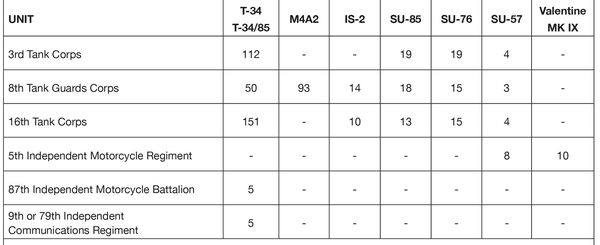
The table displayed above was compiled by General Radzjijevskij’s staff on August 28, 1944 and may not be entirely accurate.
It is not clear if the report overlooks certain independent units who operated under the direction of the army commander. In addition, there is some question as to whether any of the tanks were otherwise occupied or undergoing repair. The list includes a total of 568 tanks and tracked assault guns (among them 19 SU-57s). According to other sources, which are also based on Soviet records (T. Sawicki, W. Wołoszyn), the 2nd Tank Army on July 17, 1944 was composed of a total of 810 armoured vehicles; (665 tanks, 145 tracked assault-guns) while on July 27, 1944, reports indicated they still possessed some 680 armoured vehicles.
A Polish “Studebaker” US-6 with soldiers from the 1 st Army in liberated Lublin, July 1944. (WAF)
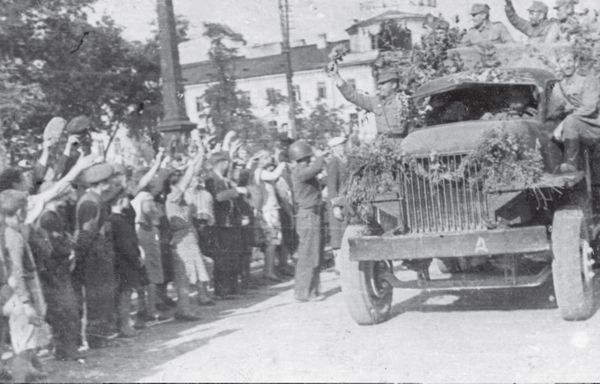
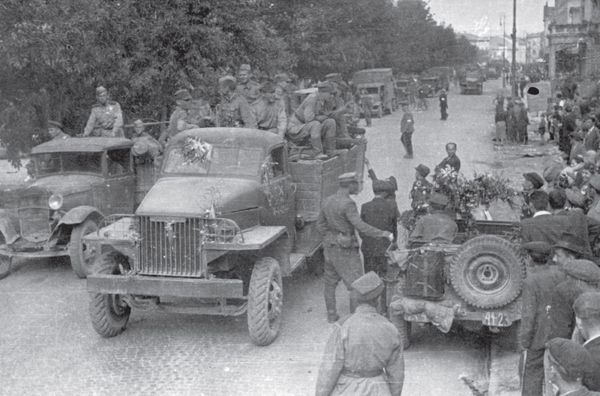
A Polish “Willy’s” jeep (see right) and a “Studebaker” US-6 from the 1st Army in liberated Lublin, July 1944. On the left, a column of Soviet lorries of model GAZ-AA passes by. (WAF)
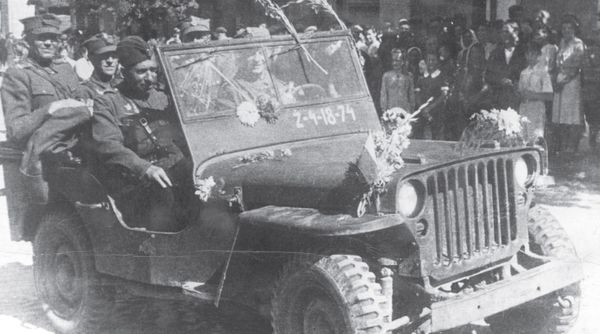
A Polish “Willy’s” jeep from the 1st Army in liberated Lublin, July 1944 (WAF)
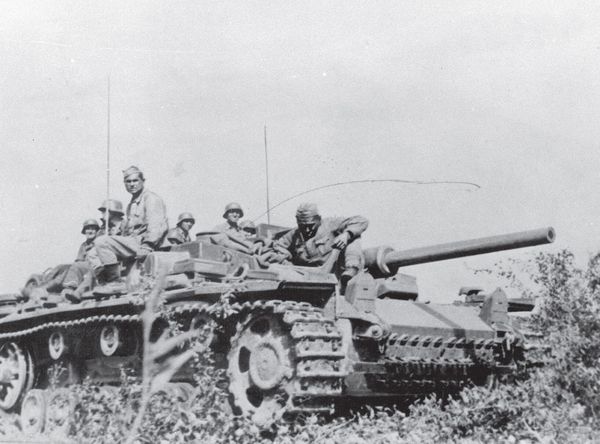
An assault-gun of model StuG 40 Sd Kfz 142/1 Ausf. G on the eastern front, summer 1944. Note that the muzzle on the StuG 40 has no muzzle-suppressor. (CAW)