
On the morning of July 29, tanks from the 3rd Tank Corps under the command of General Nikolaj Vjedjenjejev resumed their northward offensive. From the east, they had gone around elements of the 73rd Infantry-Division, which were retreating towards Warsaw, and cut off the main roadway towards Siedlce between Mińsk Mazowiecki and Kałuszyn. This accomplished, the corps’ tank brigades once again headed west and reached the Stanisławów-region. General Vjedjenjejev then sent out reconnaissance patrols in the direction of Tłuszcz. That evening, the 3rd Tank Corps’ advance troops cut off the railway line between Warsaw and Białystok.
East of the 3rd Tank Corps along the Wisła, units from General Ivan Dubovoj’s 16th Tank Corps went on the offensive. These were probably the same tank troops from the corps who had, on or about this time, destroyed the German armoured train nr. 74 along the stretch between Otwock and Pogorzel Warsaw (It may also have been tanks from the 109th Tank Brigade). But following immediately behind the 3rd Tank Corps, General Aleksiej Popov’s 8th Tank Guards Corps also rolled northwards and, at the same time, secured the tank army’s right flank. On July 29, this corps reached Mińsk Mazowiecki.
The Germans tried to assemble their combat forces as quickly as possible for Generalfeldmarschall Model’s counter-attack. That day, responsibility for the defence of Praga was placed on Lt. General Dietrich von Saucken’s XXXIX Panzer-Corps, which had been deployed there from the 4th Army, which at that time was being reconstructed in Lithuania. Under Von Saucken’s command were the 19th Panzer-Division and the Parachute-Panzer-Division “Herman Göring.” His greatest problem was the all too real shortage of combat forces. General Hans Källner’s 19th Panzer-Division had just begun to move in the direction of Warsaw, starting out from the northeast near Wysków. Moreover, this force didn’t mount to a full formation since the transport of the Panzergrenadier-Regiment 73 and the division’s artillery from Holland had not yet been completed. By July 29, only one of these Kamfgruppe had actually arrived in the area around Praga, almost certainly strengthened by a couple of tanks from Panzergrenadier-Battalion “Panther.” The rest of the formation was expected to arrive over the coming days.
The situation for division “Herman Göring” was far from ideal. They were forced to transport General Schmalz’s force in, all told, 72 railway coaches As a result of Soviet bombing raids on the capital city’s railway stations, large sections of the division, tanks included, were off-loaded outside the city in Pruszków and Piastów – after which, these units were reassembled in Warsaw’s western suburbs, from where they then made their way to Praga. The outcome of this, given the limited capacity of the suburbs’ railway stations; was that off-loading became an excessively drawn-out process. The first units from Division “Herman Gorimg” to turn up in Warsaw arrived on July 25, and on the following day they began to demonstratively drive through the city. An intention of this, of course, was to make a psychological impression on the city’s citizens. To a certain extent, this also appears to have been the case.
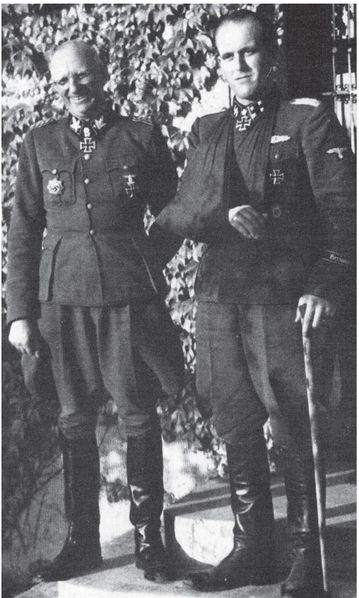
Commander of the 5th SS-Panzer-Division “Wiking” until Aug. 11, when he was appointed commader of the newly formed IV SS-Panzer-Korps, SS-Gruppenführer Herbert Otto Gille. To the right of him is SS-Obersturmbannführer, Hans Dorr, commander of SS-Panzergrenadier-Regiment 9. “Germania”. The photo was taken in July 1944. (Leandoer & Ekholm Archive)
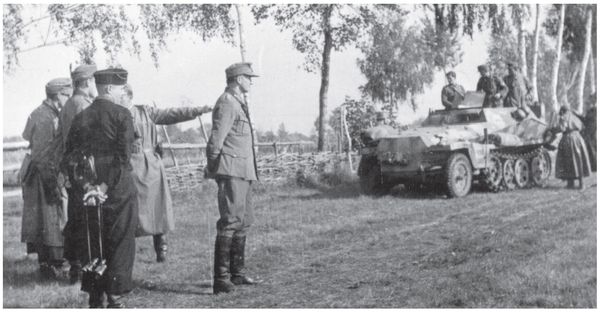
A group of HQ officers of the 4th Panzer-Division with the commander of the Division at the fore, General von Saucken. The vehicle on the right is a Sd Kfz 250/1 Alte. The man dressed in black is probably the commander of Panzer-Regiment 35, the division’s panzer regiment. The picture is taken in July 1944. (Leandoer & Ekholm Archive)
On July 30, the units of the Fallschirm-Flak-Regiment “Herman Göring”, arrived in Praga, along with elements of the Fallschirm-Panzer-Artillerie-Regiment “Herman Göring”, Pionier-Bataillon and Panzer-Aufklärungs-Abteilung. The march through Warsaw of the most vital force, that is to say – the Fallschirm-Panzer-Regiment “Herman Göring” and two parachute panzer-grenadier regiments, (Fallschirm-Panzergrenadier-Regiment 1&2), was, on the other hand, decidedly disoriented. The panzer regiment had arrived in a weakened state because as late as July 3, on special orders from Hitler, a portion of I Battalion’s personnel had been sent to Holland to equip the forces sent there with the new “Panther” tanks. The result of this was that the first vehicles to roll into battle were the Tiger tanks of the III Battalion, whose 10th Company received support from infantry troops out of the 73rd Infantry-Division, which was retreating from the area around Siennica. The following day, the company covered the infantry’s withdrawal south of Sulejówek, and a portion of the III Battalion became involved in fighting near Pogorzela. At the same time, the Fallschirm-Panzergrenadier-Regiment I, supported by artillery, consolidated with units from the II Panzer-Abteilung outside of Marki prior to the planned counter-attack, while Fallschirm-Panzergrenadier-Regiment 2 was still in route to the front.
General von Vormann was still counting on support from the 6th Luftflotte and two grenadier brigades. The Luftwaffe had at its disposal a vast number of anti-aircraft batteries from the 80th Regiment in the Warsaw region – everything ranging from units armed with light 20mm calibre weapons, to heavy 88mm artillery guns. All told, this mounted to 19 heavy batteries, 3 medium-heavy batteries and 11 light batteries. In addition to these resources, based at nearby airfields were Ju 87D bombers from 1 Gruppe in 1 Staffel out of the SG 1 (Schlachtgeschwader 1) and the 4th Flieger-Division in the 77th StG (Sturzkampfgeschwader), along with Bf 109G fighter planes from the 1 Gruppe from JG 51 (Jagdgeschwader 51). These were not especially impressive combat planes, but – thanks to the extensive distance separating Soviet airfields from the field of battle – the German planes had a local advantage in the air over the battle area outside Warsaw. Now and then, the 6th Luftflotte also took advantage of its greater strength in air battles, but they continued to concentrate most of their air power and superiority on supporting the 2nd Army. This, for the Germans, favourable balance of air power over the Warsaw area was not to change radically until the second week of August.
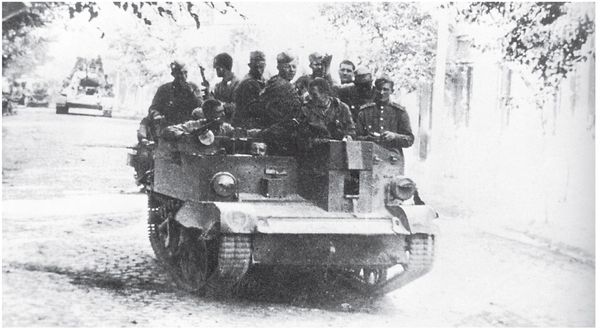
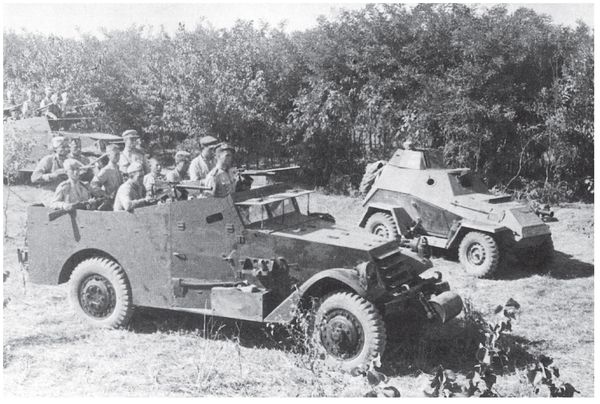
A Bren gun armoured vehicle filled with Soviet soldiers pursuing retreating German forces, in eastern Poland, July 1944. (Leandoer & Ekholm Archive)
The 9th Army also received reinforcement from the newly formed 1131st and 1132nd Grenadier-Brigades, plus a couple of defensive battalions. The Army Chief of Staff reported on their potential: “These units have far too few, or no heavy weapons whatsoever at their disposal, no artillery whatsoever and they are in no condition to withstand a heavy enemy attack both because of poor armament but also because of poor training.”
With this in mind, von Vormann put anti-aircraft guns at their disposal and thereby increased the firepower of both brigades. The Grenadier-Brigades remained in position south of Warsaw’s central sectors west of the river. If an uprising was to break out they were to be used to bring the city under control.
On July 29, Generalfeldmarschall Model, after receiving alarming reports from the commander of the 9th Army concerning the possibilities of defending Praga and about the sudden offensive with regard to enemy attacks outside Mińsk Mazowiecki, ordered the 3rd SS-Panzer-Division “Totenkopf ” and the 5th SS-Panzer-Division “Wiking” to disengage the enemy at the Bug’s lower section and march towards Warsaw. He also despatched a portion of the 4th Panzer-Division there. This Kampfgruppe would arrive in Praga immediately behind the 19th Panzer-Division through Wyszków. At this point and time, the Germans apparently had difficulty in identifying the Soviet forces which were attacking Poland’s capital city, since they had initially taken the 3rd Tank Corps to be a cavalry corps. On the other hand, they correctly identified the 16th Tank Corps and the 8th Tanks Corps.
The order to march westwards reached the 3rd SS-Panzer-Division “Totenkopf” and SS-Oberführer Hellmuth Becker at Siedlce – where, for the last two days, he had been engaged in hitting back at General Krjukov’s rapid response force. The 5th SS-Panzer-Division “Wiking” and SS-Gruppenführer Herbert Gille had not, on the other hand, completely finished their transport across the Bug where Kampfgruppe “Westland” carried out a counter-offensive against the 65th and 68th Armies. But by July 29, the majority of the divisions had nonetheless assembled outside of Węgrów, northwest of Siedlce. In some literature, information indicates that II SS-Panzer-Regiment 5 “Wiking” (which was part of Kampfgruppe “Mühlenkamp” – HQ staff of the SS-Panzer-Regiment 5 “Wiking”, II SS-Panzer-Regiment 5 “Wiking” and a part of SS-Panzergrenadier-Regiment 9 “Germania”), had fought outside Siedlce on July 28 – 29, destroying 107 Soviet tanks while only losing 6 of their own. It must be observed, however, that it’s very doubtful this battalion could have been present at that location on July 29. At Siedlce, soldiers from the 3rd SS-Panzer-Division “Totenkopf ” did fight and they actually did destroy an impressive number of the 11th Tank Corps’ tanks. But in Heeresgruppe “Mittes” situation report of July 30, it states that the 5th SS-Panzer-Division “Wiking” was located in Węgrów. And inasmuch as the 3rd SS-Panzer-Division “Totenkopf ’s” retreat from Siedlce resulted in the city being seized by Soviet forces that very day, the possibility of SS-Panzer-Regiment 5 “Wiking’s” tanks engaging in the fighting at Siedlce is hardly realistic. They did, however, participate in battle east of the city, since that portion of the 5th SS- Panzer-Division “Wiking” which battled in the south retreated across Łosice and Mordy to Sokołow Podlaski, and from there, on towards Węgrów.
On July 30, the situation was complicated even more on the stretch towards Warsaw. Early that morning, the 3rd Tank Corps’ reconnaissance units tried to seize Zielonka. The Germans beat off the assault. At the same time, the corps’ main force struck at Wołomin and after they had taken it, they set their sights on Radzymin. After a couple of hours, both towns were in General Vjedjenjev’s hands. Frontline troops within the 103rd Tank Brigade had encircled Radzymin – the 50th Tank Brigade had occupied positions west of Wołomin in the area by the road towards Marki, while the 51st Tank Brigade had secured the corps’ right flank, east of Stanisławów. Additional forces, in the form of the 57th Mechanised Brigade, were also on their way to this area, although they had for a short period of time lost connection with their tank units during an attack against German corps’ second echelon. Here, it’s appropriate to point out that in carrying out this well-executed armoured raid into unknown territory, the Soviet tank crews were indebted to local units of the Home Army and the local population, who had gladly volunteered their expert knowledge of the area.
The seizure of Radzymin by the 103rd Tank Brigade meant that the 3rd Tank Corps ‘ commander had, in effect, executed the order to cut off the German 9th Army from the 2nd Army. Meanwhile, the 8th Tank Guards Corps, which found itself in back of the 3rd Tank Corps, went round Mińsk Mazowiecki in a westerly direction. The corps’ frontline troops had reached the area east of Okuniew. The 16th Tank Corps, which attacked from the Otwock area, having identified the enemy’s defensive status, continued the offensive towards Praga. On July 30, under increased resistance from the 73rd Infantry-Division, the Soviets seized Świder, Józefów and Wiązowna. The main road to Warsaw from the south passed through Wiązowna. From here, Soviet units carried out a raid outside the Zakręt district where the main roads from Siedlce and Lublin met. The capture of this village created a threat that the combating German units would be outflanked outside of Falencia.
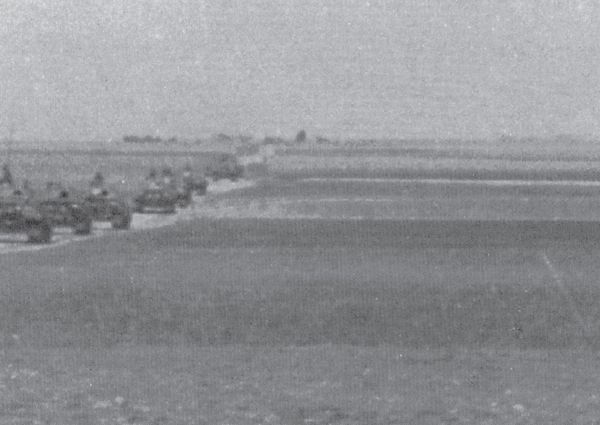
A tank column of PzKpfw V “Panthers” from the 3rd SS-Panzer-Division “Totenkopf” or from the 5th SS- Panzer- Division “Wiking”, on their way to the front, July – August 1944. (CAW)
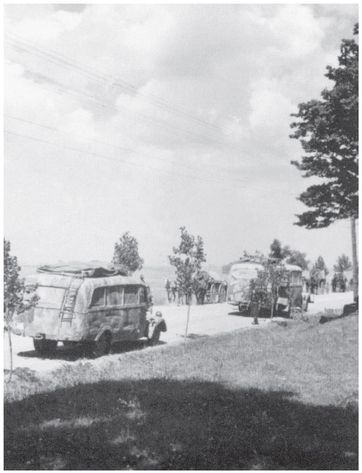
Headquarter troops from the 4th Panzer-Division during a march east of Warsaw, July 1944. (Leandoer & Ekholm Archive)
Assessing the situation that had arisen, the command staff of the 9th Army decided to immediately launch a counter-attack, but the XXXIX Panzer-Corps at this juncture commanded only the incomplete Division “Herman Göring “ plus a weak Kampfgruppe drawn from the 19th Panzer-Division. But the Germans had a bit of luck – part of which lay in the fact that on July 30 the greater part of the tanks belonging to the Fallscirm-Panzer-Regiment “Herman Göring” had already been off-loaded from the transporting freight trains – and partly in that there had been enough time to complete the consolidation of reinforcements with the 1st Grenadier Regiment, outside of Marki. At the same time, tanks from Panzer-Regiment 27 and the 19th Panzer-Division were en route from the direction of Wyszków. Moreover, PzKpfw IVs from the II Fallschirm-Panzer-Regiment “Herman Göring” sped through Warsaw, and thereafter were able to reinforce the Kampfgruppe from its own “mother” unit.
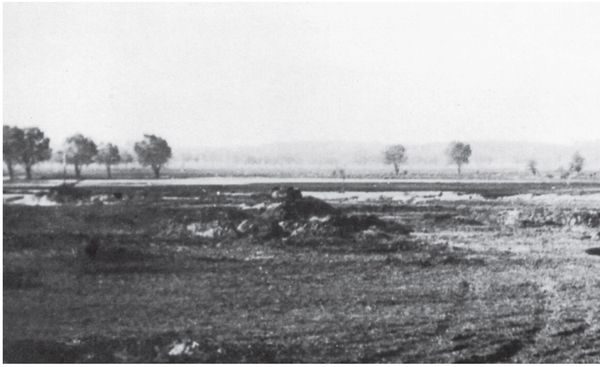
On July 30, the XXXIX Panzer-Corps launched a counter-offensive. Augmented with tanks and artillery, a Kampfgruppe from Fallschirm-Pz.Gren. Rgt. 1 “Herman Göring” attacked in the direction of Wołomin from the area around Marki. Another unit from the 19th Panzer-Division (II Pz.Gren. Rgt. 74, a Tank company from the II Pz.Rgt. 27 and the II Battery in the 19th Panzer-Artillery-Regiment), together with infantry from the 73rd Infantry-Division, conducted an attack on the village of Zakręt. Northeast of Radzymin, fighting also broke out when the 103rd Tank Brigade and advance forces from the 19th Panzer-Division clashed. The German attack was by no means overwhelming because it was carried out by fairly reduced forces: Both the 19th Panzer-Division and the “Herman Göring,” neither of which had yet completed their respective consolidations, engaged only solitary regiments in battle. An additional two Waffen-SS tank divisions were unable to participate in the fighting during the course of the day. Columns out of the 3rd SS-Panzer-Division “Totenkopf ” were just leaving Siedlce and didn’t reach Chojeczno, halfway between Siedlce and Kałuszyn, until that evening. Soldiers in the 5th SS-Panzer-Division “Wiking” were also on their way toward Kałuszyn.
The German attack from the direction of Praga, made General Radzjijevskij abundantly aware that the enemy still had the means to execute telling combat operations on his army’s left flank. Units from the 16th Tank Corps were transported from the area around Zakręt and withdrew to Wiązowna. Thereafter, the 3rd Tank Corps threw back the attack against Wołomin, as well as the attack against Radzymin, but was then forced to defend itself. General Vjedjenjejev reacted very quickly to the changed situation. He gave orders to, among other things, set about organizing an indirect defence; firing trenches must be dug for a number of tanks, anti-tank ambushes must be prepared making use of anti-tank guns, the corps’ artillery must be called in and reserve units created. With over 150 tanks and tracked artillery vehicles, the 3rd Tank Corps hardly represented an insignificant force. According to Soviet combat calculations, the 2nd Tank Army’s first echelon-corps would remain in a defensive posture until it established broad contact with 8th Tank Guards Corps and the 16th Tank Corps. At the same time, General Radzjijevskij reported to General Rokossovskij informing him about the increasingly strong German resistance in Praga’s outlying towns and requested additional heavy artillery units to break it down. Rokossovskij responded that he, General Radzjijevskij, should concentrate on cutting off the German 9th Army from its 2nd Army, and hand over the mission of seizing the city to the 47th Army which was en route as part of the second echelon. In theory, Radzjijevskij had command of forces capable of carrying out this order. However, between July 18 and July 30, 1944, the 2nd Tank Army suffered a total loss of 582 soldiers killed in action, 1,581 wounded and an additional 52 soldiers unaccounted for, along with the loss of approximately 130 tanks and tracked artillery guns. Still, given such a large fighting force, these losses were not all that serious – and the army had potential access to a further 560 to 680 armoured vehicles.
A battlefield in Eastern Poland towards the end of July 1944. In the picture, starting from the left can be seen a T-34-85, a JSII and a PzKpfw IV ausf H. The picture was taken by a German camera which probably indicates that the Red Army was the loser in this engagement. (Leandoer & Ekholm)
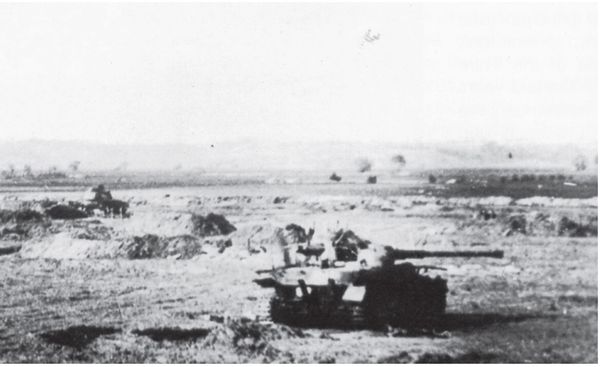
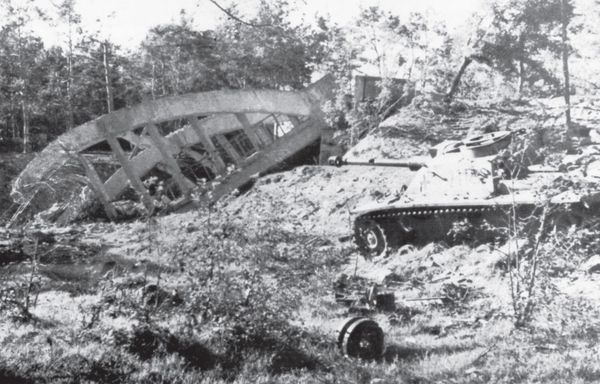
A blown up bridge and a blown up StuG III ausf G.the former will (Leandoer & Ekholm Archive)
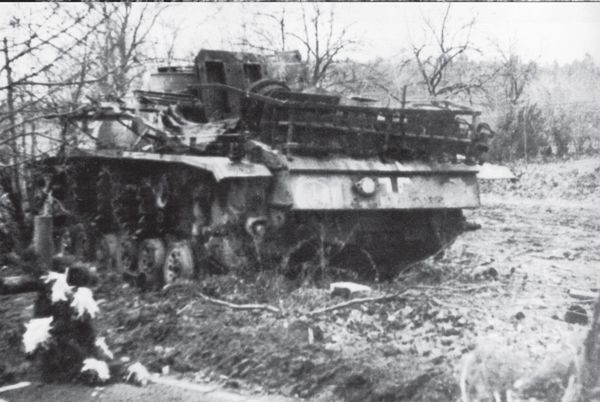
A knocked out StuG III ausf G with a recently dug German grave behind the tank. The spot is on the borderland between Belorussia and Poland, July 1944. (Leandoer & Ekholm Archive)
On July 31, just as additional units arrived from Division “Herman Goring,” the Germans increased their pressure on the 3rd Tank Army’s left flank. From the direction of Praga, attacks were mounted along the Marki – Radzymin motorway, as well as along the Zielonka – Wołomin railway line. The 19th Panzer-Division’s main combat force, in the meantime, approached Radzymin from the northeast. Despite the German XXXIX Panzer-Corps (now called: Gruppe “von Saucken”) having taken over the initiative, it was still numerically significantly weaker than the Soviet 2nd Tank Army and, in terms of frontline troops, it was even weaker than the 3rd Tank Corps. During the day, the last Pzkpfw IV from the II Fallschirm-Panzer-Regiment “Herman Göring” finally linked up with the troops already engaged in combat (the off-loading of the whole division was completed on August 4). Thanks to the above-cited unequal numerical strength and the competent defence put up by the Soviets, all German counter-attacks were beaten back with bloody results. General von Saucken was thus very impatiently awaiting the arrival of the two promised Waffen-SS-Divisions and the 4th Panzer-Division (which he had earlier commanded) to spearhead his attack. During the last day of July, the reinforced SS-Panzergrenadier-Regiment 9 “Germania” arrived, along with a portion of the 3rd SS-Panzer-Division “Totenkopf” in the area around Stanisławów – but Kampfgruppe “Westland” from the 5th SS-Panzer-Division “Wiking” was still engaged in crossing over the Bug north of Węgrów. Nor was SS-Oberführer Becker’s unit in a position to engage in battle at full strength, since the 3rd SS-Panzer-Division “Totenkopf ” was still fighting in the Siedlce region. Despite this, after having received a report that a Kampfgruppe drawn from both forces would possibly begin to participate in the fighting the following day, he contacted the commander of the XXXIX Panzer-Corps, SS Gruppenführer Gille, for the purpose of coordinating all the divisions’ operations. General von Saucken also received a report to the effect that the 4th Panzer-Division forces were en route in the direction of Wyszlów. However, because of rain and the length of the division’s transport, they could not join the fighting for an additional 48 hours.
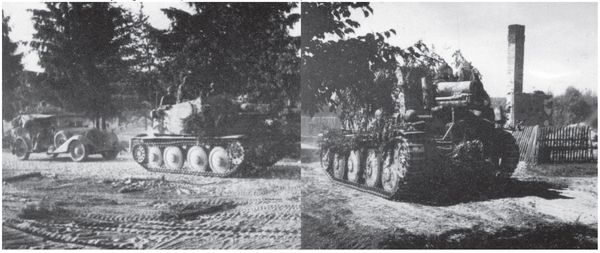
Two pictures which show 2 Sd Kfz 138’s ausf H “Grille” belonging to the 9th Panzergrenadier-Regiment 12, 4th Panzer-Division, on the move east of Warsaw, July – August 1944. (Leandoer & Ekholm Archive)
On July 31, south of Wołomin, the Soviet side continued to carry out attacks with tanks from the 60th and the 58th Tank Guards Brigades. The 8th Tank Guards Corps attacked Okuniew, which was captured during the evening hours. Their next objective was to capture the village of Ossów which was under siege on the outskirts of Wołomin. But this manoeuvre was checked by the stubborn defence mounted there by the grenadiers of the division “Herman Göring”. The terrain favoured the Germans. Despite the 3rd Tank Corps holding Wołomin, and the 60th Tank Brigade from the 8th Tank Guards Corps holding itself in wait the nearby village of Okuniew; the two areas remained separated due to the wet lands, forests and two streams, the Długa Struga and the Czarna Struga, between them. The 3rd Tank Corps, which was the first unit to attack, got around these natural obstacles by travelling in a wide arc towards the east near Stanisłwów. Now, with the nearest connection with Vjedjenjev’s corps having been blocked, General Popov decided to imitate this tactic. With the aim of broadening the wedge which the 8th Tank Guards Corps had created; he attacked Mińsk Mazowiecki together with Colonel Vasilj Bjelgakov’s, 260th Rifle Division which was en route from the south. After a short engagement, in which the 3rd Battalion out of the Home Army’s 22nd Regiment, also actively participated; the town fell into Soviet hands. The 16th Tank Corps also pressed on with their assault operations, driving the German 73rd Infantry-Division into the area around Radość.
At the same time this was taking place, the battle for Siedlce, east of Warsaw, neared its end: The city was captured by General Krjukov’s soldiers on July 30. Marshal Rokossovskij’s new orders, which were issued the very next day, meant that the crippled 11th Tank Corps was to move south to Puławay. The commander of the 1st Belorussian Front, in accord with the wishes of HQ, intended to support the 69th Army’s frontline troops at Wisła with this tank force. Other offensives towards the north, that is to say, on a direct line towards Poland’s capital city, were to be carried out by the 2nd Cavalry Guards Corps. This meant that the rapid response force was dissolved. New support for Krujkov’s cavalry troops would now be provided by the 70th Army. Following the seizure of Brest and the 2nd Army’s redeployment towards the west; General Vasilij Popov’s army, which included two rifle corps, lost contact with the enemy. At this time, Marshal Rokossovskij gave the order that after the regrouping had been carried out, they were to march in the direction of Kałuszyn and, from there, begin to participate in the storming of Praga together with the 47th Army. In addition, adjacent to the Bugs lower flow near Siemiatycz; the 28th Army, along with support troops from 1st Mechanised Corps and the 9th Tank Corps, began to prepare for an assault. These formations were to attack positioned on the right side of the 2nd Cavalry Guards Corps in the direction of Sokołow Podlaski and onward toward Wyszków.
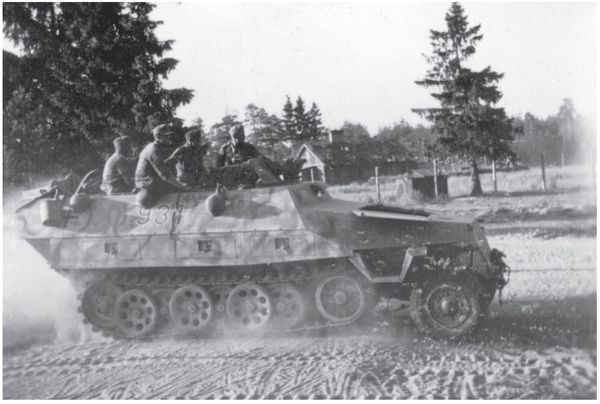
An armoured transport vehicle, model Sd Kfz Ausf. D, from Panzergrenadier-Regiment 12, 4th Panzer-Division, in Poland at the end of July 1944. (MWP)
The 3rd SS-Panzer-Division “Totenkopf’s” withdrawal clearly sealed the loss of Siedlce, however, only some 10km west of the city; the Germans built a new defensive line with the intent of retaining the area between Węgrów and Sokołów Podlaski. Model gave General Weiß a special order forbidding him from retreating any further from Warsaw. The German’s 2nd Army had also received orders to cease all attacks against the 1st Belorussian Front’s right flank along the Nur – Suraż line where the Bug and Narew Rivers joined. Set in to oppose the Soviet 48th and 65th Armies, which were attacking north of the Bug, was the newly formed LV Army-Corps (the 11th Panzer-Division, the 28th Jäger-Division, the 367th Infantry-Division, the schwere Panzer-Abteilung 507, the Calvary-Corps “Harteneck,” with their commander General Gustaw Harteneck – the 4th Panzer-Division ,the 12th. Infantry-Division and the 4th Calvary Brigade) as well as parts of the XXIII Army-Corps that along with the XX Army-Corps also defended the terrain between Nur and Sokołów Podlaski. The XXIII Army-Corps had command of the 35th Infantry-Division, the 292nd Infantry-Division, and the 541st Grenadier-Division, while General Rudolf von Roman’s XX Army-Corps had at its disposal, the 7th Infantry-Division, the 102nd Infantry-Division, the 3rd Cavalry-Brigade plus the remnants of the Brest garrison. On July 31, the 2nd Army still had command over both of the Waffen-SS armoured divisions, but these were subsequently redeployed to the 9th Army sector, consisting of the decimated VIII Army-Corps (5th Jäger-Division, 211th.Infantry-Division) under the command of the XX Army-Corps staff and that portion of the II Ersatz-Corps which had remained with the Hungarian Front’s rearguard. Within this corps were the 5th, 12th and 23rd Ersatz-Corps, as well as the Hungarian 1st Cavalry Division. The fighting capacity of the Hungarian units was not especially high, however, due to their weak armament and the low morale.
A Soviet reconnaissance unit operating from a BA-64 and two M3A1s conducting operations in eastern Poland, July 1944. (Leandoer & Ekholm Archive)
On the first day of August 1944, three significant events took place at the Warsaw-front. South of the Polish capital near the join of the Pilica and Radomka Rivers, the substantial forces of General Vasil Tjujkov’s 8th Guards Army crossed over the Wisła to its western bank. During the course of a single day, Tjujkov transported no less than nine rifle-guard regiments, 341 light guns and mortars, along with 19 tracked artillery vehicles across the river. Once the Soviet forces had crossed the river, they immediately set to work constructing pontoon bridges. By the evening of August 1, the frontline troops stretching between Mniszew and Magnuszew were already 15 km wide and 5 km deep.
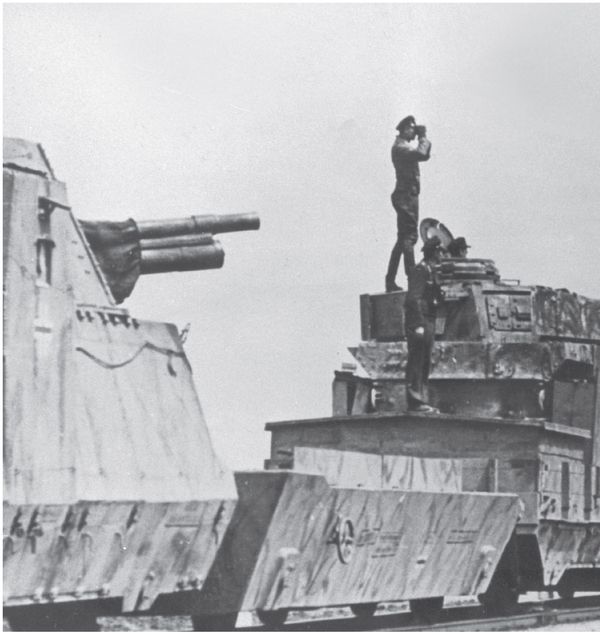
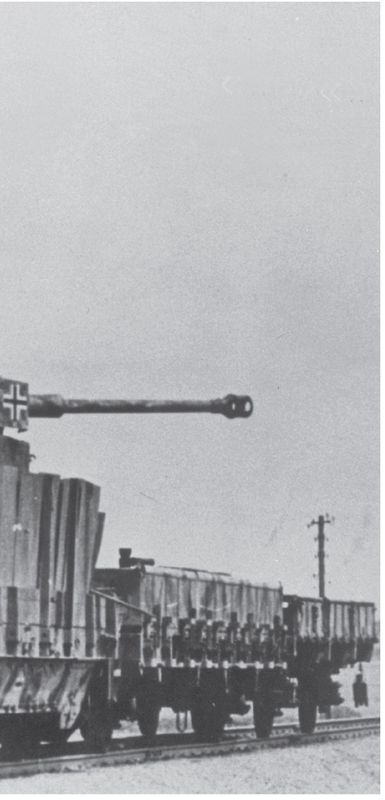
An improvised mobile gun battery “Panzerjägertriebwagen 44” from the German armoured train, model BP 44, on the eastern front, Poland July/August 1944. (CAW)
In the face of this new threat, General von Vormann now directed all available reserve troops in the direction the Pilica’s discharge. However, with his weak army devoting all its combat strength to the battles raging outside Praga, these reserves were not particularly impressive. Those who left the Warsaw sector were, first and foremost, the 1132nd Grenadier-Brigade and the Ersatz-Sturmgeschütz-Brigade that it worked in co-operation with. Two artillery units, equipped with heavy 8.8cm anti-aircraft guns, also left the country’s capital. Infantry-Regiment 95 from the 17th Infantry-Division and a few additional reserve troop battalions ended up outside Deblin. Airplanes from the 6th Luftflotte attacked the pontoon bridges and ferries. The Germans lacked the combat strength needed to carryout a bigger counter-offensive.
This day’s second significant event was the outbreak of the Warsaw Uprising. As it happened, luck fell on the side of the uprising’s supporters: It didn’t break out until the afternoon, which is to say, until a couple of hours after the city had been deserted by the most vital German forces, which coincidently included the very units that had earlier been earmarked for pacifying an eventual uprising. The commander for the Warsaw region, General Stahel, was forced to go on the defensive and, as late as August 4, the Home Army still retained the initiative. The fighting that burst out in Warsaw also made it more difficult for the division “Hermann Göring” to reach the front. This was particularly the case for Fallschirm-Pz. Gren. Rgt. 2 “Hermann Göring” which had not been involved in the fighting in Praga. However, it should be pointed out that the two, model PzKpfw V “Panther” tanks, which were captured on August 2 by insurgents in the city quarter of Woła, had not hailed from “Hermann Göring” but, instead, came from the 1st Company, I Panzer-Regiment 27. On August 2, this “Herman Göring” unit fought with all the strength at its disposal in Praga’s environs and, as earlier noted, had no access to tanks of this model. The Uprising also obstructed the 19th Panzer-Division from carrying out a complete troop consolidation. Namely, it was isolated from its main force which was en route from Holland. The resulting outcome was that the artillery reinforced II Panzer-grenadier-Regiment 73 had to make a detour south around the whole of Warsaw and, on August 1, found themselves in the Wilanów district.
Finally, in the fields outside of Praga, the tank battle reached its culmination. On August 1, a part of the 19th Panzer-Division (Gruppe “Baler”) circled around the Soviet positions outside of Radzymin, and then detoured north through Wysków, Serock and Zegrze along the Bug and Narew Rivers. After having joined together part of the II Panzer-Regiment 27, the I Panzer-grenadier Regiment 74, and the I Battery plus some smaller divisional formations in the forest adjacent to Nieporęt, the resulting force then went on the attack against Aleksandrów via Wólka Radzymińska. At the same time, the Fallschirm-Pz. Gren. Rgt. 1 “Hermann Göring” made use of the powerful support provided by the division’s artillery and tanks (the II Battalion and commandeered Tiger-tanks from the III Battalion arriving from the south) and fought their way from Marki towards Struga. Despite the heavy opposition put up by soldiers from the 50th Tank Brigade, destroying at least ten German tanks, both attacks succeeded. The 19th Panzer-Division seized Aleksandrów and the Luftwaffe grenadiers took Struga. Soviet troops were also forced to abandon the village of Słupno, retreating with heavy casualties toward the inner defensive line surrounding Radzymin. The southern Kampfgruppe, the 19th Panzer-Division (Pz. Gren. Rgt. – I 73rd , II 174th, II Artillery-Regiment), regrouped in the morning at Wesoła, west of the capital, and from there launched an attack against the troop forces defending Okuniew, drawn from the 60th Tank Guards Brigade and the 8th Tank Guards Corps. This counter attack was also crowned with success. Having captured Okuniew; the Germans switched to a defensive war posture while awaiting the arrival of tanks from the Waffen-SS scheduled to arrive from the east.
4:e Panzer-Divisions armament, August 1st 1944 Model:
|
TYPE |
|
|
PzKpfw V “Panther” |
58 (40) |
|
PzKpfw IV |
83 (45) |
|
PzBfWg III |
5 (3) |
|
Panzerjäger IV |
12 |
|
“Marder” III |
10 |
|
“Grille” |
9 |
|
“Wespe” |
6 |
|
“Hummel” |
6? |
|
Sd Kfz 250/251/253 |
311 (237) |
|
Armoured cars |
? |
|
Pak 40 AT-guns |
7 |
|
|e|G infantry guns |
10 |
|
leFH 18/sFH 18/K 18 guns and howitzers |
38? |
|
sGrWr 34 (8 cm) mortars |
26 |
|
sGrWr 42 (12 cm) mortars |
12 |
|
FLAK 36 (37 mm) AA-guns |
8 |
|
FLAK 18/36 (8.8 cm) AA-guns |
8 |
|
Machine guns |
718 |
|
Soldiers |
12,700 |
On August 1, both Waffen-SS divisions drove round Stanisławów, while simultaneously covering the 5th SS-Panzer-Division “Wiking” forces’ southern flank from the Mińsk Mazowiecki direction. The 3rd SS-Panzer-Division “Totenkopf “received orders to attack Wołomin, and 5th SS-Panzer-Division “Wiking” was ordered to move out quickly in the direction of Okuniew with the objective of linking up with the XXXIX Panzer-Corps. The success of this offensive operation meant that the 3rd Tank Corps was sheared off from the rest of the 2nd Tank Army. Immediately after the attack began, however, some tens of Soviet tanks from the 59th Tank Guards Brigade cropped up on SS-Gruppenführer Gilles division’s left flank. They were about to carry out the 8th Tank Guards Corps’ manoeuvre against Stanisławów on orders they had received the previous day. Confronted with this situation the SS-forces were forced to intensively defend themselves instead of attacking. Both sides suffered heavy equipment losses and both sides broke off further attacks. At this juncture, General Popov took advantage of the 5th SS-Panzer-Division “Wiking’s” aborted attack against Okuniew and re-deployed his troops precisely in that direction. In the evening, the 8th Tank Guards Corps struck back against Okuniew and drove the Kampfgruppe from the 19th Panzer-Division out from there and to some extent restored contact with the 3rd Tank Corps. Here it should be pointed out that during this time both the 3rd and the 5th SS-Panzer-Divisions “Wiking” only succeeded in setting isolated units into battle. SS-Panzergrenadier-Regiment 10 “Westland” had not yet completed the transport of its entire complement across the Bug, and the most vital troops in the 3rd SS-Panzer-Division “Totenkopf” were still fighting east of Siedlce. In short, the contribution of the 3rd SS-Panzer-Division “Totenkopf” to the fighting at Praga was at this time decidedly modest.
Infantry from either the 4th Panzer-Division or the 19th Panzer-Division inspecting the remains of a Soviet tank unit they had just detroyed. The wreck of a T-34-85 is engulfed in smoke. Behind it stands an SU-85. The location is east of Praga; date – August 1, 1944. This is one of the few pictures of the battle that halted the Red Army at the gates of Warsaw at the time of the Home Army’s Uprising on August 1, 1944. It was in this battle that the 3rd Tank Corps out of the Soviet’s 2nd Tank Army sustained such heavy losses that they were actually forced to retire and relinquish newly won terrain at the outskirts of Warsaw/Praga. Thereby, the “magical” Soviet retreat chronicled by historians the world over. (Leandoer & Ekholm Archive)
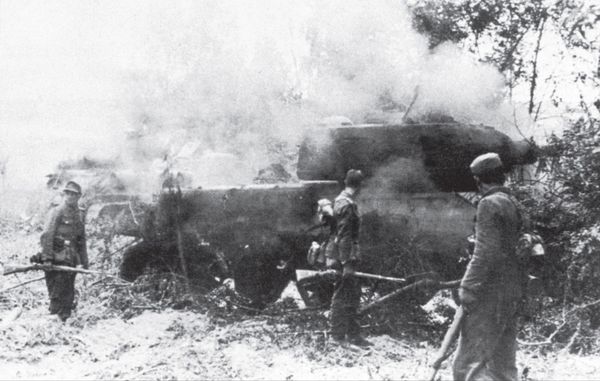
Another picture of destroyed Soviet equipment from the beginning of the battle for Praga. It appears to be the same location as shown above, a few days later. In front of the JS-II tank appears to be a T-34, model undetermined. (Leandoer & Ekholm Archive)
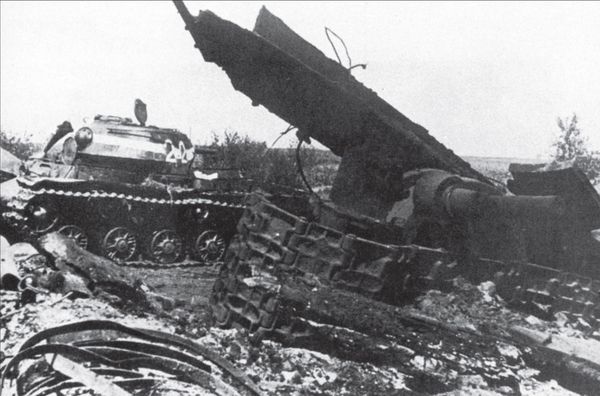
The intensity of tank battles increased. Generalfeldmarschall Walter Model ordered General von Vormann to set about annihilating the frontline troops in the enemy’s panzer corps as fast as possible, and, moreover, see to it that the Soviet bridge-defence emplacements at Magnuszew were likewise destroyed. The commander of the 9th Army reported that, due to the prevailing shortage of equipment, it was impossible to carry out both missions simultaneously. Model informed him that the VIII Army-Corps’ command had been transferred to the 9th Army. This force would organise the defence of the Wisła south of Warsaw (as a result of the Uprising in Warsaw, the Army-Corps’ staff, with General Höhne at its head, finally reached the new battlefield after a delay of four days). In addition, at Wyszków a Kampfgruppe “Felzmann” was formed drawn from units of the German 2nd Army. Incorporated into it was a Kampfgruppe from the 4thPanzer-Division that had been promised to von Vormann a couple of days earlier, along with the remainder of the troops from Brest and two heavy artillery units. General Betzel’s 4th Panzer-Division provided Panzer-Regiment 35, Panzergrenadier-Regiment 12, Panzer-Artillery-Regiment 103, Panzer-Pioneer-Battalion 79, two companies from the Panzer-Flak-Artillerie-Abteilung 290, along with a communications unit. Model despatched these troops to Radzymin with the mission of supporting the 19th Panzer-Division. In order to further better the German command, the field marshal gave orders directing that the 3rd SS-Panzer-Division “Totenkopf ” and he 5th SS-Panzer-Division “Wiking” should also be incorporated into Gruppe “von Saucken.” This meant that both divisions would, in effect, be transferred to the 9th Army.
The 2nd Tank Army’s Units, August 1, 1944
|
2nd Tank Army |
The 2nd Tank Army, in fact, ceased to exist on August 6, 1944, following the crushing of the 3rd Tank Corps and the retreat of the 16th Tank Corps back to Magnuszew. From this point on, each corps operated independently under the aegis of the regular army. The 2nd Tank Army (as of November 20, 1944, called the 2nd Tank Guards Army) never re-established the corps structure that existed in July 1944. The above chart contains all the large unit formations within the 2nd Tank Army but does not include certain smaller formations, subordinate to corps or army commands. Theoretically, each tank corps had a subordinated mortar regiment, an armoured artillery regiment (the regiments’ self-propelled guns are presented in tables together with the equipment; the 8th Tank Guards Corps had the 301st and the 1817th Anti-tank Guards Regiments; the 16th Tank Corps had the 1239th and the 1441st Anti-tank Regiments), a motorcycle battalion, an engineer battalion (in the 3rd Tank Corps, the 220th Battalion; in the 16th Tank Corps, the 201st Battalion), and an anti-aircraft Tank Corps, the 201st Battalion), anti-aircraft regiment. Likewise, on the tank “army” level apart from the corps structure, there were, among other units, a motorcycle regiment, an artillery regiment, a rocket artillery regiment, an anti-aircraft regiment, a communications regiment, an air-support liaison regiment (20 Po-2), an engineer battalion, a repair battalion or a transportation regiment. But in 1944, every Soviet tank army had a somewhat different make up, depending on the mission it was then carrying out. Sometimes, a special army unit was attached which cannot be found in the formal register, and certain units were simply never actual. |
|
|
Commanding Officer: General Aleksiej Ivanovitjv Radzjijevskij |
||
|
Army forces: |
||
|
41st Anti-aircraft Artillery Brigade |
||
|
5th Independent motorcycle regiment |
||
|
87th Independent Motorcycle Battalion |
||
|
9th or 79th Independent Liaison Regiment |
||
|
86th Guards Mortar Regiment |
||
|
10th Flame-thrower Battalion |
||
|
729th Independent Mortar Battalion |
||
|
3rd Tank Corps |
||
|
Commanding Officer: General Nikolaj Vjedjenejev |
||
|
50th Tank Brigade |
||
|
51st Tank Brigade |
||
|
103rd Tank Brigade |
||
|
57th Mechanised Brigade |
||
|
8th Tank Guards Corps |
||
|
Commanding Officer: General Aleksiej Popov |
||
|
58th Tank Guards Brigade 58th Tank Guards Brigade |
||
|
58th Tank Guards Brigade |
||
|
60th Tank Guards Brigade |
||
|
28th Mechanised Brigade |
||
|
62nd Guards Regiment (heavy tanks) |
||
|
16th Tank Corps |
||
|
Commander: General Ivan Dubovoj |
||
|
107th Tank Brigade |
||
|
109th Tank Brigade |
||
|
164th Tank Brigade |
||
|
15th Mechanised Brigade |
||
|
6th Guards Regiment (heavy tanks) |
||
On August 2, the 3rd Tank Corps’ situation further deteriorated. The entire area controlled by General Vjedjenjejev’s soldiers came under heavy enemy artillery fire. The Germans attacked Radzymin from the northeast with a Kampfgruppe from the 4th Panzer-Division, and from the north and west with the 19th Panzer-Division. Along the Radzymin-Wyszków roadway, an attack was launched by Kampfgrupp “Christern” (under the command of Colonel Christern, commander of Panzer-Regiment 35), with 28 model PzKpfw IV tanks from the II Panzer-Regiment 35, along with the 12th Regiment out of the I Panzergrenadier-Battalion. This offensive developed into fiercely contested battles fought over the bridges crossing the Rządza River in the vicinity of Dybowo, a village the Germans had succeeded in taking. Due to the concentric attack, the Soviet 103rd Tank Brigade’s units were forced to turn back toward Wołomin, and in doing so, simultaneously abandoned a considerable amount of war materials on the battlefield. In the evening, Colonel Christern’s kampfgrupp, having split into two separate assault units, attacked Ciemne and Dobczyn. (The first unit was made up of the II Panzer-Regiment 35 together with the Panzergrenadier- Regiment 12 from the I Panzergrenadier-Battalion – the second unit consisted of the I Panzer-Regiment 35 and Panzergrenadier-Regiment 12 from the II Panzergrenadier-Battalion.) The re-taking of Radzymin meant that the vital road between Warsaw and Wyszków could be re-opened and that contact between the 9th and 2nd Armies could also be re-established.
A PzKpfw “Panther” tank Sd Kfz 267 from the 3rd Panzer-Regiment 35. The photo is probably taken during the course of fighting in the vicinity of Radzymin during the first ten days of August 1944. (MWP)
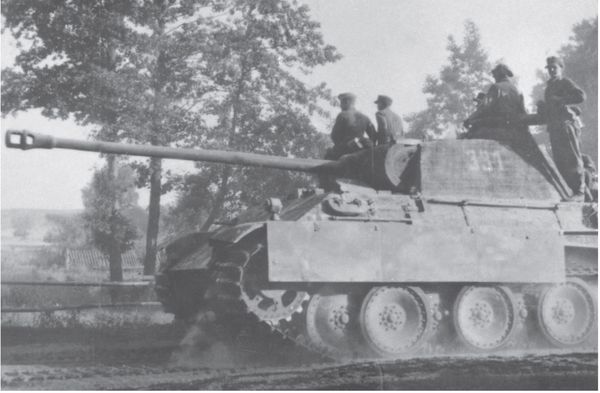
Further south, enemy positions outside Wołomin were attacked by Division “Hermann Göring” from Zielonka, and by the 3rd SS-Panzer-Division “Totenkopf” from the area around Tłuszcz. This time, the Soviet tank troops from the 51st Tank Brigade and the infantry from the 57th Mechanised Brigade proved to be the more skilled combatants. They inflicted heavy casualties on their attackers and forced them to quickly retire. The 5th SS-Panzer-Division “Wiking” (II SS-Panzer-Regiment 5 “Wiking” and the grenadier battalions from SS-Panzergrenadier-Regiment 9 “Germania”) also participated in the attack and tried to break through the 3rd Tank Division’s positions around the village of Poświętne. This effort was only partially successful. Clearly, the Soviet forces withdrew from Międzyleś, Wólka Dąbrownicka and Pośwętne, but they succeeded in setting up another defence line. SS-Gruppenführer Gille could not commit his entire division to battle because he was also responsible for the defense of the battlefield outside Warsaw between Mińsk Mazowiecki and Kałuszyn (SS-Panzergrenadier-Regiment 10 Westland,” which had also been reinforced, completed its transport across the Bug that same day and only just now was able to join up with the rest of the formation). On August 2, components within the 5th SS-Panzer-Division “Wiking,” together with soldiers from the 3rd SS-Panzer-Division “Totenkopf,” were positioned along this stretch to repel attacks from the 8thTank Guards Corps supported by the Soviet 47th Army’s frontline units. By reason of the above-described situation, the Germans were not in a position to launch a new attack against Okuniew.
A PanzerbefehlsWagen III ausf M has fallen through a bridge. The crew had a huge job in front of them, either to lift it up and transport it back to their unit, or destroy it so that it did not fall into the hands of the Russians. Eastern Poland, August 1944. (Leandoer & Ekholm Archive).
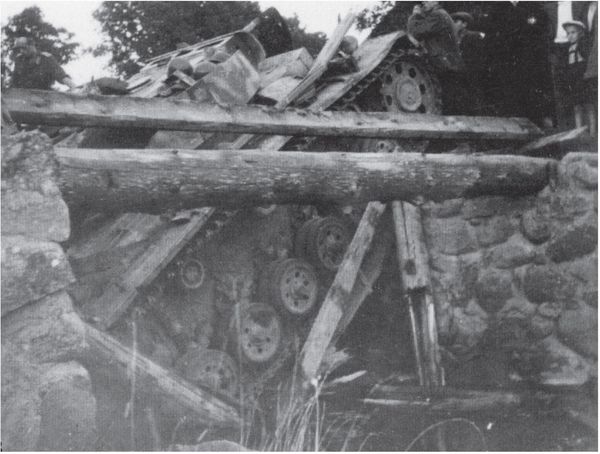
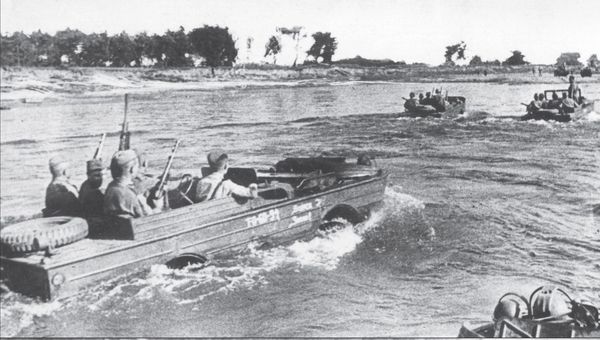
Soviet units crossing the Wisła at Puławay in August 1944. In the foreground is an amphibious vehicle, model Ford GPA (WAF)
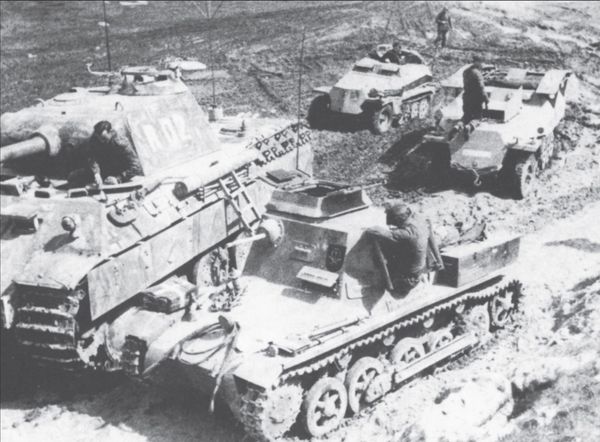
A command vehicle, PzBfWg V Sd Kfz 267 “Panther” (tactical number “R 02”), from the command company, SS-Panzer-Regiment 5 “Wiking”, August 1944. On the right, a KIPzBfWg Sd Kfz 265 from Panzer-Regiment 35. (MWP)
At the same time, the Soviet the 16th Tank Corps, which fought side by side with the 73rd Infantry Division, slowly began to approach Praga. Once in the vicinity of the city, Soviet units were fiercely attacked by the German infantry supported by a small number of armoured vehicles. The commander of the corps, General Dubovoj, however, did not regard these troops as being particularly threatening. Despite this, he complied with General Radzjijevskij’s three-day-old order, making it clear that the tank corps alone did not have permission to storm the buildings inside the city. Thus the 16th Tank Corps waited in Międzyleś and Zbytki for the arrival of the 125th Rifle Corps out of the 47th Army. To better the 2ndTank Army’s situation, General Dubovoj renewed the attack on the area of Zakręt – and after it was seized, he dispatched the 73rd Infantry Division to the Zastowski-Forest which lay between Anin and Stara Miłosna. Outside Zakręt, the 16th Tank Corps linked up with the 8th Tank Guards Corps’ left flank. Despite the 3rd Tank Corps’ difficult situation, the 109th Tank Brigade from the 16th Tank Corps withdrew to the army reserve at the rear of the front.
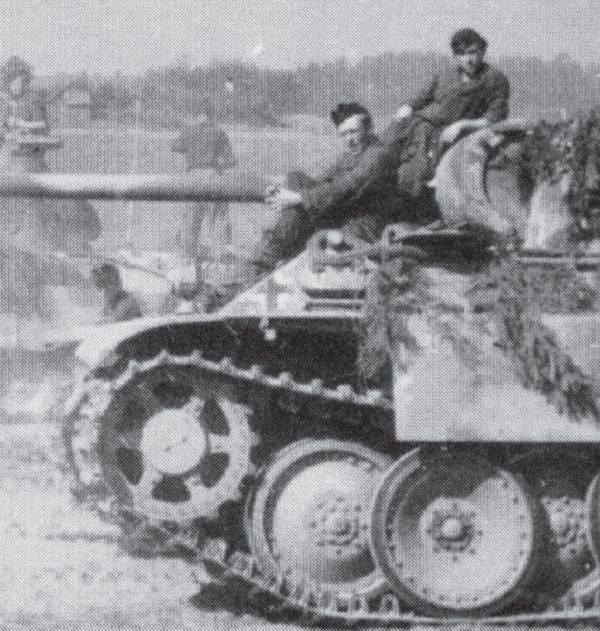
Two Panther tanks from the 4th Panzer-Division east of Warsaw at the beginning of August 1944. Note the extra camouflage which is draped on both vehicles. Apparently, the Luftwaffe wasn’t totally to be relied on! (Leandoer & Ekholm Archive)
On August 3, Gruppe “von Saucken” placed even more pressure on General Vjedjenjejev’s increasingly weakened 3rd Tank Corps. After the tank attacks, came aerial assaults with SG 1s and SG 77s, along with intensive artillery bombardment. However, the Soviet troops were not completely chanceless. What they plainly lacked were fuel and ammunition, but around Wołomin they organised a defence by making use of close to 100 tanks. The terrain was favourable to making anti-tank ambushes, but the fighting was hindered by hilly terrain and marshy wet lands. General von Saucken attacked from the north with a Kampfgruppe from the 4thPanzer-Division; from the west with the 19th Panzer-Division and a portion of the “Herman Göring”; and from the east with units from the 3rd SS-Panzer-Division “Totenkopf.” The 5th SS-Panzer-Division “Wiking” attacked the 8th Tank Guards Corps east of Okuniew. General Popov’s forces also launched offensives. The Soviet forces tried to improve their situation along the Michałów-Okuniew-Sulejówek line. Controlling this line would ensure contact with those units fighting at Wołomin.
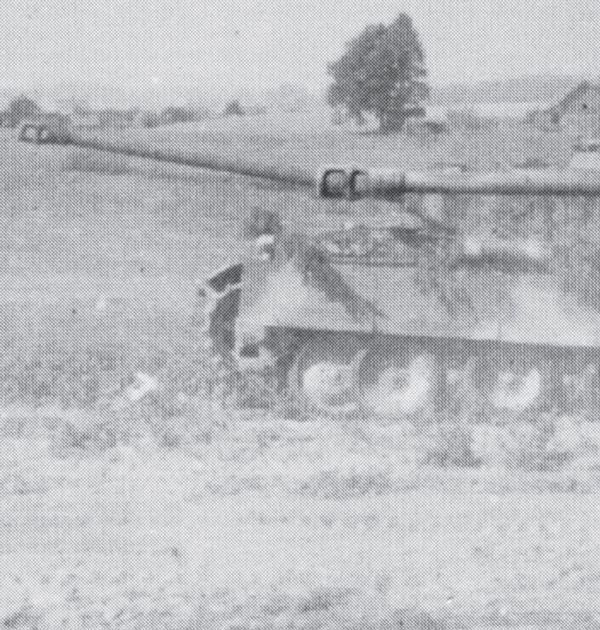
For the entire day, the 3rd Tank Corps held their positions outside Wołomin at the cost of some tens of tanks, but they also caused significant losses to the German forces. Reports from Gruppe “von Saucken” tell of heavy fighting having taken place. In Gruppe “Herman Göring’s” daily report, special mention is made of the III Panzer-Abteilung “Herman Göring” 10th Company, under Captain Bellinger’s command, which apparently had destroyed as many as 36 enemy tanks. Panzer-Regiment 35 from the 4th Panzer-Division reported the elimination of 14 Soviet tanks. However, in the commander of the 2nd Panzer-Army’s report made some four weeks later it states that, on the day of the engagement at Wołomin, 47 tanks were lost as well as six 7.62 cm guns, two 5.7 cm guns, a 12 cm mortar, two motorcycles (footnoted as having been crushed), seven 8.2 cm mortars, along with 12 vehicles. By that evening, it was apparent to General Vjedjenjejev that it would be impossible to hold the town any longer. He ordered his troops to withdraw south through Leśniakowizna. During the night of August 3, the Soviet troops left Wołomin and after having marched through the woods along the Długa Brook, they reached the 8th Tank Guards corps’ position. A part of the heavy war-equipment was evacuated, among other things, some tens of tanks. These were probably driven away on a forest road via Łysa Góra.
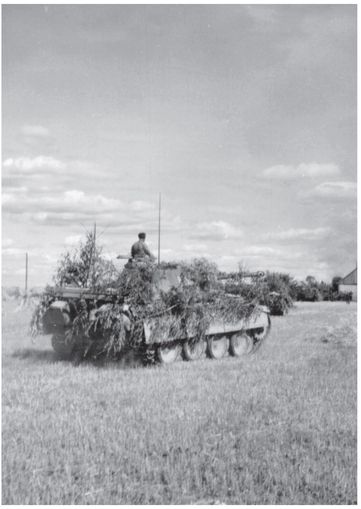
Command tank, PzBfWg V “Panther” Sd Kfz 267, from the company staff’s Panzer-Regiment 35. The photo is probably taken during fighting in the vicinity of Radzymin during the first ten days in August 1944. (MWP)
A command vehicle PzBfWg V “Panther” Sd Kfz 267 from the Company Staff’s Panzer-Regiment 35. The picture is probably taken during fighting in the vicinity of Radzymin during the first ten days of August 1944. (MWP)
On the morning of August 4, General von Vormann informed General Field Marshal Model that the 3rd Tank Corps had been destroyed, although it actually had not been completely neutralised. The commander of Heeresgruppe “Mitte” made a mistake here caused by the successive and, for every passing day, increasingly serious crisis emerging outside Magnuszew. At this point in time, the most vital concern for Model was the 8th Guards Army’s attack on his frontline troops. On August 3, the enemy had namely concentrated nearly nine rifle divisions, a tank brigade, plus two “assault-gun and tracked-artillery” regiments on the German forces. He then gave the order that the combat forces in Gruppe “von Saucken” be divided into two independent combat forces. A portion of the 19th Panzer-Division, together with “Hermann Göring,” would cross over the Wisła at Pilica while two Waffen-SS panser divisions would guarantee that stability was maintained in moving towards Praga. The 4thPanzer-Division was also to be withdrawn.
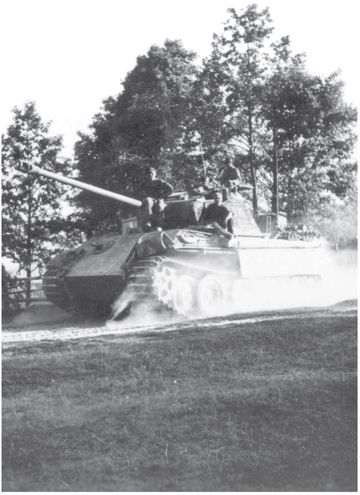
A tank, model PzKpfw V Sd Kfz 171 “Panther” Ausf. G, from the I Panzer-Regiment 35, August 1944. (MWP)
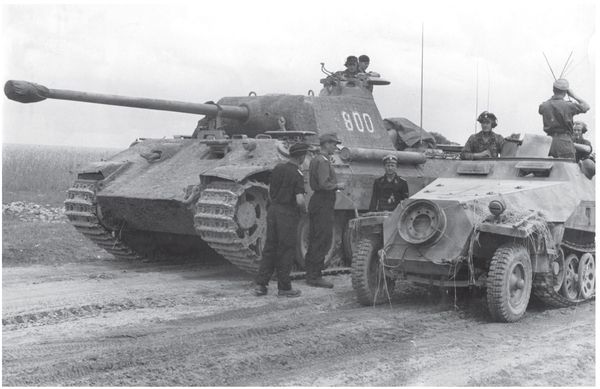
A tank, model PzKpfw V Sd Kfz 171 “Panther” (“800”), belonging to the commander of the 8th SS-Panzer-Regiment 5 “Wiking,” SS-Obersturmführer Karl Nicolussi Leck, Radzymin region August 1944. (ADM)
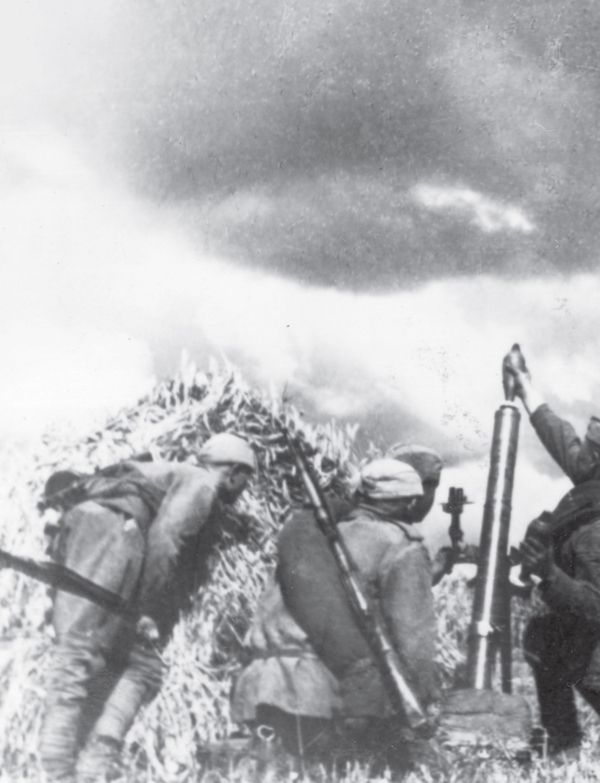
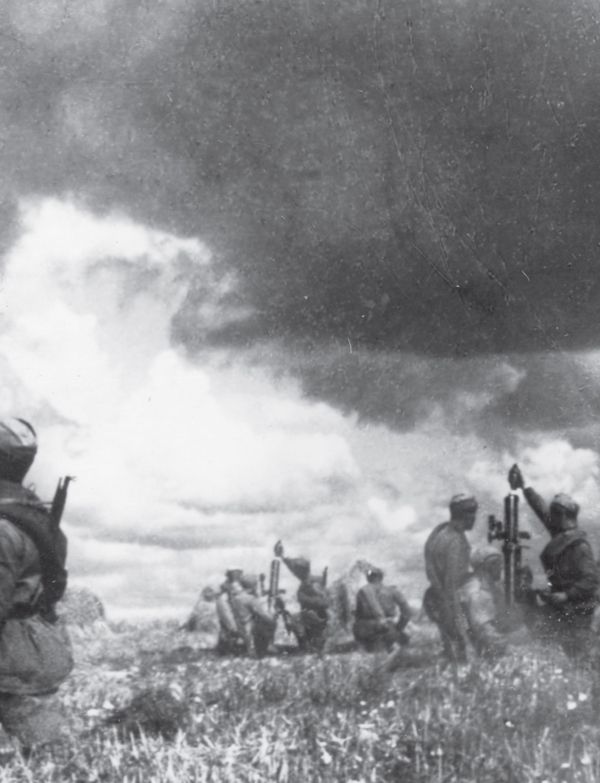
A Soviet 8.2 cm calibre mortar, model 1938, in the vicinity of Warsaw, August 1944. (WAF)
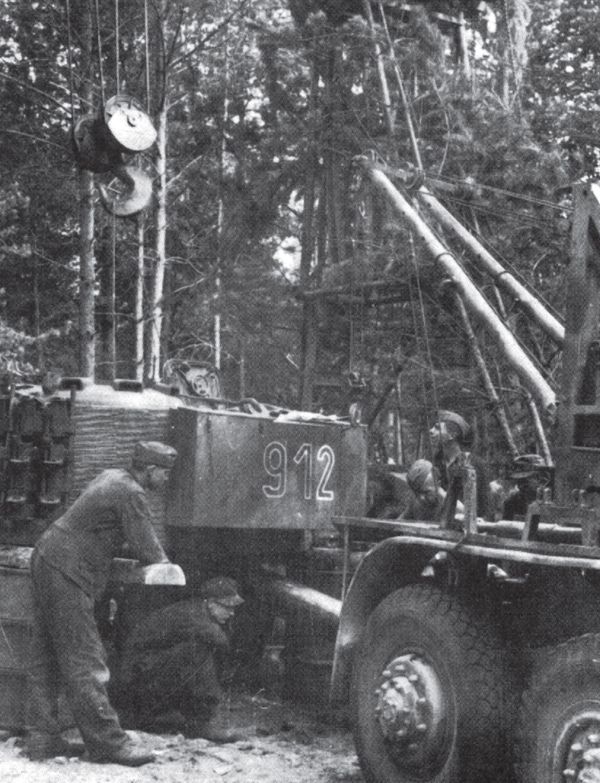
A Tiger tank under repair, serial nr. “912” from the 9th SS-Panzer-Regiment 3 “Totenkopf”, the Slupno region, August 1944. (Bundes-Archive)
This order began to be implemented almost immediately after it had been given. Fallschirm-Pz. Gren. Rgt. 2 “Hermann Göring” – which had only just now completed its consolidation and had not participated in the fighting in Praga – was sent towards the frontline troops. A panzer grenadier battalion from the Panzer-grenadier-Regiment 74, supported by a column of PzKpfw IV tanks, left on the same day through a Warsaw in violent revolt. The Germans’ objective was to makes their way into the city, in which they were only partly successful and only at a heavy cost of lives.
The rest of General Källner’s division and the “Hermann Göring” left the battlefield a short while later. General von Vormann decided to continue pursuing the battle outside Praga until at least August 5. In this way, he could capitalize on the successes he had thus far achieved, thanks to the formidable consolidation of combat strength. On August 4, an attack was launched from the Wołomin area in a southerly direction against a Kampfgruppe from the 19th Panzer-Division and “Hermann Göring.” The Germans attacked the 8th Tank Guards Corps’ position (60th Tank Guards Brigade, 59th Tank Guards Brigade, and the 28th Mechanised Guards Brigade) outside of Okuniew along both banks of the Długas River. In carrying out this attack they sought to drive yet another Soviet tank corps away from the suburbs of Praga. The difficult terrain and the strong defences hindered the attack. The I Panzer-Regiment 35 and the II Panzergrenadier-Regiment 12, for example, could not force a break in the 59th Tank Guards Brigade’s position in the area around Zabraniec, though they spent an entire day in the attempt. At this same time-point, troops from the 3rd SS-Panzer-Division “Totenkopf ” began an offensive against Okuniew from the east through Pustelnik and Michałów. This attack, despite some initial success outside Michałów, was also bloodily thrown back. The battles conducted by Becker’s division received no support from units of the 5th SS-Panzer-Division “Wiking” for the reason that, on August 4, this force had been drawn into the fighting outside Staniławów by the 77th Rifle corps from the Soviet 47th Army. Despite a dearth of successes on this the 4th day of August, that very day the Wehrmacht reported 76 Soviet tanks as having been destroyed (this figure probably reflects the total number of wrecks recorded outside Wołómin).
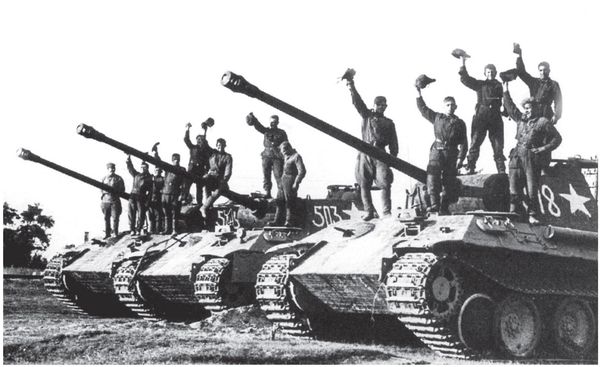
Three captured Sd Kfz Panther ausf A’s in working condition east of Warsaw in August are ordered into action around Praga under the command of Lieutenant Sotnikov. (Leandoer & Ekholm archive)
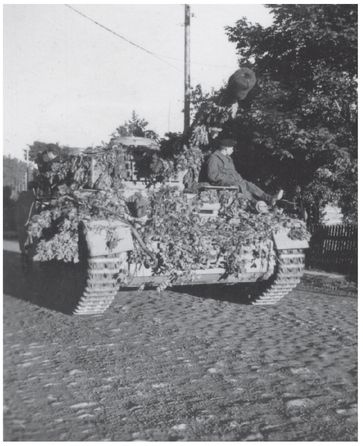
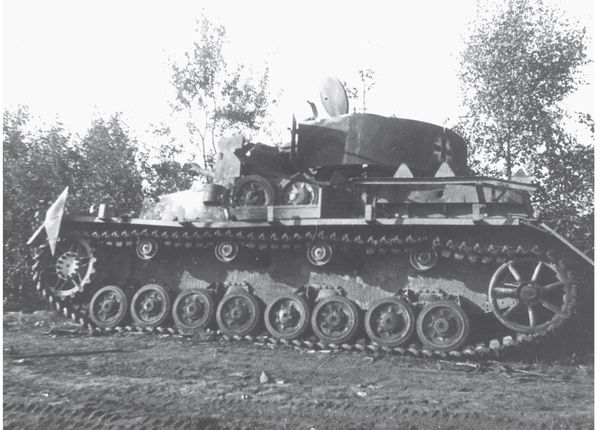
A well camouflaged tank, model PzKpfw IV Sd Kfz 161/2 Ausf. H, from the II Panzer-Regiment 35. The photo is probably taken during fighting in the vicinity of Radzymin during the first ten days of August 1944. (MWP)
A destroyed tank, model PzKpfw IV Ausf. H, from the SS-Panzer-Regiment 3 “Totenkopf”, Radzymin region, August 1944. (Janusz Ledwoch)
On August 5, the 19th Panzer-Division’s began a westward march across the bridges of Warsaw and Modlin. The Soviet 47th Army’s (less the 125th Rifle Corps) sudden attack against the 5th SS-Panzer-Division “Wiking,” which had begun along the road towards Siedlce, forced the German side to withdraw both Waffen-SS Panzer Divisions that same day from the battles directed against the 8th Tank Guards Corps. They now made battle-ready and manned defensive positions between Stanisławów and the Liwiec River. Left to oppose the 8th Tank Guards Corps in this tank battle, there now remained only sections out of Division “Hermann Göring” plus the Kampfgruppe from the 4th Panzer-Division. Together, they launched an attack to the north and northeast against the 8th Tank Guards Corps’ positions outside of Okuniew. The 4th Panzer-Division noted only insignificant territorial gains, while the Luftwaffe’s grenadiers were wiped out under intense fire from positions manned by the Soviets at the start of battle. General Popov, who still had considerable combat resources at his disposal, organized a counter-attack with the aim of retaking their original positions. Thanks to his successes (the 4th Panzer-Division lost 11 tanks), by evening, the front was back to the situation as it had been on August 4. And since at the same time this was taking place, General von Saucken received orders to immediately re-deploy Division “Hermann Göring” to Magnuszew, he had also lost any opportunity of carrying out further attacks on the enemy.
The commander of the 4th Panzer-Division, General Betzel, in an armoured transport vehicle, Sd Kfz 251/6. The photo is probably taken during fighting in the vicinity of Radzymin during the first ten days of August 1944. (MWP)
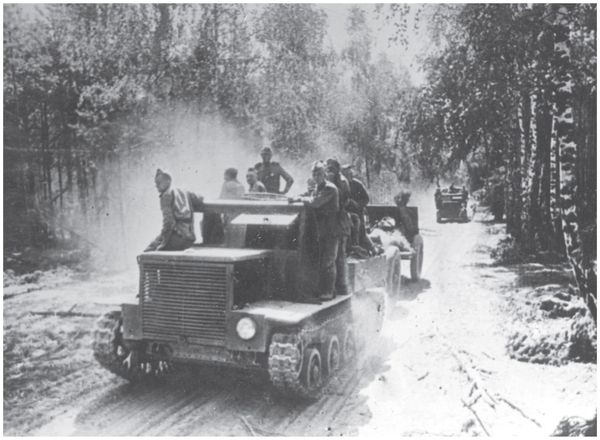
A Soviet artillery, tracked tractor, model JA-12, tows a 12 cm howitzer 1907/30 toward the front, summer of 1944. (WAF)
On August 6, the remaining German units withdrew from the area around Okuniew and were replaced by the 73rd Infantry-Division and the 1131st Grenadier-Brigade. Still positioned outside Zabraniec was the artillery-reinforced Panzergrenadier-Regiment 12, which the 4th Panzer-division I Panzergrenadier-Regiment 33 attached themselves to. Tanks from the 35th Army, on the other hand, were sent back to Wołomin for repairs. The 8th Tank Guards Corps held its positions and the tank battle was about to end. General Radzjijevskij did not restart hostilities but instead ordered that the 3rd Tank Corps be reorganised, and that the positions occupied by the 8th Tank Guards Corps be defended – nor could he commit the 16th Tank Corps: As late as August 4, General Dubovoj’s corps, acting on orders from Rokossovskij, had started a withdrawal from Warsaw’s suburbs – and instead – he redeployed them to the bridge emplacement outside Magnuszew. The area outside Praga was transformed into an enormous battlefield, littered with the wrecks of close to 300 tanks and tracked artillery.
Paradoxically enough, when the battle was over, i.e. on the morning of August 6, the Soviet side still held an advantage in terms of armoured combat vehicles versus the enemy on the frontline at Warsaw. General Popov’s 8th Tank Guards Corps still possessed 126 tanks, and the beaten 3rd Tank Corps had 50, (the figure, 44 tanks and 12 tracked assault guns is also supplied). In addition, the independent units from 2nd Tank Army could also despatch a further 24 (19) vehicles into battle. Between Okuniew and Mińsk Mazowiecki the Soviet forces had, all told, over 200 tanks and tracked artillery at their disposal. On August 6, the 2nd Tank Army still had between 334 to 373 armoured vehicles at their disposal, including the withdrawn 16th Tank Corps (134-166 vehicles). But the Soviet soldiers were completely exhausted and their tanks in urgent need of repair. Heavy losses had been suffered. Between July 29 and August 6, it’s not unlikely that as many as 340 tanks and tracked artillery vehicles were put out of action. Calculated beginning from July 18, this mounted to a total loss of close to 470 armoured vehicles (destroyed, damaged, or otherwise non-functional). Over August 2 and 3, when the most intense battles were raging, the Soviet Army lost several score of tanks each day as a result of artillery fire, air attack, and direct battle.
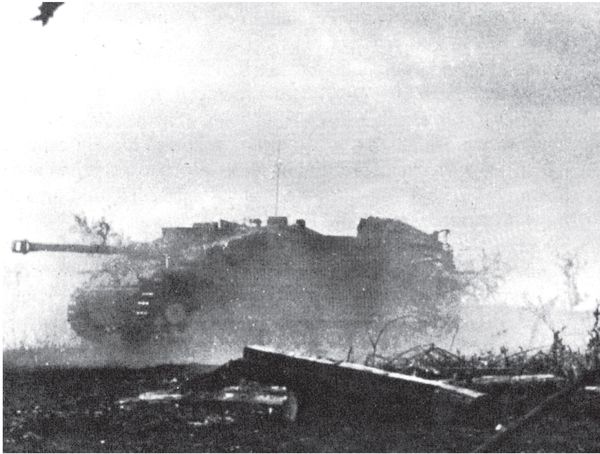
Assault-guns of model Stug 40 Sd Kfz 142/1 Ausf. G from an undetermined unit on the eastern front, summer of 1944. (CAW)
Precisely determining Soviet tank losses, however, is difficult. In the Wehrmacht’s official report of August 6, it states that during the battle for Radzymin and Wöłomin 192 enemy tanks and 45 guns were destroyed. In another report from the 4th Panzer-Division dealing with the fighting that took place between August 2 and August 9, there appear – under the heading “divisional successes” – notations listing enemy losses mounting to 108 tanks, 2 tracked gun vehicles, 65 artillery and anti-aircraft guns, and a great deal of other war material, as having been destroyed. The information contained in General Radzjijevskij’s report of August 28 reports only 116 tanks as having been irreparably destroyed during the first week in August. It primarily concerned tanks from the 50th and 51st Tank Brigades which had been abandoned in German controlled terrain. Both brigades, in fact, were split up and their wounded commanders (Major Fundovnoj and Colonel Mirvoda, respectively) were captured.
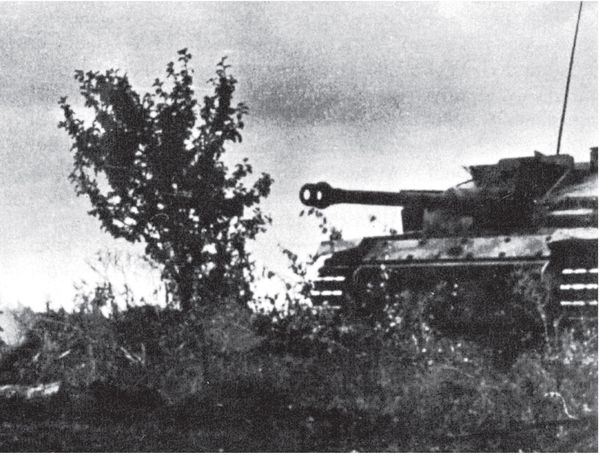
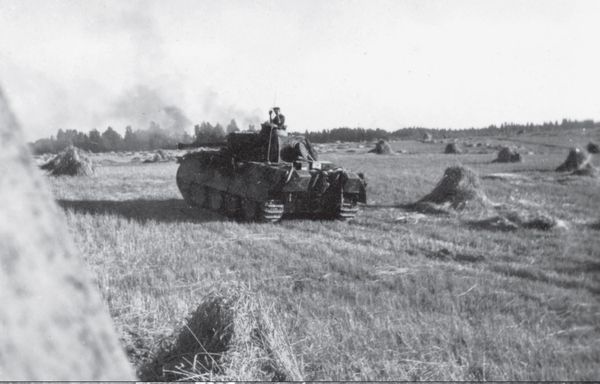
One of the PzKpfw V Sd Kfz 171 “Panther” tanks Ausf. G from the I Panzer-Regiment 35, during fighting in August 1944. (MWP)
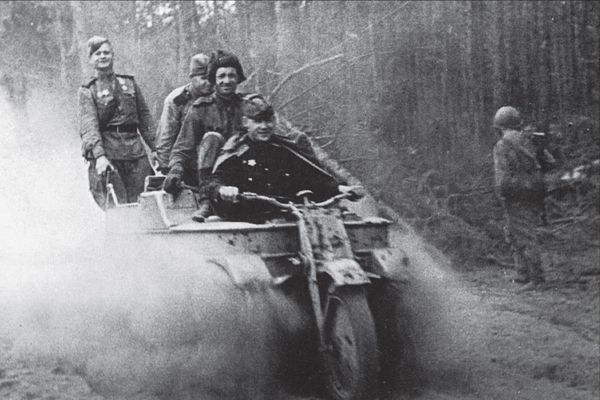
Soviet soldiers test-drive a captured NSU HK 101 “Kettenkrad”, a tracked motorcycle. The photo was taken in August in the woods outside Warsaw. (Leandoer & Ekholm Archive)
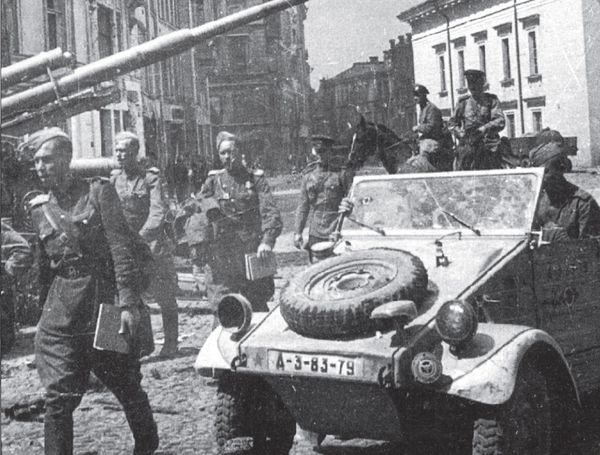
A VW Kfz 82 “Kübelwagen” with “new” owners. The picture was taken in Lublin, July 1944. Leandoer & Ekholm Archive).
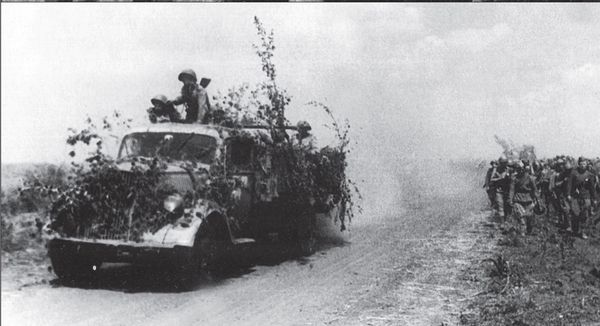
An Opel Bliz 3.6-36s under new ownership, July, 1944, Eastern Poland. (Leandoer & Ekholm Archive)

The majority of the 8th Tank Guards Corps’ “destroyed” tanks, on the other hand, were rather quickly repaired and, after the assignment of new crews, sent back into action. Human loss of life (only tank personnel?) in the 2nd Tank Army mounted to 409 men, killed by either guns or fire, 127 wounded and 589 “missing without a trace.” Some of the wounded Soviet soldiers, thanks to help furnished by the local population, were able to make their way back to their units. To what extent the commander of the 2nd Tank Army’s report is reliable remains an open question.
The Germans also suffered significant losses. On August 6, within the 19th Panzer-Division there remained only 28 battle-worthy tanks, while the 4th Panzer-Division had only 40. The Waffen-SS divisions, which had fought at the front for almost a month, had at their disposal 56 tanks within the 3rd SS-Panzer-Division “Totenkopf” and 45 tanks in the 5th SS-Panzer-Division “Wiking”. The elite division “Hermann Göring” which had been sent into battle a week earlier, reported only 51 combat-ready tanks (although these statistics are based on the original German reports, they do not include tracked gun vehicles; nor is it known if the 19th Panzer-Division’s complement refers to the whole division or only to the II Panzer-Regiment 27). Given this, it’s possible to calculate that Gruppe “von Sauckens “ divisions could have lost as many as 100 to 150 of their own tanks during the course of battle, but this is only a hypothetical number. It is simply not possible to confirm how many vehicles fell victim to the 2nd Tank Army and how many were disabled due to motor failure. The 4th Panzer-Division’s complement, for example, is a case in point. At the start of August, the divison had 45 PzKpfw IV tanks, 40 PzKpfw V “Panther” tanks, 12 Jagdpanzer IVs, 10 Marder IIIs, as well as 237 other transport and armoured vehicles. In addition to these combat-ready vehicles, 38 PzKpfw IV tanks, 18 Panthers, and 74 transport vehicles were undergoing repairs. On August 6, only 20 Pzkpfw IVs, 20 “Panthers,” 10 Panzerjäger IVs and 6 “Marders” were reported as operational. This indicates that over the course of six days of fighting and marches, Panzer-Regiment 35, consisting of two tank battalions, lost at least 45 vehicles – which is to say, over 50% of their entire complement. Undoubtedly, the regiment’s combat strength increased when the damaged military equipment had been repaired. According to General Radzjijevskij the Germans should have lost 273 tanks, 100 armoured transport vehicles and 8,000 troops killed in action. These figures are widely over-exaggerated, especially when compared with the number of German POW’s taken – only 138, in total!.
Model PzKpfw IV tanks and vehicles from Panzer-Regiment 27, 19th Panzer-Division, Eastern Front, August 1944. (CAW)
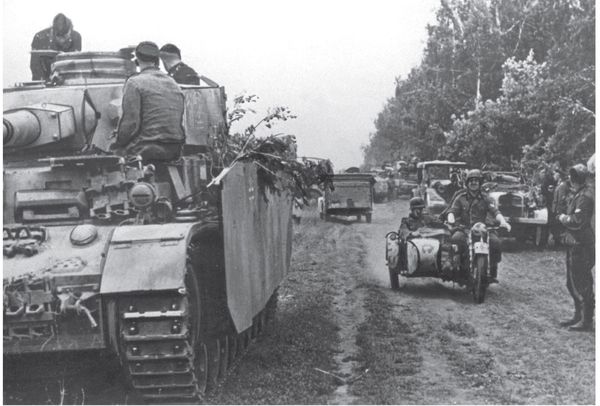
After the departure of the two divisions towards Magnuszew, the German 9th Army, together with the 2nd Army, succeeded for a period of time in holding the entire Warsaw isthmus with a mobile combat force numbering approximately 200 armoured vehicles (the 3rd SS-Panzer-division “Totenkopf”, the 5th SS-Panzer-Division “Wiking”, and the 4th Panzer-Division). Even though the repair and recovery crews towed away the disabled tanks from Radzymin and Wołomin and were subsequently able to return a portion of them back into battle, the total number of German armoured vehicles in Praga’s suburbs was very low at the beginning of the second week in August. After the withdrawal of the 4th Panzer-Division on August 8-10 to the vicinity of Modlin and Nasielko, opposition to General Popov’s 150 tanks along the Okuniew-Stanisławów line consisted of only a very few score tanks belonging to the enemy’s 5th SS-Panzer-Division “Wiking” (the 4th Panzer Division had been despatched to Kurland).
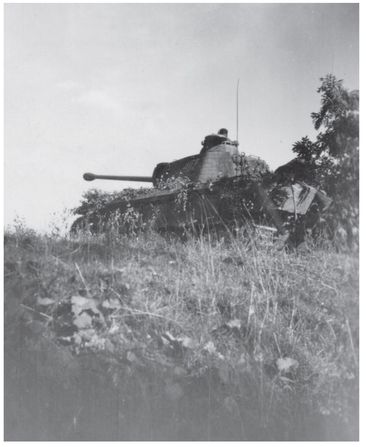
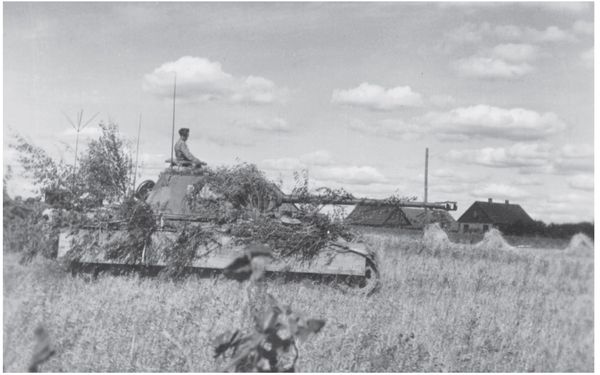
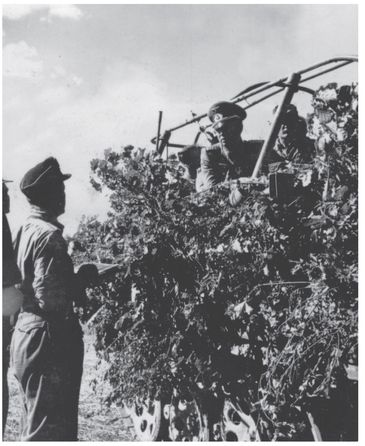
A PzKpfw V “Panther” tank camouflaged with bushes from the I Panzer-Regiment 35, at a “jump off” point prior to an assault, August 1944. (MWP)
A battery of “Hummel” tracked artillery from the SS-Panzer-Artillery-Regiment 5 “Wiking” in combat, Poland, summer of 1944. (CAW)
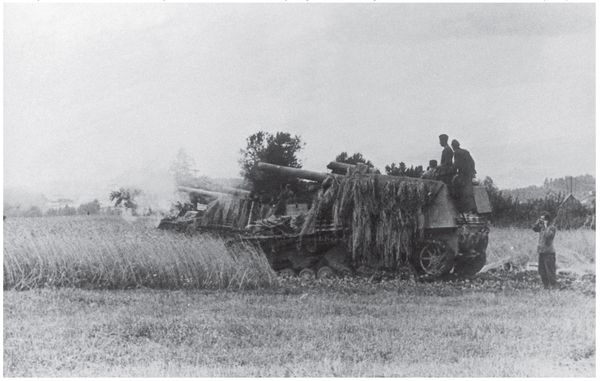
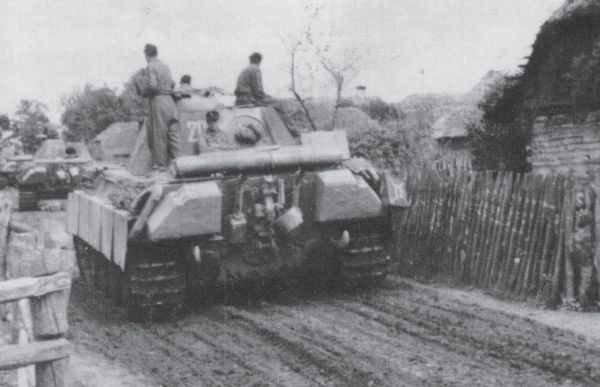
Three Panthers drive through a village on their way to the front. Air superiority has probably been established or, alternatively, the crew feels over-confident, given their relaxed posture on the deck of the last tank. The vehicles hail from the 2nd SS-Panzer-Regiment 3 “Totenkpf”. The location is east of Praga, August 1944. (Leandoer & Ekholm Archive)
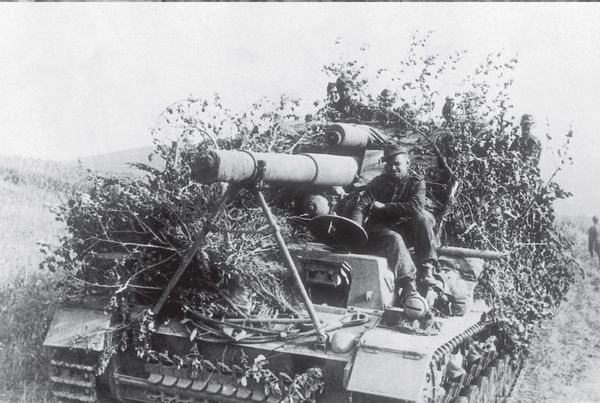
A tracked artillery gun, 15 cm sFH 18/1 Fgst auf Gschw III/IV “Hummel” from an unknown unit, Eastern Front, Summer 1944. (CAW).