
Throughout the month of August, Stalin, as has already been mentioned, deliberately held back the storming of Praga since it clearly risked hindering the Germans from pacifying Warsaw, despite the unspeakable brutality of their methods. Nor did he, notably enough, make a secret of this reasoning which he wrote of in his letters to the leaders of the western powers. The dictator’s wording concerning “the public distancing from the Warsaw-disturbance” – together with his order concerning the denial of allied landing rights – was an openly hostile policy towards the Uprising. However, such a clearly spelled out perspective, which also served as clear evidence of his capacity for grim and mercilessly cold calculation, came to provoke strong exception in the western press. Political relations with Great Britain became extremely strained and the USA’s ambassador in Moscow talked about his “serious concerns regarding the Soviet government’s position.”
In this sensitive atmosphere, Stalin consulted with the officers at headquarters toward the end of August about near-term operational plans. STAVKA at this time had its attention primarily focused on the Romanian front and the planned new offensive in the Baltic States which was to be carried out in the very near future. Zjukov asserted that the 1st Ukrainian Front and the 1st Belorussian Front had already exhausted their resources with respect to offensive warfare, which was also reflected in the order dated August 29, directing a tactical shift to defensive warfare and consolidation. This order, in practice, merely sanctioned the prevailing situation. Zjukov’s order encompassed not only the right flank in Marshal Rokossovskij’s front, which should make every strain necessary to reach the Narew and take the well defended bridgeheads on its west bank (this was the purpose of the fighting between Wyszków and Radzymin). According to the commander’s representative, one of the considerations behind this operation was the necessity of also storming Praga itself, primarily to even out the front and improve the tactical connection between the flanks of Marshal Rokossovsk’s forces. STAVKA already possessed information concerning the stubborn defence mounted by the IV SS-Panzer-Corps and consequently wanted to eliminate any possible threat from the enemy panzer corps. And lastly, the prospect of success for the fighting along the Narew was partly dependent on the continued presence of the German’s 9th Army along the Wisła – a factor that materially hindered it from being used as a support force to the 2nd Army,
Stalin approved Zjukov’s plans. Marshal Rokosovskij, after regrouping his troops, would storm Praga, clear the area surrounding the Narew’s entry into the Wisła, from this join to Modlin, and then shift from attack to defence of the river’s eastern bank. Help to the crumbling uprising was not a consideration in the planning. The attack, scheduled to commence September 10, was to be carried out by the 70th and 47th Armies, along with the 8th Guards Tank Corps. With regard to the 28th Army, the decision was made that it would no longer be a part of the 1st Belorussian Front. Instead, it would be moved north to join the planned fighting in East Prussia. The 28th Army was finally relieved on September 8, and left the outskirts of Warsaw as late as the evening prior to the storming of Praga.
On September 4, the British War Cabinet communicated its special decision to Stalin, where, among other items, it read::
“The War Cabinet wishes to inform the Soviet government that public opinion in this country is deeply outraged over the events taking place in Warsaw and the terrible suffering of the Poles […] The British people cannot understand the motive for not sending relief with aid and materials to the Poles of Warsaw. The fact that this material could not be sent because You refused to grant Your permission for American aircraft to land on airfields within Russian areas is on the threshold of becoming a matter of general public knowledge. [...] The War Cabinet, itself, cannot understand Your government’s refusal [...] Your government’s actions in hindering aid assistance, we regard as not being consistent with the spirit of cooperation required between allies, in which You, as do we, today, and in the future, place such a considerable measure of weight.”
In diplomatic terms this was a serious warning, a threat of sanctions. Stalin was, of course, dependent on military aid from the west, particularly with regard to modern industrial equipment. He had also approved the original concept of storming Praga and, at first, had ordered the reinforcement of the 1st Infantry Division’s 47th Polish Army (according to the operational order issued on September 5) and then, on September 11, the withdrawal of the entire 1st Polish Volunteer Army from Magnuszew and its re-deployment, in the 47th Army’s wake, towards Warsaw. The dictator sought in this way to show his goodwill towards the Uprising, and by having engaged the use of Polish troops even indicate that the capital should indeed be freed by the Poles themselves. On September 10, he also withdrew his order not to grant allied planes landing rights on Soviet airfields, and ordered the Soviet Air Force to take complete control over Warsaw’s airspace. On September 13 1944, the first airborne weapon delivery was parachute-dropped to the resistance men.
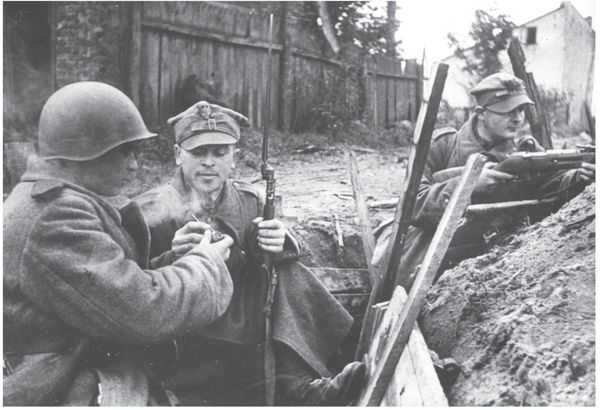
A propaganda photo which depicts Polish/Soviet comradeship, Warsaw-Praga, September 1944. (WAF)
On September 9, Marshal Rokossovskij received reports from Generals Popov and Gusiev that their armies were ready to conduct further attacks on Warsaw. On the same day, the Soviet bomber wing launched heavy raids on positions held by the 73rd Infantry-Division and the Hungarian 1st Cavalry Division. Intensive reconnaissance of German positions in the IV SS-Panzer-Corps area was carried out, with the intent of disorientating the opposition with regard to the main direction of attack. This succeeded because, even as late as September 7, von Vormann reported that “ – an attack is expected from the 70th and 28th Armies against the 9th Army’s left flank, as well as from the 47th Army against Praga.” The German High Command thus perceived the greatest threat to be in the north, although the 8th Guards Tank Army on September 6 was re-deployed from the 70th to the 47th Army. It wasn’t until September 9 that German reconnaissance flights observed this Soviet troop movement and then noted it in reports. The following day the offensive was launched.
Early September 10, the two sides were deployed as follows. On the German side along the Zbytki – Międzylesie – Stara Miłosna – Wesoła line stood the 73rd Infantry-Division: Between Wesoła and Zielonka stood the Hungarian 1st Cavalry Division: In the forests between Zielonka and Słupno, the 3rd SS-Panzer-Division “Totenkopf” was stationed, and in the terrain stretching from the village of Sieraków to Rynia, the 5th SS-Panzer-Division “Wiking” – less SS-Panzer-Regiment “Wiking.”
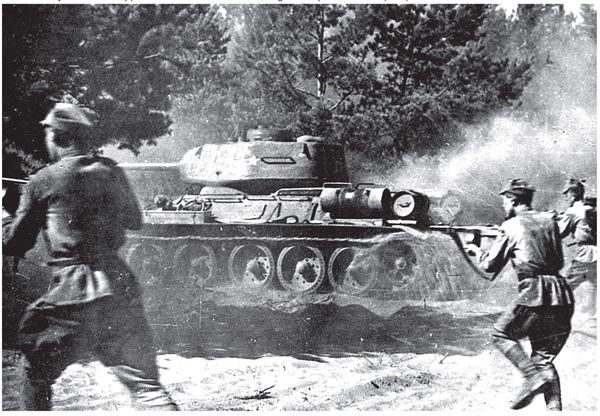
Polish infantry attack with support from Soviet T-34/85 tanks, August – September 1944. (WAF)
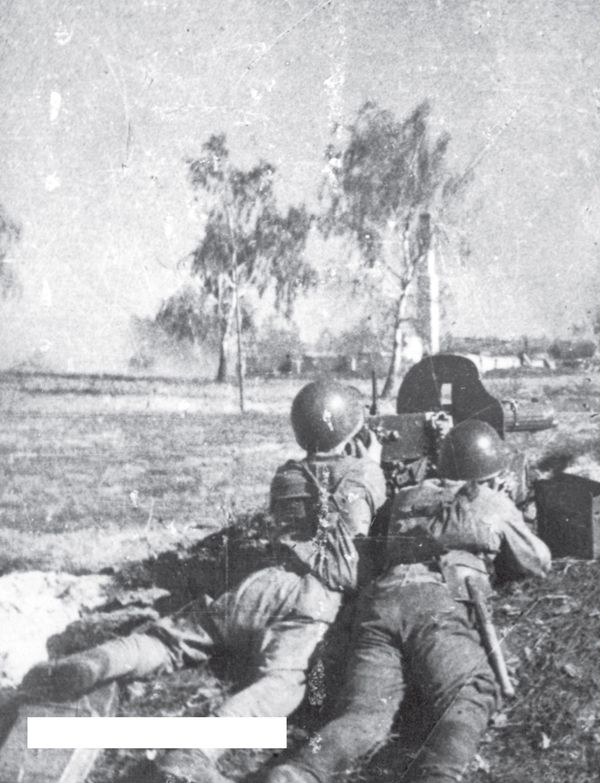
A Polish Maksim machinegun (model 1910) being fired from a 1st Infantry Division position at Anin in September 1944. (WAF)
The list of all the units comprising the IV SS-Panzer-Corps included:
· Eisenbahn Panzerzug Regiment 1
· The II and IV Batteries from the 102nd Werfer-Regiment (from the 300th Festung-Werfer-Brigade),
· Kommando 9th Army Sturm-Battalion (except the 1st Company)
· The 9th and 421st Festung-Pionier-Battalions
· The 2nd and 4th Companies, 737th Festung-Pionier-Bataillon
· The 2nd Company, 5th Festung-Pionier-Ausbildungs-Bataillon
· The 500th SS-Jäger-Battalion
· The 5 II, 1 VI, 2 VI and 4 II Flak-Festungs-Companies
· The 23rd Festungs-MG-Battalion
· The 73rd Infanterie-Division (except the 73rd Machinegun Battalion and parts of the 1886th Infantry Regiment) along with the subordinate 745th Panzer-Jäger-Abteilung, 2./475 Panzer-Jäger-Artillerie-Abteilung
· The 1st The Royal Hungarian Cavalry Division and the unit subordinated to them, schwere Artillerie-Abteilung 154
· The 3rd SS-Panzer-Division “Totenkopf” and
· The 5th SS-Panzer-Division “Wiking” along with its subordinated units: the 1145th Grenadier-Regiment, the 560th Infanterie-Abteilung z.b.V as well as the 1405th Infanterie-Festungs-Bataillon.
Their opposition included: the 47th Army, the 70th Army, the 8th Guards Tank Corps (the 58th Guards Tank Brigade, the 59th Guards Tank Brigade, the 60th Guards Tank Brigade, the 28th Guards Mechanised Brigade). The complement and operational positioning of the 47th Army was as follows: the remnants of the 105th Reserve Brigade, as well as the 175th Rifle Division, the 1st Tadeusz Kościuszko-Infantry Division, the 76th Rifle Division, a Rifle Regiment from the 60th Rifle Division (from the 125th Rifle Corps) in the area of Międzylesie-Stara Miłosna. As a reserve for the 125th Rifle Corps, in the vicinity of Michalin stood the remnants of the 60th Rifle Division and the 143rd Rifle Division. The 234th Rifle Division and the 185th Rifle Division were located between Stara Miłosna and Ossów
The Wołomin region was manned by the 129th Rifle Corps which encompassed the 260th, the 132nd and the 328th Rifle Divisions. In the area from Słupno to the Narew we find the 70th Army, with combat forces from the 114th Rifle Corps in the area of Radzymin (160th, 165th and 413th Rifle Divisions) and the 96th Rifle Corps (the 1st Rifle Division, the 38th Guards Rifle Division & the 76th Rifle Corps).
The above summary shows the concentration of Soviet forces in the two most important compass points from which to launch attacks. The first is the southern location around Anin where the following forces were assembled: five infantry divisions, a tank corps, a reserve brigade, and a reinforced artillery. The other was between Wólka Radzymińska and Słupno. Concentrated there, within very small bounds, was the 70th Army’s 114th Rifle Corps. The Soviet command also planned during the course of following days to send the 1st Polish Volunteer Army to fight in the southern sector.
At that time the Polish forces were attached to General Kuzmin’s 125th Rifle Corps. On September 9, 1944, the 1st Tadeusz Kościszko-Infantry Division counted a total of 8,893 soldiers and had at its disposal 102 8.2 to 12 cm, mortars, 37 4.5 cm. anti-tank guns, 36 7.62 cm. guns, 12 12.2 cm. howitzers and 13 assault-guns, model SU-76M, plus 244 vehicles and 1,193 horses. Direct support was provided by the Soviet 13th Light Artillery Brigade, the 23rd Rocket Artillery Brigade, the 30th Heavy Artillery Brigade, the 100th Howitzer Brigade, the 139th Engineer Battalion, the 58th Guards Tank Brigade’s 2nd Battalion (support provided by the Soviet units). Initially, the division only sent selected infantry battalions into combat. As it happened, the Poles opposition in the Anin-area was an infantry battalion from the 73rd Infantry Division’s Infantry-Regiment 70 supported by a battery of 12 cm mortars (incidentally, it can be noted that the German 12 cm mortars, model sGrWr 42, were an identical copy of the mortars used by the Red Army). Longer out on 1st Infantry Division’s attacking shoulder, Artillery-Regiment 173 from the 73rd Infantry-Division was also deployed on the front.
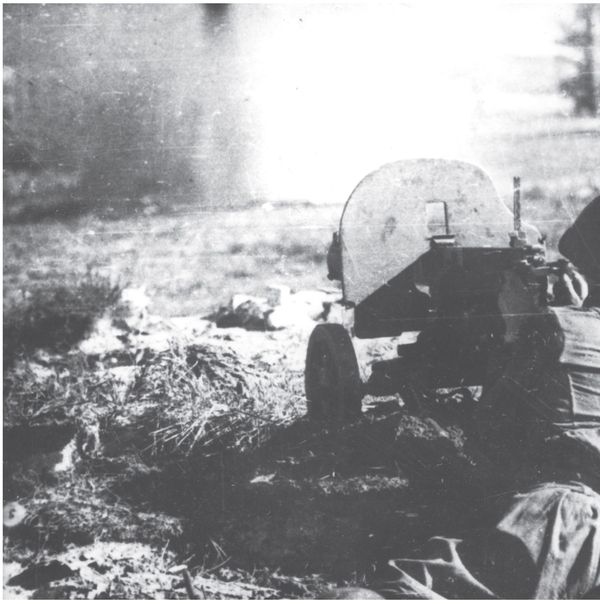
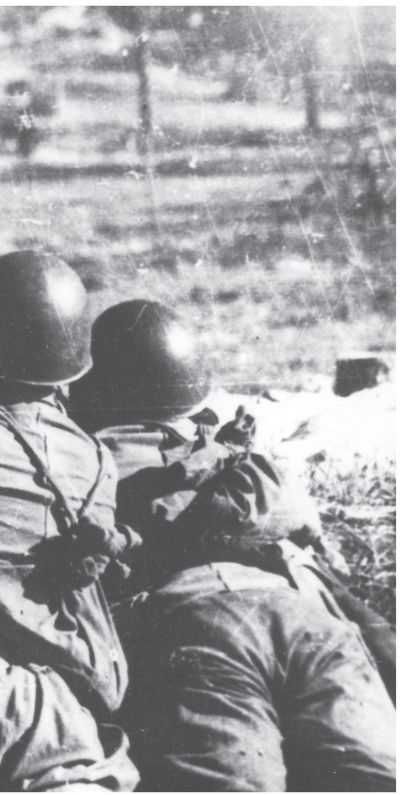
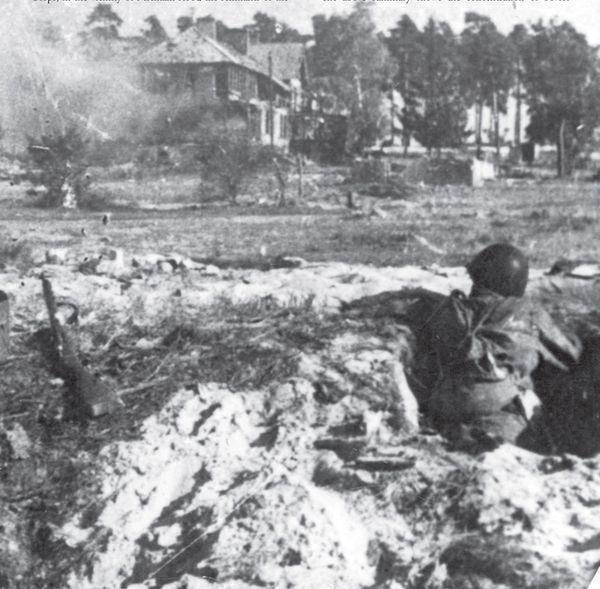
A Polish Maksim machinegun (model 1910) in position in September of 1944. (WAF)
At 10:00 AM, September 10, after a one-and-a-half hour artillery barrage, the 114th Rifle Corps had the honour of being the first unit to open the attack. Once again, intensive fighting broke out at Słupno and at the entry points to the Nieporet-Forest. Troops from the 3rd SS-Panzer-Division “Totenkopf” and the 5th SS-Panzer-Division “Wiking” threw back all enemy infantry attacks, inflicting heavy losses in the process. The vicinity of height no. 104 marked the first incident that took place with consequences that would have dramatic repercussions on both sides: One of the 160th Rifle Division’s regiments, supported by a tank company, fought through the deadly fields of fire and passed the German lines and, when they reached the forest’s main road, set off towards nearby Stanisławów. But when the next wave of Soviet infantry and tanks began to attack the defending force from the direction of Słupno, StuG 40 assault-guns from the 3rd SS-Panzer-Division “Totenkopf” suddenly cropped up near height no.104 and forced the enemy to retreat under massive bombardment. In this way, the lead regiment, which toward evening had been decimated to 150 soldiers and 6 tanks, were separated by the 3rd SS-Panzer-Division “Totenkopf’s” detached rearguard. They fought relentlessly outside Stanisławów – but before dark, the SS- troops had brought them to their knees. At the same time, the main infantry forces from the 114th Rifle Corps had become bogged down in the ruins of the villages of Sieraków and Słupnos.
Events worked out much better for the main forces of the 47th Army. Their attack commenced at 1300 hours along the Wisła, opening with only the 175th Rifle Division. The German, 73rd Infantry-Division met this first attack with violent counterattacks. Soon, however, the entire 125th Rifle Corps joined in the fighting. Thanks to their numerical superiority, which also applied to artillery an anti-aircraft gun support, they eventually were able to crush the enemy’s resistance. The German infantry began to withdraw towards the north. The commander of the 73rd Infantry-Division, Colonel Kurt Hählig, was wounded and lost command of his unit. And though individual battalions attempted to carry out counterattacks – for example, the 76th Rifle Division had, in fact, been beaten back from Stara Miłosna - nevertheless, before the clock reached 1600 hours, the Germans were forced to retire from Anin (godsen Zastów and Sadul). Towards evening, Polish and Soviet infantry began to approach the buildings of Praga’s suburb, Wawer, by fighting their way through on the right-hand side of the railway tracks.
The knowledge that the attack on Praga had now begun forced the commands of the 9th and 2nd Armies to alter their operational plans. The decision to begin attacking the bridgehead at Pułtusk was now conditioned on how the attack outside Warsaw went. General von Vormann halted the march of the 19th Panzer-Division towards Modlin and turned it, instead, directly towards Praga. Panzergrenadier-Regiment 73 and SS-Panzer-Regiment 5 “Wiking”, which were also part of the panzer division’s complement and had thus far been fighting outside Pułtusk, were also commandeered in preparation for battle against Warsaw.
On September 11, tanks from the 19th Panzer-Division rolled into Praga. General Källner, who commanded the division, had been assigned the split 73rd Infantry-Division and gave them the order to halt the enemy attacks. The Germans organised a series of counterattacks. Since the panzer divisions had begun to participate in the fighting successively, the commander had only succeeded in stopping the 125th Rifle Corps’ advance, which as of September 11 had been supported by tanks from the 8th Guards Tank Corps’ tank brigades. That same day, the Soviet formation occupied the city sectors of Wawer, Rembertów and the village of Zielonka. Only during the attack against Grochów, a typical built-up urban area, were they driven back. In addition, the 77th Rifle Division’s infantry was activated and applied hard pressure against the 1st Calvary’s Hungarian positions in the woods north of Rembertów.
In the 3rd SS. Panzer-Division “Totenkopf ’s” area, the 114th Rifle Corps – with support from the 129th Rifle Corps’ 328th Rifle Division – continued fighting. On September 11, the infantry, supported by tanks, again sped towards the Nięporet-Forest. The Soviet units fought their way into the woods taking significant losses under close-combat conditions. The panzer-grenadiers and the Soviet infantry continued to fight on with determination but at the end of the day neither side had succeeded in forcing the other from the wooded area.
On September 12, the 73rd Infantry-Division’s line of defence was broken despite tank support from Panzer-Regiment 27. The German infantry troops fled in panic towards the town. On the road between Anin and Wawer (along the Otwock line) the Polish 1st Infantry Division destroyed the German Artillery-Regiment 173. The only troops left at the German defensive positions were panzer-grenadiers from the 19th Panzer-Division, but due to their meagre number (in the combat companies of both regiments’ four battalions at that time, there were barely 900 soldiers – but Polish records report that only Panzergrenadier-Regiment 74 participated in the fighting), the Poles were able to hold a broad front. An irritated von Vormann wrote that “the opposition’s attack has completely broken through the 73rd Infantry Division’s front […] during the course of two days fighting the division has not shown any fighting spirit whatsoever, and therefore cannot be said to possess any combat value worthy of mention.” The Hungarian soldiers also withdrew from Rembertów in the direction of Zielonka. The 77th Rifle Corps, which followed in their tracks, received support from tanks of the 8th Guards Tank Corps.. General Gusiev, however, had no intention of letting his tank corps get bogged down in street fighting – he only intended them to be used in attacking the city’s suburbs from the flanks. Despite this, individual tank battalions remained in order to support the 125th Rifle Corps.
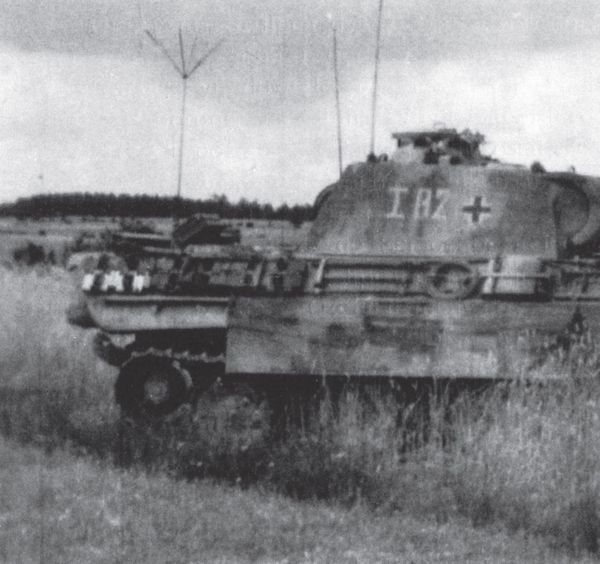
A Panther Sd Kfz from HK-Kompaniet from I/SS-Panzer-Regiment 5. Note the ID no. I02 on the turret which has another camofluage pattern elsewhere in the book. (Leandoer & Ekholm archive)
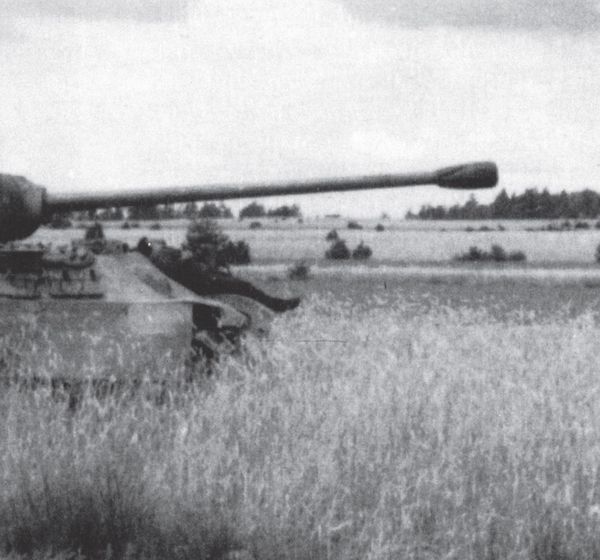
Towards evening, the 175th Rifle Division moved over towards Gocław, while the 1st Infantry Division and the 76th Rifle Division made a northerly detour around the effective defences at Grochów, taking Kawęczyn and closed in on the built up communities of Utrata, Elsnerów and Ząbki. On or about the same time this was taking place, 1640 hours to be precise, Captain Kapuściński from the 1st Infantry Regiment entered Praga’s centre. General Källner carried out several counter-attacks, with the support of tanks, near the city sector Saska Kępa in Targówek: On September 12, in the Polish sector alone, eight such attacks were carried out. But these were thrown back by the 175th Rifle Division’s artillery and the Polish 1st Infantry Division (for defensive purposes, using the 1st Light Artillery Regiment’s direct-target guns). Now the Germans, together with the Hungarian 1st Cavalry Division, tried to organise a new defensive line along the Zielonka – Ząbki – Elsnerów railway. The 19th Panzer-Division carried out a defensive manoeuvre. The commander of the 1st Infantry Division reported that the enemy operated in formations of 8 – 14 tanks supported by one or two infantry companies. What was particularly amazing was that they had identified the “Elephants” company, but naturally the whole business turned out to be a misunderstanding. On the German side, the only success experienced on September 12 was the 3rd SS-Panzer-Division “Totenkopf’s” effective counterattack, which had taken place in the forest near Słupno. Following on a violent grenadier assault supported by tank artillery, the 144th Rifle Corps was driven out of the Nięporet-Forest.
The command vehicle, PzBfWg V Sd Kfz 267 “Panther,” from II SS-Panzer-bRegiment 5 “Wiking” by the bridge across the Wisła in Kazuń, probably in Septemer 1944.
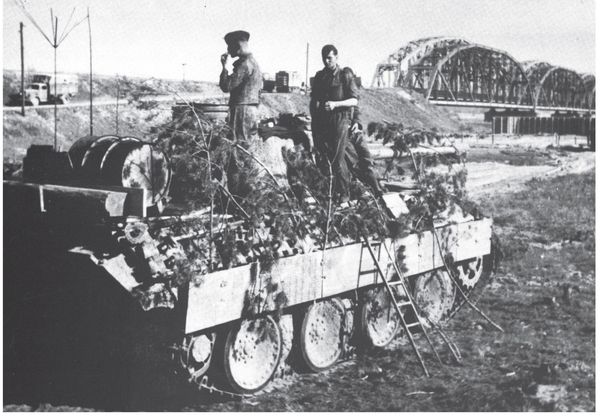
On September 13, at 1000 hours, the Soviet and Polish forces resumed the assault. It began with street battles in Praga. General Wojciech Bewziuk now despatched tanks from the 1st Tank Brigade “The Wester-Plains heroes” to the 1st Infantry Division’s assistance. (the order issued by the commander of the 1st Tank Brigade at 1100 hours indicates that the 2nd Tank Battalion and the 1st and 2nd Batteries equipped with SU-85 assault-guns from the 13th Artillery Regiment were sent into battle). After an entire day of hard fighting against a Kampfgruppe drawn from the 19th Panzer-Division. the 175th Rifle Division succeeded in taking control over the southern part of the city’s sectors of Saska Kępa, Gocławek in Grochów, which prompted the Germans to blow up the Poniatowski Bridge and also to destroy, somewhat prematurely, a railway-bridge. The Polish troops fought in Targówek and reached the area around the East and the Wilno rail stations, and continued the offensive in the direction of the Kierbedź Bridge. Meanwhile, as this was unfolding, the 76th Rifle Division became engaged in intensive fighting with the main force of the 19th Panzer-Division, between Targówek and Zacisze. The German division launched several counterattacks in the Zacisze area attempting to outflank the 125th Rifle Corps storming the buildings of Praga. But in the end, the Germans were forced to give way to Soviet pressure, particularly as during the course of that afternoon the 77th Rifle Corps’ infantry, and tanks from the 8th Guards Tank Corps, had positioned themselves in the neighbouring Zabki-Zeilonka zone.
Defending the city with only one panzer division was, for all practical purposes, an impossibility. The Germans were short infantry sufficient to man all their positions; even though the German Field Police placed the newly trained 73rd Infantry Division’s small units into battle, while the command of the 9thArmy sent what remained of the Panzer-Jäger-Bataillon 475, plus a number of security and training battalions. Clearly, these measures were of doubtful significance when compared with the massive combat forces storming Praga. General von Vormann informed the staff of Heeresgruppe “Mitte” about the situation at Praga, and on September 13, he received permission to withdraw from the centre toward the northern suburbs. The 19th Panzer-Division, remnants of the 73rd Infantry-Division and the Hungarian 1st Cavalry Division were now to form a new defence line from Brudno to Marki. Immediately after this had been organized, the IV SS-Panzer-Corps was instructed to send the Hungarian division to the reserve forces. This order was dictated by the plan to send all in-country Hungarian troops to Hungary. Instead of retaining the weak (Hungarian) cavalry, the plan was to send a Kampfgruppe from the 25th Panzer-Division under the command of Colonel Oskar Audörsch; a formation which had been previously earmarked for combat operations outside Pułtusk. In an effort to neutralise possible Soviet or Polish landing-forces from crossing to the Wisła’s western shore; the German command decided to deploy an elite unit, Fallschirm-Pz. Gren.Rgt.2 “Hermann Göring” (from Magnuszew) to Warsaw.
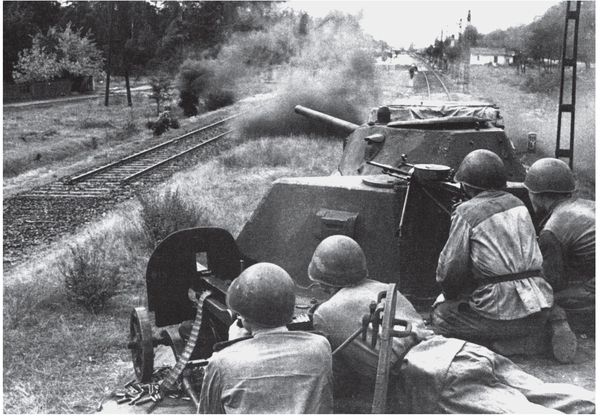
The Soviet armoured train “Ilja Muromjets” from Gorkij’s 31st special armoured troops formation fire on German positions from the station in Anin. September 1944. (WAF)
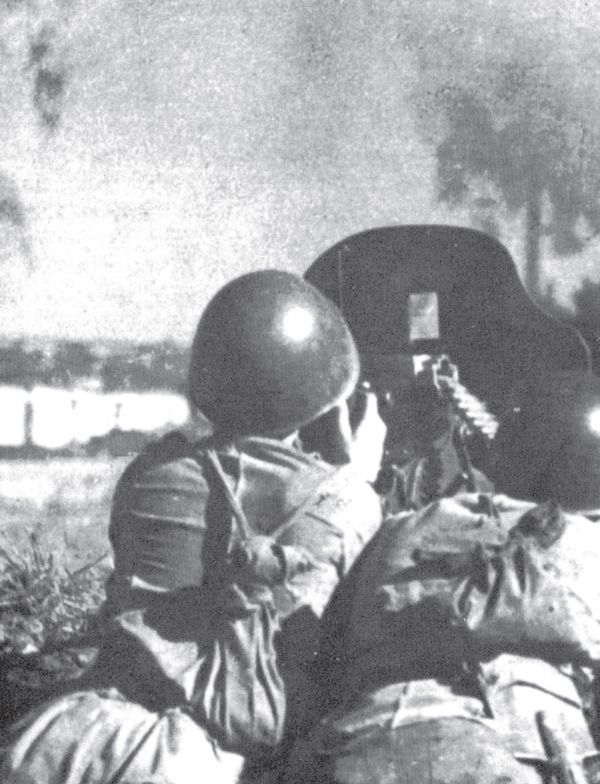
The Polish Maksim machinegun (model 1910) from the 1st Infantry Division’s position in Anin, September 1944. (WAF)
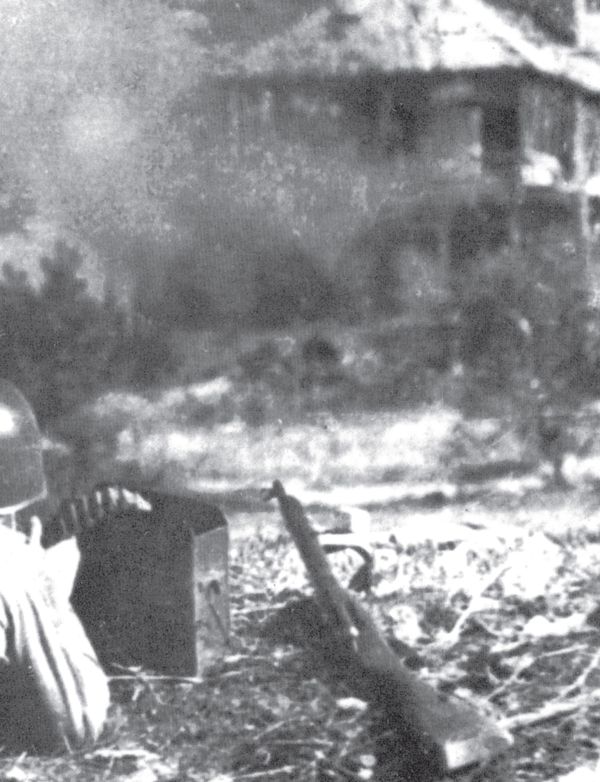
On September 14, large sections of Praga had been liberated. During the night, the retreating Germans had blown up the Kierbedź-Bridge and the railway bridge at Cytadela. At 0500 hours, the 1st Infantry Division’s 2nd Infantry Regiment had control of the Wilno rail station. Intense fighting developed around the bridgeheads, especially in the zoological garden and in the field in front of the railway bridge where the fighting continued to rage throughout most of the following day. In the evening, the IV SS-Panzer-Corps units, which up until then had been defending the city, took up positions along the Bródno – Stare Bródno – Marki line. In the vicinity of Marki, the 3rd SS-Panzer-Division “Totenkopf” had already taken command of the front. The situation for Gille’s corps became critical since all the corps within the 47th and 70thArmies had joined in the combat operations. In an effort to save the situation outside Praga, combat battalions from the Waffen-SS panzer divisions were dispatched there with the thought they would reinforce the Hungarian units or the 19th Panzer-Division. On the morning of September 15, with the support of heavy artillery and massive air assaults by planes from the 2nd and 11th Air- assault Divisions; the Soviet 70th Army, and the 96th Rifle Corps beat the 5th SS-Panzer-Division “Wiking” back from Białobrzegi to Nieporęt, which at the same time allowed these attacking forces to reach as far as the village of Aleksandrów. With the position at Słupno having been outflanked, SS-Gruppenführer Gille was forced to also order the 3rd SS-Panzer-Division “Totenkopf” to withdraw. The troops from this division, who had been in continuous combat with the 114th Rifle Corps, relinquished Nieporęt-Forest and retired across the Królewski Canal in the vicinity of Stanisławów (which in 1963, after having been deepened and broadened became part of the Żerański Canal). Soldiers from the 3rd SS-Panzer-Division “Totenkopf” were also fighting against the 129th Rifle Corps from the 47th Army. And on September 15, three rifle divisions from this corps managed to gain control of the Czarna Struga and Struga Rivers, and at Marki made contact with the 77th Rifle Corps’ 185th Rifle Division. The Germans withdrew towards the north with the intent of shortening their frontline. By evening, the 125th Rifle Corps and the 77th Rifle Corps along with the 8th Guards Tank Corps had occupied the districts of Bródno, Stare Bródno, Annopol, Żerań, Białołęka and Marki. It wasn’t until darkness began to fall that their assault was finally neutralized by counterattacks launched by Kampfgruppe from the 19th Panzer-Division and the 3rd SS-Panzer-Division “Totenkopf.”
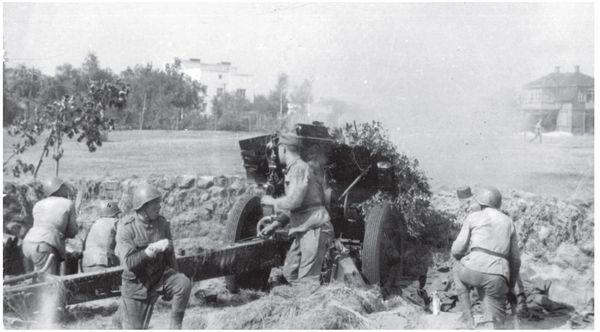
The Polish 12.2 calibre howitzer, model 1938, from the 1st Light Artillery Regiment, 1st Infantry Division, shelling German positions in Praga, September 1944. (WAF)
By September the 15, Praga was already cleared of German forces. Between the days of September 10 and 15, the Polish 1st Infantry Division, which had participated in the liberation of the city, suffered the following losses: 353 dead, 1,406 wounded and 109 missing in action (MIA.). The official operational report for September 16 lists enemy losses caused by the Polish 1st Infantry Division and its support troops, i.e. the 1st Polish Volunteer Army, as 8 dead officers, 41 non-commissioned officers and 564 soldiers. One officer, 25 NCO’s and 59 soldiers had been taken prisoner – 33 rifles, 2 sub-machine guns, 16 light machineguns, 18 machineguns, 7 mortars, 16 artillery guns, 19 tanks, 4 armoured vehicles, and 16 other vehicles had been destroyed. Captured war material included: over 200 rifles, 15 sub-machineguns, 5 light machineguns, 1 mortar, 25 guns, (mainly 10.5 howitzers from the decimated Artillery-Regiment 173 from the 73rd Infantery-Division), plus 1 motorcycle, and 1 radio transmitter. The division’s successes were reflected in order No. 25 formulated by the Polish army’s chief commander, General Michał Rola-Żymerski, on September 15, in which he wrote among other things:
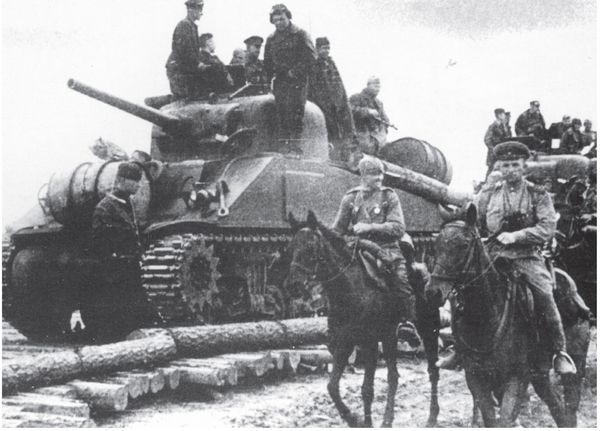
An M4A2 tank from one of the independent tank units in the battle for Praga, September 1944. Note the small bridge parts on the side of the vehicle. (Leandoer & Ekholm archive)
“Soldiers!
The Tadeusz Kościuszk-Division has, together with our brothers from the Red Army, in the early morning of September 14th, by means of storming, captured an entire suburb of our city – Praga, […] On the other side of the Wisła, in bloody flames of fire, there burn entire districts of our capital city. In Warsaw everyone is struggling […] They fight and curse the London-based government for this premature uprising.”
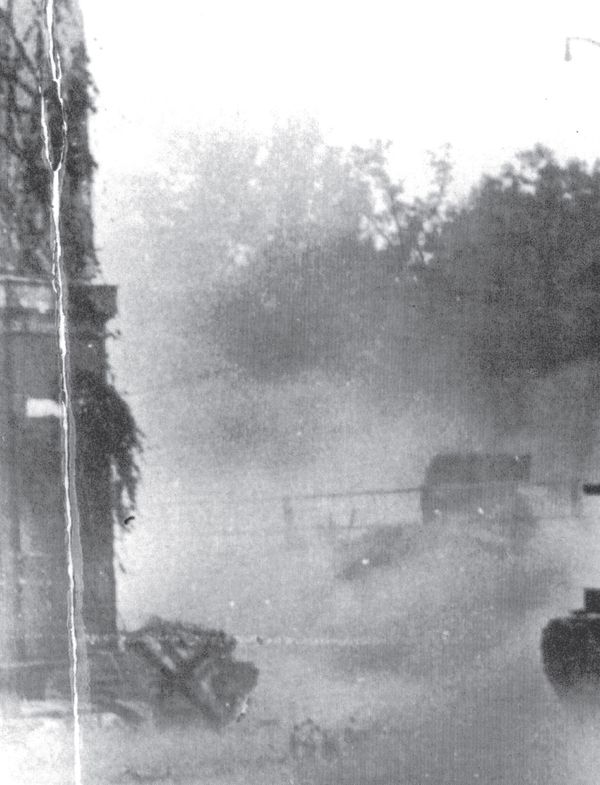
A Polish T-34 tank from the 2nd Battalion, 1st Tank-Brigade, assists attacking soldiers from the 1st Infantry Division in Praga, September, 1944. (WAF).
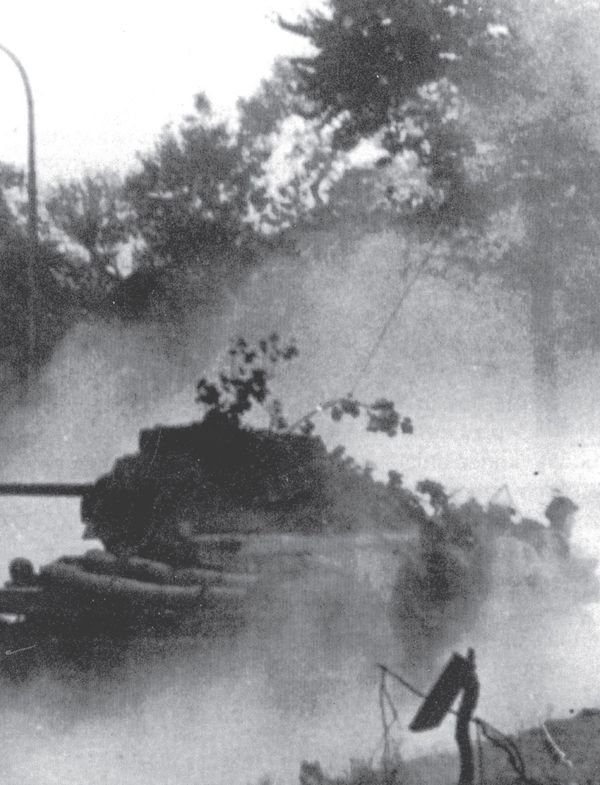
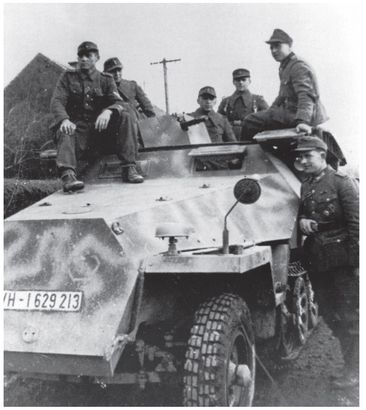
An Sd Kfz 251/7 ausf D with its crew from the 19th Panzer-Division near Warsaw in September 1944. The Sd Kfz 251/7 was one of the two pioneer variations of the 251. (Leandoer & Ekholm archive)
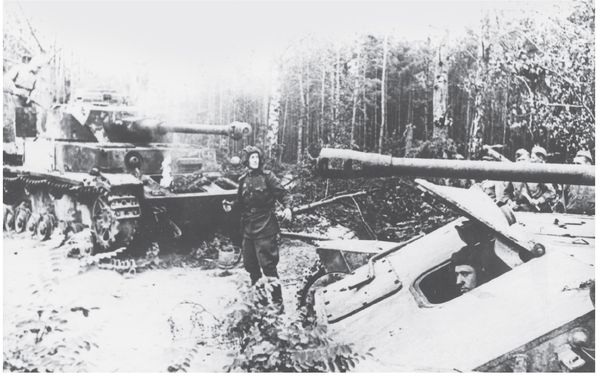
Soviet tank troops examine the wreck of a destroyed tank, model PzKpfw IV Ausf. H, probably from Panzer-Regiment 27, 19th Panzer-Division, Międzylesie, September 1944. (WAF)
General Rola-Żymierski, well-aware of how many soldiers from the Home Army were now serving in the 1st Polish Volunteer Army, was forced to weigh his words carefully when he formulated this order. For this reason he added the following:
“Among Warsaw’s ruins and on its barricades fight the cream of the Polish people’s fighting spirit – Here, struggle heroic officers, non-commissioned officers and soldiers of the Polish resistance movement. Fighting with a degree of effort never before witnessed, they are making a great sacrifice in lives and blood in the struggle for our capital city. They are an inseparable part of the Polish Army.”
At the same time, following the regrouping and consolidation of the artillery, the 47th Army together with the 70th Army resumed their collective assault in the direction of Legionowo, at 1500 hours on September 16. But on this occasion their assault was met by a well ordered defence mounted by the IV SS-Panzer-Corps. Supported by tanks, the 114th Rifle Corps’ infantry occupied the narrow Królewski Canal near Rembelszczyzna. This location, however, lies in a clearing between two wooded areas which before the war had been called the Jabłonna Forest (the woods south of Nieporęt and the woods north of Choszczówka). When the Soviet troops approached the village from the south, they found themselves exposed to deadly machinegun fire – and from both woods, the SS-division’s hidden guns and tanks suddenly opened fire. Under this heavy bombardment, the soldiers of the 114th Rifle Corps became pinned down and throughout the entire day they were unable to improve their situation.
Further south around Białołęka, three divisions from the 47th Army began an assault with one of the tank brigades from the 8th Guards Tank Corps. Initially, the operation went well, they took the village of Tomaszów and, indeed, the Soviet tanks almost reached the town of Płudy. There, however, they ran into the 19th Panzer-Division’s positions equipped with anti-aircraft guns and these destroyed a couple of tanks and stopped any further attack. Just outside Choszczówka, the German tanks started a counterattack supported by a mixed Kampfgruppe composed of panzer-grenadiers and rapid-response Hungarian cavalry troops. The surprised Soviet units offered strong resistance but were unable to organise an effective defence of the newly-won ground. Towards evening, the 19th Panzer-Division had managed to throw back the opposition to their start-out positions. The commander of the division reported 26 destroyed Soviet tanks of the 40 said to have taken part in the battle. In this way, on September 16, the IV SS-Panzer-Corps was able to stabilise the situation.
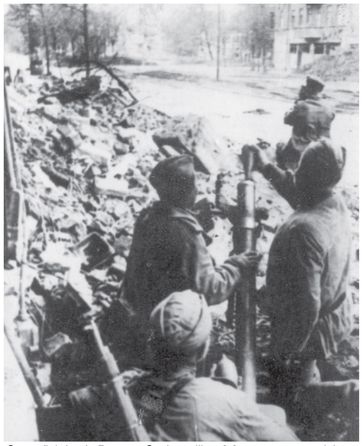
Street fighting in Praga; a Soviet calibre 8.2 cm mortar, model 1938, being loaded for firing, September 13, 1944. (WAF)
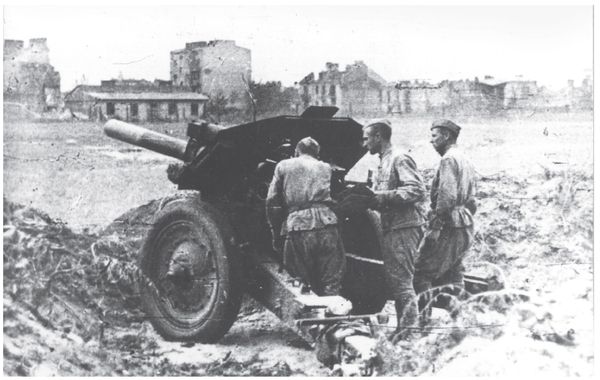
A Soviet howitzer, model 1938 of calibre 12.2, shelling German positions at Praga, September 1944. (WAF)
On September 17 and 18, two rifle divisions from the 70th and the 47th Armies resumed attacks in the vicinity of Nieporęt, Rembelszczyzna and Wiśniewo, without, however, committing a combat force bigger than a regiment. Both Soviet armies at this point were thoroughly exhausted by the fighting which had taken place, and the entirely too little pause in operations before the storming of Praga. The condition of the soldiers among the independent rifle divisions had worsened in an alarming way. The 8th Guards Tank Corps was impaired by heavy losses in armoured equipment. SS-Gruppenführer Gille took advantage of the weakening offensive against his corps’ position and on September 17, with support from the 19th Panzer-Division, started new counterattacks in motion along the banks of the Wisła. During these battles, which raged on for two days, and was a mixture of localized clashes and counterattacks from both sides, the Germans once again succeeded in retaking Tarchomin, occupying Wiśniewo and even advanced as far as Żerań. On September19, the front along the Żerań – Piekiełko – Tomaszów – Rembelszczyzna – Nieporęt line was finally secured. Fatigue was now spreading among the troops on both sides: On the Soviet side, Marshal Rokossovskij sanctioned this exhaustion by issuing, on September 20, an order to the effect that, for the time being, a defensive war posture should be adopted at the positions already taken. One day later, an order arrived from the front that directed the exhausted 8th Guards Tank Corps to withdraw, in order to reorganise and consolidate anew. It became clear that the 47th Army, the 70th army and the 8th Guards Tank corps as a result of the strong opposition mounted by the IV SS-Panzer-Corps were not capable of implementing Zjukov’s or Rokossovskij’s order with respect to eliminating all enemy forces in the area of the Wisła and Narew’s join.. Although the entire area east of the river had been brought under Soviet control (until 1951 the administrative boundary went through Annopol), the same could not be said of Legionowo or Nowy Dwór Mazowiecki. The commander of the 1st Belorussian Front, on the other hand, had not abandoned his goal of seizing them. He simply pushed this objective forward until his armies had recovered their fighting capabilities. The resumption of operations was planned to take place on October 10.
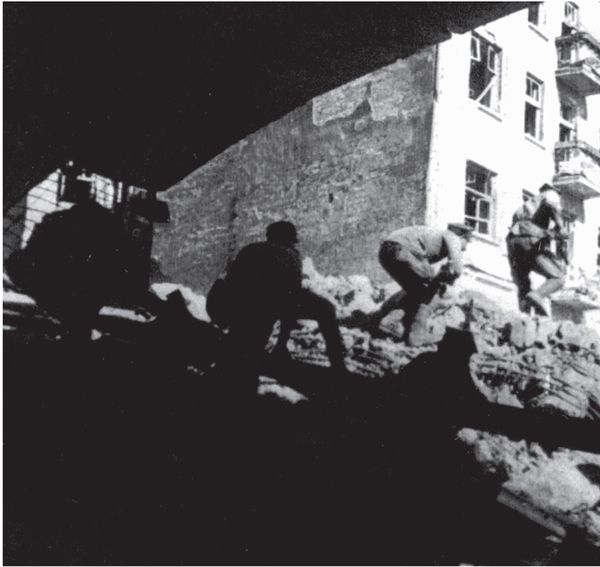
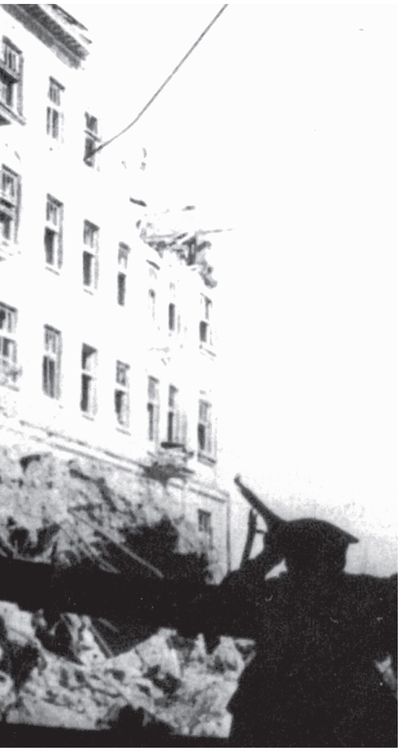
Soldiers from the 1st Infantry Division during fighting by the viaduct on Targowa Street in Praga, September 1944. (WAF)
For the while then, the Polish 2nd Infantry Division remained at the front near Annopol; the 175th Rifle Division close by Białołeka; the 143rd Rifle Division outside Szamocin; and the 328th Rifle Division, south of Rembelszczyzna. The rest of the 47th Army, including the 77th Rifle Corps with the 8th Guards Tank Corps, occupied positions in the vicinity of Zielonka and Ząbki. The zone that separated the 47th Army from the 70thArmy now ran through Rembelszczyzna. From the latter, three rifle divisions were transferred to the reserve troops at the end of September. The 160th Rifle Division from the 114th Rifle Corps remained positioned at Rembelszczyzna, while the 1st Rifle Division as well as the 38th Guards Rifle Division from the 96th Rifle Corps remained outside Aleksandrów and Nieporęt.
The loss of Praga provoked strong reactions in the German ranks. By September 15 or 16, Colonel Hans von Necker’s (as of September 24, commander over the entire Fallschirm-Panzer-Division “Hermann Göring”) Fallschirm-Pz.Gren. Rgt.2 from “Hermann Göring” had already been sent to Warsaw via rail. The disembarkation took place in the western suburb of Włochy, and on September 18, once the reserve troops had been relieved, they made their way to the other side of the Wisła with the mission of preventing contact between the insurgents and the regular Polish army, which had been identified in Praga. Although Panzer-Aufklärungs-Abteilung 25 and Panzer-Pionier-Abteilung 87, a part of a Kampfgruppe from the 25th Panzer-Division, had already arrived from the north on September 14, they were not sent into the fighting in Praga but to Zoliborz on the other side of the river and immediately began operations against the insurgents.
The new German forces that disembarked in western Warsaw were formally under SS-Obergruppenführer von dem Bach’s command. But he lacked the competency to lead frontline troops and Heeresgruppe “Mitte’s” staff therefore made the decision that General von Lüttwitz and his XXXXVI Panzer-Corps would take over the defence of the Wisła line in this sector. In the vicinity of Pultisk, confused officers in the panzer-corps learned that the Kampfgruppe they had been called in to lead at this time was not even to be formed. Lüttwitz returned to the 9th Army and, on September 18, took over command of the area between Młociny and Góra Kalwaria. Von dem Bach’s group-corps would now, as quickly as possible, set down the Uprising while the XXXXVI Panzer-Corps would defend Wisła’s western bank against Soviet and Polish forces. Under his command were the 25th Panzer-Division, Fallschirm-Pz.Gren. Rgt. 2 “Hermann Göring,” Sickenius’ Hungarian units, and in addition General Rohr’s and Colonel Schmidt’s Kampfgruppe (isolated detached sub-units with engineer soldiers, police, and volunteer units from the east, almost all of whom were of low combat value and carried with them the “rumour” of having murdered civilian residents of Warsaw).
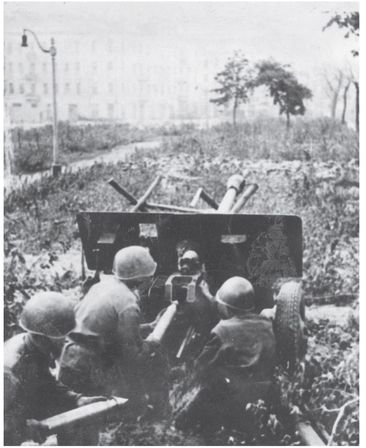
The Polish ZiS-3, 7.62 cm calibre gun from the 1st Light Artillery Regiment, 1st Infantry Division shelling German positions in Praga, September 1944. (WAF)
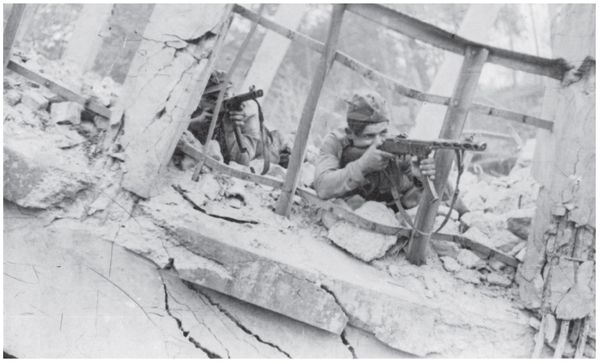
A Polish and Soviet soldier firing on German positions, Praga, September 13, 1944. (WAF)
Simultaneous with von Lüttwitz taking over command, von Vormann sent an alarming message to Heeresgruppe “Mittes” staff about the situation facing his army, stressing how adverse the conditions had become for all divisions under his command.. He wrote: “Only Division ‘Hermann Göring’ can be said to be fully adequate with regard to combat strength and battle-competence. The hard tested SS-divisions ‘Totenkopf’ and ‘Wiking’ – as well as the 9th Army – have, during the past several weeks of combat, become so decimated that at this present juncture they are only equivalent to a very mediocre fighting force.” The entire 9th Army just then had in its three infantries, two grenadier, one cavalry and four armoured divisions; only 30,335 combat soldiers at the frontline, supported by 341 functioning tanks or assault-guns, and 148 artillery batteries equipped with 602 guns. Of these, there were 10,078 soldiers, 268 tanks and 327 guns positioned along the front between Góra Kalwaria and Serock (with the exception of the troops which were in use against the insurgents fighting in Warsaw). The opposition’s fighting strength in the same sector, as calculated by the commander of the 9th Army, stood at 66,600 soldiers, 360 armoured vehicles and 920 guns. General Reinhardt was sympathetic to these troublesome observations, but after having read at the end of the report about how “- the uprising had so quickly taken hold in Warsaw,” and about the “... hopeless situation of the army,” he deemed von Vormann as incapable of fulfilling his duties as a commander. Reinhardt was strengthened in his judgement of the general’s unstable character during a subsequent telephone conversation with him. That very day he asked Hitler to sack von Vormann. On September 20, an astonished Lüttwitz was informed that he was to hand over command of the XXXXVI Panzer-Corps to General Walter Fries, as he had now been ordered to take over command of the entire 9th Army. From a personal perspective, the new commander took over this post at a fortuitous point in time: The Soviet offensive had weakened considerably and the Warsaw Uprising held on by only a frail thread.
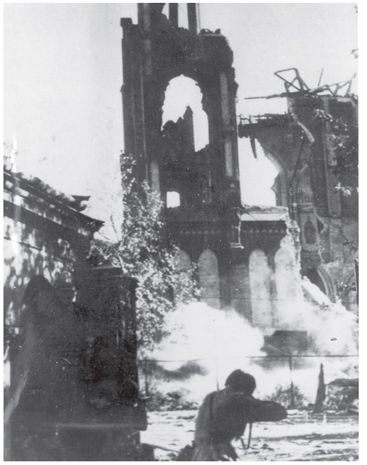
A soldier from the Polish 1st Infantry Division during fighting around St. Florian in Praga, September 1944. (WAF)
Soldiers from the Polish 1st Infantry Division during fighting on Sierakowski Street in Praga, September 1944. (WAF)
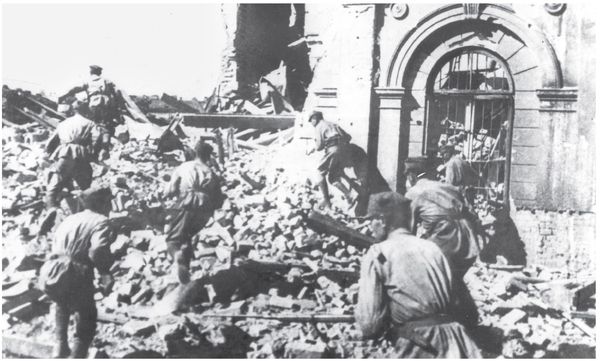
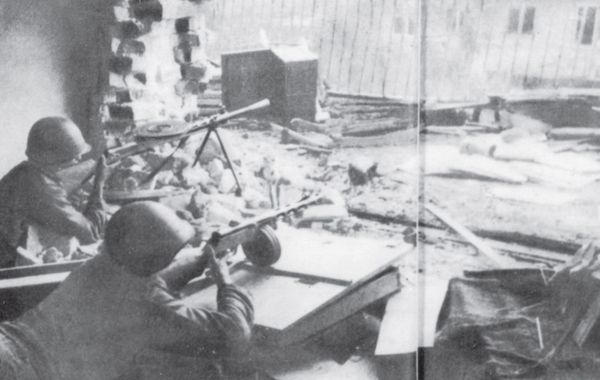
Soldiers from the Polish 1st Infantry Division during fighting in Praga, September 1944. (WAF)
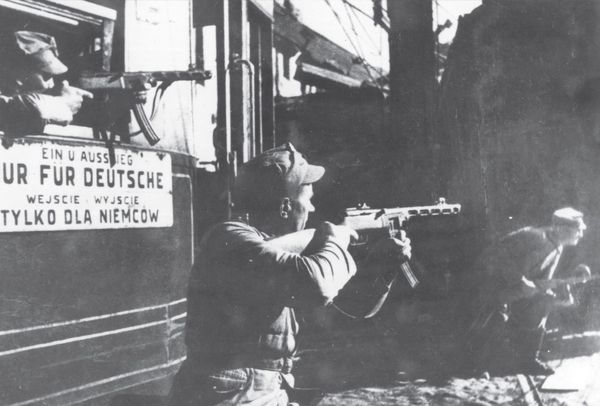
Soldiers from the Polish 1st Infantry Division during fighting at a tram stop on Kawęczyńska Street in Praga, September 1944. The tram is a model A, with an entry-exit door reserved for Germans only. (WAF)
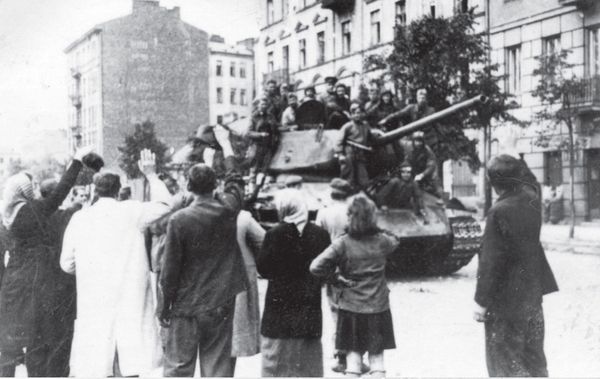
T-34/85 tanks from the 8th Guards Tank Corps, with infantry on board, rolling through the streets of Praga, September 1944. (WAF)
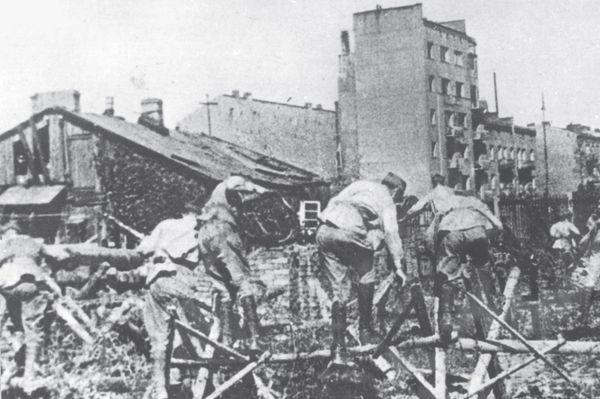
Soldiers from the Polish 1st Infantry Division negotiate barbed wire fences during fighting in Praga, September 1944. (WAF)
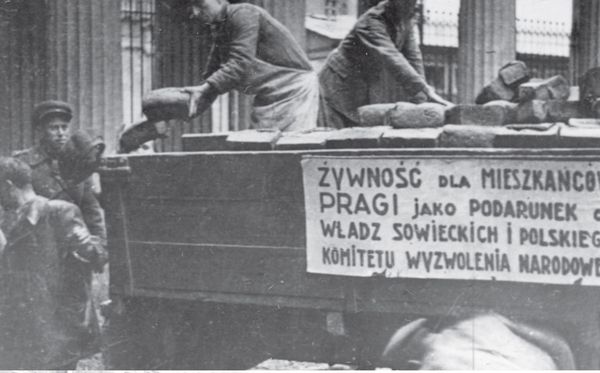
A propaganda photo depicting food handouts to Praga’s residents by the communist Polish National Liberation Committee (PKWN), September 1944. (WAF)
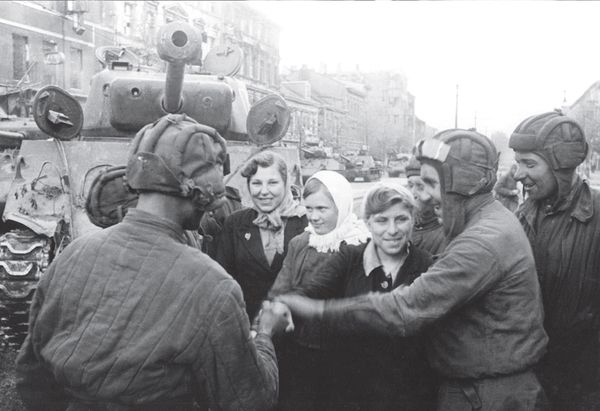
The crew of a model M4A2 (76) W “Sherman” tank from the 8th Guards Tank Corps are greeted on Targow Street, September 1944. In the background another “Sherman” as well as a ISU-122 assault-gun. (WAF)