
To a great extent, the development of combat operations outside Warsaw depended on Stalin’s wishes. No later than August 2, he received verified intelligence from Poland’s capital that reported the Uprising had begun. On August 3, this event was directly confirmed by Polish Prime Minister Stanisław Mikołajczyk who had flown to Moscow from London for talks concerning the future of his country. There was no doubt about it being the Home Army that stood behind the Uprising, and there was equally little doubt about the in-country representatives of the Polish Government having swung into action.
Simultaneous with these political developments, on August 2, or August 3 at the latest, Marshal Rokossovskij informed headquarters about the 2nd Tank Army’s troublesome situation. The commander of the 1st Belorussian Front emphasized the fiasco with the original intention of cutting away the rearguard troops for 2nd Army, and he also pointed out the enemy’s increasingly troublesome opposition between the Bug and the Narew. On the positive side, the sector of the front under his command had experienced fantastic success along the western flank where two bridge emplacements on the Wisla had been captured. At Magnuszew, it was now possible to transport large sections of the 8th Guards Army across the river to its western bank.
Stalin decided to exploit the operational situation which had arisen. The Soviet dictator ordered that only defensive warfare should be conducted on the outskirts of Warsaw, particularly with respect to the direct approaches to Pragda. In his view, the Germans – just as Hitler and other highly placed Nazis believed – should be able to crush the opposition of the insurgents over the next few days. He anticipated that when this happened and the Home Army had been eliminated, Soviet troops would then attack and seize Praga. In Stalin’s view, an attack against the city sectors east of the river should not begin until after the Uprising in Warsaw had been quashed, since a premature attack would work to needlessly prolong the time, or even make it impossible for the Germans to pacify the Polish capital.
And while it is truethat this order, with its ruthless import, was never committed to paper, it was nevertheless, on August 4, set into motion: First and foremost, a halt was called to the planned storming of southern Praga by the 125th Rifle Corps from the 47th Army over the coming days. On August 4, General Kuzmin’s corps had just reached the area around Radość, thereby making contact with the 16th Tank Corps’ left flank. Following this, the Soviet fighters were forbidden from flying over Warsaw’s airspace where German Ju 87D bombers carried out several terror attacks. Prior to August 10, the NKVD finally staked out its “defensive line” behind the front. These orders, and their underlying objective, made it impossible for help to reach the battling Home Army units from the Lublin area.
Initially, Stalin hid his hostile attitude toward the Uprising especially during talks held on August 9 with Prime Minister Mikołajczyk. However, he soon cast aside this mask and openly expressed his intention to passively await the fall of free Warsaw. On August the 13, the Soviet news agency, TASS, reported this strategy in a matter-of-fact, and to all intents and purposes, reasonable tone, but three days later in response to Churchill’s request for assistance for the Home Army, Stalin replied that:
2nd Tank Army’s losses, August 1-8, 1944
|
Model |
This list was complied by General Radzjijevskij’s staff on August the 28, 1944. How reliable it may be is debatable, especially when it comes to the lost anti-tank guns, mortars and machine guns. The report does not list any cars or motorcycles. Note the considerable discrepancy between the number of tanks totally lost (T-34s); in comparison with other models of armoured vehicles. Of the 35 vehicles destroyed in battle, model: M4A2 “Sherman” tanks, only six burned up completely, exploded or were captured by the Germans; like-wise with the anti-tank SU-85 vehicles. The rest of the vehicles of this type were later repaired and used again (although the new attacks on August 10 lengthened the list of losses). According to this list, the 3rd Tank Corps’ 50th and 51st Guards Tank Brigades and the 8th Guards Tank Corps’ 60th Guards Tank Brigade took the most serious losses. |
|
|
T-34/T-34/85 |
94 |
|
|
M4A2 |
6 |
|
|
IS-2 |
1 |
|
|
SU-85 |
8 |
|
|
SU-76 |
7 |
|
|
ZiS-3 (7.62 cm) guns |
7 |
|
|
ZiS-2 (5.7 cm) AT-guns |
10 |
|
|
20K-8 4.5 cm AT-guns |
11 |
|
|
Model 1938 8.2 cm mortar |
8 |
|
|
Model 1942 12 cm mortar |
1 |
|
|
Armoured transport vehicles (M3A1 Scout Car, Universal Carrier) |
2 |
|
|
Heavy machineguns |
26 |
|
|
Machine guns |
58 |
“ on having acquainted myself with events in Warsaw, I am now convinced that this is a foolish and awful form of troublemaking which will cost the population many victims […] In the situation which has arisen, the Soviet command has come to the conclusion to not have anything to do with the troubles in Warsaw because we cannot take direct or indirect responsibility for what is going on there.”
On August 22 he wrote:
“Sooner or later, the truth about the handful of criminals who started the trouble in Warsaw in order to seize power will be generally realised they are only interested in.”
The Soviet dictator would not even agree to granting allied aircraft carrying provisions for the Polish fighters landing rights on Soviet air fields. Stalin’s openly hostile attitude didn’t change until the beginning of September, when the issue of the Warsaw Uprising began to enflame relations with Great Britain.
Meanwhile, fighting was taking place outside Warsaw. Although Stalin had already halted the storming of Praga as early as August 4, this by no means meant that hostilities had ceased completely. Marshal Rokossovskij had only received orders to halt operations in the city’s suburbs. On the other front lines he commanded; he therefore continued to conduct offensives which at the appropriate time would also come to encompass Warsaw. For these reasons, on August 5, STAVKA requested detailed reports about 2nd Tank Army’s defeat, about the situation of the Soviet frontline forces along the Wisła, and lastly, information about the possibility of the 1st and 2nd Belorussian Fronts launching an immediate offensive. The commander of the 1st Belorussian Front replied that due to their extensive losses, and the unusually large geographical area over which the 47th Army was stretched, and the re-organization of the 70th Army, along with supply delivery problems; he would not be in a position to resume the offensive for another five days, i.e. August 10. In addition, on his own initiative Rokossovskij further weakened the front outside Praga by sending the 16th Tank Corps to Magnuszew in support of General Tjujkov. He did this partly for the reason he did not have permission to storm the city, and partly because the most important objective for the left flank of his front was to maintain and broaden the frontline positions.
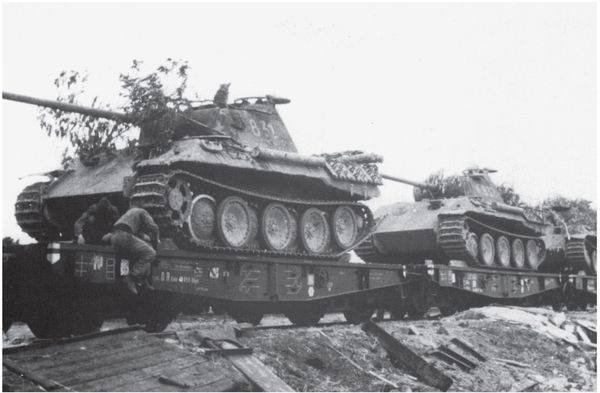
A train transports “Panther” tanks from the 8th SS-Panzer- Regiment 5 “Wiking”, 1944.
In response to these reports, Stalin ordered that a new battle plan for the central Wisła area be worked up which would take account of the successes and reverses which had been experienced, as well as the “Warsaw fuss.” On August 8, Marshal Zjukov presented just such a plan to him. In his considered view, the most important objective for the 1st Ukrainian Front and the 1st Belorussian Front was to seize the two large bridge emplacements along the Wisła. After which, seizure of similar emplacements along the Narew’s banks should be carried out. Simultaneous with this, the central sector of Marshal Rokossovskij’s front (the 8th Guards Tank Army, the 47th Army, the 70th Army, the 28th Army) should, without delay, begin attacking the enemy in Warsaw, with the exception of Praga, and this, together with an attack launched on the area around the join of the Bug and Narew Rivers (the 48th Army, the 65th Army) should lead to Heeresgruppe “Mitte” being split. Zjukov wrote, far too early, something about Soviet troops in the frontline units along the Wisla and the Narew achieving the preparedness necessary to carry out new attacks towards the west around August 25, 1944. On the other hand, he adopted a more sceptical view when it came to the possibilities of successfully carrying out further offensives in that direction, especially in light of the necessity for concentrating reserve troops as well as supplies for the large offensive planned for the Balkans which was shortly about to begin.
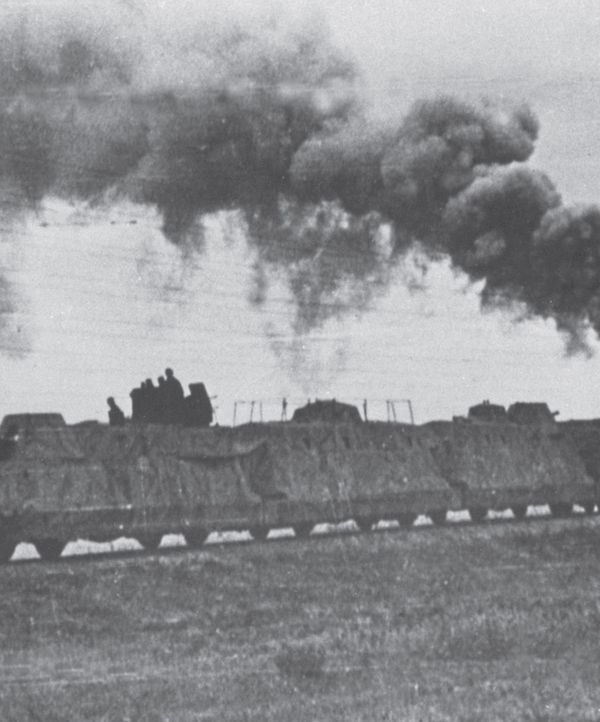
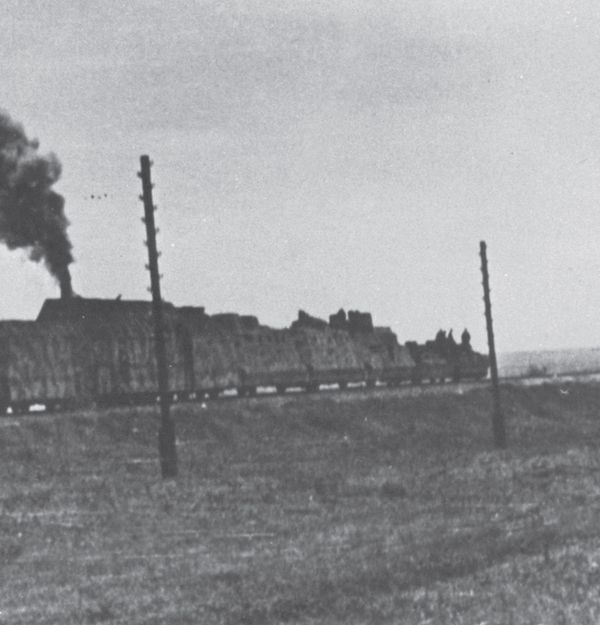
A German armoured train, model BP 42, the Warsaw Region, August 1944. (CAW)
On August 10, the fighting east of Warsaw flared up with renewed force. Marshal Rokossovskij set about destroying the German “balcony” in the frontline that stretched from Stanisławów through Węgrów all the way to Nur by the Bug River. This was not an easy mission, despite the Soviet side’s numerical superiority. At the beginning of August, immediately after the tank battle was decided and done, the following forces were positioned along the section of the frontline referred to here: the 47th Army, certain units from the 2nd Tank Army (essentially, now only the 8th Guards Tank Corps), the 70th Army, the 28th Army, the 9th Tank Corps, the 2nd Guards Cavalry Corps, and the 4th Guards Cavalry Corps. Of these, the 47th Army’s, 125th Rifle Corps stood directly outside Warsaw, and between Okuniew and the river Liwiec stood the rest of the 47th Army, the 70th Army, plus the 8th Guards Tank Corps and both cavalry corps, while the 28thArmy and the 9th Tank Corps were located to the east around Sokołów Podlaski. Two days before the offensive was resumed, the 4th Guards Cavalry Corps from this formation was re-deployed and positioned on a passive section of the front by the Wisła River between Karczew and Wilga.
Initially, the Germans organized their defence with Gruppe “von Saucken” (the 3rd SS-Panzer-Division “Totenkop,” the 5th SS-Panzer-Division “Wiking”, the 4th Panzer-Division, the 73rd Infantry-Division, and the 1131st Grenadier-Brigade), the XX Army-Corps and the XXIII Army-Corps’ right flank. With thought to the continuous Soviet pressure north of the Bug in mind, Generalfeldmarschall Model ordered, just before the enemy’s next offensive commenced, that a portion of the forces defending Praga were to regroup in that direction (i.e. north of the Bug) which served to weaken the Warsaw based forces even more. On August 9, Gruppe “von Saucken” was broken up. General von Saucken, himself, together with the XXXIX Panzer-Corps HQ staff, was sent to the 3rd Panzer-Army which was defending western Lithuania and the border with East Prussia. With him, also disappeared the 4th Panzer-Division, as well as the 12th Panzer-Division from 2nd Army (re-deployed to the 4th Army). In Praga, there only remained the 73rd Infantry-Division and the 1131st Grenadier-Brigade – in short, a very modest force. On August 11, a new corps was formed as a replacement for von Saucken’s unit. This was the IV SS-Panzer-Corps with SS-Gruppenführer Herbert Otto Gille, commander of the 5th SS-Panzer-Division “Wiking” appointed as the corps’ commander. Initially, his former Division “Wiking” command was taken over by SS-Oberführer Eduard Deisenhofer and later by SS-Standartenführer Johannes Mühlenkamp who, in turn, was replaced on October 9 by SS-Standartenführer Karl Ullrich. As we now see, it wasn’t until after the tank battle that the IV SS-Panzer-Corps was established. In addition to two Waffen-SS armoured divisions, its make up included the 73rd Infantry-Division and the 1131st Grenadier-Brigade.
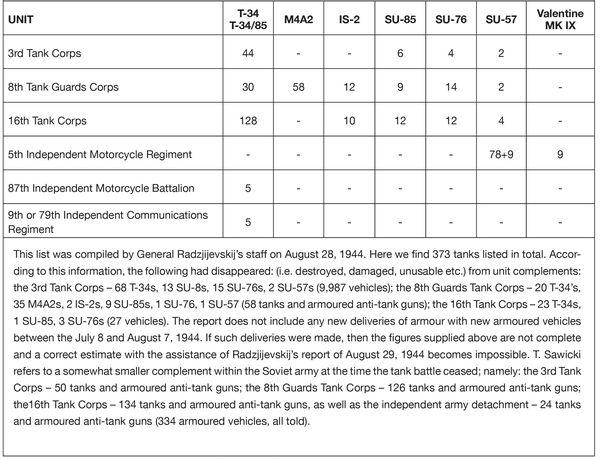
The Soviet 2nd Tank Army’s armoured equipment, August 8, 1944
On August 10, the new Soviet offensive began. Before that day ended, the 5th SS-Panzer-Division “Wiking” reported no less than fifteen enemy attacks on Stanisławów. These attacks were launched by General Popov’s 47th Army and the 8th Guards Tank Corps. On this occasion it was Soviet fighter planes that dominated the airspace and attacks carried out by the Il-2 air attack wing covered the German positions with a rain of undirected rocket projectiles and gun fire. The 5th SS-Panzer-Division “Wiking” could not hold out on the battlefield and retreated back north, but, thanks to intense counterattacks conducted by SS-Panzer-Regiment 5, the situation stabilised during the evening. The next day, the IV SS-Panzer-Corps and the XX Army Corps’ positions were attacked by units from the three infantry armies and three tank corps. The 47th Army, the 8th Guards Tank Corps and the 70thArmy’s 3rd Tank Corps set off towards the new Waffen-SS Corps. The 28th Army attacked the XX Army-Corps in the area around Sokołów Podlaski supported by tanks from the 9th Tank Corps, with the 2nd Guards Cavalry Corps held back in reserve.
The Germans withdrew, but the territory won cost the Soviet side heavy casualties. At the same time, the commander of the German 9th Army sent alarming reports concerning the critical supply-delivery situation facing his forces. The shortages primarily had to do with ammunition and fuel – shortages that were especially felt by the frontline entities (“Herman Göring”, 19th Panzer-Division and the new 4th Grenadier-Division) that had attacked the bridge emplacements at Magnuszew beginning on August 7, but the situation of the IV SS-Panzer- Corps wasn’t much better. Model believed that the greatest threat to his plans lay at Magnuszew and therefore continued to send all available reserves there, which consequently led to the German fighting strength outside Praga being yet further weakened. The new German tanks were sent primarily to the bridge emplacements and it was Gille’s corps that suffered as a result. For example, the 19th Panzer-Division improved its tank complement during the course of two weeks from 28 to 76 vehicles, despite being continuously engaged in combat. On top of this, on August 10 von Vormann took over command of Heeresgruppe “Nord Ukraine” XXXVI Panzer-Corps from General Smilo von Lüttwitz , but without being allotted any new troops. Lüttwitz took over command of the frontline extending from Radom to the discharge of the Pilica, and the VIII Army-Corps had the mission of defending the west bank of the Wisla from Pilica to Warsaw. General Höhne had only the resources of the 1132nd Grenadier-Brigade and the 23rd Luftwaffe-FLAK-Regiment to deploy along this stretch, but defended a 40 km. long frontline.
An armoured transport vehicle, model Sd Kfz 251/1 Ausf. C, from Panzer-Grenadier-Regiment 12, 4th Panzer-Division. The photo is probably taken during fighting in the vicinity of Radzymin during the first ten days of August 1944. (MWP)
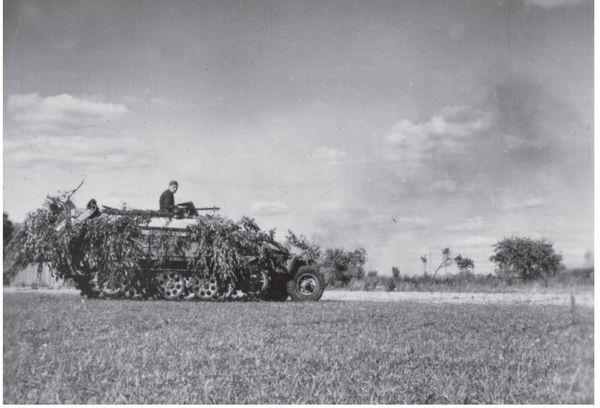
On August 12, Soviet troops launched yet another assault on the IV SS-Panzer-Corps and the XX Army-Corps. Having thoroughly prepared with artillery bombardment and an intense, almost compact, aerial attack; the infantry launched their assault with the support of tanks. The 47th Army which attacked from Stanisławów toward Tłuszcz came under heavy fire.The Soviets brought the 8th Guards Tank Corps into battle. Between August 12-15, General Gusiev, commander of the 47thArmy, ordered repeated waves of attacks in an attempt to destroy the IV SS-Panzer-Corps’ positions along the Okuniew-Wołomin-Tłuszcz line. If successful, he would also effectively sever contact between the 9th and 2nd Armies as well as both corps defending the routes entering Warsaw. On August 15, after repeated bombardment in connection with air attacks by the Ił-2 assault wing, the Soviet infantry entered Wołomin and Tłusczc. The German and the west-European volunteers from the 5th SS-Panzer-Division “Wiking” responded with a series of heavy counter-attacks in which all of the tanks and assault-guns (StuG’s) from both of the SS armoured regiments participated. Throughout the entire day, bloody close-quarter combat took place – including actual hand-to-hand use of the bayonet – and the 47th Army’s two rifle corps retreated to their start-out positions. Troops from the IV SS-Panzer-Corps together with the XX Army-Corps managed to avoid being totally crushed. Nonetheless, between August 10 and 15; they were pressed back almost as far as the Bug. The front now ran precisely along the railway line between Warsaw and Białystok. On the evening of August 15, they inflicted such heavy losses on the Soviet side that it ceased its assault, but this pause lasted only 48 hours. It was only along the stretch between Sulejówek and Radóśc, on the direct approaches to Praga, that calm continued to reign.
An assault gun of model StuG 40 Sd Kfz 142/1 Ausf. G moving towards the eastern front, summer 1944. (CAW)
In the middle of August, vital changes were made in the command positions of the German side. Hitler was impressed by Model’s effectiveness when it came to “taping” gaps in the front and was also highly aware of his dedication. For these two commendable reasons, he was awarded the prestigious post of Oberbefehlhaber “West” – commander in chief over all military forces in the west. Model would go on to organise the retreat of the defeated troops in Normandy over the Seine, simultaneously resolving sensitive political questions in the Wehrmacht staff related to lingering suspicions regarding his contacts with the July 20 conspirators. On August 16, General Georg Hans Reinhardt was appointed as the commander of Heeresgruppe “Mitte” – and General Josef Harpe was selected commander of Heeresgruppe “Nord Ukraine.” The Germans were very conscious of the weaknesses along their front, especially in the Warsaw region, therefore they decided to again send the Hungarian unit from the II Reserve Corps into combat. General von Vormann regarded this type of support as highly dubious, not just because their number was low and their weaponry light. His main objection was grounded in signs indicating they “fraternise with the Poles”, as he wrote of in his reports. Despite this, the Hungarian 12th Reserve Division took up combat positions between the Warsaw section of Żoliborz and the Kampinos-reservation (to battle against the partisans), while the 5th Reserve Division reinforced the VIII Army-Corps outside Warsaw. These units began to regroup on August 19.
A day earlier in Warsaw (with the exception of the stretch of area passing through Praga), the 47th Army, the 70th Army, the 8th Guards Tank Corps, and the 28th Army resumed the assault directed against the IV SS-Panzer-Corps and the XX Army-Corps. The opposing German troop forces were as follows: along the Radość-Solejówek line – the 73rd Infantry-Division; the Sulejówek-Ossów line – the 1131st Grenadier-Brigade; the Wołomin-Tłuszcz line – the 3rd SS-Panzer-Division “Totenkopf”; in the Tłuszcz region – the 5th SS-Panzer-Division “Wiking” ; and along the Łochów-Małkinia line, in the following order – the 5th Jäger-Division, the 211th Infantry-Division and the 102nd Infantry-Division. Once again, the Soviet offensive was preceded by massive bombing runs and hurricanes of artillery fire. The main assault was carried out by the 70th and the 28th Armies between Tłuszcz and Łochów. The Soviet infantry with the support of tanks and assault guns overran the German positions at Jadów, just where the 5th SS-Panzer-Division “Wiking” and the 5th Jäger-Division connected. Without pause, the infantry continued their assault-march reaching the suburbs of Tłuszcz in hard fighting, with at least 400 armoured vehicles participating on the Soviet side alone.
The crew of a Soviet ZiS-3 firing against German tanks on the eastern front, August 1944.(WAF)
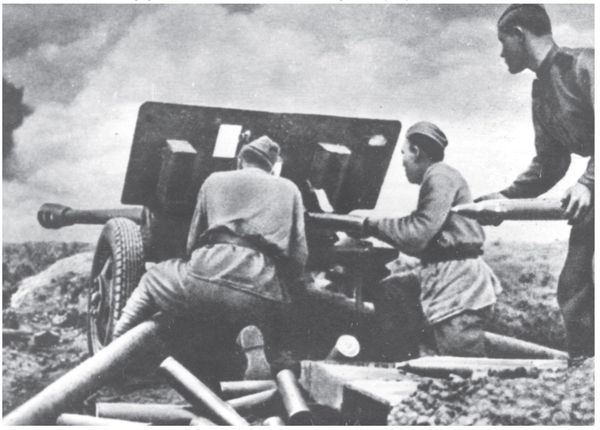
SS-Gruppenführer Herbert Gille received orders instructing him to conduct counter-attacks in the direction of Łochów. This was an impossible mission to execute since all the units in his corps were already engaged in battle. On that same day, August 18, SS-Panzer-Regiment 5 incurred heavy losses at Jadów, and the tanks which had been spared were sent speedily away in the direction of Tłusczc. Their presence made it possible for the soldiers from SS-Panzergrenadier-Regiment 9 “Germania” – exhausting the last of their strength – to hold back the enemy’s attacks.
On August 19, the German front began to collapse. Attacking Soviet columns along the Liwiec River split both German corps and advanced to the Bug River. The 5th Jäger-Division had been destroyed. General Weiß ordered a rapid evacuation of the XX Army-Corps to the other side of the Bug River, where he would take up new positions north of Wyszków. In other words, 2nd Army had withdrawn from Warsaw, and consequently, the entire burden of its defence was turned over to the 9th Army and the IV SS-Panzer-Corps.
A “Tiger” tank nr. 912 from the 9th SS-Panzer-Regiment “Totenkopf” in the Slupno region, August 1944. (Bundes Archive)
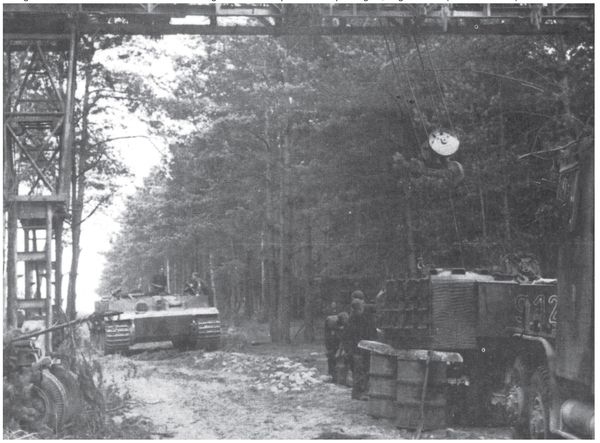
The west- European volunteers in the 5th SS-Panzer-Division “Wiking,” who were defending Tłuszcz at this time, found themselves under deadly bombardment from “Katjusha” rockets – the Soviet air force controlled the air, virtually unopposed. Wave after wave of infantry units and tanks washed over the unyielding defenders. The 47th Army stormed Wołomin; and the 70th Army, Tłusczc. The 5th SS-Panzer-Division “Wiking” which fought on the left flank was forced to shorten its front to the Tłusczc and Wyszów line, and take up positions along the railway line there. That day, they successfully withstood the violent attacks against Wyszków by the 28th Army’s frontline troops, solely thanks to a timely intervention carried out by all the panzer division’s regiments. Tank crews reported enemy losses mounting to 20 destroyed tanks – on the other hand, SS-Panzer-Regiment 5 also lost two vehicles to the marsh-terrain near the village of Skuszew by the Bug. This sort of incident, where the Germans themselves blew-up their tanks after having become hopelessly trapped in the muddy banks of a river, would be repeated on further occasions,
The situation for both SS- panzer divisions now became critical. Opposing them were three armies (more concretely: six rifle corps, as the 70th Army had only two; one corps from the 28th Army fought against the XX Army-Corps, while the 47th Army’s 125th Rifle Corps stood inactive across from the 73rd Infanterie-Division) and two armoured corps, plus countless artillery and combat aircraft. The losses were enormous and only some tens of tanks per-regiment were battle-worthy. The 5th SS-Panzer-Division “Wiking” had been driven out of Tłuszcz and organised a new defence line along the main road to Białystok between Trojany and Zabrodzie. With the aim of reinforcing Gille’s ever weaker corps, General Reinhart ordered that the Hungarian reserve, the 1st Cavalry Division, be re-deployed to Praga. Also ordered to arrive in Praga was the 1145th Grenadier-Regiment from Warsaw, which up until that time been part of von dem Bach’s corps and had helped to crush the Uprising. SS-Obergruppenführer and polizeigeneralen Erich von dem Bach opposed this decision with the argument that his pacification troop was already weak. The order, however, continued in force. In addition, the 1131st Grenadier-Brigade was put under the operational command of the severely mauled 3rd SS-Panzer-Division “Totenkopf” in the defence of Wołomin.
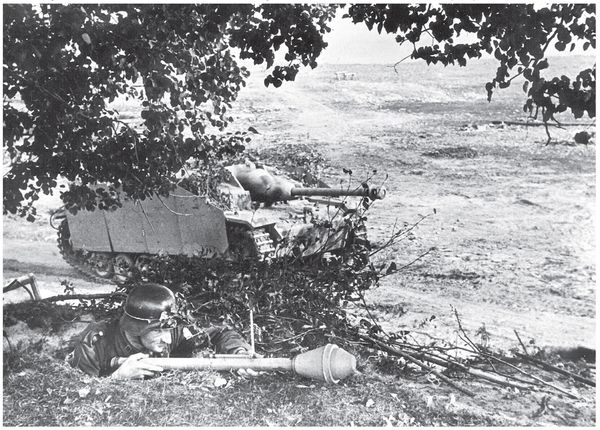
A tracked assault-gun StuG 40 Ausf. G from SS-Panzer-Division “Totenkopf” or the 5th SS-Panzer-Division “Wiking” waiting in ambush in the vicinity of Warsaw, in August 1944.
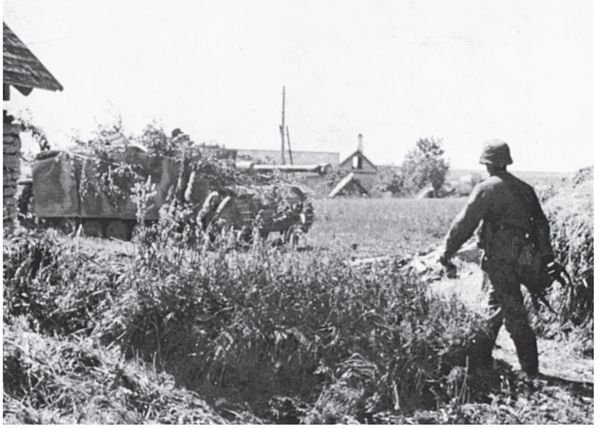
At this time, new operational plans were meanwhile being drawn up in Moscow dealing with, among other things, the fighting in central Poland. It was a cheerless satisfaction Zjukov felt when, as he had foreseen, the weakened force of Soviet attacks now began to be clearly evident. Soviet forces continued to fight hard, but the officers at Soviet headquarters knew that a breakthrough in the German frontline along the Wisla was not going to be achieved in the immediate future. To all appearances, Stalin was not concerned about this. The Soviet dictator was now completely focused on the Balkans where the 2nd and the 3rd Ukrainian Fronts were poised to launch a new strategic offensive. He also wanted to strike against East Prussia and decide the battle for control of the Baltic States. Zjiukov informed him that it was necessary to carry out a reorganization of several armies and to give them new objectives. Moreover, it was necessary to concentrate large amounts of supplies and reinforcements to the Balkans and this would primarily be at the expense of Konev and Rokossovskij’s armies. Stalin did not debate the viewpoints of his “representatives.” And on August 20, the 1st Belorussian Front and the 4th Guards Cavalry Corps were already on their way south. This had, to some significant degree, an impact on the battles for Warsaw since, on that sector of the front which these forces had up until then occupied; there now remained only the 2nd Guards Cavalry Corps. Clearly, this weakened the combat strength of the forces storming the Warsaw region.
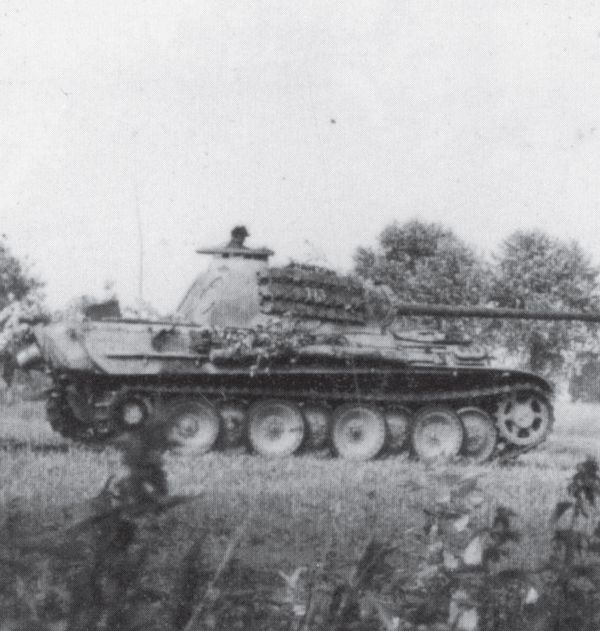
Two Panther tanks from the 3rd SS- Panzer- Division “Totenkopf” advance towards the enemy, Warsaw district, August 1944. (Leandoer & Ekholm archive)
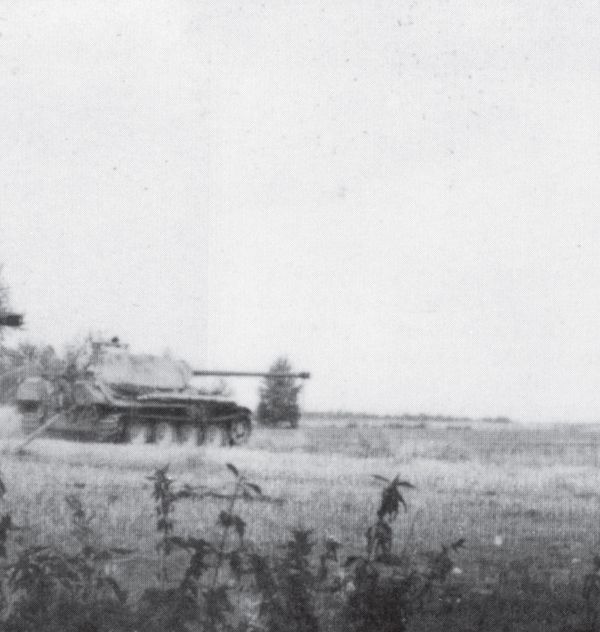
The issue of the Warsaw Uprising was dealt with separately. Stalin was surprised that the insurgent opposition had lasted so long. For the Germans, who had primarily regular troops along the front, it was increasingly apparent that they did not have enough combat strength to quickly regain control of the city. According to Stalin, Marshal Rokossovskij should not, as yet, attack Praga itself, but instead concentrate his focus on liquidating the enemy in the Wołomin-Wyszków region. Obviously, the most important objective of his frontline for the immediate future was to continue to maintain and even expand the troop positions along the Wisla. Likewise, the 2nd Army should be smashed and the Narew crossed.
The final days of August constituted a period of seldom-seen, brutally intensive fighting. Soviet pressure on the IV SS-Panzer-Corps let up on August 20, which immediately resulted in German counterattacks. The local counteroffensives which the 3rd SS-Panzer-Division “Totenkopf” and the 5th SS-Panzer-Division “Wiking” conducted were aimed to “even out” the frontline between Radzymin and Wyszków: This, because the 70th Army in earlier fighting had managed to carve troublesome pockets between various districts of defence. On August 21, the tank grenadiers (from the 3rd SS-Panzer-Division “Totenkopf” and the 5th SS-Panzer-Division “Wiking”) led counter-attacks to regain control of the main road to Białystok, which temporarily removed the risk that both Waffen-SS tank divisions would be separated from one other. Although the SS-soldiers’ tanks and anti-tank guns caused incredible losses in terms of combat equipment for the Soviet attackers; the disproportionate combat strength favouring the 70th Army on August 24 enabled them to once again cut off the road to Białystok near the village of Trojany. Volunteers from the 5th SS-Panzer-Division “Wiking” fought frenetically and managed to beat back repeated attacks by the Soviet infantry, which had the support of tanks from the 8th Guards Tank Corps. The Germans had the Bug River at their backs, and were the division’s positions to give way, it would cease to exist. The commander of the 70th Army , General Popov (the army was led by Vasil Popov while Alexei Popov had command of the 8th Guards Tank Corps), strove to cross the Bug from the village of Trojany to Marianów on the other side. It did not succeed, however, until August 25, despite one of the 28th Army’s rifle corps engaging half the 5th SS-Panzer-Division “Wiking’s” combat strength due south of Wyszków.
Two Sd Kfz 251/1’s ausf D very near the frontline. Note the soldier standing on the front of the first half-track, this was a common means of carrying out reconnaissance providing a view over the crown of a road. Both vehicles hail from the 19th Panzer-Division, August 1944 outside Warsaw. (Leandoer & Ekholm archive)
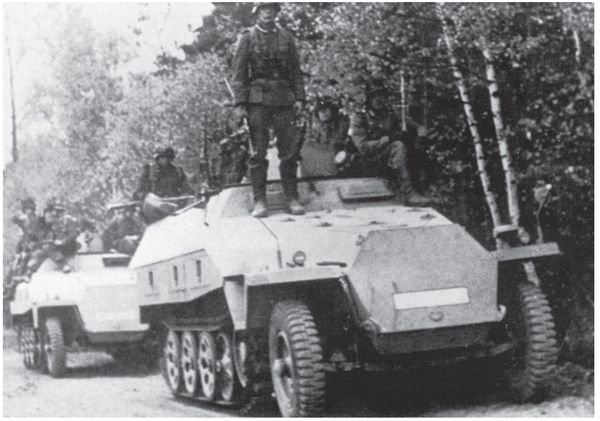
The 47th Army’s 77th and 129th Rifle Corps simultaneously attacked Wołomin from the east, and the village of Zabraniec which lay south of it. Defence of the village, which lay in ruins, was the responsibility of a combined unit composed of the 3rd SS-Panzer-Division “Totenkopf” and the 1131st Grenadier-Brigade, while the stretch of area to the south was manned by the Hungarian 1st Cavalry Division. The Germans took a pause from the fighting but, due to lack of modern weaponry, the Hungarians were beaten down and withdrew towards Zielonka and Rembertów. In an effort to save the situation, SS-Gruppenführer Herbert Gille supported the cavalry division with units from the 73rd Infantry-Division, effectively halting further Soviet successes. In the end, the front along the Wołomin – Dluga River – Okuniew line was temporarily stabilised.
The fighting that had taken place was extremely bloody. According to a report from the “War-diary of the 9th Army,” the IV SS-Panzer-Corps – taking into account only the days between August 18 and August 22 – destroyed 249 Soviet tanks and tracked artillery. Balancing this, however, was the fact that for all practical purposes the Soviet air force had liquidated this German corps’ artillery. Many troops had fallen, forcing the combining of combat entities, as for example: the 3rd SS-Panzer-Division “Totenkopf ” and the 1131st Grenadier-Brigade. Holding the main Radzymin-Wyszków road became impossible. North of the Bug, the German 2nd Army, under pressure from the 48th and the 65th Armies, withdrew to the other side of the Narew. Gille now began to withdraw the rest of the 5th SS-Panzer-Division “Wiking” towards the west, where together with the 3rd SS-Panzer-Division “Totenkopf ” it would form the new Ślężany-Zawady-Rząda Brook defence line, east of Serock. With this objective in mind, von Vormann ordered General von Lüttwitz to immediately re-deploy the 19th Panzer-Division, with the exception of Panzer-Regiment 27, to the IV SS-Panzer-Corps. Eighty tanks would halt outside of Magnuszew, while the 73rd and 74th Panzer-Grenadier-Regiments, as well as Panzer-Artillery-Regiment 19, would support the 5th SS-Panzer-Division “Wiking” in its fight to retain control of the river’s outflow.
German infantry, Poland, summer 1944. (ADM)
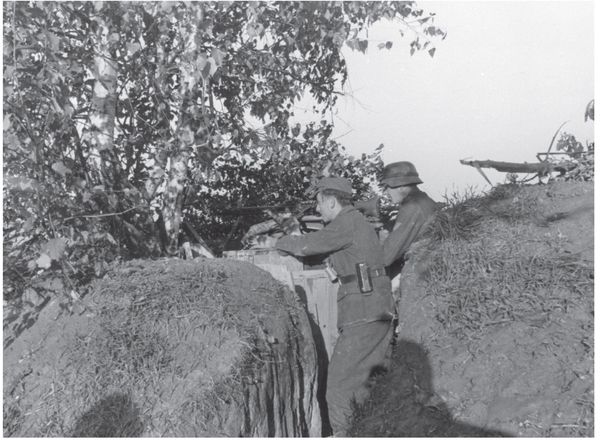
On August 26, the Soviet troops commenced the next assault with the support of massive artillery fire. Along the southern bank of the Bug, units from the 28th Army clashed with the Germans as they attempted to cross the river and strike at the XX Army-Corps’ rearguard. The Germans quickly eliminated these bridgeheads but despite this momentary success, the 2nd Army’s main fighting force was soon cut down and driven back during the first week of September across to the other side of the Narew. Prior to this, the biggest apparent problem at the location where the zones of the 9th and the 2nd Armies met involved the frontline fighting being conducted by the combined combat strength of the 5th SS-Panzer-Division “Wiking” and the 2nd Army. Rifle divisions of the 28th Army with support from a mass of T-34s and “Shermans” seized Ślężany on August 27, and during the fighting that followed, the villages of Czarnów and Kuligów were also seized. The commander of Heeresgruppe “Mitte,” General Reinhart, interpreted the enemy manoeuvre as a preparatory action for intensifying pressure in the area of the Bug’s discharge, with the goal of attacking the isolated rearguard of the 2nd Army which was engaged in the fighting outside Wyszków. Thinking along the same lines, von Vormann gave Gille the order to launch an immediate counter-attack. Tanks from SS-Panzer-Regimen 5 together with the panzer-grenadiers from the 19th Panzer-Division attacked Kuligów and Czarnów. Initially, the German fire power forced the Soviet infantry to give ground and two of their tanks were knocked out. But then a number of attacking tanks drove into a swampy marsh which they had not noticed bordering the banks of the Bug: The counter-offensive fell apart. During their withdrawal the Germans were forced to blow up twelve of their own tanks and assault guns. An unexpected order from the commander of the 9th Army instructing the 19th Panzer-Division, at the combat ready, to return to Magnuszew, further weakened the 5th SS-Panzer-Division “Wiking.” The only unit left to provide it support was Panzergrenadier-Regiment 73.
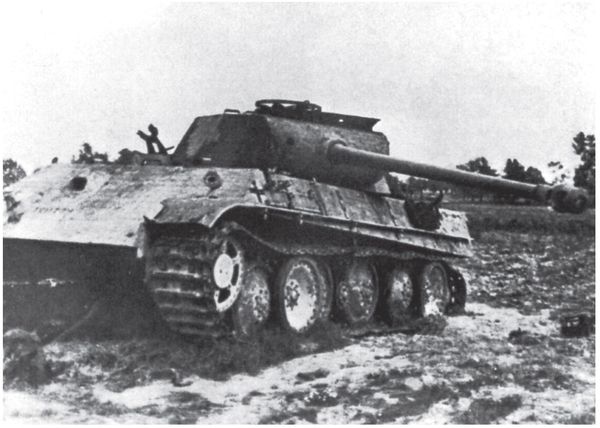
A Panther tank ausf G from the 19th Panzer-Division knocked out by Polish forces somewhere in the vicinity of Studzi-anki near Warsaw, August 1944.
Another knocked out Panther tank, ausf G from 19. Panzer-Division in the vicinity of Studzianski near Warsaw, August 1944.
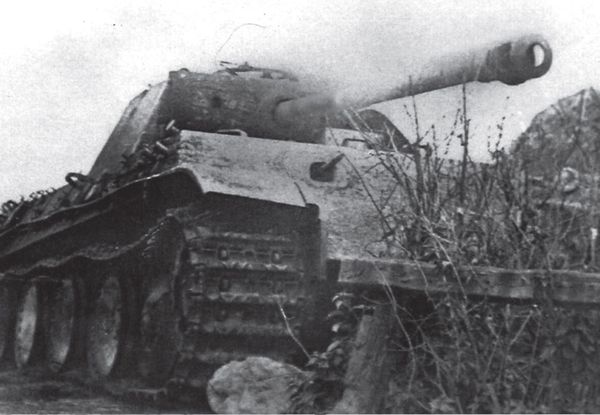
A Panther ausf G hailing from the 19th Panzer-Division acting as a troop transport to a machine gun detachment disembarking somewhere east of Warsaw, August 1944. (All photos: Leandoer & Ekholm archive)
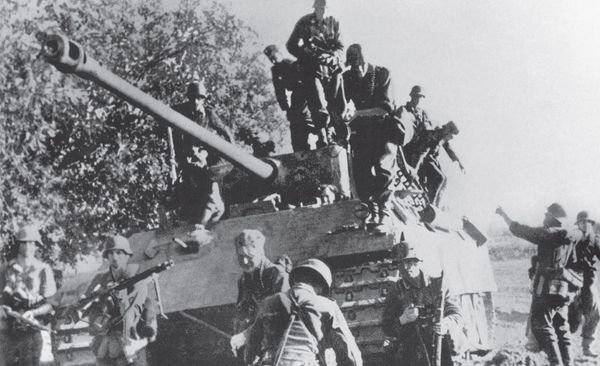
On the same day, further south, the 70th Army carried out an offensive in the area surrounding the village of Zawady – at the same location where the zone of the 5th SS-Panzer Division “Wiking” and that of the 3rd SS-Panzer-Division “Totenkopf ’s” had met. Though sustaining heavy losses, the attackers managed to take control of the villages of Zawady and Łosie, but they didn’t succeed in crushing the SS-SOLDIERS defences at Rządza Brook and on the approaches to Radzymin. The rifle divisions from the 47th Army had great tactical success when they yet again drove out the Hungarian 1st Cavalry Division from its positions outside Wołomin and were able to seize Ossów. Consequently, the Hungarian-German positions in Wołomin itself were outflanked from the south. On August 28, the 129th Rifle Corps continued to attack in that direction, and advancing from the south and the east reached the former built up sector of Wołomin which lay in ruins...
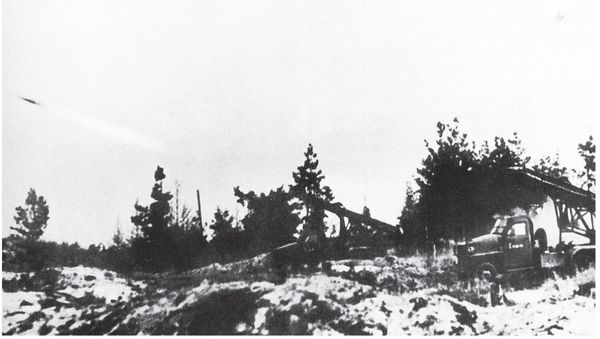
A Katyusha BM 13-16 on its way to the front outside Praga, August 1944 (Leandoer & Ekholm archive)
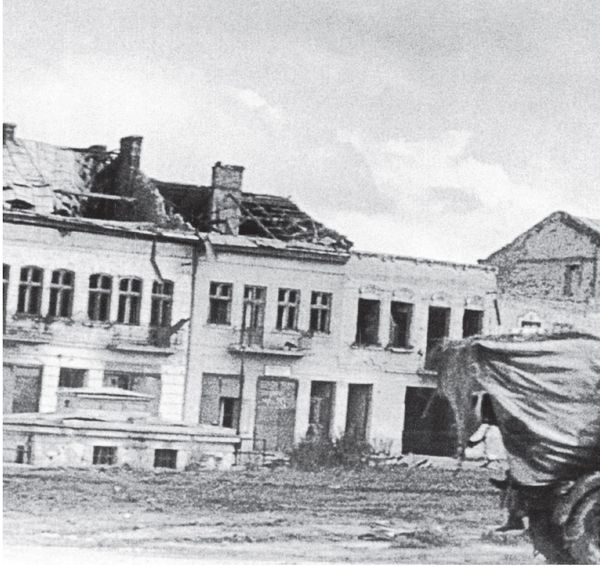
On August 29, nine rifle divisions from the 28th and the 70th Armies carried out the next violent storming of the 5th SS-Panzer-Division “Wiking” positions between Radzymin and the mouth of the Bug. Gille reported to the army staff on a massive infantry attack, in numbers never before witnessed, accompanied by waves of air attacks carried out by the Ił-2 air assault wing, and heavy artillery fire. The 5th SS-Panzer-Division “Wiking’s” right flank (SS-Panzergrenadier-Regiment 10 “Westland”), after several days of bloody fighting, was forced to retreat back to the village of Ruda. SS-Panzergrenadier-Regiment 9 “Germania” and Panzergrenadier-Regiment 73, however, had succeeded for the time being in maintaining control of the area around the outflow of the Bug River. To meet this situation, the Soviet 28th Army on August 30 increased its pressure on that area by launching periodic assaults against the exhausted enemy. On August 31, the 28th Army’s troops controlled the entire southern bank of the Bug River and thus its troops could now press on towards the Narew, in the vicinity of Serock. The Germans retired to a line which stretched along Rynia-Białobrzegi-Wólka Radzymińska. The 5th SS-Panzer-Division “Wiking’s” withdrawal toward Rynia and Białobrzegi created a gap between the IV SS-Panzer-Corps’ positions and the area controlled by the 2nd Army; a gap which encompassed the west bank of the Narew between Zegrze and Serock. General Reinhart gave the commander of the 9th Army the order to occupy the area with Gille’s corps. With the aim of ensuring the success of this mission – to begin with, a part of the SS-Panzergrenadier-Regiment 9 “Germania” was re-deployed.
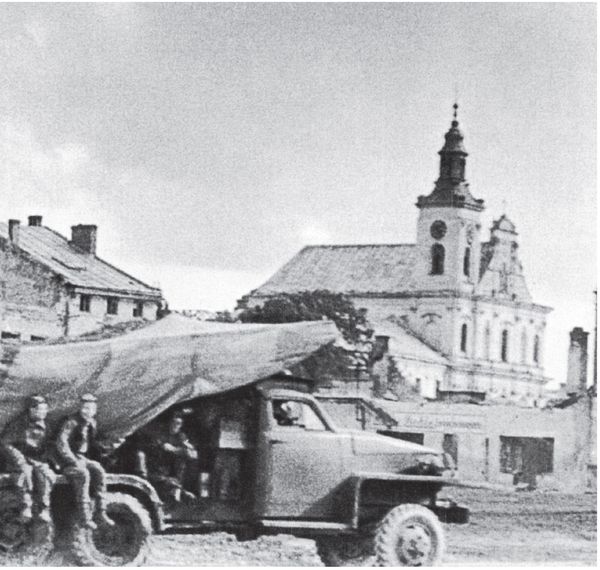
The 3rd SS-Panzer-Division “Totenkopf ” found itself under a sustained enemy attack that showed no signs of letting up. On August 30, 1944, the 96th and the114th Rifle Corps from the 70th Army attacked Radzymin simultaneously from both the north and the east. As on the previous day, the attack was accompanied by relentless waves of Soviet air attacks. The Germans were forced to withdraw from the villages of Mokre and Dybowo. The retreating SS-soldiers set up a new defensive line taking advantage of the destroyed buildings in Radzymin. But not even the devastating fire-power of their machine guns and mortars could hinder the Soviet infantry from entering the city. By that evening, when it had become evident that heavy counter-attacks supported by tanks had not improved the situation; the 3rd SS-Panzer-Division “Totenkopf” was finally forced out of Radzymin.
The day after; both corps from the 70th Army and one corps from 47th Army launched attacks along the Radzymin- Marki road and in the direction of Wólka Radzymińska. After the loss of Radzymin; Gille set the 5th SS-Panzer-Division “Wiking” in positions to defend attacks from the north, and the 3rd SS-Panzer-Division “Totenkopf ” from southerly attack, including the road towards Marki. Despite both merged Waffen-SS divisions (together with parts of the Panzergrenadier-Regiment 73 and the 1131st Grenadier-Brigade) being exhausted, they nonetheless continued to fight stubbornly and carried out almost daily counter-attacks with combat units drawn from the companies and battalions and with the support of armoured weapons. The Soviet soldiers also displayed great bravery and apparent unconcern with death. The fighting was therefore both hard and drawn out. The rate of advance for the 28th, the 70th, and the 47th Armies, as well as the 8th Guards Tank Corps, never exceeded more than 1 to 2 kilometres per day. On August 31, the 70th Army Corps together with the 47th Army’s 129th Rifle Corps only exerted the energy needed to clean up Radzymin’s southern suburbs and occupy the village of Cegielnia.
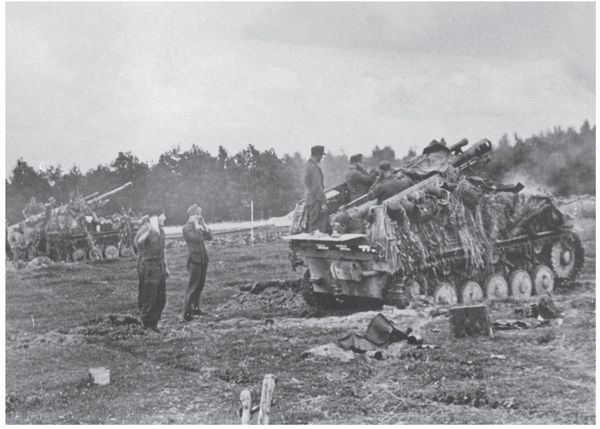
A battery of tracked howitzers, model “Wespe,” from an unidentified unit during combat in Poland, August 1944. (CAW)
On September 1, however, the pressing Soviet forces resumed the fighting in earnest. The terrain favoured the defenders because, in village after village, building structures rested on both sides of the main road to Marki, and between Wólka Radzymińska and Struga spread a forest (which before the war had belonged to the village of Nieporet), small marshes, and a number of hills (heights numbered 104, 100 and 97 in the vicinity of Słupno village). Early in the morning, after a heavy pre-assault artillery bombardment and air attack, the Soviet infantry commenced an offensive supported by tanks. After an entire day of heavy fighting, SS-Panzergrenadier-Regiment 10 “Westland” halted the enemy amidst the ruins of Wólka Radzymińska and on the muddy roads within the aforementioned forest, while units from the 3rd SS-Panzer-Division “Totenkopf” did the same thing along the line stretching between the villages of Struga and Nadma. The fact that the SS-soldiers reported – just in the area surrounding the village of Słupno – a total of 24 destroyed enemy tanks can serve as proof of just how hard these battles were fought.
The pressure exerted by the Soviet troops against the IV SS-Panzer-Corps’ left flank began to slowly taper off. Yet, on the 2nd and 3rd days of September, the 70th Army, and the 47th Army’s 129th Rifle Corps renewed their attempts to attack and breakthrough the German positions between Wólka Radzymińska and Nadma, albeit without success.
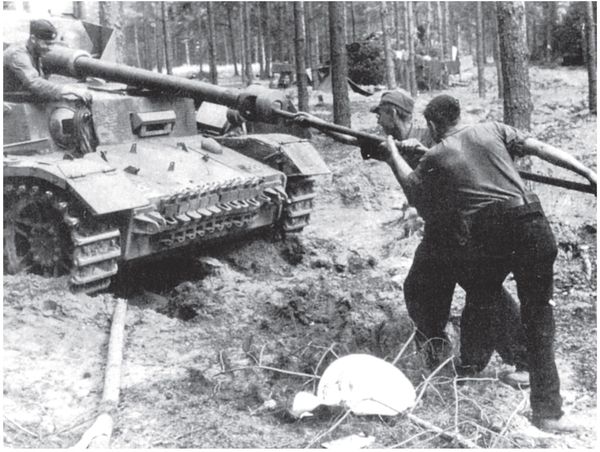
The crew of a PzKpfw IV Ausf. H tank from the I SS-Panzer-Regiment 5 “Wiking” cleans the muzzle in the vicinity of Warsaw, August 1944. (CAW)
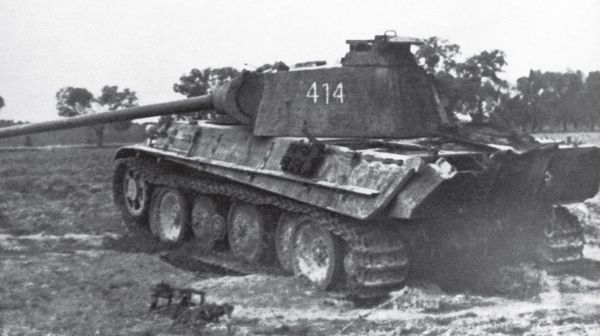
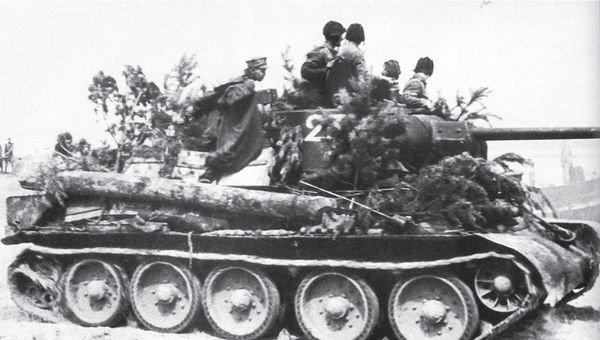
In August, the Russians sought to broaden the front by circling around Warsaw south of the city and building a bridgehead at the town of Magnuzew. The “Hermann-Göring” Division, together with other units, was pulled out of the fighting in Praga and re-deployed to meet this new threat,. Here they were confronted by the 1st Free Polish Tank Brigade. The result of this battle was a “draw” and the Russians succeeded in holding onto this location throughout the autumn of 1944.
The picture below shows a Polish T-34-76, model 1943, with infantry aboard. The picture above shows a knocked out Panther tank from the “Herman-Göring” Division after the battle. All told the German side lost thirty tanks in the battle. The lower picture on the facing page shows another Polish T-34-76 model 1943. The Russians lost some thirty tanks in the battle. The picture above shows a T-34-85 from the reinforced 164th Tank Brigade despatched by the 16th Tank Corps which arrived two days after the battle. (All photos: Leandoer & Ekholm Archive)
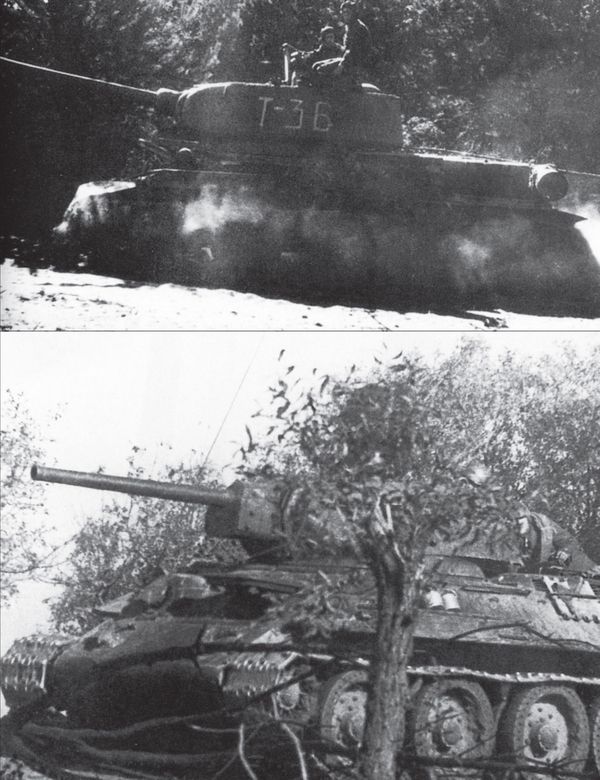
All attempts to pierce the defence were immediately met with counterattacks by improvised Kampfgruppe from the 5th SS-Panzer-Division “Wiking” and the 3rd SS-Panzer-Division “Totenkopf ”. Tanks wound up in long-distance artillery duels in which the Soviet side proved to be without chance. This was the case because the warring Soviet infantry’s main support came from outdated, model “Valentine” tanks, while their modern tanks had been placed in other armoured entities, as for example, in Guards units. In addition, the relatively few German tanks and tracked assault-guns, fought from ambush positions in the forest where they were at least camouflaged from the ever present threat of the Ił-2’s bombers.
A more difficult situation for the IV SS-Panzer-Corps had developed, instead, around Wołomin itself. After the enemy had reached the nearby village, Nadma, the German troops occupying Wololmin were fighting half-encircled and only had contact with the corps along the railway line to Zielonka. Finally, subsequent to the 129th Rifle Corps ending its assault of Wołomin; the situation became temporarily stabilised. Despite this, and with the aim of improving his troops’ situation, Gille received permission to shorten the defender’s line. On September 6, the German and Hungarian troops left Wołomin and withdrew to the suburbs of Zielonka. This was the final clever feint in the new Soviet offensive phase of the war which had begun on August 10. Beginning on September 3, SS-Gruppenführer Gille’s frontline troops experienced a welcome period of relative calm.
However, the intense fighting having let up against the frontline at Warsaw did not mean that the crisis in Heeresgruppe “Mitte’s” sector was over. The German forces defending Praga’s suburbs were extremely weak. General von Vormann had quite correctly foreseen that the Soviets side’s aim was to renew carrying out its assault strategy as soon as possible, particularly in the direction of Warsaw. Therefore he sent reminders to von dem Bach and General Hans Schirmer, (Schirmer had replaced General Stahel as commandant of urban warfare on August 25, who was dispatched in all haste to Bucharest) concerning the quashing of the Uprising and protecting the bridges across the Wisła and along Warsaw’s left river bank. He then presented these concerns in very striking terms to the 9th Army’s chief of staff, General Städke – and in a telephone conversation to von dem Bach, he stated that: “Not a single tank shall be allowed to pass!”
At the same time, the 9th Army, which had been burdened with the responsibility of defending the middle section of the Wisla, was suddenly weakened – because now it was General Weiß’s 2nd Army, fighting in the northern zone, that began the final retreat over the Narew and, among other locations, withdrew from Wyszków. Weiß reported: “During that day the situation became so grave that the order was given directing the XX and XXIII Army-Corps to withdraw to the other side of the Narew and the EastPrussian defence line.” But the 48th Army, the 65th Army, and the 1st Guards Tank Corps, all components of the 1st Belorussian Front’s right flank, succeeded in reaching the Narew at several points parallel to the retreat of the Germans and set up strong bridgeheads on its western bank. The 28th Army, positioned on the Bug’s southern bank where it ran out close to Wyszków, was also active here. The 128th Rifle Corps from this army pursued the XX Army-Corps and crossed over the Narew by Wierzbica, two kilometres north of Serock. The Soviet troops also seized the important bridgehead at Różan (the 48th Army) and at Pułtusk (the 65th Army with the 1st Guards Tank Corps).
Two T-34-76’s crossing the Vistula by ferry in August 1944. They are en route to a newly established bridgehead, south of Warsaw. Note the Willy’s jeep on top of the tank. It was all about efficency! (Leandoer & Ekholm archive)
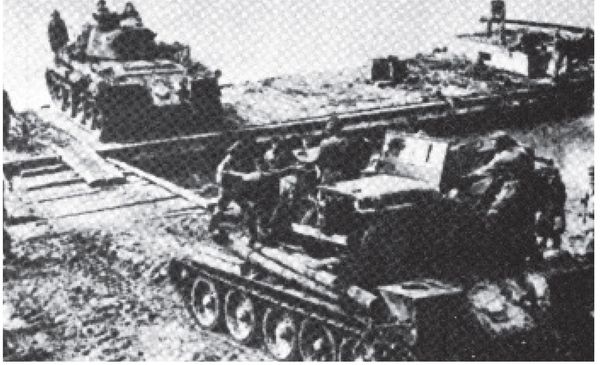
This course of events caused General Reinhardt, as soon as the temporarily stabilised situation outside of Praga was made known to him by von Vormann , to decide in favour of strengthening the 2nd Army at the expense of the 9th Army. He rescinded the order he had given two days earlier concerning the redeployment of the new 542nd Grenadier-Division to Warsaw, and despatched it instead to the area around Pułtusk, where it was to operate together with the 35th Infantry-Division and the Panzer-Abteilung 104.
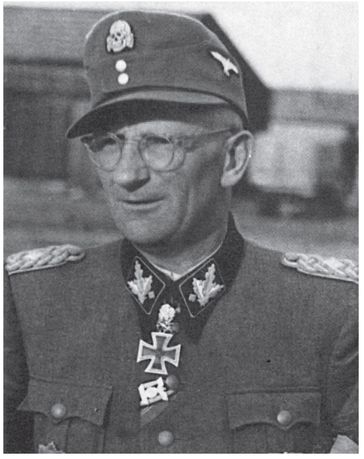
The commander of the 5th SS-Panzer-Division “Wiking“ (later the IV SS-Panzer-Corps) SS-Gruppenführer Herbert Otto Gille. (Leandoer & Ekholm archive)
Katyusha BM 13-16s carrying out a bombardment outside Praga in August 1944.(Leandoer & Ekholm archive)
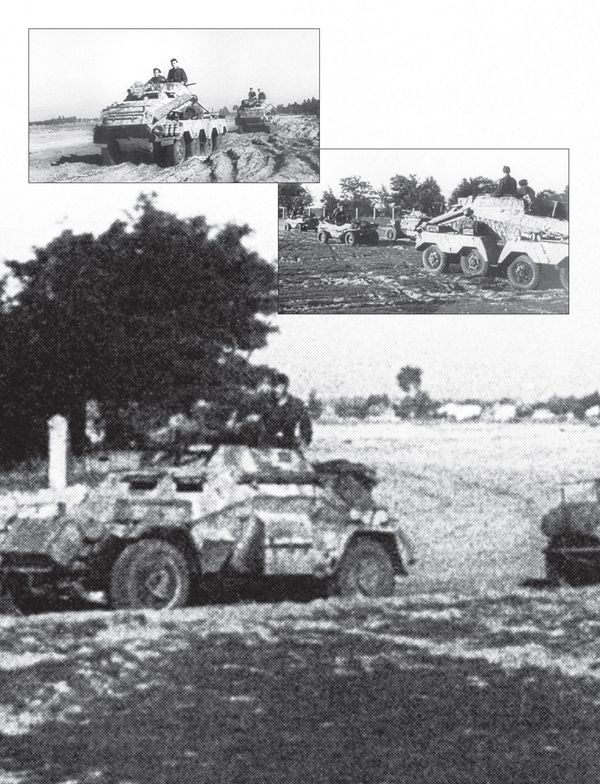
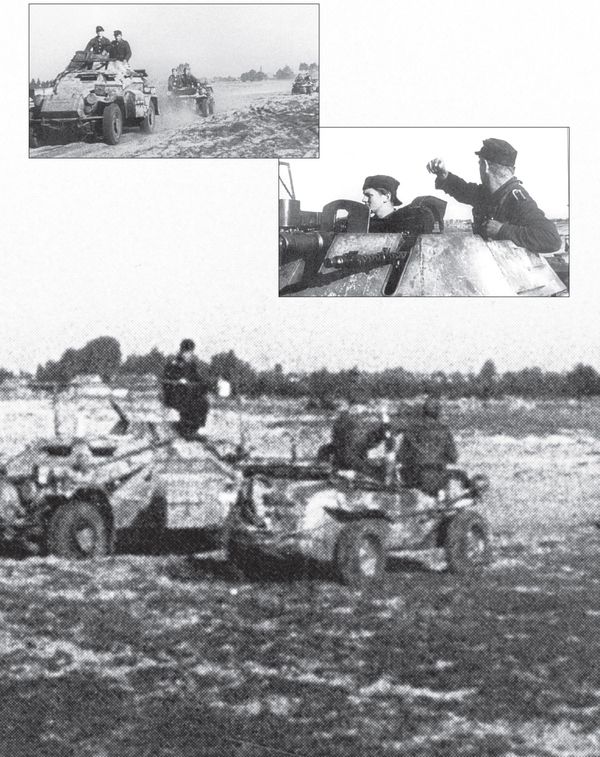
These five pictures show parts of a reconnaissance battalion from the 19th Panzer-Division, northeast of Warsaw at the turn of August-September 1944. The following vehicles are visible: Schwimmwagen.German amphibious jeep, Sd Kfz 222- German 4x4 armoured car, Sd Kfz 261 – a 222 equipped with a stronger radio and a Sd Kfz 233 7.5cm L/24 – an 8x8 heavy armoured car equipped with a short-barrel 7.5 cm gun capable of taking on both tanks and infantry. (Leandoer & Ekholm archive)
Thereafter, he further strengthened this formation with the 1131st Grenadier-Brigade that had been pulled away from its co-operation with the 3rd SS-Panzer-Division “Totenkopf” and the Panzergrenadier-Regiment 73 which had been assigned to the 5th SS-Panzer-Division “Wiking.” Over the course of two days, he even decided to commit the rest of the SS-Panzer-Regiment 5 to the stretch between Serock and Pułtusk. Meanwhile, in accord with decisions made by the OKW and OKH, the commander of Heeresgruppe “Mitte” was, at the same time, expecting that the 24th Panzer-Division, along with a Kampfgruppe from the 25th Panzer-Division, to arrive at the bridge emplacement from southern Poland (the Dukla-Pass). It was Reinhardt’s contention that a powerful Kampfgruppe should be assembled as soon as possible outside Pułtusk, because according to reconnaissance – by September 8, four days after the bridge area had been seized – the enemy had already found time to mass two rifle corps and a tank corps there. Confronted with the prospect of such a drastic reduction in his own force strength, General von Vormann naturally opposed these orders, though to no avail. On the other hand, the German command’s quick decision did make it possible for the 2nd Army to check the expansion of the Soviet bridgeheads. What particularly contributed to this success were the few model PxKpfw V “Panther” tanks from SS-Panzer Regiment 5 which provided support to the 35th Infantry-Division and the 542nd Grenadier-Division. Between September 6 and 9, they eliminated scores of tanks belonging to the 1st Guards Tank Corps.
The commander of the 9th Army had no illusions that the cessation of attacks against Praga on September 3 was anything other than for the purpose of regrouping Soviet combat forces in preparation for new assaults. His immediate superior shared this view and reported the following to the OKH on September 6:
“In the 9th Army’s zone the enemy till now has limited itself to small-scale, localised combat activities inside the 1st DKaw […]. When the enemy is now strengthening their combat forces, it is clear to the 73rd DP (Panzer Division?) that this enemy, beyond any conceivable circumstance or doubt, has not given up its plans to attack Warsaw’s bridge area.”
Despite this, on September 8 General Reinhardt gave orders to von Vormann to transfer command of the XXXXVI Panzer-Corps, together with the rest of the 19th Panzer-Division at Magnuszew, to the 2nd Army. General Lüttwitz’s staff would coordinate the counter-attack against the bridgehead at Pułtusk and the time-point was set for September 13. When the panzer corps’ officers set off on September 9, the 8th Army-Corps again overtook command of the forces blockading the mouth of the Pilica, while the area between Warsaw and Góra Kalwaria was taken over by the improvised Gruppe “Sickenius” (General Sickenius’ staff from the 391st Sicherungs-Division z.b.V and the Hungarian 5th Reserve Division). The 19th Panzer-Division’s columns also set off towards the north during the evening of September 9. General Källner’s subordinates still had no idea that instead of marching towards Pultusk, they would wind up in the middle of the battle for Praga.
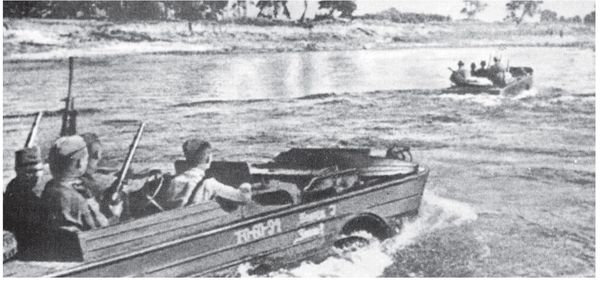
A Soviet reconnaissance detachment using American amphibious vehicles on a scouting mission across one of Poland’s many rivers. (Leandoer & Ekholm archive)
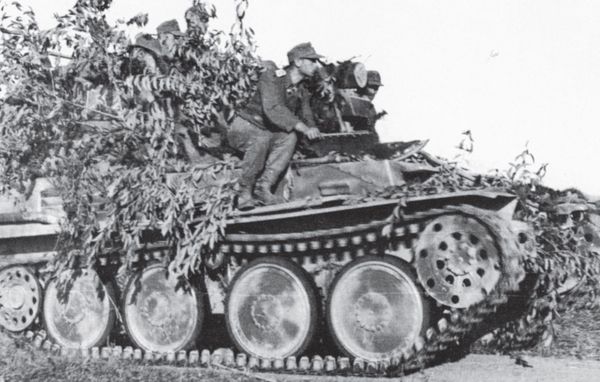
A well-camouflaged Sd Kfz 138 ausf M “Grille” from the 19th Panzer-Division redeploying toward the enemy northeast of Warsaw, August 1944. (Leandoer & Ekholm archive)
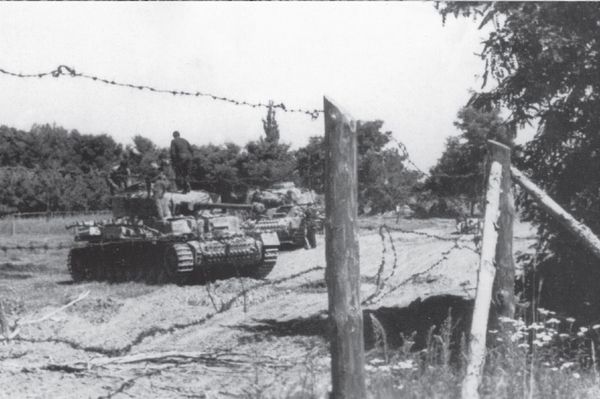
Two PzKpfw IV ausf H from the 19th Panzer-Division just east of Warsaw in the beginning of September 1944. (Leandoer & Ekholm archive)
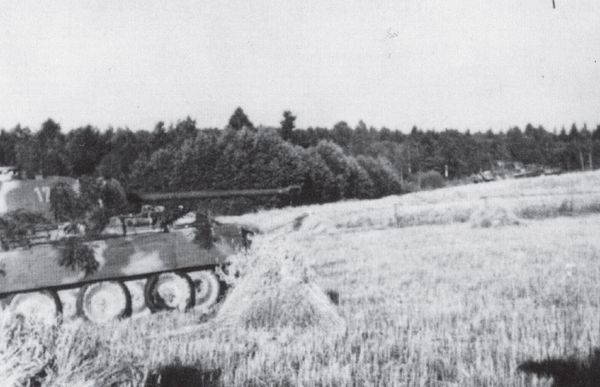
A Panther from the first company in Panzer-Regiment 27/19th Panzer-Division. Note that it is positioned at the bottom of a slope; also note that it is battle-ready, August 1944, northeast of Warsaw. (Leandoer & Ekholm archive)
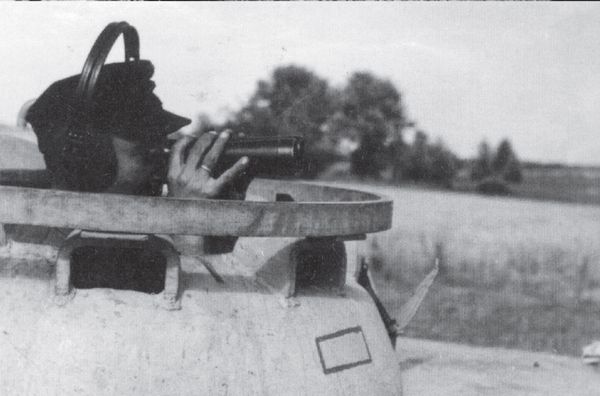
Perhaps a Panther commander from the same company at the same place? Hardly exposed, he rises just high enough within his tower to scout the terrain through his binoculars, in August, northeast of Warsaw. (Leandoer & Ekholm archive)