
Chapter 5
Both commanders were concerned about the way the battle had developed up to this point. Wellington, while not contemplating retreat, felt obliged to reinforce his front line with units from his second line of defence. He was also beginning to draw upon his reserves. Some of his staff worried that the army might not withstand another infantry attack on a similar scale to d’Erlon’s assault, especially if one of the farmhouses fell to the French. Wellington believed his army would stand for some time but was frustrated that, although the Prussians had arrived in some numbers by 2.00pm, Blücher appeared to be proceeding cautiously while the Duke desperately needed him to take some pressure off his army.
Napoleon was now more troubled about what might be happening in the east and dispatches from Grouchy alarmed him even further. At 11.30am, Grouchy’s first message revealed that his march towards Wavre was progressing slowly and it seemed very unlikely that he would be able to impose his force between the Prussian main body or attack them while they were on the march. It was now clear that there was no chance of Grouchy joining with the Emperor’s army and, even if this had been possible, the French were still likely to be outnumbered by two to one if the Prussians contributed two or more corps.
The failure of d’Erlon’s assault convinced Napoleon that the Anglo-Allied line was stronger than he had suspected, so he ordered Ney to seize the farmhouse of La Haye Sainte at all costs. Once this was achieved, French forces could concentrate closer to the enemy and subsequent assaults had more chance of carrying the ridge and penetrating Wellington’s defences. He also hoped that the fall of Hougoumont was imminent with significant numbers of his troops committed to its capture. I Corps was regrouping to the east of La Belle Alliance and Ney selected the two brigades who had suffered the fewest losses to renew the attack on the farmstead.
The Grande Batterie, now reinforced by guns from Reille’s Corps and the Imperial Guard, began to pound the Allied centre once again. Their concentrated firepower laid down a fearsome bombardment and General Alten later commented: ‘Never had the oldest soldiers heard such a cannonade.’ The strength of this fire persuaded Wellington to bring his front line further back around 100 paces. Ney was observing the Anglo-Allied position closely with his staff and, seeing signs of a substantial movement to their rear, guessed that Wellington was on the verge of retreating. In fairness, following the Duke’s well-executed withdrawal after Quatre Bras, he had grounds to suspect that Wellington would try to conceal attempts to fall back until the last moment.
However, the manoeuvres Ney had seen dimly through the smoke were actually large numbers of walking wounded, columns of prisoners and empty supply wagons retiring from the battlefield. He may also have seen the remnants of the Household and Union brigades regrouping before Mont St Jean. Combining this with the rearward movement of the entire first line (or what he could see of that manoeuvre), it was easy to see how he might have misinterpreted what he saw unfolding before him.
Hoping to take swift advantage of the enemy’s withdrawal, Ney ordered a brigade of Milhaud’s cuirassiers to move forward and press the enemy’s retreat. General Delort, one of Milhaud’s divisional commanders, questioned the order with General Farine and then with Ney himself:
He not only insisted on his original order being carried out, but demanded both divisions [of Milhaud’s corps] in the Emperor’s name. I hesitated to obey, saying that heavy cavalry ought not to attack heights held by infantry, infantry which had never yet been shaken and which was well placed to defend itself. The Marshal cried ‘Forward, for the sake of France!’ I reluctantly obeyed.
To cover their advance, Ney ordered Piré’s lancers to make a feint against the Anglo-Allied right flank, where they skirmished with Grant’s cavalry. Up to this point, many of the cavalry divisions had merely watched and listened to the fighting without taking an active part in the battle and were eager to come to grips with the enemy. Without waiting for orders, Lefebvre-Desnouëtte’s cavalry advanced once they saw Milaud’s squadrons moving forward and joined the attack. At around 4.00pm over 5,000 cavalry were moving against the centre right of the Anglo-Allied position.
GENERAL EDOUARD JEAN-BAPTISTE COUNT MILHAUD
Edouard Milhaud was born in 1766 and was the son of a farmer. He became a staunch Republican and is said to have taken part in the famous storming of the Bastille prison in Paris, which marked a turning point in the French Revolution, on 14 July 1789. He was elected as a deputy in the National Convention Government, where he voted to execute King Louis XVI, who duly went to the guillotine in front a vast Parisian crowd on 21 January 1793.
He left the world of politics for the army in 1795 and rose swiftly through the ranks. His support of Bonaparte when he seized power in 1799 greatly boosted his career as the future Emperor never forgot those who had championed his cause during this tense period. Milhaud was a superb cavalry commander and was promoted général de brigade in 1800.
Considered a fanatical Bonapartist, he fought in most of the main campaigns on the Continent and was obliged to retire in 1814 during the Bourbon restoration. It came as no surprise when he rallied enthusiastically to Napoleon’s standard upon his return and the Emperor rewarded this display of loyalty with the command of the IV Reserve Cavalry Corps in the Armée du Nord. This force included two of the famous curirassier divisions of the heavy cavalry. These horsemen were renowned throughout the French Army, their name deriving from the metal cuirass they wore, which protected a cavalryman’s front and back. They also wore tall Greek-style helmets, decorated with bearskin and having a horsehair plume flowing down the cavalryman’s back. Armed with long straight swords, their appearance was fearsome and they were renowned for the ability to deliver a decisive blow as an elite branch of Napoleon’s heavy cavalry.
When Ney called upon Milhaud’s Corps to assault the Anglo-Allied ridge, he did not question the command as others did, and immediately complied. He committed at least 3,000 cuirassiers to the initial assault and, being an officer who led from the front, received a wound at Waterloo leading his men against the infantry squares.
Surprisingly, Milhaud did his best to ingratiate himself with Louis XVIII’s regime when Napoleon was overthrown. As a known regicide, he was likely to be imprisoned, exiled or executed but his efforts succeeded to the extent that he was allowed to remain in France. Yet he was forced to resign his commission and only received a meagre pension to live on, despite his valiant service for France.
VIVE L’EMPEREUR! – THE FIRST CHARGES
The French cavalry advanced between the farmhouses of Hougoumont and La Haye Sainte. In order to bypass these positions without receiving heavy fire from their defenders, they were obliged to pass through a narrow area about 800yd wide (731m) – a constricted area for 1,000 let alone 5,000 riders. As no serious attacks had taken place on Wellington’s centre right, the tall crops planted here had not been trampled down to any serious degree. Some of the land was still sodden in places and, combined with the need to ride uphill, this meant that the cavalry progressed at walking speed and their pace did not exceed a trot until they reached the crest of the ridge.
In his eagerness to press the retreat, Ney had failed to co-ordinate this attack with a combination of different arms. Although the infantry attack on La Haye Sainte continued, the cavalry advanced without infantry support to exploit any success and only a few batteries of horse artillery followed in their wake to add supporting fire for their charges. One British officer observed: ‘We were astonished that one should attack with cavalry an infantry as yet unshaken and which, thanks to the undulations of the ground behind which it was lying, had suffered little from the cannonade.’ Ney rode at the forefront and this display of courage, while undoubtedly boosting the men’s morale, limited his ability to make command decisions. Just as Uxbridge had done earlier that day, the ‘bravest of the brave’ allowed his soldier’s instinct to overcome his judgement as a general.
Observing the French preparations from the ridge, Wellington sent orders for the artillery to move their horses to the rear, fearing they could be driven off when the cavalry attacked. He also ordered the infantry in the front line to return to their former position just behind the brow of the ridge and form squares there to repel cavalry. He instructed the artillery to fire right up to the last minute at the oncoming cavalry before running to take shelter in the squares behind them. The infantry were formed in twenty squares (though most were more rectangular in shape) placed in chequerboard fashion so they would avoid firing into each other. Most were at least sixty men wide and three or four ranks deep.

Ney’s cavalry attacks – approximately 4.00pm.
As the French rode forward, Allied artillery fired into the huge formations of men and horses. They moved slowly, offering large targets as roundshot tore into their ranks cutting down horses and emptying saddles. Colonel Ordner, commanding the 1st Cuirassiers, recalled proudly: ‘Our four superb lines were practically fresh; they moved simultaneously to cries of Vive l’Empereur! … Marshal Ney was at our head’.
When they neared the foot of the ridge, the artillerymen began to double-shot their cannon, firing both roundshot and canister and inflicting horrific losses at close range. It was a glorious but horrific sight as the magnificent squadrons rode forward into a lethal storm of fire. As the gunners fled to seek protection in the squares, the cavalry hurled themselves against the infantry. The Anglo-Allied batteries were swiftly overrun but few French cavalrymen had thought to bring gun spikes to disable cannon with. In any case, most hurtled forward regardless, eager to ride down the enemy. At first, the tall crops were a considerable obstacle. Major Llewellyn of the 28th Regiment wrote how they not only restricted the view of the infantry but also compelled the French to take drastic reconnaissance measures:
The rye in the field was so high, that to see anything beyond our own ranks was almost impossible. The Enemy, even, in attacking our Squares, were obliged to make a daring person desperately ride forward to plant a flag, as a mark, at the very point of our bayonets. On this they charged, but were invariably repulsed.
While infantrymen in the front ranks of these squares knelt, grounded their muskets and presented a wall of bayonets towards the enemy, men behind them fired at their assailants over their heads. Waiting until they saw the ‘whites of their eyes’, the infantry allowed the enemy to within close range before discharging their muskets. With many new recruits in the ranks, this was not easy, as the sight of the oncoming cavalry was frightful and intimidating. Inexperienced men tended to fire too high and it took great courage for them to hold their fire until cavalry approached within close range, when a volley would be more effective.
Their officers knew that, if the infantrymen kept their nerve and remained in square, they were relatively safe from the cavalry. Although they were not invulnerable, it was very difficult for cavalry to break their ranks without supporting fire from infantry or artillery. On the French side, the cavalry mounted furious attacks hoping either to penetrate the squares or break the morale of their defenders. If the infantry quailed at the sight of the massed cavalry bearing down upon them and ran, they could be cut down with impunity once dispersed. Losses were steadily being inflicted on both sides but it had also become a battle of wills, with those who kept their nerve the longest being the ones who would prevail.
The intense, disciplined fire of the infantry repulsed and broke up the cavalry formations and riders who approached close enough to hack down at the infantry with their sabres and inflicted only small losses in return. Those who rode close enough to do this were often shot or bayoneted as most horses baulked at the sight of the levelled bayonets and refused to charge into the men kneeling and standing before them. The cavalry swirled around the squares and the ridge became wreathed in gunpowder smoke from the massed volleys of musketry. Every time they were repulsed, the cavalry fell back to reform, stubbornly mounting charge after charge.
In places accompanying horse artillery had unlimbered close enough to see the squares and fired directly into the infantry, striking many men down in their tightly packed formations. However, the French had not brought up enough guns and, although the infantry took losses from this fire, it was not enough to make wide enough gaps in any squares for the cavalry to ride into and exploit. At least four major cavalry assaults took place before the French could even begin to check their cavalry’s over enthusiasm.
An infantry attack was also in progress against La Haye Sainte, which began just before 4.00pm. Donzelot deployed a heavy skirmish line, advancing it before the farmhouse to engage the riflemen who had returned to the gravel pit. This force covered the main attack by elements of Quiot’s Division who entered the orchard to the south of the farm and renewed their assault. The defenders were beginning to run low on ammunition, despite urgent requests to be re-supplied, but Wellington only sent two further companies of infantry to support them.
Baring’s men continued to resist the assaults on their walls and laid down a heavy fire, which drove Quiot’s men back into the orchard inflicting serious losses. Skirmishers from Kempt’s Brigade also advanced to the east of the farm and added their fire to that of the 95th, swiftly repulsing the French skirmishers covering the attack. The farmhouse was under heavy pressure but its garrison seemed likely to withstand these assaults for the present.
THE PRUSSIANS ARRIVE
Fearing that the Anglo-Allied Army might be overwhelmed at Mont St Jean, Blücher had urged his men onward throughout their difficult march from Wavre. Prussian artillery encountered severe problems in dragging their guns over hilly and rough country near Chapelle-St Lambert and it took all of the Field Marshal’s legendary willpower and enthusiasm to inspire his weary soldiers. Observing one gun team struggling to free their cannon from the mud, he leaned down from his saddle saying: ‘Come, comrades, you would not have me miss [break] my word!’ He knew that, even if Wellington managed to hold out against Napoleon, his troops were urgently needed if the Allies were to regain the initiative and turn the tide against the French.
By 1.00pm, Blücher had arrived on the edge of the battlefield at Fichermont Wood. He and his staff observed the battle closely under the cover of the trees with their spyglasses. Prince August of Thurn and Taxis (who served on the Prussian staff) recorded: ‘Hard to believe as it may be, we could see into the rear of the enemy (a distance of about 1½ hours’ march), and could even make out with our telescopes how the wounded were being carried back.’
They sent out a reconnaissance patrol of Uhlans under Major von Falkenhausen, who scouted almost as far as La Belle Alliance. He returned with prisoners who were taken completely unawares, never dreaming that the Prussians were so close. Their scouts reported that the French seemed entirely unaware of their presence.
Conferring with his officers, Blücher agreed that Napoleon would soon recognize the threat they posed and was likely to concentrate his efforts on breaking the Anglo-Allied line before they could intervene. Yet Blücher refused to mount an attack until he had concentrated sufficient forces and made them ready for battle. Committing troops in piecemeal fashion would simply result in unnecessary losses. Until then, Wellington would just have to hold out, but he began to plan an assault against the village of Plancenoit. Once IV Corps was ready, he meant to seize this village on the French right flank. If IV Corps could do this, he would then attack the French centre or rear from this position.
SERGEANT WILLIAM WHEELER OF THE 51ST REGIMENT
Wheeler served throughout the Peninsular War and participated in the invasion of France in 1814. He fought at Quatre Bras and at Waterloo and later took part in the Allied drive into France, fighting at Cambrai, until the wars ended with Napoleon’s second and final abdication.
Throughout his service, Wheeler wrote letters recounting his experiences to his family in Somerset and they read them avidly as a Sunday treat around the fireplace. They were published in 1949 and provide an interesting record of a straightforward, plain-spoken working man caught up in great events. Unlike some diarists, Wheeler rarely grumbled about poor accommodation, irregular food and low pay. Although he occasionally complained about some officers, he seemed generally content with life in King George’s Army. He saw considerable action and was among those hardy men who stood fast in square under shot and shell while surrounded and charged by some of the finest cavalrymen in Europe.
His patriotism never failed him during these adventures and he maintained an enduring faith in the Duke of Wellington, writing:
If England should require the service of her army again and I should be with it, let me have ‘Old Nosey’ to command … There are two things we should be certain of. First, we should always be as well supplied with rations as the nature of the service would admit. The second is we should be sure to give the enemy a damned good thrashing. What can a soldier desire more?
STANDING FIRM
Back on the Anglo-Allied ridge, the cavalry continued to pit lance and sabre against musket and bayonet. Every time the cavalry withdrew to reform, gunners emerged from the squares, ran to their guns and fired at them while they struggled to reform at the foot of the ridge. The crops had now been trampled beneath their hooves but the cavalry made little progress against the infantry, which remained steadfast in their serried ranks. Watching grimly from his vantage point, Napoleon voiced his disapproval of Ney’s actions to Marshal Soult: ‘This is a premature movement, the results of which may prove disastrous.’ Soult responded: ‘He is endangering us as at Jena!’ The Emperor looked long at the field of battle, reflected a moment, then said: ‘It is too soon by an hour; but it is necessary to follow up what has already been done.’
Consequently, the cavalry of Kellerman and Guyot were committed to the attack. For another hour, wave after wave of cavalry pressed relentlessly against Wellington’s centre and as many as 10,000 cavalry were sent against the ridge in total. Conditions within the infantry squares were appalling as, amidst the cloying smoke, officers struggled to keep order and shout commands above the deafening sound of musketry, the thunder of hooves and clash of steel. In the centre of the squares lay many wounded and dead, dragged back there by their comrades.
This part of the struggle became the most famous event during the battle and many drawings and paintings of Waterloo later showed Allied infantrymen standing stoically in square with their colours stirring in the breeze behind them in the centre of their squares. Their grim, determined resistance was in direct contrast to the wild courage of the French cavalry, furiously attacking the squares with great bravery. Images like this became symbolic of the titanic struggle at Waterloo.
It seemed that the situation for Wellington was desperate, with his infantry in the centre surrounded by a tide of cavalry, swirling furiously about them. Ordener, who rode against the squares himself, exaggerated slightly by claiming: ‘We were almost masters of the plateau, and the English were three parts destroyed. But they seemed rooted in the earth; we should have had to kill them to a man.’ Even Napoleon believed that victory was close and later commented that if Murat had been there enough squares might have been destroyed to enable him to break through: ‘perhaps, he would have given us the victory. For what was it that we needed to do at certain points in the battle? Smash three or four British squares.’
While only a few horse artillery batteries had advanced with the cavalry, the squares were harassed by numerous tiraillers, particulary near La Haye Sainte, and morale in the squares wavered as casualties mounted. The skirmishers sometimes denied Allied artillerymen the chance to return to their guns during the intervals between charges and Wellington knew that the situation would become perilous if the French advanced in force with infantry. Adam’s Brigade was in the second line and, in contrast, his men were agitated by occasional skirmisher fire, and were eager to adopt a more active role. The Duke now ordered them to move closer to the front line (moving slowly in square) and instructed other battalions to drive the skirmishers back if possible, declaring: ‘I’ll be damned if we shan’t lose this ground if we don’t take care.’
Although the Allied infantry suffered, far more cavalrymen and horses were cut down by their firepower during this battle of attrition. At one stage Marshal Ney, who had had three horses shot from under him, was seen standing alone in a captured battery and beating his sword against a gun barrel in rage and frustration. The Anglo-Allied infantry had not been weakened by the previous cannonades as much as the French had thought and, without infantry support, it was clear that cavalry alone could not break them. Two years before, General Thiébault had written that infantry formed in two lines of squares with sufficient intervals between them to allow them free fire, had little to fear from cavalry, especially when supported by artillery. This was certainly the case at Waterloo and he had remarked that in theory: ‘I cannot imagine what cavalry would be able to accomplish against them’ in such a scenario.
When cavalrymen rode near enough to use lance or sword, they often faced two or three defenders at a time lunging upward with their bayonets, or were shot at from point-blank range. Some discharged pistols or carbines from the saddle but they could not hope to compete with the concentrated fire of so many muskets. The chequerboard positioning of the squares allowed each battalion to offer mutual fire support to neighbouring squares and therefore the French often received fire in their flanks as well as in front as they rode past. Renowned for their efficient drill, British battalions occasionally redeployed into a line four men deep when their assailants withdrew, firing a more devastating volley after them. Observing this, the French sometimes wheeled about and charged again, only to be thwarted as jeering redcoats smoothly reformed square (a relatively easy manoeuvre to carry out from a line four-men deep).

Cavalry clashes at Waterloo. (H Chartier)
One of the infantrymen standing in the beleaguered squares was Sergeant William Wheeler of the 51st Regiment, who wrote only days afterward:
I am at a loss which to admire most, the cool intrepid courage of our squares, exposed as they often were to a destructive fire from the French Artillery and at the same time or in less than a minute surrounded on all sides by the enemy’s Heavy Cavalry, who would ride up to the very muzzles of our men’s firelocks and cut at them in the squares. But this was of no use, not a single square could they break, but was always put to the rout, by the steady fire of our troops.
Wheeler also recorded how, on one occasion, a large number of cuirassiers overreached themselves and, not wishing to retire under the fire of his square, took a circuitous route down the road lying to their left. Finding this barricaded by felled trees, the cavalry milled around in confusion and most were killed when infantry approached and fired down upon them from the embankment above.
Every time the French withdrew, Lord Uxbridge launched counter-attacks with his cavalry hoping to inflict losses and disrupt their attempts to reform. Nonetheless, mindful of the casualties his own cavalry had suffered that day, he took care to keep his men in hand and managed to prevent them from pursuing the enemy beyond the foot of the ridge before withdrawing behind the squares once again as renewed French charges began.
By around 5.00pm, Ney had realized that Wellington was not retreating and his cavalry could not capture the ridge without more support. Therefore, he ordered 8,000 infantry from Reille’s II Corps, which were not committed to the fight for Hougoumont, to advance in the wake of the cavalry attack. Yet the move was badly mistimed and they did not move forward until 5.30pm when the cavalry had fallen back to the foot of the ridge.
Reille’s infantry pressed forward into a heavy cannonade and then received devastating musketry fire as they traded volleys with the infantry on the ridge who had redeployed into line to meet them. Fearing further cavalry attacks, most Anglo-Allied battalions adopted lines four-men deep. While this was more restrictive in terms of firepower than the usual firing line, only two-men deep, it did permit them to reform a square more quickly. Even so, it was effective and General Foy recalled:
When we were about to meet the English, we received a very lively fire of canister and musketry. It was a hail of death … The columns of Bachelu’s division fled first and their flight precipitated the flight of my columns. At this moment I was wounded. A ball passed through the top of my right arm; the bone was not touched … I rallied the debris of my division [brigade] in the valley adjacent to the wood of Hougoumont.
Bachelu was also wounded during this abortive attack, receiving a shell splinter in the head. According to some accounts, the French lost as many as 1,500 men in only 10 minutes and by around 6.00pm the attack had been completely repulsed.
Historians continue to debate who was ultimately responsible for the disastrous charges at Waterloo, which devastated the French cavalry arm. Some blame Ney, while others suggest Napoleon was guilty of committing his men to unnecessary slaughter. Some suggest that the cavalry’s fanaticism and over eagerness lay at the root of the disaster but, whatever the cause, 10,000 virtually unsupported cavalrymen exhausted themselves against a heavily defended position for very little gain. Furthermore, in the face of heavy losses and lack of progress, the attack was permitted to continue for far too long. Reinforcing failure went against everything Napoleon had written about the art of war and the fact that he allowed the assaults to continue unchecked is far more difficult to comprehend than the reasons for the initial attack.
However, recent studies on the battle by Alessandro Barbero, suggest that the French gained from the multiple cavalry charges. He believes that Napoleon was well aware of how the assaults were proceeding but decided to continue with them as they occupied the Anglo-Allied infantry on the ridge and prevented Wellington bringing up reserves. This allowed the French to continue with their efforts to seize Hougoumont (without significant interference) and prepared the way for a move against La Haye Sainte, which was isolated while the cavalry attack continued. Furthermore, while the massed charges were costly, they inflicted some damage upon Wellington’s line and maintained pressure upon it until Napoleon was ready to deliver a final, crushing blow.
Viewpoints
VIEWS OF THE VALLEY
Despite the height advantage from being on horseback, the French cavalry could see very little of the Anglo-Allied line during their advance through the valley and when climbing the slope of the ridge before them. The smoke generated from the cannon firing down at them told them where to expect enemy artillery batteries to be, but even after they crested the ridge, many of the infantry squares would have been difficult to make out due to the high crops. This would have remained the case until repeated assaults crushed the rye lying in their path and Major Llewellyn’s recollections of the French having to place direction markers, as a prelude to their charges, are probably accurate for the first few attacks.
Today the reverse slopes of the ridge are open farmland just as they were in 1815. The crest is probably lower in places and the embankments on either side of the lane are long gone due to the construction of the Lion Mound. Nevertheless, visitors tracing the line of the ridge or looking up at the crest while walking through the fields below can still gain a good impression of how things stood in 1815. One thing that becomes immediately apparent from the ridge, highway or valley floor is the narrowness of the area between the two farmhouses. This was a very restrictive area to attack through for such a large force and this must have challenged the ability of officers and NCOs to direct the cavalry formations and maintain their ranks.
VILLAGE OF MONT ST JEAN
In 1815, the village of Mont St Jean was a small settlement inhabited by about 300 people. Its buildings stood around a crossroads where the roads from Nivelle and Genappe joined and the highway ran directly on towards Waterloo and Charleroi. The ridge of Mont St Jean, where Wellington established his army, is about 1,093yd (1,000m) from the centre of the old village.
After the battle, many wounded were brought through Mont St Jean on the way to Brussels or were treated in the village itself. Years afterwards, Sergeant Major Cotton returned to live in Mont St Jean and wrote his famous A Voice from Waterloo guidebook here. Victor Hugo also stayed at the Hôtel des Colonnes and wrote the Waterloo chapter of Les Misérables during his visit to the area. This hotel was demolished in 1962 but Hugo’s reputation was such that the balcony from room he stayed in was saved from the wreckage and can now be seen in the garden of the museum at Le Caillou.
Today few old buildings remain from the time of the battle and the village has been virtually swallowed by the suburbs of Waterloo and Braine l’Alleud. Nevertheless, due to its close proximity to the battle and the fact that much of the fighting took place upon Mont St Jean ridge, the French used to refer to the battle as Mont St Jean in preference to Waterloo.
MONT ST JEAN FARMHOUSE (LOCATION MAP REFERENCE 1)
The farm of Mont St Jean is located around 656yd (600m) north of Wellington’s crossroads on the eastern side of the highway to Brussels. Just before the battle, Dr John Gunning, who was the Principal Medical Officer of I Corps in the Anglo-Allied Army, requisitioned it. He used the buildings as an aid station to treat casualties in and, even though the farm was large, it soon became filled with wounded men.
Hundreds of wounded were brought here for treatment either within the buildings or within the central courtyard, where they lay exposed to the elements. Amputation was the main form of treatment for serious wounds and operations were carried out on rough farm tables or improvised platforms constructed from farm doors or anything else that came to hand. With few anaesthetics available, patients had to be firmly held down by orderlies during their agony and the courtyard must have resembled a charnel house as bloodied surgeons tended screaming men with severed limbs stacked in piles around them.
Ney spotted the movement of troops around the farm from the French ridge (some distance away) and misinterpreted it as evidence of an enemy retreat. Many of the men and wagons he saw were wounded walking or being carried into the farm. The cavalry of the Household and Union Brigades were also reforming in the fields to the south of Mont St Jean farm, which helped persuade Ney to mount the massed attacks that would simultaneously bring glory and ruin upon the French cavalry.
Mont St Jean dates back to 1150 and belonged to the Order of the Knights Templar at one stage. At the time of the battle, a square tower was located over the main gate to the complex but this fell during earth tremors in 1992. At the time of writing, this gateway is blocked by the ruins of the former tower and it is out of use. This has the effect of defacing the front of the building for photographic purposes and the rest of the structure is in a poor state of repair on the side facing the highway. Today the farmer gains access by means of a gateway on the north side of the farm. A small lane runs from this gate along the north side of the complex before turning right into the inner courtyard.
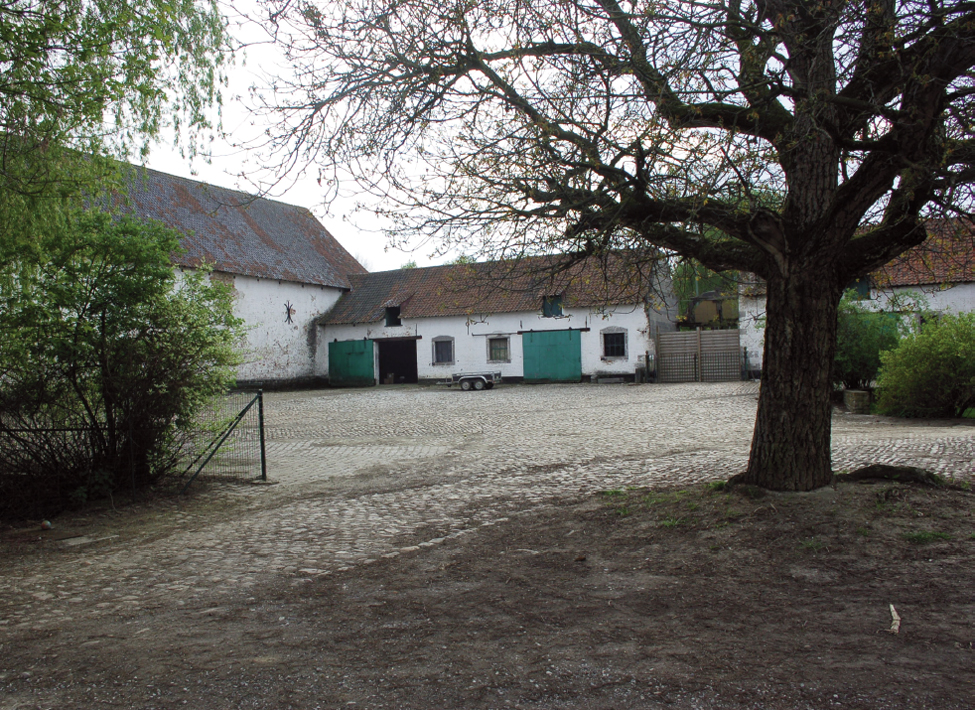
The courtyard of Mont St Jean farm where many wounded were treated either within the surrounding buildings or out in the open.
Although the buildings appear to be unoccupied ruins from the front, it is a busy farm and family residence and visitors should be cautious if they wish to gain access beyond taking photographs of the farm from the roadside. Although most locals are friendly, it is best to ask permission if in doubt about rights of access and visitors should treat the area with the respect it deserves.
The Waterloo Committee contributed towards a plaque commemorating the noble efforts of the senior staff surgeons, which is next to the ruined main gate. It reads:
In memory of Deputy Inspector Gunning Principal Medical Officer of the 1st Corps the Surgeons and other members of the field hospital which was established in this farm to care for the wounded of the battlefield 18th June 1815. This tablet was erected in 1981 by the Royal Army Medical Corps.
THE WATERLOO PANORAMA (LOCATION MAP REFERENCE 8)
In the Lion Village, a panorama/rotunda stands next to the Lion Mound displaying an incredible depiction of the French cavalry charges during the battle. This large white building is unmistakeable and it is one of the few rotundas in the world displaying a military painting, its main rivals being those in Sevastopol (Ukraine) and Gettysburg (United States of America), which also commemorate great battles of the nineteenth century.
In 1910, the artist Louis Demoulin leased this plot of land from the Belgian Government for a period of eighteen years and building began. He secured funding from numerous Belgian and foreign donors and engaged the services of four other French and Belgian artists. These included Robiquet, Malespina, Desavreaux and Vinck, whose varied experience included painting wildlife and military subjects.

A section of the Waterloo Panorama showing Marshal Ney charging at the head of his cavalry at the height of the cavalry attacks made against the Allied centre right.
The Panorama is 114ft (35m) in diameter and the painting is 360ft (110m) long and 39ft (12m) high. It was constructed from fourteen lengths of canvas and the painting and surrounding building were finished by 1912. In 1989, two exhibition rooms were added in order to display exhibits relating to the battle and the panorama.
The painting itself depicts what many consider the dramatic highlight of the Battle of Waterloo, showing the massed French cavalry attacks that continued for at least 2 hours. In the foreground stand life-size mannequins, bushes and weapons, which are designed to give the impression of blending into the painting itself. The painting is remarkable both as a dramatic depiction and for the accurate representation of uniforms and equipment. Its painters took great pains to represent as many regiments as possible and, although cuirassiers, hussars and red lancers predominate, plenty of more obscure cavalry types (such as carabiniers) are also shown in what amounts to a breathtaking display of colour and variety.
The painting also reveals that Wellington’s army was very much an allied force. In addition to the redcoated British infantrymen so beloved by most artists of the period, Brunswicker, Nassau and Belgian troops are also much in evidence. Several famous personalities can be picked out with closer scrutiny and Napoleon can be seen on horseback, surrounded by his staff, having ridden forward to watch the progress of the attacks. Likewise, his adversary is shown with his own staff sheltering within one of the infantry squares, and Wellington sits calmly on his horse as enemy cavalry stream about him.
Yet the most prominent figure is that of Marshal Ney, who has valiantly placed himself at the head of another charge to lead his men by example. Having lost previous horses during incessant and determined attacks, his hat is long gone and his famous red hair therefore marks him out as he encourages his cavalrymen onward, sword in hand.
Although the painting is worth viewing for its artistic merit alone, the centre has added loud sound effects, which add to the atmosphere. Standing on the central viewing platform, visitors hear the thunder of hooves, gunfire, war cries and the screams of the wounded, the combination of which makes a powerful impression on most observers. The painting portrays an incredible scene, simultaneously revealing the splendour, glory and horror of war (as scenes of the dead and suffering wounded are also apparent). Even pacifists of the author’s acquaintance have found this display to be impressive. No visitor should leave the Lion Village without viewing this exhibit and it is well worth the small entry fee charged, which also includes entry to the Lion Mound.
THE ALLIED CENTRE RIGHT
Anglo-Allied artillery was deployed along the line of the lane running between the Lion Mound and Hougoumont and the infantry were placed behind it during the cavalry attacks. Although the reverse slope appears very shallow along this line, the excavations carried out in the 1820s have probably altered the sharpness of this ridge significantly.
There has been considerable debate about the depth of the sunken lane at this part of the battlefield. Victor Hugo emphasized its effect as an obstacle to the cavalry when he wrote about the battle, claiming it played a crucial role in disrupting the French cavalry charges. Unfortunately, first-hand accounts that mention the lane are contradictory and its true depth will never be known. However, it certainly did not present an insurmountable obstacle to horses and, significantly, British cavalry did not encounter much difficulty when counter-attacking at various points during the battle. Admittedly, they were more familiar with this ground than their enemy but, since this feature has now disappeared, historians can only guess at how much effect it had on the tactics used on this part of the battlefield.
MERCER AND DEMULDER MONUMENTS (LOCATION MAP REFERENCE 9)
Walking the line of the lane between the Lion Mound and Hougoumont, visitors will encounter two small monuments. The first is a memorial stone dedicated to the memory of Lieutenant Augustin Demulder of the 5th Cuirassiers who died near this point while charging the infantry on this ridge. It lies about 273yd (250m) from the base of the mound and the inscription is in French. It reveals that Demulder was a Belgian, aged 31 at the time of his death and had served extensively at battles such as Eylau (1807), Aspern-Essling (1809) and Hanau (1813). Wounded three times during a notable military career, he travelled far in the service of France and it is ironic that he was killed only a few miles from his birthplace at Nivelles. His monument lies at a point where the ridge levels out and it is quite possible that he was killed very close to its location. The Anglo-Allied squares lay in two curving lines parallel with the modern lane on the reverse slope here.
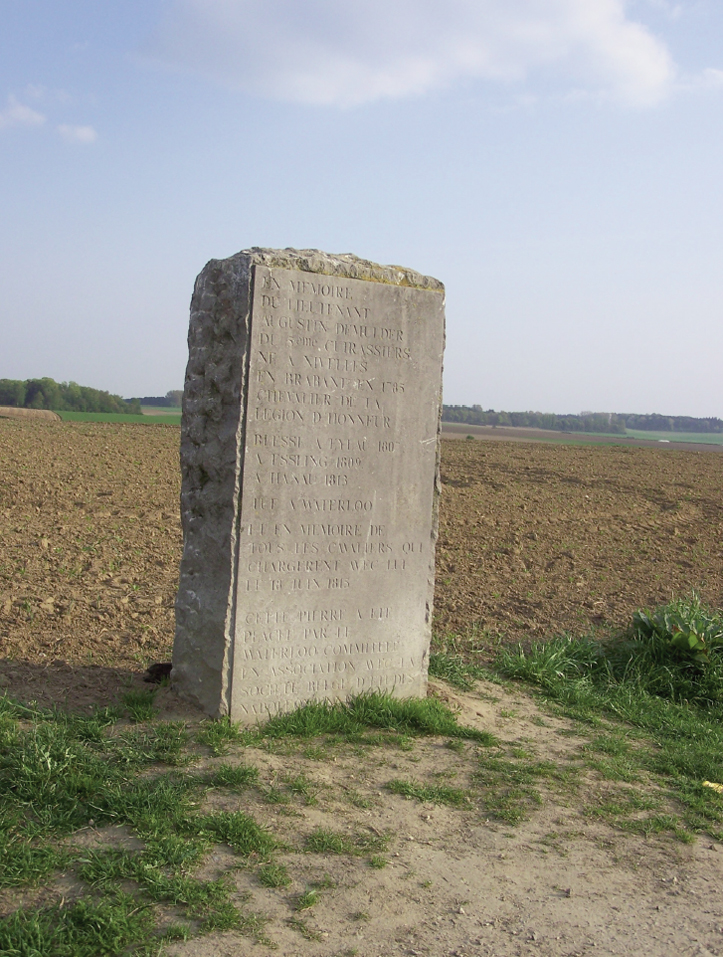
The monument is dedicated to Lieutenant Demulder who died during the cavalry assaults on the Allied right. It stands very close to Mercer’s Monument and it is quite possible that Demulder was slain by cannon fire from that very battery.
The second marks the point where Captain Alexander Cavalié Mercer’s G Troop of the Royal Horse Artillery took up its last position during the battle. This comprised five 9-pounder guns and one 5.5in howitzer and its straightforward description in English records their presence here. During the cavalry charges, G Troop was attacked several times but its fire proved so devastatingly effective that the gunners did not need to retire into the infantry squares for protection. They were the only battery who continued to fire throughout the massed French cavalry attacks that took place in this part of the battlefield.

A monument on the lane between Hougoumont and the Lion Mound marking the approximate spot where Mercer’s Battery of G Troop Royal Horse Artillery stood and fired upon the massed cavalry charges against the Allied centre right.
THE POLISH LANCERS MEMORIAL
A small stone to the Polish Lancers is located close to the Wounded Eagle Monument (Location Map Reference 14 – see Chapter 9) by the Association for the Conservation of Napoleonic Memorials. It records the contribution of the 1st Squadron of the 1st (Polish) Lancer Regiment which fought under Major Balinski. These cavalrymen were clad in blue uniforms and fought alongside the equally famous red lancers, commanded by Colonel Sourd, as part of the Light Cavalry of the Imperial Guard.
There were Polish soldiers who fought with great enthusiasm for France in all three arms of the French Army. The Polish were horrified when their country was divided between three other nations in 1795 and Napoleon won their undying gratitude by championing Polish demands for independence. When he went to war with Russia in 1812, many Polish soldiers fought with his Grande Armée and participated in the invasion of Russia, hoping to ensure that Poland became a sovereign nation. Although he ultimately failed to deliver on his promises, they remained loyal to Napoleon until the end. The French inscription refers to the ‘Battle of Mont St Jean’ and translates thus: ‘To the officers, NCOs and soldiers of the Polish Squadron who fell at Mont St Jean, 18 June 1815’.
THE 5TH ARMOURED REGIMENT MEMORIAL
Located further along the road towards Placenoit, running from Napoleon’s observation point (Location Map Reference 12), and situated on a traffic island at a fork in the road lies a small memorial to the 5th Cuirassiers. Commanded by Colonel Baron Gobert, it comprised approximately 500 men of one of the best-equipped regiments in Milhaud’s IV Cavalry Corps. Emblazoned with a Napoleonic Eagle, the stone’s inscription records how this heavy cavalry regiment was deployed in this area and joined the massed cavalry attacks against the Allied infantry in Wellington’s centre.
THE BOIS DE PARIS (FOREST OF PARIS)
The Bois de Paris lay about 1,640yd (1,500m) away from the French right flank but the woods were considerably larger in 1815 than they are today. The Prussians encountered great difficulty marching here due to the muddy roads, defiles, congestion and hills in the area. Four main tracks ran through the woods and all were narrow and unpaved. This would have restricted the passage of men marching in column and historians, such as Mark Adkin, believe that the French could have stopped Prussian progress quite easily had they intercepted them here.
However, only the 7th Hussars were present to skirmish with Colonel Schwerin’s 6th Hussars when the Prussians first began to arrive in this region. While the cavalry of Domon and Subervie were dispatched to delay the Prussians, they were not capable of holding back a large force of combined arms and when Lobau brought his infantry up, he either declined to enter the woods or arrived just as the Prussians began to emerge from them. Whatever happened, when Bülow’s infantry left the forest and began to deploy at about 4.30pm, they took up good positions for an assault on Lobau’s force and to advance on Plancenoit.
Today the lie of the land here is similar and most roads in the area are still narrow just as they were at the time of the battle. The land is dotted with many small areas of woodland and, despite the criticism the French have received, it is easy to imagine that these features could have masked the Prussian approach for even longer as the forest was more extensive. Only efficient scouting by the 7th Hussars and alert observation by Napoleon and his staff saved the French from losing even more time before they could meet the Prussian threat.