
Appendix I
An accurate picture of the various medallic awards to the 24thWelsh is not known, but on the following pages, compiled from information from various sources, are details of the known awards to the Battalion, and also known awards to officers and men of the Pembroke and Glamorgan Yeomanry who did not serve with the 24th Welsh. The Carmarthen Journal of 4 July 1919 did, however, note that:
‘A splendid share of honours and awards was won by the battalion. Lieutenant Colonel Spence-Jones, the commanding officer, was made CMG (appointed to the Order of St Michael and St George) and was awarded the DSO; Major J. B. H. Woodcock won the DSO; ten officers secured the MC and one gained the Bar to MC; whilst among the other ranks, two won the MSM, thirteen the DCM; and nineteen the MM. Seven officers and seven other ranks were mentioned in despatches.’
Victoria Cross
Major Stewart Loudon Shand VC. He had served with the Pembroke Yeomanry during the Boer War. During the First World War, he served with the 10th Battalion, Yorkshire Regiment, and commanded the battalion on the opening day of the Battle of the Somme. His award of the Victoria Cross was published in the London Gazette of 8 September 1916:
‘For most conspicuous bravery. When his company attempted to climb over the parapet to attack the enemy’s trenches, they were met by very fierce machine gun fire, which temporarily stopped their progress. Maj. Loudoun-Shand immediately leapt on the parapet, helped the men over it, and encouraged them in every way until he fell mortally wounded. Even then he insisted on being propped up in the trench, and went on encouraging the non-commissioned officers and men until he died.’
Companion of the Order of St Michael and St George (C.M.G.)
Lieutenant Colonel Cecil John Herbert Spence-Jones. His notification of the investiture of the C.M.G. was published in the London Gazette of 3 June 1919. He was also awarded the Distinguished Service Order.
Lieutenant Colonel Edward Miller. He commanded one of the reserve battalions of the Pembroke Yeomanry.
Gerald Trevor Bruce DSO. His notification of the investiture of the C.M.G. was published in the London Gazette of 3 June 1919. He had served with the Glamorgan Yeomanry before being given command of a battalion of the Lincolnshire Regiment.
Order of the British Empire (OBE)
Wing Commander James Bevan Bowen. He had served with the Pembroke Yeomanry before transferring to the Royal Air Force, becoming a Wing Commander.
The Distinguished Service Order
Lieutenant Colonel Gerald Trevor Bruce. His award of the Distinguished Service Order was published in the London Gazette of 3 June 1918. There was no citation, as the award was made in the King’s Birthday Honours List.
Lieutenant Colonel Delmé William Campbell Davies-Evans. He was a member of the Pembroke Yeomanry, but commanded the 2/8th Battalion, Worcestershire Regiment. His award of the Distinguished Service Order was published in the London Gazette of 3 June 1919. There was no citation, as the award was made in the King’s Birthday Honours List, but the award was for: ‘his fine leadership at Verchain during the Battle of the Selle in October 1918.’
Lieutenant Colonel Ernest Helme DSO and Bar. Helme was a member of the Glamorgan Yeomanry before becoming second in command of the 15th Welsh. He won the DSO twice. The citation for his first DSO, dated 2 December, 1918 reads:
‘For conspicuous gallantry and ability. He organised and carried out the crossing of a river by his battalion with great foresight and skill, and during the subsequent advance and operations lasting several days, his example of personal courage, and his powers of organisation and command enabled his men successfully to accomplish all the tasks they were called on to perform.’
Helme was awarded a bar to his DSO soon afterwards. The citation in the Gazette, dated 30 July 1919 read:
‘For gallant and skilful leading of his battalion near Villers Outreaux on October 8th, 1918. Owing to another brigade having been checked in their attack on the front enemy trenches his battalion had to delay their advance for some time while suffering heavily from artillery barrage. By his personal efforts, skill and determination the battalion, which had been thrown into some confusion, was rallied and assembled for the further advance, eventually reaching a further final objective. It was almost entirely due to his gallant leading that the advance was enabled to continue after the check experienced.’
Lieutenant Colonel Edward Darley Miller. He had commanded one of the reserve battalions of the Pembroke Yeomanry. His award of the Distinguished Service Order was published in the London Gazette of 3 June 1919. There was no citation, as the award was made in the King’s Birthday Honours List.
Major Llewellyn Partridge. His award of the Distinguished Service Order was published in the London Gazette of 26 March 1917, and reads:
‘For conspicuous gallantry and devotion to duty. He displayed great judgment and skill in the leadership of his three light patrols, and showed inexhaustible resource in overcoming the most serious physical obstacles. Later, in action he proved himself a dashing and competent leader.’
Lieutenant Colonel Cecil John Herbert Spence-Jones. His award of the Distinguished Service Order was published in the London Gazette of 2 July 1918, and reads:
‘For conspicuous gallantry and devotion to duty during an enemy counter-attack. He went forward into the firing line and remained with his men, and by his presence and example under heavy fire encouraged them to hold on to a very difficult and exposed position.’
Lieutenant Colonel Odo Richard Vivian DSO MVO TD. His award of the Distinguished Service Order was made while he was in command of the 6th Welsh in France. The citation was published in the London Gazette of 7 March 1918, and reads:
‘For conspicuous gallantry and devotion to duty when commanding his Battalion. At a most critical period of an attack he rallied his men and led an advance on an enemy strong point which was taken and held. He organised the defence of the ground gained, exposing himself under heavy fire for some hours, with an utter disregard of personal safety. Had it not been for his initiative at a difficult time no ground would have been gained at this point.’
Major John Burrell Holme Woodcock. His award of the Distinguished Service Order was published in the London Gazette of 30 May 1919. There was no citation, as the award was made in the King’s Birthday Honours List.
The Military Cross
Lieutenant Cecil Mein Probyn Coxwell-Rogers. His award of the Military Cross was for a period when he had been attached to the 74th Battalion, Machine Gun Corps. The citation was published in the London Gazette of 29 July 1919, and reads:
‘East of Templeux le Guérard, September 21st, 1918, this officer advanced with his guns as a link between the attacking brigades of the division, and by skilful disposition of his guns inflicted heavy casualties on the enemy and broke up a determined counter-attack. During the day, although his section suffered 16 casualties [i.e. two-thirds of its strength], he managed to keep two guns in action, and by his cool courage and unfailing cheerfulness under fire encouraged the survivors. His resource and initiative throughout the recent operations have been of the highest order.’
Second Lieutenant Evan John Carne David. His award of the Military Cross was published in the London Gazette of 4 February 1918, and reads:
‘For conspicuous gallantry and devotion to duty. When part of the line was being heavily shelled and a large number of casualties were caused, with total disregard of danger he steadied his men and maintained his position. Later, he led his company with great success in an attack.’
Lieutenant Daniel John Davies. His award of the Military Cross was published in the London Gazette of 29 July 1919, and reads:
‘For conspicuous gallantry and devotion to duty in bringing up rations and ammunition under ‘heavy shell and machine-gun fire when transport officer. Though wounded, he remained at duty and never failed under any circumstances to bring his transport up to the front line. His calmness under shell fire and quiet and confident bearing were an example to all.’
Lieutenant David Morris Davies. His award of the Military Cross was for his service at Bourlon Wood, while he was attached to the 17th Welsh. The citation was published in the London Gazette of 4 February 1918, and reads:
‘For conspicuous gallantry and devotion to duty. When two parties of the enemy had been passed over by the attack and opened fire in rear of the assaulting troops, he quickly grasped the situation and rushed the enemy, killing several and capturing 16 prisoners. By his prompt action he saved what might have proved a very dangerous situation.’
Lieutenant (Acting Captain) Vincent Griffiths. His award of the Military Cross was published in the London Gazette of 15 February 1919, and reads:
‘For conspicuous gallantry and leadership. On September 18th. 1918, during operations east of Ronssoy, he led his company with exceptional determination and skill, and the capture of Orchard Post, on the first objective, was entirely due to him. On September 21st he led his company with marked ability in the advance on Gillemont Farm, gained his objective, and consolidated his position. Later, under heavy counter-attack, he withdrew his command successfully, showing great coolness and ability.’
Lieutenant Percival Hay. His first award of the Military Cross was published in the London Gazette of 4 February 1918, and reads:
‘For conspicuous gallantry and devotion to duty throughout two days’ operations. On two occasions he endeavoured to reach a party of men who had been cut off by the enemy, and only desisted when most of his men were put out of action. He also did good work.’
He was also awarded a Bar to his Military Cross; the citation, which was published in the London Gazette of 14 February 1919, reads:
‘For most conspicuous gallantry and initiative. During the operations east of Ronssoy on September 19th, 1918, while his battalion was advancing on Orchard Post, he, with only one other rank, forced an enemy post containing two machine guns which had been harassing the left flank of the battalion to surrender, thereby greatly assisting the advance. Later, he and the same man again captured an enemy post containing two machine guns. During these operations he and the man captured four machine guns and over fifty prisoners. These splendid acts of courage were invaluable.’
Lieutenant Richard Fleetwood Jenkins. He was commissioned into the Pembroke Yeomanry, but was attached to the 1/4th Cheshires. His award of the Military Cross was published in the London Gazette of 4 October 1919, and reads:
‘On 16th October, 1918, he led a patrol party of eight men, who crossed the Lys Canal on a temporary raft, which only two men at a time could occupy, under heavy machine-gun and rifle fire. He maintained himself in face of machine-gun and minenwerfer fire on the enemy’s bank until reinforced by a company of another regiment. He showed marked gallantry and dash.’
Second Lieutenant James Henry Lewis. He was commissioned into the Pembroke Yeomanry, but was attached to the 1/7th Cheshires. His award of the Military Cross was published in the London Gazette of 3 October 1919, and reads:
‘In the operations near Menin, on 14th October, 1918, he led his platoon with great gallantry. Before reaching our barrage he captured a pill-box with one machine gun and fifteen prisoners, and later, in the second phase, rushed two more enemy machine guns and captured their crews. Throughout he inspired his men with confidence by his splendid example and untiring energy and fearlessness under heavy fire.’
Lieutenant John Frederick Allen Lewis. His award of the Military Cross was published in the London Gazette of 30 May 1919. The award was in the King’s Birthday Honours List, and had no citation.
Lieutenant David Lloyd Popkin Morgan. His award of the Military Cross was published in the London Gazette of 2 July 1918, and reads:
‘For conspicuous gallantry and devotion to duty. When a gap occurred in the line after the capture of an enemy position he made repeated journeys over a fire-swept zone carrying information and keeping in close touch with the situation. By his initiative and coolness he was largely responsible for driving back an enemy counter-attack.’
Reverend Hugh Rees. He was serving as chaplain to the 24th Welsh when he won his award of the Military Cross. The award was mentioned in the battalion war diary on 16 December 1917, and was in the New Year’s Honours List.
Reverend Abraham Rees-Morgan. He was serving as chaplain to the 24th Welsh when he won his award of the Military Cross. The award was published in the London Gazette of 2 July 1918, and reads:
‘For conspicuous gallantry and devotion to duty. He rendered the greatest service to the battalion by his organisation of stretcher bearers and dressing stations during an engagement. He showed complete contempt of danger.’
Lieutenant (Quartermaster) George Matthew Rumball. His award of the Military Cross was published in the London Gazette of 2 July 1918, and reads:
‘For conspicuous gallantry and devotion to duty. When ammunition was urgently needed and the position was inaccessible to transport, he personally carried 900 rounds to the firing line under heavy shell and machine-gun fire.’
Lieutenant George Alfred Sheridan Shedden. His award of the Military Cross was for a period when he was attached to the 74th Battalion, Machine Gun Corps. The citation was published in the London Gazette of 29 July 1919, and reads:
‘For conspicuous gallantry east of Ronssoy, September 21st, 1918, when in charge of a section of machine guns. During the advance his section and the infantry with him suffered heavy casualties from hostile shelling, and he found himself separated from neighbouring troops by a wide valley. He was fired at by small bodies of the enemy, whom he ordered to surrender, disarmed, and sent to the rear. When his advance was held up he dug in under heavy machine-gun fire from three sides and subsequently broke up a hostile counterattack directed between his guns and the infantry. Throughout the operation he set a fine example of courage and devotion to duty.’
Lieutenant Howell Cyril Watkins. His award of the Military Cross was published in the London Gazette of 15 February 1919, and reads:
‘For gallantry, good leading and initiative near Ronssoy. When his company commander was killed during the attack on September 7th, 1918, he immediately took command of the company, which he steadied by his personal example and powers of command, and led with great dash throughout the rest of the day’s operations. On September 18th and 21st he again showed great gallantry and dash, fighting his company with conspicuous ability and in spite of a wound, with which he was later evacuated.’
Captain James Hamilton Langdon Yorke. His award of the Military Cross was published in the London Gazette of 2 July 1918, and reads:
‘For conspicuous gallantry and devotion to duty. When part of the line was driven back by the enemy he rapidly reorganised the situation with great skill under very heavy shell and machine-gun fire. He showed splendid leadership and initiative.’
He was killed during the action on 27 December 1917 and is buried at Jerusalem War Cemetery.
The Distinguished Conduct Medal
The Distinguished Conduct Medal, or DCM, was the highest award for gallantry, apart from the Victoria Cross, that could be awarded to other ranks. The following men of the 24thWelsh gained the award of the DCM during the Battalion’s short time at war:
Sergeant Bertie Averill, 320926. (Brynmenin). His award was published in the London Gazette of 10 January 1920. The citation read:
‘For conspicuous gallantry, initiative and good leadership. During the operations east of Ronssoy on 21st September 1918, when his company commander and company serjeant-major became casualties, he reorganised the company and led it in the advance. Later he led a Lewis gun detachment with great dash to a position on the exposed flank and silenced two enemy machine guns. He was later sent with a handful of men to an exposed flank, where, owing to his fine example and leadership, his party succeeded in beating off a counter-attack.’
Private John Davies, 320156. (Carmarthen). His award was published in the London Gazette of 10 January 1920. The citation reads:
‘For conspicuous gallantry in the advance on Orchard Post on 18th September 1918. With total disregard of personal safety he advanced and captured an enemy post, consisting of an officer and thirty men, who with three machine guns were holding up the advance. By his splendid action the line was materially aided in moving forward to its objective.’
Sergeant David L. Evans, 320159. (Ammanford). His award was published in the London Gazette of 28 March 1918. The citation reads:
‘For conspicuous gallantry and devotion to duty. When the whole of a Lewis gun team became casualties, he fetched in the gun and spare parts under heavy fire organised a team, and got the gun into action again with great success. He showed splendid initiative and determination.
Acting Company Sergeant Major John Hancocks, 320016. (Camrose, Pembroke). His award was published in the London Gazette of 11 March 1920. The citation reads:
‘For conspicuous devotion to duty, ability and leadership as platoon commander. He has on various occasions led his platoon, setting an excellent example to all ranks.’
Sergeant David James Hinds, 320049. (Tenby) His award was published in the London Gazette of 1 May 1918. The citation reads:
‘For conspicuous gallantry and devotion to duty when in charge of the battalion advance report station during an attack. In the final stages of the attack he occupied a most exposed position under shell and machine-gun fire, and continued to send back messages until the enemy’s position was captured. He showed splendid courage and resource.’
Corporal Llewellyn Hopkins, 288185. (Laverock). His award was published in the London Gazette of 2 December 1919. The citation reads:
‘During operations near Ronssoy, 18th/21st September 1918, he was placed in charge of a section and did excellent work. During the most trying hours of the advance he led and cheered the men under him, and by his cool and fearless manner gave them confidence. On the morning of the 21st September, he again did good work while leading and organising his two platoons. His judgement and excellent capabilities greatly encouraged the men, and undoubtedly helped the company in an awkward situation.’
Private Alfred H. Jones, 320297. (Pontycymmer). His award was published in the London Gazette of 10 January 1920. The citation reads:
‘For conspicuous gallantry and initiative during the advance E of Ronssoy on September 21st 1918. This man, noticing that an enemy post was delaying the advance of his company, single-handed advanced on the post, killing two of the garrison: the remainder, six in number, then surrendered to him. This splendid act materially assisted in the advance and saved many casualties.’
Sergeant Thomas Lougher. (Llancarfan). His award was published in the London Gazette of 12 March 1919. The citation reads:
‘For conspicuous gallantry and initiative. On 21st September 1918, when all the officers of his company had become casualties during the advance on Gillemont Farm, he took charge of the company and elements of other battalions in South Gillemont Trench. When counter-attacked on three sides and forced to withdraw, he displayed considerable tactical skill in disposing his command so that the withdrawal was successfully carried out, frequently exposing himself to heavy artillery and machine-gun fire with absolute disregard of his personal safety.’
Private Thomas J. Morgan, 61656. (Port Talbot). His award was published in the London Gazette of 10 January 1920. The citation reads:
‘For conspicuous gallantry in the advance on Orchard Post on 18th September 1918. This man, in company with two others, with total disregard of personal safety, advanced on and captured an enemy post consisting of an officer and thirty men, who, with three machine guns, were holding up the advance. By this splendid act of courage the line was materially aided in moving forward to its objective.’
Private John O. Nicholas, 320252. (Coughton, near Ross). His award was published in the London Gazette of 2 December 1919. The citation reads:
‘For most conspicuous courage and initiative during the operations east of Ronssoy on 18th September 1918. Together with an officer he forced an enemy post with two machine guns, which were harassing his battalion’s left flank, to surrender. Later, he again, with the same officer, succeeded in capturing another post with two machine guns. During these two operations the total captures made by this officer and himself were four machine guns and over 50 prisoners. These acts undoubtedly saved many casualties. He did magnificent work.’
Sergeant Simon Rees, 320408. (Kidwelly). His award was published in the London Gazette of 11 March 1920. The citation reads:
‘On 19th September 1918, near Ronssoy, he collected all available men, and, by repeated journeys, kept up the supply of ammunition, thereby enabling the guns to put out of action an enemy machine gun which was holding up the advance. Two days later, in charge of a section, he got his guns into position under heavy shell fire.’
Private James W. Thomas, 22256. (Aberbargoed). His award was published in the London Gazette of 10 January 1920. The citation reads:
‘For conspicuous gallantry in the advance on Orchard Post on 18th September 1918. This man, in company with two others, with total disregard of personal safety, advanced on and captured an enemy past consisting of an officer and thirty men, who with three machine guns were holding up the advance. By his splendid act of courage the line was materially aided in moving forward to its objective.’
Acting Company Sergeant Major Rhys Thomas, 320160. (Lampeter). His award was published in the London Gazette of 1 May 1918. The citation reads:
‘For conspicuous gallantry and devotion to duty. He was on several occasions instrumental in establishing his portion of the line when driven back by superior numbers of the enemy, who were counterattacking. During the third counterattack, after his company commander had become a casualty, he led the line most gallantly, reorganised the defence of two companies, and held his ground, personally accounting for seven of the enemy with the bayonet. His gallantry and disregard of danger proved a fine incentive to the men.’
Acting Sergeant John Williams, 320166. (Nr. Corwen). His award was published in the London Gazette of 18 February 1918. The citation reads:
‘For conspicuous gallantry and devotion to duty. He rendered very valuable service on light armoured car patrols, and set a splendid example to the men under him.’
Sergeant William Williams, 320121. (Nantgaredig). His award was published in the London Gazette of 11 March 1920. The citation reads:
‘For gallant and able leadership on 7th September 1918, during the advance from Templeux la Fosse. When his company suffered heavy casualties from enemy barrage he reorganised two platoons, pushed on and obtained his objective. But for his initiative the line would have been held up.’
The Military Medal
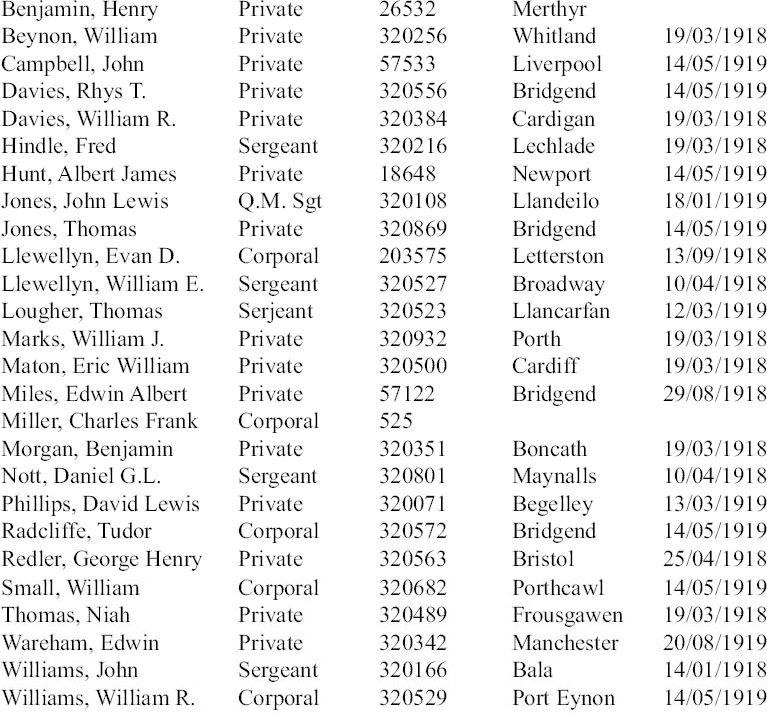
The Meritorious Service Medal

Mention in Despatches

Foreign Decorations
Serbian Order of the White Eagle, 4th Class.
Lieutenant Colonel Gerald Trevor Bruce. The award was published in the London Gazette of 15 February 1917.
Italian Bronze Medal for Valour
Corporal John Williams, 320166. The award was published in the London Gazette of 31 August 1917.
Croix de Chevalier
Major Llewellyn Partridge. The award was mentioned in the battalion war diary entry on 4 April 1917.
Romanian Croix de Virtute Militaire 2nd Class
Sergeant Thomas Lougher, 320523. The award was published in the London Gazette of 20 September 1919.
French Croix-de-Guerre
Captain Oakden Fisher. The award was published in the London Gazette of 12 December 1919.
In addition to these gallantry awards, there were also 257 awards of the Territorial Force War Medal to men of the battalion, including 127 to the Glamorgan Yeomanry and 125 to the Pembroke Yeomanry, plus thirty seven awards of the Territorial Force Efficiency Medal to men of the battalion. Details of these awards have been kindly supplied to the author by Mark Collins, but there is insufficient space to publish all of the details.