
Chapter 10
The remaining battalions had entrained by the following day, and the entire 74th Division was headed for the Somme, its HQ being established at Beaucourt Château: The division was now attached to III Corps, part of the Fourth Army. By this time no less than 128,000 prisoners, 2,069 guns, and 13,783 machine guns had been captured from the Germans in the great battle that was raging.
On 30 August the 24th Welsh marched back to Mericourt l’Abbé, and embussed for Trigger Wood, south of Carnoy, the entire division assembling nearby in preparation to move up to the front line. During the following day, the 74th Division was ordered into the line, and was taken by bus to Maricourt. 229 Brigade then relieved the first line troops of the 58th Division about three miles to the north of Péronne. The situation on this front was described in great length by Sir Douglas Haig in his despatches:

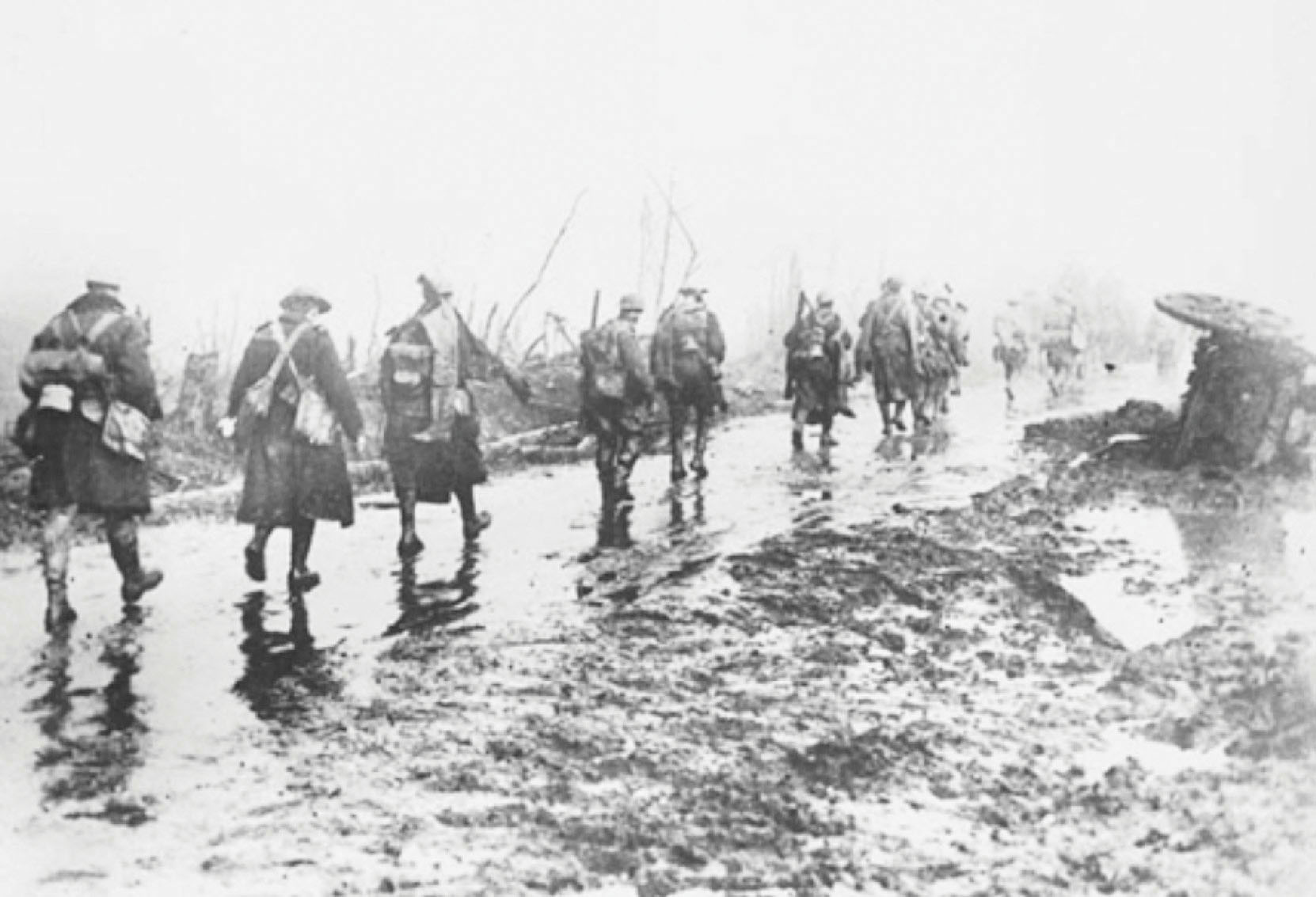
‘By the night of the 30th August the line of the IVth and the IIIrd Armies north of the Somme ran from Cléry-sur-Somme past the western edge of Marrières Wood to Combles, Lesboeufs, Bancourt, Frémicourt, and Vraucourt, and thence to the western outskirts of Écoust, Bullecourt, and Hendecourt. Any further advance would threaten the enemy’s line south of Péronne along the east bank of the Somme, to which our progress north of the river had forced him to retreat.
‘This latter movement had been commenced on the 26th August, on which date Roye was evacuated by the enemy, and next day had been followed by a general advance on the part of the French and British forces between the Oise and the Somme. By the night of the 29th August, allied infantry had reached the left bank of the Somme on the whole front from the neighbourhood of Nesle, occupied by the French on the 28th August, northward to Péronne. Further south the French held Noyon.’
It was becoming obvious that the Germans were intent on making a stand. Accurate and deadly artillery fire coupled with frequent counter-attacks hampered the Allied advance, but a brilliant operation carried out by the 2nd Australian Division on the night of 30th 31st August saw the storming and capture of the strategic position of Mont St Quentin, which commanded the Somme crossings at Péronne. As a consequence of this succesful attack, on 1 September the Australians captured Péronne itself.

The 2nd Australion Division memorial at Mont St Quentin.
In support of the operations against Mont St Quentin Fourth Army, comprising the 3rd Australian, 18th, 47th and 58th Divisions), succesfully attacked and captured the villages of Bouchavesnes, Rancourt and Frégicourt, taking several hundred prisoners.
By the end of 1 September the Germans had been pushed back to the line of the River Somme and the high ground above the villages of Rocquigny and Beugny, where their intent was to hold out for as long as possible before retiring slowly back to the Hindenburg Line defences, which would allow time to further strengthen these defences, as well as allow men, munitions and material ample time to be evacuated.
The line taken over by 229 Brigade was just south-east of the newly captured village of Bouchavesnes. The divisional artillery moved to the valleys south of Maricourt, while the 24th Welsh remained in divisional reserve. Overall, the plan was for III Corps to attack, with the 74th Division on the right, the 47th in the centre, the 18th on the left: The 2nd Australian Division, on the right of the 74th, was to co-operate, and the objectives were the spurs west and south-west of Nurlu.
The attacking troops had a tough task. The Germans on their immediate front held a strong position west of Moislains, covering the Canal du Nord, a steep sided canal, which was ideally situated for defence. The length of the Canal du Nord, which stretched from Péronne northwards past Étricourt-Manancourt and enters a long tunnel, before emerging again three miles further north, above Ruyalcourt, was all heavily defended, and was an important part of the outer defences for the Hindenburg Line. The attack of 229 Brigade was launched at 5.30 am on 2 September, the infantry following behind a creeping barrage. A slight error in distance meant that the barrage missed the German front line, and the first wave, the Somersets, were forced to deal with these Germans, causing a delay to their attack, which meant that the artillery barrage moved on too far, making the advance even harder going. The attacking troops of 229 Brigade managed, however, to cross the Canal du Nord, east of Moislaines, gaining their objectives. On the same day 231 Brigade moved closer to the front, following the advance. The 24th Welsh lost one man killed: Private Philip Martin (10658), from Lambeth, during the move. He is buried in Hem Farm Cemetery, Hem-Monacu.
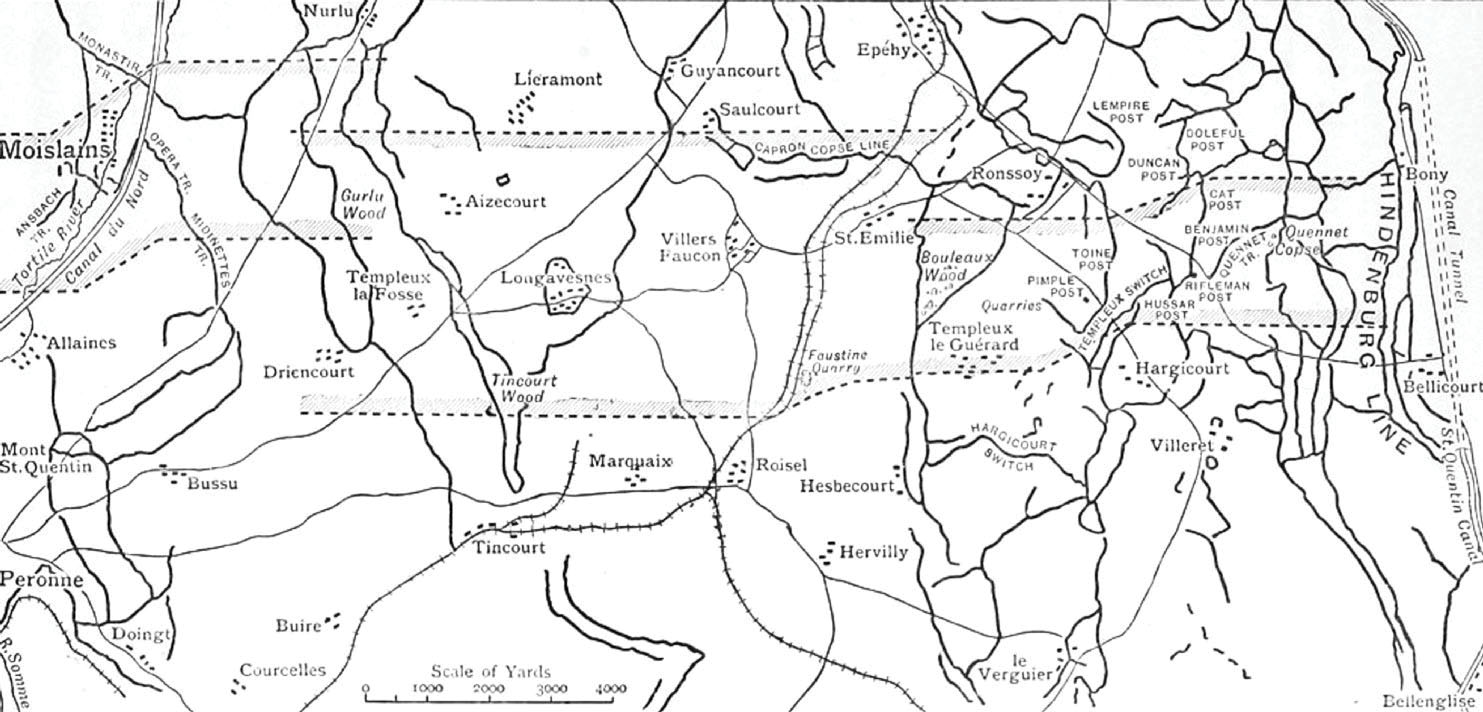
Map showing the advance of the 74th Division during the Battle of Epehy. The divisional sector was within the dotted lines, heading left to right (west to east), with the objective being the mighty Hindenburg Line.
While the advance was taking place, 231 Brigade followed behind in reserve, and on the night of 6 September received orders to carry the advance on the following day. At 8.00 am on 7 September the 24th Welsh moved through the 16th Suffolks, taking over the right front of the advance, with the 10th KSLI on the left. After some heavy fighting, the battalions of 231 Brigade attained the objective of Villers-Faucon, and the town was occupied with little resistance by 3.00 pm. The brigade had in fact outpaced the 58th Division, which was on its left, and the 3rd Australian Division on the right, and so the 25th RWF and the Suffolks were called upon to form flanks.
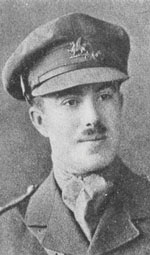
Captain Charles Herbert Stanley Wakeford. Killed on 7 September 1918.
The 24th Welsh had suffered heavy casualties during the taking of Villers-Faucon on 8 September: Lieutenant Wakeford and eleven other ranks were killed; five officers and seventy other ranks had been wounded. Charles Herbert Stanley Wakeford was the son of Herbert Steele and Mary Wakeford, of Meadow View, Clive Crescent, Penarth. He had been commissioned on 27 October 1915 into the Glamorgan Yeomanry, and sailed for Egypt with the Yeomanry in 1916. He was 28 years old when he was killed, and is buried in Tincourt New British Cemetery, along with seven other men killed alongside him on 7 September.
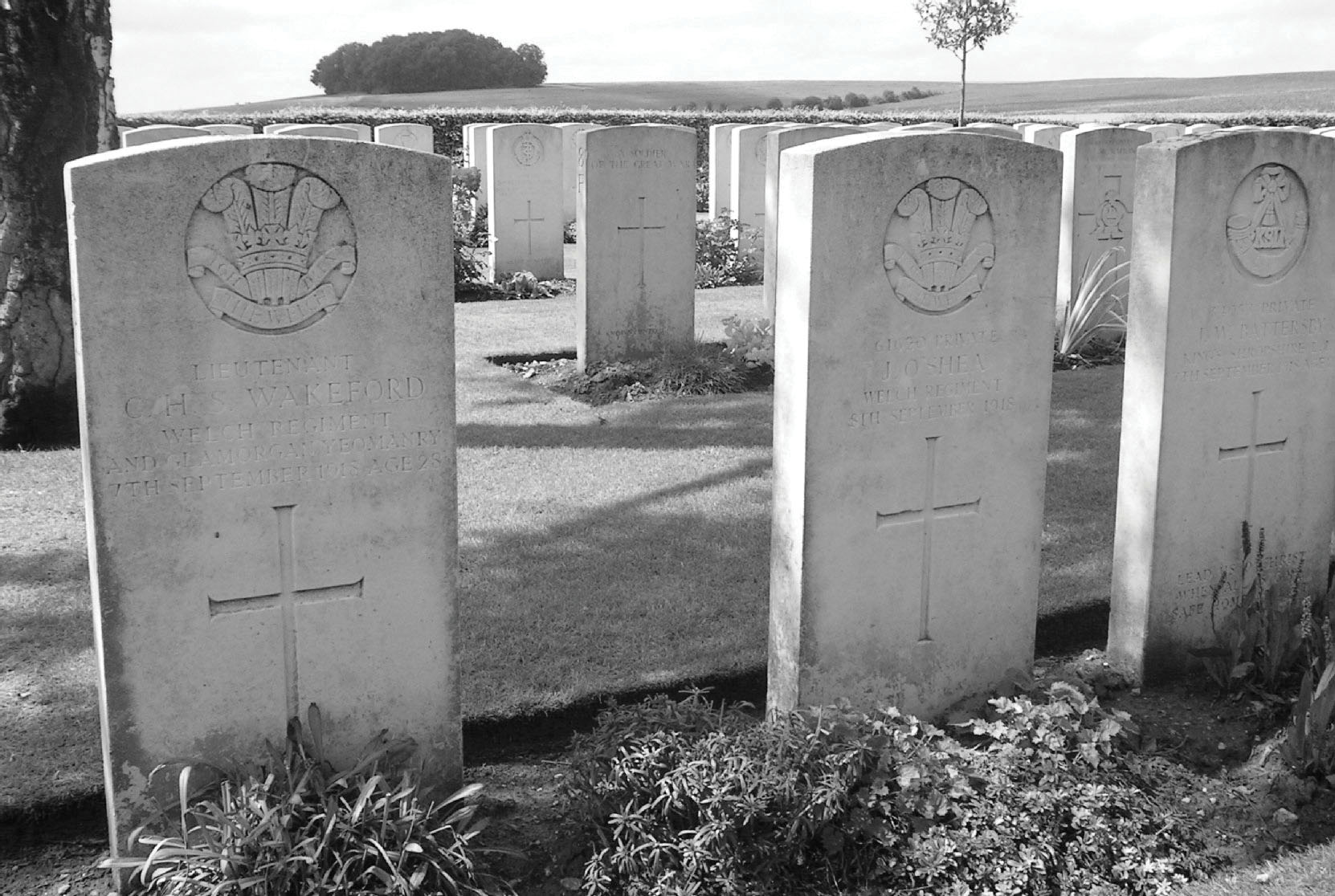
The graves of Lieutenant Charles Herbert Stanley Wakeford and Private John O’Shea, at Tincourt New British Cemetery.
On the following morning 231 Brigade, with the 25th RWF in the lead, made an attempt on the trenches north-east of Hargicourt, but the 58th Division was still struggling to take Épehy and, as a result, when the Welshmen moved forward, they were enfiladed by heavy machine gun fire from Épehy and the high ground south-east of the town, suffering heavy casualties. The Australians also did not advance during the day, so the brigade fell back to its original line, and was relieved during the night by 229 Brigade. The 24th Welsh had suffered one man killed, Private John O’Shea (61620), of Haverfordwest, and one officer and twenty other ranks gassed. Spence-Jones took temporary command of 229 Brigade for its assault, leaving Captain E. J. C. David in command of the 24th Welsh.
While the 24th Welsh moved into reserve, Major Woodcock rejoined the battalion on 14 September, assuming command of the battalion: the 58th Division attempted to capture Épehy and 229 Brigade attacked the Horse Shoe Trench system, but the Germans put up a stout defence, and both attacks failed. Haig did not want to risk the loss of too many casualties during the push on the Hindenburg Line; realising that limited attacks would be of no use against a determined enemy, ordered plans to be drawn up for a full scale attack: the Battle of Épehy.
The overall picture of progress during the advance prior to the Battle of Épehy must be appreciated to understand the reasoning behind it: the Canadian Corps, of First Army, and the left of Third Army had made great progress between the Sensée and Scarpe Rivers, and on 2 September the Drocourt-Quéant Line Hindenburg Line was broken by the Canadians. This was followed by a general withdrawal, a rapid falling back of the enemy on the whole of Third Army front, and on the right of the First Army, astride the Scarpe, on the line of the Canal du Nord. Near Havrincourt the Hindenburg Line left the Canal du Nord and ran south-east across the Beauchamp and la Vacquerie and Bonavis Ridges, to the Scheldt Canal at Bantouzelle, and along the canal to St Quentin. In front of the Hindenburg Line there were formidable positions at Havrincourt and Épehy, which had to be taken before a final attack on the main line could be launched. On 12 September IV and VI Corps, Third Army, on the left of Fourth Army and the front where the 74th Division was engaged, attacked and captured the villages of Trescault and Havrincourt, the area where the Hindenburg Line was broken in November 1917, at the Battle of Cambrai.
The date fixed for the Battle of Épehy was 18 September, and the plan was for the Third and Fourth Armies to attack on a front of seventeen miles, in conjunction with the 1st French Army on their right. The British attack was from Holnon to the southern edge of Havrincourt Wood, and was a preliminary to the attack by the First and Third Armies on the Canal du Nord, which was to take place on 27 September. General Girdwood drew up his plans for the 74th Division’s part in the attack: He would attack on the 18th on a two brigade front; 231 on the left, 230 on the right. Girdwood was struggling with troop numbers though; on the 16th the division had suffered 350 casualties from gas in the two attacking brigades, although the 24th Welsh had been lucky and had suffered just four men dead since the attack of 7 September.
Girdwood’s orders are quoted in the divisional history;
‘The IIIrd Corps is continuing the attack in conjunction with Corps and Armies on either flank, with a view to securing a position affording good observation of the Hindenburg Line.
‘The 38th Division, with 96th, 95th, 94th Infantry Regiments from right to left, is believed to be holding the line from Templeux to Ronssoy.
‘230th Brigade will be the right attacking unit, 231st the left. To each brigade one battalion of the 229th Brigade will be attached - 16th Devons to 231st, 12th Somersets to 230th…
‘Both brigades will attack the first objective with two battalions, and will leapfrog two battalions through for the attack upon the second objective.
‘230th will, on Y/Z night, move its right battalion south of the Cologne River, and will be allotted ground by the 1st Australian Division… 230th will attack Templeux and the Quarries east of it, with the battalion south of the river, moving in a north-east direction in close co-operation with the left of the 1st Australian Division, which will attack Bolsover Switch simultaneously with the 230th attack upon the Quarries. The left battalion, 230th Brigade, will attack Templeux and the Quarries from the north-west. Special parties will be detailed for mopping up Templeux and the Quarries.’
An elaborately detailed plan for the supporting artillery and machine-gun barrage was also laid out in Girdwood’s plan, detailing how the barrage would open 200 yards in front of the infantry, whose attack would be covered by a combination of a creeping field artillery barrage, a heavy artillery barrage and a machine-gun barrage.
The creeping barrage was intended to force the German defenders to remain down in their bunkers and was planned to start at zero hour, with no preceding fire to warn the Germans of the impending attack, timed to lift 100 yards every three minutes, a rate deemed suitable for the attacking infantry to be able to keep up. The heavy barrage would deal with any counter-artillery fire behind the German front line, while the machine-gun barrage, perfected by the Australians on the Somme in 1916, would rain down on the German lines. This latter barrage was also well planned, timed to fall 250 yards in front of the artillery fire.

Attack area of the 74th Division 18 September 1918 (Map 62cNE2 Épehy).
Three objectives were given to the division known, as the Green, Red, and Blue Lines, and trench maps were issued to officers with these objectives clearly marked. At 5.20 am on 18 September the infantry of the 24th Welsh formed up in heavy rain, with A and D Companies in the front, and began their attack towards the battalion’s allotted objective, at map reference F22.d.1.3, a former British strongpoint named Orchard Post, just east of the village of Ronssoy. The men advanced through the rain under heavy German artillery fire, making conditions extremely difficult, with visibility down to no more than a dozen yards, and the leading battalions found it difficult to keep touch and direction. The conditions, however, favoured the British, as the Germans could not see them coming until the Welshmen were on top of them. 230 Brigade attacked with the Suffolks supported by the Buffs on the right, and the Sussex, supported by the Somersets, on the left. The Suffolks, attacking from the Australian area, swept through Templeux and over the Quarries. This flank attack took the enemy completely by surprise, and the whole of the objectives on 230 Brigade’s front were taken by 7.15 am. After a short pause the assault on the Red Line commenced: The Buffs went through the Suffolks and secured their objective, one company reaching the Blue Line, which was the outpost of the Hindenburg System, but was unable to maintain this position, and fell back after suffering heavy casualties.
The 24th Welsh in 231 Brigade had met with fierce opposition, though. Attacking with the Devons on the right and the Welsh on the left, the first objective was taken without much trouble, but when the KSLI and RWF passed through to carry on the assault, they found the second objective was strongly held and defended. On the left of the Divisional front, a strong point, known as the Quadrilateral, which should have been captured by the 18th Division, was untouched, and had turned all its guns onto 231 Brigade, holding up the advance.
Spence-Jones noted in the war diary that the 24th Welsh had captured their objectives by 8.30 am, but overall, the division’s attack was now struggling. Girdwood ordered the divisional artillery to bombard the Red Line at 3.50 pm, and the KSLI, who had crawled into No Man’s Land ready to attack, rushed the line. The RWF were, however, in difficulties against a strongly defended position, and failed, setting up a defensive flank along the Bellicourt Road. Heavy fighting continued throughout the day. The 18th Division had failed to advance beyond their first objective, but the Australians had taken their second objective. At 6.00 pm the Germans counter-attacked the 74th Division, but after some fierce fighting, the division remained in control of the Red Line. Although the final objective had not been taken, the division had done well, with over eighteen German officers and 873 other ranks captured, as well as ten 77 mm guns, three 4” howitzers, and about eighty machine guns.
Sir Douglas Haig’s Despatch about the battle noted that:
‘In this operation our troops penetrated to a depth of three miles through the deep, continuous, and well-organised defensive belt formed by the old British and German lines. On practically the whole front our objectives were gained successfully; the 1st, 17th, 21st, and 74th Divisions and the 1st and 4th Australian Divisions distinguished themselves by the vigour and success of their attack. On the extreme right, and in the left centre about Épehy, the enemy’s resistance was very determined, and in these sectors troops of the 6th, 12th, 18th, and 58th Divisions had severe fighting.’
The 24th Welsh dug into the newly gained positions during the night, but had suffered heavily: one officer, Second Lieutenant William Dillwyn Griffiths, and twelve other ranks had been killed during the attack; four officers and sixty one other ranks were wounded, four of whom died in the following days. During the next two days the division remained in the newly won positions, consolidating them and awaiting the 18th Division to get ready to attack again on the left, but sporadic gunfire accounted for another five men of the 24th in the meantime.
The next phase of the offensive saw much heavier fighting. At 5.40 am on 21 September a creeping barrage began, and the attacking troops of the 74th Division rose from their trenches again. The object was to capture the Blue Line, but between the objective and the division was the strongly defended Gillemont Farm, a veritable fortress. 230 Brigade attacked on the right, and under heavy fire the attacking battalions, the Buffs and Sussex, headed for the Blue Line, but finding their way blocked by thick barbed wire entanglements were forced to take cover in shell holes. Confused fighting followed, with the Sussex pushing on around Quennet Copse, where ninety prisoners of the 26th and 60th Infantry Regiments of the 121st Division were taken. The battalion pushed on, but the copse had not been cleared, and the men found they were being shot at from behind.
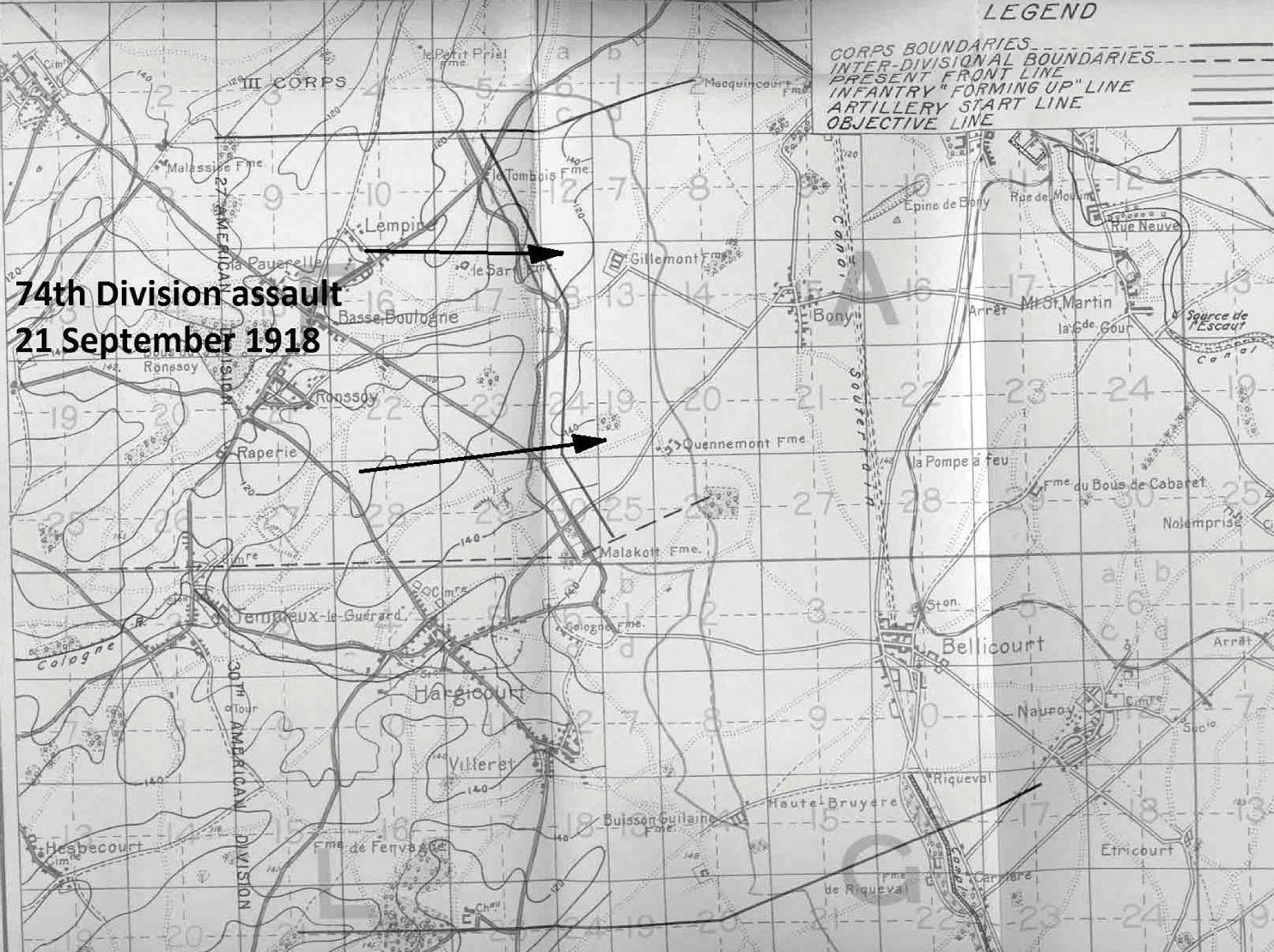
The attack of the 74th Division on 21 September 1918, advancing into the killing fields before Gillemont Farm.
While 230 Brigade were struggling due to heavy casualties and a strong willed German defence, 231 Brigade, on the left, had to change direction. The plan was for the 25th RWF, with four tanks, to advance on, and to pass through, the Quadrilateral, followed by the 24th Welsh, with the objective of Gillemont Farm. The barrage was to halt for fifteen minutes 200 yards east of this objective. Then the Welsh Regiment was to capture Gillemont Farm, and the RWF would capture and consolidate the Blue Line. The Shropshires, advancing in the rear, were to mop up the dugouts and shafts of the Quadrilateral. Unfortunately the tanks failed even to reach the starting point for the attack, so were of no use. Confusion now reigned; the RWF had passed over the Quadrilateral before continuing eastwards, but the 24th Welsh had lost direction and, instead of attacking Gillemont Farm, were following behind the RWF, while the 18th Division was again held up. The left flank was now up in the air, and the Germans took advantage of the situation, pouring reinforcements into the fray through the Quadrilateral. The Germans then began pouring fire into the rear of the RWF and 24th Welsh who attempted, without success, to bomb the Germans out. By the time that darkness had descended, 231 Brigade had been forced to withdraw to Benjamin Trench, its original line, and was relieved by 230 Brigade during the night. The division had suffered heavily during the day. In total, during September the division lost: thirty four officers and 436 other ranks killed; 143 officers and 2,712 other ranks wounded; eight officers and 188 other ranks missing, most of whom were killed.

Lieutenant William Woolf.

Private John James John.
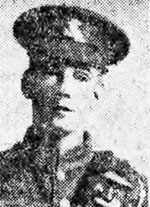
Private David John Dawson (320494), of Swansea. Killed on 21 September 1918.
The 24th Welsh lost two officers, Lieutenants William Woolf and David Louis Clemetson, and twelve other ranks killed; four officers and ninety two other ranks wounded; and one officer and twenty three other ranks missing. At least ten of the missing had been killed, making a total of twenty two other ranks during the day. Among the other rank casualties was Private John James John (320374), the son of William and Eliza John, of Halfpenny Furze, Laugharne. John was twenty five years old and was buried along with thirteen other men in an isolated battlefield grave. During battlefield clearances in the area in August 1919 his grave was exhumed, and he was reburied in Unicorn Cemetery, Vendhuile, just thirty miles away from where his elder brother David had been killed two years earlier.

Private Edward Rockingham (320155), a farm worker at Abergwili prior to the war. Edward has only recently been commemorated by the CWGC after ninety years ‘out in the cold’.
Another of the dead was Private David John Dawson (320494), the twenty nine year old son of David John Dawson and Mary Lane Dawson, of Swansea. He has no known grave and is commemorated on the Vis-en-Artois Memorial.
Among the missing was Private Edward Rockingham (320155), a farm labourer from Abergwili. Edward mysteriously remained un-commemorated by the Commonwealth War Graves Commission for ninety one years: He was born at Norwood, Surrey, but was orphaned at an early age, and came to Abergwili, where he worked for Mrs. Rees, at Penybont. He enlisted at Carmarthen into the Pembroke Yeomanry, Army Number 2237, and moved to Egypt with the Yeomanry in 1916. Rockingham has only recently been accepted for commemoration by the CWGC, after evidence of his omission was presented to them by the author, and his name will be added to the Vis-en-Artois Memorial.

Lieutenant David Louis Clemetson, of Jamaica. Possibly the first black officer in the British Army.
Lieutenant David Louis Clemetson was a Jamaican who was being educated at Clifton College when war broke out. He enlisted into the Sportsmen’s Battalion of the Royal Fusiliers, and served in Salonika before being commissioned into the Pembroke Yeomanry. He is buried in Unicorn Cemetery.
Altogether, fourteen of the men of the battalion killed that day are commemorated on the Vis-en-Artois Memorial. Some of these men may lie in some of the eighty or so graves of unknown men, which are inscribed to ‘A Soldier of the Great War’, who are buried in Unicorn Cemetery, which lies about 4,000 yards north-west of Gillemont Farm, the objective of these men. The farm eventually fell to American and Australian troops on 29 September.
Due to the heavy casualties that were incurred by the 74th Division, it was decided not to use it again: However, the Germans were still holding the Quadrilateral, and an attack was arranged, using just the 10th KSLI in conjunction with the 18th Division, at 3.00 am on the following day. This was the last action by the 74th Division in this sector. That day the 24th Welsh moved into support along the Bellicourt Road, and began the slow move back towards Villers-Bretonneux, the division being relieved on 24 September, and bivouacked for the night near Péronne.
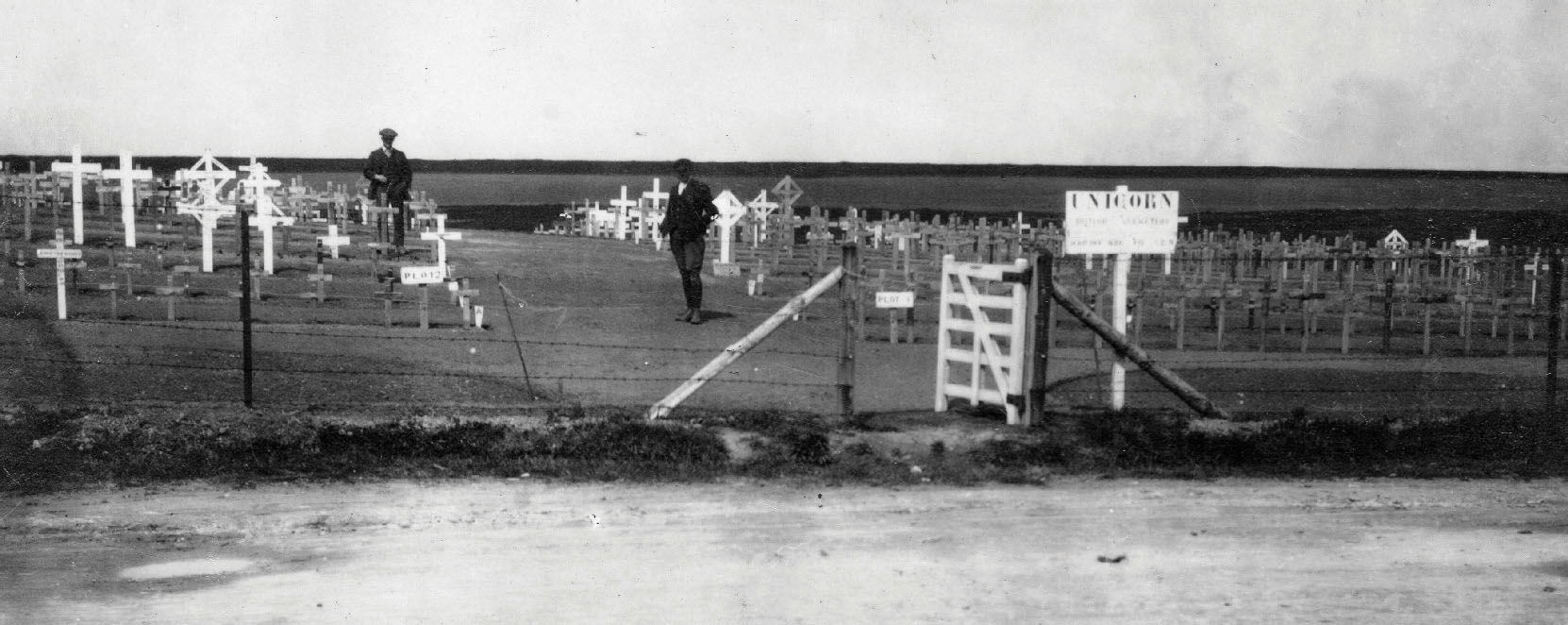
Unicorn Cemetery in about 1920, soon after the battlefield clearances began and which gathered up the graves of Lieutenant David Louis Clemetson (the battalion’s only known mixed race officer), Sergeant Francis Charles Taylor, and Privates David Barnacle, Hugh Evans, Hubert Thomas George, John James John and Edward Thomas, for concentration there.
During the week following the 24th Welsh attack in the Battle of Épehy, nine of the wounded men died, all apart from one being buried locally in France. Among the men to die of wounds suffered at Épehy in the following days were: Private John Clarke Harries (320401), the son of James and Hannah Harries, of Riverside House, Cynwyl Elfed, near Carmarthen, wounded at Gillemont Farm and evacuated to Colchester Hospital, where he died of his wounds on 3 October 1918. He is buried in Rhydargeau (Horeb) Baptist Chapelyard. He had returned home from Canada to enlist into the Pembroke Yeomanry in September 1915.

Private Ivor Morris (25427), of Aberdare. Died of wounds on 23 September 1918.
Private Ivor Morris (25427), had fought in France with the 40th (Bantam) Division, before being wounded. He was transferred to the 24th Welsh after recovering from his wounds, and had fought at Jerusalem. He was 38 years old when he died on 23 September and is buried in Ste. Emilie Valley Cemetery, Villers-Faucon.
On the night of 24/25 September the 74th Division was relieved by the 27th American Division, which in turn suffered heavy casualties during the next attempts to take Gillemont Farm and the Hindenburg Line at nearby Bony. On 27 September the First and Third Armies attacked the Hindenburg System on the Canal du Nord and broke through. On 28 September the Belgian Army and the British Second Army attacked in Belgium, and from the coast down to Ypres, began driving into the German lines. In between these two great advances lay the Fifth Army.
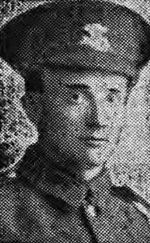
Private John Clarke Harries (320401), of Cynwyl Elfed. Died of wounds on 3 October 1918.
During the morning of 25 September the Division entrained from Tincourt and Péronne, and left for Villers-Bretonneux. The 24th Welsh entrained at Péronne at 3.00 pm and arrived at Villers-Brettoneaux at 9.00 pm, being billeted in the ruined town overnight. Spence-Jones rejoined the battalion on the following day, and the battalion marched to Corbie on 27 September, prior to entraining with the remainder of the division for Chocques, in the Fifth Army area, and arrived at Norrent Fontes on the 28th. The 24th Welsh took up billets in Chocques village, and Spence-Jones left again to take temporary command of 230 Brigade. On 1 October the Division relieved the 19th Division in the line at Locon, the 24th Welsh relieving the 10th Battalion, Royal Warwickshire Regiment.
Due to the situation facing them now, the Germans also began to withdraw on the front facing the Fifth Army. There were no plans for the Fifth to attack, however, merely to follow up the German withdrawal. As a result, General Girdwood issued the following order:

A section of trench map showing the location of Locon (36SW1–Aubers).
‘29th September 1918. The successful offensives being conducted by the allied armies may cause the enemy opposite the front of the Vth Army to continue his withdrawal to the line of the Douai - Lille Canal and the Lille defences.
‘In order to test the strength of the enemy forces opposite to the XIth Corps, minor operations are being carried out by three divisions tomorrow morning.
‘On taking over the front of the 19th Division, it is of great importance that the Division should be prepared to act promptly as soon as indications are obtained that the enemy intends to withdraw, or is in process of retiring…’
Girdwood did not intend for the 74th Division to attack and force the Germans to withdraw, but instead wanted it to be ready to follow up any withdrawal that might occur, thus limiting the number of casualties among his men. There was no real need for heroics at this stage of the war; the Germans were on the retreat, but the men were told to be ready to act quickly if such a withdrawal took place, and to seek out opportunities to cut off and capture any isolated posts that may then occur in order to gain intelligence from their garrisons about the enemy’s dispositions.
The division was alloted the Halpegarde to Herles road for traffic and signal communications, and both brigade and divisional headquarters would be located as near as possible to the road.
At 11.00 am on 2 October it was noticed that the Germans had vacated the trenches in front of the division, so Girdwood ordered his battalions forward. After just a day in the reserve trenches at Locon, 231 Brigade was sent up: the 24th Welsh marched to relieve the 9th Battalion, South Staffordshire Regiment, in the front line at Aubers Ridge, with Battalion HQ setting up in map reference N 26 c 8.3, and the 10th KSLI on the right. As had occurred during the German withdrawal to the Hindenburg Line in March 1917, their withdrawal here was also well executed: cross roads and bridges were blown up; culverts were destroyed; booby traps of all types were left; and wire obstacles were erected. Girdwood ordered the division to advance to the line La Bassée-Aubers-Fromelles, and it was dark before the trenches were reached.
On the following day, 3 October, the advance continued; no opposition was encountered, and 231 Brigade consolidated their new positions during the night, along the line Basse Rue, Fournes, Petite Hate, Bourdin, le Marais, Hockon, and Sainghin. Again, on the following morning the advance continued, but this time the Germans slowed the brigade with artillery fire, causing four casualties in the 24th Welsh. One of the men wounded died that same day in hospital in Béthune. Private Alan Morgan (60219) was the son of Jane Morgan, of Pwllswyddog, Tregaron. He was twenty years old and is buried in Béthune Town Cemetery. The division reached a line east of Wavrin and Lattres, along the railway to la Haie, by nightfall, and patrols found the Germans holding positions in force directly in front of the divisional line. The situation remained unchanged here for the coming days, with several casualties being suffered by the 24th Welsh due to sporadic artillery fire and sniping.
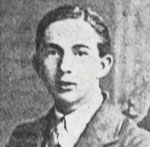
Private Alun Morgan (60219), of Tregaron. Died of wounds at Béthune on 4 October 1918

A section of trench map showing Aubers Ridge (Map 36SW1 Aubers).
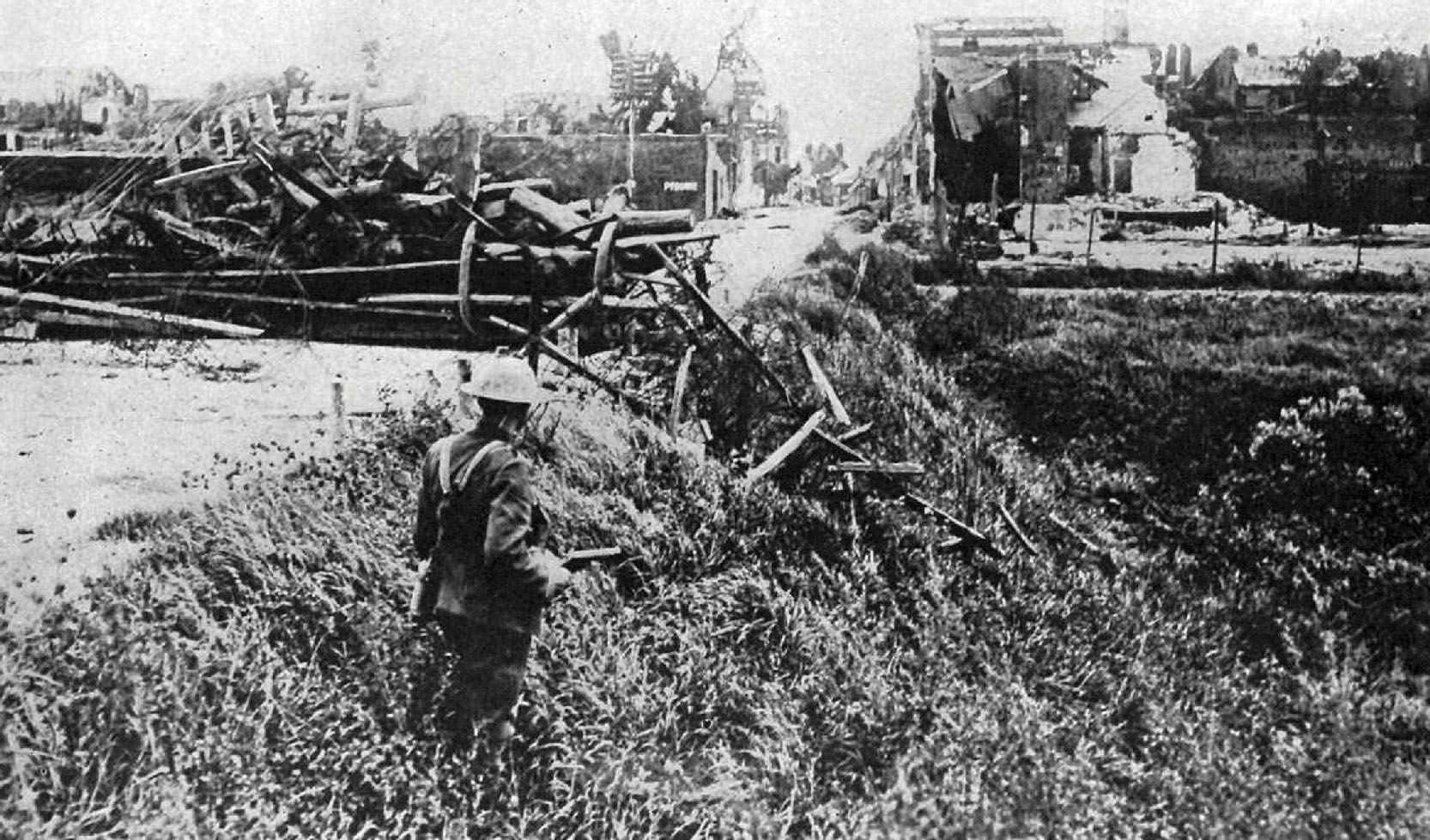
A British soldier manning a hastily erected roadblock during the period of the German offensive on the Lys.
On 7 October half of the battalion moved into reserve; A and C Companies were relieved by the 10th KSLI, and B and D Companies side-stepped, taking over the line held by A Company of the 23rd Battalion, London Regiment. On 8 October command of the sector held by the 55th and 74th Divisions passed from XI Corps to III Corps. Conditions by now must have been poor, as many of the casualties suffered during this period were succumbing to sickness, probably victims of the Spanish Flu outbreak, a pandemic which lasted from January 1918 until December 1920, killing over fifty million people. On the 9th the Germans raided the trenches held by the 10th KSLI, and on the following night the battalion retaliated, killing over twenty Germans and bringing in a live prisoner for interrogation. The 24th Welsh were relieved on the following morning by the 12th SLI, and withdrew to La Cliqueterie Farm, where it assembled for inspection on 12 October.
The front remained static while the 24th Welsh was in reserve, but on the 15th patrols from 230 Brigade once more found the German trenches at la Haie deserted, so the division moved on again, until machine-gun fire halted the advance of 230 Brigade in front of the canal near Mangre. On 16 October the 24th Welsh moved to Herlies, and on the following day moved into brigade reserve at Faches. On the following morning the Germans were found to have disappeared again, having covered their withdrawal by machine-gun fire from the canal until 4.30 am. Patrols were sent out, but did not contact the enemy, and reports came in that the Germans had evacuated Lille.
The war was drawing to a close, and the 74th Division was lucky not to be involved in any set piece battles. Further south, there was heavy fighting around Cambrai and north of Le Cateau during the Battle of the Selle, in which the 38th (Welsh) Division was caught up.
Sir Douglas Haig wrote of this time in his despatches:
‘Our advance on the north of the Lys had brought our troops far to the east of the Lille defences on the northern side, while our progress on the le Cateau front had turned the Lille defences from the south. The German forces between the Sensée and the Lys were once more compelled to withdraw, closely followed by our troops, who constantly drove in their rear-guards and took a number of prisoners. The enemy was given no opportunity to complete the removal of his stores and the destruction of roads and bridges, or to evacuate the civil population.
‘The movement began on the 15th October, when, in spite of considerable opposition, our troops crossed the Haute Deûle Canal on a wide front north of Pont-à-Vendin. By the evening of the 17th October the 8th Division, of General Sir A. Hunter Weston’s VIIIth Corps, had entered Douai, and the 57th and 59th Divisions, of Lt. -General Sir R. C. B. Haking’s XIth Corps, were on the outskirts of Lille. At 5.50 am, on the 18th October, our troops had encircled Lille, which was clear of the enemy…’
The 74th Division kept up the pursuit, suffering fewer casualties by now as German resistance wilted on this sector. 230 Brigade crossed the canal and moved forwards to the line Wattignies - l’Arbrisseau on 17 October. The bridges had been partially destroyed, but that only slightly slowed the advance, the division entering Habourdin that day, before setting up a forward line along the railway east of Ronchin. The advance was slower on the 18th, being held up by a fog. The 231st Brigade had taken over the right and found the enemy rearguard, mostly machine guns covered by a battery of field guns, at Sainghin. The village was cleared without difficulty, and an outpost line taken up on the River la Marcq. The 229th Brigade encountered the enemy on that day at Ascq, but retired before the patrols, and was found to be holding the east bank of the river. An outpost line was established on the line of the railway, west of the river.
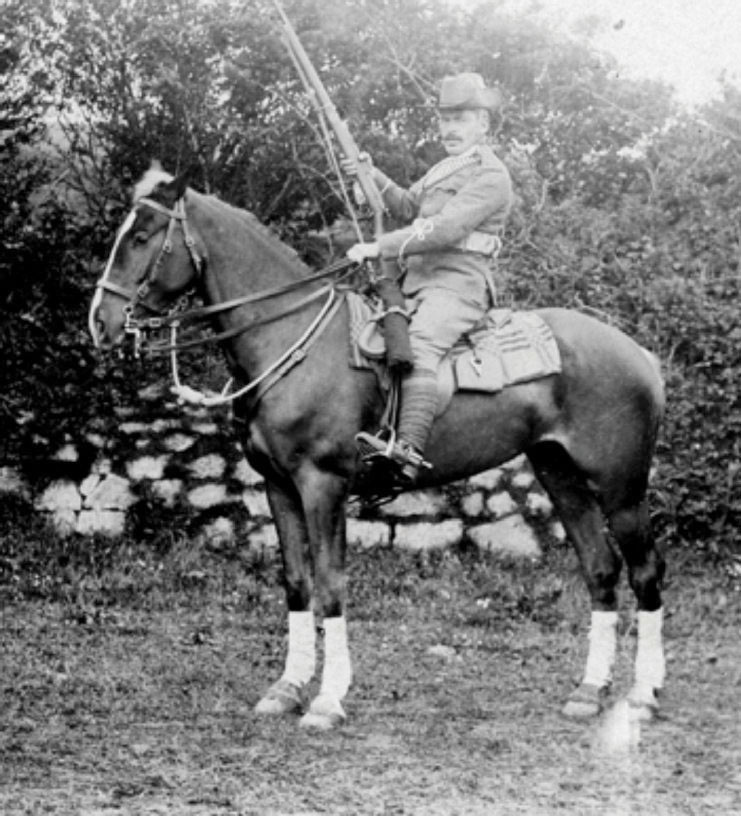
CQMS John Jenkin Davies.
The advance continued on 19 October, with 231 Brigade reaching Camphin and 229 Brigade reaching Baisseur. The 24th Welsh moved into billets at Lamain on the following day, its lucky run on casualties coming to an end with one man killed and one wounded. The dead man was Company Quartermaster Sergeant John Jenkin Davies (320157), the forty two year old son of John and Anne Davies, of Frondeg Farm, Llanfarian, and the husband of Elizabeth Davies, of 32 Bridge Street, Aberystwyth. He is buried in Lamain Communal Cemetery.
The battalion remained in Lamain until 30 October, resting and carrying out battalion drill, as well as supplying working parties. On the 30th the battalion relieved the 16th Battalion, Royal Sussex Regiment in the front line opposite Tournai. The nearby village of Orcq was strongly held by the Germans, and was attacked by the 12th SLI that day, but only small footholds were made on the village.

General Birdwood’s triumphal entry into Lille.
Apart from the Battle of the Sambre, which took place on 4 November, the last of the great battles had now been fought, and only isolated actions now took place. The Germans opposite the 74th Division seemed content behind strongly fortified positions, which were defended by belts of barbed wire, but the only action seen by the division was a series of patrols and melees on their front, while the great advances to the north and south were still pushing the Germans back. On 2 November the 24th Welsh and 10th KSLI pushed strong patrols forward, behind a creeping artillery barrage, to test German strength, but came under heavy machine-gun fire and withdrew. Second Lieutenant W. T. Harries and one other rank were wounded.
The division stayed put over the coming days, the 24th Welsh being kept busy consolidating the line, and the only noteworthy event was an attempted trench raid by the Germans on the 24th Welsh on the night of 4 November, which was beaten off with just one casualty. There is no mention in the battalion war diary of Private Thomas Thomas (320981) the twenty three year old son of John and Mary Thomas, of Tredegar, being killed on the 3rd. He has no known grave and is the only man of the battalion commemorated on the Ploegsteert Memorial.
The battalion did not move for the next two days, losing three men on 6 November: Private Owen Davies (59941), of Beddgelert, was killed; Private Albert Heath (61697), of Cardiff, died of wounds; and Private Hubert George Smith (320057), of Tenby, died of sickness.

Private Thomas Thomas’s name on the Ploegsteert Memorial, the only member of the 24th Welsh commemorated on it.
During the morning of 8 November, patrols of the RWF entered Tournai, and a Belgian lady came into the outpost line to report that the Germans had evacuated the town at 3.00 am. General Girdwood then sent patrols of the 24th Welsh into it. Tournai is split by the River l’Escaut, and the patrols found that the Germans had blown up all of the bridges and lined the opposite bank with machine guns. After the patrols had reported the situation, the battalion was relieved by the 10th KSLI, and moved into support along the Froyennes to Tournai Road. It had suffered its last man killed in action during the war during the patrol, when Private David John Davies (73690), of Maesteg, was shot by a sniper. He was 25 years old and is buried in Tournai Communal Cemetery Allied Extension.
The divisional engineers bridged the river during the morning, and the 10th KSLI crossed to the east bank, the 25th RWF close behind in support. The Germans were now forced into retreat and the division advanced to the line Beclers - Thimougies. Thimougies was entered that evening, and was found to have been evacuated by the Germans. The 24th Welsh formed pickets on the eastern exits of Tournai on the 9th, and that night moved into billets at Havinnes. On the following day the battalion moved to billets in Herquegies, while the division advanced to the railway line north of Grundmetz, finding the road to be mined, but no sign of any Germans, who had failed to detonate the mines.
At 8.30 am on 11 November 1918, the leading element of the 74th Division, 231 Brigade, entered Ath, and at 8.45 am General Girdwood sent the following message to his brigades:
‘Hostilities cease 11.00 today, after which hour no further easterly movement will take place. Outposts will be put out, and all military precautions taken. Contact with the enemy will be avoided. Troops at present in movement will halt at 11.00 and occupy best available billets, or return to last night’s billets if no facilities exist.’

King George V during a presentation ceremony in France.
The 24th Welsh moved to billets in Oeudeghien, remaining there until the 16th, when it moved to billets in Moustir, en route to Beclers. On the following day the battalion reached Velaines, where it was billeted for the night, and on 17 November reached Beclers, furnishing working parties, which were utilised in road repairing and repairing the embankment of the Tournai to Ath Railway.
As December dawned, coalminers began being demobilised and returned home. The battalion remained at Beclers until 4 December, and moved to Velaines the following day, undergoing two days of training before parading on the 7th along the Leuze to Tournai Road for inspection by His Majesty King George V. The battalion remained here for a further week before moving to Moustir on 15 December, en route for Grammont, which was reached on 18 December. The battalion were billeted in Overboulaere, a part of Grammont, which is a town inside Belgium, roughly ten miles north of Ath. Major J. B. H. Woodcock assumed command of the now depleted battalion on 22 December, while Spence-Jones assumed command of 231 Brigade. The battalion’s first and last Christmas in France was celebrated here, in a most pleasant part of Belgium. The main problem suffered now, after four years of war, was boredom, which breeds discontent, so the battalion took part in various organised pastimes: it re-assumed its early prowess as a fine rugby playing battalion, and a member of the battalion even triumphed in an army boxing tournament in Lille. Educational training was undertaken, preparing men for a return to civilian life, as well as relieving boredom.
Over 120 men were demobilised during the first week of January, so it must have been a strange feeling for the men left behind in France, especially when more batches of men were demobilised as the month drew on; during the month almost half of the remaining battalion, 248 men, had returned home. During February demobilisation continued, with an officer and sixteen men leaving on the 5th; one officer and twenty three men on the 6th; and on 7 February, after the demobilisation of forty nine more men, a motion was carried to form an Old Comrades Association. The battalion was now down to one company.
During the 13th and 14th, the Assistant Director of Armaments inspected the battalions weapons, and on 16 February five officers and a hundred other ranks were detailed to join the Army of Occupation in Germany, leaving the battalion the following month. Educational classes and gymnasium work carried on regardless throughout February, and a party of officers and men received three days leave to visit Brussels. On 8 March Major Woodcock tallied up the battalion’s casualties during its time in France:

After the death of David John Davies on 8 November, only eight more men from the battalion are known to have died as a result of the war: Four more men from the battalion died of wounds prior to the Armistice, and four more are recorded of dying of sickness after the war.

Sergeant Thomas Lougher, DCM, of Tregaff, Llancarfan, near Cowbridge.
Several more awards to men of the battalion were also noted: The Meritorious Service Medal to QMS J. L. Jones; the Military Medal to Private Wareham (320342); and the Distinguished Conduct Medal and Belgian Croix de Guerre to Sergeant T. Lougher (320523). Details of these awards, and more, are to be found in the Appendix ‘Awards to the 24th Welsh’.
News also reached Major Woodcock on 26 March that Company Sergeant Major Edwin Jenkins (320011), of Haverfordwest, who was reported as missing, had died in German hands on 26 September 1918. He is buried in Honnechy British Cemetery.

The grave of C.S.M. Edwin Jenkins at Honnechy British Cemetery.
The last days of the battalion are very sketchy. The battalion War Diary for April 1918 holds little clue to the goings on of the few men left. Twenty men left the battalion on 20 April by motor lorry to join the 6th Battalion, South Wales Borderers, at Gislenghien. A week later the last three mules owned by the battalion were despatched to Corcolo, and on 26 April the diary noted that Second Lieutenant O. Olive had been promoted to lieutenant. The last diary entry notes the total number of men demobilised during the month to have been seven officers and fourteen other ranks, although ten other ranks had re-enlisted.
On Tuesday 24 June 1919 the cadre of the 24th Welsh landed at Dover, after over three years overseas. The cadre consisted of two officers (Major J. B. H. Woodcock, DSO, and Lieut. T. L. Curtis) and eighteen men, who arrived at Carmarthen on the following day, after having caught the 5.20 am train from Dover. No one in the town knew that the battalion was returning, and so there was no civic reception. This was hastily arranged for Thursday 3 July, and notices were put in all of the local newspapers to advertise the ceremony, and also appealing for former members of the battalion to attend.
At 3.30 pm on 3 July 1919 the cadre of the 24th Welsh paraded at Carmarthen Barracks, prior to marching through the town to St Peter’s Church, where Major Woodcock presented the battalion colour, which was erected alongside that of the 15th Welsh. Sadly the battalion was never reformed, but in its short life it had won several famous and hard fought, battle honours: ‘Egypt, 1916-17’, ‘Gaza’, ‘Jerusalem’, ‘Jericho’, ‘Téll Asur’, ‘Palestine, 1917– 18’, ‘Somme, 1918’, ‘Bapaume, 1918’, ‘Hindenburg Line’, ‘Epehy’, ‘Pursuit to Mons’ and ‘France and Flanders, 1918’
Some 224 men from the battalion were killed during its time at war, admittedly a low number compared to most of the other battalions of the Welsh Regiment, especially compared to the 9th Welsh, for example, who lost almost 800 men died, or the 2nd Welsh, who lost almost 1,400 men; but many other men had been wounded or invalided home suffering from illness and disease contracted during the tough campaign in Palestine. The second line battalions of the Pembroke and Glamorgan Yeomanry, on the other hand, had supplied a constant stream of well trained recruits to units in other theatres of war, at least 104 of them killed or died of wounds.
When the Territorial Force was reformed in 1920, all but the first fourteen of the fiftythree regiments of Yeomanry were converted to other roles. The Pembroke Yeomanry became the 102nd Field Brigade, Royal Artillery, recruiting in Pembrokeshire and Cardiganshire. It consisted of four batteries, two in each county, and saw service with the Eighth Army in the Middle East during World War Two; and also fighting in Italy before taking part in the Battle of Normandy.