
Pearl Harbor
America had so far maintained an isolationist stance, refusing to be drawn into another European war. While electioneering in October 1940, the American President, Franklin D. Roosevelt, told an audience of parents in Boston: ‘Your boys are not going to be sent into any foreign wars.’ A month later, he was duly re-elected, the only American President to serve more than two terms. However, despite his isolationist claims, Roosevelt pushed through the Lend-Lease Act in March 1941, supplying the European allies, including the Soviet Union, with huge quantities of material to be paid for in instalments, which by the end of the war amounted to loans worth over $50 billion.
The Chinese contribution to the war is often overlooked; indeed for the Chinese the Second World War began in earnest in 1937. Japan saw China’s growing economy as a threat to their influence. The communists, led by Mao Zedong, and the Chinese nationalists, who had been embroiled in a vicious struggle for dominance, joined forces to fight the Japanese. Japan needed increasing resources to continue the war against China, which, with illusions of imperial greatness, they could not now abandon.
America feared Japan’s increasingly aggressive stance in the Far East, and when, in September 1940, Japan signed a Tripartite Pact with Germany and Italy, the USA responded, in July 1941, by freezing Japanese assets and placing an embargo on selling oil to Japan. Japan’s economic welfare suffered, but negotiations between the two countries failed.
At six o’clock, on a Sunday morning, 7 December 1941, 353 Japanese planes attacked the US fleet docked in the Hawaiian port of Pearl Harbor, 3,400 miles from Tokyo. Four hours later it was over – fourteen ships, including eight battleships, and 400 aircraft destroyed, with 4,700 Americans dead or wounded.
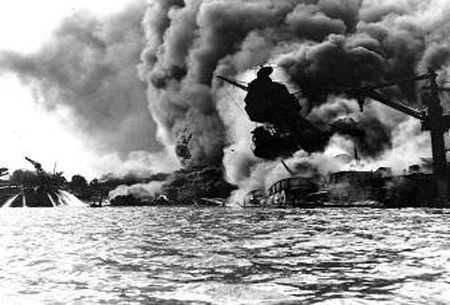
USS Arizona burning at Pearl Harbor, 7 December 1941
The following day, Roosevelt called 7 December ‘a date that will live in infamy’. Congress voted 388 to 1 in favour of war. For Churchill the news gave him the ‘greatest joy’. Hitler, too, was delighted, the lifelong teetotaller even indulging in a glass of champagne. Three days later, on 11 December, during the same week that the first Germans were being taken prisoner of war by the Russians, Hitler (and Mussolini) declared war on the USA.
The Philippines
On the same day as Pearl Harbor, the Japanese also attacked and conquered Thailand and struck at American airbases on the Philippine island of Luzon and British airbases in northern Malaya. Three days later, Japanese planes sunk two British warships off the east coast of Malaya – the HMS Prince of Wales and Repulse. Years later Churchill wrote: ‘In all the war, I never received a more direct shock.’ On Christmas Day 1941, the British lost Hong Kong to the Japanese. Also in December, American and Filipino forces, led by General Douglas MacArthur, were forced to flee from the capital of the Philippines, Manila. They retreated first to the Bataan Peninsula, then on to the island of Corregidor, when Roosevelt ordered MacArthur out of the Philippines, to Australia. MacArthur complied, though vowing, ‘I shall return.’
With no reinforcements available and with the Americans suffering from malaria and low morale, the Japanese took Bataan on 9 April 1942, forcing the 80,000 remaining American and Filipinos on to a seven-day, sixty-five-mile ‘Death March’ into captivity. One sixth died en route – shot or bayoneted by their guards. Only a third survived to liberation three years later. Corregidor fell twenty-seven days after Bataan, when the surviving Filipinos were used for live bayonet practice. The Japanese indulged in an orgy of rape, torture and murder against the local population, culminating in the ‘razing of Manila’. The Philippines were finally liberated in February 1945.
Burma
On 11 December 1941, the Japanese also landed on the southern tip of the British colony, Burma, determined to block Burmese supplies reaching China on the Burma Road. They proceeded north, defeating the British and Commonwealth forces in battle and pushing them back. Many Burmese soldiers, discontent with British rule, took the opportunity to desert and join the newly formed national army, fighting alongside the Japanese. On 7 March 1942, the Allies, led by Major-General William Slim, had to abandon the strategically important city of Rangoon, and having also lost control of the Burma Road, embarked on a 1,000 mile-retreat north-west into India, the longest retreat in British military history. But the Japanese in Burma were harassed by guerrilla jungle tactics employed by Burmese still loyal to the British and by British ‘Chindits’, led by Major-General Orde Wingate, formed specifically for the purpose, with mixed results. The Allies recaptured Rangoon in May 1945, but war in Burma did not end until August following the Japanese surrender.
Malaya and Singapore
British Malaya was considered a strategic stronghold. During February 1942, Japanese soldiers on bicycles headed south through Malaya, forcing British and Commonwealth troops onto the small island of Singapore on the southern tip of Malaya. The British had concentrated their island defences facing south out to sea, believing the dense jungle to the north impenetrable. Unaware of how numerically inferior the enemy, an impressive bluff perpetrated by the Japanese, the British and Commonwealth troops, led by General Arthur Percival, panicked at the speed of the Japanese advance, and having retreated to Singapore, destroyed the causeway between the mainland and the island. The Japanese merely built a new causeway and poured on to the island. British discipline broke, panic set in, and the cause was lost. On 15 February, the British surrendered, despite Churchill’s order that ‘No surrender can be contemplated.’
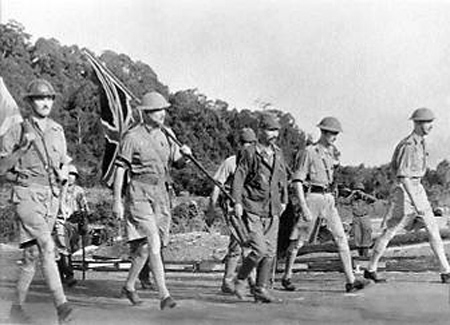
General Percival and party on their way to surrender Singapore to the Japanese, 15 February 1942
Photographs of Percival walking forlornly towards the Japanese commanders, his colleagues carrying Union Jack and white flags, flanked by Japanese soldiers (above), summed up the abysmal episode. Over 80,000 British and Commonwealth troops were to spend the rest of the war in captivity. The loss of Singapore was considered Britain’s worst humiliation in her military history.
The Battles of Java Sea, Coral Sea and Midway
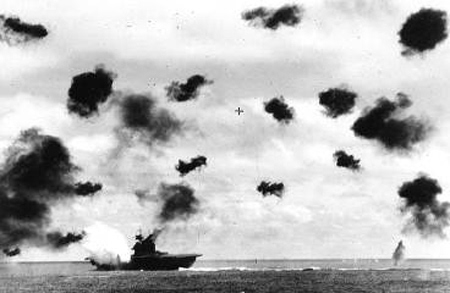
USS Yorktown is hit by a Japanese torpedo during the Battle of Midway, 4 June 1942
In the Pacific, the Japanese aimed to conquer the islands north of Australia and sever the supply line between the USA and Australia. In February 1942, the Japanese took control of the oil-rich Dutch East Indies (now Indonesia), defeating an armada of Allied ships at the Battle of Java Sea in the process. Many more Pacific islands fell, and Australia started to look vulnerable, more so when the Japanese sought to take Port Moresby in New Guinea, opposite Australia. However, having broken the Japanese navy codes, the American navy moved to intercept the Japanese fleet, taking them by surprise at the Battle of the Coral Sea, from 4#x2013;8 May 1942. It was a battle of aircraft carriers, fought with planes, the first where the opposing fleets never came within sight of each other. The battle ended inconclusively, but the losses sustained by the Japanese hampered a similar battle a month later, during Japan’s attempt to take Midway Island. Again, the ability to read their enemy’s coded messages played a crucial part in the American victory. The Japanese threat to Australia was removed and the Americans maintained their naval and air superiority throughout the rest of the war, aided by the Americans’ capacity for war production, which far exceeded that of the Japanese.
Guadalcanal and the Pacific Islands
On one of their many captured islands north of Australia, Guadalcanal, the Japanese began constructing a runway for future sorties south towards Australia. The Americans, having gleaned this information through intelligence, landed a force there on 7 August 1942, the first US ground offensive of the war, capturing the runway without opposition and sending the Japanese scurrying north into the dense jungle on the island. Two days later, the Japanese navy successfully attacked American ships bringing in supplies, but further attempts failed. Eventually, in February 1943, after the longest battle of the Pacific war, the remaining Japanese evacuated.
The Japanese at War
Had their treatment of local civilians in the countries they conquered been more humane, the Japanese cause may have been furthered, but their conduct and the atrocities inflicted towards civilians and prisoners of war were brutal and merciless. Rape, beheading, bayoneting and gruesome torture and medical experiments on human guinea pigs were commonplace. The Japanese considered surrender a shameful act and preferred honour through death than the shame of being taken alive. Therefore, they treated their prisoners barbarically and routinely worked them to death: one quarter, for example, of those detailed to work on the construction of the 250-mile Burma railway died an ignoble death. One in twenty Allied prisoners died at the hands of the Germans, compared to one in four held in Japanese captivity.