
The way of life in the rural areas can be presented as a system whose main temporal components were mixed farming and industrial activities. The mixed farming or food supply subsystem consisted of arable farming (the cultivation principally of barley, wheat, olives and vines) and pastoral farming (the rearing of sheep, goats, cattle and pigs); the gathering of produce which grew wild (fruit, nuts and herbs) added another element. Industry can be subdivided into extractive and manufacturing, or primary and secondary industries. The primary industries included the extraction of clay, timber, building stone, artefact stone, lime, earths and plants - as raw materials for the secondary industries. The manufacturing industries included the making of pottery, tools, votive figurines and idols, loom-weights, sealstones, textiles, wall plaster and the building trade. Together, all these activities made up the industrial subsystem.
A third major component was the organization of water supply which, at some sites, must have occupied a considerable amount of time. The village of Fournou Korifi, excavated in 1967-8, gives us a great deal of information about the Early Minoan way of life. With its dry, hilltop site, Fournou Korifi, or Myrtos as it is often called, must have presented its inhabitants with a serious problem: presumably they went down the hillsides to gather water at nearby springs and carried it up to the village in jars or skins.
A fourth component, trade, may have been more important at some places than others. Most villages had contacts with the larger world outside, as evidenced by varying quantities of imported goods. At Myrtos, for example, imported metal objects, stone vessels and obsidian were found. These small numbers of exotic objects do not, however, indicate long-distance trading relationships in any modern sense. Some of the exotic goods may have arrived at Myrtos as a result of many short-distance exchanges, or as gifts or dowries. Presumably, to compensate, varying quantities of goods were ‘exported’ too. In the case of Myrtos, exports may have comprised pottery or cloth.
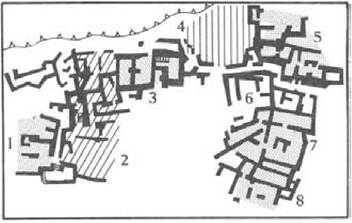 Figure 17 Plan of the Early Minoan village at Fournou Korifi. Shaded areas 1-8 represent probable household units in use during the second period of occupation
A fifth, non-temporal, component was religion. In the bronze age, many areas of activity which we would now consider to be purely secular were tinged with religious significance. Artefacts had to be ‘charmed’ to make them effective. To make the fields and flocks fertile, deities had to be propitiated and won over to the farmer’s cause.
The way of life in the Cretan countryside was an interplay among these separate component activities. At Fournou Korifi, we can see how that interplay produced a village society at a critical stage in the development of Minoan civilization. The village belongs to the third millennium bc, to the period just before urban life evolved on the plains. The first period of occupation, 2600-2400 bc, saw the building of small stone houses in an area that was to become the centre of the village. In the second period, more houses were built so that by the time of the destruction by fire in about 2200 BC the village extended across about 1,250 square metres and consisted of nearly 100 rooms, linking passages and open courtyards (Figure 17).
The little Myrtos village was probably typical of rural Crete at this Pre-Temple or Early Minoan II stage. It is unfortunate that it is the only village so far to have been fully excavated and for which all the finds and precise findspots have been fully published; it is nevertheless likely that Myrtos will prove to be representative. The artefacts found there show that cereals were grown, and sheep, goats, and cattle were reared on the neighbouring slopes; pottery was made, wool was spun and woven, and figurines were made out of clay and stone; agricultural produce was stored in jars, and food was cooked in certain localized areas.
One room dating from the earlier phase, around 2500 bc, was a potter’s workshop - the oldest so far known in the Aegean world. In it, eight circular discs were found, flat on one side and convex on the other, their centres worn down by constant turning. They were used for making pottery, turned by the potter’s hands, and they precede the introduction of freely rotating, spindlemounted fast wheels.
A later room in the south-west corner of the village yielded some broken offering vessels and a clay figurine that has become known as the Goddess of Myrtos. The goddess has a stalk-like head and neck, which may connect her with the curious later cult of pillar worship in which the pillar came to stand for the goddess. Her breasts are carefully accentuated, although not in the naturalistic way of the later snake goddess figurines or the priestess frescoes. She carries a water jug of typical Myrtos style, which suggests that she was associated with fertility and abundance. The hatched triangle on the front may represent the pubic triangle, as on other primitive goddess representations, and this would reinforce an interpretation of the figure as a goddess of fertility.
Peter Warren (1972) treats Myrtos as a single large living-complex, identifying specific areas within it as given over to different specialized activities; the implication is that the site functioned as an integrated whole with communal, perhaps clan, decision-making. The Warren view implies that family life was subordinate to that of the tribe or clan, the lack of any differentiation within the settlement suggesting that there was no chief or ruler. Warren puts the population at 100-120.
On the same data, Branigan (reviewing Warren’s study in 1975) interprets Myrtos as the mansion of a chief. The cellular structure allows us to interpret the village as a single building if we wish. Todd Whitelaw (1983) has identified about eight household units within the cellular plan, each household unit consisting of a suite of interconnected rooms. A careful examination of the findspots of artefacts shows that each room-cluster incorporated most of the settlement’s activities. Each household, in other words, had its own cooking area, its own farm produce storage area, its own wine (or more likely olive oil) storage area, its own area for general domestic activity. Not all of these were actually in use at the time of the destruction and Whitelaw suggests that the plan was the result of a very gradual organic growth through time, perhaps starting with a single nuclear family of 4-6 people and ending with five or six families by 2200 bc. Analyses of floor areas and the numbers of j ars for agricultural storage (amphorae and pithoi) both suggested that each household consisted of about five people.
Whitelaw’s study implies that Myrtos was a village of only 25-30 people, all living at about the same socio-economic level and grouped in families with a high degree of independence of one another. The key social unit was the nuclear family - a very different conclusion from Warren’s, and a more persuasive one. Such a small community as Myrtos could not have survived in complete isolation, which means that at least formal negotiating relationships must have existed to procure mates from other communities, and such meetings may have fulfilled an important social need - a sixth component in the system. The need to procure husbands and wives outside the village may be what is required to explain the exchanges of exotic goods.
At Myrtos, obsidian blades from the island of Melos and stone vessels probably from Mochlos on the north coast of Crete at first sight suggest long-distance trading links. It may instead be that such prized objects were exchanged in elaborate gift-giving ceremonies when marriages between members of different villages were settled. It may also be that some objects were exchanged or given several times over and, in that way, travelled far from their original place of manufacture.
Myrtos was just one of hundreds of rural villages on bronze age Crete and we are entitled to ask whether it was typical or representative of the island as a whole in the Early Minoan period. Todd Whitelaw believes that it was typical and that there are two supporting lines of evidence for believing so. The size of Minoan houses from the very beginning of the Early Minoan Period to the end of the Late Minoan Period implies family units of a similar size to those identified at Myrtos; in other words, the standard unit of the nuclear family, consisting of about five people, seems to have prevailed in Minoan Crete. The numbers of burials in collective tombs seem to support this. Obviously several major, and some might say unwarranted, assumptions have to be made - such as the supposition that a bronze age nuclear family would have yielded twenty bodies per century - but the results are nevertheless very striking. Whitelaw takes a sample of twenty-four tombs and compares the body-counts from them with the estimated period of use. The inference from the sample is that each tomb served 1.17 families. In other words, in death as in life the nuclear family seems to have been the unit of social organization.
When we compare Myrtos on the south coast with Mochlos on the north coast of Crete, we see some significant variations. Both the settlement and the cemetery of Mochlos have been studied extensively, so some interesting links can be made between the large village of some 300 people in the Early Minoan and the social structure implied by the burials. The tombs strongly imply differences in status between families. There are two groups of particularly rich tombs. But Early Minoan Mochlos was a proto-urban settlement and it seems as if, at Mochlos, the Minoans were crossing a threshold. As their villages became towns, social stratification began to evolve. As the settlements became larger, divisions, specialisms and hierarchies began to emerge.