
As for walls, it is quite out of date to say, as some do, that cities that lay claim to valour have no need of walls; we have only to look at what has happened to cities that made that boast. Doubtless there is something not quite honourable in seeking safety behind solid walls, but it may happen that the numerical superiority of the attackers is too much for the defenders. If then we are to save our city and avoid the miseries of cruelty and oppression, we must concede that the greatest protection that walls can afford is also the best military measure.
(Aristotle, Politics, Book 7, c. 340 BC)
Towns developed at the same time as the great lowland temples, and are identifiable from about 2000 bc. Sinclair Hood (1971, p. 50) mentions the theory that the temples (though he treats them as palaces) at Knossos and Phaistos were founded by foreign dynasts who invaded Crete at the beginning of the Middle Minoan period; according to this view, urbanization occurred in Crete as a result of the arrival of already-urbanized conquerors. There is evidence of the arrival of migrants at various stages in Crete’s prehistory, but it seems too facile to attribute each change in the island’s culture to the arrival of a new group of immigrants.
In any case, a study of neolithic Early Minoan buildings very strongly implies that the temples were not an implant but the result of a long period of indigenous development. The first neolithic settlers on the site of Knossos probably lived in wooden huts, of which only the post-holes survive in the archaeological record. By level 9, i.e. by about 6000 bc, Knossian houses were made of mud or mudbrick; some level 9 bricks seem to have been deliberately hardened by firing, which - remarkably - was never again to be the practice in neolithic or bronze age Crete. These houses, the homes of the first pottery makers on Crete, had rectangular rooms and were made across the rafters and adding layers of earth and stamped clay on top. No doubt thewithout stone footings. Later neolithic houses were normally built on a stone footing and this system - building the lower part of the walls of stone, the upper part of mudbrick - became standard in the bronze age.
A level 3 (middle neolithic) room was preserved a metre or so below the surface of the Central Court at Knossos. It was 5 metres square with a bin made of stone slabs built against the north wall: a similar bin in the north-east corner held a large storage jar. There was a fire-hole in the centre of the room, presumably for warmth in the winter. A 1.8-metre-square platform in the south-east corner is thought to have been a bed. The walls were smoothly plastered.
By the late neolithic, Knossian house plans had become quite elaborate, with square fireplaces set against a wall or in the centre of the room, and with neighbouring dwellings juxtaposed to make a cellular layout familiar in Early Minoan villages such as Fournou Korifi (Myrtos) and the temples that were to be built in the Middle Minoan. It is tempting to see the House on the Hill at Vasiliki as a half-way stage in development between the informal village plans and the rigorously organized plans of the temples. Vasiliki is a cellular arrangement of rectangular chambers disposed round two sides of a courtyard: the temples were larger cellular structures disposed round all four sides of a rectangular courtyard. Obviously, there was a quantum leap of some sort in the development of Minoan culture at the time when the temples were built, just as there was a quantum leap when the towns were built. Even so, the direction of the indigenous developments on Crete during the neolithic and Early Minoan periods is enough to show a continuity into the Middle Minoan.
The quantum leap expressed itself partly in population levels. As we saw in Chapter 3, the population of the village of Fournou Korifi was probably only 25 or 30. Mochlos, one of the smaller towns on the north coast, is estimated (by Todd Whitelaw, 1983) to have had a population ten times greater, living in an estimated fifty-five houses. Early Minoan Phaistos, over one hectare in area, may have had a population of 300450, Early Minoan Mallia, with its area of 2.58 hectares, had a population of 7001,000, and Early Minoan Knossos was almost twice as big as Mallia, with a maximum extent of 4.84 hectares and a population estimated to be between 1,300 and 1,900. The towns were thus much larger than the rural villages, and they were to expand even more once the temples were built. The town of Knossos had reached a size of not less than 45 hectares by the time its first temple was built in 1930 bc, which would have given it a population of 12,000-18,000.
Vasiliki, with its curious L-shaped half temple on a ship-shaped hill on the Isthmus of Ierapetra, was 20 kilometres north-east of Fournou Korifi and may have served as something of an urban centre for the villagers. Nevertheless, the main centre for the Isthmus of Ierapetra region was to develop not at Vasiliki, but at Gournia, close to the north coast some 6 kilometres north-west of Vasiliki. Gournia (Figure 18) was Minoan archaeologist Harriet Boyd at the turn of the century and the entire plan of the town stands completely exposed. Narrow paved streets that are little more than alleys wind informally round a low ridge once densely packed with houses. The town is dominated by the ruins of a modest temple with customary rectangular bull-court, together occupying the south-west quarter of the site. The Gournia houses are quite small, composed of perhaps five small chambers at ground floor level, although they almost certainly had at least one upper storey.
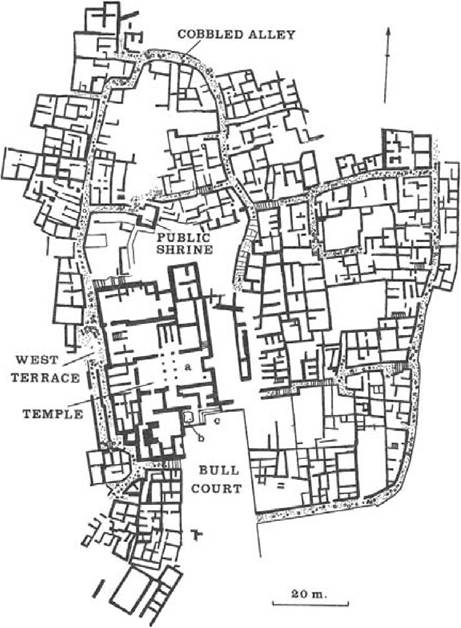
Figure 18 Gournia, a small Minoan town. a = principal hall or sanctuary, with alternating pairs of piers and columns. b = large stone slab, apparently a sacrificial table. c = L-shaped arrangement of shallow steps
The form of the Minoan town house is known from several ivory and faience plaques depicting house elevations. The faience plaques Evans discovered in the East Wing of the Knossos Labyrinth probably originally fitted together, jigsaw-fashion, to make a picture of a complete town; it may have been a town under attack from invaders, like the town shown on the silver Siege Rhyton found at Mycenae. The faience plaques of the so-called Town Mosaic from Knossos show what the Knossian houses of the seventeenth century BC looked like. There was a small top storey, a room on the flat roof which may have functioned as a sleeping place on hot summer nights: there were similar roof chambers on Egyptian houses too. There were windows on the first floor, though not (at least in the Town Mosaic) on the ground floor. Evans suggested that if the complete picture showed an attack on a city the houses depicted may have been part of an outer defence wall in which no ground-floor doors or windows would have been possible. In fact, several plaques do show doors on the ground floor, though not windows. It may be that having no windows on the ground floor was a simple security feature, a precaution against burglary. An ivory plaque of a slightly later date shows a house with a doorway flanked by narrow slit windows.
The houses, and the temples too, had horizontal beams let into each face of the wall. The beams were linked at intervals by uprights and tie beams; they were fixed to the walls and probably to each other by means of wooden pegs. This technique, which shows clearly in all the house plaques as well as in the remains of the buildings themselves (for example, the north wall of the so-called ‘Lobby of the Stone Seat’ in the Knossos Labyrinth and in Room 11 of House A at Tylissos), was standard in Minoan Crete (Plate 7). Its original intention is unknown, but it has been suggested that the timber framing gave walls the combination of strength and flexibility needed to withstand earthquakes. The timber bracing was built into stone and rubble walls as well, as can be seen at many points round the Knossos Labyrinth, so it seems likely that earthquake-resistance was the likely purpose.
In major buildings like the temples, dressed stone sawn with long bronze saws was used, particularly for sections of wall that would be seen. At Knossos and Phaistos, an extra refinement in the masonry of the West Fronts was a foundation course of very large blocks: the rest of the wall was stepped back a centimetre or two to make a feature of it. At Mallia, the foundation course projected far enough from the rest of the wall to make a ledge that was wide enough to sit on. The fine masonry extended up to the top of the ground floor, but it seems likely that the upper floors - however many there were - were usually made of mudbricks. Some of these bricks were 50 x 40 x 12 centimetres. Occasionally entire houses were made of mudbrick, but usually the ground floors were stone and the mudbricks were reserved for upper floors and partition walls (Plate 8).
Wooden columns, often painted red, were used on a lavish scale in the temples, though less commonly in smaller buildings. The largest column, which was at Phaistos, had a diameter approaching 1 metre. The columns normally tapered downward, the broad end of the inverted tree trunk supporting the capital and architrave beams. To stop the foot of the column from slipping sideways, the stone base was often given a roughened top or a shallow mortise pit into which a tenon projecting from the foot of the column fitted. The columns were usually smooth and circular in section (Plate 11), but some were ribbed or fluted: some were even given spiral flutes like sticks of barley sugar. The frescoes show us what the colonnades looked like and capitals of varying designs can be inferred from them; some of the stone pedestal lamps seem to be miniature versions of the full-sized timber columns. So far, no large stone capitals have been identified, although a small capital has survived in the house ruins to the south-west of the Knossos Labyrinth. Evans’ ‘reconstituted’ columns at Knossos have a typical cushion-shaped capital, but some were evidently cuboid.
The columns carried hefty ceiling or roof beams, sometimes spanning 5 metres, but usually less. Some of the beams, at the Temple Tomb for instance, were 50 centimetres square in cross-section. It is clear from the lavish way in which timber beams were used, both in houses and temples, that plenty of timber was available in Minoan Crete. The Minoans made flat roofs by laying branches and brushwood across the rafters and adding layers of earth and stamped clay on top. No doubt the roofs of the more prestigious buildings were coated with layers of cement.
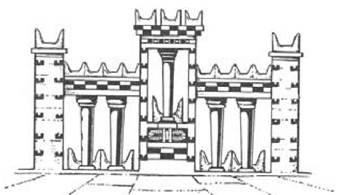 Figure 19 The Tripartite Shrine in the Knossos Labyrinth. A reconstruction
Interior walls were normally coated with a fine lime plaster. Sometimes, where a richer effect was required, a veneer of thin slabs of veined gypsum was added. Sometimes a fresco was added to the plaster above a gypsum dado. Floors were sometimes plastered, especially in light-wells or courtyards, with small pebbles mixed in with the plaster. Other floors were made of beaten earth, wooden boards or flag stones. Sometimes a chamber was given a floor of mixed materials, with a flagstone edge and a panel of painted plaster, occasionally adorned with a fresco, in the middle.
How far stone was used decoratively is hard to judge. The ruins of the Knossos Labyrinth have yielded some stone friezes carved with rosettes, spirals and halfrosettes carved in relief, but these seem to have been exceptional. At Knossos too the wall and ceiling plaster was in some rooms modelled into relief forms, sometimes abstract, like the spiral reliefs found in the North Sector, sometimes representational, like the Bull Relief from the North Entrance Passage or the Bull-Grappling Fresco from the East Wing.
Ensuring the water supply for the towns during the dry Cretan summers must always have been a problem. The Minoans built cisterns or water tanks and lined them Often these were circular, as at Zakro and Tylissos, with flights of steps leading down into them. Whether the cisterns were purely for water supply or had some ritual function as well is open to question. Certainly the plumbing arrangements in the Minoan towns were elaborate. There were covered stone slab-built drains at Knossos to carry away sewage. The remains at Knossos show clearly how rainwater was led down from the roof by way of light-wells to flush out sewage from three lavatories in the East Wing (Figure 20). The Room of the Plaster Couch was apparently a vestry, robing room or cloakroom: the ‘couch’ was probably a stand for water ewers. Water was poured through the hole in the floor immediately outside the lavatory door: an under-floor channel linked the hole with the vertical soil pipe under the lavatory seat. The lavatory could thus be flushed even during a rainless summer, either by an attendant outside the lavatory or by the user (Figure 21).
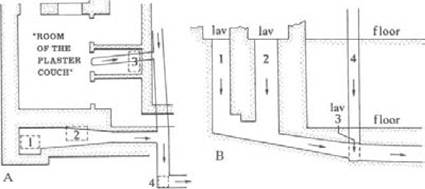
Figure 20 Three water-closets in the East Wing of the Knossos Labyrinth. A: ground-floor plan of the area Evans called ‘the Queen’s Toilet’. The large space he called ‘the Room of the Plaster Couch’ was probably a vestry or robing room. 1: vertical soil pipe from lavatory on first floor. Access to the lavatory was by way of a door from the room directly above the Room of the Plaster Couch. 2: soil pipe from lavatory on first floor. Access to this lavatory was from a room to the south. 3: soil pipe for lavatory on ground floor. 4: rain-water conduit, probably leading from roof. Arrows indicate downward gradient of channels and therefore direction of flow of rain-water and sewage. B: section from west to east. ‘lav’ indicates location of lavatory with water-resistant plaster.
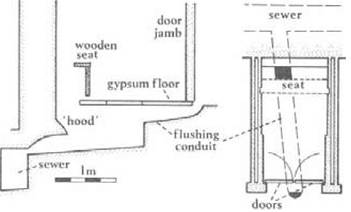
Figure 21 Detail of ground-floor water-closet in the Labyrinth. Section (left) and plan (right). Detail of lavatory 3 on Figure 20
There were also jointed clay pipes, each one a tapering tube with lugs on its sides so that it could be tied to the next. It was an ingenious system, by which the pipes could be laid straight or in curves, not unlike the rubbish chutes used in the building trade today. Evans thought the clay pipes at Knossos were used to bring water into the palace from outside. This would have been very difficult, because the site is on a low hill and some means would have had to be found for overcoming the unfavourable gradients; a siphon effect has been suggested, but that would have involved making the whole length of piping airtight, which seems scarcely credible. An alternative is that the pipes were carried across the valleys from higher ground on the far side by means of high (and now completely vanished) aqueducts.
An elaborate system of rain-water drains can be seen, reconstructed by Evans, at the East Entrance. An open clay channel runs down one side of the labyrinthine staircase. On each landing, a small rectangular settling tank was provided as a sediment trap. More substantial stone drains were fitted into the light-wells, cellars or courtyards known as the Room of the Stone Drainhead and the Court of the Stone Spout. Water travelled along well-made open stone drains 25 metres from the former to the latter, and from there into a vertical soak-away (Plate 9).
The interiors of some houses, shrines and temples were richly decorated with frescoes. The earliest known frescoes date to the time of the second temples, i.e. from 1700 BC onwards. Walls seem to have been painted in flat colour washes even earlier. There are Early Minoan fragments of coloured plaster from Knossos, Vasiliki, and Fournou Korifi; the favoured colour then was a dark red, a colour which, later at any rate, came to symbolize the underworld. From the beginning of the first temples, around 1900 bc, walls were sometimes decorated with simple geometric patterns in white and red. It was only when the new temples were built that pictorial frescoes were attempted.
The Saffron-Gatherer Fresco, found in the Lotus Lamp Sanctuary at Knossos, is reckoned to be one of the earliest. Against a background of dark red we see a blue monkey gathering crocuses into a pot. The head is missing, and Evans originally thought that the figure was that of a boy; it is now seen as a monkey. Blue was the conventional colour for monkeys in ancient Egypt and, apparently, in the Minoan culture too: monkeys in the Minoan frescoes on Thera were also painted blue. The monkey in the Knossos fresco was evidently a pet: it wears a red leather harness.
The art of the fresco painters developed from this beginning over the next 300 years to produce some of the most vivid and original images of the ancient world. The scale varied considerably. Sometimes whole walls were treated, or even whole rooms. Sometimes long narrow friezes were designed to run along the upper part of a wall. Sometimes small panels were painted, apparently so that a sequence of tableaux could be shown. Human figures vary in size from more than life size down to only 3 or 4 centimetres in the so-called Miniature Frescoes.
Most of the frescoes have been found at the Knossos Labyrinth and the ‘palace’ of Agia Triadha, but it is likely that many other buildings also had frescoes originally. It seems that frescoes were also executed on floors. The Dolphin Fresco in the Dolphin Sanctuary at Knossos may originally have graced the floor of an upper chamber in the East Wing. The floor of a shrine beside the Agia Triadha palace had a similar floor-fresco showing dolphins, octopus and fish.
The technique for producing the Minoan frescoes varied. Some were frescoes in the truest sense: colours were applied to wet plaster and left to sink into it as the plaster dried. Others were painted on to a dry plaster surface. Still others were produced by means of a curious inlay technique. After the initial fresco painting had dried, some areas requiring more detailed work were cut away, and refilled and recoloured with fresh wet plaster. In some set-piece frescoes, life-sized figures of men, bulls, and griffins were moulded in low relief; this seems to have happened in the period 1550-1470 bc, but not later. The famous ‘Priest-King Fresco’ is of this type.
The colours used for fresco painting were for the most part easily obtained: red ochre, yellow ochre, black (either from charred bone or from carbonaceous shale) and blue (from a copper-tinted glass). An analysis of the paints used on the Agia Triadha sarcophagus shows that some paints had a more exotic origin: the blue seems to be ground lapis lazuli.
Sinclair Hood (1971) says that some of the fresco subjects were secular, but the evidence points increasingly to a pervasive religious content. Even the landscapes, birds and animals may have had a religious significance (see Chapter 6). Landscapes are treated unusually, in frescoes and also in sealstones, as if seen from the air or through a fish-eye lens. Rocks and plants project into the pictures from the top as well as from the bottom, rather like stalactites and stalagmites in a cave. It is a very different approach from that of the ancient Egyptians.
The naturalistic treatment of plants and animals is deceptive: it is often quite inaccurate. The rock-rose, for instance, is given six petals instead of five. Some plants defy identification. The mythic animals are an even stronger reminder that the fresco artists were depicting another world than the everyday one; it is a symbolic world where general concepts such as fecundity were more important than accuracy of detail. A favourite plant in the frescoes is the papyrus, treated in various decorative ways: but the papyrus did not, as far as we know, grow in Crete in the Minoan period, so the frescoes do not factually depict the Cretan landscape. The papyrus may have been a borrowing from Egyptian art which to the Minoans held some symbolic value. Certainly we should not see the Minoan frescoes as simple interior decoration. From the Minoan colony of Thera, where more complete frescoes survive, comes strong evidence that frescoes were indicators of a precise ritual function for a chamber. The position of the frescoes mattered a great deal and also, according to Nanno Marinatos (1984), their visibility: it was important that certain frescoes should only become visible at certain stages in the ritual - hence the pier-and-door partitions.