
The peak sanctuaries
Religion played a maj or role in the Minoan way of life, both in the towns and in the countryside. There were some easily recognizable built sanctuaries, as well as other cult centres that are far less easily identified.
The ‘house ’ at Niru Khani has always, ever since it was excavated in 1918-19 by Xanthoudides, been the subject of controversy. Was it a country mansion as Graham (1987) suggests, or the only surviving large house in a harbour town that extended all the way along the shore to Agii Theodhori? Or was it, as Xanthoudides and Evans thought, the headquarters as well as the residence of a High Priest? Three of its rooms contained a total of about fifty clay altars neatly stacked in piles; another room contained four large stone sanctuary lamps; in another, four very large ritual double-axes made of thin bronze sheets were found. The walls were frescoed and one fresco fragment showed a sacral knot, a religious symbol. The courtyard to the east was clearly intended for religious rites: remains of sacral horns were found there together with a niche designed to receive them and, nearby, a kind of tripartite altar.
The Niru Khani temple, if we can provisionally call the building that, was evidently an important centre for religious ritual. The large number of religious objects found suggests that the building may have been, as Evans proposed, a centre for the manufacture of votive objects. Niru Khani may have been an important rural religious centre. It is nevertheless possible that other buildings stood round it along the shore, which lies only a few metres away. Minoan harbour works have been found half a kilometre away at Agii Theodhori. Whether this adds up to a port is questionable: too much of the evidence is missing.
More unambiguously rural are the peak sanctuaries, consisting of temples and sacred enclosures on the lower and more accessible rocky mountain tops, which were often riven by fissures and clefts. These places were always dramatically situated, bare and windswept. The sanctuaries varied in height from only 215 to 1,100 metres above sea-level, so the surrounding vegetation varied considerably. Petsophas, one of the lower sanctuaries, was in the zone of evergreen Mediterranean vegetation in which vines were cultivated. From 350 to 650 metres there were oak woods and maquis, although the olive could be cultivated right up into this zone; it was here that most of the peak sanctuaries were built. The highest sanctuary of all, Karfi (1,158 metres above the Mediterranean), is in the high summer grazing zone: there are still evergreen shrubs and some oaks at this altitude, although the landscape is more open.
The sanctuaries differed from each other in their appearance, but the votive offerings and other trappings of the cult were uniform; in other words their function was the same, even though the buildings may have looked different. The exposed position meant strong winds and few trees, but short shrubs, flowers and herbs grew in profusion in the rock crevices. The Zakro rhyton shows a wild, rocky site with an elaborately carved or painted shrine standing in front of a summit; a flight of altar-strewn paved terraces designed for cult activities descends before it, the temenos or sacred precinct. Walls and balustrades are crowned with sacral horns. One of the altars carries an offering of two branches, possibly torn from a sacred tree. The fagade of the sanctuary is embellished by tall masts or pylons anchored to the wall by substantial square brackets. A rhyton fragment found on the Gypsades Hill at Knossos shows a sanctuary of very similar shape, again with bracketed masts (Figure 15). The Gypsades rhyton differs in showing a worshipper stooping in front of the sanctuary to set down a basket or large bowl.
Both the rhytons show the fagade divided into three parts. The middle section is shown broader and higher than the flanking sections. The lower flanking sections are surmounted by sacral horns. The design may well contain a resonance of the tripartite form seen in the major shrine in the Central Court at Knossos. The fagades were apparently designed to be backdrops for ceremonies, cult dances, processions and possibly religioustheatrical performances.
Solitary, raised to the skies, exposed to the wind, silent but for the sounds of birds and wild goats, the peaks must have seemed places that were propitious for meetings with the gods. A range of devotional activity is implied in the various types of altar found or depicted: long, step-like altars, rectangular table-like altars, fire altars, incurved or waisted altars and natural stones functioning as altars. It seems likely that there were cult images or statues in the sanctuaries. Rutkowski (1986) interprets the curious rendering of the peak itself on the Zakro rhyton as an aniconic representation of the goddess, like the enshrined baetyls shown on some of the gold ring scenes. Clay cult statues or wooden xoana with clay feet and elaborate robes were probably installed in the shrines within the temple. Some of the statues or figurines were apparently votives, i.e. brought to the deity as offerings by pilgrims, but the larger ones were probably part of the sacred furniture of the temples. Two large statues have been discovered at Kophinas; others, discovered at Plagia, were said to have been 0.7 metres high but they were destroyed before that could be verified. On Mount Juktas, the clay curls of a large-scale human figure were discovered, though the exact findspot is not known.
The peak sanctuaries must have been elaborately furnished, though little now survives. There were movable sacrificial tables, stone ladles or lamps, libation vessels, including one from Kophinas in the shape of a bull’s head, kernoi, pottery, small balls of crystal or steatite (probably used in connection with prayers). The many clay figurines are 10 or 20 centimetres high. Typically, they are of women in bell-shaped dresses, with jackets which expose the breasts, and with high head-dresses; the hats are fantastic and widely varying (Figure 3). There are also male figures wearing loincloths. Almost all the figures stand erect, with their hands raised in a gesture of supplication, fist to forehead in salutation (or perhaps to shield mortal eyes from the dazzling apparition of the deity), but some have their hands drawn back to the collar bones. The dedication of a figurine of the worshipper in an attitude of prayer and adoration signified the worshipper’s continuing presence and continuing worship at the sanctuary; the figurine was a surrogate for a worshipper (Figures 2 and 30).
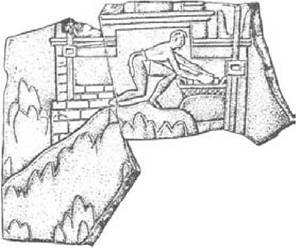 Figure 15 A Minoan worshipper leaves offerings at a peak sanctuary
The Minoans went up to the peak sanctuaries to plead with and worship the deities who controlled the heavens. The pastoralists moving about among the high pastures in particular would have used these temples to intercede with the weather gods who controlled the lives and well-being of both people and livestock. The supplicating attitudes of the figurines tell us that prayers and pleas were offered. Large numbers of cattle models, especially bulls, and clay models of oxen, sheep and rams imply that the herds and flocks were being offered to the gods’ protection.
Clay figurines of beetles have also been found in the peak sanctuary sites. Rutkowski thinks that they are intended to represent the scaraboid species Copris hispanus, which digs holes to bury sheep droppings; it may be relevant that small balls of clay, which may represent sheep droppings, have been found at peak sanctuaries too. The copris never acquired the same importance or status in Crete as the scarab in Egypt, but it was evidently thought to have some magical or religious significance. Where there were copris beetles, there were sheep. Perhaps the copris was seen as a messenger of the protecting deity, perhaps even as a theophany of the goddess.
Pilgrims such as nomadic shepherds might have visited the peak sanctuaries informally at any time, but large-scale ceremonies probably only happened at certain times, perhaps twice a year. As the worshippers arrived they placed their offerings inside the temenos, in front of the shrine. To judge from the later Greek festivals, large-scale and elaborate rituals followed; a priest placed the offerings on an altar, bonfires were lit, lambs were sacrificed and consumed at a feast. There was dancing and singing in honour of the deity, who was called up by blowing on triton shells. Pilgrims threw votives into the pyre embers. Afterwards, the ashes were swept up together with the votive offerings and kept in special repositories, usually a rock cleft. On Mount Juktas, this was a deep fissure in the rock to the west of the temple.
The Minoans clearly believed, in common with many other peoples in Africa, Asia and Europe, that deities lived on the mountain tops, or at least made appearances there. From their own habitations, the Minoans saw the mountain tops as intimately and supernaturally connected with the vagaries of weather. As rain clouds descended, the summits vanished; as they reappeared, the rain clouds lifted. Sometimes the shape of a mountain suggested supernatural properties. From Ghazi and Tylissos, the Mount Juktas ridge looks like the face of a reclining, supine giant; we can be sure that the rural peasants of Minoan Ghazi noticed it, just as the later Cretans did. Buondelmonti, visiting Crete in the fifteenth century, reported the views of the medieval Cretan peasants: ‘The mountain is shaped like a human face. On the forehead . . . is the temple of Jupiter, while on the nose are three churches. . . . To the south, more or less facing Ida, is the chin. ’
Minoans were venerating their gods on mountain tops a century or two before they started building large temples on the lowlands. The peak sanctuaries seem to have appeared rather suddenly in about 2100 or 2200 bc. As we have seen, most of them were situated on low peaks, at 400-800 metres, and they all have easy paths leading up to them, easy at any rate for habitual hill-dwellers, from nearby Minoan settlements. In most cases the peak sanctuary was less than an hour’s walk from a Minoan village and surrounded by pasturage. They were places which must often have been visited by shepherds, and we should see the development of the peak cult as a natural outgrowth of the pastoral economy. Just at the time the lowlands were becoming urbanized and the first great temples were being planned, a major shift in the Minoan economic and social system was taking place. The lowland centres needed more food: pressure increased on the outlying, marginal areas to produce more cattle and sheep, and supernatural help was invoked.
The best-known of the peak sanctuaries is the one on Mount Juktas. Its temenos walls were apparently well preserved until the nineteenth century, and the precinct within has been investigated periodically: new discoveries are still being made there. In 1837, Pashley described the site, apparently for the first time:
I found considerable remains of ancient walls. The construction is chiefly of very large stones, among which a good many small ones were intermixed. These fragments seem to offer a good specimen of the so-called first cyclopean style. ... No more than 50 paces are occupied by the actually existing remains. It is, however, evident that the old walls extended all round the summit, except where, as on its western side, it is a nearly perpendicular precipice.
Now, most of the perimeter wall is so degraded that it is unrecognizable. Originally, the 740-metre-long wall was 3 metres wide and probably 4 metres high; built in the Middle Minoan IA period, around 2100 bc, it was probably repaired intermittently until the Late Minoan period, around 1470 bc. The massiveness of the walling has led some to suggest that the place functioned as a refuge in times of danger. At the same time, structures built for cult purposes are often redundantly massive; one could cite examples such as Stonehenge, the Pyramids, or the Egyptian temples. Possibly there was a need to express on a large scale in stone the majesty and power of the divinity.
At some stage, possibly shortly after the temenos wall was completed, the temple was built inside it. The temple, a long narrow rectangular building, separated off a small area of the precinct close to the cliff edge (Plate 3). The rock rises steeply up a dramatic ramp before plunging down towards the west: this area was the focus of the ritual activity, with a large rectangular altar, a pyre, and the jagged entrance to a sacred cave. In this vertical cleft, which has been excavated to a depth of 10 metres, large numbers of small clay votives, fragments of offering tables and bronze figurines were found. The site also yielded thirty cult double-axes.
The little temple itself consisted of a row of five compartments, each of which may have functioned as a separate shrine. Their west-facing entrances were probably screened from general view by a wall. The shrines were decorated with painted plaster and probably supported an upper storey. As I have suggested in The Knossos Labyrinth, the upper storey probably consisted of a tripartite shrine.
Juktas is special because of its well documented if poorly preserved temenos wall. It is special because the discovery of its sacred cleft emphatically connected the peak sanctuary and cave sanctuary cults as parts of the same religious system. It is also special because it was said by the ancient Cretans to be the burial-place of Zeus: a piece of folklore which earned Cretans an undeserved reputation as liars in the ancient world. But most of all it is special because it is the peak sanctuary which served Knossos, the principal city of Minoan Crete, and whose temple came to dominate the religious life of much of the island. Juktas, a presiding presence high on the southern skyline when viewed from Knossos, was an integral part of the belief-system which developed in the Knossos Labyrinth.
Tylissos had its own peak sanctuary; it was discovered in 1962 on one of the summits of Mount Pyrgos. It stood at 685 metres, some 90 metres lower than the Mount Juktas sanctuary. Like Juktas, it had a stone-built temple within a terraced temenos, and there were many Middle Minoan clay votive offerings: there were even caves a little way down from the summit which may have been used in connection with the sanctuary.
The town of Palaikastro in eastern Crete was evidently served by Petsophas which, at 215 metres above sea-level, was one of the lowest of the peak sanctuaries. It was excavated in 1903 by J. L. Myres, who found many clay figurines dating from every period of the Minoan civilization. There were some large copris beetle figurines, inscribed offering tables, lamps and bronze daggers that may have been used for sacrifices. As reconstructed by Rutkowski, the temple was a two-storey tripartite shrine somewhat similar to Juktas, and also built close to a steep drop. The walls of the ruined sanctuary still remain, commanding a spectacular view across the rocky hillside and the sea.
A final example is the sanctuary of Kophinas, discovered in 1955. In Minoan times, this served a scatter of rural villages, especially in the area round the present-day village of Kapetaniana. A 9-metre section of its long temenos wall survives: originally it ran round a more or less rectangular precinct some 80 metres by 30. This was unusually large. Pyrgos and Juktas were large, but the usual size for a temenos was under 600 square metres. The sanctuary site, in use in the Middle Minoan and later, yielded a variety of cult objects including clay and bronze votive offerings. There were significant quantities of pottery as well, which was unusual; apart from Kophinas, only the peak sanctuaries at Koumasa and Juktas produced large quantities of pottery. The sanctuaries clearly varied a good deal in details of design and proportion, but the associations of site, perimeter wall, small temple, altars and votives are recognizable enough.
It is also evident from the thirty-five sanctuary sites that have been positively identified (see Appendix B) that worship at peak sanctuaries was a widespread and integral part of the Minoan rural belief-system - one which accompanied and was to an extent taken over by economic, political, and religious developments down on the plains.
The cave sanctuaries
The Minoans also worshipped their gods and goddesses in the depths of the earth. The practice of worshipping in caves may have begun as a result of the practice of cave burial. The most important burial cave is at Pyrgos near the Minoan harbour at Agii Theodhori and the Niru temple. It contained hundreds of interments. Some people were buried there in clay coffins: some were buried with grave goods of stone idols, Early Minoan vases and bronze daggers. The use of caves for burial went on right through the Minoan period and it may be that this was because of an association with ancient habitations, although some of the caves used for burial and worship can never have been used as dwellings; the sacred caves at Kamares and Mount Ida are often blocked by snow until midsummer. The explanation is probably simpler. The Minoans used caves for worship and burial because of their mysterious and other-worldly atmosphere. One has only to descend into the magnificent caverns of Psychro or Skotino to sense the awe that the Minoan pilgrims too must have felt. They are places apart, like no other, places where deities might yet dwell.
Some cave sanctuaries were centres of worship well before the great temples were built in the towns; votive ivory figurines were left in the Trapeza Cave high in Lasithi in these Pre-Temple days. The caves were visited once the temples were built, too; pilgrims from Phaistos in the days of the Old Temple made their way up the southern slopes of Mount Ida as far as Kamares, where offerings were left in pottery vessels in the Kamares Cave. Some caves, like the Cave of Eileithyia at Amnisos, continued as centres of worship long after the temples had fallen.
It is important to recognize that the Minoans did not regard all caves as sacred. Of the two thousand caves in Crete, perhaps as few as thirty-five were used by the Minoans for religious purposes: of those, only sixteen or so were definitely used as cult places (see Appendix A). The selection of a cave for cult activity depended on whether it fulfilled certain requirements: a mysterious and awe-inspiring interior with fantastically shaped rock formations, including stalagmites and stalactites, together with rock pools where holy water might be collected. Our knowledge of the cave sanctuaries is incomplete; not one of the caves has been completely excavated and documented.
Some of the caves, such as the Hermes Grotto at Patsos and the cave at Mavro Spilio at Knossos, are simple rock shelters. Some are relatively simple one-chamber caverns, like the Cave of Eileithyia at Amnisos and the Arkalochori Cave. Skotino is rather more complex, its plan dividing into four compartments linked end to end to make a chain 160 metres long overall. Skotino ranked among the most important cave sanctuaries, as the sacred cave of Knossos. Four hours’ walk east of Knossos, on a level plateau and visible only from close at hand, is a large hollow formed either by solution or by cave-collapse; the cave entrance opens from the south side of this wooded dell (Plate 4). Paul Faure believes that Evans was wrong in identifying the large building at Knossos, the House of the Double-Axe, as the Labyrinth: he considers the Skotino Cave to be the Labyrinth. There seems to be no reason to go along with this view. Even so, Skotino emerged as one of the most important cult caves in Minoan Crete.
Skotino has a narrow entrance leading into a large first chamber. Daylit, 94 metres long, 36 metres wide and with a ceiling soaring an impressive 50 metres above the cave floor, it is cathedral-like and awe-inspiring. In its centre a massive stalagmite formation rears up like some primitive piece of statuary. The floor slopes unevenly down past this impressive structure. At the end of it there is a drop into the second chamber, which is 24 metres long and has a much lower ceiling. The light here is dim and it seems that this was the focus of the Minoan rituals; remains of sacrifices and votive offerings including figurines were found in it, close to a natural rock altar.
The small third chamber, lower and darker still, has several branches leading off it, one connecting it with a circular fourth chamber. Most of the cult activity seems to have taken place in the first and second chambers. The large rock formation in the first chamber is said to look like a bear or a dog. It really looks more abstract than that, organic perhaps, but in a more general way. To pilgrims under the influence of alcohol, opium, religious fervour, or all three, it might have suggested all kinds of monsters, demons, deities. From one angle it looks like a sphinx. At its innermost end, the stalagmite formation culminates in a pillar which looks, in the half-light, like an expressive bearded head, startlingly similar to the images of Zeus made in the archaic period. Was the image of Zeus perhaps taken from this rockimage in the shadows of the Skotino Cave?
The ashes of sacrificial pyres and quantities of pottery indicate high levels of cult activity. The cave itself is huge, impressive and easily reached across the gentle hill slopes. There seems little doubt that Skotino was the principal cult place of a large region. It served the rural communities of that region and also the towns, including Knossos.
The sacred cave of Eileithyia at Amnisos was probably also visited by urban as well as Minoans, from Knossos, 5 kilometres away, and from Amnisos itself, directly below it. The cave mouth is hidden behind a fig tree in a hillside gully overlooking the sea and the southern edge of modern Amnisos. The cave is low-ceilinged and its floor extends more or less horizontally into the rock. It has a fairly uncomplicated and open plan broken up only by clusters of stalagmites. One stalagmite was clearly sacred; it had a low wall built round it and it seems to have been treated as an aniconic cult image of the goddess Eleuthia, the Minoan goddess known to have been honoured here. Offerings to Eleuthia were recorded in the Linear B archive at Knossos.
Close at hand outside the cave mouth, Marinatos discovered the remains of a rectangular building. This may have been the house of the sanctuary’s custodian or possibly a shrine: Strabo mentions an Eleuthia temple. In the late, post-Minoan period, the Eleuthia sanctuary at Amnisos was famous enough for Homer to be able to refer to it: he expected his readers on the Greek mainland to know of it. It may have started as a centre of worship for a small local community, but later acquired an importance that extended far and wide. Rutkowski (1986) suggests that the cave began as a place of general sanctity and only gradually acquired a very specific association with one particular goddess.
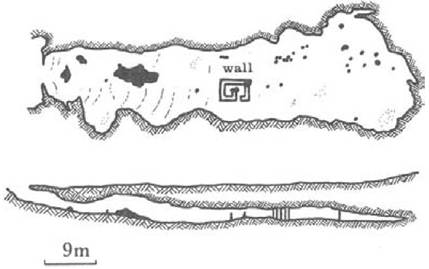
Figure 16 The Cave of Eileithyia: plan (above) and section (below). The black areas represent accretions of stalactite on the cave floor. This was the cave mentioned by Homer, and where the Minoans worshipped the goddess Eleuthia
Extending along the hillside to the west of the cave entrance is a terrace about 10 metres wide, the Square of the Altars: this was a precinct apparently connected with worship at the cave sanctuary. The fissured and weathered surface layer of the rock was laboriously quarried away to produce a smooth and level platform for ceremonies. Six large cubes of living rock, the largest some 3 metres across, were deliberately left at intervals, perhaps for use literally as altars of some kind (Plate 5). A degraded terrace wall leads eastwards from the altars towards a second cave, a well-like shaft 1 metre in diameter, which may have had some ritual function, perhaps for pouring libations; the use of a second shaft may have been necessary since the main cave was small and may often have been congested with pilgrims. Altogether, a considerable area seems to have been deployed for cult activity on this hillside. An isolated altar-cube of the same general shape as those on the Square of the Altars has been preserved further down the hillside to the north-east: it has what seem to be a battered pair of sacral horns on top.
Some of the Minoans’ sacred caves have interiors which are more complicated than that of the Eileithyia Cave, maze-like interiors with winding passages and irregularly located side chambers. The Kera Spiliotissa and the Mamelouka Trypa Caves near Khania belong to this type. Another cave near Khania, the Leras Cave, is among the most beautiful on Crete. One group of stalagmites at Leras suggests a group of draped deities standing between the columns of a Minoan temple. The natural rock formations in many of the caves suggest beasts, people or gods; the Cretans of modern times have told travellers of cave rock formations that look like men, animals, or gods - the guides at Psychro still do so - and it is likely that the Minoans saw these likenesses too and may have seen them as significant, as numinous presences.
Water too was a ritual focus at the cave sanctuaries. Towards the back of the lower chamber at Psychro is a small lake of pure water. Its level rises and falls seasonally and at its spring maximum it is 20 metres across. Large numbers of votive offerings were found in the silts flooring the lake, especially close to its shore: bronze figures, rings, pins, sealstones. Rutkowski thinks that the rock pools at the back of the Eileithyia Cave were also regarded as sacred, though without offering any evidence.
The open spaces outside the cave entrances were often used for cult activities such as sacrifices, pyres, dancing and feasting. The terrain varies a good deal. At Skotino there is a wooded dell; at Amnisos there is an open meadow; at Psychro there are rocky mountainsides and a narrow terrace (Plate 6). In front of the Idaian Cave’s entrance there is an apron of gently sloping land overlooking the Nida Plain: standing on it is a large altar which was certainly used for cult purposes in later times, although its existence there in Minoan times is uncertain.
The Minoans offered sacrifices of many kinds, both in the sacred caves themselves and in the open-air precincts near their entrances. They brought farm produce of all kinds in pottery vessels. Grain was left at the Kamares Cave. Both domestic and wild animals were sacrificed and burnt. At Psychro, there is evidence that pilgrims sacrificed oxen, wild goats, sheep, deer, domestic pigs and wild boar. In other caves, there is evidence that they left votive gold double-axes, bronze figurines of worshippers and many other offerings; at Patso, they even deposited the sacral horns which had probably once adorned the sanctuary’s altar.