
One problem in tracing the development of Minoan towns is that the Later Minoan buildings in many cases replaced and obliterated every sign of the Middle Minoan buildings, which in turn effaced Early Minoan buildings. We can see clearly what life was like in Early Minoan Fournou Korifi, because the site was more or less abandoned after that period. Nevertheless, we can gain some insight into Minoan town life in the First Temple period from boreholes and test pits dug through the ruins of later buildings.
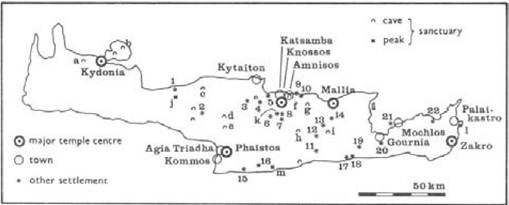
Figure 22 Map of Minoan Crete. Settlements (other than those named on map): 1 - Rethymnon, 2 - Monastiraki, 3 - Sklavokampos, 4 - Tylissos, 5 - Gazi, 6 - Temenos, 7 - Vathypetro, 8 - Arkhanes, 9 - Agii Theodhori, 10 - Niru Khani, 11 - Vianno, 12 - Erganos, 13 - Plati, 14 - Karfi, 15 - Leben, 16 - Koumasa, 17 - Myrtos Pyrgos, 18 - Fournou Korifi, 19 - Kalamavka, 20 - Vasiliki, 21 - Pseira, 22 - Sitia. Cave sanctuaries: a - Kera Spiliotissa, b - Leras, c - Pankalochori, d - Idaian Cave, e - Kamares, f - Eileithyia, g - Skotino, h - Arkalochori, i - Psychro (Diktaian). Peak sanctuaries: j - Vrisinas, k - Juktas, l - Petsophas, m - Kophinas
Another problem is the apparent incompleteness of the map of Minoan Crete (Figure 22). It seems peculiar that Minoan sites are concentrated in central and eastern Crete, while western Crete is, apparently, relatively empty. Were there really no maj or settlements in western Crete other than Kydonia, Aptera, and Rethymnon? On the evidence, it would seem so, but it may be that more intensive archaeological prospecting in western Crete will reveal many more Minoan sites. One that is emerging as a likely temple centre is Monastiraki, in the Amari valley to the west of Mount Ida. On a low hill, houses were clustered round an important building with store-rooms, storage jars, and a collection of seal impressions; it seems logical to interpret this large building as a temple, even if smaller in scale than the temples found in other Minoan towns. In the centre of the island, at Knossos and Phaistos, a Middle Minoan I-II temple also dominated a growing township: at the eastern end of Crete, the same thing was happening at Zakro.
At this time the agricultural techniques and crafts seen in the Early Minoan period were developed further. In the Early Minoan, the villages were oriented principally towards subsistence production. Now, in the Middle Minoan, they were geared to the production of surpluses. The style, level of organization and the contents of the urban temples strongly imply control over a rural hinterland, although the precise nature of that control is a matter for speculation. It may be that the temples, through their bureaucracy, were able to set quotas on production in the rural villages; these may have been specified taxes, or tribute, or they may have been expressed as required offerings. Alternatively, the power of religious belief may have been such that each community gave as much as it could afford. But, however it was organized and expressed, the extensive store-rooms of the temples needed a very large inflow of produce from the rural areas to fill them. At Knossos, the West Magazines of the New Temple (built around 1700 bc) are thought to match closely the area of the storerooms in the Old Temple (built in 1930 bc). At Phaistos, some of the pithoi and storerooms from the First Temple Period survive, projecting 5 metres further to the west than the storage area of the later temple, and extending under its West Court.
The large temples, Knossos, Phaistos, Zakro and Mallia, must have depended on an income of agricultural produce from fairly extensive rural hinterlands, from many villages, many estates. On the other hand, small temples like the one at Gournia and those towns, like Palaikastro, which apparently managed without temples, may have organized the agricultural production of their own estates near by on a scale that wascommensurate with their size and rate of population growth.
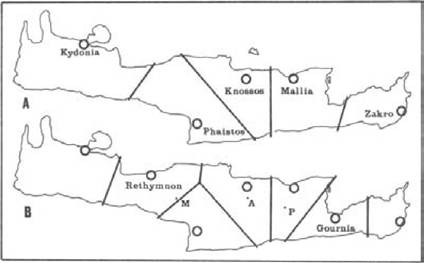
Figure 23 Major territories centred on urban temples. A: the possible territorial boundaries of the five great temples, applying Thiessen polygons. B: territorial boundaries if Rethymnon and Gournia are added to create territories that are more equal in area. Note that Monastiraki (M), Arkhanes (A) and Plati (P) are also believed to have had temples. If they also commanded territories, the sizes of the territories would become less satisfactory again, with Knossos commanding a rather small territory
A very significant change in the towns of the First or Old Temple Period was the development of the temples as major craft centres. The concentration of craftsmen and skills in the temples had profound effects. Isolating the craftsmen in this way implies that they were, by this time if not before, full-time specialists under temple patronage. Concentrating and juxtaposing the different crafts also had the effect of cross-fertilizing ideas, both artistic and technical, and paving the way for striking and ambitious new developments. Fine pottery was manufactured in the temple workshops, and it was destined to travel far, both in Crete and overseas. But this movement into the temples must not be overstated. There continued to be local craft centres scattered round the island. There must, for example, have been an industry in the Mesara Plain to supply the large numbers of votive figurines that are found in the tombs of that region.
The temple building at Mallia was, as at Knossos, preceded by the development of an important Early Minoan village into a small township. The first temple at Mallia, raised in about 1900 bc, was equipped with storage rooms, but it is clear that other buildings, apparently houses, in the town of Mallia were also equipped with storerooms. In other words, agricultural produce coming into Mallia was not all destined for the temple: some at least was going into private houses, presumably town houses belonging to the owners of estates in the countryside around Mallia.
Henri van Effenterre (1983) has tried valiantly to reconstruct Mallia’s economic pattern, but with no conclusive results. He draws attention to Aristotle’s description, in Politics, of food gathering and distribution in Crete. Although this seems to refer to a significantly later period, it can be made to relate to Mallia’s early economy, in which some surplus food was stored in the larger private houses. Large houses existed in the north-west of the town of Mallia, round the agora and in the Mu quarter; they had their own store-rooms and their own clay tablet accounts. In other words, at this stage the organization was not completely centralized. There was a mixed economy, with a proportion of the agricultural production routed through the temples and a proportion through the private houses. Aristotle noted a distinction between income from the public land and that from the citizens’ private estates.
Henri van Effenterre estimates that, if the population of Mallia was between 5,000 and 10,000, the neighbouring lowland district stretching from Stalis in the west to Milatos in the east would have provided the town with enough olive oil and to spare. This assumes a low consumption level of 15 litres of oil per person per year: in fact the citizens of Mallia may have used significantly more than this. The assumed grain requirement was 3 hectolitres per head per year. The district has a grain production potential of around 6,000 hectolitres per year, which would not have been adequate to supply Mallia’s Minoan population.
The large shortfall may have been met by supplies of grain from outside the immediate district. The most likely tributary area is the Lasithi Plain. It may be that as the town of Mallia grew, it outgrew its local territory and annexed the adjacent Lasithi territory. This is, at any rate, a possible scenario for the New Temple Period. It is nevertheless worth emphasizing that the estimates of population, storage capacity, agricultural yields and food consumption are all based on incomplete evidence; so, interesting though this line of thought may be, no conclusions can be reached yet. We have, for example, no quantified evidence of seafood-gathering or livestockrearing at Mallia.