
Often at night along the mountain tops,
When gods are revelling by torchlight,
You come carrying a great jar
(Like the ones shepherds use, but of heavy gold).
You fill the jar with milk
Drawn from a lioness and make a great cheese,
Unbroken and gleaming white.
(Alcman, Spartan lyricist, c. 630 BC)
The Minoan towns depended to a very great extent upon the large tracts of countryside around them for food, labour and other resources: they relied on them for material and political support. Today we tend to focus on the towns and in particular on the glamorous and mysterious life of the ‘palaces’, but it is important to understand the rural background which sustained them.
A hundred years ago, the rural villages of Crete were mostly small settlements of 150 to 200 people. Paul Faure (1973) speculates that this was the likely size of the Minoan villages too. Then, as now, thousands of small villages nestled among the olive groves and vineyards. There were smaller settlements too: hamlets of perhaps three or four houses and isolated farms, many of which have inevitably disappeared leaving little or no trace. Henri van Effenterre (1983) points out that no centre of Minoan economy has been discovered between Mallia and Gournia: it looks as if this whole area was a pattern of small-scale settlements - villages, hamlets, and farmsteads.
The original Minoan settlement pattern can never be fully recovered, even though new settlement sites continually come to light, but an impression can be gained of the original pattern from some pilot studies. J. L. Bintliff’s (1977) study of transhumance patterns in central Crete implies a ring of villages on the hillsides halfway up the slopes of Mount Ida, at altitudes varying between 400 and 900 metres above sea-level and grouped round the high summer pastures of the Nida Plain. Peter Warren’s (1982) study of the coastline round the Gulf of Mirabello revealed a scatter of small settlements from Kalo Horio eastwards to Pseira and Mochlos. Some were close together, implying small territories. Kalo Horio, Kopranes and Priniatikos Pyrgos were about 2 kilometres apart, which suggests that each had a territory or estate with a 1 -kilometre radius. The spacing of Gournia, Pakhyammos and Vasiliki further along the coast suggests estates of a similar size there too. We may infer from this that a typical rural estate had an area of 3-4 square kilometres. Whether this size prevailed elsewhere is uncertain; possibly on higher sites with less fertile soils and steeper slopes the villages commanded larger estates.
At over 600 metres on a southward-pointing spur to the east of the Mount Juktas ridge, are the remains of Vathypetro. This substantial and apparently isolated building, with its spectacular view towards the south and west, has been described as a country house or manor house, or even a mini-palace. Although it had some function as a religious cult centre, we should probably think of it as being, in its final phase at least, a farmhouse and industrial centre. Thought to have been built around 1580 bc, and probably never completed, Vathypetro was severely damaged in about 1550, possibly by an earthquake. It has been suggested that the original plan was an approximation to the Knossos Labyrinth, but on a much-reduced scale (Figure 12).
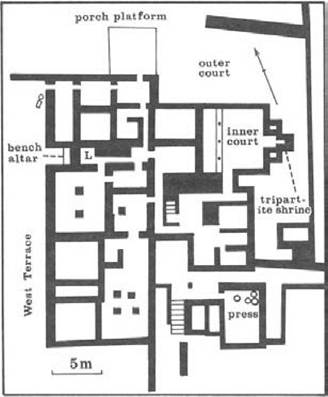 Figure 12 Vathypetro. An ambiguous Minoan building which changed its function during its period of use in the sixteenth century bc. L = a small chamber at the end of a corridor, with a drain passing under its floor: interpreted here as a lavatory
The lower walls of stone blocks supported an upper storey of brick. There was a small West Court and a ‘Central’ Court to the east of the completed West Wing. Those who like to see the building as an uncompleted minipalace imagine that an East Wing would have been built across on the far side of the ‘Central’ Court. On the other hand, this space was apparently occupied by a major structure, identified recently as a tripartite shrine. To the east of the Three-Columned Portico, across a small courtyard only 4 metres wide, stood an elaborate symmetrical structure with a central recess and square plinths on each side. This arrangement makes the design distinctly different from that of any of the palaces.
The South Sector of the building was rebuilt as a farmhouse and industrial centre after the 1550 destruction. This does not, however, tell us that the building had the same function before. It may be that the original structure was designed as a temple; there are, after all, two other known Minoan temples in the area, commanding similar views: the peak sanctuary on one of the summits and the Anemospilia temple on the northern slope of Mount Juktas. The Three-Columned Portico fronting the small courtyard and the Tripartite Shrine suggest a ritual function for Vathypetro. The benched recess in the west front may have been a shrine. Perhaps the whole building started off as a temple. In its later phase, from 1550 until its final destruction in 1470 bc, Vathypetro seems to have been primarily an agricultural and industrial centre.
One of the main rooms in the Southern Sector was equipped with a wine or oil press. Many clay loom weights found in the same room suggest that weaving went on there, or in the room above. In the West Wing there were sixteen storage jars. In the West Court were found the remains of a large oil press and basin (Plate 1). In other rooms pieces of clay potters’ wheels were found, indicating that pottery was made at Vathypetro as well.
The picture emerging from Vathypetro, though complex and far from definitively resolved, is of a Minoan country house with its own domestic shrines, acting as a collecting place for farm produce and as an industrial centre, manufacturing pottery and cloth, making wine or olive oil or possibly both. Sinclair Hood (1983) suggests that Vathypetro may have been the summer residence of the king of Arkhanes. That may be the case, but it seems at least equally likely that it functioned as an autonomous country house, the seat of a rural landowner. Possibly it also functioned as a rural religious centre in the initial stages, before it was ruined and remodelled.
Perhaps more typical was the Minoan village between Kouse and Sira, about an hour’s walk south of Phaistos, in hills at 120 metres. A stone farmhouse excavated there had a 6-metre square living room with a beaten earth floor, a wooden pillar supporting the ceiling beams and a low window, perhaps originally glazed with a sheet of translucent parchment. Grain, olives, and wine were stored along the walls. A wooden bench may have served as a seat or a bed. The six smaller rooms ranged along two sides of the farmhouse may have been store-rooms and bedrooms. Paul Faure suggests that one may have been a retiring room for women, but (see Chapter 2), there is no reason to suppose that women retired into the background at any level of society. There was neither kitchen nor stable. Food was evidently cooked in the open air, and donkeys were probably housed in a rough mudbrick shelter built against one of the outside walls.
The Kouse farmhouse yielded a range of tools, but no religious objects and no bronze cauldron. Apparently only rich Minoans owned cauldrons. On the other hand, this house was neither poor nor primitive; it represents the ordinary rural dwelling of the Minoans, fairly comfortable, well-built and durable. It had apparently stood for some 300 years before burning down in about 1500 BC.
Three substantial houses survive from the village of Tylissos, 15 kilometres to the west of Knossos (Figure 13 and Plate 2). The houses date from the end of the Middle Minoan period and Late Minoan I, although there were earlier houses on the same site; some of their remains can be seen in the south-west corner of the site. House A consisted of two wings separated by a partly roofed courtyard. An angled passage led into this paved entrance court; on the west and north sides of the court was an L-shaped peristyle: a window lit the staircase leading upwards on the western side. North of the peristyle are two large store-rooms, each with two pillars supporting an upper floor. Fallen fragments of painted plaster in the store-rooms imply that there were important rooms above them, possibly a refectory. The rooms west of the storerooms may have been kitchens. Some of the storage jars still in situ have holes near their bases: they are also set up on plinths suggesting that they were tapped for liquids, possibly wine but more likely oil.
The passage leading south from the peristyle court connects the North Wing with the South Wing. The main room in the South Wing had two rectangular paved inset panels in its floor and its own adyton, an unusually deep one, with perhaps six steps descending very steeply out of the main room. The hall with its paved floor and double doors opened on to a colonnaded light-well, which also had a window in its west wall. A portico to the north of the light-well leads to a pillar crypt with a pyramidal stand for a double-axe. Reached from the pillar crypt are two small sacristies. It was in this area that the three huge cauldrons were found - a chance find which led to the discovery of Minoan Tylissos and its excavation by Hazzidakis in 1902-13. The store-rooms also yielded an important find of Linear A tablets. Tylissos is actually named - as tu-ri-so - in the later Linear B archive tablets at Knossos.
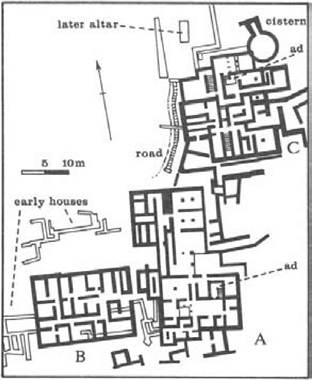 Figure 13 Plan of Tylissos. The earlier houses date from around 2000 bc, and the three later houses (A, B, and C) date from 1700-1500 bc. The cistern dates from 1400 BC or later, and the altar and its precinct from the Greek occupation in the classical period. It is a site with a long and complex history. ad = adyton
The collection of small rooms in the south-west corner, with its short passage connecting it with the principal room and its own private staircase, has suggested parallels with the alleged women’s quarters or ‘queen’s apartments’ in the temples.
All things considered, House A must have been a very comfortable villa: 35 metres by 18 metres, and at least two storeys high, it offered generous accommodation for a family. Paul Faure suggests that the first floors of all three houses were occupied by different families. The layout of House A implies that it could possibly have functioned as two entirely separate houses.
House B stood immediately to the west of House A and House c only a short distance to the north-east. An unusual feature of the site is the big circular cistern which overlaps the walls of House C and was presumably built after the demolition of the house in Late Minoan III. Water flowed from a spring, through a sediment trap and along a stone conduit into the cistern. An adyton opens out of House C’s principal room, but this sunken rectangle is unusually public in having three doors opening into it, when one is the norm elsewhere. House B has no adyton, no room with pier-and-door partition, and no obvious main room; it is probable that this house had a different function from the others.
Seven kilometres west of Tylissos, and set in spectacular hill country, there was another Late Minoan village, Sklavokampos. Not much of it survives and the one substantial house that has been excavated was only discovered by chance during road-building. The Sklavokampos villa was more crudely built than those at Tylissos and its floors were apparently unpaved. The pottery was nevertheless of good quality and the seal impressions found there show that the people who lived there had contacts that spread extensively across Crete. One seal impression showing a bull-leaping scene has been found at Zakro, Gournia and Agia Triadha as well as at Sklavokampos. It may be that the Minoans who lived at Sklavokampos traded with travelling merchants who were part of a widespread trading system.
The living quarters were in the north-east corner of the house. To the west were the porticoed entrance and store-rooms. In the centre was a courtyard, one of the earliest examples of an atrium, with what were probably the servants’ quarters ranged round its western and southern sides. The Sklavokampos house was fairly roughly finished. It had, it seems, no frescoes, no gypsum veneers, although its walls were fitted with timber frames and the building as a whole was well planned. The quality of the Minoans’ rural dwellings varied quite considerably, but most of those excavated so far show a degree of sophistication and planning. It is unlikely that caves were ever regarded as suitable accommodation in the Minoan period.