
One of the signs in the Minoan script was a plough. In the eighth century bc, Hesiod described a primitive type of plough that consisted of little more than a stout forked branch, a type which was still in use in the Roman period. The Minoan plough, as shown in the script-sign, seems to have been a little more complicated, with a handle made of two additional pieces of wood, probably bound together with leather thongs; it was drawn by pairs of oxen or donkeys. Ploughing was an important act, fundamental to food production, and may have been accompanied by rituals.
A remarkable series of clay tablets from Knossos, the Ch series, gives us the names of some of the ox-drivers and their oxen. The oxen were given simple descriptive names: Black, Dusky, Noisy, Fair, Red, Sandy, Dapple or Spotty, White-foot, White-muzzle, and Red-rump.
After the ploughing, the grain was sown. Some millet may have been grown, though no evidence of it has yet been found. Richer cereals were apparently preferred - wheat, soft wheat, spelt and barley. Barley and wheat seem to have been equally plentiful at this time. Although separate signs were available for wheat and barley, the clay tablets often record only ‘grain’, which makes it difficult to tell which cereal was intended. Sometimes it is possible to infer which was meant by the size of the ration. A basic ration was 2 ‘T’ units per month in one grain, 3.75 ‘T’ in the other. It seems reasonable to assume that the two rations were of equal nutritional value, so the smaller one must be wheat, the larger barley.
On the mainland, at Mycenean Pylos, the sizes of estates were not measured in units of land area but according to the quantity of seed-corn they required, a practice that survives into modern times in some Greek islands. The grain harvest at the village of Tylissos was recorded at Knossos as being 261 units of wheat, or 19.5 tonnes, which was probably produced on an estate of about 10 hectares or less. Lyktos, in the last harvest recorded at Knossos, produced 247 units or 18.3 tonnes, and Lato produced 31 units or 2.3 tonnes. The highest figure is for Dawos, which was apparently in the plain of Messara; the tablet was broken off, but the figure was in excess of 10,000 units or 788 tonnes of grain. The figure is quite high, but not surprisingly so, given the extent and fertility of the plain (Chadwick 1976).
The bronze age Cretan farmers equipped themselves with axe-adzes as all-purpose tools. These bronze implements had shaft holes for mounting on wooden handles. The axe blade was used for cutting down trees and bushes and clearing undergrowth, the adze for hoeing and weeding. Single-bladed axes and double-axes were also used for land clearance. The early shaft holes were round, but they were later made oval to prevent the head from twisting round on the handle.
Some of the ripened grain may have been picked by hand, just as it was until recently in upland fields on Crete. But simple sickles made of pieces of wood armed with ‘ teeth’ of obsidian or flint are known from the neolithic period and bronze sickles were made in the Minoan period. The Minoans harvested some of their grain with sickles. How the threshing was done is not known. Today, grain is threshed with a wooden sledge with chips of flint fixed into its base; this is dragged round a circular paved threshing floor by oxen. Similar sleds similarly armed may have been used by the Minoans, but so far no threshing floors have been positively identified. It is possible that the circular platforms excavated by Peter Warren in the Minoan town of Knossos were threshing floors rather than dancing floors, as Warren himself has suggested (1984). Two of the circular platforms he excavated were about 3 metres in diameter, the third was 8 metres.
After threshing, the grain was winnowed, probably by flinging it up into the air so that the chaff blew away in the breeze, leaving the grain to fall to the ground - the method still used in Crete today. The Harvester Vase, a stone libation vessel found at Agia Triadha, may show winnowing forks. A group of exultant farm workers is shown singing and dancing in procession with a priest, a musician and a trio of singers; several of the farm workers carry what appear to be winnowing forks on their shoulders.
Groups of large cylindrical pits at the temples have been interpreted as granaries. In the south-west corner of the temple at Mallia are two rows of four circular granaries, each about 4.5 metres in diameter. Each granary was built of rough masonry and lined with plaster. Professor Graham (1987) speculates that the central stump, which survives in several, was originally a pillar extending upwards to support the highest point of a corbelled dome. The excavators thought the structures were cisterns, but Graham thinks they were granaries. It is possible that the three cylindrical stone-lined pits or kouloures in the West court at Knossos and the two similar pits in the West court at Phaistos were also granaries.
Besides cereals, the Minoans were growing vetch, chick peas, pigeon peas, cultivated peas, sesame, hemp, flax and castor oil plants in their fields. Large areas were given over to vineyards. The vine may have been native to Crete. Grape pips were found at the early settlement at Fournou Korifi, and in Middle Minoan storage jars at Monastiraki and Phaistos. These pips may represent the remains of raisins rather than signs of wine production; some grapes were almost certainly dried in the autumn sun in order to store them for winter food. On the other hand, wine had been produced from grapes for a long time in the eastern Mediterranean region: there was wine production in Egypt not long after 3000 bc, so there is no reason why Cretans should have been without wine even at the beginning of the bronze age. The Egyptians had both light and dark grapes to produce white and red wines; the cretans too probably produced both, just as they do today. In historic times, it has been the Cretan red wine that was particularly well known; the province of Malemvizi to the west of Knossos is said to have given its name to Malmsey, the popular red wine that was exported to England in the middle ages.
The Knossos archive tablets contain references to vines. One, Gv 863, refers to 420 vines and 104 fig trees. Wine was not, it seems from the archives, on any ordinary ration lists: it may have been regarded as something of a luxury and generally used abstemiously. Tablet Gm 840 shows the product of the last vintage to be gathered into Knossos under the aegis of the temple priestesses, and it is a very large quantity. The total of the entries amounts to over 14,000 litres. On the other hand, the redistributed output from the Knossos temple is very small. The only inferences that can be made from this are that the archive is incomplete or that most of the wine received was consumed in the temple. The latter seems very likely, given the sort of religious ceremonies that were conducted there: libations and sacred communions would account for the consumption of large quantities of wine.
Another major crop was the olive. It was of fundamental importance in Crete as in other Mediterranean lands. The main problem with the olive tree is that it bears a heavy crop only in alternate years and that the trees of a whole district tend to be in phase. On the other hand, the fruit can easily be stored in jars and the pressed oil keeps well too. Olive oil was used for cooking, washing, lighting and possibly as a body oil. Paul Faure (1973) writes of two forms, the wild olive and the cultivated olive. Chadwick (1976) disputes this on the grounds that the wild olives are of too low a quality to have been a significant element in the Minoan economy; he suggests instead that the two sorts of olive referred to in the tablets were olives picked at two distinct states of ripeness.
The olive harvest was the last and longest of the year, starting in November and going on until the beginning of March. The olives were probably beaten from the trees with sticks, just as they are today, then soaked in water, crushed in wooden mortars or presses, and the resulting pulp put into a settling tank. Various sorts of presses that could have been used in wine-making or oil-pressing have been found in rural dwellings, together with mortars and pestles. After some time in the settling tank, the oil rose to the surface and the water was drained off through a spout at the base of the vessel. Large clay jars with spouts at the base are known from each Minoan period. An installation at Vathypetro, which includes a spouted jar of this type, has been interpreted as a wine press, but it could equally have been for separating olive oil.
Olive stones were found at Fournou Korifi and in a well at Knossos dating back to the Early Minoan I period: a cup of olive stones was found at the temple of Zakro. The Knossos tablets document olive production levels; the Dawos area, in the Messara plain, is recorded as producing about 9,000 litres of olives.
Fig trees were also grown. Like the olive tree, the fig appears to have been regarded as sacred by the Minoans. One of the Knossos tablets refers to an estate with 1,770 fig trees. Chadwick rightly surmises that the picked fruit was dried in the sun and stored for the winter: figs, like olives, were probably eaten all the year round. Other fruits were consumed as well. Quinces and pears may have been indigenous to Crete. Kydonia, the name of the principal Minoan city in the west of Crete, actually means ‘quince’ in Greek, and was sometimes, for example in Aristophanes, applied metaphorically to the plump, round breasts of a girl; it is possible that the word carried the same meanings in the Minoan language, since many words were borrowed from older languages (Newey 1989). The well-watered plain behind the site of Kydonia, now replaced and obscured by modern Khania, is still a major fruit-growing area, though now it is given over mainly to the orange, brought in during the middle ages. Almond trees were probably exploited, then as now, for their nuts.
Palms were probably not native to Crete, but they were introduced very early, and were certainly in Crete in the Minoan period. Evans identified one of the earliest script signs as a palm branch and there are lots of images of palms on sealstones and vases from Middle Minoan II (about 1900 bc) onwards. Hood feels that the date palm was sacred: later on it became associated with Apollo, who himself was probably a pre-Greek god.
Livestock farming was a major element in the Minoan economy. In the New Temple Period, according to Nicolas Platon (1968), there is much evidence of large-scale breeding of cattle, sheep, goats, and pigs. There were domestic goats in Minoan Crete and it is suggested, by Hood (1971), that the wild goats of bezoar stock (the agrimi or Cretan ibex) may really be feral, i.e. descendants of Minoan domestic goats that escaped or were deliberately turned loose back in the bronze age. The creatures so carefully depicted by Minoan artists, creatures with long horns knobbed at intervals, look very similar to the modern wild goats, yet they are often shown in domesticated situations, such as drawing goat-carts or sitting on the roof of a temple. At the same time, similar-looking goats were portrayed leaping through mountainous landscapes or being chased by hunters; in other words, in the Minoan period there was little difference between the wild and the domesticated goat.
No doubt flocks of goats and sheep were driven back and forth by herdsmen, wintering on the low ground and spending the summers on the high pastures. Paul Faure (1973) believes that the shepherds’ dwellings in the high pasture became surrounded by mystique, and that they served as places of initiation. Faure draws on the substantial and very peculiar folklore which surrounded shepherds in the later, classical period. The shepherds’ folklore includes strange three-eyed giants, the Triametes, who were both cunning and cruel: the third eye, on the nape of the neck, looked backwards. The man-eating Triametes were a Cretan variation on the cyclops Polyphemus. Odysseus’ experience with the cyclops represents a bronze age initiation in which the young shepherd became a mortal master of animals. Some of the caves high in the mountains have a sinister reputation; they are places where you can throw the beasts of your enemy if you wish to take revenge on him for some wrong. Faure speculates that many of the deeply entrenched rural customs of Crete may be Minoan in origin, but it would be rash to assume this.
There are cave drawings in the Vernofeto Cave at Kato Pervolakia (Sitia district) which indicate that the cave was used for rituals of pastoral magic. Goats are shown, one being netted. A crouching female, possibly a priestess or goddess, holds a bow and arrow with her arms upraised: a dog is near her. Below is a fishing scene, with three men in three boats casting nets for several different sorts of seafood, including octopus, dolphin and starfish. It is one of the clearest examples of sympathetic magic in ancient Crete and is thought to date from around 1400 bc.
But to return to the sheep. A clay dish found in the Minoan town of Palaikastro contains a model of a flock of sheep with their shepherd. The Knossos tablets add documentary evidence by listing very large numbers of sheep. The total mentioned for the Labyrinth’s final year, around 1380 bc, runs to about 100,000 sheep. The numbers of lambs are carefully noted, presumably so as to keep a check on the ever-changing strength of the flocks. The tablets record target figures for flocks and for wool production. The target is one unit of wool, about 3 kilograms, for every four sheep, or about 750 grams per sheep, which agrees with the quantity of wool expected from sheep in the medieval period. Breeding flocks yielded less because lambs produce no wool in their first spring. The tablets give the names of ‘sheep officials’ or owners, who are presumably not the shepherds. A second name on some of the tablets seems to indicate a dedication to either a deity or a named citizen.
J. L. Bintliff (1977) has reconstructed the likely seasonal movements of flocks in central crete. There were Minoan farming villages at Sphakia, Anogeia, Kroussonas, Gergeri, Zaros, Vorizou and Kamares. From these, flocks were taken up in the spring to graze on the Nida Plain, with the peak shrine and sacred caves of Mount Ida probably developing as a ritual focus later. After spending the summer on the Nida Plain the flocks moved down to spend the winter on the low hills in the Phaistos area. There is a clear association between the migration to the high summer pastures and the development of the peak sanctuaries and high caves as cult centres.
Pigs were apparently domesticated in crete as early as the neolithic period. In Minoan times they were widely distributed but in fairly low numbers. At Knossos, single pigs were being offered in tribute, probably as special offerings for sacrifice.
cattle were reared from neolithic times too. Their bones, along with those of sheep and goats, were recovered from the earliest neolithic level at Knossos. The Cretan cattle, introduced into the island by the same generation of neolithic occupants who built the first village at Knossos, were brought in from elsewhere, a breed apparently descended from the giant long-horned Bos primigenius. The cattle may have been kept principally for their milk rather than for their meat. They also served as draught animals, and their skins were used to make the large figure-of-eight shields carried by warriors and hunters.
Cattle featured in the bull games, a major religious rite. It seems that the bulls were sometimes sacrificed after the games, but there is no direct or necessary connection between the two rites. Bull-leaping and -grappling evidently started very early in Crete, whereas most of the evidence of cattle sacrifice comes from the fourteenth century bc, and then often in connection with funerary rites. The bulls used for the bull games are shown on the frescoes as having dappled hides, implying that they were domesticated, not wild, but their behaviour may well have been fairly unmanageable if they were allowed unmanageable if they were allowed to live in a semi-wild state. The scene of bull capture on one of the Vaphio cups shows how dangerous netting one of these half-wild beasts could be.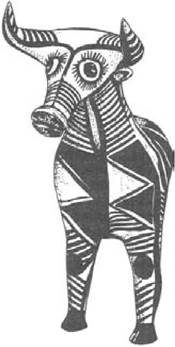
Figure 14 A terracotta bull, showing the Minoans’ love of pattern and - I think - sense of humour
Dogs are known to have existed in Minoan Crete. The handles on some Early Minoan stone pot lids are shaped like relaxing dogs. It seems that the dogs were used mainly in hunting. At Pylos, the term ‘hunters’ literally means ‘dog-leaders’, proving that dogs were used in this way. On a sealstone apparently dating to Middle Minoan III, a collared dog is shown barking at a goat cornered on the rock above. A chalcedony seal with gold end-mounts found in a Late Minoan tomb at Knossos shows a dog of mythic size wearing an embossed collar. Evans suggested that this was a sacred dog, reminiscent of those described at the classical temple of Diktynna, a goddess with a pre-Greek name and pre-Greek origins; it seems that a Minoan goddess, called Diktynna, had sacred dogs in her service on the rugged headland of Spatha, to the west of the Minoan city of Kydonia.
John Chadwick (1976) regrets that he sees no evidence of cats, but Sinclair Hood (1971) suggests that some of the Minoan sealstones do show cats. One very finely carved Middle Minoan seal has a cat-like symbol engraved on it; Evans proposed that the cat may have been the personal badge of a Cretan prince, which seems to be going too far. Another seal shows a cat attacking a group of water-birds. Domestic cats had been trained to hunt wildfowl in the marshes, and it may be that they were introduced to Crete from Egypt for the same purpose. An inlaid dagger from Mycenae, but probably made by a Cretan, shows golden cats again stalking water-birds, with fish and clumps of papyrus.
It is not certain whether the Minoans had chickens. The people of the Indus valley civilization were domesticating fowl by the year 2000 bc, but there is no mention of them in Egypt until the early fifteenth century bc, when they are mentioned elliptically as ‘the birds that give birth every day’. The chicken may have been introduced to Crete at about this time: a clay vase from Agia Triadha looks rather like a caricature of a chicken.
Cats and dogs were used to help in hunting, and the wild mountain sides of Minoan Crete were rich in game of all kinds. In addition to the water-birds and wild goats already mentioned, there were deer and wild boar. The boar were dangerous wild animals and were doubtless hunted as a pest mainly, but their meat was probably welcome too. Their tusks are found among kitchen refuse, both at Knossos and elsewhere on Crete.
It is possible that lions prowled there too. They were still in existence in Macedonia in the fifth century bc, so they may well have existed on Minoan Crete. Lions were often shown on Early Minoan and later sealstones. On Late Minoan seals they are often shown attacking other animals such as wild deer or cattle. Lions would have been regarded as a destructive menace, devourers of cattle, game and men, and pursuing and killing them a test of a warrior’s skill and courage. The best-known Mycenean dagger shows a pride of lions being hunted by men with shields, spears and bows; even though it was found in one of the shaft graves at Mycenae, it was probably made by a Cretan craftsman, and may conceivably show a scene on Crete. Lions are shown as sacred animals, attendant upon Minoan deities. One seal shows a lion walking along beside an armed goddess, and evidently accompanying rather than stalking her; another, apparently its pair, shows a lioness walking beside a god armed with a spear and a square shield.
Monkeys may have found their way, like cats, from Egypt. They appear in several wall paintings dating to the sixteenth century BC at Knossos and Akrotiri; the fossilized head of a monkey was identified - although it may have been a stone - among the debris of the fifteenth-century eruptions on Thera. Nevertheless, monkeys do appear in Minoan art and, significantly, they are painted blue, according to the contemporary Egyptian convention. They were also included in Middle Minoan jewellery and appear on Early Minoan seals: some of the early sealstones even have monkeys carved in the round as handles. The monkey may have been a sacred animal (see Chapter 6), but it may also have been caught for its meat, as it still is in the equatorial forests.
Wild birds were probably also part of the Minoans’ diet. As we have seen, cats may have been used to stalk and catch them, as shown on Late Minoan seals.
Partridges and hoopoes may have been caught for food as well; these two birds appear in a frieze painted round the walls of one of the chambers of the Pilgrim Hostel at Knossos. Hoopoes are still summer visitors to Crete and Evans believed that they were regarded as a special delicacy in the eastern Mediterranean region in the Minoan period. Set against this, though, is the Jewish prohibition against eating the hoopoe, under the name ‘lapwing’, on the grounds that it is unclean. A law of this kind suggests an ancient prejudice against eating the hoopoe in the Levant at least. Perhaps we should not be so quick to read the frieze at the Pilgrim Hostel as a menu.
Even so, the natural environment of ancient Crete brimmed with food. Bees were important in the Minoan economy, as the honey they produced was the main source of sugar. Egyptian bees were kept in horizontal clay cylinders with a flight hole at one end and a larger smoke hole at the other. When the honey was to be extracted, smoke was blown in to clear the tube of bees. As yet, no clay beehives have been found, or at any rate recognized, from Minoan Crete. Hood suggests that the honey of wild bees may have been gathered from rocky clefts or hollow trees, but it may be that hives were built partly or wholly of wood and that they have simply not survived in the archaeological record. Some containers seem to have been made in the shape of modern hives; it is possible that one of the symbols of the Phaistos Disc (Evans’ symbol number 7) shows the shape of a Minoan beehive.
The bee was used as a decorative motif. The famous gold pendant found at Mallia seems to show a pair of bees kissing. It has been proposed that it may be a pair of wasps fighting instead, on the grounds that the insects look more like wasps or hornets; on the other hand the Egyptians, with whom the Minoans shared many conventions, tended to portray bees in this way, so it is a difficult image to interpret (Figure 28).
Archive tablets at Knossos record offerings of honey to the goddess Eleuthia, so it seems likely that some of the large storage jars at Knossos were used to store honey. One of the many legends surrounding the Knossos Labyrinth is the story of Glaukos, a son of King Minos who, while exploring the labyrinth’s cellars, fell into a huge jar of honey and drowned.
This story may be taken as a half-memory of a time when jars of honey were used to embalm the dead in Crete. Herodotus mentions that in Babylon the dead were buried in honey, and the body of Alexander was embalmed in this way before being taken on its long journey to Alexandria for burial. Even so, there is no evidence at all, pace Wunderlich (1975), that the Minoans embalmed their dead with honey or anything else. More to the point is a mention in the bronze age archive at Pylos that the wine was ‘honeyed’. Honey does make a very pleasant additive to alcoholic drinks, especially mulled wine, and we may assume that at least some of the distinctively flavoured Cretan honey stored at Knossos would have been stirred into wine for consumption in the sanctuaries.
The Cretan hillsides still burgeon with herbs, shrubs and trees which can make their contribution as food sources, and this must also have been true in the Minoan period. Coriander has always been a common cooking spice. The very similar Mycenean Greek word for it was ‘koriadnon’, which may be the word the Minoans themselves used. Large quantities of coriander passed through Knossos. A total of more than 7,500 litres was issued, although the receipts recorded were far less. Chadwick (1976) says it is a mystery how the books were balanced, but there is no reason to suppose that the surviving archive, as picked from the badly eroded ruins at Knossos, is complete. Whether the coriander was gathered from the wild or grown domestically is unclear, but it was produced on a large scale. One reference at Pylos records 576 litres of coriander in a list given by a senior official to a perfume-maker. This tells us that coriander was used as an ingredient in perfume manufacture. It also tells us that in the Minoan-Mycenean world the scent of coriander was regarded as attractive - an indication of a change of tastes.
Other likely herbs and spices include cumin, fennel, sesame, celery, mint, garden cress and safflower. The cyperus mentioned at Knossos may have been Cyperus rotundus, a species which yields a fragrant oil which could have been used as a hair-or body-oil. Finally, there is the pistacia tree mentioned in the Knossos tablets. The word ‘ki-ta-no’ in the tablets has been reconstructed as ‘kritanos’, an alternative name for the turpentine tree, Pistacia terebinthos. Enormous quantities of pistachio nuts passed through the store-rooms of the Knossos Labyrinth; they seem to have been as popular with the Minoans as they are among modern-day Greeks.
There are those who would have us believe that the Minoans plundered this horn of plenty, that they over-exploited the island’s economic capacity. Soil depletion and soil erosion have been common problems throughout the Mediterranean region, but it is difficult, given the lack of evidence, to be sure how far these processes were important in Crete in the Minoan period. John Seymour and Herbert Girardet (1986) argue that a change-over in burial customs, between 1700 and 1400 bc, from the use of wooden coffins to the use of clay larnakes shows that timber supplies had declined; this in turn is made to prove, by implication, that there was significant deforestation on Crete. One problem with this rather facile reasoning, which seems not to have been based on any Cretan palaeo-environmental evidence, is that we have no reason to believe that burial in wooden coffins was ever common in Crete - even before 1700 BC.
On the other hand, we have the evidence of the temples. It must be admitted that the building and maintenance of the temples, between 2000 and 1380 bc, involved the use of enormous quantities of large timbers, particularly for rafters, ceiling beams and the hundreds of tapered columns which the Minoan architects deployed. Since the only large temple to remain in use in 1400 BC was the Knossos Labyrinth, and that was abandoned after a serious fire in 1380 bc, we might infer that the Minoans had simply run out of timber. Certainly the depletion of Cretan cedar forests would have made it very difficult for the Knossians to replace all the burnt columns, and this may have been a contributory factor in their abrupt abandonment of the temple concept; the traditional style of Minoan temple-architecture, with its mock forests of columns and pillars, was simply no longer possible.
Seymour and Girardet maintain that the Minoan civilization in effect weakened and destroyed itself by poor land management. Deforestation wiped out the supply of timber, and also exposed the hillslope soils to rapid erosion, so that agricultural production was reduced as well. A coup de grace, they argue, may have been delivered by the Thera eruption, but the civilization was already destroying itself from within. As we saw in the last chapter, the Thera eruption did not deliver a death blow to the civilization; however surprising it may be, the civilization recovered from it. There may nevertheless be some truth in the Seymour and Girardet view, to the extent that the forests were probably reduced in area and timber-production capacity as time elapsed, and the farmland too probably became less productive. Indeed, these processes may help to explain the gradual waning of the bronze age Cretan culture in the centuries between 1400 and 1000 bc.