
1
Although the nature of evidence on Alexander III of Macedon makes it difficult, if not impossible, to discover his inner being, there is sufficient agreement among the ancient sources to sketch a biography of his life with a fair degree of certainty about major events and their dates.
The basic sources on Alexander differ in several important respects: they extend from Alexander’s own lifetime into the second century CE; their authors have varied purposes for writing the accounts; most are incomplete, some existing only as scattered fragments in other sources; and the testimony they give often disagrees with other sources. The main cause of this ongoing disagreement is the nature of surviving sources: the earliest attested accounts are lost or, at best, preserved only in scanty fragments while those that have survived are late, often conflict with one another, and carry their own agendas.
But some sources do exist and the patient, hard work of scholars has determined the earlier materials upon which the later authors relied. This “genealogy” in turn provides readers with an understanding of the reliability - or lack of it - of the several accounts. The fullest account, for example, relied on two of Alexander’s companions while another author is accused of writing fiction. Comparison of the accounts has shown points of agreement as well as disagreement among them, thus providing something resembling a common position on certain aspects of Alexander’s career.
The main extant sources range in date from the late fourth century bce to the second century ce. The earliest is the official report by Nearchos of the sea journey from the mouth of the Indos River to the Persian Gulf. A Cretan by birth, Nearchos came to Amphipolis in Macedonia during the reign of Philip II. A sensible view is that he was one of the older advisors of the young Alexander. During Alexander’s kingship, he was given important commands, for example as satrap of Tykia and Pamphylia, but the assignment which he recorded was as admiral of the naval reconnaissance from southern India to the head of the Persian Gulf. The account survives since it provided the basis for Arrian’s later report known as the hidika.
Diodoros Sikulos’ universal history - the Bibliotheke in 40 books - recounted events reaching back to the origins of the world and extending to his own time, 60 bce. Only 15 of the books survive but, fortunately for scholars of Macedonia, books 16 and 17, which treat Philip and Alexander, are among the surviving portions.
The work of Curtius Rufus on Alexander dates to the first or early second century ce. Of the original ten books, the first two are lost and there are gaps in the preserved portions. The surviving portion treats events to Alexander’s distribution of governorships in 324 bce. While some scholars have called for a proper reassessment of the source, a general appraisal of its merits is that of the Oxford Classical Dictionary (second edition, p. 416): “There is little consistency . . . and the exigencies of rhetoric determine the selection of source material. Consequently he switches arbitrarily from source to source and sometimes blends them into a senseless farrago. He has often been accused of deliberate fiction.”
Roughly contemporary with Curtius Rufus was Mestrius Plutarch, from Boiotian Chaironeia in central Greece where, in fact, Philip and his Macedonians defeated the Greek force in 338 bce. His dates are c. 50 to 120 ce. During his lifetime he wrote prolif- ically; a later catalogue lists 227 works by Plutarch. One of the best known is his “Parallel Lives” of 23 pairs of great men, one of each pair Greek, the other Roman. Among them is a Life of Alexander, paired with the Life of Julius Caesar. Plutarch also composed, perhaps early in his writing career, a piece “On the Fortune of Alexander,” which is included with his Moralia. W. W. Tarn, a noted scholar of Alexander in the mid-twentieth century, described the difference in the two works: “Plutarch in youth had written Part I of the De Alexandri Fortuna with all the fervour of a young man bent on righting what he considered to be a great wrong; but by the time that the elderly Plutarch, with his comfortable sinecure at Delphi, wrote Alexander’s Lfe, the fire had burnt low and was half swamped by his much reading” (1948: 296f).
Marcus lunianius lustinus - or Justin - is variously dated to the second, third, or fourth century ce. His contribution to Alexander scholarship is in the form of an epitome of the longer, earlier study of Pompeius Trogus, The Philippic Histories in 44 books. Of this product, Tarn stated, “But Trogus’ - or perhaps one should call it Justin’s - Alexander is so hopelessly bad that, except on one point, it is hardly worth considering sources at all” (1948: 122).
By contrast, the second-century study by Arrian - Lucius Flavius Arrianus - survives in virtually complete form and it is generally regarded as the most reliable of the surviving accounts. Two of Arrian’s sources are credited with the reliability. First, he drew on the record of Aristobulos, who accompanied Alexander on campaign as a technical expert. Consequently many details such as ship and bridge construction reflect his non-military interests. The second source is that of Alexander’s friend and successor, Ptolemaios, who also participated in the campaign. It is reasonable to believe that Ptolemaios composed his account late in his own career (he died in 283 bce) after consolidating control of his Egyptian kingdom. Equally important in judging the merits of Arrian’s Anabasis of Alexander is his intent to ground his historical writing in the tradition of the trio of classical Greek historians, Herodotos,Thukydides, and Xenophon.
Remnants from many once extant sources on Alexander survive. The campaign had an official historian, Kallisthenes, who was a pupil and relative of Aristotle. When Kallisthenes fell out of favor with Alexander, his role as recorder also ended. It is known that Alexander’s chamberlain, Chares of Mytilene, wrote “stories” of Alexander in 10 books, as did others including Onesicritos, a philosopher, who participated in the sea voyage with Nearchos. Philip as well as Alexander attracted considerable attention. A Macedonian historian named Marsyas of Pella is credited with a history of Macedonia in 10 books as well as a treatise “On the Education of Alexander.” Debate persists about the existence of a number of other accounts, ranging from an account of Greek mercenaries serving with the Persian king, to a “will” of Alexander, to fragments of a “day-book” (ephemeris) of the campaign itself. To compound the problem, some 80 versions of the Alexander “romance” in 24 languages exist. In these legends, Alexander is remembered as the ancestor of the Malay royal family, as a dragonslayer, as a man who could converse with trees, as a devotee of the Judeo-Christian God, and in many other guises. There are indeed many Alexanders. Richard Stoneman presents several of these legends. The fragments of lost works have been collected by the German scholar E Jacoby. Reconciliation of this disparate evidence produces something like the following narrative.
Alexander was born in the summer of 356, the child of Philip II, then king of the Macedonians, and Olympias, whom Philip had married, probably in the previous year. The place of birth was Pella, which had become the major center in Macedonia earlier in the fourth century and now served as the political heart of the kingdom. Alexander’s education was guided by various tutors: Leonidas, a relative of Olympias, and a Greek named Lysimachos were important forces in his early years, and when Alexander was in his early teens, the Greek philosopher Aristotle was engaged to foster the intellectual maturity of Alexander along with several boyhood companions and friends. The pupils and their tutor lived apart from Pella in a location known as the Nymphaion, or place of the Nymphs. Clues exist to shed some light on the subjects of Aristotle’s instruction; we will examine the likely subjects in chapter 4. Other essential knowledge came, both directly and indirectly, from Alexander’s parents, a subject for the third chapter. That much of this knowledge was physical training is illustrated nicely in Alexander’s ability to tame a wild stallion that older, seasoned men could not even mount. The horse, named Bucephalas, became his tamer’s special steed, traveling with Alexander to the Indos, where he died. Other training included all the skills needed by the son of the king who was Philip’s potential successor. Evidence that he was a good student is clear in his father’s judgment that, at age 16, Alexander was competent to govern Macedon in Philip’s absence (340) and, two years later, that he was qualified to command the left wing of the Macedonian army at Chaironeia. Under the joint command of Philip and Alexander, the Macedonian force decisively defeated the Greeks (338). The following year was marred by a serious quarrel between father and son on the occasion of Philip’s marriage to his seventh wife, Kleopatra, so serious that Alexander and his mother left Pella for her native kingdom of Epiros. A reconciliation effected in 336 brought them back to Macedonia, the year in which Philip II was assassinated.
The year 336, then, inaugurated the reign of Alexander. Other possible successors among the Argead line also had a claim to rule: another son of Philip II, and Philip’s nephew, who, as an infant in 359, had been incapable of confronting the turmoil created by his own father’s death. By contrast, Alexander in 336 had demonstrated his ability sufficiently to be acclaimed by the army assembly and to secure the support of his father’s officers and friends, both vital to the award of kingship. His reign of some 13 years began with uprisings north of Macedonia as well as in Greece, each region remembering its former independent status. In 335, the army led by Alexander was campaigning in what is modern Albania when he was recalled to deal with a revolt in central Greece, at Thebes. When Thebes was taken and sacked, the rest of Greece resubmitted to the Macedonian hegemony that had been won by Philip. The goal of the League of Corinth, founded by Philip after his victory at Chaironeia, could now be executed: members of the League had agreed to an offensive and defensive alliance under the leadership of the Macedonian king with the specific goal of a campaign against Persia. In fact, Philip had sent an advance force to Asia Minor. After securing Greece and his northern borders, Alexander could turn to the larger campaign that his father had set in motion, namely the operation against the Persians.
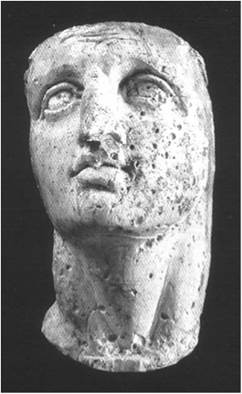
Figure 1.1 Ivory head from the decoration of the chryselephantine bier in the main chamber of Royal Tomb II at Vergina, thought to be Alexander III. Courtesy of Mrs Olympia Andronikou-Kakoulidou
Much of the foundation for the campaign was in place. Thus, after naming Antipatros - one of his father’s senior officers - as regent, Alexander led his force of some 30,000 infantry and 5,000 horse across the Dardanelles in the spring of 334. His first destination was not a battle site to challenge Persian control of Asia Minor but the legendary battle site of Troy. Although a surprising choice in the eyes of modern students of Alexander, it was a natural decision for a descendant of Achilles who was undertaking revenge for the Persian attempt to control Macedonia and Greece. Next, however, the Macedonians did challenge Persian control of Asia Minor in battle at the River Granikos. The Persian force was commanded not by its king but by satrap governors of Anatolia. There is no doubt concerning the outcome: a substantial Macedonian victory opened the door to Anatolia. Sardis, the westernmost Persian capital, surrendered and Alexander pursued the pacification of the region for the remainder of the year and much of the following year. In autumn of 333, he pressed forward, leaving another of Philip’s senior officers, Antigonos, in command of the on-going consolidation of Macedonian control of Anatolia.
The two armies met again at Issos in northern Syria, and in this encounter the Persian force, reputed to be 600,000 strong, was commanded by their king, Dareios III. While such a size is highly dubious, the Macedonians were outnumbered. However, the greater numbers of Persians proved “useless for want of space” (Arrian II.8.11). After the Macedonian victory in the field, Dareios managed to escape but his family, traveling with him, was taken captive. To secure their release, Dareios offered to cede Persian territory west of the Euphrates. Alexander replied in two ways: refusing the offer and beginning the conquest of Syria-Palestine. Many cities surrendered to the Macedonians; some were taken with little difficulty; but a siege of seven months was necessary to take impregnable Tyre, a vital location for control of naval power. When Tyre proved pregnable after all, Alexander and his force continued south to Gaza, the last town in southern Phoenicia, which, like Tyre, was well walled, requiring a counter-mound 250 feet (75 m) high, siege engines, and tunneling under its wall to take it.
Following the capture of the town and the death or enslavement of its inhabitants, the Macedonians continued to the westernmost region of the Persian Empire, Egypt, arriving in late autumn of 332. Change of overlordship required no battle. For some months, Alexander was occupied with administrative matters, laying plans for the establishment of a new capital - Alexandria - and, in another surprising excursion, he trekked some 370 miles (600 km) through the western desert to consult the famous oracle of Ammon. Unlike the outcome of battles, a great deal of debate centers on the reason for this long, difficult trek as well as on the question posed by Alexander and the answer given by the oracle. Did he in fact learn that his true father was not Philip but Ammon-Zeus? We will return to this issue and other similar actions in the final chapter.
Spring of 331 found Alexander back in Syria continuing with matters of the administration of his expanding realm before proceeding toward Mesopotamia. Crossing both the Euphrates and Tigris rivers without opposition, he rested his troops in preparation for the forthcoming battle that the Persians were mounting. That battle, fought in the autumn at Gaugamela in northern Mesopotamia, was a massive effort on the part of the Persians: the Macedonians may have been outnumbered by as much as six times. However, neither numbers nor scythed chariots, deployed to cause chaos among the Macedonian troops, won the day. Although King Dareios again escaped, Macedonian victory secured the Persian treasure at the city near the battle site and opened a route through Mesopotamia, and then to the Persian capitals east of the Tigris. Babylon surrendered and Susa followed suit. After making official appointments and effecting some reorganization of his army, Alexander marched southeast toward the Persian capitals of Persepolis and Pasargadai. The former was protected by a satrap with a force of 40,000 infantry (Arrian III.18.2), strategically stationed to block Macedonian progress. Capture of the city required circumventing the enemy by traveling through difficult terrain. Pasargadai demanded no similar effort. Both yielded great wealth in the form of treasure but also in access to the center of Persian power. Alexander could claim the throne of the Achaemenid royal family. At Persepolis, he dismissed the Greek contingent from further participation in the mission of the League of Corinth, and then burned the city. It is another action that requires knowledge of Alexander’s own thoughts and passions, and since we do not know his inner being, the reason for the destruction is hotly debated.
Alexander then began the pursuit of Dareios, moving northward to Media. While asserting Macedonian control of Media, he learned that Dareios had passed through the Caspian Gates en route to the eastern regions of the Persian Empire. When the Macedonians reached the south Caspian region, they discovered that Dareios had been killed by those traveling with the former Persian king. Alexander pressed eastward in the summer of 330, in pursuit of new claimants to the kingship and, presumably, to conquer the remaining territories of the empire.
The first goal proved more elusive than the second. As the Macedonian force made its way through the eastern satrapies in 330 and 329, many of the satraps offered their submission but others fought on. Only in 328 was Bessos - the first declared successor to Dareios - executed. The second declared successor - Spitamenes - continued to gather troops to struggle against the Macedonians for another half year or so. Alexander and his troops persisted in the pacification and settlement of Sogdiana and Bactria for another year, to summer of 327.
The three years are notable for more than the extension of Macedonian control and the elimination of claimants to the Persian throne other than Alexander himself. He finally made the decision to marry; he chose as his first wife Roxane, the daughter of a Sogdian lord, Oxyartes. Roxane, together with the wife and other daughters of Oxyartes, had been taken in a successful siege, and while the decision to marry her served to gain her father’s support, it is also reported that she was the second loveliest women in all of Asia, surpassed only by the wife of Dareios III, and upon seeing her, Alexander loved her.
A far less happy but equally significant result was that the Macedonians began to express hostility to their king, both individually and, perhaps, in the form of conspiracies. Parmenion, one of Alexander’s senior officers and Philip’s choice to lead the advance force to Asia Minor in 337, was implicated in a reputed conspiracy of his son Philotas, also a significant figure in Alexander’s entourage. Learning of a plot against him, Alexander had Philotas summoned before the army assembly. Philotas defended himself against charges of involvement but was found guilty of not reporting a conspiracy to Alexander although he and Alexander were in daily contact. Philotas and other conspirators were killed by javelins thrown by the Macedonians. Another companion of Alexander was dispatched with orders to the generals left in Media to put Parmenion to death, on the grounds that Philotas’ father had either been involved in the conspiracy or, if not, was a potential lightning rod of anger against the king because he and his family were held in high regard by both Macedonian and mercenary soldiers.
In the following year, Kleitos the Black, who is reported by the surviving sources to have saved Alexander’s life at the battle of the Granikos River, was killed during the course of a symposium at which the drinking was long-lasting. As Alexander was being flattered by his companions, Kleitos reminded the company that the aid of other Macedonians had been vital. A shouting match ended with Alexander seizing a spear or a pike from a guard and slaying the man who had been his guardian during the battle at the Granikos. The same year saw another alleged conspiracy, on this occasion raised by a number of Alexander’s young pages. The official historian of the campaign, Kallisthenes, was implicated; he had fallen out of favor with Alexander both for suggesting that praise of the king should be tempered and for refusing to prostrate himself before Alexander in the Persian fashion that had recently been introduced by Alexander. The allegation of conspiracy resulted in the death of Kallisthenes either by stoning, by hanging, or by sickness resulting from being led about in fetters as the army proceeded.
Having solved, at least in the short term, internal Macedonian issues and achieved nominal control of much of the eastern region of the Persian Empire, Alexander prepared to march even further eastward - into India. In the eastern satrapies of the now largely vanquished Persian Empire, new settlements were established in some profusion. There were several new Alexandrias (at Phrada, Heart, Kandahar, Ghazni, Merv, and Termiz as well as on the Caucasus and on the Jaxartes) and Bactra was refounded as an Alexandria. Additionally, garrisons were established at Kyropolis and in the region between Kyropolis and the northern terminus of the campaign at the Jaxartes River.
With a line of communications in place, in the summer of 327, a force of some 35,000 made its way across the Hindu Kush into the Indos River valley. At the River Hydaspes, the defeat of the force of the Indian king Poros in 326 opened an entrance to the vast subcontinent. Proceeding eastward, the Macedonian force reached the Hyphasis River - the easternmost of the great system of rivers - where yet another Macedonian reaction surfaced: Alexander’s men refused to continue (one calculation, by Count York von Wartenburg, estimates that the Macedonians had traveled 12,000 miles - over 19,000 km - in eight and a half years) and he was forced to agree to return to the west. Back-tracking to the Hydaspes, where a fleet was under construction, the force made its way southward both by land and by sea, reaching the Indos delta in the summer of 325. Alexander laid the foundations of the administration of the newly acquired territory and then organized the return. A portion of the force continued to travel by sea with the goal of exploring the route from the mouth of the Indos to the mouths of the Tigris and Euphrates rivers in the Persian Gulf. One segment of the land force was to proceed by a route to the north of the Gedrosian Desert, while Alexander led the remainder of the army directly through the desert itself. All three groups experienced severe difficulties, yet the surviving members of two armies rejoined west of the great desert, and the fleet met Alexander just inside the Straits of Hormuz. The fleet continued to sail northward while the army marched toward Pasargadai, which was reached early in 324. In the spring, Alexander moved to the Persian capital of Susa and in the following spring to Babylon.
During the last year and a half of his life, Alexander was more preoccupied with the results of his successful campaign than further campaigning, although sources report that he was planning new expeditions such as sailing around the Arabian peninsula. He also founded more settlements. Of immediate concern were his veterans and the men he had entrusted with pacification and governing, not all of whom had proved loyal and/or effective. While at Susa, liaisons between many of his soldiers and Asian women - Arrian states they were more than 10,000 — were solemnized through marriage, with Alexander himself providing wedding gifts. He gave another form of gift in paying the debts of the army, to the sum of 20,000 talents. Alexander and his closest companions also married daughters of significant Persian families: Alexander himself married Dareios’ eldest daughter and the youngest daughter of a Persian noble from another branch of the Persian royal family. Arrian lists the marriages of Hephaistion, Krateros, Perdikkas, Ptolemaios, Eumenes, Nearchos, and Seleukos, and gives a total of 80 similar unions between other Companions and the noblest daughters of the Persians and Medes.
Yet another union occurred at Susa with the arrival of 30,000 Asian youths who had been trained in the Macedonian fashion. The repercussions of this arrival produced further mutiny on the part of his Macedonian army when Alexander announced that he was discharging a sizeable number of his veterans and sending them home to Macedonia. Many of those to be discharged greeted the announcement with sarcastic anger, shouting that he should release all of the Macedonians and carry on the war with the help of his “true” father, the god Ammon. And they were none too pleased with his new Asian companions. Alexander’s first response was to have the most vocal instigators arrested and killed; he harangued the rest, and with the final word “Begone!” marched off. One and all the veterans repented and threw themselves on their king’s mercy, and they were reconciled in a grand banquet, after which some 10,000 veterans were willing to return to the kingdom of Macedon under the leadership of one of Alexander’s senior generals, Krateros.
An additional acute need was to address administration of the empire Alexander had won. Many of those left in positions of authority seem to have believed that he would not survive his eastern campaign. A number of them were called to account, punished, and replaced. Not simply individuals but entire territories outside the sphere of the former Persian Empire required ordering: Greece in particular. In the late 330s, the Spartan king Agis combined the goal of restoring Sparta’s power with a second goal of removing Macedonian control of Greece. To accomplish these ends, he succeeded in raising an infantry of 20,000 together with 10 ships and funds from Persia. In Athens, a professional soldier holding the office of strategos (general) was busy raising a coalition against the Macedonians in 324. Even further distant, delegations from Mediterranean and European peoples are reported to have sought out this surprising young conqueror.
Death intervened to shorten and confuse these efforts. First came the death of the man who had become his closest friend and aide - Hephaistion - in late 324, causing Alexander immense grief. Soon, in late spring of 323, Alexander himself was struck by a fever; he succumbed in June (the thirteenth of the month is generally accepted) shortly before his thirty-third birthday.
Alexander III of Macedon was a remarkable person in his own lifetime; his accomplishments endowed him with the title Alexander the Great in antiquity, a title that is regularly associated with his name. He has been a hero to many would-be emulators, from his own successors, to the second-century ce Roman Emperor Trajan, to Napoleon Bonaparte, who wrote “Alexander conquered three hundred thousand Persians, with twenty thousand Macedonians. I had a particular success in daring enterprises.” Historian E A. Wright’s description of Alexander may hold claim to be the most magnificent: stating that Alexander, Julius Caesar, Charles the Great, and Napoleon were “so superior to the ordinary level of human capacity, they can hardly be judged by common standards,” Wright asserted that in his work and his character Alexander “is entitled to the first place” (1934: 1).
For such a person we yearn for more than a few dates and events. What drove him? What were his true goals? What were his thoughts, his reactions, his fears - if he had any such non-heroic emotions? These are the sorts of questions Alexander inspires and for which no clear answers are possible. By looking at his world, however, we will move closer to an understanding.