
2
A view that a culture’s location determines its character is associated with the name of Hippokrates, the renowned physician of antiquity who lived in the fifth century bce. Among the large number of writings associated with his name is a study entitled Airs, Waters and Places that associates human health with an individual’s diet, environment, and way of life. The author maintains that the differing characteristics of Asian and European peoples are linked to climate: the absence of major changeable climatic conditions in Asia produces a soft people while the more volatile extremes of Europe mold a tough people. Aristotle argued along similar lines in the fourth century (Politics VII, 7, 1327b20f): Asian peoples are intelligent but lack spirit while Europeans are spirited although of less native intelligence. Most fortunate were those situations between the two extremes. For Aristotle and Hippokrates the Greeks occupied the middle position and, hence, were both highly intelligent and spirited. In many respects, however, Macedonians have even greater claim to a fortunate, middle-ground position. In fact, a tale that Hippokrates diagnosed King Perdikkas II of Macedon (454-413) would, if true, indicate that Hippokrates had experienced the environment of Macedonia at first hand. Certainly Aristotle was well acquainted with Macedonia and Macedonians, having been raised as a child at the capital of Pella and, later, having served as tutor to the young Alexander III. Investigation of the physical nature of Macedonia allows us to consider how the natural conditions there would define a way of life for its occupants - Macedonians in general, members of the ruling Argead line, and Alexander III in particular. And in company with Hippokrates and Aristotle, we can then inquire into the people who were shaped by that environment.
The land known as Macedonia has had a variety of configurations over time: its territorial extent is determined largely by the ability of one of the many groups of people in the region to establish control over other groups. From Paleolithic times to the present, the location of the region has drawn diverse people to it whether as migrants through it, immigrants seeking a place to settle, traders, or would-be conquerors. However, the geographical configuration of the region inhibits widespread unity, encouraging rather smaller regional unifications of population. Even in the twenty-first century ce, regionalism persists.
In general terms, Macedonia is the transitional region between the Greek peninsula and the European continent. In comparison with those two neighboring regions, its climate and configuration resemble the northern continent rather than the Mediterranean lands: rainfall is heavier in the winter months, less in the summer; winters are more severe, with snow covering the mountains, while summers, especially in the plains, have higher temperatures, reaching above 40°C (104°F). In the east, Macedonia borders on the Thermaic Gulf of the Aegean Sea, which provides a sizeable coastal plain. However, most of the region generally defined as Macedonia is not coastal. From the plain, two great rivers - the Haliakmon and the Axios and their tributaries - act as routes into the interior: the Haliakmon to the west and dipping south to the border of modern Albania, and the Axios (modern Vardar) reaching north to Skopje and west to the southern boundary of modern Kosovo.
The rivers and the seacoast set recognizable boundaries to the territory in geographical, if not political, terms. What is more, the rivers act as barriers to would-be intruders. For example, the pass of Rendina on the Axios near ancient Amphipolis, where it begins to descend to the sea, is very narrow and, thus, easily defensible. Similar narrow passes carved by the rivers are found elsewhere, also lessening the work of defense. However, there are passes that can be used as points of entry.
A further benefit of the rivers is that they are perennial. In their transit to the sea, they fill lakes that, in turn, provide fish; in some places - as Herodotos reports of Paionia in the north - “the number of them is so great that when a trap door is opened and baskets sink into the rush bed in the lake, after waiting only a short time, one pulls them up full of fish” (V.16.4). Even today the Haliakmon River contains 33 fish species. Beyond providing such an abundance of fish on which horses and other beasts of burden are nourished, rivers are a source of water for consumption and for irrigation even during the summer months; coupled with the snow accumulation on the higher mountains, the abundance of water offers a longer growing season than southern Greece can expect. Herodotos reports that only a single river in the region dried up when the Persian troops tried to satisfy their thirst (VIE 127). To appreciate the volume needed, it is important to remember that Herodotos numbered the Persian force at more than five million, though we think the actual numbers were about 250,000, not all of whom were combatants. Moreover, towns and cities located on a tributary have access to the sea along with the advantage of inland security. For instance, Pella, the Macedonian capital during Alexander’s reign, was located on a branch of the Loudias River, which was navigable along the approximately twenty miles to the sea.
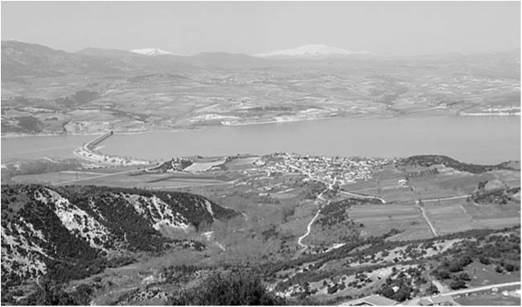
Figure 2.1 Upper reaches of the Haliakmon River. Photograph by Richard R. Johnson
Mountains are a second defining feature of Macedonia. The majority of the territory that formed the kingdom created by Philip II is over 1,800 feet (600m); this includes the low-lying region east of the Echedoros (modern Gallikos) River. The extent of the westernmost territory eventually incorporated into the kingdom of Macedon was defined by the long range of the Pindos mountains running through the Balkans down to the Gulf of Corinth. Many of the individual mountain peaks in Macedonia are impressively high, some rivaling, although not surpassing, Mt. Olympos at 9,461 feet (2,917m): a peak in the Barnous mountains reaches to 8,203 feet (2,524 m), while one in the Babuna range is 8,255 feet (2,540m). Even though natural clefts in the mountains serve as gateways to the lower-lying plains, they also provide a sturdy natural defense for, as previously noted, some of the clefts are so narrow that they are easily held. And, in parts of the region, the ranges serve as a screen; as Nicholas Hammond described it, the mountains of lower Macedonia west of the Axios provide a “continuous shield” (1972: 162).
Forests were a gift of the mountains: in antiquity, Macedonia had many great forests of both evergreen and deciduous trees, and it is estimated that even today approximately a fifth of the region is forested. Alpine ecosystems prevail near the mountain peaks; lower down the slopes, pine trees grew; oak, fir, and cedar dominated even further down. Timber provided by the forests was not only valuable for domestic use but was also sought by the timber-poor states of Greece. The rivers were used to float harvested timber to the plains, and eventually the coast facilitated transportation to the core of the kingdom, where much of the trade with others was also conducted.
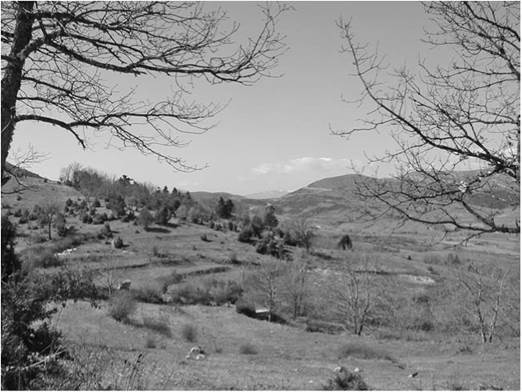
Figure 2.2 Upper Macedonia. Photograph by Richard R. Johnson
Trees also afford food and shelter for animals; Macedonian trees were no exception in antiquity, when a wide range of wild animals made their home in the forests. Presently, some 32 species of mammals and 108 of birds populate the National Park on Mt. Olympos. A large variety is attested for antiquity as well. Some - like the red deer and roe deer - were not especially dangerous to humans, but others were rightly feared: wild boars, brown bears, wolves, lynxes, panthers, leopards, and lions all inhabited the mountain woodlands. Herodotos recounts the strange experience of the Persians en route to Macedonia in 480 bce, when lions “leaving their haunts and coming down regularly at night, . . . attacked no other animal nor man, but killed only the camels” (VII. 123.3).
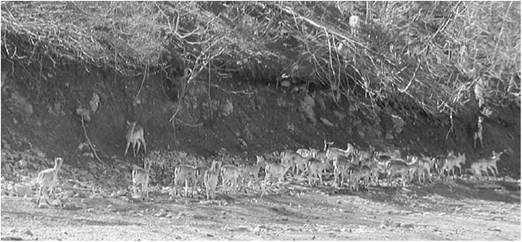
Figure 2.3 Deer still haunting upper Macedonia. Photograph by Richard R. Johnson
Domesticated animals also benefited from the mountain ranges, which provided excellent summer pastures for the flocks of sheep and goats. Much of the population of upper Macedonia - that is, northern and western regions - was pastoral from prehistoric times into the fourth century. In haranguing his angry veterans after the return to Mesopotamia, Alexander described their ingratitude for the huge changes his father had brought to the lives of many Macedonians. He inherited them as migrants without resources, most of them clothed in leather skins herding a few sheep on the mountains. Bringing them down from the mountains into the plains, Philip exchanged their skins for cloaks and made them worthy opponents of their barbaric neighbors (Arrian VII.9.2). Although Alexander may have exaggerated the earlier condition, archaeological evidence supports the basic truth of the depiction of life for many of the mountain dwellers, not only in antiquity but also in more recent times. Remembering that by far the majority of Macedonia, especially the upper or western regions, is over 1,800 feet (600 m) in altitude enhances our appreciation of the mountains’ role in life in Macedonia.
Mineral resources, too, were abundant. In modern times the region is a source of gold, silver, lead, tin, copper, iron ores, lignite, magnesite, zinc, asbestos, chrome, pyrites, and molybdenum, used for alloying steel. It is uncertain that all were mined in antiquity; however, both gold and silver were actively produced during the reigns of Philip and Alexander, as well as by their successors, and the quantity and quality of excavated objects of less valuable metals indicates that the inhabitants of Macedonia knew of the resources and developed skills at working them. Metals may well have been a factor in the contact between the Mycenaeans in Bronze Age Greece and Macedonian peoples. Moreover, recent finds from Pydna show that the Greek colonists discovered these mineral resources during the late Dark and Archaic Ages. Another element of the mountains’ composition held great value for construction, in the fine marble as well as limestone that they provided for fabrication of fortifications, roads, and buildings.
Interspersed among the mountain ranges are many extensive plains blessed by the rivers and rainfall with fertile soil. Moving westward from the Aegean, a traveler encounters layers of valleys that, while varying in types of vegetation, nonetheless support farming and stock breeding more easily than do the mountain plains of southern Greece. As early as the period of incipient agriculture, Macedonia was found to be especially receptive to the efforts of would-be farmers. In fact, sites in Macedonia and on the island of Crete are the initial regions of settled villages in the western Aegean. Cultivation of two kinds of wheat as well as barley, lentils, peas, and millet is attested from the Neolithic Age. Certainly from the time of Philip and Alexander, if not earlier, grapes were also an important item of Macedonian agriculture. Some, but not many, olive trees survived in the more coastal regions of the territory. In recent times, certain basins could boast of three crops a year. The livelihood of Macedonian peasants in the plains as well as those living in the higher reaches included the care of animals - goats, sheep, pigs, cattle, and horses. The coastal plains are excellent for pasturage of cattle and horses and provide winter pastures for goats and sheep. Horses abandoned by the German army in the final days of its occupation of Greece have managed to survive without human care to the present day along the Axios and Haliakmon rivers.
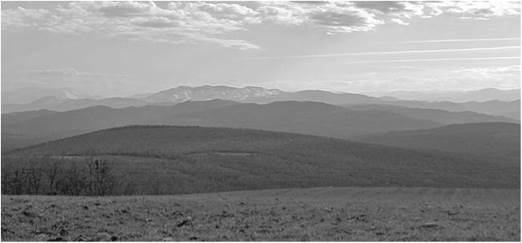
Figure 2.4 Looking west across the Pindos Range. Photograph by Richard R. Johnson
These expansive plains are separated from one another by the other natural features of the region. The rise and fall of the surface of the land in remote periods produced changes of levels within regions as well as between regions. And the individual plains are split into subdivisions by the rivers or their tributaries that run through them. Three such subdivisions exist in the central plain, which curves round the Thermaic Gulf, and a similar picture characterizes the regions of upper Macedonia. Each region can be self- sufficient thanks to a mixture of upland basins, lakes, forests, rivers, and mountains. In spite of the natural separation, however, the smaller regions are linked in that they belong to main routes that lead from the sea to the central Balkans and to the Adriatic Sea. Here is Hammond’s description of one route from Epiros to Macedonia:
The route from Epiros to Kastoria and so northwards to Lychnidus or eastwards to Macedonia presents no serious difficulties, once the river Aous has been crossed at Mesoyefira; one climbs up to Leskoviq and then winds round spurs and across ravines to enter the small but fertile basis of Ersekë, from which one crosses Mt. Lofka by the pass of Qarrë and descends into the plain of Kastoria [roughly half-way between the Adriatic Sea and the Thermaic Gulf of the Aegean]. (1972:102).
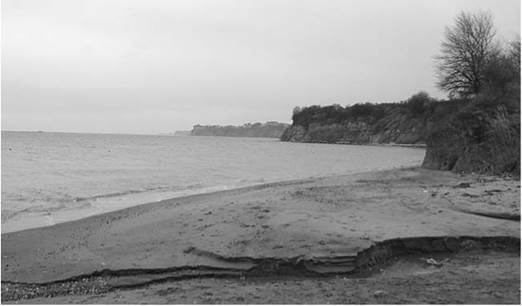
Figure 2.5 The Pydna coast along the Thermaic Gulf. Photograph by Richard R. Johnson
The Roman Via Egnatia, built toward the end of the second century, also demonstrates the possibility of linkage. It followed a trade route that had been a main source of travel in earlier times and, today, is the basis of a modern highway under construction.
Thus, the entire region known as Macedonia can be described as a middle ground. It stands at the node of connections between regions to the north and south, on the one hand, and to the west and the east, on the other. Early humans had entered Greece from Europe and from Anatolia. Clearly the migratory route of the European stock was by land through the Balkans into Macedonia and then southward. Although much of the immigration from Anatolia was by sea, the Neolithic settlements in Macedonia and Thessaly seem to have been accomplished by gradual movement out of Anatolia and across the northern Aegean. The enterprise and products of Mycenaean Greeks in the Bronze Age would push northward into Macedonia, as would the colonizing efforts of mainland Greeks beginning in the ninth and eighth centuries. The incursions of warlike peoples west of the Pindos mountains, which were common in prehistoric times, continued to be all too frequent in the age of Philip and Alexander.
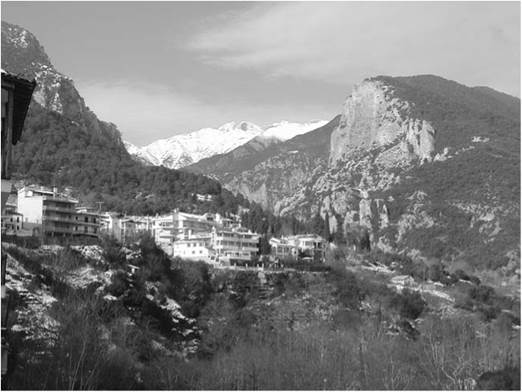
Figure 2.6 Throne of Zeus atop Olympos. Photograph by Richard R. Johnson
The inviting location of Macedonia to those outside of the region suggested that there might be strength in cooperation. When the subdivisions were unified, the collective position of resisting invasions was enhanced. Maintaining a guard on the few relatively open approaches by land and along the coastline of the Thermaic Gulf would serve to defend the security of the natural subdivisions, as well as to improve the effectiveness of routes reaching outward in all directions.
In sum, Macedonia offered its population an array of resources:
Accepting the views of Hippokrates and Aristotle on the role of an environment on the character of its inhabitants, it is possible to argue that the nature of Macedonia would promote certain characteristics in its people. Certainly it is not a “soft” environment: Macedonians must be hardy to take advantage of the resources of the mountains - to hunt the deer and lions, to mine the ores, to move the flocks from summer to winter pastures, and to guard the narrow mountain clefts from invaders. And since Macedonia was surrounded by potential invaders, the preservation of independence would fail without effective coordination of security. A would-be leader of these people would have to be trained to manage the territory that presented both great potential and constant dangers.
The Inhabitants
We have emphasized the natural divisions within the territory that was expanded during the reign of Alexander I in the fifth century and even more so during that of Philip II. Those divisions were conducive to distinctions among groups of inhabitants. Shifting populations reach back into the Bronze Age, when they are revealed by material culture: the nature of sites, burial traditions, pottery techniques. During the Bronze Age Indo-European peoples prevailed in the west and northwest; external influences can be traced to Thracians in the east, Mycenaeans in the south, and people known as the Bryges (or Phryges), whose ceramic styles reflect a central European origin. Evidence suggests that the earlier peoples persisted, although new groups relatively small in overall numbers migrated into the region. Incursions produced shifts in the populations but did not change the basic structure of life that had been developed from the Neolithic Age. Consequently, lower and upper Macedonia had a common Indo-European heritage in prehistoric times and in the age of Philip and Alexander. The same common bond existed between the core peoples of Macedonia and most of their neighbors: Thracians, Paionians, Epirotes, and even Illyrians were of Indo-European stock.
However, great differences exist between various Indo-European peoples. While they are related by a common basic language, that once single language has branched to become a many-limbed tree over the millennia of developments amongst individual Indo- European speakers. The 12 main limbs are Anatolian, Baltic, Germanic, Greek, Latin or Romance and Italic, Illyric or Albanian, Indic, Iranian, Keltic, Slavic, Thracian, and Tocharian. Each of those limbs has produced its own smaller branches in the form of dialectic differences. In terms of languages in current use these branches number 77; some 36 forms of Indo-European are no longer in common use. As the range of categories reveals, the variety of forms of Indo-European may be unclear or even unintelligible to speakers of other forms of the mother language. Moreover, different environments produce distinct ways of life that, in turn, result in new vocabulary that is not necessary amongst other Indo-European peoples.
In sum, since the diversification of language had been underway for eight thousand to nine thousand years by the fifth century bce, unification of the several Indo-European peoples in the southern Balkan region fostered by a sense common heritage and language was not likely In fact, not all of the peoples may have been Indo- European speakers; the identities of some tribal groups living along both sides of the Pindos watershed are not certain. In his sensible summary of “Early Macedonia,” Charles Edson, a dedicated scholar of Macedonian history, wrote of “congeries of barbarous tribes” in the eastern and central parts of what would become the unified kingdom of Macedon under Philip IE Common cultural elements may have been a factor making for cooperation, but perhaps even more important were common threats.
Nor would common ancestry serve to bind the Macedonians with their Indo-European neighbors further south along the Thermaic Gulf, namely the Greek branch of the Indo-Europeans. Indeed, the surviving opinions of certain Greeks of the fourth century bce reveal the weakness of a common bond between the Greeks and the Macedonians. According to the Athenian orator Demosthenes, Philip was neither Greek nor even related to the Greeks, but one of the worst of barbarians from a place where it was impossible to buy even a good slave (Philippics 1.4).
The issue of ethnicity was not only contentious in antiquity but remains so today, and not only among scholars but in the eyes of some modern Greeks. Much of the difficulty in learning the nature of the relationship is due to the absence of certain necessary kinds of evidence. For example, language is a primary key to identity - knowing whether the language of a people is Semitic or Indo- European or Asiatic is an important indicator of ethnicity - but this evidence is virtually absent for early Macedonian history. When inscriptions begin to appear in the archaeological record, the population of Macedonia has ties with Greece that are reflected in the Greek alphabetic writing of the inscriptions. Yet the use of Greek characters may have been no more than a convenience for these particular inscriptions or, as in the case of Greek alphabetic inscriptions in Thrace, may have been used because no native writing system existed. Another possibility is that Greek was becoming the koine, or common, writing system in regions beyond the primary
Greek areas in advance of the Hellenistic period. Information about the spoken language of the Macedonians is even scarcer: a single curse tablet found at Pella might be written in a “Macedonian” dialect of Greek. The only certain conclusion is that spoken Macedonian is sometimes differentiated from Greek.
On the other hand, in support of a link between Macedonian and Greek are the Macedonian personal and place names that occur in the Homeric poems. Among the personal names is that of the royal clan, the Argeadai. Tater sources suggest that Philip and Alexander, and even earlier Argead kings, conversed easily with both Macedonians and Greeks. Second languages can be learned, of course, but, as we shall see, accounts of the Argead line in the Greek sources tell of a Greek ancestry.
Herodotos recounts the tale of three brothers who, after being expelled from Argos in the Peloponnese, made their way to Macedonia, where eventually and rather miraculously the youngest, Perdikkas I, became leader of a group of Macedonians known as the Argeadai, the royal clan (VIII. 136-9). There may be truth in the tradition of movement — in fact, movements — from Greece to Macedonia; as late as the fifth century, citizens of the Greek polis of once-glorious Mycenae were given a new home in Macedonia when their land was ravaged by the polis of Argos. When the Athenians captured Histiaia on Euboia and expelled its inhabitants, the refugees were resettled in Macedonia during the reign of Perdikkas IE As mentioned above, the location of Macedonia lends itself to movement into the region and the Macedonians thought of themselves as migrants. It is the Argeads’ point of departure that is uncertain, nor will acceptance of the truth of movement into lower Macedonia give an ultimate explanation of Macedonian identity.
Physical artifacts are another clue to the identity of a people: particular styles of pottery, architecture, sculpture, coins, and other metal work can reveal a common cultural tradition. Unfortunately, the regionalism of Macedonia produced a mix of styles often influenced by different neighbors - Greeks to the south, Thracians eastward, and various Balkan peoples to the north and west. Nor has anthropological analysis of human remains produced a conclusive answer to the question yet, although DNA analysis holds promise for fuller evidence in the future.
Until new evidence becomes available, it seems appropriate to use the term by which Herodotos designated the inhabitants of the kingdom of Macedon - namely, Makednians (I.56.3) - and also to classify them as Indo-Europeans. Migrants into upper and lower Macedonia may well have been related. Movement into eastern regions took some of the Makednians, led by a clan called the Argeadai, to the coastal plain along the western shore of the Thermaic Gulf. Gradually, the newcomers consolidated control of the region stretching northward of Mt. Olympos to the head of the gulf, while other groups continued to dwell in the several more northern and western regions, which, as we have seen, were separated from one another by the natural features of the southern Balkan territory. But evidence for the nature of the languages of these groups remains elusive.
The issue of language and ethnicity is further complicated since our evidence of Macedonian ethnicity comes largely through Greek sources, and there was no single Greek view. What is more, the perception of Macedonian ethnicity changed over time. An earlier basis for defining Greekness based on ethnicity and genealogical descent from a common ancestor gave way to cultural criteria. Furthermore, a verdict on the Greekness of the Macedonians was dependent upon the criteria selected by the Greek writer in question. In light of problematic evidence in every category of proof, it is not surprising that debate on the “Macedonian Question” has a long history and has not been resolved.
With that ambivalence in mind, it is important to appreciate both the kinship and the differences with the Greeks in understanding Alexander in his world. Greek cultural influences increasingly penetrated Macedonian traditions even before Philip had added Greece to his kingdom. On the other hand, the “otherness” of Macedonia with respect to the Greek Aegean figures largely in the careers of Philip and his son. We will explore the question of Macedonian links with Greece further in chapter 4.
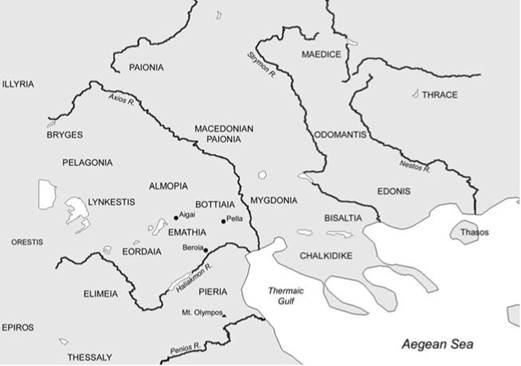
Map 2.1 Regions, Natural Features and Sites of Macedonia
The Creation of a Kingdom from the Congeries of Tribes
The use of the single word “Macedonia” suggests a unified entity, which is an inaccurate conclusion for much, perhaps most, of the ancient history of the region. Only during the reign of Philip II was control extended substantially beyond the central plain bordering on the Thermaic Gulf of the Aegean. And in the contest for control following Alexander’s death, that unity was quickly undermined. While kings preceding Philip had succeeded in adding territory northward of the small, earliest settlement of the Makednians in Pieria, their possession of authority was regularly and severely challenged from all directions.
Our earliest reliable accounts concern the reign of Amyntas I (540-498 bce), whose status was recognized even by the Persian kings, who established diplomatic relations with the Argead ruler. But the relationship was not between equals; in fact, the kingdom of Macedon might well be described as subject to Persian power during this period even if not formally brought under control as a satrapy, or province. A few years later, Xerxes used Macedonia as a staging ground for his assault on the Greek states in 480-479. Somewhat paradoxically, it may have been the enhanced status of the Persian alliance that allowed Amyntas to bring the regions of Elimeia, Orestis, Lynkestis, and Pelagonia into nominal confederacy with Macedon. His son and successor, Alexander I, whom Herodotos describes as especially clever and forceful, was able to consolidate additional territory westward toward the Pindos mountains and reaching north along the Axios River, at the head of the Thermaic Gulf, during his reign from 498 to 454. In his account of the Peloponnesian War in the last third of the fifth century, Thukydides describes the Lynkestians, the Elimiotes, and other “ethne” further inland as subjects and allies of the Macedonians (II.99.2). Also attributed to the first Alexander by some is significant innovation in infantry tactics and the relationship of footsoldiers with the Macedonian king. Alexander had witnessed the success of the Greek hoplites in confronting the Persian forces, and certainly Macedon needed a strong military force to build then maintain the confederacy, to ward off other militant neighbors, and to withstand the intensifying Greek interests - particularly those of Athens — in the northern Aegean during and beyond the reign of Alexander I.
On the death of Alexander I, the succession was contested by his several sons - a frequent occurrence in Macedon in the fifth and fourth centuries, and even during the Hellenistic period following the death of Alexander the Great. Perdikkas II was the successful heir but only after eliminating two of his brothers and, probably, the sons of one of those brothers. He ruled to 414/13 and, during his reign, all the potential threats mentioned above materialized. In fact, Perdikkas experienced even more interest on the part of outsiders in Macedonian territory and resources than his father had known, in large part due to the situation in Greece: the start of his rule coincided with the conversion of the voluntary alliance of Greek states headed by Athens into an involuntary association. That conversion, in turn, resulted in a growing division among the Greek states that led to 27 years of civil war (431-404) between Athens and her allies/subjects on the one hand, and Sparta as leader of the Peloponnesian Teague, on the other.
Macedonia’s strategic location and its timber for ships and weapons were vital to both parties in the Greek conflict. The Athenians established a permanent presence at Amphipolis on the lower Strymon River in 437. The Spartans responded to requests for aid from Perdikkas II in his struggle with Thracian incursions into the Axios region. The confederate kingdom of Tynkestis took the opportunity to separate from the fragile Macedonian coalition and became the strongest tribal state in the region during the second half of the fifth century. Under its own king, Arrhabaios, the Tynkestians proved a powerful army against the combined force of the Macedonians under Perdikkas, the Spartan commander Brasidas with 3,000 hoplites and 1,000 cavalry, and a complement of Chalkidian troops. In spite of such severe problems, the core of the Macedonian kingdom remained intact.
Perdikkas’ son and successor, Archelaos (414-400/399), benefited from developments in Greece that turned the attention of the rival states to other parts of the Mediterranean and Aegean. He is credited with strengthening the core of the kingdom by the construction of border forts to guard the kingdom’s integrity, and of roads linking parts of the territory with one another. Archelaos may also have been responsible for establishing a city at the gates of the Axios river; atop a steep hill on the opposite banks stood a watch tower within an extensive circuit wall. Another major contribution was the cultivation of Hellenic culture in the Macedonian capital. Just as Alexander I had entertained the Greek lyric poets Pindar and Bakkylides, and Perdikkas II had received visits from Hippokrates and the poet Melanippides, so too reputed visitors at the time of Archelaos included the Athenian poets Euripides and Agathon, the painter Zeuxis, and the musician/lyric poet Timotheos. Socrates was invited to visit Pella but refused on the grounds that he could not repay such hospitality. This Argead ruler was the first Macedonian to win a wreath at the quadriga (four-horse chariot) races in Olympia in 408 bce. Archelaos also enlarged the settlement at Pella, which became the capital during the reign of Philip II, if not earlier. The end to Archelaos’ endeavors came at the hand of a bitter Macedonian noble who took Archelaos’ life, leaving an heir who was but a child. In the four decades that followed, the kingdom barely managed to survive the internal and external challenges that confronted its seven or eight rulers during the period.
In less than a decade, kingship changed hands among members of three branches of the Argead clan. Initially, the young son of Archelaos, Orestes, was recognized as king, with Aeropos - perhaps his uncle - acting as regent. Aeropos became king in his own right for four years after he had done away with his nephew. On his death, Amyntas II of the line of Alexander I ruled briefly until he was killed by a Derdas of Elimeia in upper Macedonia. A son of Aeropos, Pausanias, succeeded to the kingship for a few months until he was removed by treachery. The names are not as important as the cycle of rules accompanied by intrigue and murder. To be the eldest son of a ruling Argead was not a guarantee of peaceful succession or, if one were successful in being acclaimed king, of a long or unchallenged reign.
A son in the line of Amyntas reaching back to Alexander I had survived the struggle for power; he became king as Amyntas III in 393. Although his reign endured to 370/69, it was troubled internally and externally. An Illyrian invasion of Macedon in 388/7 drove Amyntas to abandon the kingship, and for an interlude one Argaios - perhaps a son of King Archelaos - ruled briefly. With the aid of Thessalian Greeks in a three-month campaign, Amyntas regained the kingship in 387/6. In addition to the Illyrian invaders, he faced an incursion of Greeks from Olynthos on the Chalkidike peninsula in 383/2, a drive that even captured Pella. Amyntas turned to Sparta for alliance and for aid in the struggle between Macedon and Olynthos, which was not resolved until the reign of Philip II.
Twin credits are due to Amyntas for his staying power in such circumstances and for his progeny: Alexander II, who succeeded him for two years (369-368): Perdikkas III, who endured nearly seven years (368-359); and Philip II, who created the massive kingdom of Macedon in his 23-year reign (359-336). Alexander II faced civil war at home, was drawn into ongoing Greek affairs in neighboring Thessaly, and was murdered. His younger brother, Perdikkas III, succeeded him, although a regent exercised real power for several years. In addition to internal threats to his power, the main external threats demanding Perdikkas’ leadership were Athenian activities in the northern Aegean and the invasions of the Illyrians, who were successfully pressing eastward from the Adriatic. In determining to meet the threat of the Illyrians, Perdikkas and some 4,000 Macedonians perished in battle in 360/59.
Given the history of rivalry for power recounted above, the choice of successor may have been uncertain. Perdikkas had a young son who might have been declared king. He also had a brother, Philip II. Other rivals included Pausanias and Argaios from other lines of the Argead clan, both of whom had briefly been kings in the 390s and early 380s respectively. After dealing with Pausanias and Argaios, Philip may have been selected as regent for the minor son of his brother or he may have been acclaimed king in his own right. Lively debate surrounds this question, but what is important is the outcome: Philip II became the next leader of the fragile Macedonian state. Here are the powerful words of Charles Edson:
It was this moment of catastrophe and desperation which forged a nation out of the Macedonian people. All elements of society could now apprehend that mere survival depended upon willing obedience to the royal authority . . . The meteoric rise of Macedonia to the position of a great power under the genial rule of Perdikkas’ younger brother, the famous Philip II, remains a classic instance of courageous and successful response to seemingly insurmountable external pressures. (1970: 43)
Philip could not afford to be constantly genial in an attempt to restore the integrity of the extensive region of which Thukydides wrote “the whole is called Macedonia” (II.99.6). Much of that whole in upper Macedonia had separated from the alliance forged by Alexander I or had been claimed by others - Illyrians, Thracians, and Greeks. He also faced rivalry for power from five pretenders. To lead an army, his first task was gaining legitimacy; in a word, dealing with rivals and cementing his own right to command. In the meantime, he made treaties rather than war with the Illyrian king and the Athenian demos. By 358, Philip could exchange diplomacy for military action in his dealings with outside powers: a successful campaign in Illyria followed by marriage to the daughter of the defeated Illyrian king mollified that threat, at least temporarily, and an incursion into Thessaly and marriage to a woman of a noble Thessalian family began the Macedonian entrance into Greek affairs. In the following year, an alliance - again strengthened by marriage to the daughter of the king - initiated strong Macedonian ties with Epiros. Closer to the core of Macedonia, upper Macedonia was reunited with the kingdom in 358, and Philip began to use force in an effort to impede Greek, especially Athenian, presence in the territory of the northwest Aegean; in 357 he attacked and captured the Athenian settlement of Amphipolis by the River Strymon, a thorn in Macedon’s eastern side for 80 years.
A similar scheme of alliance supplemented by marriage, diplomacy, and campaign continued throughout Philip’s career. Essential to any hope of success was adequate military strength; consequently, while developments cannot be precisely dated, it is more than likely that rebuilding and reforming the army that had been so decimated in 359 were an immediate priority for Philip. He had had the advantage of learning at first hand the major reform of the hoplite phalanx accomplished by Thebes, when he had been a hostage in Thebes (367-364) at the age of young manhood, i.e. ages 15-18. The significance of this knowledge is shown by its success in allowing Thebes to create an empire of its own after defeating the hitherto superior Spartan army in 371. The changes to the Macedonian force are discussed more fully in the account of Alexander’s inheritance from Philip in chapters 3 and 5. Here we may note the major features: a more mobile infantry equipped with a longer spear; expanded cavalry; special squadrons of light infantry and light cavalry; and development of siege machinery. As the territory of the kingdom expanded - whether through conquest or alliance - more troops became available. And with efficient use of resources, they could be constantly in the field either on campaign or in drill.
Philip helped his own cause but he also benefited from the actions and attitudes of his enemies. Aid from his enemies took the form of disunity. Apart from the alliances increasingly reaching out from Macedon, there was little unity among the various peoples of the Balkans, or Thracians, or Greeks, among whom war against one another was a fact of life. Philip understood and used these internal conflicts to his advantage in expanding his sphere of influence further south into Greece; eastward against the Greek states of the Chalkidike peninsula and then into Thrace as far as the Black Sea; west to the shore of the Adriatic; and north into the Balkans.
Thessaly and the Chalkidian states continued to occupy him during the 350s. By 352, campaigns in Thessaly had met with enough success - although not complete victory - that he assumed the Thessalian position of tagos, leader of the military levies of all four regions of Thessaly. Philip’s capture of the center of the Chalkidian Teague at Olynthos in 348, and the subsequent destruction of that city as well as perhaps more than 30 other settlements, effectively brought the Chalkidike into the Macedonian sphere. Since southern Greeks - particularly the Athenians - were active in the northern Aegean, Philip’s action virtually promised ongoing confrontation with the major Greek poleis. At the same time, these more remote Greeks appreciated the force of the Macedonian army;
it might be used to aid the cause of one party in the never-ending wars between the poleis, wherever they were located.
The first half of the fourth century saw a continuation of the ruinous civil war between Athens and Sparta and their allies, from 431 to 404. In a kaleidoscope of attempts at overlordship on the part of major and minor states alike, participants moved from positions of power to the status of defeated subjects. In the process, former enemies became allies while former allies took the field against one another. As Greeks fought one another, their attention was, first, distracted from Macedonia and, later, turned to Philip and his army as tools in their own efforts. Philip used the situation adroitly. When invited to settle the war ranging between Phokis and other states in central Greece, Philip accepted that invitation. Phokis was defeated in 346 with Philip gaining another official position, namely membership in the council protecting the sacred site of Delphi.
Philip could not ignore other traditional enemies: Macedonian armies marched against the Illyrians in the north, advanced to Epiros in the west, and into Thrace and then Skythia in the east. New agreements were made, such as an alliance with the king of the Getai, who dwelt in the region between Thrace and the Danube; new colonies were founded. With southern Greece, at least for the moment, relations were not military. Philip sent and received embassies particularly to and from Athens, while supporting proMacedonian elements in various parts of Greece. The states of Messenia and Megalopolis in the Peloponnese, for example, were invited to join the Delphic Amphiktyony alongside the other Greek states and Philip.
Notwithstanding such diplomacy, fear of Philip’s intentions was increasing, again particularly in Athens, whose own interests in the Black Sea were jeopardized by Macedonian assaults. However, confrontation would involve more than Macedon and Athens and it would not be located in the Propontis. Rather, when fighting in central Greece flared again early in the 330s, Philip led his Macedonians back to Greece as both Macedonian king and Greek official. Growing concern about Philip’s ultimate intentions produced a coalition led by Athens and Thebes, with the participation of Boeotian allies of Thebes and contingents from Achaian states. At the site of Chaironeia in Boeotia, some 30,000-35,000 Greek troops met a roughly equal number of Macedonians commanded on the right wing by Philip and on the left by his son, Alexander, who held command of the cavalry. The Macedonian victory was decisive; Greek survivors fled homeward, expecting retaliation.
In place of retaliation the affairs of the Greek states were settled by the foundation of the Teague of Corinth, into which all, with the notable exception of Sparta, were drawn for offensive and defensive purposes. Sparta’s absence is telling: the presence of the once supreme hoplite state of all Greece was no longer necessary for the functioning of a kingdom that, by 336, reached from Illyria in the northwest to the west coast of the Black Sea in the southeast, and from the southern Balkans in the north through the Greek mainland in the south. The territorial size of the kingdom is estimated to have been 16,680 square miles (43,210 km2) - over 12,000 square miles (31,500 km2) of which were effectively possessed and 4,500 square miles (11,710km2) directly controlled. At the end of the Peloponnesian war, the size had been 8,400 square miles (21,750 km2), while during the reign of Alexander I it had been 6,600 square miles (17,200km2). Members belonged by conquest, alliance cemented by marriage to the Macedonian king, and partnership in shared goals planned by council meetings of delegates from all the participants. At the center of every link was Philip II, reaching out in various ways and many directions from his capital at Pella.
The new order had barely begun when Philip was assassinated in 336. It is a validation of Philip’s planning that his son and successor, Alexander III, was able to reaffirm his father’s arrangements during the first two years of his kingship. Revolts erupted - from Illyria, where Alexander led the Macedonian army in 335, and from Greece, centered on Thebes. The new king dealt with both, quickly and effectively: Thebes was destroyed. The kingdom of Macedonia was under control and its northern borders had been secured when he began the campaign against Persia in 334.
However, it is important to remember that the unification was very recent and that tensions not only remained but had been intensified in the creation of the expansive kingdom, which, under Philip, had grown so significantly in territorial size and population. Various congeries of people now drawn together by conquest or alliance remembered themselves as separate entities - separated both by natural features of the land and by culture. Most, if not all of those groups remembered their independence. Separatist movements that had been a problem for earlier Argead rulers would continue to trouble Alexander. Moreover, patterns of life still differed throughout the kingdom: in some regions, transhumant herding was a dominant pursuit, while in others, settled farming occupied the attention of most people. Herders and farmers have throughout much of history found it difficult to accommodate to one another. Another tension also stemmed from regional differences: specific locations gave exposure to a range of other peoples. In upper Macedonia, Balkan influence and potential conflict prevailed, while along the Thermaic Gulf, Macedonians were exposed to Greek and Thracian influence and incursion.
Many of the Argead kings had actively sought to incorporate elements of Greek culture. In the fifth century, Alexander I had demonstrated his right to participate in the Olympic Games; Archelaos had imported Greek goods and people to his capital at Aigai and had held games at Dion; Philip II drew on Greek innovations - such as the Theban military reform - as well as on goods and on people like Aristotle. Philip also strengthened his ties to Greece by achieving three victories at the Olympics in 356, 352, and 348. From one perspective, such cultural borrowing was practical, but from another point of view, it too was a cause of friction. It is likely that many of the subjects of Archelaos and Philip were not altogether happy about the hellenization of Macedonian culture. As Alexander led his army further and further eastward, he faced what are commonly known as Macedonian reactions against his newly acquired non-Macedonian practices.
Expansion of the kingdom had required greater centralization. Centers had been established earlier - at Aigai and Pella - but further steps had been essential as new territories were added to the realm. Existing centers were enlarged, forts and colonies established as the borders of the kingdom were extended, and roads to connect regions had to be constructed. Mandatory, too, was the need for a large, flexible military force and, as Philip’s efforts extended to the Propontis and Black Sea, naval power had to be created. All of these developments called for resources, which existed, to be sure, but had now to be efficiently produced and utilized by a central authority. That centralization, in turn, demanded an enlargement of administrative tools beyond the original, rather simple structure of Macedonian authority. Even the effective creation of these tools might well alienate conservative elements of the population, especially other elite families.
Finally, ongoing tension existed at the very heart of the state, namely in the Argead ruling clan. By the fourth century, a number of collateral branches existed, and although kingship often passed from father to son, it could - as on the occasion of the death of Archelaos, described above - move from elder brother to younger or to a member of a collateral branch. Philip’s own father, Amyntas III, came from a collateral branch of the clan. The claim to king- ship, on the death of its present holder, was regularly challenged.
In sum, in spite of the impressive expansion and the bonds of centralization within it, the kingdom remained fragile and threats from beyond the borders were ever present.
The Nature of Tife in Fourth-Century Macedonia
When Alexander chastised his men for ingratitude in 324, he pictured the massive change in the nature of life in Macedonia during his father’s rule.
Philip took charge of you as wanderers without resources, most of you dressed in hides, pasturing a few sheep on the mountain-side, and fighting poorly for them against Illyrians and Triballians and the Thracians on our borders; he gave you cloaks to wear instead of skins, led you down from the mountains to the plains, made you worthy warriors against nearby barbarians, so that you came to rely on your own virtues rather than the security of your region. He defined you as residents of cities and arranged good laws and customs. Of those barbarians by whom you once were ruled and plundered, he made you masters rather than slaves and subjects. (Arrian VII.9.2-3)
If we can accept the truthfulness of this harangue, Philip brought the Macedonians from a barbarian to a civilized status. Evidence, although it is meager, calls for some modification of the suddenness of the civilizing process, since an ongoing process of sedentarization and urbanization in Thessaly, Macedonia, and Epiros can be dated back from the end of the Bronze Age into the fourth century bce. While Philip’s efforts greatly stimulated the process, village life had increased earlier in parts of Macedonia, especially regions in lower Macedonia influenced by Greek colonies that had been established early in the Iron Age and were becoming increasingly numerous in the eighth century and later. In most regions of Macedonia, villages were small, in terms of both territorial size and population. In western Macedonia, sites larger than about 7.5 to 10 acres (3-4 hectares) were rare. By contrast, the largest settlement was Pella, with 74 acres (27 hectares) and an acropolis of 4.5 acres (1.8 hectares).
Occupations also varied between regions: in those with extensive, fertile plains farming along with stock raising would be the means of existence for many, while more upland areas fostered transhumant pasturing as a way of life, the sort of life that Arrian reports through Alexander’s speech to his men. The resources of those same upland areas encouraged hunting and fishing and, as demand for Macedonian timber increased, harvesting the products of the forests would demand the labor of some of the population. Others engaged
in recovering mineral resources. Herodotos records mining from the time of Alexander I, noting one mine that yielded a talent of silver every day for that king (V.17). Another regular occupation for adult males was warfare, which, as we have seen, was almost a continual need. Calculations based on the number of free Macedonians indicate the pool of men that could be mobilized:
Before the reign of Philip: 80,000-100,000
During Philip’s reign: 160,000—200,000
During Alexander’s reign: 240,000-300,000
The size of population in Philip’s time is estimated at 700,000, an increase from 250,000 slightly more than a century earlier.
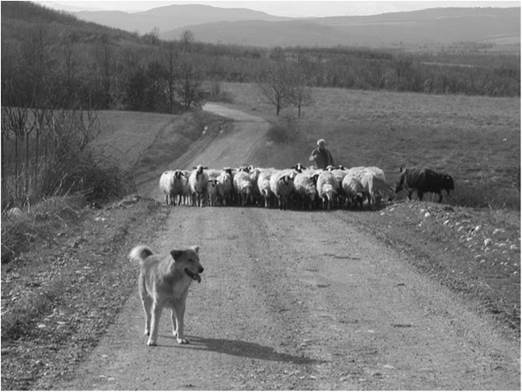
Figure 2.7 Herding is a continuing occupation, especially in the highlands, as near Grevena. Photograph by Richard R. Johnson
Some Athenians of the fourth century had rough words to describe the Macedonians. We have mentioned the view of the Athenian orator Demosthenes that Philip was a barbarian from a dishonorable place (Philippics I.4). Modern assessments are generally kinder. Perhaps Demosthenes’ rhetoric, employed to rouse the Athenians against Philip, masked a personal estimation, given in the account of one of his contemporaries, that Philip was “the most gifted of men” (Aischines, On the Embassy 2.41). He would need special gifts to deal with Macedonia, which had the characteristics of a rough, pugnacious frontier society. Written sources recount the practice of blood feud; the need for a man to kill an enemy before he could exchange a halter for a belt, and to slay a boar with a spear without the use of a net before being able to be seated at symposia (both probably were coming-of-age and status rituals); a fondness for hunting wild animals; dances that replicated the theft of cattle and enacting a sham battle at the ceremony inaugurating the campaigning season; and drinking parties where wine unmixed with water could cause the death of a participant. Euripides’ play the Bakkhai was composed when the poet was in residence at the Macedonian capital and, consequently, the atmosphere of the tragedy is thought to have been inspired by the nature of Macedonian life. It may be sufficient to recall that the chorus is composed of frenzied women devotees of Bakkhos/Dionysos, one of whom is the mother of the king, who himself is not a devotee of that god. Thinking that they have caught a fleeing animal that they will sacrifice to the god, the women tear the young king to shreds.
We must remember that most of our evidence derives from nonMacedonian accounts. There is little Macedonian written evidence, certainly no surviving work of Macedonian historians or tragic poets contemporary with Philip and Alexander. Material evidence, however, does point to a sophisticated artistic tradition. The discovery of the royal tombs at Vergina/Aigai dating to the fourth century was stunning proof of this sophistication. One tomb, perhaps the burial place of Philip himself, had two chambers. The largest held bronze vessels and weapons - including a bronze cuirass that had gilt appliqué designs with gold strips attached vertically - that were grouped in one corner, while silver objects rested in another. Also found in the main chamber were five small carved ivory heads with realistic images, most likely of Philip, his parents, his wife Olympias, and their son Alexander. The larnax (coffin) in which the remains of the cremated deceased had been placed was fashioned of gold weighing more than 24 pounds. A beautifully wrought gold diadem lay near the head.
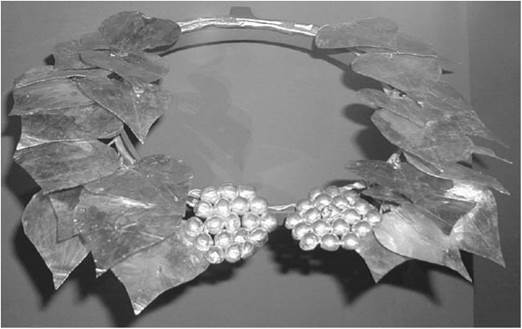
Figure 2.8 Mineral wealth: gold ivy wreath from a male burial in the cemetery of Sevasti, Pappas Mound, Prefecture of Pieria, c. 350 BCE. Now in the Archaeological Museum of Thessalonike. Photograph by Richard R. Johnson
The material evidence, considered in connection with the efforts of King Philip II, suggests another “hidden” quality of Macedonian society. A king, no matter how effective he may be, needs more than a council of heads of major families and an army assembly of all Macedonian soldiers to control a sizeable kingdom. Administrative personnel and tools become increasingly essential as the state increases in size, complexity, and power vis-à-vis other, neighboring states. It has been argued that household functionaries of the early Macedonian court evolved into administrative positions. For example, on this interpretation, the dattes, once an overseer of kingly meals, took on administrative financial responsibilities.
When formerly independent regions became administrative districts they required oversight and, in some cases, collection of taxes. The essential natural resources of the kingdom had to be supervised under central control. Dealing with envoys and sending envoys in return demanded coordination. Boundaries must be settled, treaties drawn up, scouts dispatched to learn the situation in the far-flung corners of Philip’s sphere of attention. Unfortunately, we do not have a Constitution of the Macedonians, to compare with the Aristotelian Constitution of the Athenians, to reveal the nature of the mechanisms that emerged to manage these responsibilities. However, the success of Philip would be unimaginable without an efficient system of management. The accomplishments of earlier kings such as Alexander I and Archelaos indicate that the roots of that system had been planted at least a century before Philip’s reign. Consequently, it is reasonable to envision that the extensive kingdom produced an increasingly more formal organization, at least at the core of the kingdom.
Alexander in the Context of Macedonia and Macedonians
Our goal is to understand the nature of Alexander the Great. How does knowledge of the land of his birth and youth, of the people over whom he assumed rule in 336, and the established way of life shed light on that goal?
Perhaps most apparent are the natural resources that Macedonia contained - its minerals, timber, rain- and river-water, fertile plains, fish and birds and wild animals. As Jared Diamond has argued, inhabitants of regions with an abundance of natural resources have a significant advantage in creating successful cultures. But command of these resources in Macedonia did not come without serious effort: as we have seen, the physical character of the region molded a tough people. To make use of the natural resources and inhabitants, and to create and then maintain an independent state, meant command of mountainous terrain and the abundant waters of long rivers, both of which tended to divide the region into smaller units. An ability to turn these features into assets was essential to the emergence of an effective state. An effective leader would know the importance of this ability not only with respect to economic strength but also to enhance the military skill of his force. We will examine this value of this ability in the final chapter.
The major battles fought and won by the Macedonians under Alexander’s command took place at rivers. The first encounter occurred at the Granikos River, which the Macedonians crossed, then climbed the opposite bank to engage the enemy. On the second encounter, at Issos, Alexander led his troops across the Pinaros River to engage the Persian force. The defeat of the Indian leader Poros and his troops took place along the monsoon-swollen Hydaspes River (the modern Jhelum). After that victory, the Macedonians made their way south along the Indos and then explored its two mouths and coastline in vessels that Alexander had ordered constructed for the purpose. Knowledge of the importance of waterways for communication and unification was a valuable byproduct of Alexander’s Macedonian heritage.
Macedonia also taught him well how to deal with mountains, teaching essential to the campaign in central Asia. Instructed by Alexander, the Macedonians took supposedly impregnable citadels such as Sogdiana in Bactria (Arrian IV.18.5-19.4) and the rock of Aornos, a site reputed to have repulsed the efforts of Herakles (Arrian IV.30.1-4).
Macedonian leaders appreciated the value of those who could accomplish such feats, the heart of their military. Pressures on the core of the kingdom were constant and existed on every border. Soldiers trained to withstand and, hopefully, prevail over Illyrian, Thracian, Greek, and other incursions were key to the integrity of the realm. These potential soldiers were raised in conditions that honed their physical fitness: shepherds moving flocks from lower winter pastures to summer pastures in the mountains; hunters of wild beasts; farmers. Such men could be doughty warriors and a wise ruler would appreciate the value of his Macedonian men-at-arms.
He would do well to also appreciate the middling location of Macedonia - its proximity and its attractions for others. Isolation was impossible. Consequently, gaining familiarity with likely enemies would be an important asset. As we have sketched above, Alexander watched the expansion of the territory of Macedonia and its increasing interaction with other peoples. Plutarch reports that when Alexander was very young he conversed with envoys from the Persian king while Philip was away (Alexander V.1-3). His questions were about road systems, the king’s character, and the numbers of Persian troops. Even if this report is not accurate, Pella had become a hive of international activity during Alexander’s childhood. His world extended beyond the traditional Macedonian sphere.
Surely this is essential knowledge in one who must deal with other cultures. On the other hand, too great a leaning away from the Macedonian “way of life” could be dangerous; witness the feelings of Alexander’s companion Kleitos. As Arrian reports, Kleitos was distressed by Alexander’s adoption of foreign ways, and at one point when the king was being praised, Kleitos was dismissive of that praise, feeling that “the deeds of Alexander were not as great and wondrous as some praised them. They were not accomplished by one man alone but for the most part they were deeds of the Macedonians” (IV.8.4-5). Plutarch’s account is even more explicit in reporting Kleitos as saying that it was wrong to ridicule the Macedonians in the presence of barbarians and enemies, for although some Macedonians had been bested by the foreign enemy, they were still far superior men (Alexander L). Kleitos died for these accusations at the hand of Alexander himself.
Use of the natural resources of the region demanded certain knowledge and judicious allocation of them, just as the interaction between Macedonians and others required another kind of careful balancing act on the part of the Macedonian king.