
7
The first chapter of our attempt to learn more about Alexander III of Macedon offered a sketch of his career that has emerged from patient examination and reconciliation of the problematic sources. The sketch avoided the many uncertain details and debated issues, such as the date for the destruction of Persepolis and Alexander’s motivation in burning the site. Even more hotly debated is the personality of the person who affected the lives of millions of people throughout much of the then known world and, eventually, far beyond that extent. In the introduction, we quoted Will Cuppy’s amusing but sensible answer to efforts at learning Alexander’s motivation: not only could Cuppy not provide an explanation but he proposed that Alexander himself would have difficulty in giving an answer. Claude Mossé, noted historian of the ancient world, came to a similar conclusion in her recent biography of Alexander with the observation that he “will always remain a stranger to us” (p. 211); she specifically cautioned the need to omit speculation on the psychological dimension of Alexander.
As we noted at the beginning of this present venture into Alexan- drology, the nature of the surviving evidence is largely to blame. How regrettable, for example, is the loss of the four books of letters from Aristotle to Alexander, or the single book of letters from that philosopher to Hephaistion. And, if Arrian’s account can be trusted on the matter, Alexander also wrote letters, for example to his mother while the Macedonians were in India (VI. 1.3) and in answer to the offer of Dareios following the Persian defeat at Issos (II.14.4 ff). Nothing comparable to the personal insights that letters would provide exists. Even the best of the surviving sources reflect the problems faced by their authors. Arrian states that numerous false accounts exist and are likely to be perpetuated; to counter them is the aim of his own history (VI.11.2). In his attempt to present a true account Arrian confesses that certain details are of no concern to him (V.20.2), and he admits that he cannot contribute an understanding of Alexander’s thoughts, nor is it appropriate for him to infer them (VII.1.4).
Other doors to the nature of this hero do exist. We have examined five of those doors in the belief that much can be learned about Alexander III of Macedon through the interplay between this captivating but mysterious individual and his world. To be sure, Alexander shaped the course of history by his own actions. At the same time, the nature of the world into which he was born shaped him to pursue his whirlwind career. He had to learn to cope with his world, employing strategies that were likely to succeed. The doors that offer the fullest clues to the individual are his kingdom and its people; his status as a member of the Argead line and his parentage; Macedonian vulnerability to its neighbors, which demanded a standing, resolute military; the relationship between Macedon and Greece; and the nature of the Persian Empire in the fourth century.
Youth
The year 356 was a relatively good one in which to be born by comparison with the previous four decades of Macedonian history. Surprisingly, the fearsome Illyrians had not repeated their incursion of 360/59, which took the life of the Macedonian king and probably two-thirds of his soldiers. The anticipation of another attack may in fact have strengthened the tenuous bonds between the core of the kingdom, along the Thermaic Gulf of the Aegean, and the several inland kingdoms that had a history of vacillating between inclusion in a single kingdom and independent existence. These western territories were even closer to the land of the Illyrians and could feel the force of an Illyrian push into Macedonia before the invaders reached their goal. Tighter cohesion between lower and upper Macedonia is demonstrated by the origins of men who were among Philip’s, and later Alexander’s, most reliable subordinates. Par- menion, who had strong ties with upper Macedonia, successfully commanded the Macedonian army against the Illyrians in 356 and remained Philip’s loyal, effective general through the king’s reign. He would enjoy similar status under Alexander for six years. The loyalty of Orestis is demonstrated by the high positions of Krateros and Perdikkas; that of Elimeia by Koinos; Alexander’s friend Leon- natos was a member of the royal line of Lynkestis. On the other hand, the cohesion had only recently been re-established. Lynkestis, for example, had a long record of hostility to Macedonian control, and the head of the Lynkestian royal family during Philip’s rule had three adult sons. It would have been a mistake to believe that attempts to regain independence would never recur.
In the aftermath of the Illyrian victory, the new Argead ruler, Philip II, had made a treaty with the Illyrian king and, in 358, a successful campaign against the Illyrians produced a diplomatic marriage between Philip and the daughter of the Illyrian king. The following year an alliance, again coupled with marriage, this time to the daughter of the king of Epiros, expanded the sphere of Macedonian influence to the west. Negotiations with neighbors to the north, south, and east were also increasing in the first years of Philip’s reign: diplomacy and gifts mollified the Paionians and Thracians, marriage with the daughter of an important Thessalian family in Larisa introduced a Macedonian presence into northern Greece, and problematic Athens in southern Greece agreed to a treaty, while Greek states in the northern Aegean began to feel the pressure of the Macedonian army. A son born to the Macedonian king would witness the ongoing expansion of Macedonian control as the realm doubled in size from its territorial base at the end of the fifth century.
Even when its core was much smaller, the region possessed a range of enviable natural resources: two great rivers and their tributaries with abundant fish; fair amounts of rainfall in the winter; accumulations of snow that provided water in the summer; fertile plains including a sizeable coastal plain suited to agriculture and pasturage; well-forested mountains that were home to a wide range of animals; rich supplies of minerals. Expansion not only protected existing people and resources but also added to them.
Effective use of natural and human resources was also expanding during Alexander’s youth. The settlement at Pella, which had been enlarged during the reign of Archelaos in the last years of the fifth century, was expanded by Philip II to include facilities essential to centralized control of the kingdom. Although continuous habitation and new building at Pella obscure the picture of the capital of the kingdom during the reign of Philip, sufficient evidence survives to show that it was not a small town of rustic people. Rather there were domestic quarters for the king and his extensive family, quarters for the king’s boys and visiting envoys, and necessary facilities for their care. Somewhat removed were the offices of governance: a secretariat and records, management of resources, units such as the development of military machinery. The earlier center at Aigai, which remained the kingdom’s ceremonial focal point, had a theater as well as the grand royal tombs of earlier Argead men and women. Excavation of those tombs has demonstrated the splendor of items surely used in the palace as well as serving as dedications to the deceased. Moreover, more tombs are now being identified with such rapidity that excavation cannot keep pace with the discovery. Other settlements, when brought under Macedonian control, were often refounded as Macedonian cities; new colonies were established; forts on the everexpanding borders were set in place; and efforts to connect the full sweep of the kingdom resulted in the construction of roads.
Thus, a young son of a king would be acquainted with an increasingly large, centralized, and diverse kingdom directed from a capital in which he lived in the residential portion of the palace. If this youth were not disabled physically or mentally he would receive the education appropriate to potential successors to the kingship. Central to this education would be the ability to rule directly in all matters essential to governance of the kingdom.
The physical character of Macedonia was an important force in creating a king who had to campaign through the year, enduring freezing winter temperatures, especially cold in the mountains, and summer heat surpassing 40°C (104°F). Inasmuch as river valleys and mountain passes could be points of enemy incursion, it was vital to know these natural features well. Maintaining security in upper, mountainous regions of the kingdom led to dangerous encounters with wild animals as well as with discontented subjects. The physical evidence of paintings and mosaics joins written sources to show the importance of hunting prowess among the Argeads: a “conspiracy” against Alexander in 330 involved one of the king’s boys who had been beaten for besting Alexander in the slaying of a boar during a hunt. Familiarity with the rivers entailed the ability to cross them when necessary. A successful Macedonian king would be physically fit at birth, would not be impaired in his youth, and, through training, would perfect that fitness to the point where he was akin to the Homeric heroes in being like a god by comparison with most men.
As Macedon assumed new dimensions and greater complexity, other skills were needed to rule successfully. Expertise in matters of administration could be delegated to others who had the requisite skills, but departments such as a secretariat, an equipment design unit, and a bureau of coinage had to be staffed and supervised by fit personnel. And with territorial expansion came the need to divide the basic responsibility of military leadership: the king could not be in Thrace and central Greece at the same time, yet delay in responding to uprisings or incursions would be disastrous.
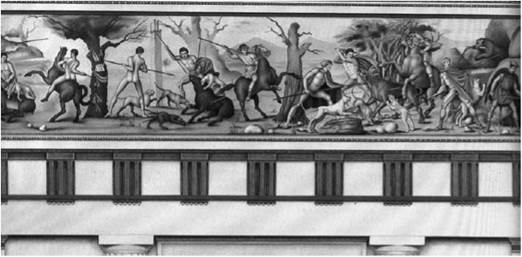
Figure 7.1 Reconstruction of the Hunt Fresco in Tomb II at Vergina. Courtesy of Mrs Olympia Andronikou-Kakoulidou
Moreover, the successful enlargement of the kingdom brought with it the need to treat with subjects and allies in ways intelligible to them. Most of Macedonia’s neighbors were of Indo- European stock, but even that common heritage now carried real differences of language and ways of life. Deeper knowledge of at least some of the cultural differences would enable a ruler to discover the proper relationship. People with bilingual ability were available, but it is not implausible to envision the growth of a common language, a koine, based on Indo-European similarities. Did Philip converse with his Elimeian, Illyrian, Epirote, Greek, Thracian wives through interpreters?
The immediate neighbor most advanced in intellectual accomplishments by the mid-fourth century was Greece. To reckon with the world of battling poleis as well as to position oneself in that world required knowledge of institutions, past history, and values. Speaking and reading Greek would be a key to all of the above. A man in the position of Philip was likely to appreciate the reality of dealing with the Greeks in language and ways that were familiar to them. Beyond his own perception, he would see the wisdom of preparing a potential heir to have the same understanding.
A highly qualified tutor for the young Alexander was found in Aristotle, who had lived at Pella in his own youth when his father was physician to the Argeads. Aristotle obviously could communicate with Alexander and the other young men he tutored for more than two years, perhaps in the Macedonian tongue but surely also in the Greek tongue. Although the texts of two of Aristotle’s works believed to have been written for the sake of Alexander do not survive, their titles are Greek, as the contents must also have been: On Colonies and On Monarchy. Subjects in which the young men were instructed have not been recorded, but Aristotle’s wide interests in the sciences, literature, rhetoric, and philosophy were probably mirrored in the training. Arrian’s account of Alexander mentions his fascination with other forms of philosophy - as, for example, the gymnosophistai (unclad wise men) of India (e.g. Arrian VII.1.4-2.1). Alexander’s experts for the campaign in Asia included surveyors and those with special knowledge in zoology and biology. His fondness for literature is remembered not only in the copy of the Iliad prepared by Aristotle that the king carried with him to Asia, but also in the literary contests that were regular events throughout the long campaign (Arrian II.5.8, in Anatolia; VII. 14.1, on the return to Ecbatana). And while we cannot trust the accuracy of the speeches attributed to Alexander by Arrian, his power of speech is plain in the persuasion needed to rouse his men for battle, for taking an impregnable fortress or crossing an unknown river in the dark of night, or for enduring a march across the Hindu Kush or the Gedrosian Desert.
In sum, training of several types began at an early age for a king’s son who was deemed healthy and of sound mind. Some of that training was indirect: acclimatization to the Macedonian environment, experiencing life in the palace and the lower city of Pella, watching one’s father and his companions as well as members of delegations from other kingdoms or states. Much of the education was formal, through tutors and, most likely, in the same physical regime in which the king’s boys were trained. In one’s second decade, carrying out the assignments of the king was incorporated into the training: Alexander acted as regent when he was 16 and he commanded the right wing at Chaironeia when he was 18.
Watching Philip was important, for, as we have seen, he created the base from which Alexander was to move against Persia only two years after succeeding his father. That base was a large kingdom under the rule of one powerful king. A standing army, based on the Greek phalanx but reformed in equipment, tactics, and personnel, was the tool that forged the kingdom. Administrative equipment for governance was developed or expanded by Philip, as was the recruitment of future officers through the training of sons of the aristocracy as king’s boys. Rewards for a military career drew men not only from Macedonia but also from the regions more recently incorporated into the kingdom. As his reach stretched into the Propontis, Philip undertook the construction of a fleet. In 334, for his crossing into Anatolia, Alexander had a fleet of 160 triremes and many merchant ships (Arrian I.11.6).
Philip had acquired solid knowledge of his neighbors and was able to insert himself into the established structure of those whom he and his men had defeated. He was an ally of some of those neighbors, related to several ruling families by marriage into them, an official in certain states particularly in Greece, such as tagos of the Thessalians, convener and leader of a Teague. He wore many “hats” in addition to the Macedonian petasos. And yet he remained the active agent in all aspects of rule: military, religious, administrative spheres all converged on the Argead ruler. An attentive son, as his own age and wisdom increased, would realize the multi-faceted role of his father.
Yet it was the king’s role as a commander of the army that would be most apparent. One indicator was the amount of time that the king was away from Pella on campaign. Often, as we have noted, the army had to be divided to deal with threats in areas quite remote from one another. At the same time, the role of the Macedonian army would have been ever visible at Pella, where youths from important families were trained for elite status in the army, older companions consulted with Philip about command positions delegated to them, and several companions of the king served as his guard. Councils with the most important of the king’s subordinates were held at Pella, as well as elsewhere when the army was on campaign. Military equipment was designed in Pella, and a naval force was planned there as Macedonian interests extended across the northern Aegean and into the Propontis and Black Sea. Embassies arrived at Pella with increasing frequency as the army’s successes mounted.
If a son of an Argead king had hopes of succeeding his father, he would acknowledge the military base of the kingdom, striving to achieve the qualities required to ensure the strength of this base. He would need the regard of his father’s men as well as that of the king’s boys of approximately his own age, whose support was crucial in the acclamation of a new king. He would appreciate the need for the promise of sound leadership to win the approval of all of the Macedonian army, ordinary foot-soldiers as well as the elite companions. However, more than promise was necessary; a potential successor must have demonstrated his ability in the field. Philip became king largely because the son of the previous king - Philip’s brother, slain in battle by the Illyrians - was an infant. An astute king would provide his son(s) with opportunities to show his (their) capabilities at a relatively young age. Philip was astute and Alexander was given opportunities to demonstrate his abilities.
Certain personal qualities, then, were essential. But it was also necessary to be a member of the Argead line, whose tradition of leadership extended back to the late sixth century according to reliable sources and much earlier if the Macedonian remembrance of its first kings is at all sound. The strength of the Argead right to rule is shown by the reluctance on the part of the successors of Alexander to depart from the tradition. While a group of powerful men craved rule on Alexander’s death, they acclaimed the yet unborn child of Alexander and Roxane, should the child be a boy, while the army assembly acclaimed Philip III Arrhidaios, the other son of Philip by his Thessalian wife Philinna. As Roxane’s son, Alexander IV, could not be expected to govern in his own right for many years and Philip III was regarded as enfeebled, real command rested in the hands of others, but the Argead claim to kingship could not be quickly ignored.
To be an Argead enhanced one’s ancestry inasmuch as Herakles was the progenitor of the family. A more suitable first Argead would be difficult to name, in light of the heroic quality of Macedonian kingship and of the nearly Herakleian tasks that accompanied the rule of Macedon. Alexander demonstrated this link regularly in sacrifices (e.g. Arrian I.11.7-8, at the start of the campaign; II.24.6, at Tyre; VI.3.2, in India). Moreover, he not only emulated the hero but, as Arrian records, “he had a sense of rivalry with him as well as with the hero Perseus who was also an ancestor” (III.3.2). His mother’s lineage added another impressive ancestor, Neoptolemos the son of Achilles who was the mightiest warrior at Troy. At our distance, we may discount the validity of the genuineness of belief in such a lineage, but in dismissing it we would be doing great disservice to the views of ancient Macedonians and Greeks as well.
More than heroic ancestry, the Argeads’ ties with the gods buttressed the royal role in Macedonian religion. Kings offered sacrifices on behalf of the Macedonians, and they established festivals and games that required special constructions such as theaters, temples, and proper sites for holding the athletic contests. The older center of the kingdom at Aigai had a theater and temple of Eukleia; Dion had a sanctuary of Demeter dating back to the sixth century. It is not improbable that the ruling king also supplied the offerings and implements for sacrificial occasions. What better god to claim as ancestor than Zeus, father of men and gods? As Arrian reflects, like the legendary Minoan kings Minos, Aiakos, and Radamanthys, Alexander traced his origin to Zeus (VII.29.3). So might he have signs from Zeus, such as the thunder and rain that came as a token of where he was to build a temple to Olympian Zeus at Sardis (I.17.6). As in the case of belief in heroic ancestry, we should be willing to accept the proposition that Argead kings believed that they were empowered by the great gods.
Illustrious ancestry was a boon of Argead association. On the other hand, Argead status carried real dangers. Over the two hundred years or so of Argead kingship, many branches had formed on the original single trunk: thus successors could come from several families and rivalry between those families was often bloody On the death of Perdikkas II, members of three branches held the rule for short times. A ruling king might well be insecure and a potential successor would have grounds to recognize dangers to his own life. Another trait as early as the reign of Alexander I was multiple marriage. Philip’s father, Amyntas III, had two wives, each of whom bore sons. One of Philip Il’s first tasks on succession was dealing with his half-brothers. Philip himself had seven wives. By the time of his murder, there were two adult sons - Alexander III and Philip III; however, his recent bride was expecting a child. Although Alexander was promptly acclaimed, there were potentially two threats to his tenure from within his immediate family. That Alexander recognized the threat to his chances of succession is evident in Macedonian relations with a satrap of Persian Karia, Pixodaros, who in 336 offered an alliance with Macedon, to be cemented by marriage between his daughter and Philip’s son Philip III Arrhidaios. Learning of this offer, Alexander sent a messenger of his own to Pixodaros urging that the satrap consider Alexander rather than Arrhidaios as a proper son-in-law. Philip’s anger at Alexander’s interference prevented the conclusion of the marriage, but its implications had been frightening to his would-be successor (Plutarch, Alexander X.l-3).
The presence and the power of women in the Argead line would become apparent to a child growing up in the residential area of the palace. Important women were guarantees of treaty agreements through marriage into the royal Macedonian family, since they derived from influential families in other kingdoms or states. While their official position was to bear sons to succeed to the throne and daughters to secure alliances, their influence could determine the future of Macedonian governance. Alexander III might enjoy better prospects if Philip III happened to be incapacitated, a condition that Olympias was reputed to have caused. In turn, Alexander might have been the target of Philip Ill’s mother. Security was a real problem for an Argead, especially the son of a king. The reactions of a potential successor would likely be balanced between admiration for his mother’s abilities and, perhaps, some revulsion at the self-centered, often ruthless actions she performed.
Filial bonds, consequently, not only were essential to the success of a particular son of a king but also heightened the importance of lineage. Early ancestors remained important but new familial ties through marriage could provide other distinguished predecessors. Marriage was an obvious means of expanding one’s family, but adoption was another. When Alexander restored Queen Ada as rightful ruler of Karia, their relationship mirrored that of family members: Alexander addressed Ada as mother and she adopted him as her son and successor (Arrian 1.23.7-8).
It is likely that the environment of the palace would encourage a young Argead male to search for friendship elsewhere. One clue to the source of his close friends is the period of education that Alexander had with Aristotle. At the sanctuary of the Nymphs near Mieza, Alexander was instructed along with several youths near his own age including Ptolemaios, son of Lagos; Kassandros, son of Antipatros; Marsyas of Pella, who wrote a treatise on Alexander’s education that, unhappily, is lost; Hephaistion, described by Arrian as most loved of all men by Alexander (VII. 14.3); and perhaps also Perdikkas and Lysimachos. That friendship could endure is evident in the appointment of Ptolemaios and Hephaistion as members of Alexander’s guard when the Macedonians had survived their trek across the Gedrosian desert. Other evidence exists in the continuing relationship with those friends from Alexander’s youth who had been exiled on Alexander’s account following the quarrel between Philip II and his son in 337: Ptolemaios, Harpalos, Erigyios and his brother, Laomedon, from Mytilene on the island of Lesbos, and Nearchos son of Androtimos, who came from Crete to aid Philip. Harpalos was given important financial command in Babylon by Alexander and he outlived his king; Nearchos rose to become admiral of the fleet that sailed from India into the Persian Gulf and also survived after Alexander’s death; Erigyios commanded the allied cavalry at Gaugamela, and later led a force sent to deal with the Persian leader in Areia in central Asia; Ptolemaios was one of the most successful of Alexander’s survivors; Hephaistion predeceased his king, but through illness, not on the orders of the king for disloyalty.
Trusted friends were vital and bravery could move newcomers into the circle of the closest comrades. Crowns for bravery awarded at Susa in 324 went to both Peukestas and Teonnatos, along with awards to friends of longer standing (VII.5.4-6). Krateros, too, became especially trusted by Alexander, who held this man who had served under Philip as equal to his own self (VII.12.3). The genuineness of the devotion of such friends was demonstrated in their selfless acts of courage on behalf of their king.
At the same time, friendship could end. Charges that Alexander was claiming too much glory for himself ended the life of Kleitos the Black, who had saved Alexander’s life at the Granikos River. The threat of a conspiracy against his life led Alexander to find guilty not only Philotas, one of his guard, but also Parmenion, Philotas’ father whom Philip had regarded as his most capable aid. Friendships were crucial but they were fragile.
By 336 Alexander III of Macedon had reached his twentieth year, having received proper training to rule as leader of the Macedonian army, which was the most important tool for the preservation of a strong, unified kingdom. He had avoided the dangers of intrigue against his succession; impairment by physical accident or through the designs of someone else; and rejection by Philip himself as heir. His mother had ensured his survival through infancy, and his father had set a course of education to prepare Alexander as a possible heir. Much of the education was physical, conditioned by the tough nature of Macedonia, by long-established traditions such as the ability to kill a wild boar without the use of a net, and by training to become the best of horsemen and foot-soldiers, second only to the king himself. Thus, it is possible to picture Alexander as impressive in his physical being - not necessarily especially tall or burly but rather tautly robust and lithe. His energy would be apparent in his actions and his words.
He had gained a corps of friends, some accidentally through their own training at Pella as king’s boys, but others by affinity. Most of Alexander’s early friends would be trustworthy aides as well as friends for the remainder of his life. We can believe that he knew the worth of such companions especially as he grew aware of dangers to his person and position. His cousin, Amyntas, had a claim to the throne through his own father, Perdikkas III: Amyntas had been too young to succeed as an effective leader when his father was killed in the Illyrian invasion of 360/59. Now, however, he was fully adult - some four years older than Alexander, and married to one of Philip’s daughters. Alexander’s half-brother, Philip III Arrhidaios, was another contender. What is more, Philip’s most recent wife, Kleopatra, was expecting a child. Since this wife belonged to an important Macedonian lineage, a son could well supplant Alexander as Philip’s choice as successor, since Philip, of course, did not anticipate that he would be murdered before the child was born or even before the child had reached the second decade of life. Alexander could well be anxious for his future.
That anxiety might carry over to the security of the kingdom of Macedon. Alexander had constant opportunities to gain awareness of this: the army was active throughout the entire year, Pella was alive with planning for war, and envoys regularly arrived to bargain. The enlargement of the kingdom was very recent. The Greeks had been defeated only two years earlier and the Teague of Corinth had existed but a single year. Old enemies were never fully pacified, and even the kingdoms of upper Macedonia might assert their independence.
Can we propose any inner emotions of Alexander III at this point in time? Perhaps a safe claim is to acknowledge his ambition to succeed Philip, believing he was fit to assume the responsibilities it entailed. Knowing that his ancestors included Zeus, Herakles, and Achilles as well as Philip would have buoyed belief in his fitness. This positive assessment was likely to be somewhat muted by anxiety for his own safety and recognition of the monumentality of the tasks he would assume, should he survive. June of 336 gave rise to these competitive emotions: Philip was assassinated at a celebration of another dynastic marriage in which Alexander’s sister Kleopatra was married to her maternal uncle, King Alexander of Epiros. On the second day of festivities, a grand procession headed by statues of the 12 Olympians together with one of Philip inaugurated the games arranged for this day When Philip himself entered the theater at Aigai, he was stabbed by one of his bodyguards and he died quickly Following the immediate confusion, Antipatros, second in power to Philip, presented Alexander to the army assembly, whose members acclaimed him their king.
Initial Consolidation of Royal Power
The nature of Macedonian kingship presented two major challenges to a new king. Times of transition, especially when a king had been murdered, sent waves not only within the kingdom but throughout its extent. And, by 336, that extent had been greatly expanded. First Alexander must demonstrate that he was the proper Argead to rule, something that would be more easily achieved were there few or no rivals. Shortly after the murder of Philip, his latest wife Kleopatra and her infant son were put to death, probably on the orders of Olympias, as was his cousin Amyntas, who may have been inveigling with the Greeks to gain the kingship. Philip III Arrhidaios was allowed to live.
A second and the essential way to prove his fitness to rule was through his own prowess as a commander without the assistance of his father. The death of Philip sparked uprisings in tribal frontier areas as well as in Greece. So Alexander led the army Thrace-ward to the territory of the Triballi and Illyrians and then into that of the independent Thracians (Arrian I.1.4-7), who launched carts at the Macedonians as they were climbing the sheer slope of the mountain. To attack the Getai required crossing in one night the Ister (Danube), the greatest of rivers (Arrian I.3.5). Familiarity with the Macedonian rivers and mountains with their narrow passes had been good training for the newly acclaimed commander of the force.
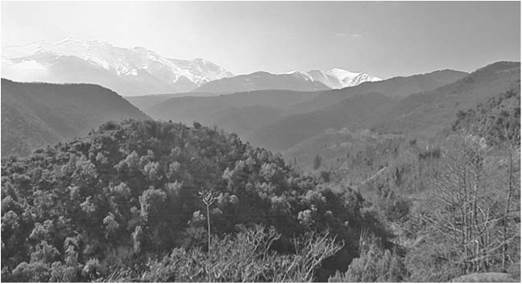
Figure 7.2 The Petra Pass. Photograph by Richard R. Johnson
Dealing with the Greeks also required military action. Revolt in Thebes while the army was occupied in the northeast instigated a rapid return to Pella and thence into central Greece. Thebes was besieged, taken, and virtually destroyed. It is noteworthy that Alexander spared the house of Pindar (Arrian I.9.10) while he eliminated the physical entity that had been one of the leading poleis of Classical Greece. Greek culture was valuable and should be preserved; the independent polity was uncontrollable, thus expendable. A Macedonian king’s role in the Greek world now also demanded administrative savoir faire inasmuch as Philip II had been Thessalian tagos, a member of the Delphic Amphiktyonic Council, and hegemon of the Teague of Corinth. His son assumed these positions along with treaty rights that had been forged by Philip. The continuation of the Teague entailed an obligation, again a legacy from Philip, to undertake war against the Persians.
After visiting Delphi and its oracle, Alexander returned to Pella to prepare for that obligation. Training his force, organizing supplies, readying ships for the crossing into Anatolia, naming a regent to control the full extent of the kingdom were joined by another march northward toward the Danube: the foray would be useful practice for the troops and test the machinery of war, while success would hopefully lighten the regent’s task. All the objectives were achieved.
Further pacification of traditional enemies provided another incentive for undertaking the charge of the League of Corinth. The recognition that a standing army was crucial to the very existence of a Macedonian kingdom entailed an understanding that the army must be employed in its natural task. If the enlarged kingdom did not require constant attention, the army could exercise its skills further afield. Second, the use of special military units from the recently incorporated territories would not only extend the range of the Macedonian force but deprive potentially restive portions of the kingdom of some of their means to revolt against Macedonian control. The Thessalian cavalry that fought brilliantly under Alexander’s leadership against the Persians (Arrian III. 15.3) could not aid a Thessalian uprising against the regent. The 7,000 Greek troops from the League of Corinth were removed from sources of potential discord in southern Greece while Alexander and his army were advancing against the Persians. Nor could the Agrianian archers and other tribal levies aid their once-independent leaders.
In light of his inheritance, his relatively smooth succession, and initial successes in dealing with uprisings on the part of components of the kingdom, we may attribute a sense of confidence to the 22- year-old king as he prepared to continue his father’s attack on Persia. His confidence was strengthened by knowledge of recent events in Persia: in 338 the Achaemenid king, Artaxerxes III, had been murdered by a “trusted” advisor Bagoas, who established a son of the murdered king as Artaxerxes IV while proceeding to purge the other royal sons. Two years later, the puppet Artaxerxes along with his own children was killed by the same advisor, and a cousin of Artaxerxes III succeeded to the throne, again through the efforts of Bagoas and the fact that few other candidates were still alive. We have noted, in chapter 5, that occasions of succession regularly produced uprisings in parts of the vast empire. These three years of purges and unsteady central control would have provided an excellent opportunity for revolt or for the success of an invading force.
First-hand information about the nature of the Persians was available to Alexander in several forms. Greek sources included written accounts. Herodotos had spent his youth in the Greek polis of Halikarnassos in Asia Minor when it was under Persian control, and later he had visited as least some parts of the Persian Empire in the course of his inquiries for writing of the Persian Wars. Xenophon’s Anabasis recounted the adventures and misadventures of himself and other Greek mercenaries hired to replace Great King Artaxerxes II with his younger brother Kyros. The Greek physician to the Achaemenids wrote 23 books on Persian history, now lost but for fragments, while Khoirilos of Samos recounted the tribal groups that had crossed the Hellespont with the Persian migrants. Word of mouth offered other information. A satrap of the territory of the old Assyrian center took refuge from his Achaemenid ruler following an abortive uprising: together with his family, Artabazos lived for 10 years at Pella. It is noteworthy that two Greek brothers entrusted with important naval commands by Dareios III were related to Artabazos by marriage. Alexander’s tutor, Aristotle, had spent some years in the small kingdom of Atarneos in the Troad. Its “philosopher-king” Hermias was suspected of collusion with enemies of Persia (as we have suggested, perhaps Philip of Macedon), and was put to death on the orders of Artaxerxes III. Envoys, too, traveled between Pella and the Persian capitals. Yet another important source of information was the reconnaissance of scouts, an important element of the Macedonian army from the time of Philip if not earlier. Finally, there are several similarities between the two kingdoms: both were monarchies with a centralized administration; they were extensive in territorial size and population by comparison with the Greek poleis; multiple cultures were drawn together by initial conquest and held, more or less tightly, by a strong military. These similar characteristics produced many of the same problems for the kings of both realms. We will return to the likenesses in examining the nature of Alexander’s efforts to weld the two kingdoms into a single empire.
The Campaign
Alexander’s brilliant generalship is not disputed. In the summary of his study The Generalship of Alexander the Great Major General J. F. C. Fuller begins with the category “As Genius.” We will not deny that genius if we argue that it was, in many respects, predictable. He possessed the legacy of his father’s work: a honed, loyal standing army and a staff of seasoned superior officers. The recruitment of future subordinates through the training of aristocratic youth at Pella had already produced men of Alexander’s own age who could eventually replace the older men. While that army, and its commanders, derived from a variety of backgrounds and military tactics, the units operated as a single unit. Even though Alexander’s force included mercenaries, they accounted for only a seventh of the total (or an eighth, depending on the full complement of the force). The great majority were bound to Alexander through his kingship, leadership of the League of Corinth, and treaty alliances. Furthermore, Philip had expanded the production of military equipment to include siege machinery and catapults capable of hurling stones weighing as much as 50 pounds (over 22kg).
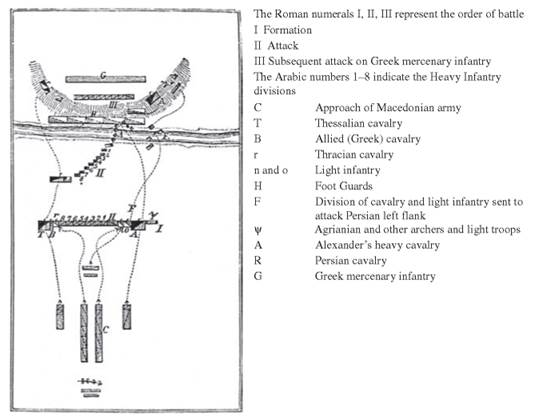
Figure 7.3 Battle of the Granikos. Source: J. P. Mahaffy, Alexander’s Empire, London: T. Fisher Unwin, 1887, Il. 1, p. 13
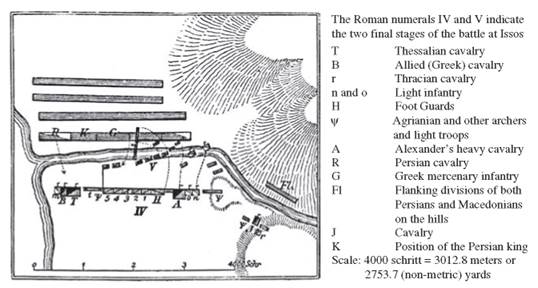
Figure 7.4 Battle of Issos. Source: J. P Mahaffy, Alexander’s Empire, London: T. Fisher Unwin, 1887, Il. 3, p. 25
The education that the Macedonians, including Alexander, had received from the land of Macedonia also contributed to Alexander’s genius. The major battles fought and won by the Macedonians under Alexander’s command often took place at rivers. In the first encounter at the Granikos in northwestern Anatolia Alexander, riding his totemic steed Bucephalas, led his army across the river to charge up the opposite bank, along which the Persian force was arrayed. The battle of Issos found the two forces on either side of the Pinaros River; again the Macedonians, with Alexander leading, charged across the river. Although Gaugamela lacked the element of a river, it was necessary to cross the Tigris with its swift current (Arrian III.7.5). The Macedonian defeat of the Indian force under Poros required intricate knowledge of the monsoon-swollen Hydaspes River. After this initial success, the Macedonians traveled south along the length of the Indos to its mouth on the Arabian Sea in vessels that Alexander had ordered constructed for him. Arrian reports that Alexander himself first explored the two mouths of the Indos and then, with a portion of his cavalry, spent three days exploring the coast in advance of the sea voyage of a portion of the Macedonians from India to the head of the Persian Gulf. Knowledge of the importance of waterways for communication and unification gained was a valuable by-product of his Macedonian heritage.
Macedonia also taught him well how to deal with mountains, essential to the successful campaigning in central Asia. At the citadel of Sogdiana in Bactria, Alexander discovered that it was sheer on all sides and covered with snow and that those holding the citadel were well provisioned for a long siege. Even so, he determined to attack. His enemy shouted down that he should find some winged solders if he hoped to succeed. He found 300 such men, who fixed iron pegs into the snow and with the aid of the pegs made their climb at night. Only 30 were said to have perished. When the occupants of the heights saw these winged soldiers at dawn, they surrendered (Arrian IV.18.5-19.4). Later his Macedonians succeeded in capturing the rock of Aornos, the site that had once held out against the mighty Herakles (Arrian IV.30.1—4).
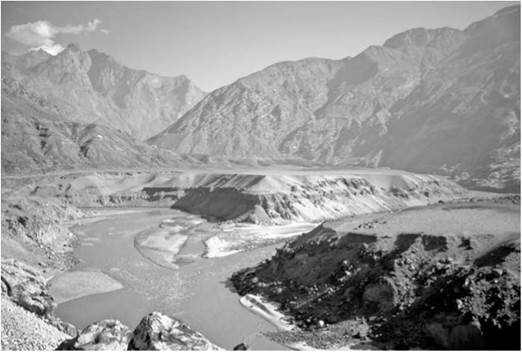
Figure 7.5 Indos River at the junction of Indos and Gilgit rivers. The Himalayas are shown ending in the east and Karakorams in the north. Photograph by and courtesy of Prof. Daniel Waugh
In addition to the skills developed by service in Macedonia, Macedonian soldiers had gained considerable skill in siege. When his engineers calculated that the height of the Gaza fortifications was too great for siege engines to be effective, Alexander disagreed. Gaza was taken with the aid of those engines (Arrian II.25.2). Ordinary soldiers too were practiced in siege: at Sangala in India, even before any part of the wall was battered by engines, the Macedonians began to undermine it (Arrian V.24.4).
Macedonian leaders appreciated the value of those who had acclaimed them kings. Pressures on the core of the kingdom were constant and existed on every border. Soldiers trained to withstand and, hopefully, prevail over Illyrian, Thracian, Greek, and other incursions were the key to the integrity of the realm. These potential soldiers were raised in conditions that honed their physical fitness: shepherds moving flocks from lower winter pastures to summer pastures in the mountains; hunters of wild beasts; farmers. Such men could be doughty warriors and a wise ruler would appreciate the value of his Macedonian men-at-arms. When Alexander sought to press eastward in India, his Macedonians described their weary longing for family and their homeland (Arrian VI.27.2—9). Alexander believed that they would change their collective mind but, when that did not happen, he made it clear to the army that he had decided to turn back.
The middling location of Macedonia - its proximity and its attractions for others - offered further insight for the Persian campaign. Isolation from others was impossible. Consequently, gaining familiarity with likely enemies would be an important asset. As we have sketched above, Alexander watched the expansion of the territory of Macedon and of the increasing interaction with other peoples. Plutarch reports that when Alexander was very young he conversed with envoys from the Persian king while Philip was away. Supposedly, his questions were about road systems, the king’s character, and the numbers of the Persian troops. Even if this report is not accurate, Pella had become a hive of international activity during Alexander’s childhood. His world extended beyond the traditional Macedonian sphere.
Surely this is essential knowledge for one who had to deal with other cultures, perhaps even in ways that are intelligible to those cultures. Philip had learned the nature and value of Greek institutions as his control extended further south in Greece. Not only did he assume certain official Greek positions but he created new organizations on Greek models. Alexander inherited these positions and organizations and, as he was successful in the Persian Empire, he involved himself in the Persian structure as well. Indications of Alexander’s grasp of this knowledge come in the form of maintaining existing institutions - satrapies and satraps, the vast machinery of treasury and recording at Babylon. He also appointed natives to positions of authority in newly conquered regions - for instance, friendship with Artabazos, who had earlier taken refuge in Pella, kept Artabazos and his sons in honorable positions in the new scheme of governance of the Persian Empire (Arrian III.23.7). In doing so, Alexander mirrored similar actions of Philip: Greek states continued to possess their polis way of life, albeit under the oversight of Macedon; the royal family of Epiros continued to rule the kingdom under the same oversight. Loyal Persians might expect their own fortunes to be comparable.
On the other hand, too great a leaning away from the Macedonian “way of life” could be dangerous, as we have seen in the case of the feelings of Alexander’s companion Kleitos. When the man who had saved Alexander’s life at the Granikos accused his king of taking excessive credit for success on his own part, he died bythe hand of Alexander. Later Alexander was forced to alter his plan to march eastward in India when his Macedonians refused to continue. It is worth remembering that while the Greek contingent in Alexander’s army was released at Ecbatana in 330, no such offer was extended to the Macedonian troops.
To repeat, his inheritance does not fully explain Alexander’s success: nothing in his training had prepared him to reckon with elephants; the administrative structure of Pella was simple by comparison with that he found at Babylon; no Macedonian road was as long or as conducive to rapid travel as the Persian royal road. Major and quick adaptation of his tools was essential. His success at doing so is a measure of his own impressive abilities.
Can we see into Alexander’s mind as he was adjusting to the circumstances of the vast empire during the 10-year campaign? Did he exchange his Macedonian kingship for the status of Great King of Persia? The evidence indicates that he did not. To be sure, he added Persian military units to his army: Indian mercenaries (Arrian IV.27.3), 20,000 Persian soldiers as well as Kossaians and Tarpurians (Arrian VII.23.1), cavalry composed of the sons of important Persians (Arrian VII.6.4-5) and 30,000 Persian youths. The incorporation of foreign corps was a regular practice of both Philip and Alexander in preparation for the campaign. Moreover, the new recruits were trained in the Macedonian military tradition in what may have been a version of the training in Pella of the sons of Macedonian aristocratic families (Arrian VII.23.6.1 and VII.23.3-4). Nor did the retention of Persian officials cause a lessening role for Alexander’s own subordinates. Loyal subordinates whose relationship with Alexander stretched back into childhood rose to positions of ever greater importance. At Susa in 324, these companions were joined even more closely to their Argead king through the instrument utilized by Amyntas III and Philip II, namely marriage. Through Alexander’s and Hephaistion’s marriage to sisters, their children would be cousins (Arrian VII.4.5). But the word “loyal” must be emphasized; disloyal subordinates, whatever their ethnicity, would be punished, often by death. As Macedonian king, Alexander was fully aware of his precarious position long before he sat on the throne of the Achaemenids, who had the same fear of traitors and rivals.
We should consider Alexander’s marriages in the light of his possible Persianization. At Susa, he took as wives one of the daughters of Dareios III and a daughter of the previous king, Artaxerxes IV. He had previously married Roxane, daughter of the Bactrian leader Oxyartes. One lasting friendship, with Barsine, a daughter of Artabazos, who was a coeval of Alexander and had spent some ten years in Pella with her satrap father and the rest of the family, was renewed in Asia. Some sources report that a son of Barsine and Alexander bore the name Herakles. There were no marriage ties to Macedonia. Remembering Philip’s wives, however, puts the role of Argead marriage into proper focus: of Philip’s seven marriages only one - made in 337 - was with a Macedonian woman. The other six were guarantors of alliances, even if some produced genuine affection. Had Alexander lived to the age of 45 - the age of Philip in 337 - he is likely to have married several more times, perhaps even to a noble Macedonian woman.
Surely the still youthful conqueror would be immensely proud of his accomplishment. Did he become delusional, believing that he was more than human? Why at the end of his campaign would he send an order to the Greeks that he should be worshiped as a god, as some of the sources report? Perhaps it was due to the assumption of the role of Great King of Persia. On the other hand, an intimate association with heroes and even great gods was customary for Macedonian kings before Alexander. Consider the expenditure of precious time to cross the 370 miles (600 km) of desert to the oracle of Ammon in western Egypt to “learn more accurate knowledge of himself” (Arrian III.3.2) From childhood, Alexander was taught to appreciate his lineage, extending back to several heroes - Herakles, Perseus, and Achilles - but also to Olympian Zeus. By his deeds, he had demonstrated his kinship with the heroes, and by his regular sacrifices he revealed his reliance on Zeus’ good will. As early as the fifth century, Herodotos knew that the oracle of Ammon was also an oracle of Zeus (11.55). We have argued that the views of the ancients deserve respect, even if they seem outlandish in the twenty-first century ce. Would a Macedonian king not perform the traditional acts to seek the favor of the father of men and gods even in Egypt? Having acquired Egypt without battle, he would soon lead his men back into territory not likely to be so easy to take. Egypt had only been reattached to the Persian Empire 10 years earlier, after nearly 60 years of independence; regions of the Levant were scenes of sporadic uprisings. To secure the ongoing good will of Zeus-Ammon was essential. What other Egyptian oracle was so linked to Zeus? Zeus remained a helpful aide to Alexander all the way to India and then back to Babylon. With their growing success, both Philip and Alexander exhibited their impressive ancestry and did so in rather exuberant fashion: we remember that Philip had his own image carried together with those of the 12 Olympians.
The Empire of Alexander
Schemes of periodization often use Alexander as the start of a new age: beginning in 336 or perhaps 323 the Classical Hellenic Age yields to the Hellenistic era. Greeks, Greek culture and language, even Greek poleis continue but they are enfolded in something larger and not altogether hellenic. To determine the correctness of this scheme, let us consider the nature of the empire that Alexander had created and had begun to organize. How greatly had he departed from his Macedonian heritage?
It is obvious that the amalgamation of the Macedonian and Persian realms produced a new state, something that the Persians under kings Dareios I and Xerxes I had attempted in the early fifth century but had failed to achieve. During Alexander’s lifetime, few of the existing structures of either realm was changed; he employed the tools of both. As commander of the Macedonian army, he was inextricably committed to reliance on the force that had proved so successful. To the advance force of c. 10,000 infantry and 1,000 cavalry dispatched to Anatolia by Philip, Alexander added another 30,000 infantry and 5,000 cavalry These troops were primarily Macedonians, Macedonian subjects, or Greeks, both members of the Teague of Corinth and mercenaries. As control over once-Persian lands expanded, troops from Persia were incorporated into the army. In other words, the practice was continued of strengthening the security of the territory under Macedonian rule through a standing army composed of men from all regions. Their training was in the Macedonian military fashion.
In succeeding to the kingship, Alexander was obligated to begin hostilities with the Great King of Persia through Philip’s announcement of the charge to the Teague of Corinth, a history of fear of Persian expansion westward shared by Macedonians and Greeks, and the necessity of providing employment for the vital tool of Macedonian existence. But need Alexander advance beyond Asia Minor into lands where there were few Greeks to be freed from Persian overlordship? Two motives seem likely. First, Macedonian expansion from the fifth century on, especially during the reign of Philip II, presents an underlying image: the coherence of lower and upper Macedonia brought threats from more distant peoples, for example Illyrians and Greeks, just as Macedonian activity in the Black Sea raised the enmity of Anatolian Persia. A second motive was surely the existence of good opportunities as, for instance, in Egypt, which regularly smarted for return of its independence from Persian control.
In addition to military strength, Alexander engaged other means of unifying the vast territory. He established garrisons in regions not fully pacified that were vital to communication, in already or recently fortified citadels, and in association with major settlements. Some were temporary but others were permanent. There is little departure from the practice of previous Argead kings. Alexander was enthusiastic about creating new settlements that were more than military garrisons. Seventy such foundations are attributed to him but only twenty-five or so are certainly known. Some were refoundations; others were new; some were royal residences converted into cities. A recognition of the value of royal foundations was instilled early into a potential successor. In 340, for instance, Alexander led a force northward to deal with a rebellion of the Maidi and, on capturing the rebels’ center, he refounded it as Alexandropolis, echoing Philip’s several sites named Philipopolis and one named Philippoi.
The practice is indicative of the Macedonian governance: monarchies require administrative and economic centers, but they do not easily tolerate autonomous states within their territories. A decision to establish a secure center for Argead control was taken in the late fifth century, and we have stressed the likely intensification of activity at Pella from 359 to 336. Alexandria in Egypt is similar to Pella in its protected setting on a river removed from the seacoast, planned nature, and the union of royal residence with the machinery of governance.
Philip and Alexander were not compelled to erase all earlier settlements. Corinth was strategically located and a valuable center of production and trade. Those features could argue for its continuation, but as a meeting place for members of the king’s League. The elaborate bureaus of accountancy centered in Babylon were essential for management of an empire, be it under an Achaemenid or an Argead king.
Alexander became both Great King of Persia and basileus of the Macedonians (and others). He also added new official positions to his repertoire in succeeding the Pharaohs of Egypt, in making alliances with some, in becoming the adopted son of a ruler, and through marriage with important families in the newly conquered lands. No earlier Argead king had been Great King of Persia, but Philip had demonstrated well the value of accumulating a variety of official positions in his own being.
Can a similar link with earlier Macedonian tradition be argued for the culture of the “new” age? Do the distinctive elements of earlier Macedonia vanish with the use of Greek language and culture as a thread offering some form of unity in the hugely diverse environment of Alexander’s empire? It cannot be denied that Alexander’s success was the foundation for developments following his early death. The outcome of the struggle for succession was the kingdoms of the Hellenistic Age, not a Macedonistic or neo-Persian Empire. But the interaction of Greek and Macedonian elements was not new; our consideration of earlier interaction between Greece and Macedonia has led to a conclusion that the adoption of Greek language, religion, customs, and institutions was well established before the reign of Alexander. In fact, his father’s reliance on Greek aides is good testimony - not only human assistants but divine partners as well. Alexander was educated by Aristotle, he was supported by Zeus. Certainly, the hellenism of Macedonia was entwined with older Macedonian customs and beliefs: thus the cultural bond of the new empire of Alexander was a Macedonian brand of hellenism. By the early years of the successor kingdoms in Egypt, Asia, and Macedonia itself, the two cultures had grown even closer. That closeness presupposes a longer period of interaction than the 32-year lifetime of Alexander III.
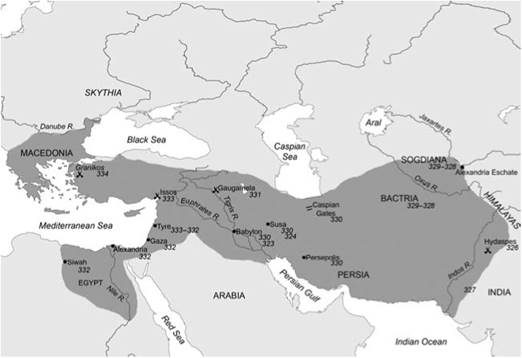
Map 7.1 Alexander’s empire
None of the description of the impact made by the conditions of the world into which Alexander was born and which served to mold his life is intended to diminish his ability and accomplishment. The interaction between society and individual members is mutual, so that the rules and structures of a culture set boundaries, on the one hand, but individual reactions to existing conditions can effect significant changes, on the other. Some people have more impact on their worlds than others. Alexander belongs in the first category.
Appreciating the nature of his several worlds enhances our understanding of this dynamic young man whose thoughts and emotions are hidden from us. The influences of the Macedonian physical environment, his status as a member of the Argead ruling line, and his training to be a potential successor to Philip II combined to produce a youth driven to excel everyone. His body had to be absolutely fit, his mind trained in every task of leadership for quick, wise response. Ancestors that included Herakles, Achilles, and even Zeus would provide some assurance that he would succeed. Accomplishing heroic deeds of his own as great or greater than those of his ancestors might well have deepened his belief that his status was special. The tasks awaiting him on the murder of his father were defined: traditional enemies must learn immediately that the new king intended to maintain the kingship he inherited, but also he must act in the charge of war against Persia. In addition to the tasks, he had inherited the necessary tools: an excellent military force and knowledge of the enemy’s present condition.
As the Macedonians moved deeper into Persian territory, he discovered that Macedon and Persia had several common qualities and thus the two states might become a single realm under a single ruler. Both vested power in a king, and while the administrative apparatus of Macedon did not match that of Persia, division of responsibility was increasing in Macedon. Even earlier, Argead kings made treaties and alliances in their names, and Philip had assumed official positions in territories brought under Macedonian control. Alexander was expanding the established Macedonian practice. Not everyone agreed with the blending; dissenters could not be tolerated. The elimination of perceived threats was second nature to any Macedonian king. The legacy served him sufficiently well that he could advance further and further into the Persian Empire and, if he had been able to persuade his Macedonians, well beyond its eastern limits.
Sources describe various plans that Alexander had formulated after his return to Babylon in 324. However, his death the following year cut short whatever intentions he had in mind, for on his death certain leadership ended in the shuffling for power amongst his successors. It is possible, nonetheless, to sense the broad scheme of future plans. Since the Macedonian military capability had been the instrument of creating and enlarging the kingdom, the army would have remained the essential tool, and its form would have been Macedonian even though non-Macedonians were added to its complement. Portions of the military would have been stationed in garrisons, but the core would have been mobile in enforcing the cohesion of the realm and in expanding its borders. The king himself or, when division was necessary, a trusted companion would have led the force. Acclaimed by the army assembly, Alexander would have understood the need to be one of the army, leading directly, knowing the names of his comrades, holding councils with his chief subordinates as well as carousing and hunting with them on a regular basis, and directing religious ceremonies. Surely Zeus and other major deities would not have been replaced by Ahura- Mazda. In all these capacities he - and they - recognized Alexander’s superiority, demonstrated by his understanding of tactics and strategy as well as his brilliance in combat.
In addition to the military base, Alexander would sustain existing centers and establish new foundations as he had done in the early years of his reign. They supplied the administrative needs that Pella filled in Macedon and that Babylon, Susa, and Ecbatana contributed to the Persian Empire. Moreover, they could cement the diverse cultural mix of the new realm, again a function of the centers in both Macedon and Persia before the two were joined.
In sum, we may best understand Alexander III of Macedon as intensely driven throughout his entire life. From birth, as a member of the ruling branch of the Argead line, his life was endangered. In fact, there were threats to the boy from within that very branch in the form of cousins and other members of his father’s polygamous family. As a healthy, sane son of the king, he would have been pushed by his father to develop the skills required of a future king, while his mother, a non-Macedonian, would hone his skills in other ways as, for instance, through the choice of her kinsman Feonidas as his early trainer. From both parents, he would learn that his lineage promised that he could aspire to the accomplishments of Achilles, Herakles, Dionysos, and Zeus.
Familiarity with the nature of Macedonia and neighboring regions was essential to the defense of its borders. That nature was rough, demanding excellent physical fitness to climb mountains, ford rivers, defend narrow passes. Competition with other youths in the training at Pella was further motivation to excel if ever he hoped to win their respect as their king. Since the king’s boys were of aristocratic birth, their fathers would have been skilled horsemen. So too must Alexander exceed them in horsemanship.
With the successful enlargement of the kingdom came administrative needs, another category of Alexander’s education. Fife in Pella would provide acquaintance with the several units, while knowledge of a king’s treaty-making and assumption of multiple official positions gained through the conquest of other states derived from Philip. A further dimension was added by his later tutor Aristotle. On Kingship, though lost as we have noted, would have addressed theoretical aspects of governance.
Alexander was thus tested constantly in the course of his young life. When he reached early manhood, that testing took the form of official positions: serving as regent, commanding a wing of the army. A good showing would win the respect of older subordinates of the king for a youth perhaps less than half their own age. Might the boy be nearly as skilled as Philip? Might the boy push himself to be better than Philip? Surely an estimation that he might be able to lead in ways at least akin to those of his father caused his father’s men to support the army’s acclamation. And that acclamation came from many who had experience of Alexander’s abilities through their mutual training.
Does the first nearly two-thirds of his life allow much time for quiet, private relationships such as marriage to a woman of his own choice? No. Marriage for the Argeads was now primarily a diplomatic tool and, until his death, Philip was the agent for such marriages. Nor did the first two years of Alexander’s reign demand new marriage alliances; Thrace, Greece, Illyria, Epiros were already drawn into the web of treaties cemented through marriages. Moreover, there is sound reason to suspect that the atmosphere of the domestic quarter at Pella was none too cordial. On the other hand, Alexander was capable of great love, especially for companions who had risked their own lives on his behalf, and who had followed his commands and done so competently. His relationship with the Greek/Persian Barsine - first as friend in Pella, later as mistress in Persia - is somewhat akin to his relations with his male friends. But would he have felt absolutely secure even in the embrace of these companions?
This essential, indomitable drive was the foundation of his success, and it would have been apparent in his physical presence. We cannot know whether his eyes were startlingly blue in color, but we can believe that his gaze would have held the attention of all who looked into those eyes. We do not know whether he was short or broad-shouldered, but it is certain that he was fit for any physical task. Alexander was fortunate in his circumstances. He used the product of those circumstances brilliantly.