
6
In his broad retrospective Memory and the Mediterranean, Fernand Braudel wrote of “Alexander’s mistake,” namely leading his troops eastward rather than toward the west. Had he made the decision for the west, “might it not have pre-empted the destiny of Rome?” (p. 250). After all, contemporaries, even another Alexander — his brother- in-law who was king of Epiros - had turned their attention to Italy. However, few fared well. Surprisingly, Alexander III of Macedon enjoyed phenomenal success against the vast, wealthy, and mighty empire of Persia. The choice of foe and the Macedonian success both deserve consideration. Why was Persia Alexander’s target? What was the condition of that empire in 336? In addition, there are several other issues that will help us understand Alexander himself: how deep was his knowledge of the Achaemenid Empire and how foreign were its structure and culture to him? Did the conquest of Persia influence his subsequent plans?
The Creation of the Achaemenid Empire
Complex cultures emerged in the late fourth millennium in the eastern Mediterranean in the form of individual city-states. As these Mesopotamian states expanded their territory, larger kingdoms arose in the late third and second millennia in Egypt as well as the Near East. At the same time, those civilizations acted as magnets, drawing new peoples into their webs of activity. By the late second millennium, the eastern Mediterranean region was dominated by two major powers: Egypt in the south and the Hittite realm in the north. The still mysterious collapse of civilizations at the end of the second millennium atomized power bases for several centuries. However, in the sixth century, late entrants into the region drew together under a single ruler and expanded explosively, becoming the single empire in the eastern Mediterranean sphere. This synthesis was the Persian Empire. In reach, it was the largest state in Mediterranean and Near Eastern history until the consolidation of the Roman Empire: it stretched from Thrace to the Jaxartes River in the north, the Libyan coast to the Indos River in the south. The variety of peoples drawn together by the creation of this vast state was reflected in the philosophy of governance: its overlords encouraged the retention of local cultural traditions beneath the structure of uniform administration.
The empire was formed quickly in the sixth century bce, when several states were contending for sovereignty following the collapse of Assyrian dominion in the Near East in 612. Primary contestants were the older kingdoms of Babylonia and Egypt, now freed from foreign control, and the Indo-European Medes, who had arrived more recently; their reach extended southward from west of the upper Tigris toward the Persian Gulf. In their successful drive, the Medes had established sovereignty over another Indo-European people, the Persians, who were less unified than their linguistic relatives and, thus, vulnerable to more powerful neighbors. A marriage between the daughter of the Median king and Kambyses I of Persia reversed the roles of the two peoples: a son of this marriage, Kyros by name, conspired against his Median grandfather, who capitulated in 559. Kyros was the first in the Achaemenid line of kings — named after a claimed ancestor of the line, Achaemenes - which continued until Alexander of Macedon assumed the kingship.
Kyros won the title “the Great” through a whirlwind career of establishing the basic boundaries of the empire. Having inherited the Median quarrel with the Anatolian kingdom of Lydia, he took to the field with his army and decisively defeated the Lydian force in 546. Then he moved to the coast of Anatolia, thereby drawing the Greek poleis of Asia Minor into the expanding realm. In Mesopotamia, he was invited to assume management of Babylon, which he did in 538. With that acquisition, he gained the territory west of the Euphrates River. Persian soldiers were active in the east as well, in modern Afghanistan, outer Iran, and beyond to the borders of modern India. Kyros did not establish sovereignty over the third contestant for power; the addition of Egypt to the empire was left to his son and successor, Kambyses II (530-522) after Kyros had been slain in battle with the Massagetai in the northeastern portion of the realm. Kyros had previously named Kambyses king of Babylon, where he seems to have remained for much of his reign. In 526 he organized the invasion of Egypt, which was brought under Persian control by summer of 525. Apart from enlarging the empire, a fondness for atrocity describes his reputation in the accounts of Egyptians, Greeks, and Persians alike. He died, by his own hand or by murder, in 522.
With the inclusion of Egypt, the empire reached nearly its greatest size. It was clear that direct rule by a king situated in the old heartland of Persia would not provide effective control. Moreover, many of the incorporated territories had discrete boundaries as well as long-established systems of governance. The Achaemenids utilized both the recognized regions and their structures in devising their own administrative structure. The regions were satrapies, each ruled by a satrap, or “protector of the realm.” Appointment by the king symbolized the fact that ultimate authority rested with him. Another tie existed in the personal bond between the satraps and the king: the importance of personal bonds of loyalty between individuals, so common in tribal societies, seems to have formed the basis of satra- pal authority. Initially, satraps were members of important Persian families or clans whose support was essential to the stability of Achaemenid rule, rather than members of the ruling family itself. In some parts of the empire, local dynasts continued in power, carrying out the responsibilities of a satrap. Such was the case in island realms drawn into the empire. Evagoras of Cyprus is an example of the persistence of local forms of governance, albeit now under the oversight of the imperial structure.
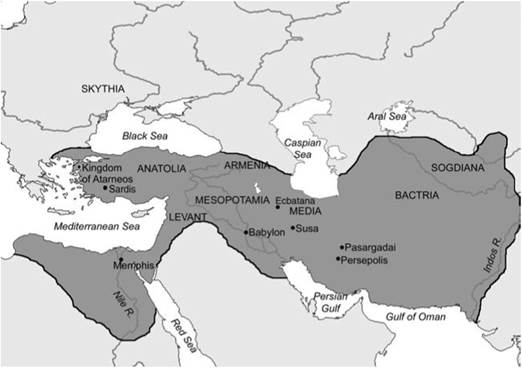
Map 6.1 Achaemenid Persia
Under Kyros and Kambyses, military responsibility was the chief duty of the satraps, for although formerly independent kingdoms and regions had been conquered, many were not thoroughly pacified. Even when peace had been established, the maintenance of internal order was an ongoing need. The support of troops added an economic dimension to the satraps’ responsibilities: the levy and collection of taxes as well as the requisition of goods and perhaps land for garrisons would fall to the protector of each realm. Although changes to the nature of satrapal responsibilities occurred over the nearly two centuries between the death of Kambyses and the end of Achaemenid kingship, the essential structure of local control of regions within a centralized overlordship persisted.
Upon the death of Kambyses, a serious struggle for supreme power ensued, though the details are unclear. The contest ended in 522 with the success of Dareios I, a member of an important Persian family that had played a strong role in the formation of the empire under Kyros. His claim to be the ninth ruler of the Achaemenid line is problematic because of varying genealogies extant for Kyros and Dareios I, but Dareios’ claim was respected by contemporaries and successors. His initial attention was directed toward quelling uprisings in many parts of the realm. With the support of leaders of loyal regions and their forces, Dareios pacified most of the rebels within a year, although revolts continued in some recalcitrant areas such as Babylon.
It may well have been the overly impressive military power of certain protectors of the realm that led to a restructuring of satrapal authority. The largely independent military authority of the satraps was now limited by the division of authority between two officials: the satrap was the chief civil authority, but military commanders within the satrapy were directly responsible to the Great King. Most likely associated with the attempt to rein in satrapal power was the institution of “king’s scribes,” “king’s eyes,” and “king’s ears” to perform and monitor affairs in the provinces. That these innovations were not altogether successful is shown by the continuing difficulty in limiting the independent authority and means of the satraps apparent in events of the fifth and fourth centuries.
Dareios I is highly regarded for the erection of a sound administrative structure for the sprawling territory under Persian control, a structure that would endure to provide the framework for the control of the empire won by Alexander of Macedon. An inscription at Behistun from the time of Dareios describes the 22 lands that were subject to him. In terms of satrapal organization, the division was into 20. Many of the satrapies contained a number of major cities. As was the case in Mesopotamia and the Tevant, these cities provided the means of another level of administration - military, fiscal, and secretarial - although in certain matters local officials were subordinate to satrapal governance. Some cities had unique status: Babylon, for example, was at times under the control of one of the king’s elder sons, likely as a training experience for his future when he succeeded his father. The elaborate administrative structure inherited from the past millennium and a half made Babylon a critical hub as well as an excellent training ground.
Tablets from Persepolis describe the ladder of power for the central satrap of Persis, a structure that may suggest similar arrangements elsewhere in the empire. One Pharnakes, a brother of Dareios’ father, appears to have had charge of the financial, administrative, and royal household affairs of the whole region. An important subordinate official managed the treasury with its regional branches; another seems to have been responsible for coordination of production and supplies; and a third can be associated with the central chancery.
Other titles are recorded. Hyparchs held special commands; one such official had the responsibility for an important fleet base in Asia Minor at Kyme. An overarching military responsibility is attached to the official position of karanos; when the sources discuss a karanos, the responsibility is a command of a great army that combines the forces of more than a single satrap. One Abrokomas apparently held this position on the occasion of the revolt of the brother of a reigning king, who was pressed to draw upon all the military strength at his disposal, not merely that of the core region, that is, Persis.
Military might was essential to the preservation of the empire, and its organization was carefully defined. Infantry units appear to have been built in multiples often from 10 to 10,000, with commanders at each level. The most important, thus most privileged, unit was that of the 10,000 Persian Immortals who served as the king’s own bodyguard in battle. Naval power was equally important to the security of the empire; the seaward regions - especially Phoenicia and Asia Minor - offered both ships and trained sailors. Military service was required of all peoples of the realm: in his account of the Persian advance into Greece under Xerxes,
Herodotos lists 45 different peoples. Another source for both soldiers and officers lay beyond the confines of Persian territory in the presence of the great numbers of mercenaries, both Greek and others, increasingly available for hire in the fourth and third centuries.
One feature of governance in many other states is largely absent: there appears to have been no formal consultative body in the Persian Empire. While the Greek historian of the Persian Wars, Herodotos, describes consultations between Xerxes and his key officials during the Greek campaign, no ongoing forum of discussion played a part in decision-making. Even the members of the seven major families who, in Herodotos’ account, determined among themselves the successor to Kambyses do not act regularly as a group after the decision on the allotment of kingship. In fact, two of those families disappear from the record and descendants of the others are often found in posts far from the royal centers of Susa and Persepolis.
In addition to the division into administrative units and the creation of an organized official structure, the kings worked to tie the far-flung empire together through the building and maintenance of roads, bridges, and ferries. Especially remarkable is the “royal road” that stretched the 1,600 miles (2,600 km) from Susa to Sardis, the western capital of the empire. Provided with guard houses and garrisons, the road was relatively safe for travelers. Moreover, a relay system used by important couriers allowed messages to be relayed in approximately a week, while ordinary travel would require 90 days or more. The development of a single coinage was another form of unification, as it facilitated trade throughout the realm.
At the apex of this structure stood the king, virtually absolute, at least in theory. Kingship belonged to the lineage of Achaemenes, usually passed from father to son. An Achaemenid king ruled as the regent of Ahura-Mazda, the god of all that is good. “By the grace of Ahura-Mazda,” the Behistun inscription of Dareios I proclaims, “I am king; Ahura-Mazda gave me the kingdom.” His word was law; all people were subjected to him and all property was his, albeit through the administrative ladder described above. Still, Achaemenid rulers proved their merit through their own deeds and many demonstrated their worthiness by their physical qualities. A court doctor described Dareios as the most handsome of men. Training in the physical arts of riding horses, throwing spears, and shooting arrows conditioned their physique and bearing. And they were made even more impressive by their clothing and jewels: the costume and jewels of one fourth-century king are said by Plutarch to have been valued at three million pounds of gold. Great numbers of servants holding parasols or flicking away insects or offering drink would add even more aura to the king. Other insignia proclaimed his lofty status: a sacred chariot, a magnificent royal tent, images engraved on the walls of the royal palaces. The Persian custom of acknowledging such status was a posture of obeisance as lesser men prostrated themselves in the presence of the king.
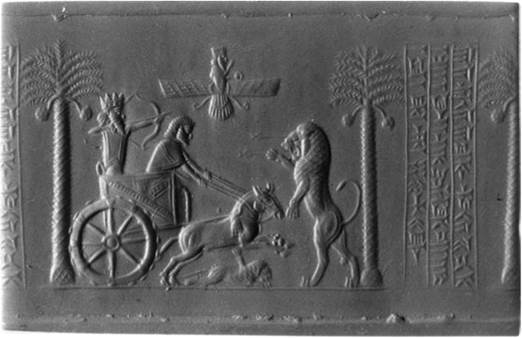
Figure 6.1 Cylinder seal of Dareios.
The king’s well-being, and that of his wives and children, was protected and their pleasures assured. One royal prerogative was possession of a harem, often very large: Dareios III is reported to have lost 329 members of his harem while fleeing Alexander after the battle of Issos. Equally important to his household were eunuchs, perhaps initially as attendants in the harem and caretakers of royal children. Over time, however, they assumed official positions and became confidants and advisors to the king himself.
This picture of the Persian imperial system would differ in various aspects over time. Scholars of Persian history describe its development as moving beyond feudal ties toward bureaucratic structures. With the growing officialdom, the personal leadership of the king was also transformed, and in the transformation, difficulties in maintaining cohesion throughout the vast territory are visible by the mid-fifth century.
Further Expansion
Before the flaws became serious Dareios I and his successor Xerxes determined to expand the realm. After dealing successfully with several uprisings in various parts of the empire and, perhaps, initiating administrative reforms, Dareios turned to further expansion in Skythia and Thrace and, possibly, also in the Indos River region by means of naval exploration from the Persian Gulf into the waters of the Gulf of Oman. In 499, he was forced to deal with another revolt, this time by the Greek states in western Anatolia. With the assistance of two mainland Greek states - Athens and Eretria on the island of Euboia - the insurgents succeeded in taking Sardis. Unable or unwilling to press on with military action, the Greeks were defeated and returned to Persian control by 494. The circumstances of the revolt, however, drew Persian attention to the pesky world of the Greek mainland, a world divided by hundreds of constantly quarreling independent states. Dareios organized two retaliatory actions against the mainland participants in the revolt: the first, in 492, was a maritime expedition into the northern Aegean. Although Thrace and Macedon submitted to Persian pressure, a large portion of the fleet was sunk in a gale off the eastern peninsula of the
Chalkidike with a great loss of men. By 490 the fleet was restored. Sailing through the Cycladic islands, it made for the strait between Euboia and the mainland of Attica to deal with the mainland contributors to the earlier Ionian Revolt. After Eretria was taken, its sanctuaries were burned and its people deported to the heartland of the Persian Empire. Then the Persians turned their attention to the second offender, disembarking on the plain at Marathon in eastern Attica, where 10,000 Athenians with a contingent from the small state of Plataia in central Greece had mustered to contend against a far larger force. To everyone’s surprise the Persian effort at Marathon was defeated.
Dareios made no third attempt; revolt in Egypt claimed his immediate attention. In fact, the former satrapy was not yet restored to Persian control when Dareios died in 486 and his son Xerxes succeeded to the kingship. Only in the second year of the new king’s reign was Egypt returned to satrapal status. It is important to note that its new “satrap” was a brother of Xerxes rather than a member of another aristocratic line. We will consider the significance of this change in policy later.
It was now possible for Xerxes to turn his attention to the unfinished business with Greece. Xerxes mounted a massive campaign to add the mainland of Greece to the Persian realm. A force approximately 250,000 strong, according to modern calculations, was assembled while preparations for the joint venture by land and sea were carefully made. A massive double bridge was erected across the Hellespont for men, animals, and provisions to make an easy crossing; food depots were established along the route; many Greek states were persuaded to ally themselves with the Persians or promised, if not formal alliance, at least neutrality. Xerxes was successful initially: the Macedonian king became a virtual vassal, with the northern kingdom serving as a staging ground for the southward thrust. The Greek forces holding the crucial pass at Thermopylai were defeated and, soon afterward, Athens was destroyed. Despite these victories, however, the Greeks prevailed by sea at Salamis in the Saronic Gulf, persuading Xerxes that he should return to his capital, and in the next year the Greek forces defeated the Persian land force left behind at Plataia. On that same day, or not too distant from it, the Greek fleet won a decisive battle over the Persian fleet off the coast of Asia Minor. A dozen years later, a coalition of Greek states under Athenian hegemony dealt another defeat to the Persian fleet off the southern coast of Anatolia. This Greek success marked the finale in an attempt to free the Greek states of Asia Minor from Persian control and, therefore, reduce the extent of the Persian realm. Their victory would be remembered not only by the Greeks but also by the Macedonians, who had been drawn into the attempted westward Persian expansion.
While these losses did not collapse the bonds of empire, or deplete the treasury, they demonstrated that ongoing expansion so distant from the heart of the empire was unwise. Babylon again rose in revolt and military reinforcements were set in place in Asia Minor in the 470 s. More widespread uprisings began in the next decade, although Xerxes did not live to confront them. His death, however, demonstrates two other serious faults in the structure of the Persian state. He was murdered by the important noble official Artabanos with the assistance of the eunuch of the bedside; Artabanos’ goal, though not fulfilled, seems to have been to become king in his own right. There were other candidates in the persons of Xerxes’ three legitimate sons: Dareios, Hystaspes, and Artaxerxes in order of their age. It was customary for the eldest son of the king to succeed, but in this case Artaxerxes murdered Dareios. Artabanos then attempted to kill Artaxerxes, but was himself murdered. Artaxerxes took the throne, but became secure only after he met the challenge of his surviving brother Hystaspes, who marched with troops from his satrapy in Bactria to contest the throne, only to be killed in battle. To anticipate, the murder of a reigning king and the struggle among would-be successors would come to mark much of the remaining history of the Achaemenid dynasty. It hardly needs mentioning that insecurity at the pinnacle of absolute power disrupts the entire structure of control.
After his rough drive for power, Artaxerxes ruled for 40 years, from 465 to 424. Rather than expanding the empire, he was preoccupied with retaining the territory unified by his predecessors.
The pesky Greeks continued their attacks on Persia by sending a large expedition to Egypt to remove Persian control from that once- independent kingdom. Dispatched in 461, the force enjoyed some initial success and the Greeks were not defeated until 454. A treaty of peace was made between Persia and Athens five years later. In the meantime, Greeks were also active in stirring up problems in Asia Minor. To manage the unstable situation, Artaxerxes sent one of his sons, Kyros, with the rank of karanos, or superior commander, to the region. In addition, one Megabyzos revolted in Syria with the aid of Greek mercenaries, and there seem to have been hostilities in Judah. Other problems surfaced on the periphery of the empire; there was trouble in Bactria, and in Cyprus the native king Evagoras, though nominally subservient to the Persian Great King, had ambitions of his own to add to the territory under his control.
A sign of deeper changes within the imperial structure is the surrender of his private name (perhaps Arshu) in exchange for the adoption of a throne name by the ruling Achaemenid. Artaxerxes means “power through the deity Arta.” The development reveals a subtle change in the nature of kingship: while use of his personal name emphasizes the ability of a king to rule by his own qualities, adoption of a throne name stresses the inherited prestige of the position. Another reminder of kingly power was given by their images now found on Persian coins. Both developments suggest the further institutionalization of the Persian governance.
Artaxerxes I died a natural death, something few of his successors would experience. In fact, his legitimate son and successor, Xerxes, was murdered after a 45-day reign by one of the illegitimate sons of Artaxerxes, Sogdianos. Another of Artaxerxes’ illegitimate sons, Okhos, raised an army in his Caspian satrapy and was joined in his contest for the throne by the satrap of Egypt. Yet another serious problem was that the commander of the household cavalry for Sogdianos had made the mistake of alienating the palace troops. Sogdianos surrendered and was allowed to live for some six months before being put to death. Okhos became king, taking the throne name of Dareios II. His reign to 404 was not peaceful. After facing the revolt of his full brother, Arsites, he contended with rebellions in Media and Anatolia and by a group of people, the Kadousioi, living south of the Caspian. Equally problematic was the involvement of Persia in Greek affairs: a vacillating policy of support for Sparta and its allies and then for Athens was costly in financial expense as well as in prompting different policies among the satraps most concerned with Greece, namely those of Anatolia.
On his death - a natural end, it seems - Dareios II was succeeded in 405 or 404 by his elder son Arses, who took the throne name of Artaxerxes II. Early in his reign, the new king had to deal with his brother Kyros, who was attempting to unseat him. In exercising the military role in Anatolia assigned to him by his father, Kyros had raised a large force, which he now directed against his brother. As we know from one of the participants, the Athenian Xenophon, who describes the expedition in his famous Anabasis, some 13,000 of that army were Greek mercenaries who from 401 marched westward through the empire to do battle with Artaxerxes’ force at Cunaxa, north of Babylon. The outcome was decided by the death of Kyros, allowing Artaxerxes to rule until 359. Those decades were marred with revolts and rebellion. Egypt, which had been independent for sixty years until it had been returned to at least partial Persian control between 404 and 400, revolted. Some fifteen years elapsed before a Persian force was assembled to regain control; that effort failed. The Achaemenid king was occupied elsewhere. Unrest occurred in many parts of Asia Minor due both to internal dissatisfaction and to the military activity of Sparta in the region. The Greek king Evagoras of Cyprus was also extending his activity, taking Tyre in Phoenicia, an event that fostered revolt in southern Anatolia. What is known as the King’s Peace of 386 can be seen in light of controlling the Greek interference in Persian territory, by declaring that the cities in Asia as well as the islands of Clazomenai and Cyprus belonged to the Great King and that all larger associations of Greek states should be ended. This Peace was not successful: in the 360s many of the western satraps were in revolt against the king, a condition that continued into the 350 s.
Even relations within his own family were conflicted: his eldest son, the crown prince, was executed after conspiring against him; another legitimate son committed suicide; a favored illegitimate son was murdered. His surviving legitimate son, Okhos, succeeded to the throne as Artaxerxes III. Testimony from a writer of the first century ce suggests that he was concerned about his own ability to survive threats from family members: to prevent at least some of the attempts, he buried alive the woman who was both his stepmother and his sister, and had his uncle and more than one hundred of his own sons and grandsons locked in a courtyard where they were killed by volleys of arrows.
Thus he lived to rule for 21 years, during which his major success was retaking Egypt in 342. To manage the situation in Anatolia, he ordered the western satraps to disband the private armies that they had raised. That some centralized control was re-established is demonstrated by the decision of the satrap of Phrygia, Artabazos, to seek refuge for himself and his family beyond the reach of Artaxerxes, namely at the court of Philip II in Pella. Revolt in Cyprus was smothered without great difficulty. His commanders even managed to end the revolt of the Kadousioi that had been raging since the reign of Dareios II.
The end of Artaxerxes III was similar to that of most of his predecessors as well as that of his successor, Artaxerxes IV He was murdered in 338 by his own sons with the assistance of one of his most influential officials, the eunuch Bagoas. After ruling for two years, Artaxerxes IV and his sons were purged, again on the plotting of Bagoas. Few successors remained alive. The most eligible candidate was one of the commanders of the campaign against the Kadousioi, a cousin of the king, who had been made satrap in Armenia. Thus he was out of harm’s way during the purge and when invited to assume the kingship, first forced Bagoas to consume the liquid of a poisoned cup intended for his own consumption.
Thus, Kodomannos became the last of the Achaemenid line in 336 under the throne name of Dareios III. By that year, Philip of Macedon had formed the League of Corinth and announced the
League’s declaration of war against Persia. In fact, he had begun to establish forward bases before he was assassinated in 336, leaving the Macedonian kingship to Alexander III. Dareios would thus have little time to set his empire in order before dealing with the Macedonians on Persian soil.
Comparison of the Persian Empire with the Macedonian Kingdom
Most of our information about the Persian Empire comes from Greek sources, and the nature of relations between Persians and Greeks generally imbues those sources with a less than complimentary tone. There are exceptions, to be sure: Xenophon’s Cyropaideia, or The Education of Kyros, has positive comments on many features of Persian life. But even Xenophon speaks of the faithlessness of Persians (Hellenika IV 1.32-3), a trait he witnessed at first hand as one of the Greek mercenaries hired by Kyros the younger in his bid to dethrone the king, who as we have seen happened to be his brother. Plato described the poor administration of the Persian Empire owing to the Persian excess of slavery and despotism (Laws III.694 ff), and Isokrates disparaged the “softness” of the Persians (Panegyrikos 138-49). Such views of one’s enemies are not unique to the case of the Greeks and the Persians; we have seen that the usual depiction of Philip II in the Greek sources was unfavorable, to say the least.
In an attempt to move beyond such judgments to information that may shed more light on Alexander and his career, our attention is focused on the nature of the Persian Empire by the mid-fourth century as Philip was strengthening his Macedonian kingdom and, somewhat later, as Philip and soon Alexander advanced against the empire. How different were the two realms? How full was the knowledge of one another’s territory and its organization? Great differences between the two realms may lead to an appreciation of the flexibility and adaptability of Philip and, even more, of Alexander, who replaced the Achaemenid dynasty with his own rule. On the other hand, a large number of similarities may suggest an underlying rapport that a clever would-be conqueror could employ.
We begin with the physical nature of the realms, their size in terms both of territorial extent and of population. Related questions are how each realm was created and, once created, how it was governed. The merging of varieties of peoples within the two realms produces another question: were local customs of once-independent peoples retained and, if so, what were the political, cultural, and economic consequences of the retention? Inasmuch as the Macedonian kingdom and the Persian Empire were not static entities throughout their histories, it is necessary to inquire whether developments over time provoked internal difficulties.
The Persian Empire was the largest unified realm that the Near East had experienced in the 2,500 years of the growth of increasingly greater states. Approximate dimensions yield a breadth of some 2,500 miles (4,000 km) from western Anatolia to the Hindu Kush, and more than 1,000 miles (1,600 km) from the southern coast of the Black Sea to the northern coast of the Persian Gulf in the region of the Persian capital of Persepolis and Pasargadai. Although population estimates are difficult to calculate, numbers for the Persian Empire were in the millions. Egypt alone in the period after Alexander’s death supported a population of seven to eight million. Individual cities, such as Babylon, grew to 50,000 or more. These peoples were extraordinarily diverse in terms of both ethnicity and way of life. At the core were the Indo-European Persians themselves, whose tribal groups had only recently unified. Unification allowed the extension of control over long-established peoples of Mesopotamia, the Levant, Anatolia, and Egypt in the west; tribal peoples of Arabia in the south; mountain dwellers in central Asia; and, at least through alliance, inhabitants of western India. The political organization of the conquered ranged from personal control by a tribal chieftain to deeply entrenched administrative structures. Just as diverse were the economic structures of the individual elements of the empire: nomads co-existed with highly specialized and carefully managed economies. Many languages, beliefs, and material cultures were concrete demonstrations of the differences of the empire’s inhabitants.
While the territorial size that Macedon achieved during the reign of Philip II paled by comparison with that of Persia, growth over time had vastly enlarged its extent: its physical dimensions had more than tripled since the reign of Alexander I, under whom the size had already grown extensively. The kingdom’s more than 16,600 square miles (43,000 km2) reached from the Adriatic to the western coast of the Black Sea and southward from the Balkans through the mainland of Greece. The population was not as large as that of the Persian Empire, yet an estimate suggests nearly a million inhabitants through the whole of the territory under Philip’s effective control by 336, also a tripling since the end of the fifth century. Viewed in comparison with the size of states in the western Aegean, Macedon was gigantic. The diversity of its population was also notable: although most of the peoples drawn together by Philip were Indo- Europeans, their languages and cultures varied widely. Greeks had lived a polis way of life for centuries; the Illyrians and the Thracians retained a tribal existence; and the inhabitants of lower Macedonia were witnessing the creation of the administrative structure of a growing kingdom.
The physical extent of both realms produced problems of communication. We have noted that the further expansion of Dareios I and his son Xerxes I was repulsed by the tiny poleis of the Greek mainland. The regions most distant from the Persian capitals were often in rebellion from the reign of Artaxerxes (465—424): Greek Asia Minor was a source of constant concern as Greeks from the mainland sought to free it from Persian shackles. Egypt, too, was difficult to control: after becoming independent before the end of the fifth century, it remained free until 343. It might have been retaken earlier when the Persians won control of one of the mouths of the Nile in the late fifth century, which put them in a position to take the capital of Memphis by surprise. By the time the commander had referred the plan to the king for approval, the defenders had gained the upper hand. More inaccessible areas throughout the empire were hot-spots throughout much of the Achaemenid period, but increasingly revolts occurred closer to the Persian capitals. Media was in revolt during the last years of Dareios II. Even the satraps, whose positions were due to the king, could amass large armies and, thus, independence from royal control. Some of this freedom was exhibited in the rivalry between the satraps of larger regions. During the 360s, on the other hand, all the western satraps were in revolt against Dareios II.
And as the Macedonian kingdom expanded, it was impossible for the king to personally command armies in all areas of unrest. Thus he had to rely on his subordinates. It required time, for example, for reports to reach Philip from Parmenion, who had been designated to command the contingent of 10,000 troops sent to Asia Minor by Philip. Philip’s own actions depended on the success or failure of troops under the command of others.
The two realms were alike in their creation through military means, which has been summarized in this chapter for Persia and in chapter 5 for Macedon. Gaining a secure independent existence was the motive for both the early Achaemenid and Argead rulers. Persia had been subservient to Media before the reign of Kyros, while the small kingdom of Macedon was threatened on all sides by stronger powers. Although the Persian expansion was more rapid and far more extensive, the maintenance of the unified empire demanded ongoing military strength and the regular exercise of that strength. Macedonian unity over wider territory ebbed and flowed with the continual threats from Illyrians, Thracians, Greeks, and, as we have seen at the end of the sixth century, Persians, thus requiring a similar military readiness.
In addition to force of arms, unity was strengthened by diplomacy and the creation of an efficient central administration by both dynasties. Alliances, trade agreements, negotiations carried on through envoys all were tools of governance, as was the implementation of means to lessen the power of potential rivals within the realms. Achaemenid kings faced threats from other Persian aristocratie families as well as revolts on the part of rulers of once- independent states. The practice of assigning important positions, such as that of satrap, to the Persian aristocracy was a tool for mitigating unrest from that quarter, just as settling hopefully loyal Persian officials in military and civil positions in all regions of the kingdoms was a response to the danger of separatism in whole portions of the empire. Non-Persians were also invited to serve in important roles. Equally dangerous was the power of the Macedonian aristocracy, not only that of branches of the Argead line but also of the noble families of upper Macedonia, as the spotty career of Philip’s father shows so clearly. The fashioning of a structure that would enlist the aid of these potential rivals was often successful, while the creation of the scheme of the king’s boys - as we have seen, sons of aristocratic families who entered career training in Pella at the age of 13 or 14 - was an equally powerful incentive for good behavior on the part of their fathers. Drawing on non-Macedonians for vital positions was another answer.
In both realms, a balance was sought between the culture of the conquerors and the local cultures of the conquered. Achaemenids and Argeads alike had much to gain from long-established institutions throughout their territories: Philip II was adept at inserting himself into inherited positions such as those of tagos of Thessaly, member of the Amphiktyonic Council, hegemon of the League of Corinth. The incorporation of tested administrative systems, as those of Egypt and Mesopotamia, facilitated the creation of the initially rather simple framework of the Persians. Acceptance of various beliefs, languages, and traditions not only created a cultural koine but also softened the status of conquest. People transplanted by the Assyrians, for example the Israelites, were allowed to return to their original homeland, where they might rebuild their temple and practice the religion that identified them. For Macedonians, acceptance of the skills and culture of conquered groups enriched, but did not replace, their own culture and, at the same time, lessened the enmity of many, but certainly not all, of those brought under control from Pella.
While tolerant of local systems, the creation of a centralized structure of governance was the primary concern for many obvious reasons. On the one hand, the state provided the kings of both realms with a considerable advantage over potential rivals with respect to resources, financial as well as personnel, and to their personal power. Although certain features of Achaemenid administration are unclear, its main characteristics reveal the structuring of authority from the absolute power of the king, to satrapal authority, to special functionaries in treasuries and archives throughout the empire. Physically too the parts of the empire were connected through roads, coins, ceremonial centers, displays of royal decrees. We have argued, somewhat against the general view, that the Argeads were advancing centralized control in much the same fashion, albeit to a lesser extent than the Persian situation demonstrates. It is important to remember that much of the Macedonian development was accomplished by Philip, whereas the Persian structure had been evolving from the mid-sixth century. Macedonian archives no longer exist, although evidence of treaties with other states has been preserved. A measure of royal resources is shown in the treasures discovered at Vergina, while the remains at Pella reveal an impressive combination of administrative facilities and royal residence. As early as the reign of Archelaos, the Argeads knew the value of a network of roads. Philip pressed on with such construction and used the devices of his coins to illustrate the nature of his rule.
But the true center of each kingdom was its king. The Achaemenid ruler was known as “king of the countries,” and although the Argeads did not receive this title, Philip and his son Alexander surely deserved it. Philip was Argead king of Macedon, tagos of Thessaly, hegemon of the Teague of Corinth, ally by treaty and marriage with the Molossians of Epiros. Alexander was all of the above and a great deal more by the time of his death in 323. The kings of both realms were not hampered by powerful assemblies or councils, even though the Macedonian army assembly had certain defined rights, and though both Achaemenid and Argead rulers consulted with their important subordinates. What is more, the vastness of the kingdoms further impeded the royal exercise of power. As mentioned above, delay in securing the king’s approval for a plan to capture the capital of Egypt caused the effort of the Persian troops at the end of the fifth century to fail. Philip’s own actions in 356 would depend upon news of Parmenion’s success or failure in dealing with new threats by the Illyrians. Thus neither ruler was truly absolute in the exercise of power. On the other hand, their power was far less fettered than that of leaders in the Greek states.
A second result of centralization was economic: the wealth at the kings’ disposal was immense. In quantity, richness, and elegance, the Macedonian grave goods attest the nature of resources in the control of the later Argeads. Land conquered by the king’s army held the status of royal land that could be allocated to subordinates or worked on lease by tenants. In addition to revenues from the land, Macedonian kings seem to have had control of timber and mineral resources - coinage was a royal prerogative. Taxes were levied on the use of harbors. Persian royal wealth derived from similar, although more extensive, sources: rents, taxes, services, goods, animals, the produce of the land, as well as certain monopolies such as coinage. Arrian reports (III. 16.7) that Alexander, on entering Susa after defeating Dareios and his army at Gaugamela, discovered 50,000 talents of silver along with the other royal apparatus.
In sum, the nature of Macedon in the reign of Philip and Alexander shared many characteristics with the more mature Persian Empire. Furthermore, the origins of the royal lineages show rather striking similarities. The Persians were relative newcomers to the Near East, moving into the territory east of the Tigris in the midsecond millennium. The Indo-European migrants gradually formed small kingdoms ruled by chieftains, and nomadism was replaced by settled agriculture and herding. Nearly a millennium passed before pressure from more unified neighbors prompted growing centralization among the individual groups. Herodotos’ account of the succession of Dareios I, while fanciful in several respects, conveys the nature of early Persian rule in describing a contest between the leaders of seven major clans for the Achaemenid throne. (III.82-6). Continuing rivalry with the king from Persian aristocrats marks the subsequent history of the empire. Moreover, the family of Achaemenes itself proliferated, forming many branches. The report that Artaxerxes III protected himself by killing more than a hundred rivals of Achaemenid lineage indicates the seriousness of the proliferation.
The Macedonians, too, had only recently arrived in the territory that would become the core of the kingdom. Moving eastward from the Pindos mountains, Makednian peoples settled along the strip of land hugging the Thermaic Gulf toward the end of the eighth century. They were led by the chieftain of a clan known as the Argeadai. Tike the Persians, the newcomers cohabited with existing peoples, establishing an agrarian way of life. As we have noted, similar circumstances of rule by clan chiefs prevailed amongst other groups in upper Macedonia as well as in further-distant regions. Well into the reigns of Philip II and Alexander, the power of many of these once-independent rulers was feared, and rightly so. Also comparable to the Persian case is the branching of the Argead line itself. Philip had rivals not only in three stepbrothers but also in Amyntas, who was the son of his brother King Perdikkas III, whose death in battle with the Illyrians emptied the throne; and in two pretenders. The pretenders were defeated and disappear from the records, the stepbrothers took refuge outside of Macedon, but Amyntas was allowed to live into the reign of Alexander. That king, however, found evidence that Amyntas’ death might prolong his own life.
Despite the potential threat of other aristocratic families and other branches of the royal clan, the control of enlarging realms committed Achaemenid and Argead rulers to reliance on assistance from these powerful and wealthy families as subordinate officials in civil as well as military positions. A mark of the importance of such support is found in the oath (bandaka in Old Persian) exchanged between the individual clan headsmen and their king, intended to establish and preserve trust between both parties. A similar bond existed among the Macedonians, for the Argead king also had to rely on the heads of other important lineages for his officials. The nature of the relationship is one of comradeship: the king’s men were his companions, or hetairoi. A festival known as “Hetairideia” in honor of Zeus may have very early roots. In the fifth century, the comrades in arms appear to have been limited to families whose affluence allowed them to provide elite cavalry to the collective military force. By the time of Philip, foot companions were equally important both to the army and as a buttress to royal power. Persian and Macedonian kings also created trusted subordinates who were not Persian or Macedonian by birth. Not only would the practice provide more officials but it would also reduce complete reliance on native noble families.
Means of limiting the power of the aristocracy were developed by Argeads and Achaemenids alike: the introduction of foreigners into important positions, the education of noble youth at the king’s court, obligations to be present at functions held in the royal centers, the possibility of being called to account for betrayal of the pledge or inherent bond of comradeship - all diminished the power of subordinates. Yet, even when diminished, the potential for serious harm to the royal line was ever present, be it in satrapal revolt against central authority or in threats to the life of the king himself. In a way akin to a difficult personal relationship, the king could not live happily with his near peers, nor could he manage without them.
One consequence of this situation was a growing institutionalization of central power. In the case of Persia, increasing consolidation together with contact with the more structured states of the ancient Near East had produced a degree of centralization by the mid-sixth century. The rapid expansion of Persian control required the initial reversal of vassalage to the Medes. The tradition that Kyros’ mother was a daughter of the Median king may explain the role of Kyros himself in gaining the independence of the Persians. His own success in battle, on the other hand, was likely to have strengthened the claim to rule of subsequent members of the
Achaemenid line, thus making appropriate the definition of “heerkonigtum” or “war-kingship” for the early Persian organization. It fell to Dareios I to expand the structure of governance inherited from Kyros and Kambyses, as described earlier in this chapter. Sophisticated mechanisms of rule inherited from once- independent kingdoms in Mesopotamia, Egypt, and Anatolia were useful models for management of the now vast empire. Another symbol of the increasing institutional character of Persian rule is the adoption of a throne name by Xerxes’ successor, who took the name Artaxerxes and began the display of images of the king on coins of the realm. Both practices would be followed through the last of the Achaemenids.
Overpoweringly impressive displays of the power of the royal line were its physical insignia: palaces, tombs, roads, images, and inscriptions. The displays accompanied the kings even on campaign. After the defeat of the Persians at Plataia, Herodotos reports the treasures from the Persian camp: “Tents full of gold and silver furniture; couches overlaid with the same precious metals; bowls, goblets, and cups, all of gold; and wagons loaded with sacks full of gold and silver basins . . . not to mention richly embroidered clothes which, among so much of greater value, seemed of no account” (IX.80). The numbers of personnel employed in royal centers were also stunning tokens: a list of kitchen and banquet attendants in the train of Dareios III totals 795 (Athenaeus XI.781f-782). This reckoning was found at Damascos, where the king left these attendants as well as women and children traveling with the army as he hurried back to the center of his realm after the Persian defeat at Issos.
The account of the host and paraphernalia accompanying the Persian kings reflects another change from the sixth-century origins of the kingdom. Personal fitness and success in military command declined as the administrative structure increased. Kyros had created the vast kingdom through personal leadership; Dareios I campaigned in person although he also delegated military authority to others, a practice that became more frequent over time; and Herodotos gives credit to Xerxes for decisions made in the Persian attack upon the Greek mainland but at Thermophylai the Great King issued orders to his contingents without taking part himself, and he watched the naval battle off Salamis from a location across the strait from the island. Thereafter no Persian king commanded in the field until the reign of Dareios II. And while Dareios III commanded the contests with the Macedonians at Issos and Gaugamela, he had delegated authority to satraps in the first encounter with Alexander.
Not as dramatic a development occurred in Macedon, although kingship was gaining a new character from its original “heerkonigtum.” In fact, as we have noted, the king was acclaimed by the army assembly. Other organs of governance were minimal. A council of advisors seems to have been called by the king at his pleasure or need. Contact with neighboring peoples provoked internal political developments. As suggested in chapter 2, the success of the Greek hoplite infantry against the Persians in the early decades of the fifth century could well have spurred Alexander I to expand the Macedonian infantry, a step that enhanced his power vis-à-vis that of the other noble families. It also expanded the size of the Macedonian state, which in turn produced the need for means of control of the new territory. Dealing with states eager to procure Macedonian timber showed the value of beneficial treaty-making. And to restrain outsiders who sought to take resources rather than trade for them, fortresses on the boundaries, roads connecting parts of the core, and the concentration of functions at a center were implemented, particularly by Archelaos in the late fifth century. While the first four decades of the fourth century weakened the developments of the fifth, Philip reinstituted all of the earlier measures and added more of his own. Pella was a royal residence on a hill overlooking bureaus of governance surrounding a large agora, with locations for archives, control of coinage, design of weapons, training grounds for the king’s boys, private residences with remains indicating that they are not the homes of lower-class workers, and sanctuaries. Following in the steps of his predecessors, Philip had his own image imprinted on the Macedonian coins: l'état c'est moil
A major point of difference between the two kings is that despite the increasing regularization of administration, the Macedonian kings continued to lead their troops in battle.
The continuity of the royal line was buttressed by marriage alliances. Until the reign of Dareios II, the marriages of the king and his sons tended to be endogamous, that is, within the lineage. Dareios I had six wives, two of whom were daughters of Kyros and one the daughter of Kyros’ son Bardiya. Dareios I also took as wives the daughters of two major aristocratic families in the daughters of Gobyras and Otanes, the latter having been the wife of both Kambyses and Bardiya.
Evidence gives Amyntas III, the father of Philip, two wives: Eurydike, the mother of Philip, had Illyrian and Lynkestian ancestry while Gygaia was of the Argead line. The choices reveal the twin motives of maintaining the royal lineage but also forging alliances with other independent - and thus likely dangerous - kingdoms. The seven marriages of Philip II illustrate the same motives, although the expansion of the kingdom produced six unions with non- Argeads and only one Argead, interestingly Philip’s last marriage. His other wives were from Thessaly (two daughters of important families), Illyria, Elimeia, Epiros, and Thrace. Alexander III had only three wives: Roxane, the daughter of a Bactrian lord, and two daughters of Dareios III.
While marriage ties strengthened the control of power in one line, enabling wider bonds with other important families both within and beyond the borders of the realm, the king’s religious role added prestige to his relations with more numerous non-aristocratic elements of the kingdom. Dareios I announced his debt to Ahura- Mazda plainly in the Behistun inscription carved on the face of a mountain along the road leading to Ecbatana from Babylon: Dareios stands in front of bound captives; behind him stand two figures, one holding a bow, the other a spear. Above the captives is a figure fastened to a winged disk and holding a ring in his left hand. The image of Dareios extends its right hand toward the figure and the ring: the inscription asserts that Dareios is king through the favor of Ahura-Mazda, the force of truth in Zoroastrian religion, who protects and empowers the Persian king, who, in turn, rules to ensure that truth will prevail throughout his kingdom. Imperial festivals and the construction of temples were royal prerogatives, extending to permission for and funding of temples of religions other than Zoroastrianism.
Although the deities, festivals, and religious structures differ in kind, they are similar in defining the role of Macedonian kings. Zeus and Herakles were the most important figures for the Argead kings. Herakles was the progenitor of the clan; Zeus was Herakles’ father as well as the father of Makedon, eponymous ancestor of the Macedonians themselves. The Macedonian towns of Dion and Herakleion on the main route southward into Thessaly, and the use on coins of images of both figures, are indicative of the role of that ancestry. Cult centers to Zeus were located at Dion and the original capital at Aigai, where Archelaos established a festival in honor of the “greatest god,” while Herakles was honored at Aigai and Pella. The kings exercised special responsibilities in these and other festivals. Mosaics at Pella reveal the importance of Dionysos, something that is to be expected given the importance of wine in the Macedonian symposia. There is no inscription similar to that carved at Behistun to state that Zeus gave the kingship to the Argeads. Nonetheless, this aspect of Macedonian kingship is clearly visible without such an inscription.
Physical evidence also confirms the power and wealth of Achaemenids and Argeads. Persian centers at Susa and Persepolis were overpowering in dimensions and expenditure of labor. The city of Susa was built on a sloping founding of unbaked brick between 33 and 40 feet (10 and 12 m) high. A person passing through the Dareios gate into the palace would walk through the central one of three halls for more than 68 feet (21m) and, if looking upward, his gaze would rise to 40 or 43 feet (12 or 13m). The platform on which the palaces rested stretched over nearly 30 acres (12 hectares or 120,000m2). At Persepolis the terrace was even larger, some 31 acres (125,000m2). Pella was not of similar dimensions, although by comparison with other centers in Macedonia and Greece it was immediately impressive. The agora covered 17 acres (7 hectares or 70,000m2) and the palace 15 acres (6 hectares or 60,000m2). Structures surrounding the agora enlarged the sweep of the city and surely the 2,300 feet (700 m) of territory separating the palace from the city core was more than no-man’s-land. Pella’s Hippodamian plan reveals a deliberate process of construction akin to that of the Achaemenid rulers.
These capital cities were centers of administration overseen by the kings to which foreign envoys, guests, and refugees from elsewhere traveled to deal with the king. Roads were planned and constructed in accord with royal directives; treasuries maintained to hold the royal wealth were managed by royal officials; ceremonial locations were established by royal command or permission, and many of them were dedicated to events in which the kings played the major roles. In sum, although the kings of Persia and Macedon were aware of persistent threats to their power, they enjoyed a status that set them apart from their subjects, even subjects of aristocratic status.
Knowledge of one Another
The realms of the Achaemenids and the Argeads show a number of similarities, if on different scales. It remains to inquire as to their actual knowledge of one another before the campaigns of Alexander III.
In the sixth century and the early fifth, contact initiated by Persia was direct, too direct for the Macedonian way of thinking: Persian expansion took its army into the northern Aegean and westward to the borders of the small state of Macedon. If not control, Dareios I may have effected a relationship of vassal to lord. When Xerxes renewed his father’s campaign against Greece, Macedon was his staging ground and its king, Alexander I, joined the train of the Persian force. The surprising success of Greek hoplites and rowers removed the direct link between Persia and Macedon essentially until the reign of Philip II, whose own expansion extended the borders of his realm eastward through Thrace so that the two kingdoms became neighbors across the Propontis and the Black Sea. In fact, there are grounds for believing that Philip was establishing a foothold in northwestern Asia Minor in the 340 s through an affiliation with Hermias, who had managed to achieve independence from Persia for his small kingdom of Atarneos. First-hand knowledge of Persian affairs reached the later Argeads through Persian officials who determined that their lives would be more secure in Macedon.
The case of Artabazos is especially enlightening for our investigation of Alexander’s world. The first known Artabazos was a commander in Xerxes’ Greek expedition in 480—479; his high command was due, in part, to his lineage: he may well have been the son of a brother of the brother of Dareios. He remained in Greece for a time after Xerxes had returned to Persia following the defeat at Salamis, and on his return, he was rewarded with the satrapy of Daskyleion (Assyria), which Herodotos describes as “by far the most coveted of all their provincial posts.” Its satrap “received an artaba (about five bushels) of silver every day” (I.192). The satrapy remained the preserve of his descendants for 90 years. The great-grandson of this first Artabazos bore the same name, but unlike his ancestor he became embroiled in the struggles of the western satraps against the king in the 360s. Finding himself in a precarious position, he determined to leave. His marriage to a Greek woman whose brothers were powerful mercenary captains pointed to exile in the west: Artabazos with his family — including one of his brothers-in-law — went into exile in Macedon, where they were the guest-friends of King Philip. The stay lasted about a decade until one of Artabazos’ Greek brothers- in-law, whose services to Persia were significant, persuaded King Artaxerxes II to recall Artabazos and his family. During those 10 years, however, there was opportunity for Philip to learn a great deal about the situation in Persia and for members of Artabazos’ family to become well acquainted with the life and people at Pella. One of Artabazos’ daughters, Barsine, a near contemporary of Alexander, quite surely knew Alexander in those years. After the family’s return to Persia, several members were captured by the Macedonians in 332 or 331. The captives were not executed and, in fact, a new relationship between Barsine and Alexander began. A son of that bond, Herakles, was born about 327.
More information could have been learned through another Persian official, the Parthian Amminapes, who traveled to Pella when he was exiled by Artaxerxes III. He also returned, to join his superior, Mazakes, satrap of Egypt, in surrendering to Alexander III in 332.
In addition to direct contacts, much was gained through Greeks whose contacts with Persia had been ongoing following the Persian Wars of 480-479. Persian aristocrats sought refuge in Greek states as well as in Macedon, and prominent Greeks transplanted themselves to Persia. Ktesias, from the island of Knidos, who was physician to Artaxerxes II, also employed himself in writing the Persika in 23 books. Although it survives only in limited fragments today, it could have been known to contemporaries of the author, Macedonians as well as Greeks. Xenophon of Athens was one of the Greek mercenaries who took service with Kyros the younger, who sought to take the throne from his brother, Artaxerxes II. Xenophon reported on that expedition in his Anabasis and Hellenica, providing details concerning the western region of the Persian Empire. Earlier accounts of Greek and Persian interaction existed in the Histories of Herodotos and the History of the Peloponnesian War of Thukydides. The celebrated Athenian leaders Themistokles and Alkibiades were indebted to the Persians: Themistokles, a hero of the Greek defeat of Xerxes’ campaign, finished life as a Persian official in Asia Minor while Alkibiades, in his vaccilation in and out of favor in Athens, met his end in Asia Minor, where he had taken refuge with a major Persian official.
By the reign of Philip, those interactions were hostile, as the incessant fighting amongst the major poleis allowed Persia to reassert its power in the Aegean sphere. In 387-386, Artaxerxes II imposed an agreement on the Greek states known as the King’s Peace, described earlier in this chapter as the Persian claim to control both Greek territories and affairs. Those terms were reaffirmed 15 years later. Such conditions unsurprisingly brought protests and calls for change from Greece. The Athenian Isokrates argued in his Panegyrikos that no enduring peace could exist among the Greeks until they agreed to make war against the barbarians of Asia. He further understood that joint action depended on a powerful individual, not a Greek polis. Thus, his address to Philip c. 345 encouraged that king to carry out both efforts: namely, uniting Greece and leading an army into barbarian Persia.
This chapter began with the question of why Alexander looked eastward rather than to the west as his Epirote relatives did. One answer is that Persia was familiar through direct and indirect knowledge of its organization, through the western regions of the empire, and through some important officials who certainly shared their reasons for seeking refuge at Pella and surely offered other information. Such information would reveal the existence of vast “Lebensraum” and wealth in the east. A second answer is that the two realms were similar - not identical of course - in their origin, nature of political governance, and problems. Greeks of the mainland and of Asia Minor wanted to be rid of the Persian menace, but by the mid-fourth century were unable to accomplish that result for themselves. A good pretext for a Macedonian ruler was at hand in Greek sources: before long, Philip had accomplished the first task urged by Isokrates and could undertake the second.
|
Achaemenid kings |
|
|
Kyros |
559-530 |
|
Kambyses |
530-522 |
|
Dareios I |
522-486 |
|
Xerxes I |
486-465 |
|
Artaxerxes I |
465-424 |
|
Xerxes II |
424 |
|
Sogdianos |
424-423 |
|
Dareios II |
423-405 |
|
Artaxerxes II |
405-359 |
|
Artaxerxes III |
359-338 |
|
Artaxerxes IV |
338-336 |
|
Dareios III |
336-330 |
|
Alexander III |
330-323 |