
Chapter 19
Earthquakes
With the incorporation of the Mediterranean areas into the Roman Empire, Rome was increasingly confronted with the problem of earthquakes. These are reported for Italy during the time of the republic as well, in 217 and 91 BC, with Pliny even telling of simultaneous coastal inundations (nat. 2.199–200). For the imperial era we have more detailed reports about numerous further earthquakes at various places. After Emperor Augustus had already provided assistance to cities in Asia Minor for reconstruction in 25BC(Strab. 12.8.18; Suet. Tib. 8), in AD 17 the ‘twelve-city earthquake’ in Asia Minor gave cause for Emperor Tiberius to provide state relief as well: Sardes received 10 million sesterces and five years’ tax exemption, and similar provisions also applied to the other cities (Tac. ann. 2.47). An earthquake shook Campania in AD 62, which later made imperial aid from Vespasian necessary, and caused damage in Pompeii that is visible to this day (Sen. nat. 6.1.13ff.).1 Seventeen years later came the devastating eruption of Mount Vesuvius.
Earthquakes shook the eastern Mediterranean particularly frequently: in AD 115 Antioch was struck by an earthquake from which Emperor Trajan was just able to escape, and during which several miraculous rescues were attested (Dio 68.24–5). In the middle of the second century AD the earth shook in Lycia, Caria, Kos and Rhodes, leading Emperor Antoninus Pius to provide help for the reconstruction of the cities there (Paus. 8.43.4; Hist. Aug. Antonin. 9). In AD 358 an earthquake in Nicomedia was accompanied by whirlwinds and lightning, so that many houses collapsed, fire broke out and many deaths were lamented, since no help from outside came (Amm. Marc. 17.7.1–8). And in AD 365 an earthquake and tsunami struck the Mediterranean area, devastating Mothone in the Peloponnese and especially Alexandria (Amm. Marc. 26.10.15–19).
For Seneca the incident in Campania in AD 62 was cause for examining earthquake theory (Sen. nat. 6.1.3). He favoured Aristotle's ‘pneumatic theory’, but also believed that underground fire and water had an effect. His chief goal was to reduce the terror of such natural disasters. In the imperial era, attempts to predict earthquakes, or to prevent them by means of astrology and magic, became widespread (Plin. nat. 2.191ff.). Other measures too were intended to help avoid damage, such as special types of construction of foundations and walls, and a suitable choice of sites (Strab. 12.8.18; Plin. nat. 2.197–8). However, since no comprehensive prevention was possible, emperors could repeatedly portray themselves as rescuers in time of need, and give propagandistic proof of their beneficence. Even if special commissions were in some cases appointed, no permanent organisation for dealing with disasters ever emerged.2
The eruption of Vesuvius
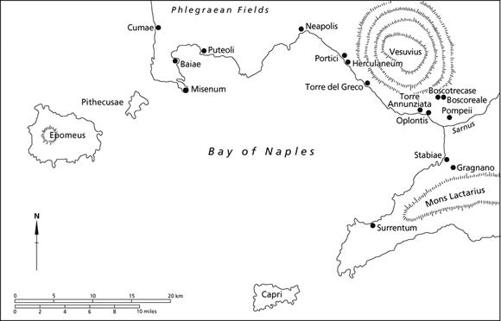
The eruption of Mount Vesuvius in the region of the Gulf of Naples in AD 79 buried the Roman villa sites Oplontis, Boscoreale and Stabiae as well as the two cities of Pompeii and Herculaneum, in the midst of their flourishing everyday life, thus conserving a wealth of information for posterity (Fig. 20). Moreover, this is the first volcanic eruption in history for which a detailed eyewitness report is available – two letters from Pliny the Younger to the historian Tacitus (see below), albeit not written until some 30 years later. Together with earlier mentions of Vesuvius and later interpretations of the catastrophe, they nevertheless yield information about how people dealt with the volcano and its eruption.
Fig. 20 The Gulf of Naples, with the cities destroyed by the eruption of Vesuvius.
The eruption of Vesuvius in AD 79 started in the late morning of 24 August. First, the volcanic plug of cooled lava was blown out; there followed the ‘Plinian eruptions’, named after Pliny's description: intense, continuous gas emissions which hurled large quantities of magma and lapilli – small pieces of old lava from the plug and the inner slope of the crater – up to 30 km into the air and formed a kind of pine-shaped cloud. The liquid magma was torn into small pieces by the rapid expansion and hardened in the air to porous pumice, so that a hailstorm of glowing stones fell upon Pompeii and Stabiae; during this first phase they were buried to a depth of some 2.5 m. When the pressure eased, glowing material emerging from fissures in the mountainside ran down the slope in a pyroclastic flow. At the same time, the sputum material sparked torrential rains through condensation in the stratosphere, which in turn mixed with the lava flow to form a river of hot mud which engulfed Herculaneum and buried it to a depth of 12 to 20 m. Since the magma and the lava flows also brought forth a cloud of gas, many of the 15,000 to 20,000 residents of Pompeii who attempted to escape the disaster were then killed by suffocation, a fate which also befell Pliny the Elder. Some 2,000 inhabitants who tried to find safety in their houses and cellars died there. On 25 August came the second phase, in which a rain of ash and lapilli was dumped on the city, burying it under another layer up to 6.5 m thick.3
The region around the Gulf of Naples had long been densely populated, since the volcanic soil was fertile, and the area was particularly scenic. According to Strabo (5.4.8), Vesuvius was considered extinct, so that it was not feared, nor indeed perceived as a real volcano. The last eruption had occurred centuries earlier, and the earthquakes which regularly struck the region were seen as the real problem. As noted, the last great earthquake had occurred seventeen years earlier, in AD 62, and was believed to have been caused by underground winds, so that it was not seen as a harbinger of volcanic activity (Plin. nat. 2.192). Rebuilding was thus still well under way when Pompeii and Herculaneum disappeared apparently forever under ash and mud.
Pliny the Elder, the famous author of the Naturalis historia, was at that time the commander of the fleet at Misenum on the Gulf of Naples, about 30 km west of the main event (Fig. 20). On 24 August he had just welcomed his nephew, known to us as Pliny the Younger, for a visit, so that the young man was able to record his uncle's reactions in a later letter to Tacitus (epist. 6.16). As the eruption became visible in the Gulf of Naples, the naval commander wanted to launch a reconnaissance journey, but, in response to a call for help from an acquaintance named Rectina, sailed for Herculaneum. There, however, a muddy lava flow prevented him from landing, so that he turned towards Stabiae, where his friend Pomponianus lived, and where he died of suffocation the next morning. Pliny the Younger, who had stayed in Misenum, reported in a second letter to Tacitus (epist. 6.20) how on 25 August, the second day of the events, he retired temporarily inland because of some tremors, and there he came into contact with the distraught crowds. Pliny, who was eighteen years old at that time, thus watched the catastrophe only from a distance, and could receive no more first-hand information from his uncle. Only much later, in AD 106/7, was he asked to describe the course of events by the historian Tacitus, who wanted to use the account in his Histories. An interpretation of the letters must thus take into account that they were written long after the event, and must be seen as a literary work, and not only as a documentary report.
The two letters give extensive information about the characterisation of Pliny the Elder by his nephew, as well as his own self-description. He describes his uncle as eager to learn, and helpful, fearless and courageous. He comforted and calmed his friends in Stabiae with simple explanations ‘by repeatedly declaring that these were nothing but bonfires left by the peasants in their terror, or else empty houses on fire in the districts they had abandoned’ (epist. 6.16, Loeb). While the others stayed awake through the night, Pliny the Elder went calmly to bed, and in the morning tried once more to reason with the terror-stricken inhabitants, who were making ready to flee, but he was overcome by difficulty in breathing and finally suffered a dignified death on the beach. Two days later he was found stretched out and covered up, and apparently uninjured, ‘looking more like sleep than death’.
Pliny the Younger in Misenum, too, remained unconcerned, and pursued his daily reading habit. A friend who had come from Spain showed little understanding for this attitude. When the next morning the two left the city because of the earthquakes, they ran into panicky crowds no longer capable of rational behaviour. The Spanish friend too was upset and departed, while Pliny took care of his mother and maintained a stoic quiet and a will to survive. While the masses were wailing and screaming, calling upon the gods or questioning their existence, and rumours were spreading, Pliny remained impassive and awaited his fate. As the smoke thinned, he and his mother returned to Misenum and waited for a message about Pliny the Elder. However, the nephew tells us nothing about conditions in the afflicted area itself.
The biographer Suetonius (Tit. 8) informs us that, after the eruption, Emperor Titus (AD 79–81), out of fatherly concern, dispatched a commission of high-ranking senators and former consuls, the curatores restituendae Campaniae, who used the possessions of those who had died in the eruption of Vesuvius for the reconstruction of the destroyed cities. However, the residents of the Vesuvius region were not the only focus of interest, for the capital had priority. The major portion of the imperial donations and restoration measures was provided to Rome, which had suffered a fire and an epidemic. The Roman writer Cassius Dio (c. AD 150–235) moreover informs us that Titus had inspected the disaster area himself before sending out the aid commission, and helped with available funds, accepting no outside donations (Dio 66.24). Here, too, the emperor appears as the personal saviour and noble donor, in the antique tradition of euergetism (charity), without, however, initiating any comprehensive measures.
The overall view is that precious objects and materials were sought in Campania, and relief actions undertaken for reconstruction. Survivors and refugees were supported locally, to the extent that their settlements were still viable, while the reconstruction of Pompeii and Herculaneum seemed hopeless. Only Stabiae, a nearby villa location, experienced a renaissance, and in AD 120/1 Emperor Hadrian can be credited with the restoration of the road network in the region, particularly the road between Naples, Nuceria and Stabiae (CIL X 6939–40). In the third century AD, new construction activity started again on the territory of Herculaneum. The catastrophe thus did indeed have long-term effects. The event was also interpreted religiously in various ways.
The poet Martial, who visited the region of the Gulf of Naples in AD 88, lamented (epigr. 4.44):
This is Vesbius [i.e., Vesuvius], green yesterday with viny shades; here had the noble grape loaded the dripping vats; these ridges Bacchus loved more than the hills of Nysa; on this mount of late the Satyrs set afoot their dances; this was the haunt of Venus, more pleasant to her than Lacedaemon; this spot was made glorious by the fame of Hercules. All lies drowned in fire and melancholy ash; even the High Gods could have wished this had not been permitted them.
(Loeb)
The poet Statius too held the gods responsible for the incident. Jupiter, he claimed, had torn the mountain out of the earth and lifted it to the stars, only to drop it upon the unfortunate cities (silv. 5.3.205–8). Shortly after the catastrophe the Jewish prophetic literature the Oracula Sibyllina (4.130–6) held Titus responsible for it, because of his destruction of the temple in Jerusalem in AD 70, calling the eruption divine retribution for his crimes against the Jewish people. Cassius Dio reports that in AD 79 enormous clouds of dust darkened Rome and even reached Africa, Syria and Egypt. In AD 202 he witnessed another, smaller eruption of Vesuvius, which he describes as the work of the giants, the colossal primal figures who had in the legend fought the gods, and were now throwing rocks into the skies (Dio 66.22–3, 77.2). The Christian writer Tertullian of Carthage (c. AD 150–230) also interpreted the Vesuvian eruption as a divine judgement to be explained by moral decadence. In an overall defence of Christianity, Tertullian associated the event with worship of a false God or of heathen gods in general (apol. 40.8; pall. 2.4).
1 J.-P. Adam, ‘Observations techniques sur les suites du séisme de 62 à Pompéi’, in Albore Livadie 1986, 67ff.
2 Sonnabend 1999, 220ff.
3 Etienne 1998, 29ff.