
Chapter 20
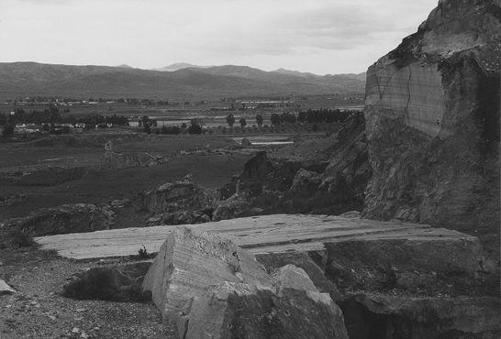
With the expansion of the Roman Empire and its enormous building activities, the need for raw materials and building materials increased steadily. Their transportation was in some cases carried out over long distances, especially in the case of valuable materials or luxury goods. Marble was obtained not only from Carrara, Italy, and the old Greek centres, but also from Asia Minor and Numidia (Fig. 21), while granite and porphyry came from Egypt. At the same time, with the expansion of their empire, the Romans continued the mining activities of the newly integrated provinces. The demand for iron, which was first mined in Etruria and Elba, and then also at a number of locations outside Italy, was particularly great; some 38 tons of iron were necessary to equip a Roman legion. Moreover, in the second century BC approximately 125 tons of silver coin were already in circulation, a quantity which was to increase more than tenfold very shortly.1 The increased requirement for lead could be met in Britain (Strab. 4.5.2; Diod. 5.22.1ff., 38.5; Tac. Agr. 12.6).
Fig. 21 Ancient quarry at Chemtou, Tunisia, with Giallo Antico marble.
On the Iberian peninsula there was copper (Huelva) and silver (Sierra Morena) in the south-west, gold in the north-west (Las Medulas), and tin in the west; moreover, silver was mined in Cartagena, the Punic New Carthage, during the imperial era (Strab. 3.2.10). Everywhere the Romans expanded the state-owned mines intensively, and dug extensive shafts, up to 250 m deep, with ingenious drainage galleries; scoop wheels and screw pumps (Archimedean screws) were also used for pit drainage. The newly developed gold mines of Las Medulas near Léon were washed out with water brought in by means of numerous aqueducts and redirected river beds (Plin. nat. 33.67ff.), which resulted in about fifty extensive terraced open-pit excavation sites.2
Wood was needed in large quantities for the smelting of ores; one modern estimate is that some 5,400 ha of forest were felled in the Roman Empire every year.3 Moreover, innumerable tons of slag were created at Rio Tinto and Tharsis, near Huelva, and at Aljustrel, Portugal. Mining left behind numerous barren ‘lunar landscapes’, as in the Sierra de Cartagena and the Sierra Morena. In antiquity it also endangered the health of the slaves and other workers (Strab. 3.2.8; Lucr. 6.810–15), for lead poisoning was characteristic of the ‘pale lead workers’ (Vitr. 8.6.11; Sil. 1.231ff.). The contaminated air deposited ever greater amounts of metals in the soil – and not only in Spain;4 even in the Greenland ice and in lake sediments in southern Sweden increased quantities of lead particles have been found for the time from the second century BC to the second century AD.5
Ancient authors, particularly Ovid (met. 1.138ff.) and Pliny the Elder (nat. 2.158–9, 33.1–6), were already voicing criticism of mining. With pathos they describe how Mother Earth's entrails and veins were torn out, from greed and to satisfy the demand for luxury, so that the ground shook and trembled. Moreover, the exhaustion of these underground resources was, they argued, foreseeable, so that only the renewable products of the earth's surface should be used. If the modern idea of sustainability seems to shimmer through here, it still does so against a different background: the analysis may be that humankind is challenging nature, but the conclusion is more moral – an appeal to moderate the quest for luxury – than an environmental call aimed at saving nature (cf. Plin. nat. 3.138). Moreover, miners were reported, despite the high price they paid, to have seen themselves as conquerors of nature (33.73).
1 Schneider 1992, 72–3.
2 Lewis and Jones 1970, 174ff.
3 Healey 1978, 152.
4 Martínez-Cortizas et al. 1999.
5 Hong et al. 1994, 1996; Renberg et al. 1994.