
Chapter 21
Housing and urban sanitation in Rome
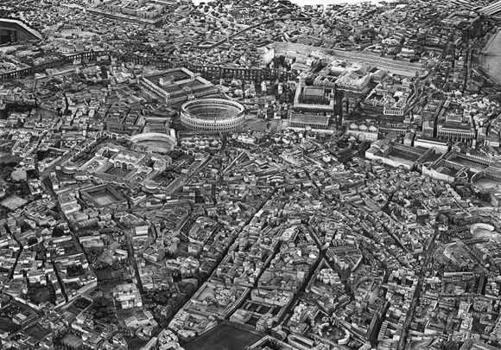
By the end of the republic Rome had grown to a city of almost one million inhabitants. The residential areas of the wealthy were located on the Palatine Hill, which from the time of Tiberius (AD 14–37) was also the site of the imperial palace, and on the Esquiline, Caelius and Viminal hills; the simple people lived on the Aventine Hill and in the lower-lying areas of the Subura, where many craftsmen were also established (Figs. 22 and 23). The domus, the private home of the rich citizen, was built in a spacious style, with a high standard of comfort and culture; ideally, it was equipped with a bathroom, ‘flush toilets’ – albeit flushed by an underfloor channel – and heating. It contrasted with the more modest insulae, the housing blocks for the middle and lower classes. There were some 26 insulae in Rome for each domus; their total number is estimated at 47,000.1
Fig. 22 Map of Rome, c. AD 70.
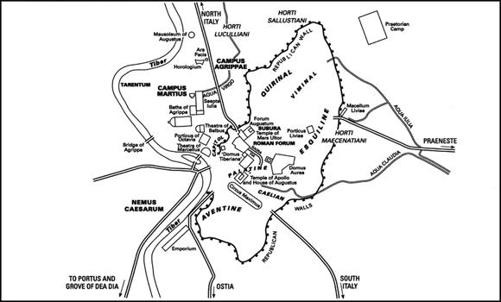
Fig. 23 Model of ancient Rome: view from the north towards the Subura.
An insula might be up to ten storeys high, and was generally surrounded by streets on all four sides. Such housing blocks were the objects of speculators, who wanted to squeeze as much profit for as little effort as possible out of them. In the first century BCM. Licinius Crassus (‘the rich’), who had made his money during the civil wars under Sulla, was famous as a housing speculator, but other prominent gentlemen, such as Cicero, were engaged in the same business (Plut. Crass. 2; Cic. Att. 14.9.1). Their profession was a business in which profit was made at the expense of living space and the quality – and safety – of housing. Poor structural quality and cheap building materials, including much wood in the upper storeys, meant great danger. The buildings were often dilapidated, and in danger of fire or simply of collapse, and the cramped conditions meant that escape routes were often unavailable. The tenement houses were often overcrowded, they had no water connections, toilets or kitchens, and the unventilated, unheated rooms provided very unhealthy living conditions, especially when compared with those of a private domus. The only heating was provided by coal basins, which filled the rooms with smoke. Water mainly had to be carried in from wells, since only a few flats on the ground floors had their own connections to the public water system.2
A sewage system, too, was the privilege of the private homes of the wealthy, so that faeces were commonly collected in pits or bins. Latrines were often located next to the kitchens, and were receptacles for all kinds of waste. Urine was collected by the fullers, who could use it for leather processing. Only those who could afford it visited public toilets, whose number had by imperial times reached 144.3 From the later part of the first century AD the public thermal baths provided some relief from the miserable residential conditions. They served the purposes of both hygiene and conversation, but used a good deal of firewood, and produced corresponding amounts of smoke.
The streets of the capital were generally overcrowded. Trade and through traffic were constantly in each other's way. The paths of merchants, traders, building carts, litters, children at play and animals crossed in the narrow, winding and unpaved streets. ‘In hot haste rushes a contractor with mules and porters; a huge crane is hoisting now a stone and now a beam; mournful funerals jostle massive wagons; this way runs a mad dog; that way rushes a mud-bespattered sow’ (Hor. epist. 2.2.70ff.; Loeb). The crush of wagon traffic was so great that, by the time of Caesar, it was already necessary within the municipal area to ban such traffic during the day – with the exception of ‘rubbish carts’ and construction vehicles (CIL I 593 = Tabula Heracleensis, lines 56ff., 66–7). This, however, caused loud rattling and rumbling at night, so that road traffic noise continued at all hours, despite the lack of street lighting (Hor. epist. 1.17.7–9; Mart. epigr. 4.64.18–24). The poets, too, complained about urban noise – the strepitus Romae (Hor. carm. 3.29.12; Sen. epist. 56.1ff.).
Although residents were allowed neither to dump waste onto the streets nor to throw objects out of their windows (Dig. 9.3, 43.10, 44.7.5.5), and were obliged to keep the streets in front of their houses clear and in repair (CIL I 593, lines 24ff.), much waste lay on the streets (Mart. epigr. 5.22). Juvenal (3.268ff.) even warned against going out of the house at night, because of the danger of objects and liquids being dropped onto the street. Although the aediles and a four-man collegium were responsible for keeping order in the streets, there was apparently no regular refuse-collection system.4 The legal regulations point indirectly to abuses which should be removed. Hygiene was regarded as a communal duty, incumbent upon both the municipal authorities and private persons. Since these measures had to be addressed anew repeatedly, it is obvious that no permanent consciousness of cleanliness ever developed, and waste in residential areas was accepted as a familiar phenomenon. Rubbish pits were therefore located in houses and neighbourhoods, as well as on the outskirts of, or immediately outside, the city, as a number of examples in the provinces also indicate (Vindonissa/Windisch, Carthage).5
The air in the capital was of poor quality, even though there were no internal combustion engines. Dirt in the streets, sewage ditches, the vapours of rot and smoke polluted the air. The cremations on the funeral sites (ustrina) outside the city exuded additional nasty smells. As early as the first century BC, Horace (carm. 3.29.12) mentioned thick smoke (fumus) covering the city, and Seneca (epist. 104.6) too tried to escape the heavy air of Rome. Even though contagion was in antiquity generally blamed on polluted air (miasma) (Hippocr. flat. 5), efforts to improve air quality were nowhere to be seen. Even without modern traffic, the ancient city was burdened with considerable environmental problems. Despite the high technical standards achieved in water supply and the sewage system, Rome was still plagued by numerous problems which could never be comprehensively solved.
Rural villa construction in Italy
The upper classes often preferred to leave the city, at least temporarily, to find relief in the countryside from Rome's noise and smoky air (Cic. ad Q. fr. 3.1.1; Sen. epist. 104.1, 6). The trend toward urbanisation was accompanied by a growing longing for the countryside, where one might try to escape the plagues of the city. Horace (epist. 1.14.14ff.) praises the advantages of self-chosen country life, and criticises longings for the city. Juvenal in the early second century AD lamented the inconveniences of the city, but also denounced the pomposity of the rich who could, even in the countryside, enjoy all the amenities of town (Iuv. 3.190–238).
Since the late republic, the leading families had owned villas in the countryside where they could take refuge after their daily business in the capital, or during holiday stays. A luxurious villa in a lovely landscape outside the city (villa suburbana) became an unsurpassable luxury for the upper classes. Prestigious houses appeared which served both for individual relaxation (otium) and for maintaining social contacts (Cic. de orat. 1.24ff.; Plin. epist. 9.36). They were built in the Alban Hills (Tusculum, Lavinium), as well as on the coasts or along the rivers and lakes of Latium, Campania and northern Italy.6 Moreover, in such places as Tibur, Praeneste and Velitrae, former rustic estates were renovated into splendid villas. Even by Augustan times, according to Strabo (5.4.8), the Gulf of Naples looked like a single city, as a result of the villas lined up in close order along its shores.
P. Cornelius Scipio Africanus the Elder, the victor over Carthage at the battle of Zama in 202 BC, at the end of his career (184 BC) retired to his estate at Liternum in Campania, which was then still simple and well fortified (Liv. 38.52; Sen. epist. 86.4–5). Cato too was said to have lived in a simple, unassuming villa in Tusculum (Gell. 13.24). P. Cornelius Scipio Aemilianus Africanus the Younger, the conqueror of Carthage in the Third Punic War, and D. Iunius Brutus planted bigger gardens for their country houses; Scipio apparently resided in Lavernium near Formiae (Cic. Lael. 2.7, 7.25; rep. 1.14; fat. fr. 5). After his retreat to private life in 79 BC, Sulla enjoyed hunting and fishing on his estate in Cumae (App. civ. 1.104.488). Cicero and his father had their villa rustica in Arpinum rebuilt as a country house (Cic. leg. 2.3). With reference to Greek philosophy, copies of entire gymnasia were built for leisure and prestige (Cic. de orat. 1.98), and equipped with Greek sculptures (Cic. Att. 1.8.2, 9.2). Another villa of Cicero's at Lake Avernus near Cumae was called the ‘academy’, after Plato's philosophy school (Plin. nat. 31.6); at another estate in Tusculum, a part of the garden was also called the ‘academy’ (Cic. Tusc. 3.7; div. 1.5.8). Caesar, too, like Marius and Pompey, owned a villa in the area of the spa Baiae near Naples (Sen. epist. 51.11).
Pliny the Younger in his letters describes two examples of large, early imperial era estates (epist. 2.17, 5.6): his rural estate in Laurentum (‘Laurentinum’) on the coast of Latium, south of Ostia, 17 miles from the capital, which he would happily visit after the tribulations of a workday, and his villa in Tuscany, at the foot of the Apennines (‘Tusci’). Both were equipped with a xystus (arcade/terrace) and a gestatio (avenue/promenade); at Tusci there was also a hippodrome (riding course/gardens). In Tivoli, Emperor Hadrian proudly displayed his position and education in a variegated, natural-style architectural ensemble with an academy, a palaestra, a library, thermal baths and so on, decorated with statues, waterfalls, fountains, nymphs and a grotto. He also had rebuilt on the grounds of his villa such famous buildings and landscapes as the Prytaneum and the Stoa Poicile, a columned hall in Athens, the Vale of Tempe in Thessaly, and the Canopus channel in Egypt connecting the cities of Canopus (modern Abukir) and Alexandria (Hist. Aug. Hadr. 26).
The villa gardens were seen as an improved version of nature, and as a statement against its uncontrollability. The urban lifestyle was to be maintained in the countryside too; the goal was to be able to enjoy the same comfort as in Rome. The landscape served as aesthetic scenery. The houses were provided with park-like gardens complete with fountains, pools, grottos, pavilions and sculptures, and separated from the work of the peasantry. Fish ponds, aviaries and animal enclosures (leporaria, vivaria), which harked back to the royal paradeisos of the Hellenistic east, were also popular. The Roman hunting enclosure was said to have been invented by Q. Fulvius Lippinus in the first century BC (Plin. nat. 8.211); at that time, however, the rhetor Q. Hortensius already owned an enclosed and wooded game park in Laurentum (Varr. rust. 3.13.2–3).
Horace (carm. 2.15) had already denounced the crowding out of farmland by the villas and fish ponds of the rich. Sallust (Catil. 13) and Varro (rust. 3.3.10) complained about intrusions upon the mountains and the sea. Excessive construction on riverbanks and lake shores was also criticised (Sen. epist. 89.21; Sen. contr. 5.5); however, these were the usual laments about the luxuria of the upper classes. Generally, criticism was levied against one's peers – without displaying any difference in one's own behaviour. The villa owner Cicero, for example, reprimanded fish-pond owners (piscinarii) for caring only about their fish, and not about their communities (Cic. Att. 1.18.6, 19.6). No further-reaching thoughts about the environment were pursued, nor did any real concept of conservation ever emerge. Statius continued to celebrate villa construction as a victory over the conditions of nature (silv. 2.2.4ff., 32–3, 3.1.96ff.).
With the new form of government, the principate, the possibilities for political participation increasingly faded, and had to be compensated for in other ways. By shifting their leisure time (otium) to the countryside, members of the upper classes could pretend to uphold the old customs, which were supposedly still alive in the countryside. Neither the emperor nor the senators therefore had any interest in stopping the construction boom. The amenities of villa life were thus maintained until late antiquity.
1 Brödner 1989, 183.
2 Carcopino 1992, 55ff. (47ff. in 1939 edn); C. Liedtke, ‘Rom und Ostia: Eine Hauptstadt und ihr Hafen’, in Hoepfner 1999, 706ff.
3 Robinson 1992, 119ff.
4 Thüry 2001, 9.
5 Thüry 2001, 31ff.
6 D’Arms 1970, 171ff.; Mayer 2005, 59ff.; Marzano 2007, 235ff.