
3
Cyrus I in an Elamite-Persian Milieu
The Assyrian Empire was at its height during the reign of Ashurbanipal (669–c. 630 BCE). Sources from Assyria on Elam and the early Persians, especially after the Assyrian sack of Susa in 646, are scarce. Scattered Elamite evidence attests to a number of kings that may be dated to this late period (c. 650–550 BCE). But beyond their names, little is known of these individuals: their chronologies, the scope of their rules, and their relationships with one another are all uncertain. Among those kingdoms was the earliest Persian kingdom ruled by Cyrus the Great’s forefathers, whom Cyrus lists in the famous Cyrus Cylinder, one of the most important extant pieces of evidence for Cyrus’ reign (see discussion later in this chapter). In modern scholarship it has generally been assumed that Cyrus the Great’s grandfather (Kurash in Akkadian), whom Cyrus named “King of Anshan” in the Cyrus Cylinder, is the same as the Cyrus, King of Persia (Parsumash in Akkadian), who sometime in the late 640s sent a delegation to Ashurbanipal.
Cyrus, the King of Parsumash, heard about my victory. He became aware of the might that I wielded with the aid of Ashur, Bel, and Nabu, the great gods my lords, with which I leveled the whole of Elam like a flood. He sent Arukku, his eldest son, with his tribute to Nineveh, the city of my lordship, to pay homage to me. He implored my lordship.1
Such descriptions are typical of the aftermath of Assyrian conquests, both in the fate of the antagonist and the ways in which the neighboring rulers rushed to pay their respects and to curry Assyrian favor. The particulars of the matter, of course, would have been more complicated, even if Ashurbanipal’s rhetoric was true at its core. In the version quoted above, Cyrus’ son, Arukku, was sent as a hostage to the Assyrian court. This was a common practice, a means of ensuring good relations between the Assyrians and their subjects or distant neighbors. The success of such practices was mixed, however. Roughly a decade before the Cyrus of Parsumash episode, Elamite princes that had been given refuge at the Assyrian court were returned and enthroned in Elam with Assyrian help. But these Elamite princes then turned on their erstwhile benefactors and rebelled, which necessitated further Assyrian military action.
Beyond the political ramifications, this type of exchange – royal children and their entourages living at the Assyrian court – undoubtedly played a role in the transmission of cultural knowledge. In this instance, we know nothing further of Arukku. But what if, after a long stretch at the Assyrian court, he returned home? What sorts of knowledge would he have brought with him? What sorts of commercial or cultural ties might this episode have forged between Assyria and early Persia? Persia was clearly indebted to Elam, Babylonia, and Assyria for modes of imperial organization and ideological expression. How such knowledge was transmitted is rarely easy to specify, and to attribute too much influence to one individual would distort the reality. But an Arukku who spent several years at the Assyrian court – quite likely with elite hostages (whom the Assyrians would have considered “guests”) from other areas – would have been exposed to a variety of other peoples and influences, at the highest levels of Assyrian society.
Another piece of critical evidence for the earliest Persian kings is the inscribed seal impression of one “Cyrus, the Anshanite, son of Teispes” (Figure 3.1). This seal impression recurs with some frequency on the Persepolis Fortification Tablets from the reign of Darius I. We do not know the identity of the person who used the seal, but it was clearly a prestige item, perhaps an heirloom. The image portrays a rider running through an enemy, who holds a broken bow – a widespread symbol of defeat and humiliation in the ancient Near East. The rider is presumed to be the Cyrus of the inscription, who is identified with the grandfather of Cyrus the Great, the founder of the Empire. There is ongoing debate about the date of this seal’s manufacture, and whether or not the Cyrus of its inscription may be identified with the Cyrus of Parsumash who paid obeisance to Ashurbanipal. The link is attractive, but it is not a settled issue.2
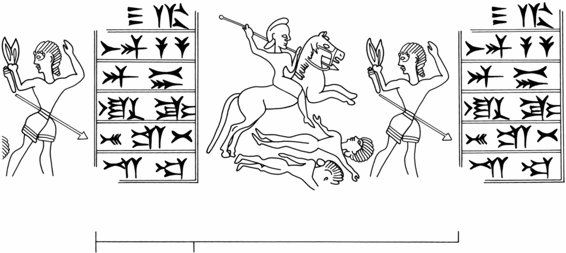
Figure 3.1 Collated line drawing of PFS 93* from the Persepolis Fortification Archive. Courtesy Persepolis Seal Project.
The Fall of Assyria and Its Aftermath
After Ashurbanipal’s death, the Assyrian Empire was ruled briefly by his son Ashur-etil-ilani (c. 630–627 BCE) and then the latter’s brother, Sin-sharru-ishkun (627–612 BCE). The Babylonians under Nabopolassar began already in the 620s to throw off the Assyrian yoke. An essential source for this period is the so-called Babylonian Chronicle series that records each year’s notable political, military, and religious activities. There are several different chronicle texts, each with a different chronological range. Those of main concern here are closely related and often treated as one document. They provide a consistent record from the mid-eighth century through Cyrus’ conquest of Babylon in 539 BCE, but there are many gaps. The copies of the chronicles that we possess date to later periods (the Achaemenid period, sometimes later) and may have undergone revisions that we cannot track.
What is most surprising in these accounts is the prominent place given to the Medes in Assyria’s downfall. Nabopolassar and the Babylonianshad been fighting Assyria for ten years, when the Medes appear in the chronicle: they were involved in an attack on Arrapha (modern Kirkuk, roughly 60 miles east of Ashur) in 615 BCE. In 614, the attacks against Assyrian cities continued, and the Median king Umakishtar (Cyaxeres in the Greek tradition) made a pact of alliance with Nabopolassar, the terms of which the chronicle does not divulge. The great Assyrian capital city of Nineveh was sacked in 612, and in 609 the last Assyrian king, Ashur-uballit II, and the remnants of his army were destroyed near Harran in northwestern Mesopotamia. Thus ended Assyria. The Elamites, whom one might expect to have been involved in their bitter enemy’s overthrow, do not appear in any sources relating the downfall of Assyria. The Persians make no appearance either, though references to them in Assyrian and Babylonian inscriptions or chronicles are scarce before Cyrus.
Cyrus’ Conquest of the Medes
Cyrus’ impact on the course of history was broad, if often underrated, and the Near Eastern accounts of his conquests are supplemented by the biblical and, especially, the Greek traditions. Not until the reign of the Babylonian king Nabonidus (reigned 556–539 BCE) do we gain significant insight into the Persians as a rising power. In one of his inscriptions, Nabonidus relayed a dream-omen that occurred to him at the beginning of his reign. The Medes posed a threat to Nabonidus’ reconstruction efforts of the Ehulhul temple, dedicated to the moon god at Harran, which had been destroyed during the last stage of the overthrow of Assyria. In the dream dialogue, the god Marduk commands Nabonidus to get to work. Nabonidus expresses concern about the Medes, but his concern is unwarranted. The term umman-manda used to describe the Medes has negative connotations in Akkadian literary tradition.3
(Marduk replies to Nabonidus) “The umman-manda of whom you speak, he, his land, and the kings who go at his side, are no longer a threat.” When the third year came, the gods roused Cyrus, king of Anshan, his young servant, against the umman-manda. With his small army he dispersed the vast umman-manda. Cyrus seized Ishtumegu (Astyages), the king of the umman-manda, and took him captive to his land.
This is the first reference to Cyrus the Great, initially as king of the city and region of Anshan in ancient Parsa, modern Fars in southwestern Iran. It appears to date Cyrus’ conquest of the Medes to Nabonidus’ third year, 553 BCE. One of the Babylonian chronicles dates Cyrus’ victory to 550. That account relates Astyages’ attack on Cyrus, the defection of Astyages’ army to Cyrus, Cyrus’ subsequent victory and the sack of Ecbatana (Astyages’ royal city), and the removal of plunder from Ecbatana to Anshan.
These two testimonies tell the same story but with some significant variation, which historians attempt to reconcile. The difference in date is one. Since the chronicle series is considered more accurate than royal inscriptions, 550 is the date generally followed. For much of twentieth century scholarship, the reference to “his young servant” in the Nabonidus text was taken to mean that Cyrus was Asytages’ servant. This interpretation bolstered the Classical tradition that portrayed the Persians as subject to the Medes. The relationship between the two peoples remains unclear, but to understand the phrase “his young servant” as a reference to Cyrus being a subordinate of Astyages is not a given. The phrase appears to refer to the god Marduk, who chose Cyrus as the instrument to implement his divine will – a common motif in ancient Near Eastern texts for centuries. In positive answer to Nabonidus’ concern, Marduk assured Nabonidus that he would send his (i.e., Marduk’s) young servant, Cyrus, to destroy the Medes. The phrasing “the kings who go at his (the Median king’s) side” is also noteworthy. Although these kings are not specified in Nabonidus’ inscription, the Greek writer Ctesias’ later account identifies the kings of the Hyrcanians, Parthians, Scythians, and Bactrians as beholden to the Median king (Fragment 8d §46). If these peoples were indeed subject to the Medes, that could have been the basis for a significant Median power in the sixth century.
Cyrus’ Conquest of Lydia and Ionia
In many modern works, Cyrus’ campaign against Lydia is precisely dated to the year 547 BCE, based on an entry in one of the Babylonian chronicles:
In the month of Nisan (= March/April), Cyrus king of Persia mobilized his army and crossed the Tigris River downstream from Arbela (in Assyria). In the month of Ayaru (April/May) [he marched] to …4
The tablet is damaged exactly where the name of the place against which Cyrus marched was written. The difficulty provides an excellent example how the reading of one cuneiform sign, in one text, may impact historical analysis and reconstruction. Depending on whether one reads the crack running through the tablet as hiding one part of a cuneiform sign, or as just a crack in the tablet, makes a difference in what country name is read there: Lydia or Urartu. For much of twentieth-century scholarship, the reading “Lydia” was favored, and that interpretation has had remarkable staying power. Many Achaemenid historians now accept the reading of Urartu (so followed here), and thus for the year 547 assign Cyrus’ campaign against that region in southeastern Anatolia, not against Lydia.
Even scholars who accept the reading Urartu in that line of the chronicle still date the Lydian conquest in the 540s, though no longer precisely to 547/546. This interpretation is dependent primarily on evidence from the Classical tradition and, mainly, the sequential order of Cyrus’ conquests as given in Herodotus, who is thus our main source for Cyrus’ Lydian campaign. Herodotus’ detailed account of the Lydian royal house contains all sorts of object lessons relevant to the study of Greek literature, less so for Lydia’s history. A classic story in Herodotus (1.53–54) illustrates this. During his preparations to confront Cyrus, Croesus sought the advice of the Oracle of Delphi. The oracle predicted that if Croesus made war against the Persians, he would destroy a mighty empire. Croesus took the oracle to mean that he would be victorious. He was wrong, though he did destroy a mighty empire: his own.
Cyrus met Croesus’ army in Cappadocia (central Anatolia). Cyrus’ forces were augmented by his conquest of the Medes – which included contingents from northern and eastern Iran – as well as those areas through which Cyrus had marched to confront Croesus. Despite the Persian advantage in numbers, the fighting was inconclusive. With winter fast approaching, Croesus withdrew and disbanded his army, with every intention to resume hostilities in the spring. Cyrus made a surprising, and daring, maneuver: he did not disband his own army but instead pursued Croesus to the Lydian capital, Sardis. Cyrus took Croesus at unawares – as Herodotus puts it, “Cyrus came as his own messenger to Croesus” (1.79) – and defeated him in a pitched battle outside the city. Outnumbered and outmaneuvered, Croesus then took refuge in Sardis, sent desperate pleas to his allies, and was besieged. Just a couple weeks later, some Persians scaled a part of the fortifications that the Lydians had deemed inaccessible, and it was by that route that Sardis was taken.
With the fall of Sardis and capture of Croesus, the Lydian kingdom also then fell. Cyrus was merely getting started, and the historian must again confront questions of chronology and sequence. If the Lydian campaign is dated to the mid-540s BCE, that leaves several years before the firmly dated conquest of Babylon in 539 – a conquest that we may assume was more than a year in the making, despite implications of Cyrus’ own testimony. The nascent Persian Empire, still a work in progress, was already a big place. Herodotus indicates (1.153) that, after the fall of Sardis, Cyrus intended to campaign personally against the Babylonians, the Bactrians, the Scythians, and the Egyptians. He delegated the remaining operations in western Asia Minor to subordinates.
In short order, some of the Lydians rebelled. One Pactyes, a Lydian to whom Cyrus had assigned the collection of tribute, instead hired mercenaries and marched on Sardis, where Cyrus’ appointee Tabalus (a Persian) had been left in charge. Entrusting local elites such as Pactyes with continued, important roles in the Empire’s administration was common later, and this episode suggests the practice began even under Cyrus. In this case, though, the appointment proved to be a mistake. When Cyrus learned of Pactyes’ revolt, he dispatched a Median named Mazares: his position reflects the elevated place that some Medes held in Persian administration, even outside the confines of Media itself. Pactyes fled to Cyme, a Greek city on the central western (i.e., Ionian) coast, from where he was passed on to various other Greek cities. The islanders of Chios were induced with a bribe to give him up (Hdt. 1.160).
The Mede Mazares fell ill and died shortly after Pactyes was captured, but not before he began the process of systematically punishing those cities that had helped Pactyes in his revolt. After Mazares died, the Mede Harpagus was sent to finish the job, a job that probably took several months, if not a few years. One by one Greek cities in Ionia were subjugated, some ruthlessly. This rather dark chapter in Greek history is not preserved in much detail, especially when contrasted with the successful resistance of the mainland Greeks against Xerxes’ invasion two generations later. This is understandably so, in light of the result during Cyrus’ reign: a complete Persian victory. If things had gone otherwise, instead of Marathon, Thermopylae, and Plataea, the western tradition would have perhaps celebrated the battles in west central and southwestern Anatolia, such as Priene, Magnesia, and Phocaea. But these cities were subjugated or destroyed by the Persians, and their territories incorporated into the Empire.
The fate of Croesus varies in ancient traditions. In Herodotus, he became a stock literary character (the wise advisor), a counselor to both Cyrus and his son Cambyses. An earlier tradition implies that Croesus was killed – or removed from the mortal world – during the sack of Sardis. Herodotus portrayed Cyrus intending to do just that, but Apollo’s intervention saved Croesus (1.87). The Greek poet Bacchylides (died c. 450 BCE) provided a dramatic rendering of Croesus’ intended suicide on a pyre, when the intervention of Zeus and Apollo removed him to the land of the Hyperboreans, a mythical people who dwelled far in the north. Croesus on the pyre occurs in both traditions, but Bacchylides’ version implies Croesus’ death, couched in divine “removal” to a magical place. Like Herodotus, a later tradition recorded by Justin (perhaps from Ctesias, Fragment 9e) also relates that Croesus was saved by Apollo and that Cyrus granted him territory in a city called Barene near Ecbatana.5
Cyrus in Eastern Iran and Central Asia
Herodotus’ assessment of Cyrus’ strategy after the conquest of Lydia is probably correct. It is easy to envision Cyrus placing higher priority on other areas while leaving mop-up operations in Anatolia to subordinates. Among these other important areas were eastern Iran and Central Asia, the least known but certainly not the least significant areas for the Persians’ rise. It is difficult to say much beyond outlining the strategic importance of these areas to the Empire. The evidence is sparse, and the chronology of Cyrus’ activities there is impossible to ascertain. Many of the peoples in the extreme northeast were nomadic, but agricultural settlements were widespread. Archaeological surveys have revealed extensive irrigation projects in oases of the Amu Darya (Oxus) River basin. Various individuals and groups from these regions figure prominently in Achaemenid political and military organization subsequently. Bactrian and Scythian forces, especially their cavalry, were renowned throughout Achaemenid history. Cyrus’ son, Bardiya, governed the satrapy of Bactria; Darius I’s father, Hystaspes, held an important command in Parthia during the crisis of 522 BCE. Other examples abound, but it is impossible to organize them into a narrative. The eastern territories of the Empire figure most prominently in the source material concerning Alexander of Macedon’s conquests there in the late 330s and 320s BCE; these territories’ political importance during that turbulent time is viewed as characteristic for the entire Achaemenid period.
The regions of Bactria, Hyrcania, Parthia, and Scythia were all incorporated into the Empire at the time of Darius’ accession in 522. A later Roman source, Justin (1.7.2), implies that the submission of these northern regions at the time of the Median conquest must have mainly been a formality, as they all subsequently caused Cyrus a great deal of hard campaigning. Further, both Herodotus’ and Ctesias’ versions set Cyrus’ death in the extreme northeast – with the implication being that he campaigned in those regions to the end.
Cyrus’ Conquest of Babylonia
For Cyrus’ conquest of Babylonia we are able to privilege Near Eastern sources once again, but they present their own interpretive issues. Foremost among these sources are the Nabonidus Chronicle (part of the Babylonian Chronicle series noted previously), the famous Cyrus Cylinder, and the so-called Verse Account of Nabonidus. The latter two were commissioned by Cyrus and present his conquest in an idealized manner.
We know from Nabonidus’ inscriptions and other Babylonian evidence that Nabonidus himself had been away from Babylon for ten years (c. 553–543 BCE) at the oasis in Teima in northern Arabia. This surprising absence from Babylon, governed in the meantime by Nabonidus’ son Bel-shar-usur (or Belshazzar, the Hebrew version of his name from the Book of Daniel 5), has been interpreted in a number of ways. Some associate it with Nabonidus’ patronage of the moon god, prominent at Teima. Nabonidus’ devotion to him was especially evident in Harran in northwestern Mesopotamia. Because of this, Nabonidus has often been portrayed in a negative light, sometimes even as crazed lunatic. That portrayal was no doubt augmented by the resentment of the priesthoods of other Babylonian deities, if they viewed their sanctuaries as receiving short shrift. It has also been heavily influenced by Cyrus’ propaganda and has been tempered only in recent scholarship. An assessment of the advantages gained from Babylonian control of trade routes running through the northern Arabian peninsula has encouraged modern scholars to reevaluate Nabonidus’ strategy and the virtues of his efforts there. Nevertheless, his ten-year absence from the city continues to raise numerous questions about his rule and popularity in Babylonia itself. Nabonidus’ own inscriptions follow the age-old Mesopotamian pattern of the pious king, one concerned for and active in the building and maintenance of divine sanctuaries. These are some of the very concerns, also formulaic but of utmost importance, expressed by Cyrus in the Cyrus Cylinder.
The preliminaries of the Persian-Babylonian conflict are opaque. It is difficult to understand Nabonidus’ extended absence from Babylon if he viewed the Persians as a serious threat during that time. The Babylonians, of course, would have been well-informed of Cyrus’ activities: his conquests of the Medes, Urartu, the Lydians, and other regions. It is similarly difficult to link Nabonidus’ return to Babylon circa 543 as attributable to concerns about rising Persian power. There is no evidence for such a contention, but it is not hard to imagine a growing sense of unease in Babylonia.
The Nabonidus Chronicle reports that during the summer of 539 the cult statues of gods from various Babylonian cities were taken to Babylon, presumably as a precaution against an imminent Persian attack. Cyrus, on the other hand, implied that Nabonidus’ removal of the gods was impious, and Cyrus celebrates his return of those gods to their own cities in his own inscription (Cyrus Cylinder, lines 30–32).6 As we see even in modern times, it is all about the message. In late September or early October of 539 BCE, a major battle was fought at Opis, north of Babylon, one that resulted in a Persian victory. On October 10 the city of Sippar was captured, and on October 12 Cyrus entered Babylon peacefully and in triumph. Nabonidus was captured. His subsequent fate the chronicle does not reveal; in the Cyrus Cylinder it is noted only that Nabonidus was delivered to Cyrus (line 17). Another Babylonian text – the so-called Dynastic Prophecy, written during the Seleucid period – suggests that Nabonidus was exiled.7 The Dynastic Prophecy finds echo in Berossus’ account (Fragment 10a): the defeated Babylonian king gave himself up before a protracted siege and received territory in Carmania (modern Kerman, in southern Iran), where he eventually died.
Let us consider Cyrus’ own version of the Babylonian conquest as given in the Cyrus Cylinder, the longest (by far) inscription that we have that was commissioned by Cyrus himself. The text is inscribed on a clay barrel cylinder (roughly 10 inches long and 4 inches thick), a standard foundation inscription of the type used in Mesopotamia for centuries (Figure 3.2). Foundation inscriptions were dedicated to the gods and deposited as an offering within the foundation or walls of sanctuaries; historians thus conclude that such texts were written for the gods. It is understood, however, that the information contained in these inscriptions, formulaic as it usually was, was also distributed or proclaimed in other ways. The Nabonidus Chronicle (column iii, lines 18–20) refers to a proclamation of Cyrus read to all the people of Babylon. This is perhaps not a word-for-word rendering of what was inscribed on the Cyrus Cylinder, but it is reasonable to assume that the essence was the same: the previous king Nabonidus was unstable and impious; the god Marduk’s chosen agent Cyrus was given victory in order to restore peace and harmony, especially the reinstitution of divine offerings and normal workings of his cult; the abandoned sanctuaries would be restored and the gods who dwelled therein returned, with full favors and honors; the displaced peoples would be allowed to return home; and the new king, blessed by the gods, would restore the entire city. The Cyrus Cylinder (line 18) offers a sample of the idealized conqueror entering his new city: “The people of Babylon in their entirety, the whole of Sumer and Akkad, the princes and the governors, all knelt in submission, they kissed his (Cyrus’) feet, and their faces brightened.”
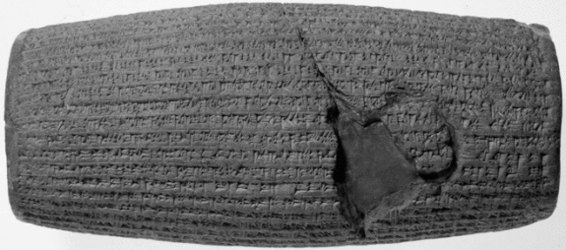
Figure 3.2 Cyrus Cylinder, Babylon. © The Trustees of the British Museum/Art Resource, NY.
Images of Cyrus
One result of Cyrus’ conquest of Babylon was the return of Jewish exiles who had been deported to Babylonia, the so-called Babylonian diaspora, after Nebuchadnezzar’s sack of Jerusalem in 587–586 BCE. Jewish tradition also suggests that it was Cyrus who was responsible for the rebuilding of the temple of Yahweh in Jerusalem, which had been razed during Nebuchadnezzar’s sack. These dramatic changes from the Jewish experience under Babylonian rule explain why Cyrus has such a glowing reputation in Jewish tradition. Indeed, in Second(Deutero)-Isaiah Cyrus is referred to as Yahweh’s shepherd (44.28) and his anointed (45.1), the messiah. Isaiah prophesied that Yahweh would take Cyrus by the hand and lead him to victory over all nations; this is reminiscent of Marduk’s role in the elevation of Cyrus (Cyrus Cylinder, lines 11–19).
The Book of Ezra (1.2–4 and 6.2–5) contains notice of a proclamation by Cyrus, found during the time of Darius I in the archives of Ecbatana, that authorized the rebuilding of Yahweh’s temple in Jerusalem:
In the first year of Cyrus the king, Cyrus the king issued a decree: “Concerning the temple in Jerusalem, let it be rebuilt, the place where sacrifices are offered and burnt offerings are brought … let the cost be paid from the royal treasury.”
(excerpted from the Aramaic version of Ezra 6.3–4)8
How much of the proclamation is historical is difficult to say; the notation that the expenses will come from the royal treasury is surprising. In any case, there is no traceable action of the rebuilding itself until Darius I’s second year. Thus, the proclamation may have been anachronistically attributed to Cyrus’ time, because it coincides with the picture presented elsewhere of the Empire’s founder. If historical, it is unlikely that this was an isolated incident, that Cyrus made such special provisions only for the Jews of Babylon, though it may seem like it based on the limited evidence.
Cyrus’ rise in both the Hebrew and Babylonian traditions is placed in prophetic context: he fulfills both Yahweh’s and Marduk’s purposes for their chosen people. Such an image, and its consistent application, was not a coincidence; it was carefully tailored by the Persian conquerors to justify their takeover. Cyrus’ victory and the dispensations granted to the Jews fit well within a rubric of overarching tolerance, and this has influenced his image even to the present; among specialists, Cyrus’ motives are generally understood as more practical than altruistic.9 The return of gods (the cult statues) to various sanctuaries throughout Greater Mesopotamia was also good policy, one that followed age-old Mesopotamian patterns. Cyrus’ return of gods and restoration of sanctuaries simultaneously manifest and entreat divine favor.
Cyrus in the Greek Traditions
Xenophon’s Cyropaedia (“The Education of Cyrus”) is the most admiring of our sources for Cyrus but is also in many ways the least useful for narrative history. The Cyropaedia is more romance than history, although it is frequently cited for what it reveals about Persian culture and society as well as about preeminent Persians who figured importantly in the Empire’s history. Xenophon’s idealized representation of Cyrus’ life and reign – Cyrus in effect becomes what in Plato’s philosophy would be called the philosopher king – is often impossible to reconcile with the mainstream historical record. Cyrus is the ideal ruler, whom Xenophon uses as a vehicle to explore questions of leadership and government, an ongoing conversation among Greek writers of the Classical period.
Herodotus is our main Greek source, and his version of Cyrus’ origins warrants summary here. Notably, Herodotus acknowledges that he knows three other stories about Cyrus (1.95), but he has chosen to relay a version “based on what some Persians say, those who do not wish to glorify the details of Cyrus’ life but rather to tell the real story.” If Herodotus considered the version he gave as the least exaggerated of the four, one may wonder how over-the-top the other three were. For such a monumental figure, there were clearly many stories in circulation.
In Herodotus, dreams and portents heralded any significant event. The Median king Astyages had portentous dreams that involved his daughter Mandane urinating so copiously that she flooded not only Ecbatana but also all of Asia. This frightened Astyages, so that when Mandane was of marriageable age he refused to give her to any prominent Mede. Astyages staved off the perceived threat by marrying Mandane to a Persian named Cambyses, “of a noble house and of mild disposition, though he (Astyages) considered him beneath a Mede even of middle rank” (1.107). A subsequent dream alarmed Astyages even more: a vine grew forth from Mandane’s private parts and spread over all Asia. There was not much ambiguity there, but Astyages consulted his priests, the dream interpreters, who informed him that any offspring of Mandane would become king and be a threat to him. Astyages summoned the pregnant Mandane home and charged one of his nobles, a man named Harpagus, to destroy the child as soon as it was born. Harpagus in turn gave the job to Mithridates, a humble herdsman, but Mitradates instead exchanged the newborn Cyrus for his own stillborn child, and Mitradates and his wife Spako raised Cyrus as their own son.
This story is another manifestation of an age-old motif of the legendary hero’s birth: the child exposed, or of humble origins, who rises to greatness. The story is often called the Sargon Legend, after the birth story of the king Sargon of Akkad (reigned c. 2340–2284 BCE), and associated with many other famous people including the biblical Moses, and Romulus and Remus in the Roman tradition.10 Cyrus’ true identity was revealed when as a boy of ten he was chosen king by the other boys during a game and, in acting the part, he whipped a malcontent who happened to be the son of a Median notable named Artembares. This was a scandal. In questioning the young Cyrus about the incident, Astyages realized he was speaking to his trueborn grandson. The initial omen of Astyages’ dream about Mandane, that her offspring would be a king, was presumed fulfilled through Cyrus’ playacting the part of king with the other boys. The consequences of this miscalculation have been relayed above: Cyrus ultimately triumphed over Astyages and took his place.
Ctesias also places Cyrus in the Median court, as a ward of Astyages, but not of his bloodline. Instead, Cyrus is given the humblest of origins, named the son of Artadates the bandit and Argoste the goat herder. Scholars have debated the significance of these base origins, because they deviate so much from other versions. Another Artembares, who in Ctesias’ version was Astyages’ cupholder, served as Cyrus’ mentor and foster-father. Through that connection and Cyrus’ own aptitude and potential, Cyrus became one of Astyages’ foremost lieutenants and advisors. Portents play a large role in Ctesias’ story as well, including a flood of urine like in Herodotus, though this time from Cyrus himself as dreamed by his mother.
It is notable that Cyrus is entrenched so firmly in the Median tradition by numerous Greek writers. We have no Median sources per se, but one cannot help but assume that Cyrus’ excellent press in Babylonian and Hebrew sources was applied among the Medesas well, which carried over to the Greek tradition. Claims that Cyrus was descended from Astyages would go a long way toward the legitimization of his Median rule.
Back to Anshan
Given Cyrus’ prominence in disparate traditions, it is important to return to Anshan itself, where Cyrus claimed himself and his forebears as kings. Unfortunately, we have little to go on here, because excavations at Anshan have not yet revealed extensive, sixth-century habitation. Mention of Anshan in the extant sources for the seventh and sixth centuries is rare, so it is surprising when the “King of Anshan” (Cyrus) makes such a powerful entrance on the scene. Royal titles are significant markers in understanding what the king represents and what message(s) he wished to convey. With Cyrus we have a very small sampling, and it is necessary to highlight the fact that we have found none of Cyrus’ royal inscriptions from Iran itself. The inscriptions from Pasargadae inscribed in Cyrus’ name were in fact commissioned by Darius I, in order to bolster Darius’ legitimacy (see pp. 148–150).
It is not only in Nabonidus’ inscription and the Babylonian chronicle that Cyrus is named “King of Anshan.” Cyrus’ own inscriptions, from Babylon and from Ur, use the same title. By the time these inscriptions were commissioned, sometime after Cyrus’ conquest of Babylon in 539 BCE, Cyrus had already conquered three of the great powers of his day: the Medes, the Lydians, and the Babylonians – and by extension much of the ancient Near East. In the Cyrus Cylinder, line 20, Cyrus arrogates traditional Babylonian titles: “I am Cyrus King of the world, great King, strong King, King of Babylon, King of Sumer and Akkad, King of the four quarters.” But earlier in the inscription (line 12) he is referred to as “King of Anshan,” as are his four predecessors: Cambyses I, Cyrus I, and Teispes (line 21). On inscribed bricks from a temple in Ur, Figure 3.3, Cyrus again calls himself and his father Cambyses “King of Anshan.” The entire inscription reads:
Cyrus, King of the world, King of Anshan, the son of Cambyses,
King of Anshan. The great gods have delivered all the lands into my
hands, and I caused the land to live in peace.
Stamped inscriptions of this sort were commonly used by Mesopotamian rulers. This inscription also uses archaic sign forms, a practice carried over from the Neo-Babylonian period kings. These archaic cuneiform signs evoked a connection to the script used by the earliest kings in the Mesopotamian tradition, from centuries previous, such as Sargon of Akkad. Once again, the new Persian king adopted and adapted older forms to legitimize himself and to locate Persian rule within Mesopotamian norms. But that was not all. The title “King of Anshan” has few antecedents, but most scholars take it as a conscious modification of the traditional Elamite title “King of Anshan and Susa,” with emphasis on the former as the seat of Cyrus’ family’s power. This appears to be Cyrus’ initial title, and that of his forebears, another compelling testimony to the Elamite-Persian acculturation that lay at the roots of the Achaemenid Persian Empire’s history.
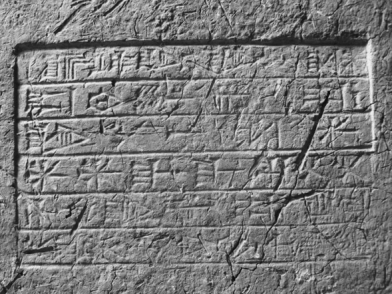
Figure 3.3 Cyrus Brick Inscription, Temple of Nanna-Suen, Ur. Courtesy of Grant Frame, Associate Curator, Babylonian Section, University of Pennsylvania Museum of Archaeology and Anthropology.