
CHAPTER NINE

THE ROMANO-GALLIC EMPIRE C. A.D. 260ñ274
The Roman Empire was in a state of chaos in the year 260. Italy was recovering from a shocking invasion by the Juthungi, who had swept down from the Rhine only a few months before, and the senior emperor, Valerian I, had been captured by the Sasanians. Since Gallienus (the son of Valerian I) was then occupied on the Danube frontier, the western provinces were left in the hands of commanders who were to defend against Germanic invasion.
One of the men in charge of the Rhine defense was Postumus, the governor of Upper or Lower Germany, who rebelled against Gallienus in 260. Postumus was able to create his own separatist Empire by seizing western provinces that had been under Roman control for centuries. Indeed, this was no simple revolt, for it resulted in a new government, complete with a senate modeled after the one in Rome.
Throughout Postumusí reign, border wars along the Rhine and Danube kept both the Romans and the Gallo-Romans occupied enough so that they battled each other in only one serious campaign ó and that ended in a stalemate. The core of Postumusí Romano-Gallic Empire was the three provinces of Gaul (Lugdunensis, Aquitania and Narbonensis), the two Germanys (Upper and Lower), and the island of Britain. Initially Postumusí Empire also included Raetia, but that was lost to Gallienus in 263.
The whole of Spain and the Gallic territories east of the Rhone were also part of the separatist Empire until the emperor Claudius II reclaimed them beginning in late 268 or early 269. Indeed, it was probably in 269 that Postumus was murdered. It seems that the founder of the separatist Empire had fallen victim to a conspiracy between the Spanish nobility (represented by the usurper Laelianus) and the new emperor, Claudius II.
After the murder of Postumus, the separatist Empire spun in decline for the next five years, being ruled by two members of noble Gallic families, Victorinus and Tetricus I (who associated his son with his reign). The significantly biased Historia Augusta declares of the Romano-Gallic emperors: ìÖ they were all sent from heaven to prevent the Germans being afforded the opportunity of making themselves masters of Roman territory, while that monster Gallienus was entangled in a net of unheard of profligacy.î Thus, we must take the scant, often contradictory information about this separatist Empire with a grain of salt.
The Romano-Gallic Empire ended when Tetricus I surrendered to the emperor Aurelian in the spring of 274 after a hard-fought battle at Châlons-sur-Marne (not far from Paris), which itself may have been a mere formality. Historians have rightly pointed out that a secret guarantee of surrender had probably been made in advance. With the vast size of the Roman Empire, the western provinces would prove equally hard to manage in the remainder of Roman history, and they were the base of revolts by many usurpers in the next two centuries.
NOTE: Much is still uncertain about the Romano-Gallic Empire, with two hotly debated subjects being chronology of the reigns and mint locations. The former is especially volatile. The beginning of Postumusí reign is placed in 259 or 260 (or seldom in 258), and its ending either in 268 or 269. The latter date affects the reigns of Laelianus and Marius, as well as the beginning of the reign of Victorinus (which belongs to 268 or 269). The dates of the reign of Tetricus I are inconsistently reported as beginning either in 270 or 271, and ending in 273, 274 or 275. The reign of Tetricus II offers different chronological challenges that are only made more difficult by the uncertainty of the framework to which it belongs. The chronology adopted here is by no means certain, though it does take into account current scholarship and opinions from outside the realm of numismatics. Romano-Gallic coins were struck in considerable quantities, with by far the largest outputs coming from Postumus and the Tetrici. They are found principally in France, but also in England, Belgium, Luxembourg, Holland, Germany and Switzerland, and perhaps elsewhere.
POSTUMUS A.D. 260ñ369

Marcus Cassianius Latinius Postumus, d. A.D. 269. The year 260 was catastrophic throughout the Roman Empire. In Asia Minor, the co-emperor Valerian I was captured alive by the Sasanians, the Juthungi had invaded Italy itself, and revolts were flaring up in the Propontis, Syria, Egypt, the Balkans and Gaul.
Gallienus, the son of the captured Valerian I, now had to manage the entire Empire himself, so he set out for the Balkans to quell the revolt led there by Ingenuus (and reactivated by Regalianus). In the meantime, he left the Rhine defense to his teenage son, Saloninus, and to subordinate military commanders, one of whom was Postumus, then the governor of Upper or Lower Germany. The anticipated invasions occurred as the Alemanni poured over the Rhine and invaded Gaul, and the Franks cut as far south as Spain.
Amid this chaos, Postumus was hailed emperor by his legions in the summer or fall of 260, possibly at Deuso (modern Diessen in Holland), as this otherwise obscure village is commemorated on his coinage. (Alternatively, Deuso may be where Postumus was born, for he is said to have hailed from a village.) Postumusí first action was to besiege Cologne, where Saloninus and his praetorian prefect, Silvanus, had established their court.
Postumus had formerly co-directed Roman policy in Gaul with Silvanus, but the two men had quarreled, and now were enemies. Silvanus remained loyal to Saloninus and at some point while besieged probably suggested that the boy be raised from Caesar to Augustus. However, the prestige associated with the rise in rank did not protect Cologne from Postumusí legions. Both Saloninus and Silvanus were executed after the walls were breached shortly after the siege began, after which Postumus erected a triumphal arch to commemorate his victory at Cologne.
The renegade emperor established his headquarters at Trier, and went about creating a smaller version of the Roman Empire, complete with its own senate, consuls and praetorian guards. Postumus himself held the consulship on five occasions. Although he had the upper-hand on Gallienus now, Postumus had no intention of threatening Rome, and made that point clear to Gallienus, reporting that his express purpose was to protect the western provinces.
Postumus spent the next two years fighting the Germans, over whom he won a major victory at Magosa in 261. He appears to have visited Britain to secure the loyalty of that island province, and then returned to Gaul where he fought the Germans once again in 263. He had pacified his own rebel Empire ó by now extending from the Rhine to the south of Spain ó and he would now face the wrath of Gallienus.
Not only had Gallienus lost his eldest son in 258 and his father in 260, but he had lost his younger son, Saloninus, to the treachery of Postumus in 260. Inevitably, Gallienus invaded Postumusí territory with great ferocity sometime between late 263 and early 265. After trapping Postumus in ìa town in Gaul,î Gallienus began the siege, but was injured by an arrow and had to withdraw. He was obliged to pass the leading role onto his cavalry commander, Aureolus, who was unable to capitalize on the impressive gains made by Gallienus. The offensive turned into a stalemate, as Postumus wisely avoided fighting a pitched battle. The escape of Postumus from certain death in the siege invites speculation that Aureolus allowed him to escape because they had become allies (as was shown to be true a few years later).
From this point onward Gallienus was so occupied with crises in the rest of the Empire that he never again took the field against Postumus. Indeed, the historical and numismatic evidence would lead one to believe they had entered into a non-aggression pact. To be sure, however, Gallienus had Aureolus make preparations for taking up a defensive position at Milan, so as to discourage an invasion of Italy from Gaul.
Much to the disappointment of Gallienus, Aureolus revolted late in 267 or early in 268, clearly in alliance with Postumus, for he struck coins with Postumusí name and invited him to invade Italy. Whether Postumus feared a trap, decided to honor a pre-existing agreement with Gallienus or found the venture impractical is not certain. Traditional thinking has held that the uprising of Laelianus prevented Postumusí acceptance of Aureolusí invitation, but the revised chronology makes that impossible. In any case, he did not invade ó a decision that either directly or indirectly caused the murder of all men concerned.
After having just defeated the Goths at Naíissus, Gallienus returned to Italy to wage war against his turncoat commander Aureolus, who by then seems to have already established himself in Milan. Both Gallienus and Aureolus perished at the siege late in 268, the emperor by assassination, the usurper by execution. The next emperor of Rome, Claudius II ìGothicus,î was probably responsible for Gallienusí death, and certainly was the one who executed Aureolus.
Several months later, Postumus faced an identical crisis in his own realm, when one of his governors in Germany, a Spaniard named Laelianus, staged a revolt in Mainz sometime between February and June of 269. There is every reason to believe Laelianusí revolt occurred in concert with an invasion of the South by the new emperor, Claudius II. Not surprisingly, the first territory to fall to Claudius was Spain, a region in which Laelianus no doubt could assure the support of local nobility.
The Roman success in the South did little to distract Postumus from taking revenge on Laelianus, whose revolt he crushed in two months or less (probably ending in the spring of 269). Laelianusí death set into motion a series of violent overthrows, with the next victim being Postumus himself, for he was murdered in the aftermath sometime between April and August 269.
The founder of the separatist Empire was killed by his own soldiers, either for refusing to let them sack Mainz, or because there were men among them who secretly supported the apparent conspiracy of Laelianus and the Romans. Alternatively, he could have been killed by those who attributed their current predicament to Postumusí hesitation to invade Italy in the previous year.
NUMISMATIC NOTE: Postumusí first issue of double-denarii contained about 20 percent silver, and were complimented with uncommonly heavy aurei and a massive issue of sestertii and double-sestertii. All of these were far more impressive than the degenerate coins then being produced by Gallienus, and no doubt helped Postumus win support in his region. By the end of Postumusí reign, the purity of his double-denarii had dropped by more than half, to about 8 percent, a purity that still was three or four times higher than the issues of Gallienus or Claudius II. Coins bearing the letters CA or CCA A on the reverse were struck at Cologne (Colonia Claudia Agrippina Augusta).
In general, it can be said that Postumus was quite imaginative with his coinage, and that he no doubt must have taken a personal interest in determining its types. That Postumus associated himself with Hercules is clearly demonstrated by the coinage. On a level equal to Maximian (286ñ310), he identifies himself with the Graeco-Roman hero, initially on the localized level with Hercules of Deuso (and those of Lugdunum ó MAGVSANO and PACIFERO), but later in a more general sense. Sometimes he is shown donning a club and the Nemean lionís hyde. On much rarer occasions his bust occurs jugate with Hercules. Postumusí reverse types depicting either Hercules or his attributes (club, bow, quiver, etc.) formed a regular part of his coinage, while a much rarer component depicts the labors of Hercules.
On other reverse types, Postumus ó rightfully so ó styles himself as ìrestorerî of the Gauls and as victor over the Germans. But later he extends these legitimate claims to the illusory by taking credit for the salvation of the Roman world (RESTITVTOR ORBIS and PACATOR ORBIS) and Romeís provinces in general (SALVS PROVINCIARVM). Whether these types reflect a quiet alliance between Gallienus and Postumus or are nothing more than simple braggadocio remains uncertain.
AUREOLUS A.D. 267(?)ñ268
ALLY OF POSTUMUS
Marcus (or Manius) Acilius Aureolus, d. A.D. 268. Aureolus rose from his obscure origins as a Dacian shepherd to become one of the Empireís most decorated generals. He was serving as Gallienusí governor of Illyricum when, in 260, he stamped out the rebellion of Ingenuus in Pannonia and Moesia, and sent his deputy commander, Domitianus, to defeat the Syrian legions of the Macriani that had invaded Illyricum.
Although both engagements were successful for Aureolus, the revolt of the Macriani persisted in Syria for another eight months, and Ingenuusí rebellion was renewed later in 260 by Regalianus, a rebel whom Gallienus himself eliminated. After these laudable successes, Aureolus revolted in 262, only to later reconcile with Gallienus. But this was not to be the last time Aureolus would rebel against his benefactor.
In recent years the Sasanians, the Sarmatians and others had employed heavy cavalry to great effect against the Roman legions, so Gallienus created a new cavalry corp, and chose Aureolus as a commander. The new (and very expensive) cavalry proved immediately effective in the war against Postumus that Gallienus and Aureolus waged sometime between late 263 and early 265. Indeed, Postumus was besieged in a town in Gaul, and his end seemed near. However, Gallienus was wounded by an arrow and was forced to leave the campaign in the hands of Aureolus, who was either incapable or treacherously unwilling to capitalize on Gallienusí gains, and thus the campaign was ended.
Although Postumus had not shown designs beyond his own borders previously, Gallienus was wary, and so enlisted Aureolus to take a defensive position. Though the details of his task are far from certain, it seems Aureolus was first sent to Raetia to recruit soldiers, which he was to then lead south to Milan, where they could safeguard Italy from possible invasion. But to the faithless Aureolus, this was just another opportunity to betray Gallienus, who was then occupied by a war in Greece against the Goths and Heruli.
From here out the story of Aureolus takes two different paths that historians cannot seem to reconcile, so they will be presented separately. In the first scenario Aureolus revolted while in Raetia or while already en route to Italy, and was intercepted by Gallienus (or one of his officers) at Pontirolo, where his army was routed and Aureolus was wounded. The usurper then occupied Milan, where he endured a siege by both Claudius II and Gallienus, or possibly just the latter.
Alternatively, Aureolus had already installed himself at Milan before he declared for Postumus, and Gallienus hurried back from northern Greece upon learning of his revolt. Aureolus may have briefly left Milan to intercept an army led by Gallienus or one of his subordinates, only to be wounded and return to Milan. This defeat may have been at the hands of the future emperor Claudius II, who seems to have begun the siege of Milan before Gallienus arrived. After Gallienus arrived, he took over the siege and placed Claudius II in command of the reserve forces at nearby Ticinum.
The two versions of this story conjoin at the point where Gallienus has taken over the siege of Milan (which no doubt was a bitter, personal affair). During the course of this siege, Gallienus was treacherously murdered in September of 268, almost certainly at the instigation of Claudius II, who was hailed the new emperor. Aureolus is said to have attempted to bribe Claudius II to save his own life and seems to have come to terms, for he surrendered. But any such deal that was made was not honored by Claudius II, for Aureolus was executed shortly after leaving the walls of Milan.
Most noteworthy about Aureolusí revolt, however, is its link to Postumus. Not only did he invite Postumus to invade Italy, but the numismatic record shows that Aureolus struck coins with the name and effigy of Postumus at Milan. It is possible that Aureolus was hoping to win Postumusí support through such overtures, but more than likely he had come to an agreement with him in advance. In either case, the alliance did not work out, for Postumus refused Aureolusí offer to invade. In the end, Postumusí refusal proved to be the doom of both Aureolus and Gallienus, and quite possibly contributed to his own downfall less than a year later.
NUMISMATIC NOTE: The aurei bearing the name of Aureolus are believed to be forgeries. However, while at Milan ó a city never controlled by Postumus ó Aureolus struck aurei and double-denarii in the name of Postumus. The coins struck by Aureolus are distinguished from Postumusí regular issues of Lugdunum and Cologne by their ëcompactí die engraving and their thick, short planchets. Also distinguishing them is the frequent appearance of a P, S or a T in the exergue to indicate the three officinae in use at Milan (Prima, Secunda and Tertiae). This feature is unique to Milan for coins struck in the name of Postumus (though rarely a P or a V will occur in the left field on the reverse of double-denarii of Cologne). However, the best diagnostic for coins issued by Aureolus is the reverse inscription, for most often it ends with Aeqvit, Eqvit or Eqvitvm (a reference to the Equites (íhorsemení), the special cavalry corp which Aureolus commanded). The only coins without reverse inscriptions ending with one of the three versions of (A)Eqvitvm which are still attributed to Milan are those which have an officina marker in the exerge.
LAELIANUS A.D. 269

Ulpius Cornelius Laelianus, d. A.D. 269. Postumus was at his capital city of Trier when he learned that one of his governors in Germany, Laelianus (sometimes called ìLollianusî in the Historia Augusta), had staged a rebellion at Mainz. The date of the revolt is debated, but it probably began either in February or June of 269 and lasted only a month or two.
Postumus was in a dangerous position, for Laelianus had two legions of his own. This was equal to the number of soldiers Postumus could muster on short notice. To make matters worse, Postumusí territories to the South were concurrently under attack by the emperor Claudius II. This arrangement is so coincidental that it has led many researchers to read between the historical lines, and arrive at the conclusion that Laelianusí revolt was coordinated with the Roman offensive.
Whatever hopes Laelianus may have entertained, his revolt quickly failed. Postumus moved in rapidly and besieged him at Mainz, and after a few weeks, Laelianus was executed by his soldiers because, as the Historia Augusta reports, ìÖ he tasked them too severely.î Whatever the cause of his demise, his death seems to have occurred sometime between April and July of 269.
The siege of Mainz also proved fatal for Postumus, however, who was murdered by his own troops in the aftermath. The reason for Postumusí murder is open to speculation, although the traditional explanation is that he refused to allow his soldiers to sack the city.
We know little of Laelianus except that he apparently was a brave man of Spanish extraction and was a member of the noble family (the Ulpii) from whom the emperor Trajan (98ñ117) hailed. A blatant allusion to Spain occurs on an aureus that depicts Hispania reclining with a rabbit at her side. This coin type, taken as evidence in addition to his respectable Spanish nomen, shows that he probably enjoyed support among the nobility of Spain. Thus, his association with the invasion of Claudius II is made all the more likely, for in late 268 or early 269, Spain switched allegiance from Postumus to Claudius II, seemingly without a fight.
NUMISMATIC NOTE: It must be presumed that Laelianusí coinage was struck at Mainz, for not only was that the base of his revolt, but several of his reverse dies were used by the subsequent usurper, Marius, in the production of his own coinage at Mainz. Though Laelianus has a few different reverse types for his aurei, his double-denarii employ only Victory and Pax as reverse types.

MARIUS A.D. 269
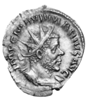
Marcus Aurelius Marius, d. A.D. 269. During the chaos that followed the murders of Laelianus and Postumus, the soldiers proclaimed one of their own, an enormously strong soldier and blacksmith named Marius, as their new emperor. Eutropius states that ìÖ a workman of the lowest class, grasped the purple and was slain on the second day,î and Marius Pollio suggests he ìwas only emperor for three days.î But the extreme brevity of his reign can be dismissed on the numismatic evidence alone, which suggests his reign almost certainly lasted several months.
The circumstances of his death in the summer or fall of 269 are equally uncertain. Though he is said to have been killed with a sword of his own manufacture, by a soldier he had treated poorly at the forge where they had worked previously, it is equally likely that he was strangled to death as the result of a private quarrel.
NUMISMATIC NOTE: With the exception of a small coinage produced at Trier(?), all of Mariusí coinage seems to have been struck at Mainz. His own coinage shares reverse die links with the final issues of Laelianus. It is also of interest that some double-denarii of his successor, Victorinus, have portraits with the slightly modified portrait of Marius. Not only are these pieces quite rare, but they are also one of the best examples of ìportrait fusionî on Roman coinage. Marius expanded the use of reverse types considerably over that of Laelianus. This, combined with the far greater commonness of his coins, suggests his reign was at least twice as long as that of his predecessor.
DOMITIANUS c. A.D. 269(?) or 271(?)
Domitianus, lifespan unknown. This issuer is unknown to history, but based on the style and fabric of the unique coin bearing his name and image (which some authorities question), his bid for the purple can securely be placed in the era of Victorinus (269ñ271). What follows is a description of the coinís occurrence and likely place in history as told in part 2 of volume 5 of The Roman Imperial Coinage.
ìIn 1900 a hoard of 1300 coins, from Gordian III to Aurelian, was discovered at Cleóns, Loire Inférieure, and fortunately fell into the competent hands of Colonel Allotte de la Fuÿe. The bulk of the hoard consisted mostly of coins of the Gallic Empire: there was one fine piece of Macrian the younger, and one coin of Gallic fabric in good preservation which bore the obverse inscription IMP C Domitianvs PF AVG., with a radiate, draped and cuirassed bust to right. The portrait is that of a large-featured, heavily bearded man, distinguishable from those of Victorinus and Tetricus I, though the style of the coin is similar to their regular coinage. Ö Though we have no historical record of any western usurper named Domitian, there seems no reason to doubt the genuineness of the coin, or to reject the attribution of it favoured by Colonel de la Fuye to Domitianus, ëdux Aureoli fortissimus et vehementissimus,í who actually achieved the victory over the Macriani. We may fairly surmise that he made a momentary grasp at power either during the troubles which preceded, or those which followed, the reign of Victorinus, for the style of the coin suggests that his rebellion had place in a mint-city in Gaul. Öî
The authors suggest in a footnote that the coin might also represent an attempt to rally the defeated Gallic army after the battle at Châlonssur-Marne (where the Tetrici were defeated by Aurelian in the spring of 274), but based on the style and fabric of the coin, this seems far less likely than the original proposal of associating it with the reign of Victorinus. Indeed, it is not impossible, or even unlikely, that Domitianus was a usurper during the reign of Victorinus, rather than a contender at the beginning or ending of his reign.
VICTORINUS A.D. 269ñ271

SON OF VICTORIA
UNCLE OR FATHER(?) OF TETRICUS
GREAT-UNCLE OR GRANDFATHER(?) OF TETRICUS II
Marcus Piavonius Victorinus, d. A.D. 271. The descendant of a noble Gallic family, Victorinus was proclaimed emperor by the soldiers after a two-day interregnum that followed the murder of Marius. It appears that sometime between summer and the month of November in 269, Victorinus opposed Mariusí revolt, and that he was perhaps inspired to action by his mother, Victoria.
A wealthy noblewoman, Victoria (or Victorina or Vitruvia, for she is called by all three names in the dubious passages of the Historia Augusta), may have been instrumental in the downfall of Postumus, for she appears to have secured the throne for both Victorinus and Tetricus I. But in any event, Victorinus was one of the Gallic armyís top men, having served as consul in the Romano-Gallic senate in 265 or 267, and being the tribune of the guards at Trier at the time of his elevation.
Although Victorinus may have been the natural successor to Postumus, he failed to earn recognition from Spain, which seems to have defected to the Romans during the brief usurpation of Laelianus. Victorinusí fortunes suffered an additional blow when the new emperor Claudius II gained the support of the Aedui and incited them to revolt in Central Gaul. In the process, Victorinus lost his territories east of the Rhone to Claudius II, and only after a protracted siege of Autun in the fall of 270 did he regain control of the heart of his Empire.
But in the end it was not military uprisings or Roman advances that brought down the regime of this brave and talented soldier, but rather his lust for the wives of his colleagues. His relentless pursuit of married women earned him powerful enemies who resented his transgressions, and Victorinus was killed after he propositioned one too many wives of his officers. His murder occurred at Cologne sometime in 271 (with accounts varying from the spring to early winter), ending a promising reign and forecasting the inevitable downfall of the Romano-Gallic Empire.
NUMISMATIC NOTE: Victorinus is unique among the Roman-Gallic emperors in that he was deified by his successor, Tetricus I, who struck memorial coins in his honor with the reverse inscriptions CONSECRATIO and CONSACRATIO, the latter being a Gallic peculiarity. Victorinusí coinage ó which seems to have been struck at only one mint (perhaps Lugdunum) ó records that he held two consulships and, more importantly, that his tribunician power was renewed three times (suggesting his reign exceeded two calendar years). Some 19th Century scholars suggested that the bust of Victory he sometimes used as a reverse type was meant to personify his mother, Victoria, thus named in the inscription VICTORIA AVG. Though the possibility exists, it is impossible to prove. The most imaginative of Victorinusí coins were his aurei, which commemorate more than a dozen Roman legions (and which some scholars consider to be more likely small medallions than coins). Though some of the legions were based in Britain and the Upper and Lower Rhine, most were stationed in the rest of the Roman world, as far afield as Egypt, Phoenicia, Judaea, Pannonia, Dacia and Moesia. Some scholars have suggested that the non-local legions named represent detachments or vexillations of these legions which served under Victorinus rather than the legions themselves.
TETRICUS I A.D. 271ñ274
AUGUSTUS: A.D. 271ñ274
(A.D. 271ñ274: SOLE REIGN)
(A.D. 274: BRIEFLY WITH TETRICUS II(?))

NEPHEW OR SON(?) OF VICTORINUS
FATHER OF TETRICUS II
GRANDSON OF VICTORIA
Gaius Pius Esuvius Tetricus, lifespan unknown. The uncertainty that followed the apparently spontaneous murder of Victorinus was resolved by the mother of the deceased, Victoria. If we are to believe the Historia Augusta, she used her wealth to secure the elevation of Tetricus, the governor of Aquitania who probably was her grandson, and at the very least a close relative.
Tetricus was hailed emperor at Bordeaux in 271 (accounts vary from spring to fall), and then established his court at Trier, from which he could deal more effectively with an anticipated invasion from Germany. He made a formal entry at Cologne and in the opening year of his reign fought the Germans. But the problems that had plagued Victorinus only grew under Tetricus, who was to be the last of the Romano-Gallic emperors.
At some point during his reign, Tetricus I raised his son, Tetricus II, to the rank of Caesar, and (it appears) to the rank of junior Augustus not long before their abdication. Tetricus I must have realized that his days were numbered, and that his greatly reduced Empire would soon fall to the new emperor, Aurelian, who returned to Europe late in 272 after crushing the more formidable separatist Empire of Palmyra. Though Aurelian may have begun his conquest as early as the summer of 273, Tetricusí Gallic army was defeated by Aurelianís legions in a hard-fought battle at Châlons-sur-Marne in the spring of 274. There, Tetricus and son surrendered to Aurelian. At long last, the Roman Empire was whole.
The battle at Châlons-sur-Marne may have been a mere formality, since there is ample circumstantial evidence to suggest that Tetricus had secretly agreed to surrender before the armies clashed. Indeed, Tetricus may have invited Aurelian to invade, and to thus to rescue him from the difficulties he faced. Although paraded as trophies in Aurelianís triumph, Tetricus and his son were honored and taken into Aurelianís administration. When the familyís senatorial status was restored, the father was appointed governor of Lucania (in southern Italy) and is said to have lived to a greatly advanced age.
NUMISMATIC NOTE: The days when a separatist Empire seemed a good idea had long passed by the time Tetricus I assumed command. Gaul had now become a net importer of Roman coins, which were now of higher value than their Gallic counterparts. The double-denarii of Tetricus was greatly reduced in weight and purity, and had only 6% to 8% of the intrinsic value of Postumusí first issues. Furthermore, the planchets and method of striking had degenerated so greatly (even from the preceding reign of Victorinus) that differentiating the worst of the official coinages from the best of the ìunofficial mintî issues is often impossible.
TETRICUS II A.D. 274(?)
CAESAR: A.D. 273ñ274 (UNDER TETRICUS I)
AUGUSTUS(?): A.D. 274 (WITH TETRICUS I)

SON OF TETRICUS I
GRAND-NEPHEW OR GRANDSON(?) OF VICTORINUS
GREAT-GRANDSON OF VICTORIA
Gaius Pius Esuvius Tetricus (II), lifespan unknown. Bearing the same name as his father, Tetricus II was raised to the rank of Caesar either in the spring or summer of 273 (though some scholars prefer 271), and shared the consulate with his father in 274. Along with his father, young Tetricus filius abdicated, and surrendered to Aurelian following the defeat of their army at Châlons-sur-Marne in the spring of 274. Though the young man was paraded through the streets of Rome in Aurelianís triumph, he was subsequently restored to senatorial status. He is said to have been very intelligent, and though we know little of his actual accomplishments, his career as a senator in Rome was stellar, for we are told that in his lifetime, no other senator was so highly esteemed.
NUMISMATIC NOTE: The nature of the titles accorded Tetricus II, and their chronology, has been contested among scholars for more than a century. There is ample numismatic evidence to suggest Tetricus II achieved the rank of Augustus, although coins indicating this are often suspected of being barbarous or outright counterfeits. Not to be dismissed are the coins with reverse inscriptions ending in AVGG, some of which are not rare and are of undoubted authenticity. The coins that actually name Tetricus II as Augustus on the obverse are so rare that, if genuine, they must fall within the final weeks of the reign of the Tetrici as they prepared for the invasion of Aurelian. The confusion of Tetricus IPs reign is largely due to the unreliable literary sources of the period. For a closer study of the evidence, see ìAn Unpublished Coin in the Name of Tetricus II,î by C. H. V. Sutherland in the ANSMN 11 (1964).
THE KINGDOM OF PALMYRA C. A.D. 260ñ272
The stability of the Roman East was shattered in 260 when Valerian I was captured by the Sasanian king Shapur I. The eastern legions no longer had a leader, and so a revolt was sparked in Antioch by the praetorian prefect Callistus (ìBallistaî) and the quartermaster-general, Macrianus Senior. Though neither assumed the purple himself, they hailed Macrianusí two sons, Macrianus and Quietus, as emperors in opposition to Gallienus.
These developments had a similar effect in the European provinces, where revolts and invasions demanded the full attention of Gallienus. Unable to march into Asia himself, Gallienus had to rely on Septimius Odaenathus (a leading citizen of Palmyra whose family seemed to have been of recent importance, and who was only called ìking of kingsî posthumously) to restore order in Asia Minor. This meant not only suppressing revolts, but also keeping the Sasanians in check.
Palmyra (the ìcity of palms,î also called Tadmor), a desert oasis located between Mesopotamia and Syria, long had served as a buffer state between Roman and Parthian territories. The region first caught the attention of Rome under Marc Antony in the mid-30s B.C., and was incorporated into the Roman province of Syria during the travels of Germanicus in the east in A.D. 18. Palmyraís affluence derived from its ideal location as a staging point for caravans bound for the Euphrates and the Persian Gulf, and thus to the sea-routes to India.
For seven years Odaenathus served the Romans admirably ó first in 260, in the aftermath of Valerianís capture. The Sasanian army was defeated in Cilicia by the prefect Callistus (where even the harem of Shapur was captured), and on its retreat, Odaenathus delivered a second defeat, which drove the Persians out of Roman territory. In the process, Odaenathus reclaimed Mesopotamia for Rome. In 261 he turned his attention from the Sasanians to the Roman rebels, causing the murder of Queitus when he besieged Emesa. For these services, Gallienus gave Odaenathus the title ìRuler of the Romansî and ìGovernor of the East.î
Although peace had already been established with the Sasanians, hostilities occurred again in 266, when Odaenathus defeated Shapur in a pitched battle near Ctesiphon. In the following year, 267, he led his army north to repel another invasion of Asia Minor by the Goths. The height of his achievement, in the fall of 267, Odaenathus and his eldest son were killed while returning from this campaign. The traditional explanation for his murder is a domestic squabble, but historians have not overlooked the possibility that it was committed by agents of Gallienus, who no doubt feared the growing power of his eastern viceroy.
The throne of Palmyra was inherited by Odaenathusí second wife, Zenobia, and her son, Vabalathus (also called Athenodorus). An unsteady peace now existed between Palmyra and Rome, and shortly before his own death in 268, Gallienus sent a general named Heraclianus on a campaign against Palmyra. The venture was a failure, and achieved the opposite of its intended result, for now Zenobia and Vabalathus were aware of Romeís hostility toward them. Neither Gallienus nor his successor, Claudius II, would grant Vabalathus the titles that his father had earned from years of valiant service.
Gallienus and Claudius II were so occupied with wars in Europe that they could pay no attention to the East, and so relations worsened between Palmyra and Rome. The Palmyrenesí great expansion occurred during the otherwise successful reign of Claudius II, when in 269 the queen and her son conquered lands as far west as Ancyra. In late 269 or early 270, during the last few months of the reign of Claudius II, they invaded and occupied the important province of Egypt, jeopardizing the grain supply to Rome.
Shortly after his accession, the new emperor, Aurelian, granted (either at the end of 270 or early in 271) the royal titles to Vabalathus and Zenobia which they had long demanded. Aurelian hoped this overture would placate them while he dealt with the local threat of the Vandals, Juthungi and Marcomanni. Though it probably had some mild effect, his gesture did not prevent the Palmyrenes from continuing to strengthen their authority throughout Asia, nor did it dissuade Zenobia from hailing herself Augusta, and Vabalathus from claiming the title Augustus. Egyptian papyri confirm that Vabalathusí revolt in 272 began after April 17 and had been suppressed by June 24.
When Aurelian had sufficiently stabilized Europe to focus on recovering his lost provinces in the East and West, he led his army past the walls of Byzantium and cut a path directly across Anatolia, recovering city after city. Finally, he engaged the Palmyrene armies at Immae, about a dayís march from Antioch, where his cavalry was victorious over the Palmyrene commander, Zabdas. He next routed the enemy at Emesa, giving Zenobia no choice but to take refuge in her capital city of Palmyra.
The legendary siege skills of the Romans paid off yet again, for Zenobia and Vabalathus were captured later that year, narrowly escaping the prospect of the Sasanians being drawn into the conflict. In the meantime, the future emperor Probus had recovered Egypt. Although he spared the city destruction, Aurelian executed Cassius Longinus, the chief adviser of Zenobia (she blamed him for the revolt) and returned to Europe with his two royal captives so they could be displayed in his triumph at Rome.
After returning to Europe to fend off a new invasion by the Carpi, however, Aurelian learned that the 600 Roman archers stationed at Palmyra under the command of Marcellinus and Sandarion had been slaughtered. A new revolt had been ignited, this time led by a certain Septimius Apsaeus under the titular figurehead Antiochus, a descendant of Odaenathus. We are told that the Palmyrenes had gained nominal support in Egypt from a certain Firmius, a man of whom the Historia Augusta gives a colorful, but certainly fictional account, and who may be the same man who, papyri indicate, assumed the title epanorthotes or corrector.
Aurelian made the arduous journey to the desert oasis for a second time, with Zenobia and Vabalathus still in chains, and crushed the rebellion in Palmyra. Next, he marched on Alexandria, where he caused Firmius to commit suicide. Once bitten, twice shy: Aurelian leveled Palmyra before he left. The city never recovered its former glory, although Diocletian did construct some baths there from 293 to 303 for his soldiers.
ZENOBIA A.D. 267ñ272
QUEEN: A.D. 267ñ270/1
AUGUSTA: A.D. 270/1ñ272

WIFE OF ODAENATHUS
MOTHER OF VABALATHUS
DAUGHTER OF JULIUS AURELIUS ZENOBIUS
Septimia Zenobia (Bat-Zabbai), born c. A.D. 241(?). As the queen of Palmyra, Zenobia gained authority through her husband and retained it through her son, Vabalathus. Zenobia herself claimed descent from the Macedonian rulers of Syria and Egypt, though her name indicates she was of Semitic heritage.
Thus, when Odaenathus was murdered in 267, the throne was passed onto the rightful heir, Vabalathus. The circumstances of Odaenathusí murder are still uncertain, but the fact that his eldest son Hairanes (by an earlier wife) perished with him leads one to conclude that it was a dynastic purge rather than a mere ìdomestic squabbleî as we are often told. Whether it was Gallienus or Zenobia who caused the murders is unknown.
In any case, Zenobia and Vabalathus, her son by Odaenathus, inherited an Empire that was now all-powerful in the East thanks to the fierce leadership of Odaenathus. He had taken command on behalf of Rome, and had defeated the armies of Shapur I on several occasions. The result was that Zenobia and her son were in a unique position to threaten Roman supremacy in the East.
Bearing that in mind, it seems a foolhardy move for Gallienus to have sent an expedition against Zenobia in 268. Not only would the expeditionís failure spell certain doom (for there would be no longer any doubt as to Romeís hostility), but even if successful, Gallienus was in no position to protect the east. So it comes as no surprise that Zenobia viewed Rome as an enemy, and that she took strong measures to consolidate her power as Rome went through another three emperors in as many years.
Gallienus, Claudius II and Quintillus all refused to give her son, Vabalathus, the same titles and honors won by his deceased father, and so the hostilities grew. During the reign of Claudius II (268ñ270), Zenobia led the campaigns by which Palmyra claimed Asia Minor and the Levant. Next, either late in the reign of Claudius II or early in the reign of Aurelian, she seized Egypt, a notoriously difficult land to conquer. Egypt was dear to the Romans both as the emperorís personal province and as one of the main sources of grain for Rome.
Having little choice in the matter, the new emperor, Aurelian, granted Vabalathus and Zenobia the titles they demanded, hoping it would buy him the time he needed to settle affairs in Europe. In the end of 271 or the spring of 272, Aurelian was ready to exact his revenge, and led his army across Anatolia, liberating the Greek cities and defeating the Palmyrene armies at Antioch, Emesa and finally at Palmyra, where Zenobia and her army eventually took refuge.
Supplies ran short in Palmyra, and Zenobiaís Armenian allies defected to the Roman side. Zenobia then decided to appeal to the Sasanians for help. She made a dash toward the Euphrates on a camel, but was overtaken by the Roman horseman, after which the city fell. Late in 272 Aurelian returned to Europe with the Palmyrene royalty with the intention of featuring them in his triumph, bound with golden chains, while all along the arduous journey they attracted the curious spectator. The royal captives did not arrive in Rome until 273, after both the Danubian front and the second revolt in Palmyra and Alexandria were settled.
Two versions exist of Zenobiaís fate: subsequent to Aurelianís triumph in Rome, she was beheaded by Aurelian or was allowed to retire to a villa near Tibur, where she married a senator and later died peacefully. The latter version seems more likely, for Eutropius says her descendants enjoyed good reputation, and the Historia Augusta tells us that during the reign of Valentinian I (364ñ375), her descendants were reckoned among the nobility in Rome.
Zenobia was said to be dark complexioned and exceptionally beautiful, with black eyes that were ìpowerful beyond the usual wont Öî In inscriptions she is called Bat-Zabbai, daughter of La-Zabba, meaning the ìone with beautiful long hair.î Beyond her physical beauty, she was a shrewd stateswoman and proved to be a capable general in the field. The historians tell us that although chaste, she was not adverse to hunting and drinking with her generals or with visiting dignitaries.
NUMISMATIC NOTE: The coinage of Zenobia consists of billon double-denarii struck at Antioch and/or Emesa, and potin tetradrachms struck at Alexandria. Though her son had been issuing coins jointly with Aurelian since the emperorís accession late in 270, Zenobia does not appear on coinage until late spring of 272, when war was declared. Her striking seems not to have lasted more than about two months (perhaps considerably less), and consequently her coins are very rare. Like the sole issues of her son that were struck concurrently, her Alexandrian issues are dated year 5 (E), and thus are back-dated to 267, when her husband, Odaenathus, died (rather than to late 270, when their titles were recognized by Aurelian).
VABALATHUS A.D. 267ñ272
KING: A.D. 267ñ270/1
AUGUSTUS: A.D. 270/1ñ272

SON OF ODAENATHUS AND ZENOBIA
HALF-BROTHER OF HAIRANES (HERODES)
Lucius Julius Aurelius Septimius Vabalathus Athenodorus (also Wahballat), born c. A.D. 256/7(?). Much like his father, Odaenathus, Vabalathus owed his royal position to the bloodlines of his mother, Zenobia. After the murder of his father and step-brother in 267, Vabalathus and his mother assumed control of Palmyra, which at that time was the dominant force in Asia Minor.
Initially during the co-regency of Zenobia and Vabalathus, there was an unsteady peace between Palmyra and Rome, which was shattered by the failed expedition sent against Palmyra in 268 by Gallienus. The succeeding emperors, Claudius II and Quintillus, both refused to grant Vabalathus and his mother the titles they demanded. But in 269 and 270, during the reign of Claudius II, the Palmyrenes seized most of Asia Minor, from the heart of Anatolia to the border of Cyrene, including Egypt.
Late in 270 or early in 271, the new emperor Aurelian (270ñ275) thought it wise to grant Vabalathus the titles of his deceased father. Later still, most likely in 271, Vabalathus and his mother took further initiative against Rome, and Vabalathus boldly claimed the title of Augustus.
However, Rome was now in capable hands. By late 271 or the spring of 272, Aurelian began to direct his efforts to recovering the lost provinces in the East and West. In the resulting war, both Vabalathus and Zenobia were captured during the course of the siege of Palmyra, which fell later in 272. The king and his mother were then led away as captives for display in Aurelianís anticipated triumph at Rome.
NUMISMATIC NOTE: The coinage of Vabalathus consists of double-denarii struck at Antioch and potin tetradrachms (and one rare issue of Æ drachms) struck at Alexandria. Both main coinages were struck in two phases, the first being when he shared honors with Aurelian (late 270 through late 271 or spring 272), and the second being after he and his mother had declared themselves independent from Rome (after which Vabalathus was Augustus). The Imperial double-denarii Vabalathus struck jointly with Aurelian at Antioch have his own laureate portrait on the obverse and Aurelianís radiate bust on the reverse. (It is worth noting that scholars have disagreed as to which side is the obverse.) Equally challenging is Vabalathusí inscription, which adds VCRIMDR to his name. The likely interpretation is Vir Clarissimus Rex (or Romanorum) Imperator Dux Romanorum (with the first portion translating to ëmost noble man, kingí or ëmost noble Roman maní). At the provincial mint of Alexandria, Vabalathus uses his own regnal years 4 (Δ) and 5 (E) to Aurelianís 1(A) and 2 (B), thus ëback datingí his accession to 267, when his father died.
THE ROMANO-BRITISH EMPIRE C. A.D. 286/7ñ296/7
The island of Britain had always been a source of trouble for the Romans, as it offered the unenviable combination of being poor in natural resources and difficult to control. The Romans first took a serious interest in Britain after hearing reports of its mineral wealth, which only later were proven to be greatly exaggerated.
Although Julius Caesar campaigned there in 55ñ54 B.C., it was not until the reign of Claudius (41ñ54) that serious efforts at annexation were made. The next half century saw many tragedies in Britain, including the immensely destructive revolt of Boudicca in 60, in which some 70,000 Romans are said to have perished and London was burned to the ground. The Roman reprisals were equally ruthless. Not long after this, the governor Agricola (78ñ85) also campaigned with success.
Still later the emperors Hadrian and Antoninus Pius erected long walls to help defend Britain from the Picts and Scots in the north. The insurrections and border wars in Britain are almost too numerous to recall, and in hindsight, the Romans probably would have chosen to leave the island alone. But once they had staked their claim, the Romans were unwilling to suffer the loss of pride associated with abandoning it. Even the emperors Septimius Severus and Constantius I were to die at the frontier city of Eburacum (York), while preparing for campaigns in the north.
For a period of about 15 years (260ñ274), the island was incorporated into the Romano-Gallic Empire founded by Postumus. In this first separation from Rome, Britain did not play an important role, and indeed was drawn away from Rome largely by virtue of its geographic location. Britain had subsequently returned to Roman possession for only a dozen years before it once again fell into the hands of a separatist emperor. But this time Britain was the heart of the rebellion, not merely an adjunct.
Leading the revolt was a man of humble origins, the Roman naval commander-turned-pirate, Mausaeus Carausius. Later he added some coastal regions of northern Gaul to his Empire, and throughout was able to defy attempts of the emperor Maximian to unseat him. However, after about six years of independence, Carausius suffered a major defeat at Gesoriacum (Boulogne) at the hands of the new Caesar Constantius I, and was assassinated by his chief minister, Allectus, upon returning to Britain. Allectus took command in his place, but did little over the next three years except brace himself for the inevitable attack.
When it came, seemingly in 296, the Roman invasion was swift and decisive, and Constantius returned Britain to the Roman world. The island rarely experienced a momentís peace thereafter, and was the source of numerous revolts, including those of Magnus Maximus (383ñ388) and Constantine III (407ñ411), both of which resulted in coinage. A general deterioration in the west caused the Romans to strip the island of its garrisons until it was abandoned for good in the 5 th Century. Thereafter, Britain lost most of the wealth and prestige it once enjoyed, and reverted to a virtual barter economy. It subsequently came to be occupied by Angles, Saxons and Jutes, all people who earlier had frequently raided its coastal cities.
CARAUSIUS A.D. 286/7ñ293

Marcus Aurelius Valerius Carausius (earlier Mausaeus Carausius), d. A.D. 293. Carausius was a man of humble origins from Menapia, a seafaring region between the Waal and the Scheldt rivers. Carausius came to prominence in the Roman army, and by 285 had risen to a high position in the Channel Fleet, at which point he came into the service of the newly appointed Caesar Maximian.
At that time a band of oppressed Gaulish peasants, united under the name ìthe Bagaudae,î had turned to marauding, and had elected two of their own, Amandus and Aelianus, as their emperors. Carausiusí naval actions proved to be of great value to Maximian, who was able to crush the Bagaudae. After the operation was finished, it seems, Carausius was appointed as commander of the Channel fleet, though this may have happened earlier. Maximian entrusted his new, gifted commander with the task of ridding the western coasts of Frankish and Saxon pirates.
But it seems Carausius adopted the policy of attacking the pirates after they returned from their raids so that he could claim a portion of the booty for himself. On no level was this in Romeís best interest, so Maximian (who was busy fighting the Alemanni and Burgundians on the Rhine) sentenced him to death on the charge of embezzlement late in 286 or early in 287 (accounts vary). Carausius was forewarned of the charge and, having no other option, sailed his fleet around to the western shores of Britain, landing about 50 miles south of Hadrianís Wall.
There he met with the Scots and Picts, arranging a treaty of resistance to Rome, and defeated the army assembled by the Roman governor, Quintus Bassianus, who was stationed at nearby York. After absorbing many of the Roman soldiers into his own ranks, Carausius marched the nearly 200 miles to London, and assumed control. To the great advantage of Carausius, many new fortresses had been built on the Saxon shore of Britain, and Maximian himself was then occupied with Germans on the Rhine.
It was not until 288 or 289 that Maximian could launch an offensive against the rebel, but that attempt (which required the construction of a new fleet) was a disaster, and immediate plans of ousting Carausius were abandoned. In the truce that resulted, it is possible that Carausius negotiated rights to some territories in northeastern Gaul, though if not, he forcibly annexed them by 290.
Carausius was able to maintain his position while the Romans were sufficiently distracted, and as a result was able to organize his own Empire by copying the best aspects of Rome. Much like Postumus before him, he held consulships and he even assumed the titles pontifex maximus and pater patriae. Additionally, he struck coins honoring the legions, held Saecular Games ó in short, he was building a Roman Empire in miniature.
He trumpeted such themes, especially the concept of a Roman renewal, on his coins. Not only does he use the inscription Romano Ren OVA paired with the she-wolf suckling Romulus and Remus, but he frequently uses the curious letters R S R. A new translation for these letters is put forward by G. de la Bedoyere in the 1998 Numismatic Chronicle: instead of meaning rationalis summae rei (chief finance minister), as has long been thought, it almost certainly abbreviates redeunt saturnia regna (íthe golden age returnsí). These famous words appear in the second half of a line from Vergilís Fourth Eclogue, which are followed in the next sentence with lam nova progenies caelo demittitur alto (ínow a new generation is sent down from heaven aboveí), which no doubt represents the unusual inscription I N P C D A, which occurs on a medallion of Carausius. With this remarkable discovery, not only can we praise the suprisingly refined and subtle propaganda of this mere provincial, but we can avoid finding in the letters R S R a representation of the title Allectus is suspected as having held in Carausiusí regime.
In hope that Diocletian and Maximian would recognize him as a partner rather than an enemy, Carausius appealed to the joint Augusti throughout his reign, even to the point of adopting their names, Aurelius and Valerius. Though abundantly reflected in the coinage, this ìfraternalî policy was ineffective. The end for Carausius came about shortly after Diocletian and Maximian each adopted a Caesar in 293. The western Augustus, Maximian, chose Constantius I, who in the summer of 293 dislodged Carausius from his possessions in Gaul ó including the important naval base of Gesoriacum (Boulogne). The latter feat was accomplished by a siege that starved the inhabitants and kept Carausiusí navy at bay with a flimsy but effective palisade that Constantius I built across the harbor mouth (and which is said to have broken the day after the Carausians capitulated).
The new Caesar attacked Carausiusí Frankish allies, clearing them from their island and mainland strongholds in Batavia. This setback weakened Carausiusí authority, and effectively reduced his kingdom to the island of Britain. Through being cut off from the continent, Carausiusí options were limited; he could no longer receive the supplies and military support that had made his reign tenable. Indeed, it was this critical loss that led to his assassination in 293 by his chief minister, Allectus, who then assumed the title of Augustus in his place.
NUMISMATIC NOTE: Carausiusí coinage is remarkably varied in design content, with many elaborate obverse busts and a wide array of imaginative reverse types. Equally fascinating is the variety of issue marks that appear on the reverses. It is noteworthy that he produced denarii of good silver years in advance Diocletianís introduction of the argenteus (in 294). In doing so, Carausius may have been following in the footsteps of Postumus, who in 260 helped secure his own reign by producing coinage more valuable than that of the Romans. The aurei of Carausius are very rare, with perhaps 20 pieces known.
Of great interest are his overtures for recognition from Diocletian and Maximian, whom he styled as his colleagues on some of his coinage. Best known are his double-denarii that bear the jugate busts of Carausius, Diocletian and Maximian, declaring the three men as joint-Augusti both on the reverse (with the inscription ending AVGGG) and on the obverse, with the inscription CARAVSIVS ET FRATRES SVI (Carausius and his brothers). Other coins Carausius struck were entirely in the name of either Diocletian or Maximian, with no mention of himself except in the reverse inscriptions, which end AVGGG (and as such also refer to him). These coins may be distinguished from the regular products of Diocletian and Maximian by the peculiarities of their manufacture and the reverse inscription. Carausiusí coinage has much in common ó relatively speaking ó with that of the Romano-Gallic emperors, including the unusual facing bust, also struck by Postumus.
ALLECTUS A.D. 293ñ296/7
MINISTER OF CARAUSIUS

Allectus, d. A.D. 296/7. Allectus was in a position of great authority in the regime of Carausius at the time of the latterís murder. His title and responsibilities are not certainly known (for he is variously called first minister, and even henchman and companion). Another possibility is that he was the chief finance minister (rationalis summae rei), though that long-held view has suffered a setback with the new reading of R S R as redeunt saturnia regna (ëthe golden age returnsí). In essence, almost nothing is known about this shadowy figure, including his full name or his ancestry. Indeed, he may even have been sent by the emperors to undermine Carausius, as some of the ancient chroniclers intimate.
Speculation aside, we may be certain that Allectus had Carausius assassinated upon his return to Britain in the summer of 293, after he had lost the important naval base at Gesoriacum (Boulogne) to the new Caesar Constantius I. Though it would be unfair to blame Allectus for the collapse of his Empire (for the wheels had already been set in motion), it would be equally unfair to suggest he was a competent ruler, for we are told by the chroniclers that he ìmiserably oppressed the Britons and afflicted them with manifold disasters.î
Now in possession of the hollow title of Augustus, Allectus managed affairs in Britain while Constantius eliminated the last of Carausiusí former allies on the continent. In the meantime, the Romans also enlarged their fleet (Constantius at Boulogne and his praetorian prefect Asclepi-odotus about 100 miles south at Rouen) for the anticipated invasion, which probably occurred in 296, though some scholars suggest 295, and others 297. The attack was made simultaneously at two locations ó by Constantius along the coast of Kent, and by Asclepiodotus in Hampshire.
The navy commanded by Asclepiodotus may have been launched on a rumor that Constantius had already sailed, and thus arrived sooner, narrowly missing the separatist fleet in the fog off the Isle of Wight. Upon disembarking near Clausentum, the Roman army burned its fleet and marched directly on London. En route they met the armies of Allectus while still in Hampshire. Allectus was killed in the ensuing battle, and the badly battered soldiers of Allectus retreated to London, which they intended to pillage, but they were prevented from doing so by the timely arrival of Constantius, who had led his fleet up the Thames. We are told that the Britons were overjoyed at the islandís liberation by the Romans.
In retrospect, it is odd that the Tetrarchs chose this moment to invade Britain, for at the same time wars were raging elsewhere in the Empire. Diocletian had just begun to besiege Domitius Domitianus in Alexandria, Maximian was guarding the Rhine front in place of Constantius I, and Galerius was battling the Sasanians on the eastern frontier. If this troubled era demonstrated anything, it was that the Tetrarchic system of shared authority was incredibly effective in dealing with the crises of a vast Empire.
NUMISMATIC NOTE: Allectus initially followed in the numismatic footsteps of Carausius, but soon faltered. He produced a more limited range of reverse types, struck very few denarii (and these were merely billon) and eventually reduced the size and weight of the double-denarius. The fact that the reduced coinage has its own reverse type (war galley) and a QL or QC in its exerge has misled some researchers to conclude that it is a ëquinarius.í
The recovery of Britain from Allectus was commemorated on various gold coins and medallions issued by the Tetrarchs, including some struck at a specially opened mint at Iantinum. The most famous of these is the 10-aureus piece struck by Constantius I at Trier , which survived as part of the famous Arras Hoard. Its reverse is inscribed REDDITOR LVCIS AETERNAE (loosely translating to ìreturner of the eternal lightî) and depicts Constantius, holding a spear, riding horseback toward the city walls of London; beneath him is a galley along the bank of the Thames, and before him the kneeling figure of Britannia (or London) welcoming him with open arms. There is no mistake about the identification of the walled city, as the inscription LON appears beneath the scene.