

CHAPTER FIVE

Ever since coinage was invented late in the 7th Century B.C., it has been produced in what could rightly be called denominations. The regulation of weight was an integral part of the invention itself. The regulation of purity and the establishment of tariffed values (seemingly not present at the beginning) followed very shortly thereafter. Even though the names, weight standards and denomination systems may elude us all these centuries later, they existed none-the-less.
The Romans struck coins in four basic compositions: gold, silver, debased silver (íbilloní) and copper (or one of its main alloys). Since Roman base-metal coins were struck in copper, brass (copper alloyed with zinc), bronze (copper alloyed with tin) and leaded-bronze, they are collectively referred to in this book and in most others as ëbronzesí or are identified with the terms æs or Æ. Roman gold coins were generally pure, if not always consistent in weight, but the silver was often debased. Whenever it is important to do so, distinctions are made as to the purity of metals.
Always sticklers for organization, the Romans formalized their denomination systems from the outset of what we would consider their coinage (for their earliest ëbronzesí were lumps called aes rude ó literally meaning ërough bronzeí). Compared with their Greek neighbors in Southern Italy, the Romans adopted coinage into their economy relatively late, and when they did start it was an eclectic combination of cast bronze ingots and discs useful in central Italy and silver didrachms of the type used by their Greek neighbors to the south. It was not until the Second Punic War (217ñ211 B.C.) that the Romans seriously restructured their coinage system, at which point the two fundamental denominations were the copper-based as and the silver denarius.
The monetary systems of the late Republic and early Empire are well understood, but matters become greatly confused during the 3rd, 4th and 5th Centuries when economic stress forced the coinage to evolve and to be reformed in significant ways. Though many theories have been proposed, the later monetary reforms (as well as the proper names for the coins) are still largely a mystery to researchers.
Our understanding of the late Roman denominational system suffers from the dearth of literary and epigraphic evidence. Even more disconcerting is the fact that when documentation does exist, it is often contradictory.
The reader must bear in mind that perspectives on late Roman coinage change rapidly in academic circles and many different opinions exist as to proper names of the coins and their relative values. The sweeping reforms of Diocletian, the fine-tuning of Constantine the Great, and more subtle changes made by their successors all combine to create a confused scenario. Therefore, a degree of caution has been exercised in the following list.
Names: This is one of the most actively debated subjects in Roman numismatics. Though the early period is relatively well understood, the names of denominations in the later period, beginning in the 3rd Century A.D., are often uncertain. Full descriptions of the denominations and their probable names are given in the descriptions that follow, and when no definite names can be applied to the coins, an effort is made to explain why.
What must be borne in mind is that the names applied to coinage may be inconsistent. Not only are there differences between official names and the colloquial names (which themselves can vary depending on the time and region in which they are applied) but we suffer the additional confusion of the use of anachronistic names in some of the literary sources.
On no design of a Roman Imperial coin is the name of a denomination stated in full. This was, however, not always the case in the provinces, where we do have precious few examples. At Byzantium a quasi-autonomous bronze explicitly states ΔPACMA (meaning one drachm). Similarly, at Antioch, coins struck by Nero, which formerly were attributed to Ephesus, bear the inscriptions apaxmh (drachm) and ΔIΔPAXMON (didrachm).
Nero was especially instructive in this manner, for not only did some of his provincial pieces bear the names of their denominations, but his Imperial coins sometimes offer substantial hints: an s (meaning semis) appears on some of his æs semisses, and he uses other marks such as a II to indicate a dupondius. Later in the Empire indicators of purity sometimes appear (such as XXI, meaning 5 percent pure). But at other times such letters indicate the weight standard to which a coin was struck, such as the XCVI (96) or LXXII (72) meaning the number of coins struck to the Roman pound.
Marks, however, are by far the exception, and we usually must rely on the physical properties of the coins to determine how they fit into the grand scheme of the monetary system. We can be sure that the Romans had a well-defined system throughout Romeís history, even if the evidence does not survive to allow us to reconstruct it satisfactorily.
Authority for issue: Though the real power in the Empire rested in the hands of the emperors or empresses, the senate had a public role in the coining of æs coinages. The sc that appears on æs coinages abbreviates senatus consulto, indicating that in some capacity the senate was responsible for its issuance (though exactly what capacity is debatable). It appears on the vast majority of æs coinages through the late 3rd Century A.D., and no doubt the emperors tolerated it as mere window dressing from the days of the Republic.
Weight and purity: Roman base metal coins were generally struck al marco, meaning they were to produce the prescribed number of coins from a Roman pound of coining metal. Thus, the weights of individual coins vary, sometimes considerably. The weights of Imperial denarii and double-denarii often vary so much that it leads one to speculate that they may have been struck in a similar fashion during certain periods of Roman history. If a coin weighs more or less than that amount (within reason) there is no reason to suspect it is a counterfeit on that evidence alone. Circulation wear usually contributes surprisingly little to the loss of weight.
Roman gold, however, was usually (if not always) struck al pezzo, meaning that the mintmasters paid close attention to the weight of individual pieces. In the late Empire, Julian II (360ñ363) instituted a policy of having an official weigher (a zygostates) in each municipality, by whom disputes about the weights of coins were settled. Thereafter appropriate weights were produced, many of which were used specifically to weigh gold solidi and can be termed solidi exagia .
The basic Roman weight was the pound (c. 327.5 grams, though the exact weight is unknown). The smallest unit was the carat, being 1/1728th of that pound. Purities of Roman coins vary considerably based on the time and circumstance of striking. Copper was struck in nearly pure form or in an alloy, such as bronze (containing up to 10 percent tin) and the more valuable orichalcum (better known as brass ó copper alloyed with zinc). Pure copper was worth less than either of the principal alloys (except, perhaps, leaded-bronze), and the base metal coinage therefore was the opposite of silver or gold, which increased in value with purity. Later in the Empire, the small nummi (Æ4ís, or nummi minimi) often contained lead in amounts of 20ñ30 percent or more, as well as other impurities, signaling a degradation of the æs coinage.
Debasement and Reduction: The decline of the Roman Empire is reflected in the degeneration of its coinage over the course of five centuries. The story of Roman coins, it would seem, was one of gradual degeneration of a denomination until it was finally discontinued and replaced, at which point the cycle would begin again. With the exception of gold (which rarely fell below 95 percent pure, and often exceeded 99 percent pure), the final issues of Rome in the late 5th Century do not even remotely compare with those of the 1st and 2nd Centuries.
The first important devaluation of coinage in the Empire occurred under Nero (54ñ68), who reduced the purity of his silver denarius from approximately 96 percent pure to 88 percent; a corresponding drop in purity took place in Alexandria where the AR tetradrachm ó already an impure coin ó became even more so. Along with these drops in purity also came a decrease in weight. Further debasements occurred under Commodus and other emperors, with one of the most significant being made by Septimius Severus and Caracalla. The former reduced the denarius to about 50 percent pure, and the latter introduced an inflationary double-denarius and reduced the weight of the gold aureus by about 10 percent.
In the mid-3rd Century a quick slide in the purity of the double-denarius occurred, resulting in its transformation from a visibly silver coin into a virtually copper piece by 270. Aurelian, and later Diocletian, reformed the coinage dramatically, but neither reform took hold for long. Aurelianís lasted about two decades, and Diocletianís considerably less than that. Constantine the Great fine-tuned Diocletianís reformed denominations, introducing gold and silver coins (solidi, miliarenses and siliquae) that would see the Empire through its final days. In each case, reform was necessary because economic realities had made the coinage structure impractical.
When silver was heavily alloyed with base metal, it usually is described as being ëbillon,í but sometimes also as ëbase silverí or ëpotin.í It is not uncommon to find coins with contents ranging from 1/2 percent to 10 percent being given a coating of higher-purity silver (of about 66 percent) on their surface (called ìsilveringî or ìplatingî). This was done so that the coin could easily be identified as being a part of the silver series, even though it did not have a high enough silver content for that to be readily apparent without the surface treatment.
Accounting: The Romans used a ìbase-twoî accounting system in which their coins usually were worth half of the next-highest denomination, and twice the next-lowest denomination. Though it did not translate from the denarius to the aureus (with their 25-to-1 value ratio), it worked well within the gold, silver and bronze denomination sets. This system made the abbacus an ideal tool for arithmetical calculations.
ABBREVIATIONS:
N = Gold
AR = Silver
Billon = Debased Silver
Æ = Copper (or alloy of)
RELATIVE VALUES OF EARLY IMPERIAL COINAGE
Value of coins at left in terms of coins heading column

Ü These values are speculative, for the semis and quadrans may actually have been ìredemp-tiveî coins rather than strictly monetary items. See the discussion under quadrans for details

THE EARLY EMPIRE
GOLD
Binio (pL Biniones). A double-aureus. See AV Medallion for details.
Aureus (pl. Aurei). Tariffed at 25 denarii, the aureus was the standard gold coin of the Empire. Though first struck under Sulla (c. 83 B.C.), it was not made a regular part of Roman coinage until the reign of Augustus. The first massive issue was struck under Julius Caesar, and so large an issue was not again produced until a century later under Nero.
The name originally was an adjective meaning ìgolden,î but soon became a noun representing the denomination. The emperor is usually shown wearing a laurel wreath, or simply bare-headed; depictions of empresses vary. Like all Roman gold coins, the purity was consistently high. It began being struck at 40 to the Roman pound, but was gradually reduced in weight: under Nero (1/45), under Caracalla in 215 (1/50), and Diocletian (1/60 and 1/70, sometimes indicated on the reverse, respectively, with the Greek letters Xi and Omicron). Special attention was paid to the denomination by Trebonianus Gallus, who struck a gold coin with his portrait adorned with a radiate crown (weighing c. 5.8 grams) and a smaller piece with the traditional laurel wreath on his head (c. 3.6 grams). They may best be viewed as a double-aureus (binio) and aureus introduced to combat rapid inflation. Shortly thereafter, in the 260s and 270s, weights were unregulated (see Light Aureus below), and during the Tetrarchy there was variance depending on the date and the minting location.
The quality of the engraving on Roman gold coins is usually of a higher standard than that achieved on the silver, though it is certainly surpassed by some of the æs coinages, which had the benefit of a larger planchet. The aureus was eventually replaced by the solidus, a lighter coin introduced by Constantine the Great in 309. [c. 18ñ22 mm. Augustus-Claudius: typically c. 7.6ñ8.0 grams. Nero-Septimius Severus: declining to c. 7.1ñ7.4 grams. Thereafter declining to as low as c. 3.75 grams.]
Light Aureus. The aureus was victimized by the declining fortunes of Rome in the mid to late 3rd Century A.D., but unlike the silver coinage (which was routinely debased), the gold, with rare exception, maintained its purity. Where the significant cuts were made, however, was in the weight, which was sometimes reduced dramatically. The most tenable theory is that the number of coins required (for a donative, for example) would be struck from the bullion on hand. Sometimes this resulted in vastly underweight coins, but none-the-less, the necessary number of coins. It was reduced most noticeably under Gallienus and Valerian, and great strides were taken by later emperors, such as Claudius II, to stabilize its weight. Another theory is that because the value of gold was rising in relation to base metal, and that the most practical way to maintain the traditional value ratios between aurei and sestertii (etc.) was to reduce the weight of the aureus. The gold coins in this category usually fit somewhere between the weights of the aureus and the quinarius, but sometimes fall well below that of even the traditional quinarius. Unlike other gold coins, their planchets are usually thin, crude, short, ragged or crimped. For unusually heavy aurei, see the entry of AV Medallion. [c. 16ñ18mm; typically c. 2.3ñ3.3 grams, declining to c. 1.5 grams.]
Quinarius (pl. Quinarii). Sometimes called a ìquinarius aureus,î the gold quinarius was the half-denomination of the aureus, and was struck infrequently in some reigns and not at all in others. Consequently, it is much rarer than the aureus, and did not form a regular part of the coinage. Undoubtedly it was struck for ceremonial purposes, and probably specifically for donatives. The treatment of the busts of emperors and empresses is similar to those on the aureus. During some reigns of the mid to late 3rd Century the weights of the gold coinage are so inconsistent that it is difficult to distinguish a low-weight aureus (ìlight aureusî) from a quinarius. [c. 13ñ16mm; c. 3.25ñ3.75 grams, declining to c. 2.1 grams].
SILVER & BILLON
Double-Denarius (commonly called an ìAntoninianusî). The misleading name ìantoninianusî has been abandoned in this catalog in place of the term double-denarius. This coin was introduced by Caracalla in 215 (though possibly at the end of 214), and we can only assume that it was valued at two denarii (even though it only weighed about 1ñ1/2 denarii) because of its ìradiateî and ìlunateî iconography ó the men are shown with radiate crowns, and the womenís busts rest on crescent moons (this symbolism, at least for ëradiateí crowns, had already been used to indicate ëdoublingí on bronze coinages, such as dupondii).
Its common name, antoninianus, is derived from the reference to the argenteus antoninianus in the Historia Augusta. Scholars mistakenly attributed that anachronistic name to the double-denarius because of the name of Caracalla (Marcus Aurelius Antoninus). However, the passage was written long after the fact, and if the Historia Augusta is renowned for anything, it is that its entries are often flawed or fictional. Like Caracallaís denarius, his double-denarius was about 50 percent silver. The use of the double-denarius was sporadic until the reigns of Pupienus, Balbinus and Gordian III (238ñ244), when it supplanted the denarius as the principal silver coin of the Empire. From the 230s onward there sometimes occur unusually heavy examples of the double-denarius, which weigh c. 5.5 to 7.5 grams. Because they are struck with regular dies, and are undistinguished in any way other than their weight, they are often called ìheavyî double-denarii.
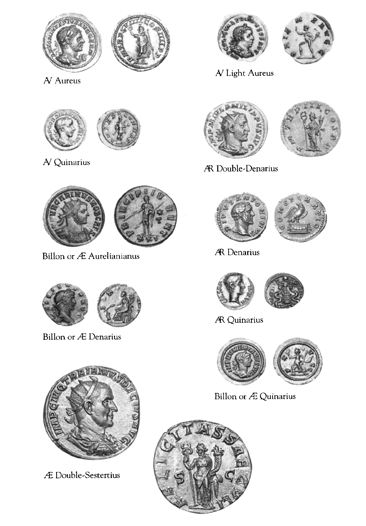
By the accession of Valerian I in 253, the silver content of the double-denarius had fallen to about 20 percent. By the late 260s its silver content had fallen below 5 percent, and by the early 270s it contained less than 2 percent silver. Since their purity was so low, these coins were usually coated with a thin layer of silver (called ìsilveringî) that would distinguish them as part of the silver coinage system. This coating may have been applied, or created by ìpicklingî in acid to bring out the surface silver through enrichment. The double-denarius was inherited by Aurelian at its lowest point, so in 274 he replaced the ailing denomination with a new coin researchers often call an aurelianianus (see below), [c. 17ñ24mm, c. 4.0ñ5.0 grams, declining to c. 2.5 grams].
Aurelianianus (pl. Aurelianiani). This denomination was first struck by Aurelian, and continued through Diocletianís reform of 294, at which point it was replaced by other coins. By the late 260s, the double-denarius had been reduced to an essentially copper coin of small, irregular proportions, and it remained so during the first four years of the reign of Aurelian (270ñ275). However, in the spring of 274 he reformed his coinage, with the most important change being the replacement of the double-denarius with a new billon ëradiateí coin that is often called an aurelianianus.
This does not seem to have been merely an upgraded double-denarius, but a distinctly different coin. Its iconography is virtually identical to its predecessor. However, its planchet was now large and round, and its silver content was raised to 4.5ñ5 percent. Furthermore, the method of applying the silver coating to the surface was greatly improved. Also, the value marks XXI or KA, meaning 20:1 in Latin and Greek, respectively, appear on the coin. Though the meaning of these value marks is much debated, it most likely refers to the coinís purity (l/20th or 20-to-1 = 5 percent).
Tacitus (275ñ276), increased the content on some of his aurelianiani to about 10 percent, an improvement that is indicated by the value marks XI and IA (each indicating a 10-to-1 ratio). The coinage of the emperor Carus (282ñ283) offers further mysteries, for he struck similar coins with X ET I in the exergue, and another of large size with two confronted portraits and the enigmatic inscription XII. Other coins have a radiate crown with two head-bands instead of one, perhaps indicating double purity similar to those marked XI or IA. It is worth noting that when the aurelianianus was abandoned by Diocletian in 294, it may have been replaced by the large nummus, for some of those issues are marked XXL [c. 20ñ24mm; typically c. 3.5ñ4.5 grams, but actually ranges from c. 2.7ñ5.5 grams.]
Denarius (pl. Denarii). The standard silver coin of the Romans, it required 25 denarii to equal a gold aureus. The denomination was used regularly for more than 450 years ó from its introduction in c. 212 B.C. through the last large issue of Gordian III in 240. Thereafter, its role as the principal silver coin of the Empire was overtaken successively by the double-denarius, the aurelianianus, the argenteus and the siliqua.
The denarius (meaning ìof tenî or ìcontaining ten,î which later became a noun describing the coin) was originally tariffed at 10 copper asses and was struck at 72 to the Roman pound. By about 141 B.C. the relative value of copper to silver had changed, and so the tariffed value denarius was inflated to 16 asses, and its weight was reduced to 84 to the Roman pound. The purity of the silver remained high until the reign of Nero, when it was very slightly debased and its weight was dropped to 96 to the Roman pound, where it remained until nearly the end of the 2nd Century A.D., when Commodus dropped it again.
From the time of the Flavians onward the weight of the denarius does not seem to have been carefully regulated, and varies considerably on an individual basis. The denarius suffered a great debasement under Septimius Severus, dropping it to about 50 percent silver. After the reign of Gordian III the silver denarius becomes a great rarity; it seems to have taken on a ceremonial role. Later still, by the 260s and 270s, it becomes thoroughly debased. Though it continued to be struck as a ceremonial piece up through the Tetrachy, the denarius had two short-lived revivals: under Aurelian (270ñ275), and under the Romano-British usurper Carausius (287ñ293). Aurelianís denarius was part of his reform of 274, and was a handsome, but still heavily debased coin, whereas Carausiusís was struck in good silver. A tangible successor to the true silver denarius was introduced by Diocletian in 294 (perhaps called an argenteus), but also was shortlived. [c. 18ñ22mm. Imperatorial-Commodus: typically c. 3.4ñ4.1 grams. Septimius Severus onward: declining to c. 2.7 grams. Thereafter, in billon: c. 2.3ñ2.8 grams.]
Quinarius (pl. Quinarii). The quinarius was the half-denomination of the denarius, and was struck infrequently during the Imperial period. It was introduced c. 212 B.C. (at which point it had a value of five asses) and was used for a few years before it was abandoned. The denomination was revived c. 101/100 B.C. (with the new value of 8 asses, since the denarius had been retariffed to 16 asses) with the types of the then-defunct ìVictoriatus,î which it no doubt was intended to replace. In Imperial times it wasreintroduced by Augustus, though it continued to be more rarely struck than the denarius.
Under Augustus, it seems to have had specific use in the provinces (especially in Gaul and in the East); under the later Julio-Claudians and the Flavians its equivalent occurs in the East as a provincial hemidrachm. Beyond these Augustan and later provincial applications, the true Imperial quinarius is generally accepted as having been a ceremonial coin. The treatment of the busts of emperors and empresses is sometimes ornate, but usually similar to that on the denarius. The purity of the Imperial quinarius followed that of the denarius, and the issues of the later 3rd Century are heavily debased, though most often with traces of silvering on the surface. These later pieces ó surviving into the early 4th Century ó are often struck on broad, over-size planchets. For other coins which may be late quinarii, see the entry Billon or Æ Nummus Fraction(?) in the Billon and ÆS section of the Late Empire, [c. 13ñ16mm, c. 1.2ñ2.0 grams.]
Æ: COPPER, BRONZE & BRASS
DoubleíSestertius. Struck only during brief periods in Roman history, this coin was valued at two sestertii, and presumably would have been equal in value to the tiny silver quinarius. It is distinguished from the sestertius not only by its larger size, but also by the portraits, which show the emperor wearing a radiate crown, and depict the empressís bust resting on a crescent moon. It was first struck by Trajan Decius (249ñ251) and his wife, Herennia Etruscilla, and later by the Gallic usurper Postumus. The so-called ìinterregnumî bronzes with radiate crown (attributable to the reign of Gallienus) would have been intended as double-sestertii, unless they were strictly medallions. The dual-portrait bronzes of Aurelian and Severina (with his bust radiate, and hers on a crescent moon) ó which have been traditionally called sestertii ó are actually double-sestertii. The same can be said of the curious two-headed bronzes of Diocletian and Maximianus (each bust radiate). Though the latter two conclusions have not been proven to the satisfaction of all scholars, they are likely since the so-called ìassesî of this period are probably sestertii, [c. 35mm, declining to c. 24mm; c. 42ñ45 grams, declining to c. 7.5 grams.]
Sestertius (pL Sestertii). This denomination began as a silver coin in c. 212/11 B.C. with the denarius and the quinarius. It was worth 2ñ1/2 asses, or half of a quinarius, and one-fourth of a denarius. When the denarius was revalued to 16 asses, the silver sestertius thus changed its value to four asses. About the same time the sestertius became the ìunit of accountî in Rome, and was the denomination in which transactions were reckoned, though routinely they were paid in other coins.
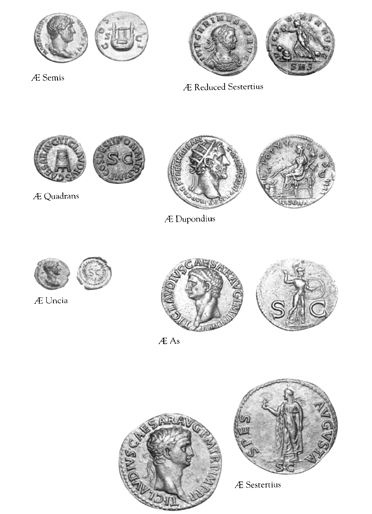
The monetary reforms of Augustus transformed the sestertius into a large coin struck in bright, ìgoldenî orichalcum (brass). More than two centuries later it had become a smaller piece, typically on a squared planchet of leaded bronze. Although mass production of this coin ended during the reign of Gallienus, it seems to have been reintroduced by Claudius II in the form of æs coins that are the size of an earlier as, and continued to be struck occasionally up through the Tetrarchy. Because of their smaller size, they have traditionally been called asses, when in fact they are probably ìreduced sestertii.î Except for those struck by Aurelian and Severina, all of these reduced sestertii are quite rare. Its role as the ìunit of accountî of the Empire ended late in the 3rd Century A.D., when the sestertius was replaced by the denarius (which by then also was a seldom-struck coin), [c. 30ñ35mm, declining to c. 25mm; c. 18ñ30 grams, declining to c. 5.5 grams.]
Dupondius (pl. Dupondii). The dupondius was worth two asses, or half of a sestertius, and was struck throughout the first 250 years of the Empire. Though it originated in the Republic, it came to be struck frequently in the Empire beginning under Augustus. Early in Imperial times it was struck in yellow orichalcum (brass) to distinguish it from the less-valuable red copper as. The denomination was made more easily recognizable by the use of a radiate crown for emperors and by a crescent moon below the busts of empresses (though this occured only in the mid-3rd Century).
The radiate crown was introduced on the denomination in 64 by Nero (who also sometimes distinguished the denomination by placing II in the exergue on the reverse). The use of the radiate crown to identify the dupondius was important, especially since the metallurgical aspects of these issues were sometimes variable. To confuse matters, in the early 3rd Century dupondii were struck without the radiate crown, and they can only be distinguished by their heavier weight. Indeed, the line of separation is not always clear, and in fact under the Julio-Claudians it is often the as that bears the radiate crown. Dupondii and asses often are referred to collectively as ìmiddle bronzes.î [c. 25ñ30mm; c. 11ñ16 grams.]
As (pl. Asses). This was the standard Roman copper coin, of which all other æs coinages are either multiples or fractions. Though the origin of the word ìasî is not entirely certain, it seems to have meant a ìfull unit.î Originally, early in the 3rd Century B.C., the as was a large cast coin, and later came to be struck. It also was the official ìunit of accountî until that role was taken over by the sestertius in the 2nd Century B.C. The as was originally made of bronze, but during the Empire came to be struck in pure copper (though Nero struck some in brass) until well into the 3rd Century A.D., when it once again became bronze. On asses, the emperor is usually shown bare-headed or laureate; the depictions of empresses vary. The later Imperial bronzes struck from Claudius II through the Tetrarchy (which are commonly called asses, see discussion above under Sestertius) are better considered ëreduced sestertii,í and the so-called ësemisí struck by Trajan Decius may actually have been a ëreduced as.í If the latter is true, the experiment failed so completely that the reform was not adopted by Deciusí immediate successors, [c. 23ñ30mm; c. 8ñ12 grams.]
Semis (pl. Semisses). The word semis means ìhalf;î the related word Semissis (pi Semisses) is only used for the Late Roman gold piece (half-solidus). If the semis played a standard role in the Roman monetary system, it would have been worth half of an as, and by consequence, two quadrantes. It began as a large cast coin, and in the 2nd Century B.C. came to be struck, and formed a regular part of the monetary system. In the Empire it was never a commonly struck coin, and it was produced in both orichalcum (brass) and copper. In some cases Nero identified the denomination with the letter ìS.î Except for a possible occurrence under Marcus Aurelius (though they may be quadrantes), and what may have been a brief revival under the emperor Trajan Decius (see his Numismatic Note), the semis did not survive past the reign of Hadrian. See the discussion under Quadrantes, for the possible use of the semis as a tessera or redemption coin rather than as an standard part of the coinage system, [c. 1820mm; c. 3.0ñ4.5 grams].
Quadrans (pl. Quadrantes). The quadrans was the smallest regularly issued coin of the Empire, and if its presumed value of 1/64th of a silver denarius is accurate, was only useful for purchasing the very low-valued goods and services. The word quadrans means ìquarter,î and as such the quadrans, based on its name and weight, would have been worth one-quarter of the copper as. Indeed, it is specifically named by ancient sources as the cost of entry to public baths.
However, the monetary role of the quadrans (and semis) may not have been as simple as we suspect. Many researchers believe they may have been the token coinages called tesserae nummariae mentioned by ancient authors. Suetonius informs us that the emperor Domitian would throw handfuls of them into seating areas at public games. Were these merely coins of the lowest value, this gesture would have been of little substance, and furthermore, may have been received as an insult from the senators and knights, into whose sections Suetonius tells us Domitian also dispersed them.
Furthermore, the poet Martial tells us that clients visiting their Roman patrons were sometimes given 100 quadrantes as a gift. Clearly, if these were just low value coins, the gift would have constituted less than two silver denarii (and would have been a cumbersome way to receive so low an amount). But if they had redemption value for substantial products or services, it would be a gift of some consequence, perhaps an invitation to enjoy the services available in Rome and its environs. As such, quadrantes may have been intended for donatives, distributions and special gifts to the poor or to guests. Indeed, quadrantes are seldom found outside of central and southern Italy. Considering that a recurring design on quadrantes is the modius (grain container), they may have been used as tokens redeemable in Rome for grain allotments.
It must be recognized, however, that most numismatists subscribe to the idea that the quadrans and the semis were standard coins without special redemptive value.
With rare exceptions, the quadrans was struck in copper. It was produced most actively by the Julio-Claudians, and was not struck after the reign of Marcus Aurelius (161ñ180). Unlike the rest of the Imperial coinage, the quadrans seldom showed the portrait of the emperor or empress, but instead offered a variety of topical designs. Those quadrantes without a portrait and regal inscription are attributed to the general period from Domitian through Antoninus Pius. The variety of designs on quadrantes and semisses also blurs the line between official mint coinage and privately produced ìtesserae.î The denomination in some cases is noticeably smaller during the principate of Nero, when he experimented with striking them in more valuable brass, which greatly reduced their weight and diameter, [c. 16ñ18mm (in copper), though as small as c. 11mm (in brass); c. 3.5 grams, though as low as c. 2.0 grams.]
Uncia (pl. Unciae). A denomination struck in Republican times and then only in the 2nd Century in the Empire. If it belongs to the Imperial system it would have been worth 1/3 of a quadrans, and 1/12 of an as. However, it seemingly was struck only for circulation in the East. [c. 11ñ14mm, c. 0.81.2 grams].
THE TETRARCHIC REFORM
This section includes the denominations introduced c. 294 by Diocletian, which, except in gold, completely replaced the earlier system. This ambitious coinage reform was tied in with Diocletianís overall attempt to reform the economy by regulating prices and wages. However, it quickly failed, as natural market forces rendered the structure impractical. Diocletianís system rested upon a denarius communis (ìcommon denariusî), or coin of account that also had been used by Aurelian to set a standard by which other coins, products and services could be valued. Researchers believe this conceptual unit had an actual numismatic equivalent in the copper ìlaureateî coin (though possibly the large billon nummus). Since this coin was not struck in great quantities, it clearly was not the anchor of the system, but none-the-less a representation of the unit.

PROBABLE RELATION OF TETRARCHIC POST-REFORM COINAGE
(Value of coins at left in terms of coins heading column)
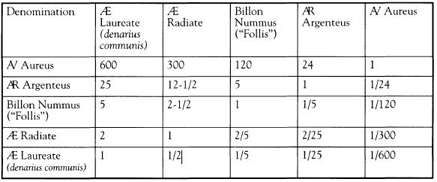
Note: These are the probable initial rates, which later changed dramatically. By 301 or so, the gold, silver and billon coinages seem to have risen two- to five-fold in compariston to the Æ Post-Reform Laureate and Æ Post-Reform Radiate, both of which were soon discontinued. For a different view of the values relationship, see Carson, Coins of the Roman Empire, pp. 237ñ9.
GOLD
Aureus (pl. Aurei). The reformed aureus of Diocletian was fixed at 60 to the Roman pound, which is sometimes indicated by the Greek Z (60) in the reverse field. Also at about this time the fabric changes from the broad, thin planchet of the pre-reform to one of lesser diameter but higher relief. This coin was probably called a solidus, the name by which its successor coin (introduced by Constantine the Great in 309 at 72 per Roman pound) is better known. Indeed, the aureus continued to be struck past 309, and for a few years was being produced concurrently with the solidus. With the rare exception of ceremonial strikings, the aureus did not survive past 324. [c. 16ñ22mm; typically 5.0ñ5.5 grams, though ranges from c. 4.1 to 7.3 grams.]
Quinarius (pl. Quinarii). An extremely rare half-aureus. [c. 15mm; c. 2.7ñ2.8 grams.]
Quarter-Aureus. Another extremely rare fraction, purely ceremonial, [c. 12ñ13mm; c. 1.2ñ1.3 grams.]
SILVER
Argenteus (pl. Argentei). Believed to have been called a nummus argenteus this coin represented the rebirth of the traditional Roman denarius, but proved to be too pure for its own survival. It was introduced in 294 by Diocletian, and at the theoretical weight of 96 to the Roman pound and the purity of about 90% or higher, it was the virtual equivalent of the reduced denarius of Nero. With the exception of the limited strikings of the rebel Carausius (in Britain and Gaul, 286/7ñ293), the Romans had been without a good silver coin for three generations when this coin was introduced.
The theoretical weight of the argenteus at 1/96th of a Roman pound is demonstrated by the inscription XCVI that appears on the reverse of certain issues. Since it was valued at 1/24th of the reformed aureus struck at 60 to the Roman pound, each argenteus represented a single carat of the gold in an aureus. It seems to have been introduced, rather optimistically, at the rate of one per 25 denarii communes, but in January, 300 it was doubled to 50, and an inscription at Aphrodisias dated 301 seems to refer to this coin, which it calls a nummus argenteus and tariffs at 100 denarii (communes). The argenteus was struck in large quantities but saw little commercial use, as it was instead hoarded, melted or exported to the East to be recoined into Sasanian dirhems.
Production of the nearly pure silver pieces had stopped by c. 312, when the value of silver seems to have risen greatly in relation to copper, thus making the denomination in its current, pure form a candidate for the effects of Greshamís law (bad money driving out the good). The argenteus was reintroduced in a debased form after the pure argenteus was abandoned (see Billon Argenteus in the subsequent section). Even when pure, the argenteus played a subsidiary role compared with the gold and æs ó a complete reversal of the role of the denarius of the past. [c. 17ñ21mm; usually c. 2.6ñ3.5 grams, though ranging from 2.0ñ4.0 grams. Theoretical weight of c. 3.4 grams.]
Half-Argenteus. A considerably rarer companion to the argenteus that was abandoned c. 312. [c. 14ñ15mm; c. 1.2ñ1.7 grams.]
BILLON AND ÆS
Billon Nummus (commonly called a ìfollisî). This denomination, a cornerstone of Diocletianís reform of 294, initially was struck at about 32 to the Roman pound, but declined steadily in weight over the next two decades. Some of these issues are marked XXI in the same fashion as the smaller aurelianianus, which ceased to be produced when the nummus was introduced. Others are marked K-V, perhaps indicating they were valued at 20 sestertii (accounting units) and 5 denarii communes. Diocletianís nummus was argentiferous and initially contained about 3.4 to 4.3 percent silver in the alloy, in addition to having two-thirds-pure silver applied to the surface in the form of plating.
However, after Diocletianís abdication in 305, if not slightly before, the silver content of the alloy dropped to about 1ñ2 percent (see Reduced Billon Nummus in next section). These coins may have been tariffed at 20 denarii communes, for the contemporary argenteus seems to have been valued at 100 denarii communes. The inappropriate name ìfollisî has been abandoned in this catalog. The word follis means ìsacculus,î or a bag that held a stated amount of metal, which we know from literary references often was in the form of coins. While this term has numismatic significance in the 3rd, 4th and 5th centuries, it is not mentioned specifically as the name of a coin until 498, when the 40-nummus bronze was called a follaro (by Greek speakers) or a terentiani or terunciani (by Latin speakers). [Prior to the reduction of c. 307/ 8: c. 26ñ31mm; c. 7.5ñ12.5 grams].
Note: For nummi fractions (half-, third-quarter-nummi, etc.), see the Billon and ÆS section under the The Late Empire.
PostíReform Radiate. This invention of the reformed Tetrarchic monetary system has a similar appearance to the aurelianianus both in size and design (though in one rare case the bust is inexplicably laureate, see RIC VI, pgs. 359 and 670 for three instances), but it contains only an accidental trace of silver. As such, it was not part of the ësilverí coinage, and was not intended to replace the aurelianianus. It began as a substantial piece (now extremely rare) and was quickly reduced in size and weight, at which point it came to closely resemble the aurelianianus. Its principal reverse type is CONCORDIA MILITVM (or CONCORDIAE AVGG), though votive inscriptions in laurel wreaths also occur. It was largely discontinued after the monetary system was adjusted in c. 301, though it did survive as late as 307 at Alexandria. [Initially: c. 24ñ25mm, 5.0ñ6.5 grams. Thereafter: c. 19ñ22mm; c. 2.6ñ3.2 grams].
PostíReform Laureate (or Denarius Communis). The smallest coin in Diocletianís post-reform issues, the laureate contained only an accidental trace of silver, and is sometimes mistakenly called an Æ quinarius. One of its principal reverse types is VTILITAS PVBLICA, with the standing figure of Utilitas. Considering this seldom-struck coin may have represented the denarius communis, this reverse type seems especially appropriate, [c. 15ñ18mm; c. 1.2ñ2.3 grams.]
THE LATE EMPIRE
This grouping covers almost everything struck from c. 300/301 onward, although there is some overlap until about 324, as might be expected. The initial part of this period presents a decline from the standards (set by Diocletian in 294) which were stabilized in reduced form by Constantine the Great, principally by his introduction of the gold solidus (which eventually replaced the aureus) and the silver siliqua and miliarensis (which replaced the argenteus). The probable relationship of value between gold and silver seems to have been unstable. The denominations created by Constantine remained intact in one form or another for the remainder of the Empire.
With one possible exception, Constantine did not introduce any new billon or copper coins, but instead simply reduced Diocletianís argentiferous nummus both in weight and purity. There seems to have been an explosion in value of silver and gold in comparison to copper, which caused Constantine, perhaps, to abandon ìofficialî correlations between the values of æs coins and precious metal coins.
The vast majority of the billon and copper coins of the Constantinian Era (up until the reform of Constantius II in 348) seem to have been of one denomination, Diocletianís argentiferous nummus. This coin was gradually reduced in weight and purity, with the reductions occurring at different rates depending on the location and the era of the striking. After the Constantinian Era it is replaced with other bronzes, some of them very small (10ñ12mm), which perhaps were known as nummi minimi Egyptian papyrii reveal that a Roman pound of gold (officially given a maximum value of 50,000 denarii comunes under Diocletianís reform) was in some cases bringing somewhere between 300,000 and 1,500,000 denarii communes depending on the date and location of the transaction.
During the late Constantinian period and beyond, a number of names are found in ancient inscriptions and literature clearly in reference to billon and æs coinages (known collectively as pecunia). Numismatists have attempted to assign these names to specific coins, but the efforts have generally been speculative, and in some cases have resulted in names being matched with coins in a manner that we are certain is not correct. The best examples are the ëfollis,í the ëcentenionalis,í the ësiliqua,í and from an earlier era, the ëantoninianus.í All four of these names are incorrectly applied, yet they are so much a part of the standard terminology that shedding them is a difficult task. In this book all such terms have been abandoned except ësiliqua,í which has been retained out of simple practicality.
With the possible exception of the term nummus (usually incorrectly called a ìfollisî), it is pure speculation to assign names to specific coins with the evidence currently available. However, we can hazard a guess, and a discussion follows on the ancient names and their possible associations. (The catalog listings, however are not speculative, and most æs are described with the term nummus or with a description of their diameter such as Æ1 Æ2, Æ3, Æ3/4 and Æ4 rather than with speculative names).
The Centenionalis, Maiorina and Decargyrus Nummus. The first two of these terms are often applied to larger-module billon and bronze coins of the late Empire. They have been derived from ancient inscriptions, but they seem to be used in variants, sometimes with pecunia or communes, and as such may represent colloquialisms.
The centenionalis or centenionales communes (indicating 100) is mentioned in inscriptions dated to 354 and 395. Since the last of these considerably post-dates the coinage to which the name centenionalis has traditionally been applied, the name most likely belongs to a later coinage. Names for the companion denominations of the centenionalis have been invented by numismatists: the double centenionalis and half-centenionalis. The double centenionalis (called a Billon Æ1 in this catalog) is typically used to describe the largest bronze issued by Magnentius and Decentius, and the half-centenionalis (called a Billon Æ3 in this catalog) is applied to the half-denomination of the coin (called a Billon Æ2 in this catalog).
The term maiorina or pecunia maiorina is also used in inscriptions relating to copper coinage of the late Empire, and specifically occurs in inscriptions of Roman laws dated to 349 and 354. Regrettably, it is not known whether maiorina is a synonym for centenionalis (in the inscription of 354 it is mentioned in parallel with ì centenionales communes î) or is a different denomination. Maiorina literally means ìrather large,î and when used in the phrase maiorina pecunia (as in the law of 395), it would mean ìthe rather larger æs coin.î
The decargyrus nummus (which infers ìtenî) is not a term in general use by numismatists, but is specifically named in the law of 395. In this law (addressed to the praetorian prefect Rufinus in Italy), the centenionalis denomination is meant to remain in circulation, while the production of higher denominations is suspended; specifically the changing of decargyrus nummus into other coins is forbidden. Some researchers have connected this denomination name to the billon or æs coin of Æ2 size.
In the final analysis, the strongest possibility is that the maiorina or the decargyrus nummus is the Æ2 (and seemingly also the Æ1), the centenionalis would apply to the post-348 coins of Æ3 size, and the Æ4 would be called either a nummus or perhaps a fraction of the larger two denominations.


GOLD
Aureus (pl. Aurei). Though this denomination is principally associated with earlier periods, it was struck occasionally after the solidus (see below) was introduced. Initially there was some overlap, but strikings of the mid-4th Century and beyond are of great rarity, and must be considered ceremonial pieces, especially since the solidus was by then the principal gold coin. As such, most authorities refer to the later gold pieces of aureus weight (60 to the Roman pound, worth 1 1/5 of a solidus) by the German term festaureus. [c. 23ñ24mm; c. 5.0ñ5.4 grams.]
Solidus (pl. Solidi). This denomination, called a nomisma in Greek, was introduced by Constantine the Great in 309. It was struck at 72 to the Roman pound, and was intended as a replacement of the Diocletianic aureus, which usually had been struck at 60 to the pound (though occasionally at 70 to the pound). For the first few years of its production, the solidus (valued at 24 silver ëpre-reformí siliquae) was struck concurrently with the Tetrarchic aureus, which it had almost completely replaced by 324. A series of solidi struck at Antioch (c. 336ñ7) have the letters LXXII in the reverse field, reaffirming that the standard was 72 to the Roman pound.
The solidus became the principal gold trade coin of the Mediterranean world, as the foes and federates of Rome rarely struck gold (and when they did it was on a smaller scale, and usually was a re-coining of exported solidi). Though Magnentius significantly reduced the weight of his solidus and in the central Empire from c. 346ñ368 its purity fell to c. 95% (the return to 99% purity was marked by the letters OB, meaning obryzum ), this coin otherwise maintained its weight and purity until the fall of Rome, and well into Byzantine times. After c. 450, a solidus was valued at 7,000 or more copper nummi (v4<4s), and was the preferred coin in the east. [c. 17ñ23mm; c. 4.3ñ4.6 grams, but occasionally as low as c. 3.7ñ4.1 grams when they were purposely struck at lower weights.]
Semissis (pL Semisses) This coin, the half-solidus at 144 to the Roman pound, was also introduced by Constantine the Great. The word semissis indicates ìhalf;î the related word Semis (pl. Semisses) is only used for the early Imperial brass coin (half of an As). It was struck only for special occasions and ceremonial purposes in the 4th and 5th Centuries. However, beginning in the 6th Century (which is beyond the scope of this work) it was struck on a large scale and formed part of the regular coinage system of the Byzantine Empire. The normal reverse type for semisses of emperors is Victory seated, inscribing a votive on a shield, and for empresses often a Chi-Rho in a wreath, [c. 16ñ18mm; c. 2.1ñ2.3 grams].
1ñ1/2 Scripulum or Nine-Siliqua (pl. 1ñ1/2 Scripula or Nine-Siliquae). This inconvenient denomination was introduced by Constantine the Great and, like the semis, was never struck in quantity, fulfilling a purely ceremonial function. However, unlike the semis, it was abandoned in about 388, and was replaced by the slightly lighter ó and more convenient ó tremissis, a coin that eventually assumed a legitimate commercial role. [c. 14ñ16mm; typically c. 1.6ñ1.7 grams.]
Tremissis (pl. Tremisses). This denomination, struck at 216 to the Roman pound, was probably introduced in 383 or 384, and may have been the invention of the usurper Magnus Maximus (383ñ388). During the late 4th and early 5th Centuries, tremisses are quite rare, but they came to be struck on a large scale by about 430. Not only did the tremissis eclipse the semissis, but it nearly achieved the level of acceptability enjoyed by the solidus. This was largely due to the fact that it fit into the Germanic weight system. The normal reverse inscription for this denomination (for emperors) is VICTORIA AVGVSTORVM, and the types show Victory in various poses. Empresses typically used the cross-in-wreath design, [c. 13ñ16mm; c. 1.2ñ1.6 grams.]
SILVER
Miliarensis or Miliarense (two types: ëHeavyí and ëLightí) (pl. Miliarenses) These large silver coins were introduced by Constantine the Great, and many scholars consider them to be medallions rather than coins in the commercial sense. Initially, they were struck to two standards concurrently: the heavy miliarense at 60 to the Roman pound (as was the gold aureus), and the light miliarense probably at 72 to the Roman pound (as was the gold solidus). The target weight of the heavy version is confirmed by a legal document and seemingly also by the appearance of LX (60) in the exergue of some heavy miliarenses struck for Constans and Magnentius at Aquileia (RIC 57 and 142), a mint which later marked some of its reduced billon Æ2ís with LXXII, indicating 72 to the pound. The lighter version of the miliarensis was equal to two gold carats, and was twice the value of its smaller counterpart, the ëlight siliqua.í
Distinguishing the heavy and light miliarenses in the 5 th Century is a difficult task; the iconographic differences no longer compliment the differences in weight, and indeed they often contradict. Light miliarenses often, but certainly not always, had left-facing busts, whereas heavy miliarenses rarely had anything but right-facing portraits. Thus, distinguishing heavy miliarenses from regular ones becomes not only virtually impossible, but essentially unimportant, for both coins had become purely ceremonial in nature, with the siliqua and half-siliqua taking on the commercial role. [Heavy: c. 23ñ24mm; c. 5.1ñ5.7 grams. Light: c. 21ñ26mm; c. 3.9ñ4.9 grams].
Siliqua (two types: ëHeavyí and ëLightí) (pl. Siliquae) When introduced by Constantine the Great in 324, the siliqua was struck at 96 to the Roman pound, thus making it the intrinsic equivalent of Diocletianís argenteus, a coin which had been abandoned for about a decade. However, the siliqua was distinctly different looking, for it was struck on a broader, thinner planchet (in the same manner the solidus was broader and thinner than the aureus).
There is no evidence to suggest this denomination passed by the name siliqua (which originally was a word associated with weight), and, indeed, it probably continued to be called an argenteus. However, the universal acceptance of this name by numismatists has led it to being used in this catalog.
In 355/6, Constantius II reduced the weight of the siliqua by about one-third, striking them at 144 to the Roman pound (c. 2.3 grams). At half the weight of the ëlightí miliarense, the reformed siliqua seems to have been the silver equivalent of a carat (0.189 grams) of gold. As with the gold coinage, the break between the pre-reform and post-reform versions was not firm; some western mints continued to strike the heavier pieces late into the 4th Century and beyond. Even though siliquae are usually called ëheavyí or ëlightí (as has been adopted in this catalog), they are perhaps better understood as ëpre-reformí and ëpost-reform.í The massive striking of siliquae ceased about 410.
The weight of the light siliqua was extremely variable, based on the time and location of minting. This fact, perhaps, has led some researchers to conclude that there were 1ñ1/2 siliquae later in the Empire, after the reform of c. 355/6. However, these pieces are perhaps best understood as siliquae struck to the older, heavy standard of 96 to the pound, possibly for special use in donatives or ceremonies. The lighter siliqua often was struck at weights of about 1.0 gram in the east during the mid-5th Century. Though this weight is more in line with the half-siliqua, many scholars still consider them to be siliquae because there is no change in the design. Edges of siliquae were frequently clipped in Britain during specific periods. The current theory is that the clipping was intended to create two reduced denominations, one of 1.2 grams and another of 0.8 grams. [Pre-reform (íheavyí): c. 18ñ21mm; theoretical weight of c. 3.4 grams, true range c. 2.83.8 grams. Post-reform (ílightí): c. 17ñ19mm; initial theoretical weight of c. 2.3 grams, falling to c. 2.0 grams by later 4th Century, then to c. 1.3 grams at beginning of 5th Century; true range c. 1.3ñ2.3 grams.]
|
Denomination |
Number to the Roman Pound |
Theoretical Initial Weight |
Other Names Applied |
|
PRE-REFORM |
|||
|
Heavy Siliqua |
96 |
c. 3.40 grams |
Argenteus, 1ñ1/2 Siliqua |
|
Heavy Half-Siliqua |
192 |
c. 1.70 grams |
3/4 Siliqua |
|
PRE-REFORM |
|||
|
Light Siliqua |
144 |
c. 2.30 grams |
Siliqua |
|
Light Half-Siliqua |
288 |
c. 1.15 grams |
Half-Siliqua |
Half-Siliqua (two types: ëHeavyí and ëLightí) (pl. Half-Siliquae) In its earliest form, the half-siliqua (to the ìheavyî standard) was the equivalent of the half-argenteus, and it is a great rarity At the reduced (ìlightî) weight standard it was theoretically struck at 288 to the Roman pound. It was introduced c. 379/80 or soon thereafter, and was struck in the West, seemingly for ceremonial purposes until c. 474, after which it became a regular component of the coinage system in Italy. Authorities have sometimes used the term 3/4-siliqua to describe coins of c. 1.7 grams, but this coin is perhaps better understood not as 3/4 of a light siliqua, but as half of a heavy siliqua. The weights of half-siliquae were not carefully regulated, and they vary considerably, with some weighing at levels appropriate for a light quarter-siliqua. However, it seems this denomination suffered the weight reductions affecting the siliqua in the late 4th and early 5th centuries. This denomination is not to be confused with the clipped siliquae of Britain (see above), which were reduced in weight after they were minted. [Heavy: theoretical weight of c. 1.7 grams. Light: theoretical weight of c. 1.15 grams. Actual range, including later reduced pieces, c. 0.5ñ1.2 grams; c. ll-16mm.]
BILLON AND ÆS
Note: In the catalog listings the term ëbilloní refers to any coin which was intended to have some silver content, even if most often they do not survive with any palpable trace of silver being visible on the surface or in the alloy. The denominations are presented below in the relative chronological order in which they were introduced.
Billon Argenteus (pl. argentei). Much controversy is associated with these particular coins. They are of the Æ3 module, but in some cases have a substantial silver content, and thus would constitute a separate enomination. The two issues we may be certain about are: billon argentei are the IOVI CONSERVATORI AVG (Jupiter riding on back of eagle) of Licinius I and the SOLI INVICTO COMITI (Sol in facing quadriga) of Maximinus II Daia, both of which were struck at Trier c. 312ñ313 and seem to contain about 25% silver. Later, c. 318ñ319, Constantine the Great struck some coins of this same module at Trier in his own name and in the name of Licinius II. Though most of these coins are clearly low-content silver pieces (no different from the regular ëBillon Æ3ísí), the occasional piece is clearly of higher silver content. As such, the issue may represent an attempt to re-introduce the denomination which failed quickly, [c. 18ñ22mm; c. 2.8ñ3.6 grams.]
Billon Nummus (Reduced) (pl. Nummi). The successor to the billon nummus (or ìargentiferous nummusî) introduced by Diocletian in 294, the denomination was reduced in weight and purity gradually, with two sharp drops occurring in c. 307/8 and c. 311/13. In general, it was first reduced by Constantine at his Western mints, after which his rivals in the East followed suit. During the period 316 to 318, the fabric of the reduced nummus was altered: no longer was it thin and spread irregularly at the edges, but was instead struck on round, compact planchets. It is roughly at this point, when the fabric of the coin was ìreformed,î that the categorization of the nummus in this catalog switches to the designation Æ3. Despite all the adjustments to the official value of the nummus since its introduction in 293/4, it probably was tariffed at 25 denarii communes in the east under Licinius I, for he seems to have cut its value in half in 321, when he began to strike billon nummi (Æ3ís) with the marking Xlir (12ñ1/2). Since Licinius was striking no silver in his eastern realm, the ëargentiferousí nummus must have served in this capacity (with 12ñ1/2 being half of 25 denarii communes at which Diocletian had established the value of his true silver argenteus). The possibility that they are half-nummi is remote since these were the only billon coins struck at Liciniusís mints from 321 to his surrender in 324. [After first reduction: c. 23ñ28mm; c. 4.6ñ7.5 grams. After second reduction: c. 21ñ24mm; c. 2.6ñ6.0 grams.]
Billon HalfíNummus (Reduced). These pieces were seldom struck, and with the exception of some types depicting Sol or Genius standing (c. 305ñ310), they are limited to unusual types produced especially in 312313 and 317ñ318. Most were struck in memory of Maximinus, Constantius I and Claudius II. Other larger pieces which fit this category were struck by Maxentius, whose nummus was heavier than that of the contemporary issues of Constantine. Some researchers suggest the larger examples in this category are 3/4 nummi, but their larger size may simply be the result of varying mint standards. For a discussion of a possible half-nummus struck by Licinius in the early 320s, refer to the Reduced Billon Nummus entry above. [The larger: c. 18ñ21mm; c. 1.9ñ4.5 grams. The smaller: c. 15ñ18mm; c. 1.5ñ2.8 grams.]
Billon Quarter- and Third-(?) Nummus (Reduced). Although the quarter-nummus is often similar in size and weight to the half-nummus, it can be identified when taken in context with the nummi with which it is associated. The earliest pieces were struck by members of the First Tetrarchy. Later issues were struck by Maxentius (and in the names of Maximianus and Romulus), and still smaller coins issued a few years later by Constantine the Great (with one of the reverse types having the inscription Sapienta Principis). [The larger: c. 18ñ20mm; c. 1.5ñ2.3 grams. The smaller: c. 13ñ16mm, c. 1.0ñ1.3 grams.]
Billon or Æ Nummus Fraction(?) These coins of uncertain status were principally struck at Trier from c. 302 to 308 in the names of seven issuers (Diocletian through Constantine the Great) during various stages of their careers. They are about the size of a quinarius (and may well be quinarii), but are, perhaps, more likely small fractions of the nummus. Their small size (sometimes weighing only one-eighth of a nummus), votive reverses and overall rarity assure us they were for distribution at special occasions. Typical inscriptions, always in a laurel wreath, are MVLTIS XX, SIC X SIC XX, VOT(IS) X SIC XX, VOT XX AVGG, VOT X CAESS (NN), VOTIS XXX, VOT XXX AVG N, MVLT NATAL FEL or PLVR NATAL FEL. An interesting successor to these distribution coins is the POP ROMANVS issue seemingly struck for the dedication of Constantinople in 330. [c. 13ñ15mm; typically 1.0ñ2.0 grams, but range from c. 0.75ñ3.0 grams].
Billon Æ3 (Nummus). Coins of this category are mixed both in their design and in their alloy, for some have ample silvering on the surfaces (see Billon Argenteus above), and others appear to be nothing more than pure copper. These coins seem to have been struck at a reduced standard of 96 to the Roman pound, and coins of this size may well have been called centenionales, a name traditionally applied (in error) to the large billon coins introduced by Constantius II in 348. [c. 18ñ22mm. From c. 313ñc. 325/6: c. 3.0ñ3.5 grams; from c. 325/6ñ335/6: c. 2.5ñ3.0 grams.]
Billon Æ3/4 (Nummus). This category represents a further decline of the nummus, which was struck c. 335/6ñ337, the period during which the module of the Æ3 was abandoned (though it was revived by post-Constantinian emperors). This ìreformî occurred in conjunction with Constantineís division of the Empire between his sons and half-nephews, [c. 1518mm; c. 1.4ñ2.0 grams].


Billon Æ4 or Æ4 (Nummus). Coins of this small module began to be struck in 337 (after the adjustment of 335/6ó337), and represent the final Constantinian reduction of the Tetrarchic nummus. Originally, they still had a trace of silver and may have been struck at the standard of 192 to the Roman pound, but most examples of this coin do not meet the theoretical weight of about 1.7 grams. Alternatively, it could have been based upon a weight of about 8 carats (c. 1.5 grams). It began as a thin, spread coin, but with the passage of time became thick, compact and heavily leaded. These later pieces, which had lost any silver content and were probably identified with the term nummus minimus, are simply called Æ4ís in this book. [Initially c. 13ñ16mm, declining in late 4th and 5th Century to c. 10ñ12mm; initially c. 1.3ñ1.7 grams, declining to 0.7ñ1.3 grams.]
Billon (or Æ) Æ, Æ2 and Æ3 (commonly called a ëDouble-Centenion-alis,í ëCentenionalisí and ëHalf-Centenionalisí) This category of coin was introduced in 348 by Constantius II, and usually is identified by the inscription FEL TEMP REPARATIO, which was paired with several standard designs. The principal denomination, the A2, was struck at two different weights: the earlier (c. 348ñ352) at 60 to the Roman pound, and later (beginning c. 352) at 72 to the Roman pound. The later pieces often were ragged and had virtually no silver content. These ëtargetí weights are certainly accurate, though the weights of specimens differ within the expected range for æs coinages. Interestingly, some of the ëreducedí Æ2 pieces struck at Aquileia (RIC 187ñ98) and Siscia (RIC 334ñ41) have the formula LXXII on the reverse, removing any doubt as to the standard of 72-to-the-pound at which they were struck. The western usurpers Magnentius and Decentius struck coins which are based on these issues introduced by Constantius II. In their case they did not use the standard inscription and types, but chose their own, and furthermore added a slightly larger piece (usually called a ëdouble-centenionalisí) which is termed a ëBillon Æ1 in this book. [Ah c. 27ñ30mm. Æ2: the heavier: c. 22ñ26mm; c. 4.9ñ6.1 grams; the lighter: c. 20ñ22mm, c. 3.0ñ4.7 grams. Æ3: c. 14ñ20mm; c. 2.3ñ3.5 grams].
Billon Æ1 or Æ1 (sometimes called a ìMaiorinaî). This module of coin was introduced by Julian II at 36 per Roman pound, and perhaps was inspired by the similarly large pieces struck by the usurper Magnentius. Under Julian II and Jovian, this coin contained about 2 percent silver. Thereafter it fell to a trace amount of less than 0.1 percent, and became a purely copper coin, at which point it is simply termed A1. [Range c. 2432mm, usually c. 27ñ30mm; c. 7.5ñ11.0 grams.]
Æ2. This copper or leaded bronze coin is a successor to the nummus. It ceased to be struck in 395 with the death of Theodosius II. If any of the ancient names are to be applied to this coin, it would seem to be the maiorina that is named in the law of 395. [c. 22ñ25mm, c. 3.8ñ7.5 grams].
40-Nummus. This large bronze was first struck at Rome by the Ostrogoths in the name of the Eastern emperor Zeno (474ñ491), after the West had fallen. Its denomination is identified on the reverse by the letters XL (the Latin equivalent of 40). This Ostrogothic issue was small, and most likely was limited to 477/8. However, the denomination was adopted in 498 by the emperor Anastasius I, who identified its circulation value with a large M (the Greek equivalent of 40); it is at this point that ancient texts reveal that it commonly was known by the name follaro or ìfollis.î [c. 26ñ29mm, c. 13.5ñ20 grams.]
MEDALLIONS, MEDALLIC ISSUES, AND RELATED ITEMS
N Medallion. This category includes Roman gold pieces that are not part of the normal coinage system, and were struck for reasons other than commercial necessity. Generally they commemorated special events and were most likely made for distribution to high-ranking officials in the government or the army. Gold medallions were probably prized mainly for their intrinsic value, although they certainly were prestigious items worthy of display. They frequently were used in jewelry by both Romans and barbarians, and were consequently pierced, held in bezels, or were mounted with suspension loops.
The weights of gold medallions typically range from 1.25 to 4ñ5 times the weight of the standard gold coin of the day (aureus or solidus). The occasional 12-solidus piece was struck, and the largest known examples were struck to the standard of a full Roman pound (c. 327.5 grams). Sometimes gold coins without any unusual design elements were struck at weights heavier than one, but less than two aurei. These enigmatic pieces are usually called ìheavy aurei.î
Another Roman gold coin which seemingly was ceremonial or was struck for donatives was the binio, or ëdouble aureus.í This denomination was usually equal in weight, and presumably in value, to two aurei. It usually shows the emperor wearing a radiate crown to signify the double denomination. Under Trebonianus Gallus, such a coin was struck, though it typically weighed only about 50% or 60% more than its laureate companion (itself reduced to about 3.6 grams). Since biniones were struck so infrequently, and were of exceptional value, they are considered by some scholars to be medallions. It would seem that at least some biniones were struck with dies intended for the striking of double-denarii.
Some gold pieces struck in the era of the solidus (post-324) were about 20 percent heavier than the solidus, and thus are referred to as festaurei. These had the same weight as the earlier aurei of Diocletian (at 60 to the Roman pound) during the period when solidi were being struck at 72 to the Roman pound. Often their reverse depicts the emperor tossing handfuls of coins while standing in a facing quadriga.

AR Medallion. These issues are excessively rare in all but the 4th and 5th Centuries A.D., and sometimes are of enormous size (such as those issued by Priscus Attalus that weigh about 80 grams, or a quarter of a Roman pound, and were the silver equivalent of a gold solidus). Some of the earliest examples occur in the 2nd Century, during the period Domitian through Hadrian, with weights ranging from 5 to 12 denarii. However, most silver medallions do not exceed about 13 grams. Because the weights of silver coins were fairly consistent, the medallions are quantified in terms of multiples of the basic silver unit in use at the time. Usually they do not show a great deal of wear, although there can be little doubt that some of the larger pieces were valued for their precious metal value, as they show signs of circulation. [Size and weight vary considerably.]
Bimetallic Medallion. Two different colored metals (most often red copper and yellow orichalcum) were used to produce the planchets of these medallions, which were typically struck during the 2nd and 3rd Centuries A.D. They had a central core composed of a different metal than the ìringî in which it was contained. Although in most cases the striking pressure seems to have fused the core to the ring, occasionally they are not entirely stable. Sometimes they can be difficult to identify as bimetallic if a thick patination obscures the surfaces. [Size and weight vary considerably.]
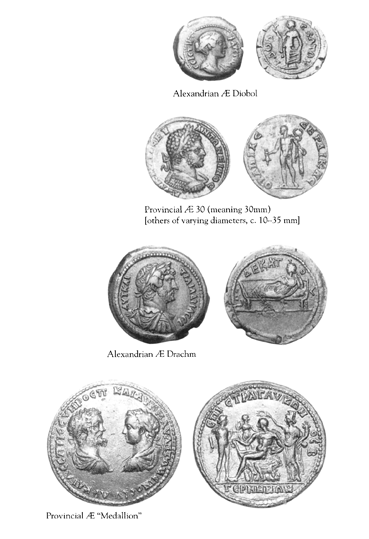
Æ Medallion. This category covers many numismatic items, and the line which separates Æ medallions from regular bronze issues is not always clear. Medallions were not part of the normal coinage system, and were struck for special events, and most especially for New Yearís distribution. Most likely they were given to officials in the government, the military, though in some cases (such as the ìmedaletsî struck for the Festival of Isis) to the public.
Some of these medallions are distinctly ìmedallicî in appearance because of their size, weight, or other peculiarities of production. However, medallions struck up through the mid-3rd Century A.D. are usually also identifiable by the absence of the SC that appears on virtually all the regular æs coinage of the time. Medallions struck thereafter are usually distinguishable only by the size of the planchets. Typically,Æ medallions are larger and thicker than even the largest æs denomination of the reign to which they belong. [Size and weights vary considerably.]
Æ Trial Strikes or ìMedallicî Issues. Occasionally a coin struck with regular dies has an uncommonly large, or off-metal planchet. These are usually described as ìtrial strikesî when the metal of the planchet is different from that for which the dies would have been intended, and as ìmedallic strikesî (i.e. ìmedallic asî or ìmedallic dupondiusî) when the dies used are properly matched with the metal used in the striking. Such strikings range in size from the quadrans through the sestertius. Even some double-sestertii of Trajan Decius are known which weigh exactly twice the weight of a normal piece ó and these should perhaps be considered ìmedallicî rather than simply a ìdouble-double-sestertius.î Trial strikes were usually made as experiments by the mint to determine the suitability of the dies. [Size and weight vary considerably.]
Æ Protoícontorniate. These were made presumably in the 3rd and 4th Centuries by hammering up the edges of sestertii, dupondii, asses or other bronzes taken from circulation. Some believe they were made as ëcountersí or game pieces, but it seems more likely they were New Yearís gifts. In that respect they inspired the unusual form of the contorniates described below.
Æ Contorniate. This category of base metal medallion derives its name from its unusual form, which features a deep groove incised along the periphery which either creates a rim or accentuates a raised rim that already existed. Contorniates seemingly were produced in the 4th and 5th Centuries at the mint of Rome, for there are at least three recorded instances of their sharing dies with Rome mint products.
They may have been used as entrance tickets for games and festivals or as prizes for the victors of competitions. More likely, however, they were distributed at circus events held to celebrate the New Year. This idea was presented by Curtis Clay in a lecture (yet unpublished) at the 1986 International Numismatic Conference in London. Mr. Clay asserts that contorniates were struck at the Rome mint under the authority of the largely propagan senate, and that they, in essence, were the successors of the large Imperial bronze medallions, which ceased to be struck in any significant quantity after the reign of Constantius II (337ñ361). That they were inspired by the proto-contorniates seems a foregone conclusion considering their unusual edges and the fact that so many of their designs are derived from earlier bronze coin types.
They are among the final remnants of pagan life in the Empire before the Christian church outlawed pagan games in 394. Their designs are remarkably diverse, but the obverse usually bears the portrait of an earlier pagan emperor, a Greek hero, or occasionally a charioteer or philosopher. The reverses usually relate to Greco-Roman mythology or allude to games and contests. One of the most common designs is a victorious charioteer, whose name (or the name of his racing party) is sometimes also inscribed. Many also have the unusual feature of silver inlays in the fields (usually a palm branch or a monogram), but the majority are strictly of base metal, [c. 35mmñ40mm; weights vary.]
Æ Tesserae, Tokens and Spintriae. Like contorniates, these were not official Roman coins, but coin substitutes of private manufacture. The tesserae are interesting because some of them bear the portraits of emperors (often paired with Roman numerals), whereas others have inexplicable designs. One category of token is the so-called spintriae, which feature a variety of sexually explicit scenes, and as such are considered brothel tokens. [Size and weight vary considerably.]
PROVINCIAL COINAGE
EL Stater (pl. Staters). The stater was issued for more than three centuries by the kings of the Bosporus, who were client-kings of the Romans. It began as a coin of high-purity gold, and with the passage of time was reduced to a mix of gold and silver known as electrum (abbreviated EL). Normally these staters bear the portraits of at least two men, one of them being a king, the other a Roman emperor. From the mid-3rd through the early 4th Century they were debased to almost entirely base metal, [c. 1822mm; c. 7.5ñ7.9 grams, declining to c. 5.5 grams in base metal.]
AR Cistophorus (pl. Cistophori). This large silver coin was equal in weight to three Roman denarii, and though it is considered by most researchers to be a provincial coin, it shares many ties to the standard Imperial coinage, including the exclusive use of Latin inscriptions. The cistophorus was first struck c. 166 B.C. under the Attalid kings who ruled Pergamum, and represented a reduction from the weight of the standard tetradrachm. They were designed to be officially over-valued within the Pergamene Kingdom in order to prevent their export. The last king of Pergamum, Attalus III, bequeathed his kingdom in 133 B.C.
The Romans continued striking cistophori (sometimes at more than 10 mints) from the time they inherited the Pergamene kingdom through the Severan period. Some of the early pieces were issued bearing the names of the Roman proconsul in Asia. Many cistophori of Imperial date (especially those of Hadrian) show obvious signs of having been over-struck on earlier cistophori, either of Attalid or Roman manufacture, and those few that do not were probably overstruck well enough to obliterate any traces of the undertype. A rare half-cistophorus was also struck during the early phase of the coinage, [c. 24ñ30mm; c. 9.5ñ12 grams].
AR Tetradrachm (pL Tetradrachmi). This was the traditional major silver denomination of the Greek world, and was also struck by the Romans at numerous provincial mints in the East. The most prolific of these mints was Antioch in Syria. A coin of this same denomination, but of different fabric, was issued at Alexandria in Egypt, and is presented in a separate listing below, [c. 24ñ31mm; early coins typically c. 13.0ñ14.7 grams, declining to c. 9.5 grams.]
AR Tridrachm, Didrachm, Drachm and Hemidrachm. These denominations, also popular with the Greeks, were struck at more than two dozen mints in the Near East, foremost of which was Caesarea in Cappadocia. The drachm closely approximated the Roman denarius, and the hemidrachm the quinarius. [Tridrachm: c. 24ñ26mm; c. 9.5ñ10.5 grams. Didrachm: c. 18ñ23mm; c. 5.7ñ7.5 grams, declining to c. 4.0 grams. Drachm: c. 16ñ21mm; c. 2.6ñ4.0 grams, declining to c. 2.2 grams. Hemidrachm: c. 14ñ16mm; c. 1.3ñ1.8 grams.]
Billon Tetradrachm of Alexandria. This prolific coinage began under Tiberius and continued through the usurpation of Domitus Domitianus, thus covering a period of nearly three centuries. They began in 20/1 as a debased silver coinage (about 31 percent pure), which followed the debased tetradrachms struck by the last Greek rulers of Egypt. The Egyptian economy had been isolated ever since Ptolemaic times, with no foreign coins allowed to circulate. For this reason a severely debased coinage could be maintained within that economic microcosm. Not surprisingly, the provincial coinage of Egypt provided great profits to the Romans.
The purity of the tetradrachm dropped to about 23 percent under Claudius, and to about 15ñ17 percent after Neroís debasement of 58/9. A great many of Neroís pieces survive, since he recalled the existing tetradrachms for melting, and recoined them into the new pieces of lesser intrinsic value. But at the same time the purity fell, so did the weight. Thus, the post-reform tetradrachm of Nero had less than one-third the silver of Tiberiusís issue, and only about 15% of the Greek tetradrachms of about a century earlier. From the later part of the reign of Commodus through the era of Gallienus, the tetradrachm falls into the category of debasement which many specialists call ëpotin,í meaning it contains only about 5ñ10 percent silver. Subsequently, from about 270ñ295, it is virtually pure copper with only a trace of silver that most often is not even visible on the surface, [c. 23ñ27mm, declining to c. 18mm; c. 9.5ñ14.5 grams, declining to c. 6.0 grams.]
ÆS of Alexandria. Subsidiary æs denominations formed an important part of Egyptís coinage system, though the billon tetradrachm was the principal denomination. Foremost in this category was the drachm, a large-module coin which, along with the hemidrachm, was introduced during the reign of Nero. Smaller æs denominations (such as the obol, worth one-sixth of a drachm and the chalkon, worth one-sixth of an obol) also were struck, some of them quite early on in the history of Roman Egypt. [Measurements of the various æs denominations are as follows: drachm c. 33ñ36mm, hemidrachm c. 28ñ3Omm, diobol c. 23ñ26mm, obol c. 19ñ21mm, dichalkon c. 12ñ15mm, and chalkon c. 10mm].
Æ ìMedallionsî. Whereas some specific and reliable indicators exist by which Imperial medallions can be differentiated from coins, there are few (if any) such guidelines for provincial issues. In fact, some scholars believe that even the largest and most impressive provincial bronzes were struck strictly with monetary function in mind, and were the monetary equivalents to silver denarii and quinarii. None-the-less, the larger pieces are called medallions by many numismatists, even if the practice may not be strictly accurate. Diameter and weight are most often used to make the determination, though occasionally the design or inscription are factors, [c. 40ñ45mm; weights vary considerably.]
Æ Coinages. This category includes the vast majority of Roman Provincial issues, of which many thousands of different types are known. Since in most cases the denominations were not indicated in the design, most provincial æs are simply distinguished by their diameter as measured in millimeters. For example, a provincial bronze with a diameter of 25 millimeters would be cataloged as an ìÆ25î or less often as an ìÆ25mm.î Metallic contents can vary, though copper is always the principal ingredient. Significant percentages of lead or tin are not uncommon.
Denominations (such as assaria, chalki and obols) in some cases were explicitly marked on the coins. When the provincial bronzes approach the higher end of the diameter spectrum (c. 40mm) they are often called ìmedallionsî by numismatists (see above), [c. 10ñ35mm; weights vary considerably.]