Around 2350 BC, a Sumerian king makes war on corruption and poverty and loses his throne
IT IS DIFFICULT TO IMAGINE the Sumerians, with their spiky independence, ever granting a ruler as much power as the pharaohs of Egypt were given. Sumerian citizens would likely have rebelled if asked to sweat for twenty years over a monument to their ruler’s magnificence. Nor were the kings of Sumer in any state to compel this kind of obedience. Gilgamesh’s four-city coalition was the closest thing to a unified kingdom that Sumer had ever seen, and this coalition barely outlasted Gilgamesh’s lifetime. His son Ur-Lugal inherited his kingdom and managed to keep it together, but the cities had all been weakened by the constant fighting. And while Egypt did not face any immediate threat from outside its borders, the same was not true of Sumer. To the east, the Elamites were waiting.
The Elamites had been living in their own small cities, over to the east of the Gulf, almost as long as Sumerians had occupied the Mesopotamian plain. Their ultimate origin, like that of most ancient people, is unknown, but their cities grew up not only just south of the Caspian Sea, but also along the southern border of the large salt desert plateau that lay east of the Zagros Mountains.
From about 2700, the Elamites too had kings. Twinned cities, Susa and Awan, served as the center of their civilization. Awan (whose exact location is unknown) was the more important of the two. Insofar as any king had jurisdiction over the whole Elamite collection, the king of Awan did, not unlike his Sumerian counterpart in Kish.
Inscriptions from the two centuries after Gilgamesh give us a glimpse of a churning mass of competition. The Elamites and the cities of the Sumerian plain—Uruk and Kish, but also the cities of Ur, Lagash, and Umma, now increasing in strength—fought an unending series of battles for primacy.
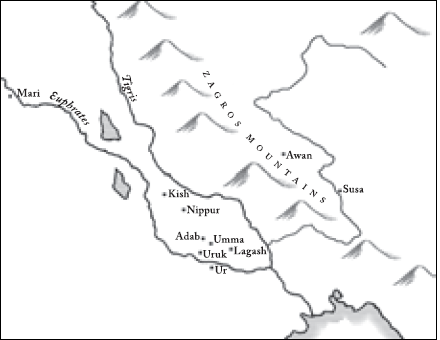
12.1 Battling Cities of Sumer and Elam
The Sumerian king list is missing quite a few names, and since it tends to list kings of different cities who reigned simultaneously as though they followed each other, it’s not easy to construct an exact chronology. We do know that sometime after Gilgamesh’s son inherited his father’s kingdom, the city of Uruk was conquered by Ur, and that Ur was then “defeated in battle, and its kingship was carried off to Awan.” This seems to indicate an Elamite invasion of great strength; and indeed the kings of Kish’s next dynasty have Elamite names.
Not all of Sumer’s cities fell under Elamite rule by any means. Sometime after the Elamite invasion, the Sumerian king of another city, Adab—almost in the exact center of the Mesopotamian plain—gathered his men around him and challenged their supremacy.
This king, Lugulannemundu, ruled sometime around 2500 BC. To drive out the Elamites, he fought an enormous coalition of thirteen Elamite-dominated cities. According to his own victory inscription, he triumphed; he calls himself the “king of the four quarters” (the whole world, in other words) and declares that he “made all the foreign lands pay steady tribute to him [and] brought peace to the peoples…[he] restored Sumer.”1
If he did indeed carry out these conquests, he put together a temporary empire much larger than Gilgamesh’s. But Lugulannemundu’s exploits, which may have rescued Sumer from the Elamites and preserved its existence as an independent culture for a little while longer, didn’t fire the imagination of his contemporaries. No epic poems elaborate on this conquest. Nor did his kingdom last any longer than Gilgamesh’s. The next incident of note on the Sumerian plain is a border dispute between the cities of Lagash and Umma; a boring, run-of-the-mill quarrel over an undistinguished piece of land which would eventually bring the Sumerian culture to an end.
THE INSCRIPTIONS which record the start of the argument were written only two or three generations after Lugulannemundu’s rule, but his kingdom had already disintegrated. Sumerian kings ruled by force of arms and charisma. Their kingdoms had no settled bureaucracy to sustain them. When the crown passed from the dynamic warrior to the less talented son, the kingdoms inevitably crumbled.
Lugulannemundu’s kingdom had crumbled so quickly that his home city of Adab was no longer even a power on the Sumerian scene. When Lagash and Umma quarrelled, another king—the king of Kish, which had once again risen into prominence—stepped in. The two cities, which lay about fifty miles apart, had been trespassing on each other’s land. Kish’s king, Mesilim, intervened and announced that Sataran, the Sumerian judge-god, had shown him the proper border for both cities to observe. He put up a stele (inscribed stone) to mark the line: “Mesilim, the king of Kish,” says an inscription commemorating the event, “measured it off in accordance with the word of Sataran.”2 Both cities apparently agreed to this judgment; the claim that a god had spoken directly to you was as hard to refute then as now.
However, the agreement didn’t last long. After Mesilim’s death, the new king of Umma knocked the stele down and annexed the disputed land (which suggests that fear of Mesilim, rather than respect for the god Sataran, had imposed the temporary peace). Umma held the land for two generations; then a military-minded king of Lagash named Eannatum took it back.
We know more about Eannatum than many other Sumerian kings because he was much inclined to inscriptions and monuments. He left behind him one of the most famous monuments of Sumer, the Stele of Vultures. On this stone slab, scenes carved comic-strip style show Eannatum’s victory over Umma. Rank on rank of Eannatum’s men march, helmeted and armed with shields and spears, over the bodies of the dead. Vultures pick at the strewn corpses and fly off with their heads. “He heaped up piles of their bodies in the plains,” an inscription clarifies, “and they prostrated themselves, they wept for their lives.”3
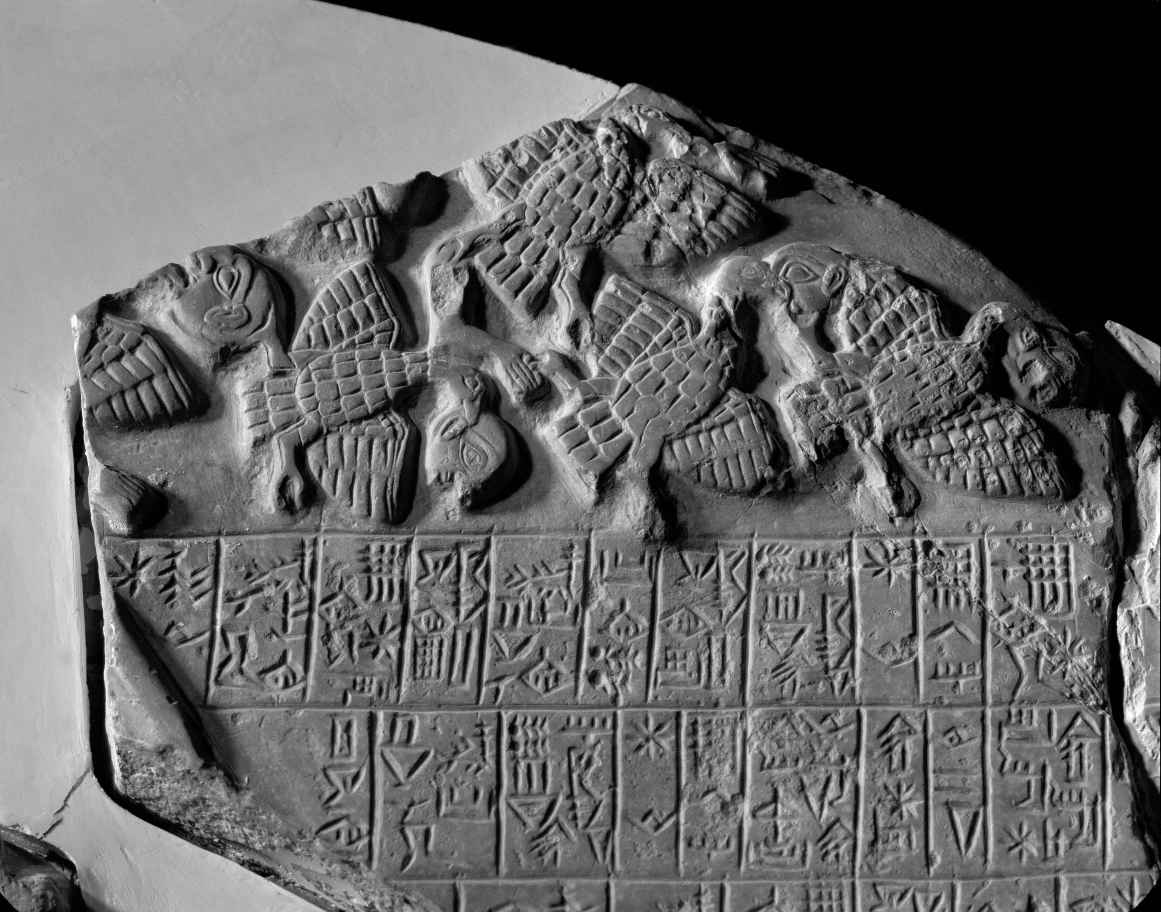
12.1. Stele of Vultures. Vultures carry away heads of the conquered on the Stele of Vultures, carved to celebrate the triumphs of the king of Lagash. Louvre, Paris. Photo credit Erich Lessing/Art Resource, NY
The Stele of Vultures shows an advanced state of warfare. Eannatum’s men are armed not only with spears, but with battle-axes and sickle-swords; they are armed identically, showing that the concept of an organized army (as opposed to a band of independent warriors) had gained ground; they are marching in the tightly packed phalanx that would later prove so deadly to the countries that lay in the path of Alexander the Great; and Eannatum himself is shown riding in a war-chariot, pulled by what appears to be a mule.31
Eannatum of Lagash used this well-organized army to fight not only with Umma but with practically every other city on the Sumerian plain. He fought with Kish; he fought with the city of Mari; on the side, he fought with invading Elamites. After a lifetime of war he was apparently killed in battle. His brother took the throne in his place.
For the next three or four generations, Lagash and Umma fought over the exact placement of their boundary line, a bitter and bloody domestic squabble occasionally interrupted by the odd band of trespassing Elamites. The next king of Umma burned the steles, both Mesilim’s and the strutting Stele of Vultures; this was basically pointless, since both were stone, but may have relieved his feelings. Eannatum’s brother passed the throne of Lagash on to his son, who was then overthrown by a usurper.4
A hundred years or so after the quarrel began, it was still going on. Lagash was now ruled by a king named Urukagina. Urukagina, the Jimmy Carter of the ancient Middle East, was the first Sumerian king with a social conscience. This great strength was also his weakness.
War with Umma was not the sole problem facing Lagash. A series of inscriptions from Urukagina’s reign describes the state into which the city had fallen. It was entirely run by corrupt priests and the rich, and the weak and poor lived in hunger and in fear. Temple land, which was supposed to be used on behalf of Lagash’s people, had been taken by unscrupulous temple personnel for their own use, like national parklands seized by greedy rangers. Workmen had to beg for bread, and apprentices went unpaid and scrabbled in the rubbish for scraps of food. Officials demanded fees for everything from the shearing of white sheep to the interment of dead bodies (if you wanted to bury your father, you needed seven pitchers of beer and 420 loaves of bread for the undertaker). The tax burden had become so unbearable that parents were forced to sell their children into slavery in order to pay their debts.5 “From the borders to the sea, the tax collector was there,” one inscription complains, an expression of frustration that has a rather contemporary ring.6
Urukagina got rid of most of the tax collectors and lowered the taxes. He cancelled fees for basic services. He forbade officials and priests to seize anyone’s land or possessions in payment of debt, and offered amnesty to the debtors. He slashed Lagash’s bureaucracy, which was bloated with pork-barrel positions (these included the head boatman, the inspector of fishing, and the “supervisor of the store of the cereals”). He also, apparently, took authority away from the priests by dividing religious and secular functions, thus preventing exactly the kind of authority that had allowed Mesilim to set up his stele by the authority of the god Sataran: “Everywhere from border to border,” his chronicler tells us, “no one spoke further of priest-judges…. The priest no longer invaded the garden of the humble man.”7
Urukagina’s intent was to return Lagash to the state of justice intended by the gods. “He freed the inhabitants of Lagash from usury…hunger, theft, murder,” the chronicler writes. “He established amagi. The widow and the orphan were no longer at the mercy of the powerful: it was for them that Urukagina made his covenant with Ningirsu.”8 Amagi: the cuneiform sign seems to stand for freedom from fear, the confidence that the life of Lagash’s citizens can be governed by a certain and unchanging code and not by the whims of the powerful. This is, debatably, the first appearance of the idea of “freedom” in human written language; amagi, literally “return to the mother,” describes Urukagina’s desire to return the city of Lagash to an earlier, purer state. Urukagina’s Lagash would be a city that honored the wishes of the gods, particularly the city-god Ningirsu. It would be Lagash the way it had once been, back in an idealized past. From the very earliest times, nostalgia for a shining and nonexistent past goes hand in hand with social reform.32
There wasn’t much in this of benefit to Urukagina himself. It is impossible, at a distance of nearly five thousand years, to know what was in the man’s mind, but his actions show a man possessed by a piety that overruled any thought of political gain. Urukagina’s moral rectitude proved to be political suicide. His curtailment of priestly abuses made him unpopular with the religious establishment. More seriously, his actions on behalf of the poor made him unpopular with the rich men of his own city. Every Sumerian king ruled with the help of the double-barrelled assembly of elder and younger men, and the elder assembly was inevitably stuffed with the rich landed men of the city. These very men, the lugals (“great householders”) of Lagash, had been severely criticized in Urukagina’s inscriptions for abusing their poorer neighbors.9 They were unlikely to have suffered this public chastisement without resentment.
Meanwhile, the throne of Lagash’s old enemy Umma had been inherited by a greedy and ambitious man named Lugalzaggesi. He marched on Lagash, and attacked it, and Urukagina’s city fell.
The conquest apparently went swimmingly, with very little resistance from the city. “When Enlil, king of all the lands, had given the kingship of the land to Lugalzaggesi,” the victory inscription announces, “[and] had directed to him the eyes of the land from the rising of the sun to the setting of the sun, [and] had prostrated all the peoples for him…the Land rejoiced under his rule; all the chieftains of Sumer…bowed down before him.”10 The language of this inscription suggests that the priests not only of Lagash, but also of Nippur, the sacred city of Enlil, were cooperating with the conqueror.11 The powerful priests of Nippur were not likely to have been thrilled by the curtailment of priestly power down to the south; it set a very bad precedent. And if the assembly of elders did not actually aid in Urukagina’s overthrow, certainly they did not fight vigorously on his behalf. His reforms had brought his political career, and possibly his life, to a violent end.
An account written by a scribe convinced of Urukagina’s righteousness, promises that the good king will be avenged: “Because the Ummaite destroyed the bricks of Lagash,” the scribe warns, “he committed a sin against Ningirsu; Ningirsu will cut off the hands lifted against him.” The record ends with a plea to Lugalzaggesi’s own personal deity, asking that even this goddess visit on Lugalzaggesi the consequence of his sin.12
Encouraged by his easy victory over Lagash, Lugalzaggesi cast his net wider. He spent twenty years fighting his way through Sumer. By his own account, his domain stretched “from the Lower Sea, along the Tigris and Euphrates to the Upper Sea.”13 To call this an empire is probably an exaggeration. Lugalzaggesi’s boast to reign as far as the Upper Sea is probably a reference to the odd raiding party that made it all the way up to the Black Sea.14 But there is no question that Lugalzaggesi made the most ambitious effort yet to bring the scattered cities of Sumer under his control.
While Lugalzaggesi was surveying his new empire, with his back turned to the north, retribution arrived.