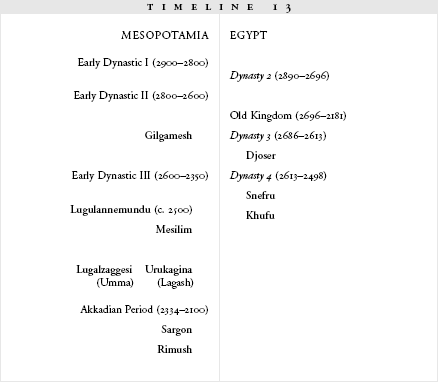
In Sumer, between 2334 and 2279 BC, the cupbearer Sargon builds an empire
IN THE CITY OF KISH, a cupbearer named Sargon was laying his own plans to build an empire.
Sargon was a man of absences and disappearances. In the inscription that chronicles his birth, the voice of Sargon speaks:
My mother was a changeling, my father I knew not,
The brother of my father loved the hills,
My home was in the highlands, where the herbs grow,33
My mother conceived me in secret, she gave birth to me in concealment.
She set me in a basket of rushes,
she sealed the lid with tar.34
She cast me into the river, but it did not rise over me,
The water carried me to Akki, the drawer of water,
He lifted me out as he dipped his jar into the river,
He took me as his son, he raised me,
He made me his gardener.1
This birth story tells us nothing about Sargon’s origins. We do not know his race or his childhood name. The name “Sargon” doesn’t help us out, since he gave it to himself later on. In its original form, Sharrum-kin, the name simply means “legitimate king” and (like most protestations of legitimacy) shows that he was born to no lawful claim whatsoever. 35
If he came from the highlands, he may well have been a Semite rather than Sumerian. Semites from the west and south had mingled with Sumerians on the Mesopotamian plain since the beginning of settlement; as we noted earlier, dozens of Semitic loanwords appear in the very earliest Sumerian writing, and the earliest kings of Kish had Semitic names.
Nevertheless, there was a real division between the Sumerians of the south and the Semites, who lived mostly in the north. The two races traced their ancestry back to different tribes who had wandered into Mesopotamia, long before, from different parts of the globe. A Semitic language, related to the later tongues of Israel, Babylon, and Assyria, was spoken in the north; in the south, the Sumerian cities spoke and wrote Sumerian, a language unrelated to any other that we know. Even in the areas where Sumerians and Akkadians had mingled, a racial divide of some sort still existed. When, a century and a half earlier, Lugulannemundu of Adab drove out the Elamites and temporarily asserted himself over the “four quarters” of Sumer, the thirteen city chiefs who united against him all boasted Semitic names.2
But Sargon’s story doesn’t confirm his Semitic origins, because the man was careful to obscure the details of his parentage. He claims no knowledge of his father, which neatly removes the problem of a low or traitorous ancestry. The “changeling” mother is just as elusive. Presumably she had changed her own identity at some point. Maybe she rejected a secular life for a religious role (some translators choose to render the word “priestess”), or managed to rise from a low class to a higher one, or settled among people of another race.
Whatever her place in life, the changeling mother did not share it with her son. By abandoning him on the river, she left his own identity to chance. The very act of being pulled from the water carried then the same resonance that echoes later in the writings of both Hebrews and Christians; Sumerians thought that a river divided them from the afterlife, and that passing through the water brought an essential change of being. Drawn from the water, Sargon took on the persona of his adopted parent. The man who rescued him, Akki, bears a Semitic name; Sargon became a Semite. Akki was employed in the palace of the king of Kish; he raised his adopted son to be the king’s gardener.
By the time Sargon was a grown man, he had risen much higher. According to the Sumerian king list, he had become “the cupbearer of Ur-Zababa,” the Sumerian king of Kish.3
Ancient cupbearers were not merely butlers. The Sumerian inscriptions do not describe the cupbearer’s duties, but in Assyria, not too long afterwards, the cupbearer was second only to the king. According to Xenophon, the cupbearer not only tasted the king’s food but also carried the king’s seal, which gave him the right to bestow the king’s approval. He was the keeper of the king’s audiences, which meant he controlled access to the king; the cupbearer of the Persian kings, writes Xenophon in The Eduation of Cyrus, “had the office of introducing…those who had business with [the king], and of keeping out those whom he thought it not expedient to admit.”4 The cupbearer had so much authority that he was required to taste the king’s wine and food, not to protect the king from random poisoners (the cupbearer was too valuable an official to use as a human shield), but so that the cupbearer himself might not be tempted to increase his own power by poisoning his master.
While Sargon was serving Ur-Zababa in Kish, Lugalzaggesi was busy sending out raiding parties and adding bits of Sumerian territory to his kingdom. While Sargon carried the king’s cup, Lugalzaggesi attacked Lagash and drove Urukagina out; he besieged Uruk, Gilgamesh’s old home, and added it to his realm. Then, as every Sumerian conqueror did, Lugalzaggesi turned his eyes towards Kish, the jewel-city of the plain.
A fragment of an account tells us what happened then. “Enlil,” the fragment announces, “decided to remove the prosperity of the palace.” In other words, Lugalzaggesi was the aggressor; Enlil was his special deity. Ur-Zababa, learning that the army of the conqueror was approaching his city, grew so frightened that he “sprinkled his legs.” In the face of the coming attack, he was “afraid like a fish floundering in brackish water.”5
This aimlessness was aggravated by Ur-Zababa’s growing suspicions of his cupbearer. Something in Sargon’s bearing had made him wonder (with justification) whether his trusted second was in fact on his side. So he sent Sargon to Lugalzaggesi with a message on a clay tablet. The message, ostensibly an effort to come to terms, instead bore a request that his enemy might murder the bearer. Lugalzaggesi declined the assignment and kept on marching towards Kish.
This part of the story may be apocryphal. Stories of Sargon were much embroidered by later Assyrian kings, who claimed him as their great progenitor; certainly the next part of the tale, in which Lugalzaggesi’s wife welcomes Sargon by offering “her femininity as a shelter,” falls into a very long tradition of portraying great conquerors as sexually irresistible. However, the attack on Kish itself suggests that Sargon was not fully behind his king. Lugalzaggesi marches triumphantly into Kish while Ur-Zababa is forced to flee. Sargon, presumably Ur-Zababa’s right-hand man, is nowhere in sight.
Apparently, while Lugalzaggesi was revelling in his victory, Sargon was collecting an army of his own (perhaps culled from Ur-Zababa’s forces through careful recruiting, over the previous years) and marching towards Uruk; we can deduce this because accounts of the battle reveal that Lugalzaggesi was absent, when Sargon first hove into view on the horizon, and his city was taken by surprise. “He laid waste the city Uruk,” Sargon’s victory inscription tells us, “destroyed its wall and fought with the men of Uruk and conquered them.”6
Lugalzaggesi, getting news of the attack, left Kish and headed home to destroy this threat to his power. But by now Sargon was unstoppable. He met Lugalzaggesi on the field, captured him, put a yoke around his neck, and marched him as a prisoner to the sacred city of Nippur. At Nippur, he forced the defeated king to go as a captive through the special gate dedicated to Enlil: the god Lugalzaggesi had thanked for his own victories, the god who had given Lugalzaggesi the right to “shepherd” the whole land. It was a bitter mockery. Two decades after the conquest of Lagash, Urukagina’s curse had finally drifted home to roost.
Immediately Sargon took the title of king of Kish. In the same inscription that describes his conquest of Lugalzaggesi, he records that he travelled south, conquered the city of Ur, wiped out Umma, and blew through all remaining Sumerian resistance in an all-conquering march south to the head of the Persian Gulf. There he “washed his weapons in the sea” in a mysterious gesture of victory.
Sargon’s relatively speedy conquest of the entire Mesopotamian plain is startling, given the inability of Sumerian kings to control any area much larger than two or three cities. A combination of his own strength and Sumerian weakness tipped the scale in his favor. His army was stronger than the Sumerian defenders, thanks to their heavy use of bows and arrows. Thanks to a lack of wood, bows were an uncommon weapon in Sumer; Sargon appears to have had a source for yew, suggesting that very early he extended his reach over to the Zagros Mountains, just east of the Gulf. His soldiers also seem to have shifted formation. Where the Stele of Vultures and the Standard of Ur show armed soldiers clustered together, moving in something like the later phalanx, Sargon’s soldiers appear in engravings as lighter, less loaded down, and more mobile, moving freely through the battlefield to attack and re-form at will.7
In addition, the Sumerians were probably crippled by a rift in their cities. Sumerian cities just before the conquest were suffering from an increased gap between elite leadership and the poor laborers. The abuses that Urukagina swore to correct were symptomatic of a society in which aristocrats, allying themselves with the priesthood, used their combined religious and secular power to claim as much as three-quarters of the land in any given city for themselves. Sargon’s relatively easy conquest of the area (not to mention his constant carping on his own non-aristocratic background) may reveal a successful appeal to the downtrodden members of Sumerian society to come over to his side.8
Whatever Sumerian weaknesses played into the conqueror’s success, the outcome was a new thing. Sargon did what no Sumerian king had yet done successfully; he turned a loose coalition of cities into an empire.36
ONCE CONQUERED, the new territory needed to be controlled.
As part of his strategy for ruling far-flung cities, Sargon built a new capital, Agade; it is from the Hebrew spelling of this city’s name, Akkad, that his empire drew its name.37 The remains of Agade have never been found, but the city probably stood on the northern Sumerian plain, possibly near present-day Baghdad, in the bottleneck where Sippar lay. From this position, a little bit north of Kish, Sargon could control river traffic and keep an eye on both ends of his kingdom.
In this kingdom, the Sumerians rapidly found themselves living as foreigners in their own cities. Sargon’s men were Semites from the northern plain. Their dialect, which became known as Akkadian, was Semitic. Their customs and their speech were unlike those of the southern Sumerians. When Sargon took over a city, it became an Akkadian stronghold, staffed with Akkadian officials and garrisoned with Akkadian troops.
Unlike his predecessors, Sargon was willing to run roughshod over the natives. When Lugalzaggesi conquered Kish, he claimed overlordship but didn’t remove the Sumerian officials, the lugals, who ran Kish’s bureaucracy. They were, after all, his countrymen, and he left them in place as long as they were willing to change allegiance. Sargon had no such mildness. When he conquered a city, he replaced its leadership with his own men. “From the sea above to the sea below,” his inscription reads, “the sons of Akkad held the chiefdoms of his cities.” The Semitic Akkadians, long mingling with the Sumerians, now triumphed over them. Agade alone had a standing garrison of fifty-four hundred soldiers who “ate bread daily before” the king. Thousands more were spread throughout Mesopotamia.
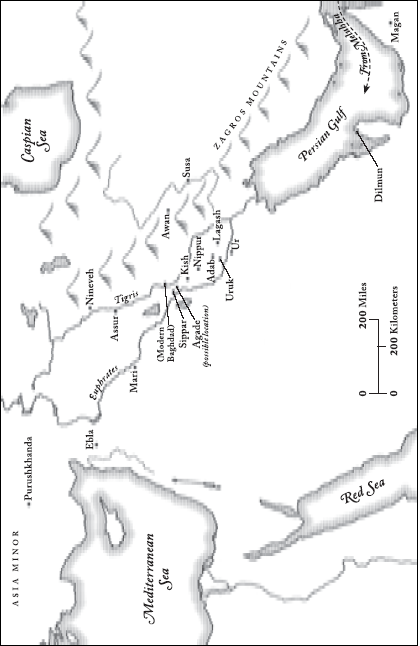
13.1 Sargon’s Empire
With the Mesopotamian plain under his control, Sargon set out to build an empire that stretched beyond Mesopotamia. He led these soldiers in campaign after campaign; “Sargon, the king of Kish,” reads one of his tablets, “triumphed in thirty-four battles.”9 He crossed the Tigris and seized land from the Elamites, who in response apparently shifted the center of their kingdom from Awan to the slightly more distant Susa, where the capital remained. He fought his way north to the city of Mari, which he captured, and then pushed even further into the land of another Semitic tribe, wilder and more nomadic than his own Akkadians: the Amorites, who ranged across the land west of the Caspian Sea. Campaigning up the Tigris, he reached and conquered the little northern city of Assur, which had been a center for Ishtar-worship for perhaps three hundred years before Sargon’s birth. After this, he ranged even farther north and asserted his rule over the equally small city of Nineveh, a hundred miles on. Nineveh was a distant outpost; from this northern vantage point, his sons watched out over the wild northern conquests, while Agade remained his eye on the south.10
Sargon may even have invaded Asia Minor. A later story, “Sargon, King of Battle,” describes his journey to the city of Purushkhanda, whose people had sent him a message asking for his help against Nur-daggal, the cruel local king. In the verses that survive, Nur-daggal scoffs at the possibility that Sargon will show up:
He will not come this far.
Riverbank and high water will prevent him,
The massive mountain will make a thicket and tangle in his way.
No sooner had the words left his mouth, when Sargon crashed through his city gate:
Nur-daggal had not spoken,
when Sargon surrounded his city,
and widened the gate by two acres!11
Whether or not Sargon actually reached Purushkhanda, the story is revealing. He must have seemed as unstoppable as a juggernaut, almost magically ever-present all across the known world. He claimed himself to have marched all the way west to the Mediterranean,12 and even boasted of controlling ships from Meluhha (the Indus), Magan (in southeast Arabia), and Dilmun (on the southern coast of the Gulf).
Keeping control of this vast expanse of land required a standing army; the men who “ate bread” in Sargon’s presence daily may have been the first professional soldiers in history. Holding onto the varied peoples under his rule also required a certain amount of religious canniness, which Sargon had in spades. He paid tribute to pretty much every important local god he ran across, built temples at Nippur like a good Sumerian, and made his daughter the high priestess of the moon-god of Ur.
Records from Sargon’s court show that this empire had a bureaucracy far beyond anything developed to this point in Sumer. Sargon tried to standardize weights and measures within his borders; he also put into place an Egyptian-style tax system, run by state officials who managed the empire’s finances.13 And his political strategy encompassed more than taxes and administration. He kept representatives of the old ruling families at his court, in a move which would become standard for much later empires; these representatives, ostensibly hosted by Sargon in honor for their exalted lineage, were hostages for the good behavior of their cities.14
This strategy reveals the continuing fault lines in his empire. This far-flung kingdom was continually on the edge of revolt.
The Sumerian king list credits Sargon with a reign of fifty-six years. Near its end, when he was most likely past seventy, a serious rebellion broke out. Old Babylonian inscriptions record that the “elders of the land,” now deprived of their authority, gathered together and barricaded themselves into the Temple of Inanna, in Kish.
Sargon, naturally, claimed to have crushed the uprising at once. But according to the Old Babylonian records (which, granted, are late and generally anti-Sargon), at least one campaign against the revolutionaries went so poorly that the old man ended up hiding in a ditch while the rebels marched past.15 It is beyond dispute that, almost as soon as Sargon died, his son Rimush had to mount an attack on a five-city coalition of rebels that included Ur, Lagash, and Umma.16 Rimush reigned less than ten years and died suddenly. A later inscription says that his servants assassinated him.
Despite this scuffle after Sargon’s death, his descendants kept the throne of Agade for over a hundred years—far longer than any Sumerian dynasty. The Akkadian empire was held together by more than charisma. Sargon’s bureaucracy and administration, like those of Egypt, had finally provided Mesopotamia with a structure that could hold an empire together even when the throne passed from great father to struggling son.