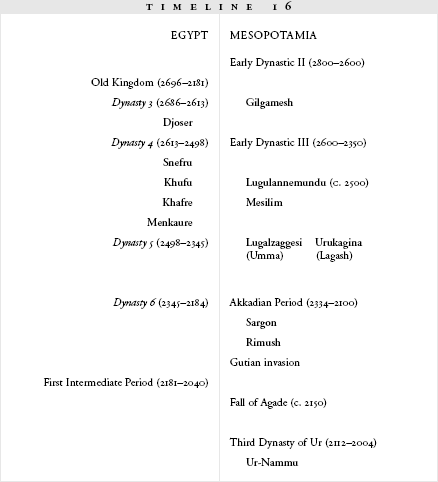
Between 2278 and 2154 BC, Gutian hordes invade the Akkadian lands and the Third Dynasty of Ur drives them out
THE AKKADIAN EMPIRE, now under Sargon’s son Manishtushu, was looking to expand. Unlike Egypt, Agade found that its greatest enemies still lay outside its own borders.
Manishtushu’s inscriptions boast that he was just as warlike as his father. He brags of conquering yet more territory for the empire, even travelling across the Persian Gulf by ship in order to fight against “thirty-two kings gathered against him,” where “he defeated them and smote their cities.”1 There may be more smoke than fire in this. Although he brags of his conquests, the areas that appear to have paid tribute to him seem to be those which Rimush had already subdued. “These are no lies!” one victory inscription ends up. “It is absolutely true!”2 (which tends to suggest the opposite, like the title “Legitimate King” in the mouth of a usurper).
Manishtushu’s fourteen-year reign is mostly interesting because he fathered Naram-Sin the Great, the grandson of the great Sargon and the Akkadian king who would spread the empire to its greatest extent. Like his grandfather, Naram-Sin fought constantly. One of his steles announces nine victories in a single year; another, the unimaginatively titled Victory Stele, shows his victory over a tribe in the western Elamite territory. The Akkadian borders also crept over to swallow Susa, one of Elam’s twinned capital cities. But Awan remained free, with Elamite resistance to the growing western threat centered there.
Ignoring the Elamite king’s independence, Naram-Sin gave himself the titles “King of the Four Quarters of the World” and “King of the Universe,” in self-puffery excessive even for ancient Mesopotamia. His name in cuneiform appears next to a sign that indicates godship,3and the Victory Stele shows his huge figure standing above his battling armies, in the position that the gods occupy in earlier engravings. Naram-Sin did not need any gods to bless his battles. He could do that all by himself. So far as we can tell, Naram-Sin was the first Mesopotamian king to lay hold of godlike status during his life; it is an action that shows a certain maturity in the power of the throne.
By Naram-Sin’s day, the Akkadians themselves had reached a certain maturity as a people. Sargon had corralled the warring cities of Mesopotamia into a single empire, but the Akkadian culture itself was never exactly identical with the Akkadian political sphere. You could live in the Akkadian empire, obeying its Akkadian king, and still be a Sumerian. Sargon’s sons and grandson described their victories in Sumerian cuneiform (for the sake of the conquered) and in Akkadian as well (for the sake of themselves). The officials and their garrisoned troops lived in the cities of Sumer, but also knew themselves to be part of a culture that was separate from them.
This growing sense of a cultural identity is most on display at the time of the empire’s greatest peril. Down from the Zagros Mountains, the rocky rise east of the Tigris, swept the Gutian tribes, and hurled themselves against the edges of Naram-Sin’s kingdom.
Chaos threatening the established order of a kingdom was nothing new. The Chinese tradition records the struggle of rulers against internal chaos: an impulse towards oppression and cruel exploitation. The Egyptians tell stories of the battles between brothers, as the kingdom along the Nile breaks apart into separate kingdoms. Gilgamesh fights a wild man, but this enemy proves also to be his shadow self.
But Naram-Sin faced something new: the invasion of barbarians, those from outside, the others who want to wreck and destroy. The Akkadian takeover of Sumer was violent and forceful, but Sargon’s people had a language and a writing of their own. By the time of Naram-Sin’s reign, the Akkadian empire had become more like a nation and less like a spreading army that occasionally stopped to eat. It had a history of its own; it had its own founding father. Only now was it even possible to speak of a contrasting kind of people: of “barbarians.”
“No one calls himself a barbarian,” historian David McCullough has remarked, “that’s what your enemy calls you.”4 The culture of the Akkadians stood in opposition to the scattered piecemeal world of the Gutians, who—although they shared a spoken language—left no inscriptions, no traditions, and indeed no histories behind them. Certainly none of the Akkadian inscriptions ever use the word “barbarian,” which comes from the Greeks much later on. But the Akkadians saw, in the Gutian hordes, an outside force that came simply to destroy—not to set up another culture in place of their own. The Assyriologist Leo Oppenheim has pointed out that the sheer hatred found in the Akkadian chronicles of the Gutian invasion is new in the ancient world; it is, he remarks, “comparable only with the hatred of the Egyptians for the Hyksos,”5 an event which came two hundred years later and represented the first time that Egypt was invaded by a destructive wandering people from outside. The Sumerians called the Gutians snakes and scorpions and parodies of men:
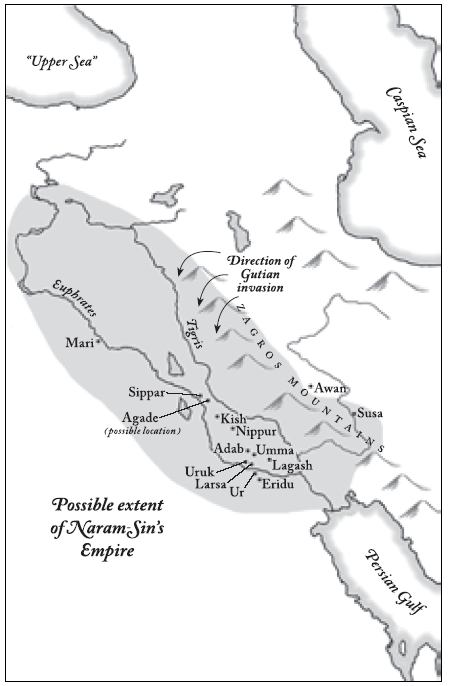
16.1 The Mesopotamia of Naram-Sin
those who are not part of the Land:
the Gutians, a people with no bridle,
with the minds of men, but the feelings of dogs,
with the features of monkeys.
Like small birds, they swooped over the ground in great flocks….
nothing escaped their clutches,
no one escaped their grasp.6
Naram-Sin’s armies were unable to keep the Gutian hordes away; they streamed in and took over city after city. The Gutian occupation of Akkadian cities turned the rightful order of things upside down.
The messenger could no longer travel the highway,
the boat of the courier could no longer travel the river….
Prisoners manned the watch, bandits occupied the roads….
They planted gardens for themselves inside the cities,
not, as is usual, on the wide field outside.
The fields gave no grain, the floods no fish,
the orchards no syrup or wine,
the clouds did not bring rain….
Honest men were confused with traitors,
heroes lay dead in heaps on top of heroes,
the blood of traitors streamed over the blood of honest men.7
The overthrow of order by the barbarians was so unsettling that a long story was written, only slightly later, to account for the devastation. The gods were angry: the first, but not the last time that barbarian invasions produced this explanation.
In “The Cursing of Agade,” Naram-Sin destroys the great Temple of Enlil in his capital city and steals its gold, silver, and copper. It is an act of sacrilege that dooms his country; he loads the treasures into ships and sails them away, and “as the ships moved away from the docks, the city lost its intelligence.”
Lost its wits: its distinctive, civilized, human character. Enlil, who then decides to unleash the Gutian hordes in revenge, comes against Agade like “the roaring storm that subjugates the entire land, the rising deluge that cannot be confronted.” The barely human hordes are instruments of the god’s anger. “And so it was,” the story ends. “On the tow-paths of the canal banks, the grass grew long; on the highways, the grass of mourning grew.” The cleared spaces of civilization had begun to disappear.
From the king list, we know that Gutian warriors seized control of Uruk, the ancestral home of Gilgamesh, early on. Since they worked their way so far to the west, they almost certainly broke the Akkadian hold on southern Sumer.
By Naram-Sin’s death in 2218, the Gutian hordes had managed to shrink his kingdom to half of its former size. Naram-Sin left the whole mess to his son Shar-kali-sharri, who was faced with the task of attempting to drive the barbarians back out again. He didn’t succeed; Lagash too fell to the Gutians, and by the end of Shar-kali-sharri’s reign, the south of Sumer was irretrievably gone. Gutians moved into some of the southern cities, but other cities, including those in Elam, simply took advantage of Shar-kali-sharri’s preoccupation with the Gutians to finally free themselves from an allegiance to the Akkadian king which had probably been nominal for some time.
What followed in the Akkadian lands was, apparently, anarchy. After Shar-kali-sharri’s death sometime around 2190, the center of the kingdom still barely held together. But the Sumerian king list asks, “Who was king? Who was not king?” which implies that no one actually managed to hold on to power for any length of time.8 Finally, a warrior unrelated to Sargon took the throne, managed to hold onto it for twenty-one years, and then pass it to his son.
But this non-Sargonic dynasty, of which we know absolutely nothing, was doomed. Inscriptions lament the fall of Agade itself, sometime around 2150 BC, as Gutian invaders broke through its walls. Since we haven’t found the ruins, we don’t know whether the city was sacked and burned. Perhaps the very absence of the site suggests a thorough destruction. And since the city left no mark on the landscape, it was probably not reoccupied afterwards. Most city sites in the ancient Near East show layer after layer of succeeding occupation, but a city considered to be under a curse sometimes lay deserted for centuries.46
FOR ALMOST half a century, the Gutian “barbarians” ranged across the entire Mesopotamian plain. They left little behind them to suggest that they developed a culture of their own: no writing, no inscriptions or statues or cultic centers. The Gutian invasion brought an end to an existing civilization without building another in its place.
The king list draws a stark line between the reigns of the Akkadians and the Gutian “kings,” who clearly have no idea of how to establish a succession. Manishtushu ruled fifteen years, Naram-Sin fifty-six; even Naram-Sin’s son, who was faced with the difficulty of protecting the remnants of his father’s kingdom against steadily encroaching hordes, is credited with a stable reign of twenty-five years. But the Gutians who seized Agade and the cities nearby were a shifting and unstable mass. An unnamed king is followed by twenty-one kings, only one of which manages to hang on to his power for more than seven years; most rule for only a year or two, and the last reigns for forty days.
The old and powerful Sumerian cities—now, presumably, occupied by a mix of Sumerians, Akkadians, and Gutians—did not long tolerate the rule of the barbarians.
The resurgence began in Lagash, the city closest to the Elamites. The warrior Gudea of Lagash rid his own city of Gutians, took Lagash’s reins as king, and then began to purify and rebuild the temples of the Sumerians, which had apparently been wrecked either by the Akkadians or the Gutians.
Gudea doesn’t appear in the Sumerian king list at all, which most likely means that his control never stretched beyond the borders of his own city. However, he is impressed enough with his own victories to call himself the “true shepherd” of his people. He also claims, in celebratory tablets, to have reestablished trade with the Elamites in the mountains, who sent copper; with India, from which “red stones” were procured; and even with the northern parts of Mesopotamia. He claims that he
made a path into the cedar mountains…he cut its cedars with great axes…like great snakes, cedars were floating down the water from the cedar mountain, pine from the pine mountain.9
If this is true, the Gutians were not capable of guarding the river, which was still open for trade.
Gudea also brought stone from Magan (Oman, in Arabia) to build statues of himself. These statues show the king as a worshipper of the gods, unarmed and dressed in ceremonial clothes, his hands clasped in supplication. A greater contrast to Naram-Sin’s arrogant striding divinity could hardly be found; Gudea was not going to risk the wrath of the gods by copying his predecessor’s errors.
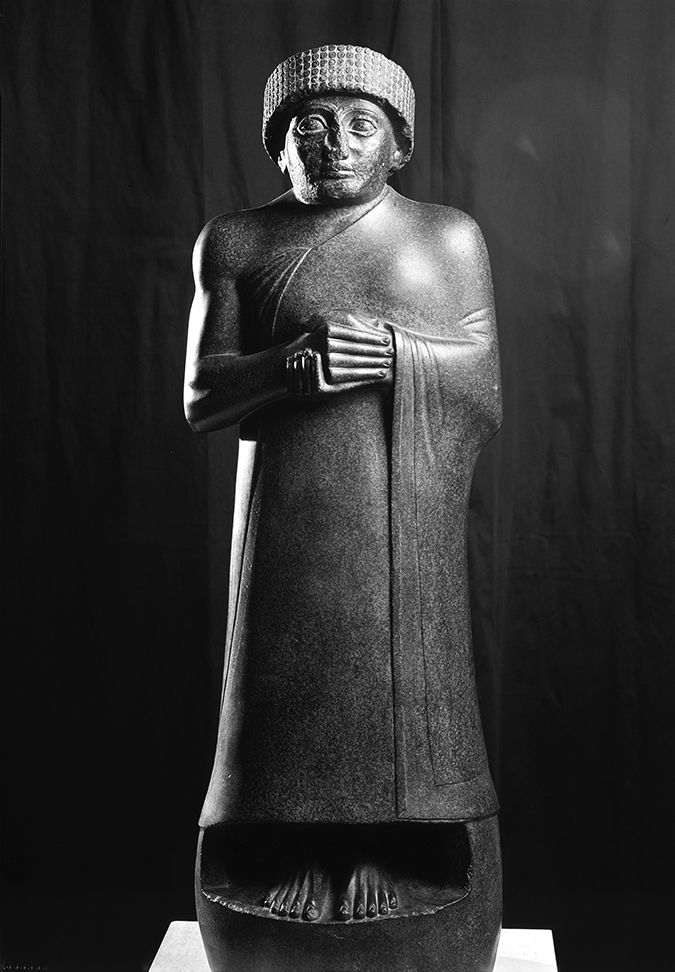
16.1. Gudea. Gudea, King of Lagash, depicted as humble worshipper of the gods. Louvre, Paris. Photo credit Scala/Art Resource, NY
Lagash’s freedom was followed, very shortly, by the freedom of Gilgamesh’s home city of Uruk, where the king Utuhegal had much bigger plans than simply freeing his own city. He drove the Gutians out of Uruk, and then his soldiers (fiercely loyal to him; in his own words, they followed him “like one man”) marched in their wake out in a spreading ripple of circles: to Ur, to Eridu south of Ur, probably as far north as the ancient sacred city of Nippur.
Freeing Nippur from the Gutians symbolized the final freedom of the plain from the Gutian hordes. With his soldiers garrisoned in the cities which had once been under the chaos of Gutian rule, Utuhegal began to describe himself in inscriptions with a title no one had claimed for years, perhaps since Sargon’s sons ruled his empire: King of the Four Quarters. He is, in his own victory accounts, “the king whose orders cannot be countermanded.”10 He captured the strongest Gutian leader, a man he describes as a “snake from the mountains,” marched him into his court in handcuffs, and—in a posture which would become familiar in the reliefs of the next great empire to arise on the plain—“set his foot upon his neck.”11
But although Utuhegal brought an end to the dominance of the invaders, he did not live long enough to enjoy his domain. The real snake in the grass appears to have been his right-hand man Ur-Nammu, who was also married to Utuhegal’s daughter.
After driving the Gutians out of Ur, Utuhegal left Ur-Nammu in charge of the city, with troops on hand. Shortly afterwards, Ur-Nammu sent his soldiers against his own king. The king list records that Utuhegal’s reign over his newly freed land had lasted seven years, six months, and fifteen days—the only time that a king’s rule is specified in more detail than simply years. The precision argues for a sudden and shocking end to Utuhegal’s reign: perhaps his death, in battle, at the hands of his own son-in-law.
Despite this bloody beginning, Ur-Nammu, once in control of both Ur and Uruk, behaved not primarily as a warleader but as a king. He mounted the occasional campaign against lingering Gutians, but records of treaties made, and alliances sworn out, suggest that Ur-Nammu’s empire was spread largely through negotiation (although undoubtedly the soldiers standing behind the smiling diplomat had a great deal to do with Ur-Nammu’s success). Where Ur-Nammu did not conquer, he befriended. He made a match with the daughter of the king of the city of Mari (we have no record of the reaction of his first wife, daughter of the slain Utuhegal, to this strategy). He built temples in cities all up and down the plain, including a new temple to the great god Enlil. Even Susa acknowledged his overlordship, although Awan remained aloof.
Under Ur-Nammu, the Sumerians enjoyed their last renaissance. His rule over this neo-Sumerian empire, and the reigns of the kings who followed him, is known as the Third Dynasty of Ur. Ur-Nammu was not only the conquerer of the plain, but the reestablisher of civilization. He rebuilt roads and walls; he dug canals to bring fresh water back into the cities where brackish water had stood. “My city is full of fish,” he claimed, “the air above it is full of birds. In my city honey-plants are planted.”12
Ur-Nammu’s praise poems boast not only of his rebuilding projects, but of his reestablishment of order and law:
I am Ur-Nammu,
I protect my city.
I strike those guilty of capital offenses, and make them tremble….
My judgments set Sumer and Akkad on a single path.
I place my foot on the necks of thieves and criminals,
I clamp down on evildoers….
I make justice apparent, I defeat wickedness….
In the desert, the roads are made up as for a festival,
and are passable because of me….
I am the good shepherd whose sheep multiply greatly.13
Chaos had been temporarily beaten back, the rule of law and order asserted. For a little while longer, the cities on the Sumerian plain were safe.