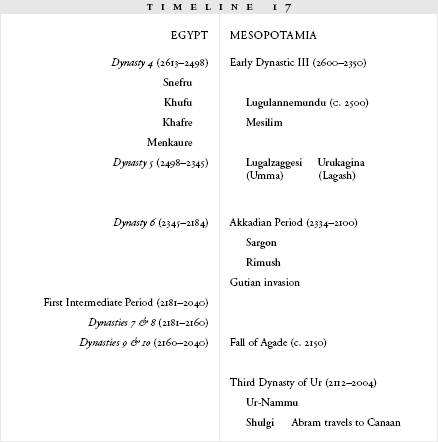
Abram leaves Ur sometime after 2166 BC and travels to the Western Semitic lands, while the neo-Sumerian empire grows stronger
SOMETIME DURING THE SUMERIAN STRUGGLE with the Gutians, a citizen of Ur named Terah collected his servants, his livestock, his wives, his sons and their families, and set off westwards. Among the household was Abram, Terah’s son, and Abram’s wife Sarai, who had the misfortune to be still childless.47
Terah was not a Sumerian, but perhaps an Akkadian or a member of a related tribe; he traced his ancestry back to Shem, the biblical progenitor of the Semites.1 Born sometime during the rule of Naram-Sin, Terah had probably never lived in an Ur that was free of the Gutian threat. During his childhood, Ur had taken advantage of the weakening power of the Akkadian kings to free itself from Akkadian domination. By the time he became the father of three sons, the last Akkadian king was making a final stand for the throne; as his young family grew, the Gutians wrecked Agade and ranged freely across the northern plains.
Sometime around the time that Utuhegal was marching towards Ur, to take it over and then lose it again to his son-in-law, Terah and his family decided (understandably) that they would be better off out of the city. They set off, according to the book of Genesis, towards “Canaan”—to the west, towards the Mediterranean shore and away from barbarian Gutians, vengeful Elamites, and ambitious Sumerians.
The theological explanation for the journey, in Genesis 12, is that Abram had heard the voice of God. This was not a Sumerian god, or an Akkadian god, but the God: a God who gave himself the puzzling name, YHWH, possibly a form of the verb “to be.”48
This seems to have been a new idea for Abram. Terah and his sons were likely to have been worshippers of the moon-god Sin and his daughter Inanna, the patron deities of the city of Ur, simply because all Ur natives paid at least lip service to the moon cult. Also, the family names show a fairly standard homage to the Akkadian/Sumerian pantheon. Terah’s own name expresses kinship with the moon-god Sin. Sarai, Abram’s wife, was also his half-sister, Terah’s daughter by another wife; her name is the Akkadian version of Sin’s wife, the goddess Ningal. Terah’s granddaughter Milcah was apparently named after Sin’s daughter Malkatu.2 Abram’s own name, which means “exalted father,” is ambiguous. Nevertheless, we can assume that both Abram and Sarai’s names were connected with moon worship, in part because later in the story, YHWH renames both of them as part of the making of a covenant. The new names, Abraham and Sarah, both contain the new syllable ah, the first syllable of the covenant name YHWH, a name which reclaims them from the possession of Ur and transfers ownership to the God of Genesis.
From this God, Abram gets both a promise and a command. The promise is that Abram will be made into a great nation and will be blessed; the command is that he leave his country and his people (the city of Ur and its mixed blend of Akkadians, Sumerians, and other Semites) and go “to the land I will show you”: to the land of Canaan, almost due west.49
Plenty of races have claimed to trace their ancestry back to one particular god-favored individual, but this is the first time it happens within recorded history. By blood Abram was no different from the Semites around him, and not so different from the people who inhabited the land he was headed towards. But by divine fiat, he was separated from the rest and began something new: one Semite out of the rest, one God rising above the chaos of polytheism. He was the first monotheist.
RATHER THAN HEADING DIRECTLY WEST, a route which would have taken them across desert, the clan travelled northwest along the easier route of the Euphrates. Eventually this would have brought them out on the northern corner of the Mediterranean coast. But they got as far north as the Bilikh river, which runs into the Euphrates at the point where they should have made a left-hand turn. Instead, they turned eastwards, followed the little river over to the small city of Haran, and settled there. Haran lay on a well-travelled trade route; it was, like Ur, a center of moon worship, and perhaps it felt familiar. Terah was growing old, and Haran was relatively peaceful.
Back down south, Ur-Nammu had taken his father-in-law’s throne and extended his rule into a neo-Sumerian empire, but his reach never came as far north as Haran. Around 2094 he died, after an eighteen-year reign; his funeral poem praises him as a wise and trustworthy shepherd of his people, a king who had restored Sumer to itself, a man worthy of sharing a throne in the afterlife with Gilgamesh himself.3
Ur-Nammu’s son Shulgi took his place. Not long afterwards—perhaps within four or five years—Abram left Haran and resumed his journey towards the land God had promised him. He travelled southwest and arrived, eventually, at Shechem, west of the Jordan river and halfway between the two bodies of water later known as the Sea of Galilee and the Dead Sea.
There, he required reassurance from God that the land would be his, because as far as he could see, it was full of Canaanites.
“CANAAN” is an anachronistic name for the land which would be known in the first millennium BC as Israel, to the Romans as Palestine, and to the Crusaders as “the Levant.” The earliest occurrence of the word “Canaanite” comes from a tablet found at Mari, Zimri-Lim’s walled city, and dates from around 1775; it appears to be an uncomplimentary reference to roving bandits from somewhere around the Jordan river.4 In 2090 BC there was no name for the land God promised to Abram, because it had neither a racial nor a political identity.
The people who lived along the expanse of the eastern Mediterranean shore were “Western Semites.”50 We met their close relations all the way back in chapter 1, when Semites mingled with the Sumerians in the earliest days of the Sumerian cities. Instead of settling down on the Mesopotamian plain, the Western Semites kept on going. While their relations taught the Sumerians to farm, the Western Semites spread up and down the coast and built their own cities.
Abram is the first personality to bob up from the surface of the history of this particular area. Without any unified culture, the Western Semites produced no chronicles, and what we know of them comes only from the ruins of their cities. By 7000 BC, farmers with domesticated goats and sheep occupied towns all through the area. Sites such as Catal Huyuk in the far north and Jericho, farther south and close to the Dead Sea, claim the honor of being among the oldest cities in the world. Jericho, down in the land that Abram’s descendants would eventually claim, stands out; most of the Western Semitic sites are villages with no particular defenses, this far back, but by 6800 BC, the people of Jericho had built themselves a startlingly huge stone wall. At the corner of the wall, a circular tower rose thirty-five feet high so that watchmen could keep a constant eye on the surrounding land.
What the people of Jericho were expecting to come at them is not entirely clear. It is true that Jericho is located at the site of a steady and constant stream of fresh water,5 but after all, the Jordan river was not so very far away. Nevertheless, the people of Jericho, alone among the Western Semites, built huge defenses against some frightening threat from the outside, and watched constantly lest it arrive unannounced.
By the time Abram arrived,51 the Western Semitic cities had built up their own trade routes, particularly with Egypt. Byblos, halfway down the coast (and known as Gubla to the Akkadians, Gebal to the Semites), had built its entire economy on shipping cedars down to Egypt in exchange for Egyptian linen and precious metals. The northern city of Ebla was collecting taxes from cities that sent caravans its way.6 The city of Megiddo, built on the pass between the Jordan valley and the plain of Sharon, had been growing in size since at least 3500 BC. Shechem, where Abram first asked God to confirm his promise, was at least as old, and was perhaps settled because of an ancient well that rarely ran dry. The original Western Semitic settlers had been joined by various immigrants who filtered in from the north and south; most notably the Amorites, nomadic peoples speaking a Semitic language of their own, who may have come from the Arabian peninsula.
Abram can’t be blamed for wondering how this patchwork country was ever going to be his. Nevertheless, he did not get the opportunity to wonder for long, because not five years after arriving in his promised land, he left again.
He wasn’t alone. The archaeological record shows that, sometime between 2400 and 2000, the culture of the Western Semites—which had been moving increasingly towards urbanization—took a turn back towards a less organized, more nomadic lifestyle, with many cities temporarily abandoned.52 A combination of overplanting and drought had shrunk streams and croplands; large settlements that consumed a lot of water had to disperse to survive.7 Add to this the collapse of the Old Kingdom to the south, and the Western Semites had lost not only cropland, but also their wealthiest and most consistent trading partner, the country which had once lavished riches on Byblos and a dozen other cities in exchange for goods. The Old Kingdom chaos had radiated north. In response, Abram went south.
“There was a famine in the land,” reads Gen. 12:10, “and Abram went south into Egypt for a while, because the famine was severe.” There was more water in Egypt; and, temporarily, a little more order. The “goofy” Seventh Dynasty had been followed by an Eighth Dynasty, slightly more stable but entirely unremarkable; it had 27 kings spanning 146 years, and not a single pharaoh’s name has survived.
Around 2160, though, a powerful nobleman from Herakleopolis named Akhtoy had managed through force of personality, canny alliances, and sheer force to pull all of Egypt together under his reign. Manetho calls Akhtoy “more terrible than his predecessors,” probably a comment reflecting the amount of bloodshed that the temporary reunification demanded.8 For the next hundred years, the descendants of Akhtoy—seventeen successive kings, comprising Manetho’s Ninth and Tenth Dynasty—ruled over an Egypt that had lost almost all of its former greatness. It suffered not only from internal troubles, but from the inability to defend its edges from Western Semitic invaders, who constantly raided the Nile Delta in small nomadic bands.
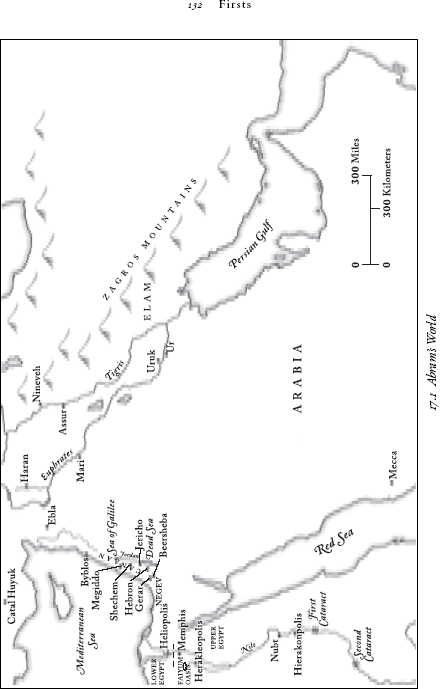
17.1 Abram’s World
According to the traditional dating, Abram arrived down in Egypt with his wife, his servants, and his livestock sometime around 2085. This was not very distant from the time of Akhtoy III of the Tenth Dynasty, a pharaoh who wrote of the Western Semitic invaders:
The vile Asiatic! It goes ill with the place where he is, lacking in water and covered in brushwood….He never dwells in one place but has been forced to stray through want, traversing the lands on foot…. The Asiaticis a crocodile on the riverbank: he snatches on the lonely road.9
Perhaps this hostility explains why Abram, once down in Egypt, announced that Sarai was his sister rather than his wife. According to Genesis, Abram looked at Sarai, somewhere on the trip down to Egypt, and thought to himself: She is beautiful, so the pharaoh of Egypt is likely to order me killed so that he can have her (which certainly suggests that Semites had an equally low opinion of Egyptians).
Abram’s fears came true. The pharaoh (one of the nameless, faceless, unremarkable kings of the Tenth Dynasty) co-opted Sarai and gave Abram thank-you gifts for bringing his beautiful sister to Egypt. Abram ended up with Egyptian sheep, cows, donkeys, camels, and servants. Meanwhile, the pharaoh and his household fared less well. Gen. 12 informs us that Sarai’s presence in the pharaoh’s harem brought a divine curse on it; the pharaoh and all of his household were inflicted with something called neh-ga. English translations tend to render this, politely, as “plague,” perhaps because it involved nasty running sores. It rendered the pharaoh totally uninterested in any visits from any women of his household, let alone Sarai.
This odd story makes more sense if set beside the rest of the Genesis epic. Escaping from Egypt (and the pharaoh, who declined to kill Abram, clearly fearing further divine retribution), Abram returned to Canaan and settled near Hebron, significantly south of Shechem. The promise that he would be the father of a whole new nation did not seem to be coming true. The couple continued childless until Sarai was far too old for any hope of conception.
Twenty years or so after the original message from God, Abram decided to give the promise a helping hand. He borrowed Sarai’s servant Hagar as a second and unofficial wife, promising Sarai that any child of Hagar’s would be officially considered as her offspring.
This was not a practice unknown in the Sumerian cities—it is regulated in a set of Sumerian codes called the Nuzi Tablets—but it didn’t work for Abram. God’s promise of a new nation had been specific not just to Abram, but to Abram and Sarai together. Abram was to be the father of a new nation, but Sarai, not just any fertile and available woman, was to be its mother. Like the one God himself, the new nation was going to resemble what came before it, and yet be entirely different. The God of Genesis shared some of the qualities of the nature-bound pantheon, but was beyond nature and uncontrolled by it. The new nation would be different from the peoples around it because it was created by the promise of the one God. That promise had been given to Abram and Sarai, not Abram alone. Any contribution from a Tenth Dynasty pharaoh or an Egyptian maidservant (“Hagar” is an Egyptian name that means something like “immigrant” this woman was one of the maidservants given to Abram by the afflicted pharaoh) was not welcome; any more than the one God would have welcomed Enlil or Ishtar dropping by to give him a hand. It is after the episode with Hagar that God repeats his promise to Abram and renames him Abraham, showing his divine ownership of this man and his descendants.
Not long afterwards, Abraham again met a king with a roving eye. This time the king ruled Gerar, a city south of Hebron, in the area between Canaan and Egypt called the Negev. Once again afraid of being casually removed, Abraham again insisted that Sarah was his sister, and again Sarah was taken to the royal harem.
As a result, every woman in the entire household was rendered barren until Sarah was returned (and the king, Abimelech, was “kept from touching her,” which seems to suggest that the women weren’t the only ones temporarily deprived of their natural functions). Once again the story is preoccupied with the racial identity of this people God had promised to create.
Genesis was written, by any reckoning, well after the events it describes, with a deliberately anachronistic style of telling. The biblical accounts typically use names which would be familiar to contemporary readers, rather than the names in use during the historical past: “Ur of the Chaldees” is one such reference, since the land at the head of the Persian Gulf was not known as the land of the “Chaldeans” until the reign of Ashurnasirpal II of Assyria (884/883–859 BC) at the earliest.53 Abram has dealings with “Amorites” Abimelech, king of Gerar, is called a Philistine. These names refer to later political identities that evolved as Western Semitic tribes staked out territory and began to battle for it.
Yet even if the names in the text are deliberately anachronistic, the events in the story itself show a clear understanding of the difference not only between Abraham’s blood and Egyptian blood, but between Abraham’s race and the race of Abimelech. For the first time, it was possible to speak of Western Semites as belonging to different races.
In Sumer, from the earliest times, the primary identity of its people had not been as “Sumerians.” They had been citizens of Ur, citizens of Lagash, citizens of Uruk, each paying primary loyalty to a different deity while acknowledging the existence of the others. The rise of Sargon’s Akkadian empire, with its clear differentiation between Sumerians and Akkadians, had brought about a change: two peoples within one set of political boundaries, with a common identity (“subjects of Sargon”) that nevertheless had not removed their basic difference. The raiding Gutians had further clarified this: two different peoples could nevertheless share an identity as civilized that set them off, together, against the contrast of a third.
Now Abraham, wandering west, speaking a language so like that of the Western Semites that he was able to communicate without too much difficulty, is set apart in a more sophisticated way yet. He is unlike Abimelech, another Western Semite, because of choice.
When the promise of God is finally fulfilled and Isaac is born, a new race is created and given a physical mark; God orders Abraham to circumcise his sons, himself, and his family as a sign of their separateness. (Presumably the sign would remind them, at the crucial moment, that they were not to mingle their blood with other races.) Later, when Abraham wants to find a wife for his son, he refuses to allow Isaac to marry any of the Western Semites around him. Instead he sends his servant all the way back to northwest Mesopotamia to bring back a blood relative, his great-niece Rebekah, from those relations who had remained behind in Haran.
Out of the old, a new race had come.
HAGAR’S SON too was different.
Sarai, with Abram’s permission, chased the pregnant Hagar away. Hagar set out on the road that went from Hebron, past Beersheba, south towards Egypt. She was going home.
But Abram’s son was not to be reabsorbed back into the chaos of Egypt during the First Intermediate Period. Hagar, according to Gen. 16, encountered a messenger of God on the road, and she too was given a promise. In a mirror image of the promise given to Sarai, Hagar’s children would also become a nation too numerous to count.
So Hagar returned to Abram’s household; and the baby, when born, was named Ishmael and grew up in his father’s household. To him, the Arab peoples have traditionally chalked up their heritage. According to the Qur’an (written at an even greater distance than Genesis from the events described), Abram—Ibrahim, in the Arabic spelling—was the first to worship Allah, the one God, rather than the stars, the moon, or the sun. When grown, Ishmael went with Ibrahim down into Arabia, to the city of Mecca on the southwestern corner of the peninsula, and together they built the Ka’ba, the first house for the worship of Allah. To this house, the Qur’an orders all of Allah’s followers—the “People of the Book”—to turn: “Wherever you are,” the Qur’an says, “turn your faces in that direction.…From wherever you start forth, turn your face in the direction of the Sacred Mosque; wherever you are, turn your face there.”10
BACK IN the neo-Sumerian empire that Terah’s family had fled, the unrest of earlier days had settled into an empire.
Shulgi, who had succeeded his father, the ambitious Ur-Nammu, on the throne of Ur, had spent the first part of his reign taking stock of his situation. After twenty years on the throne—less than halfway through his reign, as it turned out—Shulgi began to reorganize his domain.11 This organization involved a certain amount of conquest; Shulgi campaigned his way up north as far as the little cities of Assur and Nineveh and then back over across the boundary of the Tigris, into the land of the Elamites, taking back Susa. He never pushed his way up north into the Elamite highlands, where Elamite kings from a long-lasting Elamite dynasty called the Simash kept their claim on sovereignty. But where his fighting ended, his negotiation began. Shulgi made treaties and covenants with a score of small princes and warleaders, marrying three of his daughters to the rulers of territories that lay over in the Elamite lands. He divided his growing territory into a series of provinces, with governors who reported back to him. This was an empire under the rule of law and treaty, bound by regulations that his people were to obey. They were to be obedient not simply because Shulgi had soldiers who could enforce his demands, but because he was the chosen one of the gods, selected by the divine for special favor:
Mother Nintu nurtured you,
Enlil raised your head,
Ninlil loved you…
Shulgi, king of Ur.
He is, in particular, beloved of the goddess Inanna, who has set her love on him thanks in part to his sexual prowess:
Since he ruffled the hair of my lap….
Since on the bed he spoke pleasant words….
A good fate I will decree for him.12
He is also beloved of the moon-god Nanna. In gratitude to his divine protectors, Shulgi built the largest ziggurat of Ur, the neo-Sumerian equivalent of the Great Pyramid; an enormous structure for worship, named in Sumerian “The House Whose Foundation Is Clothed in Terror.”13 Andinhis attempt to rule righteously, as the gods required, Shulgi established a new set of laws. They are fragmentary, but these laws bear the distinction of being the first written code in history to prescribe set penalties for set offenses.14
WHILE SHULGI REIGNED IN UR, Abraham fought constantly to keep his family safe. It was a rough time to be in Canaan. During this time, the walls of Jericho alone were damaged and repaired seventeen different times.15
Abraham had fathered not one but two nations; both of his sons were marked with the sign of the covenant, the ceremonial removal of the foreskin that created a physical difference between them and the other Semites who were battling over the rough land between the Mediterranean coast and the Jordan river.54 But this difference gave them no edge in the struggle for territory. When Sarah died, almost thirty years after giving birth to Isaac, the clan still had so little land that Abraham had to buy a cave from a nearby Western Semitic landlord in order to bury his wife.