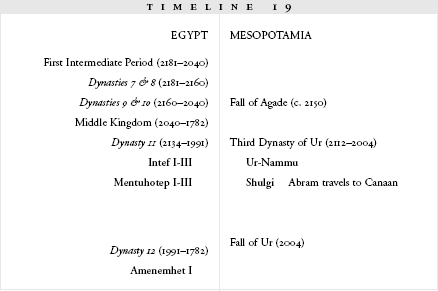
Between 2181 and 1782 BC, Mentuhotep I reunites fractured Egypt, and the Middle Kingdom begins
FOR A CENTURY AND A HALF, Egypt had no pharaoh worthy of the name.
Abram had arrived in the country sometime during the rule of the Ninth or Tenth Dynasty, two families of kings who probably overlapped. According to Manetho, the Ninth Dynasty was founded by a king named Achthoes, who began a royal line and ruled all of Egypt from Herakleopolis, farther south. Achthoes, he tells us, was the most cruel ruler Egypt had ever seen; he “hurt people all over Egypt.”1
This king, who appears in inscriptions as “Akhtoy I,” was actually the governor of the province centered at Herakleopolis; the tradition of his cruelty most likely stems from his armed attempt to seize all of Egypt. Almost as soon as Akhtoy was dead (Manetho says that he went mad and was eaten by a crocodile, the instrument of divine vengeance), another “pharaoh” announced himself much farther to the south. His name was Intef, and he claimed to rule all of Egypt from Thebes.
Manetho says that Akhtoy’s Ninth Dynasty was followed by a Tenth Dynasty, and then neatly by an Eleventh Dynasty. What actually happened was that the Ninth and Tenth Dynasties and the Eleventh Dynasty ruled simultaneously. “Rule” is a kind word; unruly sets of warlords were fighting each other for the right to claim nominal control of Egypt, while other provincial governors went on doing as they pleased. An inscription from one of these governors (or nomarchs; the territories ruled by the nomarchs were known as nomes) shows a complete disregard for the royal pretensions in Herakleopolis and Thebes. “[I am] overseer of priests, overseer of desert-countries, overseer of mercenaries, great overlord of the nomes,” Ankhtifi boasts. “I am the beginning and the peak of mankind.…I surpassed the feats of my ancestors…. All of Upper Egypt was dying of hunger and people were eating their children, but I did not allow anybody to die of hunger in this nome…. Never did I allow anybody in need to go from this nome to another one. I am the hero without equal.”2 In his own eyes at least, Ankhtifi is the equal of any pharaoh.
Manetho’s neat succession of dynasties is produced by his determination to stuff all of this chaos into the framework of the old dynastic successions. Even more than fifteen hundred years after the fact, Manetho cannot quite admit that the authority of Horus-on-earth has entirely disappeared. In this, he is far from alone. What inscriptions survive from the period show that Egyptian scribes either ignored the reality of their kingdom’s breakdown (other ancient king lists pretend that the Ninth and Tenth dynasties never happened and pick up partway through the Eleventh),3 or tried to put it in slightly less threatening terms. Egypt had not fallen into anarchy. No; the old north-south hostility had just made a temporary return. Clashes between the north and south were nothing new, and in the past a pharaoh had always risen to reunify the whole mess.
So we find Intef I, the Theban pretender, calling himself “King of Upper and Lower Egypt” in his own inscriptions.4 This was more than a little grandiose, as he certainly was not king of Lower Egypt and probably didn’t control all that much of Upper Egypt either. Nevertheless, it put him firmly into the tradition of Upper Egyptian pharaohs who had managed to bring the rebellious north back under control. Intef’s soldiers fought, more than once, with troops from Herakleopolis, in a re-creation of those old battles between north and south. Meanwhile, rival nomarchs clashed, Western Semites wandered into the Delta, and Egypt’s great past receded a little further. “Troops fight troops,” an account from the period reads. “Egypt fights in the graveyard, destroying tombs in vengeful destruction.”5
Then, halfway through the Eleventh Dynasty, Mentuhotep I came to the throne of Thebes.
Mentuhotep, who was named after the Theban god of war, spent the first twenty years of his reign fighting his way north into Lower Egypt. Unlike Narmer and Khasekhemwy before him, he had to campaign not only against the soldiers of the northern king, but also against the nomarchs in his way. One of his first great victories was against the governor of Abydos; the ferocity of the takeover is marked by at least one mass burial, a tomb containing sixty soldiers all killed in the same battle.6
As he fought his way north, the soldiers of the Tenth Dynasty ruler at Herakleopolis retreated in front of him. Just before Mentuhotep reached Herakleopolis, the Tenth Dynasty king who reigned there died. The scramble for succession threw the defense of the city into disorder, and Mentuhotep marched into it with ease.
Now he held both Thebes and Herakleopolis, but Egypt was far from united. The nomarchs were not keen to give up their long-held powers; battles with the provinces continued for years. Portraits of Egyptian royal officials during this time tend to show them carrying weapons, rather than papyri or other tools of office, suggesting that going to the office remained chancy for quite a long time.7
But by the thirty-ninth year of his reign, Mentuhotep was finally able to alter the writing of his name. His new Horus-name was, unsurprisingly, “Uniter of the Two Lands.” In fact, his forty-year struggle for power had almost nothing to do with north-south hostility; but the old paradigm of civil war gave him a much better chance to cast himself as a great pharaoh who had rescued Egypt once again.
His spin was successful. Not long afterwards, his name begins to appear in inscriptions next to that of Narmer himself. He is praised as a second Narmer, equal to the legendary king who had first pulled Upper and Lower Egypt together into one.
MENTUHOTEP’S REIGN was the end of the First Intermediate Period and the beginning of Egypt’s next period of strength, the Middle Kingdom. He ruled, according to Manetho, for fifty years.
Although tomb inscriptions identify at least five different women as his wives, no inscriptions that date from his reign mention a son.8 The next two kings had no blood link to him or to each other, and the third was a commoner: Amenemhet I, who had served Mentuhotep III as vizier. It seems that the idea of a divine royal bloodline, if honored in theory, had passed away in practice.
Amenemhet I is the first king of Dynasty Twelve. A southerner by birth (according to inscriptions, his mother was from Elephantine, far into Upper Egypt), Amenemhet immediately put himself into the line of great unifiers by building himself a brand-new capital city, just as Narmer had, to celebrate his hold over the country. He called this new city, twenty miles south of Memphis, “Seizer of the Two Lands” (“Itj-taway”).9 It would serve him as his own balancing point between north and south; Memphis, still a center of worship of the Egyptian pantheon and home to Egypt’s most sacred temples, was no longer the place where the pharaoh made his home.
Amenemhet also commissioned scribes to write a “prophecy” about him, a document which began to circulate through Egypt very near the beginning of his reign. This “Prophecy of Nerferti,” supposedly from the reign of King Snefru five hundred years before, begins with King Snefru brooding over the possibility that Egypt will fall to Asiatic invaders from the east (a clear case of a later worry imposed on a much earlier time, since this possibility probably never occurred to Snefru). Fortunately, Snefru’s sage has a happy prediction:
A king will come from the South….
He will take the White Crown,
He will wear the Red Crown….
Asiatics will fall to his sword,
Rebels to his wrath, traitors to his might….
[He] will build the Walls-of-the-Ruler
To bar Asiatics from entering Egypt.10
Amenemhet then proceeded to carry out the prophecy. With the help of his son Senusret, he led an expedition against the “sand dwellers” who had infiltrated the Delta.11 He also built a fortress east of the Delta to keep other invaders out and named it, not surprisingly, Walls-of-the-Ruler.
Near the end of his reign, Amenemhet was powerful enough to build himself a pyramid near his new city of Itj-taway. It was only a small pyramid, but it stood as a monument to the return of the old order. Amenemhet must have felt himself to be walking in the footsteps of his great predecessors Narmer and Khufu and Khafre. The pharaoh’s might was on the upswing once more.
Then Amenemhet was murdered.
SENUSRET I WROTE the story of his father’s assassination shortly afterwards, in his father’s own voice. “I awoke to fighting,” the dead Amenemhet says, “and I found that it was an attack of the bodyguard. If I had quickly taken weapons in my hand, I would have made the wretches retreat…. But there is none mighty in the night, none who can fight alone…. my injury happened while I was without you, my son.”12
A few more details are contained in a story from slightly later, the “Tale of Sinuhe.” According to this account, Senusret was campaigning down south in “the land of the Libyans,” the desert west of the Nile, where desert-dwellers had long troubled the Egyptian border. Hearing the news of his father’s murder, Senusret left his army behind and flew like a hawk back north to Itj-taway, a long and difficult journey. As the crown prince approached, the courtier Sinuhe fled from the palace up into the land of the Asiatics because he was certain that he would be suspected of involvement in the crime.
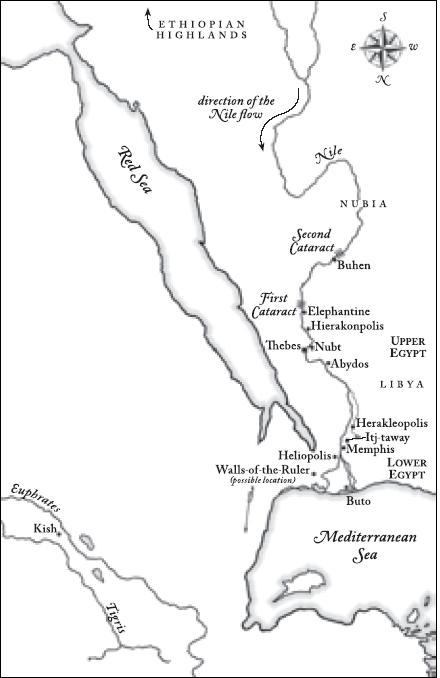
19.1 The Middle Kingdom
To flee into Canaan was a desperate act indeed for any Egyptian. Sinuhe had a difficult journey; he had to sneak past the Walls-of-the-Ruler fort (“I bowed down in the bushes, for fear the sentinels on the fort…should see me”) and travel over desert sands for hot thirsty days. Finally, he reached Canaan, which he calls “Yaa,” and found a land flowing with milk and honey. “There were figs,” he exclaims, “and vines; more plentiful than water was its wine, copious was its honey, plenteous its oil.”
Much later, Sinuhe would return to his native land to be pardoned by Senusret, who had taken his father’s place and made Egypt both stronger and wealthier. Lest the listener get any idea that the land of the Canaanites was a good place to be, however, Sinuhe points out that before he rejoined polite Egyptian society, he had to be recivilized after his years among Asiatics; this was a lengthy process that apparently involved shaving him all over, since exile among the Western Semites had made him shaggy.
SENUSRET HIMSELF, having avenged his father’s murder by executing the bodyguard, had a prosperous rule of his own. He made his son his co-regent a few years before his death, a practice which became standard for Twelfth Dynasty pharaohs. Co-regencies made the changeover from one pharaoh to the next both simpler and more peaceful. They were also a concession of sorts; the establishment of a co-regency must have flown in the face of the old tradition of the king’s death and rebirth in his son. But by now, the pharaoh was clearly less god than man. His changing status is reflected in Twelfth Dynasty statues of the kings, which are portraits of real people very unlike the immobile god-faces of the Fourth Dynasty rulers.
The succession rolled on; Egypt, in relative peace, had regathered itself to something like its previous prosperity. Senusret’s son was followed by his grandson and then his great-grandson, Senusret III, who is memorable for his enormous size (apparently he was over six and a half feet tall) and his instantly recognizable statues, which show him with a lined face, wide-set eyes with heavy eyelids, and ears that stick out far enough to hold his headdress back. He built more forts down in Nubia than any other pharaoh; according to his own records, at least thirteen of them. The fortresses are huge, like medieval castles with towers and ramparts and moats. One of the largest, the fortress at Buhen, near the Second Cataract, had mud-brick walls thirteen feet thick, five tall towers, and a massive central gate with double doors and a drawbridge across a protective ditch. Inside the fortress was enough space for a whole town, streets, and a temple.13
The Egyptians who lived at Buhen did not sleep outside these walls, where Nubians might find them. During Senusret’s brutal campaigns, Egyptians had slaughtered Nubian men, brought women and children north as slaves, torched fields, and destroyed wells. The Nubians hated their overlords too much to live side by side with them.
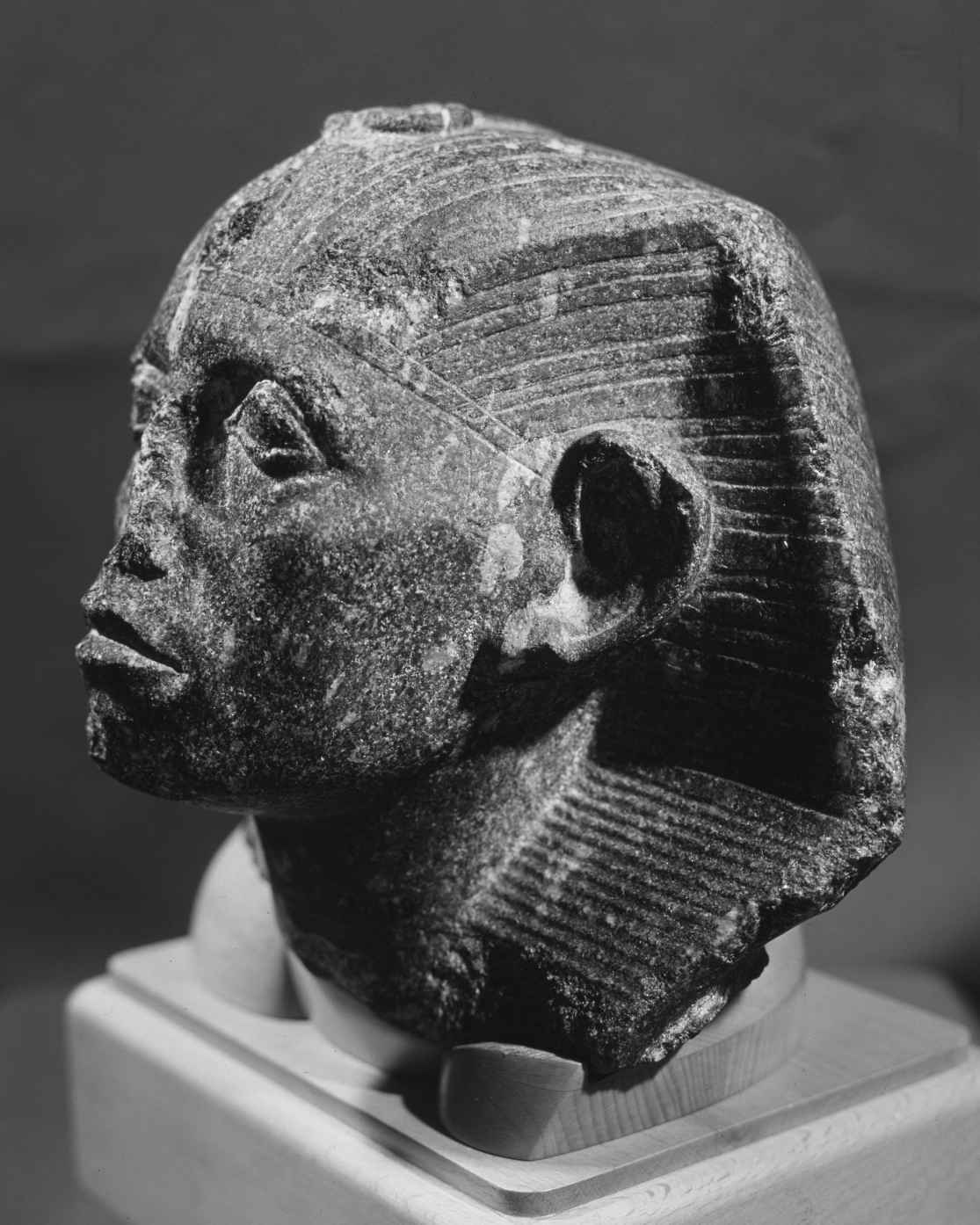
19.1. Senusret III. Granite head of Senusret III, Pharaoh of Egypt, found near Karnak. Photo credit Bridgeman-Giraudon/Art Resource, NY
But this savage treatment of Egypt’s most troublesome province temporarily halted its resistance. By the time that Senusret III passed Egypt on to his own son, the Egyptian territories were peaceful. Egypt had again begun to trade with Byblos for cedar. The Sinai mines were worked to their full extent. And the Nile floods were at the highest point in years. The Middle Kingdom was at its height, even though a man rather than a god was on its throne.