Between 2004 and 1750 BC, the kings of Larsa and Assur build kingdoms in the south and north, while Hammurabi of Babylon waits for his chance
WHEN EGYPT BEGAN its journey back up to prosperity, the Mesopotamian plain was still a mess.58 After sacking Ur and hauling off Ibbi-Sin in triumph to Susa, the Elamites had occupied the remains of the city and fortified the walls, ready to use it as a base to conquer more territory. But they had reckoned without the treacherous and canny commander Ishbi-Erra, still firmly in control of the city of Isin to the north. Ishbi-Erra needed Ur in order to carry out his charade of establishing a new Sumerian dynasty, as great as the Ur dynasty that had fallen.
He didn’t have much competition. After the sack of Ur, most of the scattered cities which had once been under the protection of the Third Dynasty kings had not managed to reassert themselves as powers in their own right. There were only three possible challengers: two ancient Sumerian cities that had managed to retain some independent power after the Ur III collapse, and the Elamites themselves.
The first of these cities, the city of Eshnunna, was far to the north, along the right-hand bend of the Tigris river. Almost as soon as Ibbi-Sin began to run into difficulties, Eshnunna had taken advantage of its distance from the capital and rebelled. The city was certainly a threat to Ishbi-Erra’s power, but it was also a long way away from Isin (and there were Amorites in the path). On the other hand, the second independent city of old Sumer, Larsa, was right on the southern plain that Ishbi-Erra coveted. It too had rebelled against Ibbi-Sin’s rule, but its kingship had been claimed by an Amorite.
Rather than weakening his forces by battling against Larsa, Ishbi-Erra fortified his own city of Isin, and built up his army in preparation for an attack on the crown jewel: Ur itself.
He took his time. It was near the end of his reign—perhaps ten years after the Elamite conquest of Ur—that he swept down from the north, went right past Larsa, and mounted an attack against the Elamite occupiers. An extremely fragmentary poem records his victory over the Elamites and his recapture of Ur from the enemy:
Ishbi-Erra approached the enemy,
and they did not escape his power, there on the plain of Urim.
On a great chariot,
he rode into the city in victory,
he took its gold and jewels,
and the news was brought to…[the] king of Elam.1
Ishbi-Erra had to be content with his crown jewel; he never did get to attack either Larsa or Eshnunna. He died shortly after and left his son in charge of his four-city kingdom of Isin, Nippur, Uruk, and Ur.
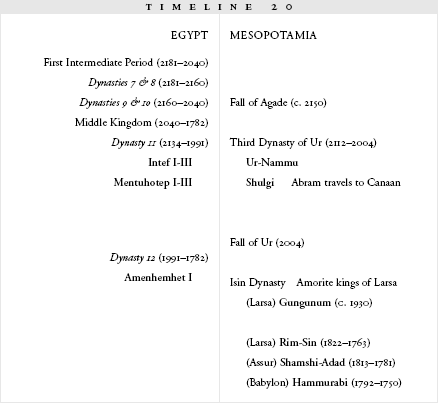
FOR THE NEXT FIFTY YEARS the Isin dynasty of Ishbi-Erra and the Amorite kings of Larsa fought it out against each other on the southern plain. Neither gained the upper hand.2
Up in the north, cities which had once been under the watchful eye of the Third Dynasty of Ur started to reassert their own independence. Assur, which had been added first to the Akkadian expanse by Sargon, and then to the Ur kingdom by Shulgi, rebuilt its walls and began trading with the Western Semites near the Mediterranean coast; merchants from Assur even built their own little trading colonies on the eastern edge of Asia Minor.3 West of Assur, the northern city of Mari, on the banks of the Euphrates, was doing the same. Between Assur and Mari, and between the two rivers, lay a shifting patchwork of Amorite chieftains, mostly ruling over little patches of agriculture, who wandered and quarrelled and redrew each other’s boundary lines.
Sometime around 1930 BC, the balance of power in the south began to shift.
The fifth king of Larsa, an Amorite named Gungunum, took the throne after the death of his brother and made his own play to build an empire. He fought his way over to Susa and left an inscription with his name on it there; he fought his way up to Nippur and took it away from the control of Isin; and then he mounted a campaign against Ur, the pride of the Isin dynasty. We have from this campaign several frantic letters between the king of Isin, Lipit-Ishtar (Ishbi-Erra’s great-great-grandson, so far as we can tell), and his general as they try to cope with the advancing troops. The general writes, “Six hundred troops of Gungunum have arrived; if my lord does not send reinforcements, they will soon build brick fortresses; do not delay, my lord!”
20.1 Mesopotamian Mixing Bowl
Lipit-Ishtar’s response echoes the same desperation that Ibbi-Sin had felt at the advance of Ishbi-Erra, eighty years before: “My other generals are better servants to their king than you!” he writes. “Why haven’t you kept me better informed? I have sent you in haste two thousand spearmen, two thousand archers, and a thousand axe-men. Chase the enemy away from their camp and guard the cities nearby. This is urgent!”4
The reinforcements arrived too late, or were too few; the enemy troops of Larsa overran Ur. Not long afterwards, Gungunum had declared himself the divine protector of the ancient city and was commissioning poems that—his Amorite ancestry notwithstanding—promise the moon-god that he longs to restore the ancient ways: “You, Nanna, are beloved of the king Gungunum,” one reads. “He will restore your city for you; he will bring back for you the scattered peoples of Sumer and Akkad; in your Ur, the ancient city, the city of the great divine powers, the house which never diminishes, may Gungunum live for many days!”5 Claiming the right to restore someone else’s heritage: this would became the strategy of more than one later conqueror.
Gungunum’s successor inherited Larsa and Ur, and decided to add the city of Nippur to his collection. When the king of Isin (a usurper; Ishbi-Erra’s descendants had lost their throne in the wake of the Ur disaster) objected, the two cities revived their old rivalry. Once again Larsa and Isin waged a war that went on for years, this time over hapless Nippur, which changed hands at least eight different times in the course of the fighting. Meanwhile the other cities of the plain—Isin, Larsa, Uruk (now ruled by another Amorite chief), Eshnunna, Assur, Mari—existed alongside each other for some years in a state of high alert, but in heavily armed neutrality.
A new city rose to join them when yet another Amorite chief settled in the riverside village of Babylon and decided to make it into his headquarters. This chief, Sumu-abum, built walls around the settlement and made it into a city, with himself as king and his sons as heirs. The inscriptions he left behind him, commemorating his rule, name him (like Gilgamesh of old) as the great builder of his city: the second year of his reign is described as “The year in which the wall was built,” and the fifth year as “The year in which the great temple of Nannar was built.”6
Apart from Sumu-abum, none of the cities were blessed with distinguished leadership. Petty king succeeded petty king without leaving much in the way of tracks behind. Isin suffered from an embarrassing shift of power when its ninth king, Erra-imitti, was told by a local oracle that disaster was heading his way. Erra-imitti decided to avert the coming catastrophe by following a scapegoat ritual familiar from later Assyrian practice; he picked one of the palace workmen, a groundskeeper, to be king-for-a-day. At the end of a prescribed period, the faux king would be ceremonially executed. In this way, the omen would be fulfilled, since disaster had already come upon the king, and the real king would escape unscathed.
Unfortunately, as the chronicle that preserves the event tells us, once the groundskeeper was temporarily crowned, Erra-imitti went to eat a bowl of soup and died sipping from it.7 Soup is hard to choke to death on; probably a palace poisoner was at work. With the king dead, the groundskeeper refused to give up the throne and reigned for twenty-four years.
The fight with Larsa had gone on all this time, and Larsa, weakened by constant battle, was an easy target when the Elamites staged a partial comeback. Sometime around 1834, a warrior-chief from northwest Elam rounded up an army and struck back across the Tigris. He took Larsa for his own and—not long afterwards—captured Ur and Nippur as well. He gave Larsa to his younger son, Rim-Sin, to rule on his behalf.
Rim-Sin’s new domain was shabby and unhappy from years of war; Rim-Sin set out to bring Larsa back to its previous glories. We don’t know exactly how he spent the first years of his reign, but we know that by 1804, eighteen years after he ascended Larsa’s throne, three cities were worried enough about Larsa’s growing might to put aside their historic differences and join together against the common threat. The king of Isin, the Amorite ruler of Uruk, and the Amorite chief of Babylon fielded a joint army against Rim-Sin.
Rim-Sin wiped it out and marched over to Uruk, which he occupied by way of reprisal. The kings of Babylon and Isin retreated to meditate on their next move.
At this point, the king of Eshnunna decided to take advantage of the southern chaos to extend his own territory northwards. He marched up the Tigris, knocked the Amorite king of Assur off his throne, and entrusted the city to his son to run for him. But before he could plan further campaigns, an invader appeared outside Assur’s damaged walls.
This warrior, a man named Shamshi-Adad, was probably an Amorite, like many of the armed power-players of the day. The Assyrian king list (which records the succession of king after king to Assur’s throne, in the same style as the Sumerian list) tells us that Shamshi-Adad had spent some years in Babylon, and then had moved up from Babylon and “seized the town Ekallatum,” a military fortress that stood just north of Assur, on the opposite bank of the Tigris, and probably served Assur as an outpost.8 Here he stayed for three years, apparently planning his takeover. Then he marched on Assur, deposed the Eshnunna deputy, and ascended the throne himself.59
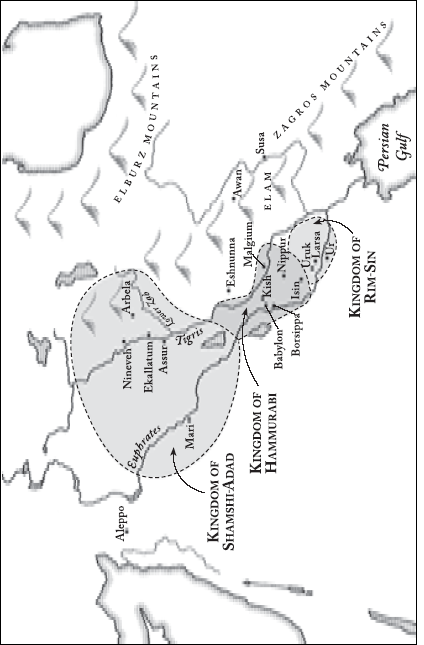
Then he set out to build an empire that would be the northern reflection of the Larsan kingdom, now growing to the south under Rim-Sin. Shamshi-Adad put his older son Ishme-Dagan in charge of Ekallatum and Assur’s northwest lands, and then seized control of the land between the Tigris and Euphrates. He marched west as far as Mari, defeated Mari’s defensive line, and executed Mari’s king; one of Shamshi-Adad’s officials wrote to him, a little later, asking how much effort to put into the dead king’s funeral.
The king’s sons were put to death. Only one, the young prince Zimri-Lim, escaped. Zimri-Lim fled west to the Western Semitic city of Aleppo, north of Canaan; sometime earlier he had married the daughter of the king of Aleppo, and in the face of Shamshi-Adad’s invasion, he took cover with his father-in-law. Shamshi-Adad put his younger son Yasmah-Adad on Mari’s throne instead, to serve as its governor-king under his authority.
Shamshi-Adad not only commissioned the usual inscriptions, recording his victories, but also corresponded copiously with both of his sons. These letters, recovered from the ruins of Mari, tell us that Shamshi-Adad took control not only of the westward plain, but also some of the land east of the Tigris—in some places as far over as the Zagros Mountains, encroaching on Elamite holdings—and northwards conquered both Arbela and Nineveh. Under Shamshi-Adad, for the first time, the triangle of land between the upper Tigris and the Lower Zab river, cornered by the three cities of Assur and Arbela and Nineveh, became “Assyria”: the center of an empire.
This was the largest extent, outside of Egypt, of any king’s reign, and Shamshi-Adad was not slow to trumpet his own worth and the favor of the gods, which he courted by building elaborate temples. “I am Shamshi-Adad, king of the universe,” one of his dedicatory inscriptions on a new temple read, “builder of the temple of Assur, who devotes his energies to the land between the Tigris and the Euphrates.…I have roofed the temple with cedars, and in the doors I placed door-leaves of cedar, covered with silver and gold. The walls of that temple I have laid upon foundations of silver, gold, lapis lazuli, and stone; with cedar-oil, honey, and butter I have anointed its walls.”9
Shamshi-Adad’s empire was marked by his tight control, both of his bureaucratic servants and of the people he conquered. “I installed my governors everywhere,” he records of his own kingdom, “and I established garrisons everywhere.”10 He had to worry about more than the revolt of his subjects; his empire was also threatened by the Elamites, who were massing troops to his east. The official who watched over the far eastern reach of Shamshi-Adad’s territory wrote, more than once, warning him that the king of Elam had twelve thousand soldiers ready to march.11 But Shamshi-Adad drafted enough of his subjects to man his garrisons and assemble an impressive defensive force, and the Elamite attack held off a little longer.
Back down south, Rim-Sin had finally managed to conquer Isin, which had been Larsa’s rival in the south now for almost two hundred years. With the dynasty of Isin ended, he was unquestioned ruler of the south, as Shamshi-Adad was of the north. By 1794, the two men held almost all of the Mesopotamian plain between them.
IN 1792, the Amorite chief of Babylon died, and his son Hammurabi succeeded him.
Hammurabi, according to the Babylonian king list, was the great-great-great-grandson of Sumu-abum, that first Amorite to build walls around Babylon. He may even have been a very distant relation of Shamshi-Adad, since the Babylonian list has, as the earliest ancestors of the Babylonian rulers, twelve of the same names that show up as the “kings who live in tents” from Shamshi-Adad’s own list; the two men shared a common descent from those Amorite nomads.12
The massive holdings of Rim-Sin and Shamshi-Adad sat on either side of Hammurabi’s Babylon like two giants on either side of a man with a slingshot. But Babylon’s central location was also an advantage. The city was a little too far south of Assur to worry Shamshi-Adad, too far north of Larsa to threaten Rim-Sin. Hammurabi began, cautiously, to claim control of the nearby cities in central Mesopotamia. Not long after his accession, we find him attaching his name to the old Sumerian city of Kish and to Borsippa, south on the Euphrates.13
If he wanted to expand his holdings any more, Hammurabi had to look either north or south. He turned south; Rim-Sin’s conquest of Isin had left the city’s defenses shattered. In 1787, five years after taking the throne of Babylon, Hammurabi attacked Isin and took control of it away from its Larsan garrison. He also campaigned across the Tigris and took the city of Malgium, which lay on the very western edge of Elamite territory.14
But he didn’t yet try to take over the center of Rim-Sin’s kingdom. Nor was he ready to challenge the north at all. Nine years into his reign, he made a formal alliance with Shamshi-Adad. A Babylonian tablet records the oath, which both men swore to; the language implies that although both were bound by it, Hammurabi acknowledged Shamshi-Adad as the superior. Certainly he knew himself not yet strong enough to take the king of Assur on, headfirst. Conceivably, he could see the future. Two years later, Shamshi-Adad was dead; probably of old age, although the date of his birth (like his parentage) remains a mystery.
Even then, Hammurabi did not immediately move north into Assyrian territory. He bided his time, building canals and temples, reinforcing cities, and strengthening his army. He even established more-or-less friendly relations with Shamshi-Adad’s son Yasmah-Adad, still ruling as king at Mari, and also with the king of Eshnunna, north of Babylon. He was on good enough terms with both monarchs to send officials as ambassadors (and spies) to their courts; playing both sides of the card, he also made a gesture of friendship towards Aleppo, where the ousted rightful heir to Mari’s throne was in exile, by receiving a delegation from Aleppo’s king.15
To the south, Rim-Sin was in no doubt about the growing threat in the center of Mesopotamia. Hammurabi might be sitting relatively still, but he was dangerous. Rim-Sin was already building alliances. He was sending messages to the Elamites and the king of Malgium to the east of Babylon, to the king of Eshnunna north of Babylon, even to the Gutians who lived north of Elam: hoping to arrange a pincer move that would trap Hammurabi from both north and south.
Meanwhile Hammurabi waited, in relative peace, strengthening the center of his kingdom against the coming storm.