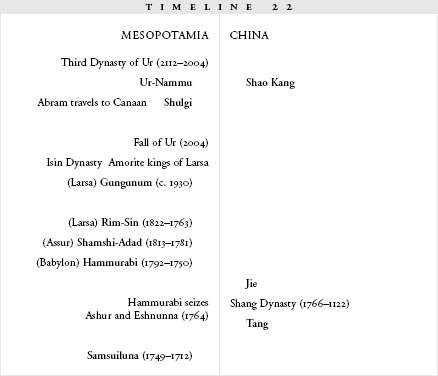
Between 1781 and 1712 BC, the king of Assur and his allies fall to Hammurabi of Babylon, who then makes laws to control his empire
AFTER YEARS OF BIDING HIS TIME, Hammurabi had begun to see fractures in the empire to his north.
When Shamshi-Adad died of old age in 1781, the crown of Assur had gone to Ishme-Dagan, who had been ruling as his father’s co-regent over a territory consisting of Ekallatum and the northward expanses. Ishme-Dagan now controlled the entire empire, including the city of Mari, where his younger brother Yasmah-Adad was reigning as his deputy.
Ishme-Dagan and Yasmah-Adad had never been good friends. The older son had been Shamshi-Adad’s pride; the younger had suffered from his father’s disdain since the very beginning of his term as governor-king of Mari. In letter after letter, Shamshi-Adad had compared the brothers, always to Yasmah-Adad’s disadvantage. “Your brother has won a great victory in the east,” Shamshi-Adad writes to the younger son:
[But] you remain there, reclining amongst the women. Can’t you behave like a man? Your brother has made a great name for himself; you should do the same in your own land.1
Rarely did Yasmah-Adad manage to please his father; Shamshi-Adad’s letters criticize him for everything from not choosing a steward to manage his household affairs (“Why haven’t you appointed a man to the post yet?”) to not sending a requested official quickly enough. The constant criticism drained away whatever assertiveness Yasmah-Adad had. We find him writing back to his father in an agony of uncertainty over the reassignment of another minor official: “You have asked me to send Sin-iddinam to help you, and I will do as you say,” he begins. “But if I do, who will stay here and govern? I honor my father, and I will be glad to send him to you. But then, what if you come here and say, ‘Why didn’t you tell me that you would have to leave his post empty? Why didn’t you keep me informed?’ So I am informing you, so that you can decide what you want me to do.”2
Meanwhile, Ishme-Dagan peppered his younger brother with reports of his victories.
In eight days I became master of the city of Qirhadat and took all the surrounding towns. Rejoice!
I marched against Hatka, and in one day, I flattened the town and made myself master of it. Rejoice!
I raised siege-towers and battering rams against the town of Hurara, and took it in seven days. Rejoice!3
No wonder Yasmah-Adad hated him.
After Shamshi-Adad’s death, Ishme-Dagan wrote to his brother, apparently in an effort to improve their relationship. Unfortunately he had inherited his father’s hectoring tone:
I have ascended the throne in my father’s house, and I’ve been extremely busy, or I would have sent you news before. Now I will say—I have no other brother than you….You must not be anxious. As long as I am alive, you shall sit on your throne. Let’s swear brotherly loyalty to each. Oh, and be sure to send me your complete report right away.4
It is hard to know how sincere this gesture of friendship was. The indecisive Yasmah-Adad was soon facing a siege; Zimri-Lim, the prince of Mari, who had been forced to run west by Shamshi-Adad’s attack, was planning a return. He was reinforced by soldiers given to him by his father-in-law, the king of Aleppo. Six years after Shamshi-Adad’s death, Zimri-Lim was ready to move against Yasmah-Adad.
No reinforcements arrived from Assur. Alone, Yasmah-Adad faced the besiegers, and died in the waves of the attack.
Now, Zimri-Lim was king of Mari once more. Given that three large and greedy kingdoms now lay to his east (Ishme-Dagan’s centered at Assur, Hammurabi’s at Babylon, and Rim-Sin’s to the south), Zimri-Lim knew that Mari needed to make an alliance with the strongest in order to survive the other two.
But it was far from clear who the strongest might be. One of Zimri-Lim’s own letters from this point in his reign reads:
There is no king who, by himself is strongest. Ten or fifteen kings follow Hammurabi of Babylon, the same number follow Rim-Sin of Larsa, the same number follow the king of Eshnunna….5
After surveying the territory, he finally settled on Hammurabi as his best bet.
Hammurabi accepted the alliance. Undoubtedly he had his eye on the forces gathering against him. Ishme-Dagan had negotiated a two-way treaty with the king of Eshnunna, that independent city east of the Tigris, and the country of Elam. This created a force to be reckoned with. Since the fall of Ur, Elam had been more or less a unified country; the southern realms had, at various times, fallen under the rule of various Mesopotamian kings, but the northern lands had always remained an Elamite stronghold. Now a new dynasty, the Eparti line, had taken control of the entire region and was ready to join in the fight against Babylon.63
Down in the south, Rim-Sin appears to have thought better of joining the anti-Hammurabi coalition of Assur, Eshnunna, and Elam. Possibly he now believed that Hammurabi could not be defeated. Just as possibly, he was too tired and too old to join a fight so far to his north. He had now been on the throne for nearly sixty years, longer than any other known Mesopotamian king.
Ishme-Dagan and the kings of Eshnunna and Elam moved without him. In 1764, nine years after Zimri-Lim returned to the throne of Mari, the joint army began its march against Hammurabi.
Hammurabi, his own Babylonian army reinforced with Zimri-Lim’s soldiers, wiped the floor with them. He seized Assur and made it part of Babylon; he took Eshnunna as his own; and although he did not drive eastwards all the way into the Elamite highlands, he captured Susa and sacked it. He also carried off various statues of Elamite goddesses and had them taken, ceremonially, to Babylon, accompanied by their priestesses. This was a polite and sacred version of carrying off your enemy’s wives and ravishing them.
The year after, he turned against Rim-Sin, whose neutrality had done him no good. Hammurabi used this very neutrality as a reason to attack the southern king. Why had Rim-Sin not joined him against the northern aggressors? When Rim-Sin could not answer the question satisfactorily, Hammurabi diverted the flow of a river across a heavily populated section of Rim-Sin’s kingdom. Apparently Rim-Sin buckled without too much of a fight, agreeing to do homage (and, according to his own records, draining land elsewhere so that he could hastily resettle the men and women who had been flooded out).
Hammurabi then turned against his own ally.
Apparently Zimri-Lim was too powerful a warrior, and too strong a personality to make Hammurabi feel entirely comfortable. He didn’t attack his former partner; instead, he demanded the right to examine (and control) all of Zimri-Lim’s correspondence with other powers. This particular sort of domination—the right to manage another country’s foreign relations—would be much exercised in later centuries, when it generally spelled the end of actual independence. Zimri-Lim knew this. Indignant, he refused. Hammurabi threatened reprisal. Zimri-Lim defied him. Hammurabi marched to Mari and began executing prisoners outside its walls. When the gates stayed closed, Hammurabi besieged the city, broke down its walls, hauled its people off into slavery, and set it on fire.6
Zimri-Lim’s fate is not recorded; nor that of Shiptu, his queen, nor that of his daughters. He had two young sons, but neither appears again in the annals either of Mari or of Babylon.
THE YEAR AFTER THIS ATTACK, Hammurabi turned again towards Larsa. We can assume that Rim-Sin had thought better of his homage and mounted a resistance. After a six-month siege, Larsa fell.
This time, Hammurabi took Rim-Sin prisoner, removing him from his throne. His sixty-year rule was over. Now all of the old Sumerian cities—not to mention a good many west and north of old Sumer—were part of the empire centered at Babylon. “May all men bow down in reverence to you,” Hammurabi’s scribes wrote. “May they celebrate your great glory; may they give their obedience to your supreme authority.”7
This was no unruly empire; it was ruled by law. Hammurabi managed his growing conquests, in part, by enforcing the same code over the entire extent of it. The only surviving copy of this code was discovered centuries later in Susa, carved onto a black stone stele. Clearly the laws were intended to embody a divine code of justice (the top of the stele shows the god of justice, bestowing his authority on Hammurabi), but their showy presence in conquered cities also kept control over the conquered people. According to the stele itself, the laws were observed faithfully in Nippur, Eridu, Ur, Larsa, Isin, Kish, Mari, and other cities.
Hammurabi was not the first lawgiver—Ur-Nammu had scooped him in this regard—but his laws are certainly the most complete to survive from ancient times, and they show an amazingly wide range of concerns. Penalties for robbery (death), aiding in the escape of a slave (death), kidnapping (death), designing a house that collapses on someone else’s head (death), and the poor performance of an obligation to the king (death) are accompanied by regulations on marriage (a contract was required; husbands could obtain divorce from a judge, but so could a wife whose husband had disgraced her), injury (any man who puts out the eye of another free man will lose his own, but putting out a slave’s eye only costs a fine of silver), inheritance (widows can inherit land but can’t sell it; they must keep it for their sons), and firefighting (if a man goes to fight a fire at his neighbor’s house and pinches any of his neighbor’s goods under cover of smoke, he “shall be thrown into the fire”).8 All of these laws and codes of Hammurabi, handed down and reinforced from the center of the empire, were meant to convince conquered peoples of the justice and rightness of Babylonian rule. But they also served to keep a very tight rein on Hammurabi’s subjects.9

22.1 Hammurabi’s Empire
A tight rein characterized almost all of Hammurabi’s relations with his realm. Thanks to his wide conquests, he controlled all of the shipping routes from upstream downwards to the south; cedar and lapis lazuli, stone and silver, metal and bronze, all had to pass by his checkpoints, where only ships given a royal passport were allowed to continue on.10 Not only did this guarantee the full payment of taxes, but it allowed the king to keep a very close eye on the goods going down into the troublesome south. No city in Hammurabi’s empire would be able to arm itself in secret. Hammurabi liked to call himself the shepherd of his people; nevertheless, he seems to have been more worried that the sheep would grow wolf’s teeth and break out of the fold, than that wolves would approach from the outside.
He knew perfectly well that his empire would only hang together as long as he appeared in complete control. In a letter written to one of his generals, we find him, after a run of bad luck in battle, trying to figure out a way to get the statues of those Elamite goddesses back to their homeland, so that they will bless his campaigns. He can’t quite see how this will be accomplished, though. He doesn’t want to fight his way in, and if he were to just hand them over, the Elamites might see the act as one of weakness.11
Particularly in the north and east, Hammurabi’s rule was almost entirely one of subjection and coercion. Not ten years after claiming Eshnunna, he was again campaigning against the city, in a siege that lasted two full years and ended with Babylonian soldiers sacking, burning, and levelling it. He fought at the eastern border; he fought up near Nineveh, where more rebels were attempting to break away; he fought for almost the entire time that he ruled over his hard-won empire. By the end of the 1740s, he was an old man, ill from years of rough travel and in constant pain from partly healed battle wounds. He died only five years after the destruction of Eshnunna, and left his son Samsuiluna with a very big mess.
FOR SOME YEARS, small bands of nomads—the Kassites—had been wandering over the Zagros Mountains, across the Tigris, and into the center of Mesopotamia. Babylonian accounts occasionally mention them as wandering workers, cheap immigrant laborers hiring themselves out.
The ninth year of Samsuiluna’s reign was known as the year “in which the army of the Kassites came” the laborers had armed themselves and were raiding the northeastern borders. Eshnunna had served as a barrier against the invaders. With the city gone, they streamed over the edge of the empire in larger and larger numbers.
At the same time, Samsuiluna was facing the rebellions that his father had spent his life putting down; Uruk, Isin, Larsa, and Ur all revolted in turn, requiring soldiers to go down and herd them back into the Babylonian fold. In the process, Ur was destroyed so thoroughly that it lay unoccupied for centuries afterwards; a little later, Nippur suffered the same fate.12
Already fighting on multiple fronts, Samsuiluna then discovered a new threat on his east. The Elamites had a new king, the warlike Kutir-Nahhunte I; ten years after the Kassite attacks began, Kutir-Nahhunte came across the Tigris with an army. The thin Babylonian ranks retreated out of Elamite territory, well back into their own, and then finally back to Babylon itself. This defeat of the Babylonian soldiers was so resounding that a thousand years later, Babylon’s enemy Assyria was still taunting the Babylonians with it.
Samsuiluna couldn’t keep his father’s tight hand on his empire while fighting off these threats. By 1712, the end of his reign, he had lost all of the south. Without a ceaselessly campaigning warrior behind it, Hammurabi’s code was helpless to hold the far reaches of the empire together.