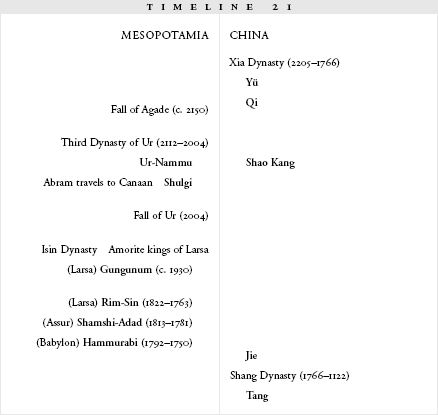
In the Yellow river valley, the Xia Dynasty grows corrupt and falls to the Shang in 1766 BC
MEANWHILE THE KINGS OF CHINA were still perched on the edge of myth.60 According to Sima Qian, the Grand Historian, the Xia Dynasty founded by Yü kept the throne for four hundred years. Between 2205 and 1766, seventeen Xia monarchs ruled. But although archaeologists have discovered the remains of a Xia palace and capital city, we have no direct evidence from these centuries for the existence of any of the personalities that Sima Qian describes, more than fifteen hundred years after the fact.
Taken as oral tradition that reflects, however dimly, a real succession of rulers, the story of the Xia Dynasty and its fall shows that the struggle for rule in China was very different from the clashes on the Mesopotamian plain. In China, there were as yet no barbarians invading civilized people, no struggle between one nation and another. The greatest struggle was between a king’s virtue and his wickedness. The threat to his throne came first from his own nature.
The Three Sage Kings who came just before the Xia Dynasty had chosen as their successors not their sons, but worthy and humble men. Yü, the third of these kings, gained his position by sheer ability. Sima Qian records that he was a vassal, recruited by the Sage King just before him to solve the problem of Yellow river floods so violent that they “surged towards the heavens, so vast that they embraced the mountains and covered the hills.”1 Yü worked for thirteen years, planning ditches and canals, building embankments and dikes, directing the Yellow river floods into irrigation and away from the settlements threatened by waters, and showing himself to be a man “both diligent and indefatigable.”2 At the end of his efforts, “the world was then greatly ordered.”3 Yü did not protect his people from outside forces, but from threats that lay within their own land.
The land that Yü ruled would have overlapped that occupied by the predynastic Chinese culture called the Longshan,61 a people who built walled villages in the valley at the southern bend of the Yellow river. These villages were most likely governed by patriarchs, strong family heads who allied themselves with other village patriarchs through intermarriage and, occasionally, through conquest. The accounts of the early Xia Dynasty speak of the “feudal lords” or “dukes” who support or trouble the Xia kings; these are anachronistic titles for the Longshan patriarchs.4
We don’t know where the capital city of Yü, the king who struggled with the river, might have lain. But at some point between 2200 and 1766, a Xia capital seems to have been built just below the southern bend of the Yellow river; excavations there have uncovered extensive buildings which appear to be royal palaces.62
Erlitou, just below the southern bend of the Yellow river, lies in a valley formed by the Lo river, which flows into the Yellow river from the south. The land around it is unusually good, since it is fertilized by silt deposits, and the ring of mountains surrounding the valley on three sides made Erlitou so easy to defend that the city had no walls.5
Despite the presence of a palace at Erlitou, the chiefs of the walled settlements (or yi) along the Yellow river seem to have kept plenty of independence of their own, directing their own trade with other villages and keeping their own small armies.6 But tradition says that there was at least some sort of kingly power exercised along the valley. Possibly Yü’s struggle with the devastating Yellow river floods preserves an ancient change in the rising of the waters, a more severe flooding; if so, the increased difficulty of surviving in a more hostile environment might well have led the villages to accept the unifying and protecting power of a leader.
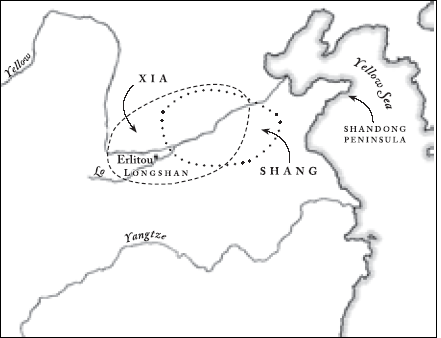
21.1 Xia and Shang
The hereditary assumption of this power began with Yü, who did his best to follow the example of the Sage Kings who preceded him. Like them, he rejected blood inheritance by choosing a worthy man as his successor and bypassing his son. Unfortunately the powerful patriarchs of the villages disagreed with his choice and instead supported Yü’s son Qi; it was their will to have a hereditary dynasty. This rebellious action carried the Yellow river settlements from the days of the Sage Kings into an era of blood succession.
This innovation did not go unchallenged. One village, the village of the Youhu, so objected to this refusal to pass the crown from one family to another that all of the Youhu boycotted Qi’s accession feast. Qi was having no such principled refusals. He sent his army to round up the rebels, defeated what resistance the Youhu could muster, and destroyed the village, claiming to be “carrying out Heaven’s punishment” for their rebellion.7 Force had trumped sagacity.
The first years of the blood succession did not go smoothly. After Qi’s death, his five sons fought over the kingship; there were no conventions to guide the Xia state in the peaceful transfer of the crown from one generation to the next. The son who managed to triumph justified every Youhu fear about the dangers of a hereditary monarch. He immediately applied himself to carousing and womanizing, rather than ruling. At this, a powerful village patriarch mounted an attack on the palace and took the throne away. In turn, he was murdered by a court official, who seized the throne for himself.
In the absence of the sage choice of one king by his predecessor, chaos was reigning. Even a blood succession was better than this; and the blood relative who eventually rounded up enough support to challenge the usurper was Shao Kang, the great-great-nephew of Qi.
Shao Kang had fled the bloodshed in the capital city to hide in another village. Now with his followers behind him, he marched back to Erlitou, defeated the official who sat on the throne, and claimed the right to rule. The Xia Dynasty, barely begun, had already required rescuing.
AFTER THIS ROUGH START, the Xia succession bumped along for centuries. But Chinese historians tell us that the right to rule, based on no quality but that of accidental birth, slowly corrupted those who held it. The Xia kings entered into a cycle which would repeat again and again throughout Chinese history: The first kings of a dynasty earn their right to rule by their wisdom and virtue. They pass their rule to their sons, and as time goes on those sons become lazy. Laziness becomes decadence, decadence becomes dissolution, and dissolution leads to a dynasty’s fall. A new man, wise and powerful, takes the throne, a new dynasty rises, and the pattern repeats. At the end of each cycle, tyrants fall and virtuous men return to the foundational principles; but they cannot hold those principles for long. Good faith deteriorates into mistrust, piety into superstition, refinement into pride and hollow exhibition. “For the way,” Sima Qian writes, “is a cycle; when it ends, it must begin over again.”
Sima Qian, who inherited his father’s position as Prefect of the Grand Scribes in the second century BC, may have had a slightly jaundiced view of the world; after offending his own emperor with an unflattering remark or two about the emperor’s father, he was given the choice between execution and castration. (He chose the latter, so that he could finish his history; a dedication to his work possibly unmatched in historiography.) But his description of the cycle of history was based on long tradition, and on long observation. The ideal of Chinese kingship was rule by wisdom, but as soon as a king could claim power over those villages along the Yellow river, corruption, oppression, and armed conflict inevitably followed.
In the Xia Dynasty, conflict reached a head during the reign of the Xia king Jie, who slowly alienated his courtiers by emptying the palace treasury in order to build palaces for himself. He alienated his people by taking as his mistress a beautiful but unpopular woman, both cruel and evil, and spending his days cavorting and drinking with her rather than ruling. And he alienated the lords of the villages by arresting anyone who might pose a challenge to his rule and either imprisoning or killing them. Jie, Sima Qian sums up, “did not engage in virtuous government but in military power.”8
One of the village patriarchs arbitrarily jailed was a man named Tang, a member of the Shang clan, who held enough power over the lands east of Erlitou to appear threatening. After a little while, though, Jie (perhaps addled by wine and late nights) seems to have forgotten his original objections. He set Tang free. Immediately Tang set about strengthening his position among the leaders of the other cities that were nominally under the Xia rule. As Jie’s unpopularity grew, Tang lived a conspicuously righteous life in contrast; Sima Qian says that he “cultivated his virtue” (and presumably exercised plenty of diplomacy). He even used his own men to march against one of the other feudal lords who was himself tyrannizing the people nearby.
Eventually Tang claimed the divine right to take vengeance against evil, and led his followers against the emperor.9 Jie fled from the capital city, and in 1766 (the traditional date of his accession) Tang became the first Shang emperor.
Jie died in exile. His last words, apparently, were, “I should have killed Tang when I had the chance.”10
The Shang conquest was not the establishment of a brand-new rule, but the extension of an existing power over a weakening palace at Erlitou. For decades, the Shang family had been growing in power to the east of the Xia capital. Just as the prehistoric Longshan culture itself extended overtop of the Yang-shao and the Xia grew up overtop of the Longshan, so the Shang state lay overlapping the Xia land. The takeover of Tang, who was given the title Tang the Completer, was an internal affair. The Xia kingdom struggled with itself; when it fell, it fell to its own people.
The cycle had begun again. Tang’s rule was a model of justice, in which he threatened the feudal lords with punishment if they did not “do good deeds for the people.” Like his great predecessor Yü, he also tackled the flooding problem; Sima Qian says that he “regulated” four troublesome streams, producing new fields and new village sites. The Shang Dynasty began in hard work and in virtue: for the way is a cycle, and it must begin again.