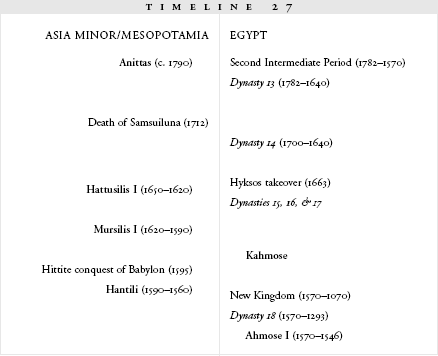
In Egypt, the pharaoh at Thebes defeats the Hyksos between 1570 and 1546 BC
AFTER SEQUENERE OF THEBES fell in battle against the Hyksos, his older son Kahmose took the throne.74 Apepi I, the longest lived of the Hyksos kings, was still on the throne, and Kahmose needed to avenge his father’s death.
His plans had to take account of an unpleasant reality: his Theban kingdom was sandwiched between a hostile power to the north, and that power’s ally in the south. During the chaos just before the Hyksos takeover, the Egyptian governors of Nubia had gone their own way. Native Nubians had risen to official positions, and for years Nubia had been behaving like an independent country. Rather than attempting to subdue them, the Hyksos kings of the Fifteenth Dynasty had made a treaty with them. The Nubians agreed to come to the aid of the north against Theban Egypt, which would then have to fight a two-front war.
Kahmose of Thebes knew this. When he began to move his soldiers north along the Nile, he also spread out spies all across the south, hoping to intercept any Hyksos attempt to call their Nubian allies to arms. According to Kahmose himself, this strategy was brilliantly successful. In an inscription dedicated to Amun the sun-god, a deity much favored by the Hyksos, Kahmose claims that he conquered his way all the way to Avaris, where the Hyksos, frightened of his approach, “peeped out of the loopholes on their walls, like baby lizards.” Meanwhile, his men managed to intercept the Hyksos messenger on his way down to Nubia. The letter he carried is preserved in Kahmose’s records: “Kahmose has chosen to ruin both our lands, yours and mine,” the Hyksos king told his Nubian counterpart. “Come north, then, and don’t be afraid. He is already right here in my own area…. I will harass him until you arrive, and then you and I will divide up the towns of Egypt.”1
The capture of this letter was cause for much boasting on the Egyptian side: “I caused the letter to be taken back to Apepi,” Kahmose bragged, “so that my victory should invade his heart and paralyze his limbs.”2 He then marched back to Thebes, claiming victory the entire way and timing his arrival to coincide with the flooding of the Nile.
This fairly transparent attempt to remind everyone that he was the rightful king of all Egypt, responsible for the rising of the waters, suggests that Kahmose’s victory wasn’t quite as shattering as he claims. If he did indeed terrify the Hyksos with his might, it is difficult to see why he didn’t go on and reclaim the north. At the very least, he could have attempted to occupy Memphis, the secondary Hyksos power center, from which the Hyksos appear to have kept an eye on the southern part of their realm; Avaris was too far north to be an effective center for the administration of the whole country.
He did neither, which suggests that his attack on Avaris was nothing more than a successful raid. Kahmose had little time to follow up on it. He died in that same year, after a reign of only three years; possibly he was wounded during the campaign, and lingered for a while before succumbing to his injuries. Since he died without sons, his brother Ahmose took the throne.
He was still very young, and his mother Ahhotep ruled as his regent.
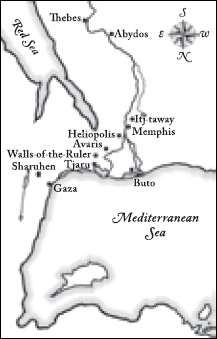
27.1 Ahmose Against the Hyksos
Around the same time, the long-lived Apepi I finally died in Avaris. The Hyksos throne was inherited by another king of much less personality; no contemporary records say much about him, and the scribes even disagree on his name. Apparently Queen Ahhotep took advantage of this northern weakness to follow up on her son’s raid with a campaign of her own. In inscriptions, she is called “the one who has looked after her soldiers…has pacified Upper Egypt, and expelled her rebels.”3 She was buried with a ceremonial axe in her coffin, along with three medals, the Egyptian equivalent of medals of valor.
With this head start, Ahmose, when he inherited the throne, managed to battle his way successfully all the way to Avaris. By the twentieth year of his reign, he had captured both Heliopolis (just south of Avaris) and the eastern border fortress Tjaru. With these southern and eastern strongholds under his control, he was ready to pinch Avaris between the two wings of his army.
Manetho, quoted in the pages of Josephus, describes the next phase of the war:
[The Hyksos] built a wall round all [Avaris], which was a large and strong wall, in order to keep all their possessions and their prey within a place of strength. But [Ahmose] made an attempt to take them by force and by a siege, with four hundred and eighty thousand men to lie round about them. When he despaired of taking the place by that siege, they came to an agreement. They would leave Egypt, and go, without any harm done them, wherever they would. After this agreement, they went away with their whole families and effects, not fewer in number than two hundred and forty-thousand, and took their journey from Egypt, through the wilderness.4
We should take this account with a grain of salt, since Egyptian accounts describe much more bloodshed. The tomb inscriptions of Ahmose’s general (who is, confusingly, also named Ahmose) describe at least three different savage battles at Avaris: “I fought there, and I brought away a hand,” he says proudly. (Egyptian scribes used amputated hands to tot up enemy casualties.) “This was reported to the royal herald, and I was given a medal of valor.”5 Egyptian relief sculptures commemorating the event show warships, battles, and herds of Hyksos led captive. Ruins show that Avaris was sacked. The Hyksos palace was flattened, and a new building, commissioned by pharaoh Ahmose, was built overtop of it.6 Other traces of Hyksos occupation were so thoroughly obliterated that it is exceedingly difficult to reconstruct the details of their reign over Lower Egypt at all.
Nevertheless, the city’s ruins show no evidence that a general slaughter, often the final phase of a long siege, ever took place at Avaris. Nor are there very many Semitic names in servant lists for the next fifty years, so it is unlikely that many Hyksos were enslaved. So it is indeed possible that a mass exodus, particularly of noncombatants, marked the end of Hyksos domination in Egypt.
We do know that, after the surrender of Avaris, the pharaoh Ahmose kept on marching north into Canaan, finally halting at Sharuhen near Gaza. Here, General Ahmose helped lead another successful siege. This may well have been a follow-up to the expulsion of the Hyksos from Avaris; if they fled just far enough to hole themselves up in another fortress, Ahmose would not have wanted them to regather their strength anywhere near Egypt.7 Sharuhen was a danger to Egypt in any case. Excavations on its site show that it had become the center of a Western Semitic kingdom, the strongest military headquarters in the south of Canaan.8 Conquering Sharuhen did more than simply make Egypt a little safer from reinvasion; it turned the south of Canaan into an Egyptian province.
According to General Ahmose’s tomb inscriptions, the siege of Sharuhen took six years.9 If this is true, pharaoh Ahmose probably left his general in charge and headed back home to take care of matters in Memphis, because he died not too long after the capture of Avaris.
It had taken Ahmose twenty years to take back Lower Egypt, and both Manetho and Josephus give him a rule of twenty-five years. He did not enjoy his position as king of all Egypt for long. But for his reunification of Egypt, and his reassertion of native Egyptian rule over the kingdom, Manetho names him the first king of the Eighteenth Dynasty. With this reunification, Egypt enters into a new phase of building, of peace and prosperity, of art and literature: the New Kingdom.