In Egypt, between 1546 and 1446 BC, Tuthmosis III loses the throne to his aunt Hatshepsut but regains it and conquers the Western Semitic lands
AFTER AHMOSE’S DEATH, his son Amenhotep I took up the reins of power, trampled on the Nubians until they were firmly back within the Egyptian fold, and consolidated his father’s victories. But the family line ended there. Amenhotep remained not only childless, but also unmarried for most of his life. His first wife (and full sister) died young, and Amenhotep did not take another.1
In an age where pharaohs boasted multiple wives and dozens of concubines, this suggests that Amenhotep’s taste didn’t run to women. Even so, it is unusual that he didn’t marry again. Most ancient rulers who preferred the company of their own sex still managed to produce the heir required for dynastic stability; Amenhotep I remained alone, deeply solitary, and appointed his trusted general to be the next king.
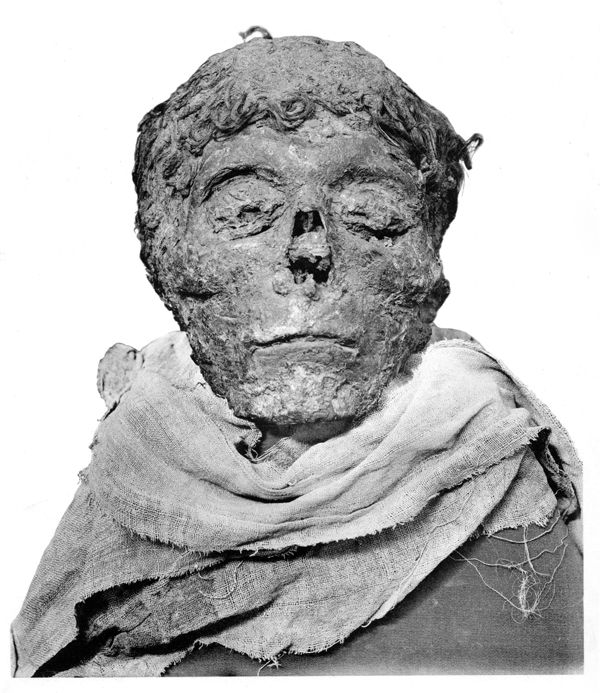
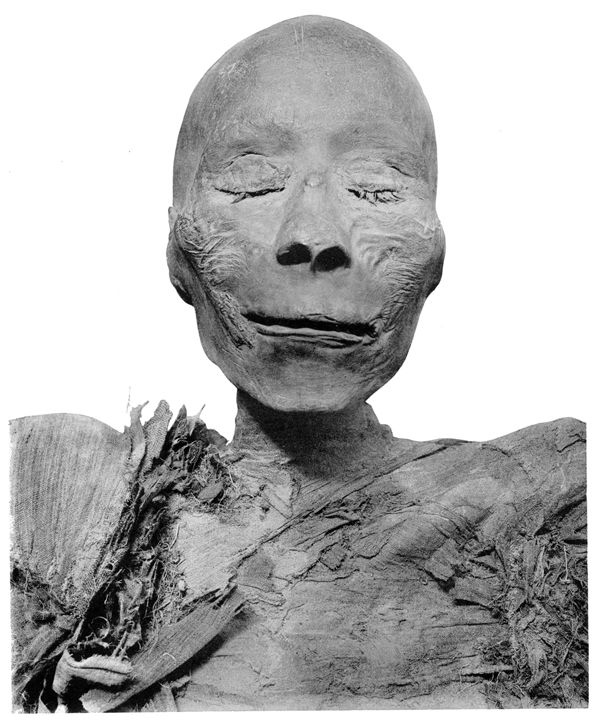
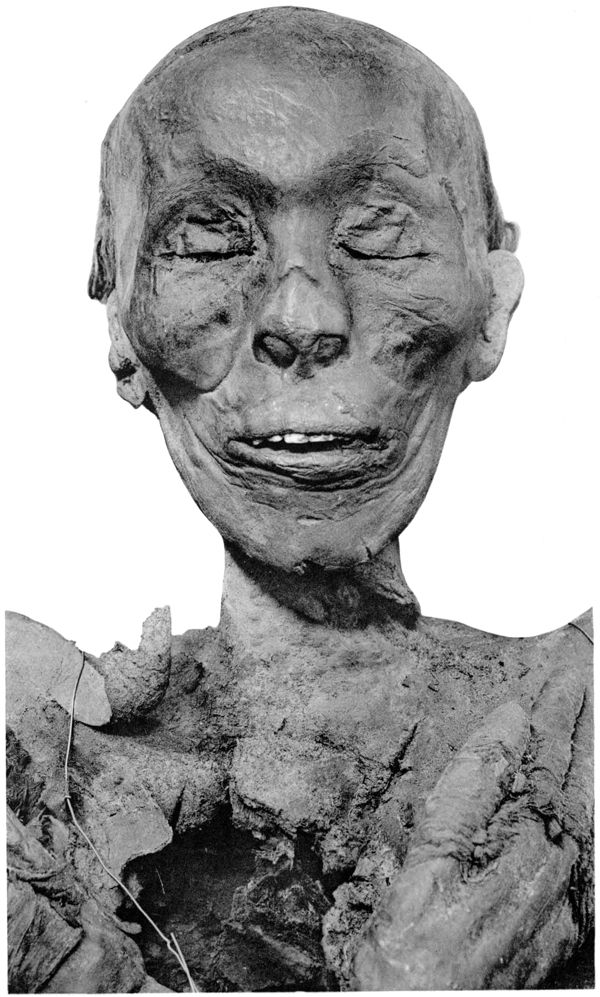
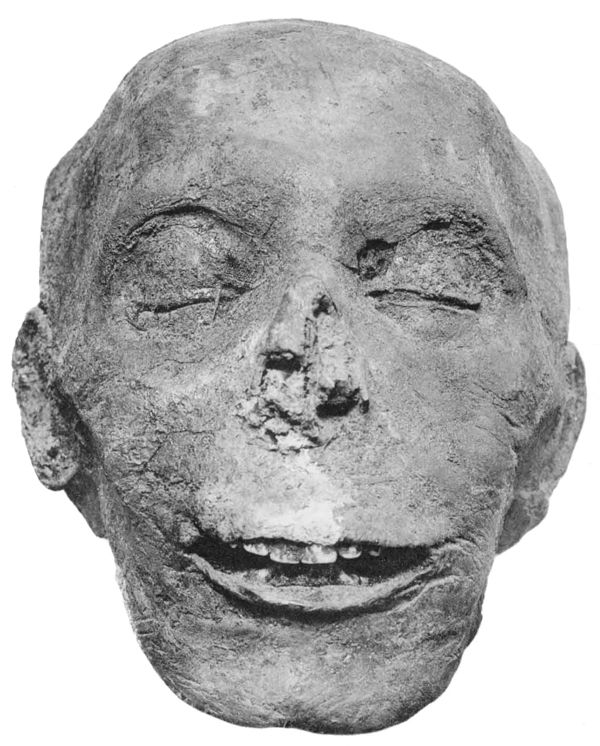
This general, Tuthmosis, was also his brother-in-law. Technically, this made him a member of the royal family; still, his coronation was a major break in the normal father-to-son succession. The mummies of Ahmose, Tuthmosis I, and two of Tuthmosis I’s descendants—his son Tuthmosis II and great-grandson Tuthmosis IV—have been so well preserved that their features can be clearly seen. The family resemblance in the Tuthmosis line is startling, and markedly different from the face of Ahmose I.75
|
|
|
|
|
|
28.1. Kings of Egypt. Ahmose I (top left) does not share the family resemblance of Tuthmosis I, II, and III. Photo credit G. Elliot Smith, Catalogue Général des Antiquités Egyptiennes du Musée du Caire, Cairo
Tuthmosis I, elderly when he became king, reigned for only six years. Very early in his rule, he began to plan his tomb. For some time, the pyramids, which were supposed to inspire awe, had been less than sacred to rank-and-file Egyptians. Tomb robbers had managed to break into almost every pyramid in Egypt; they were, after all, enormous treasure markers that pointed down to burial chambers stuffed with gold. To avoid losing his grave goods, Tuthmosis I planned a new, secret burial place: a cave with painted walls, just as ornate as the inside of any pyramid, but with a hidden entrance. The valley where his cave was located later became known as the Valley of the Kings.76
Unlike his predecessor, Tuthmosis I married at least twice. His most royal wife was Amenhotep’s sister, the daughter of the great Ahmose, and mother of two sons and two daughters. But he had also married a lesser wife, who bore him a son.
When he became pharaoh, Tuthmosis appointed first his elder son, and then his second son, as heir. Both died before him. He had no intention of passing the crown to a trusted friend, and his only living male heir was his son by the lesser wife. So in order to strengthen this son’s dynastic position, Tuthmosis not only appointed him heir, but married him to one of the daughters of his primary wife: the princess Hatshepsut. When Tuthmosis died, after a reign of only six years, his son became Tuthmosis II; Hatshepsut became queen.
Tuthmosis II had suffered from bad health all his life, and his physical weakness was complicated by his wife’s readiness to take over any (or all) of his duties. Hatshepsut is mentioned alongside Tuthmosis II as co-ruler from the very beginning of his reign. Apparently this did nothing for their marriage; Hatshepsut had only one child by her half-brother, a daughter. After this valiant gesture, during which he apparently closed his eyes and thought of Egypt, Tuthmosis II had no more children by Hatshepsut. He preferred the company of a woman named Iset, whom he never married. When Iset gave birth to a son, Tuthmosis II immediately named the illegitimate baby his heir, which was a slap in the face for his wife.
When Tuthmosis II died before the age of thirty-five, his only son—now Tuthmosis III—was still a child. At once Hatshepsut claimed her right, as the baby’s aunt and stepmother, to rule as his regent.
For three or four years at the beginning of the regency, she appears in carvings standing behind the young Tuthmosis III in a properly supporting role. But sometime around 1500, Hatshepsut began to build a huge temple: a mortuary temple, a place of worship which had once stood at the foot of a walkway from a pyramid, and now often served as the primary burial monument itself. This temple was theoretically built in honor of the sun-god Amun. On the east, it faced directly across the Nile at Amun’s other, larger temple, the temple at Karnak.2 Across one wall, Hatshepsut ordered a relief carved: Amun, properly impressive, paying a visit to Hatshepsut’s mother. The implication was that Hatshepsut had been conceived by the god himself.
Playing both sides of the paternity card, she also commissioned an engraving announcing that Tuthmosis I, her earthly father, had ordered her crowned true ruler of Egypt before his death. This coronation had taken place in front of the entire court on New Year’s Day, and showed that Hatshepsut had the right to claim a Horus-name and rule as King of Upper and Lower Egypt.
Since this story was a complete fabrication, someone from the court might have been expected to protest. But no protest is recorded, which suggests that Hatshepsut had managed to convince powerful court officials that she would be a better ruler than Tuthmosis III, now rapidly approaching the age of accession. Certainly she had the strong support of one of the most powerful men in Egypt, the Chief Steward of Amun: Senenmut. She awarded him, over the course of several years, a dizzying array of titles. He became Chief Architect, Steward of the Royal Ship, Overseer of Amun’s Graineries, Overseer of Amun’s Fields, and also Overseer of Amun’s Cows, Amun’s Gardens, and Amun’s Weavers.
This made him powerful, but not popular. Senenmut, it was whispered, was much more to Hatshepsut than an advisor. A scrawled graffiti found on the wall of a cave near Hatshepsut’s mortuary temple shows a very small Senenmut with a very erect member sneaking cautiously up behind a very large and very masculine Hatshepsut: a rude commentary on the powerful female pharaoh and the ambitious steward.3
Hatshepsut never actually deposed the young Tuthmosis III. She simply portrayed herself as the senior of the two rulers. More than one of her statutes show her with the royal headdress and even the formal square beard of a crowned pharaoh. In the mortuary temple, she also had her figure carved celebrating a heb-sed festival, the ritual renewal of power. Tuthmosis III is in these reliefs as well, celebrating alongside the queen. But only Hatshepsut is pictured actually performing the running ritual central to the heb-sed renewal, the ritual that recognizes the pharaoh’s ability to make the waters return.4
Tuthmosis III’s own inscriptions tell us where he spent most of Hatshepsut’s reign: well away from Memphis, sent by his aunt to fight in one campaign or another, mostly in the new northern province of Egypt, where the Western Semitic subjects were always threatening to revolt.
She probably hoped that he would fall in battle. That he didn’t succumb either to injury or to assassination says much for his wariness, and also suggests that the army may have been less enthralled with Hatshepsut than Senenmut and the folks back at home. Certainly Hatshepsut put almost all of her energy into domestic projects, particularly buildings; in the ancient world, the number of buildings a king put up was considered a direct index of his success, and Hatshepsut wanted no question as to her greatness. The army, meanwhile, had no great triumphs—for almost twenty years.5
Twenty-one years after her husband’s death, with her co-ruler and stepson now well into his twenties and hardened by years of fighting in exile, Hatshepsut died. Her steward and factotum Senenmut also died, just afterwards.
There is no direct evidence that Tuthmosis III was involved. But just after the deaths, Tuthmosis III returned from the front and began a savage wiping away of his stepmother’s name. Her titles were scraped off every monument he could find. The reliefs showing her divine appointment were smashed. He had her statutes thrown into a nearby quarry. Hatshepsut had ordered sunward-pointing obelisks built, in honor of Amun; Tuthmosis III did not smash these, perhaps fearing the god’s wrath, but he had walls built around them so that they could not be seen.6 He also ordered Senenmut’s tomb destroyed. He was thirty years old, and it was long past time for him to get to work.
Technically, Tuthmosis III had been king of Egypt for twenty-two years by the time he actually gained the throne. All of those years of impotence had stored up a great deal of ambition. His campaigns, over the next years, were Napoleonic in their intensity.77 He became the anti-Hatshepsut, carrying out his greatest endeavors in the area that she had neglected.
Tuthmosis III appointed a scribe to travel with the army and record his campaigns. This account is long gone, but the parts of it that were copied into other documents show us the pharaoh’s first moves. In the same year that Hatshepsut died, Tuthmosis III made a pass through Canaan. The king of Kadesh, more than halfway along the coast, organized a group of allies to march against the invader. Tuthmosis met them at the city of Megiddo, which stood at a pass through the mountains that ran crossways, cutting off Egypt from Mesopotamia.78
The battle was a rout. Before long, the allies led by the king of Kadesh were retreating back into the city so quickly that soldiers were hauling each other over the walls by their clothing. The Egyptians stopped to plunder the tents outside, which allowed the defenders to swing the gates of Megiddo closed.
Unlike the Assyrians, the Egyptians did not have much experience in attacking city walls; no siege towers or ladders.7 They had to starve the enemy out. Seven miserable months later, the king of Kadesh surrendered, followed by his allies. The Egyptian army returned home in triumph with treasure, armor, chariots, livestock, prisoners, and grain: the first booty of the restored army, post-Hatshepsut. The men who had refused to assassinate Tuthmosis III were now rewarded for their pains.
This campaign appears to have frightened the countryside. Semitic warlords from nearby cities began sending gifts to Tuthmosis III, doing their best to make peace with the angry young man in the south. Those cities that resisted were attacked, and sacked, in Egyptian campaigns that stretched over the next few years. Joppa, on the coast, tried to make a deal instead of surrendering unconditionally; according to a later story, the king of Joppa agreed to visit the Egyptian commander in order to discuss peace terms, was served a banquet, and then was knocked unconscious and stuffed into a back room. The Egyptian commander went out and told the king’s charioteer that the Egyptians had decided to surrender to Joppa, and that the charioteer should return quickly and tell Joppa’s queen that her husband was on his way with prisoners. A procession of captive Egyptians soon appeared on the horizon, carrying baskets of plunder from the Egyptian camp. But each basket contained an armed warrior; when the queen of Joppa threw the gates open, the warriors burst out of their baskets and forced the city to surrender.8
The city of Ardata was conquered and plundered in a more traditional way. The walls were stormed and the gates broken down, upon which the Egyptian troops discovered to their great joy that the cellars were all full of wine. They got drunk every day, until Tuthmosis III had had enough of rejoicing. He ordered them to burn the fields and fruit trees, and dragged his soldiers off to the next target.9
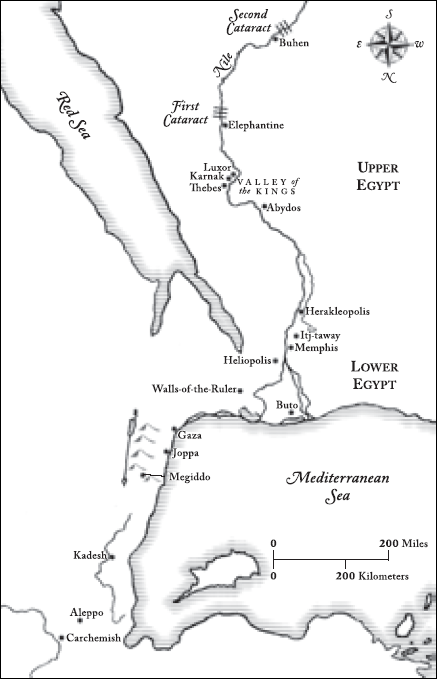
28.1 Egypt’s Greatest Northern Extent
Tuthmosis III spent almost two decades campaigning into the northern reaches. He worked his way to Kadesh itself and forced its surrender; he claimed Aleppo; he even seized Carchemish, which brought him to the edge of Asia Minor. By the last years of his reign, Tuthmosis III had succeeded in redeeming the years of his exile. His Egypt stretched almost to the Euphrates, a northern border never matched again.