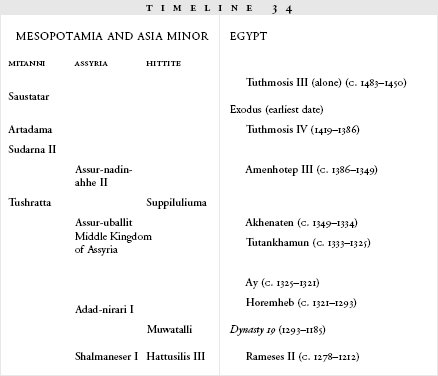
Between 1321 and 1212 BC, the Nineteenth Dynasty of Egypt begins, Rameses II fights the Hittites to a draw at Kadesh, and the Assyrians begin a century of conquest
HOREMHEB MANAGED to hang onto Egypt’s throne for twenty-eight years. He finished restoring the Temple of Amun, a job Tutankhamun had started; he ordered the rest of the temple to Aten levelled; and he restored the priesthood of Amun by simply choosing his old army comrades to be priests. Since he was the highest ranking Egyptian officer around, he could be fairly certain that army discipline would trump any tendency for the priest-officers to usurp power.1 And then he died, well into his eighties, having outlived five sitting pharaohs.
He had no son, and so appointed another soldier to be his heir. This soldier, Rameses I, was the first pharaoh ever with absolutely no blood connection (real or imagined) to any previous royal line. He was not much younger than Horemheb and he died after a year on the throne, having done nothing of interest.
But from this undistinguished beginning, the great Nineteenth Dynasty of Egypt had its beginnings.90 Rameses I passed the throne on to his son Seti (remembered mostly for building temples in every available spot); Seti in turn left the crown to his son, Rameses II. Rameses II earned fame for the length of his reign, the number of his building projects, the legendary strength of his army, and for accidentally surviving the biggest battle in the world.
AFTER THE MURDER of Suppiluliuma’s son and the great Hittite king’s death from plague, the Hittite-Egyptian concord had pretty much shattered. Along the border between the two countries, armed clashes were common. By the time Rameses II came to the Egyptian throne, the Hittite crown had gone to Suppiluliuma’s grandson Muwatalli, and Egypt had lost its northernmost holdings; the city of Kadesh, held by Egypt for over a century, had passed into Hittite hands.
At twenty-five, the new pharaoh had already been living an adult life for at least ten years. He had married for the first time at fifteen or so, and had already fathered at least seven children. He had already fought in at least two of his father’s campaigns up into the Western Semitic lands.2 He did not wait long before picking up the fight against the Hittite enemy. In 1275, only three years or so after taking the throne, he began to plan a campaign to get Kadesh back. The city had become more than a battle front; it was a symbolic football kicked back and forth between empires. Kadesh was too far north for easy control by the Egyptians, too far south for easy administration by the Hittites. Whichever empire claimed it could boast of superior strength.
Late in 1275, Rameses II heard from his spies that Muwatalli was nowhere near Kadesh. These were perfect conditions for an attack, and so Rameses II collected an unheard of number of soldiers (according to his own count, twenty thousand divided into four companies, named Amun, Ra, Ptah, and Set) and began his march north. It took at least two months to get anywhere near Kadesh, but Rameses II was reassured when guards at a Hittite outpost, captured and questioned, told him that the Hittite army was still far up in Hittite territory, unlikely to get near Kadesh any time soon. He drew his divisions into battle order, in order of importance of the gods (Amun first, Ra following, Ptah behind, and Set to the rear) and began his approach to the city.
But the outpost had been a plant. Muwatalli was actually just behind Kadesh with forty-eight thousand soldiers, both Hittites and hired mercenaries collected for the occasion. Almost three thousand were mounted in chariots, each containing a driver, an archer, and a shieldman to protect the archer as he shot.3 While Rameses had his back turned, pitching camp just west of Kadesh with his first division of soldiers, Muwatalli’s army poured out from behind Kadesh like a sweeping thunderstorm. The Hittite forces swung around behind Amun and flattened the second division, Ra, cutting off Rameses II and his five thousand men of Amun from the remaining two divisions behind.4 Nearly seventy thousand men clashed outside the walls of Kadesh.
It should have been relatively easy to wipe out both Amun and the king, but the Hittites found themselves with a problem. The Amun division had camped in a fairly small plain, and when the chariots thundered into it, they scraped against each other and piled up in heaps.5 The Hittite foot soldiers still outnumbered the Egyptians, but Rameses II had put a backup into place: he had sent reinforcements up the coast, probably by sea, in case the main body of the army ran into trouble on land.6 The reinforcements reached the battlefield from the north just as Ptah arrived to attack from the south, and the two-front battle seems to have confused the Hittites; their army, swelled with mercenaries, was less disciplined than the smaller, tightly organized Egyptian force. Muwatalli did have men in reserve, but he held them back (possibly suspecting that even more Egyptian reinforcements were on the way). When dusk began to fall over the battlefield, the Hittites drew back to regather themselves.
At dawn, the battle began again. But the element of surprise was now missing, and the experience of the Egyptian soldiers paid off. The fight was a stalemate, and Muwatalli suggested a truce.
Rameses II declined to agree to an ongoing peace, but eventually he did agree to go home with his prisoners and booty, leaving Kadesh in Hittite hands. He then marched back to Egypt and proclaimed victory.
If this doesn’t sound like an overwhelming triumph, it mutated into one later on, when Rameses II had flattering accounts of the battle carved at least nine times onto the walls of Egyptian temples, with plenty of graphic illustrations of Egyptians slaughtering Hittites. Accounts of the battle became school exercises for children to practice their penmanship on, like Caesar’s victories in Gaul centuries later.7 The Battle of Kadesh, even though it was more or less a draw, became an emblem of Egyptian superiority.
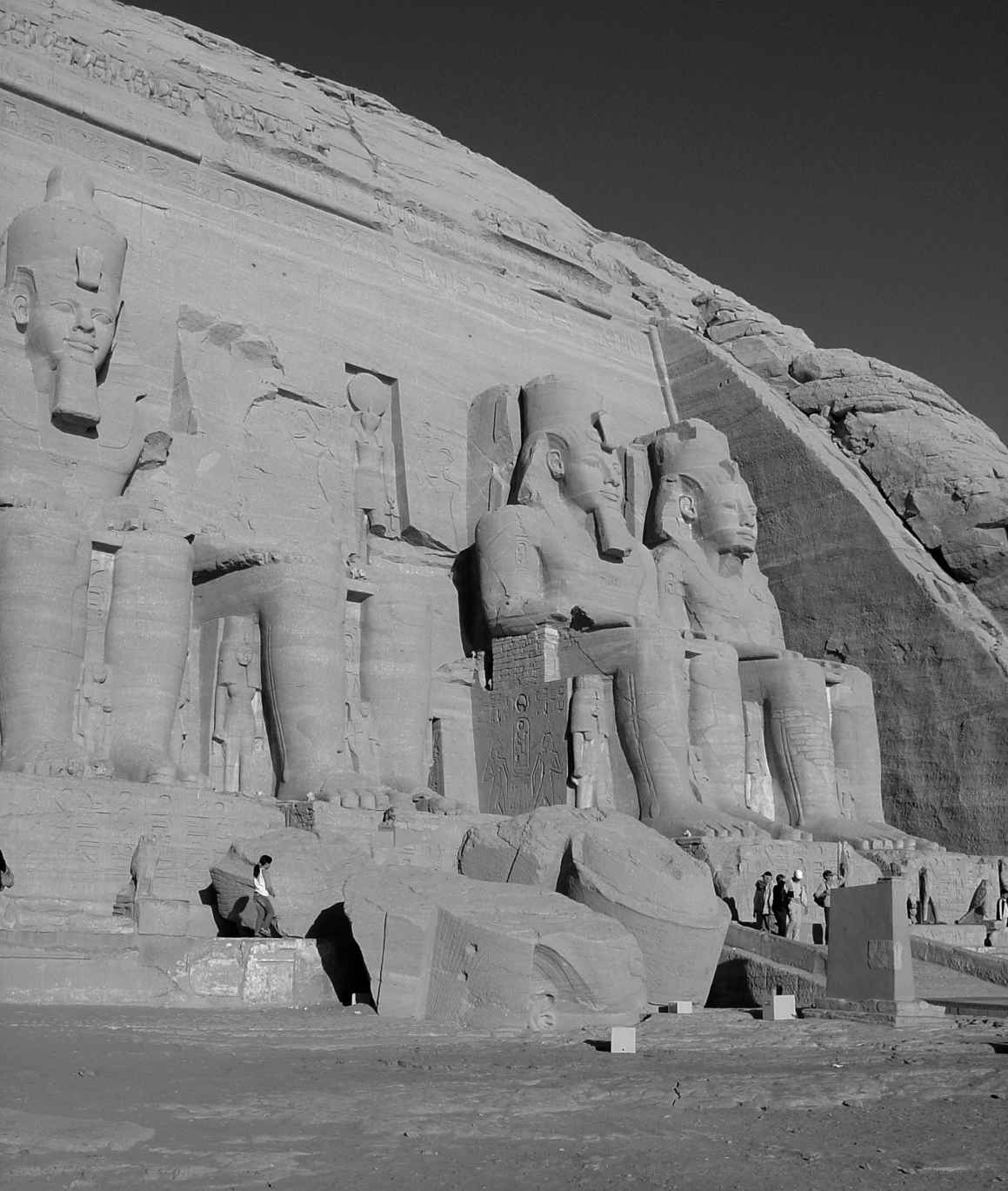
34.1. Statue of Rameses II. Rameses II built colossal figures of himself at Abu Simbel. Photo credit Galen R. Frysinger
Which shows how far Egypt had come from its previous greatness. Egypt was still mighty, but it had become an empire that depended on reputation as much as actual strength to keep its position as a world leader. Had Egypt’s army truly been as powerful as it appears in the reliefs of Rameses II, he would not have turned and marched home again, leaving Kadesh in the hands of the Hittites. Instead, Rameses devoted himself to the symbols of dominance; he built, within the safe territories of his own land, more temples, statues, and monuments than any pharaoh before him. So it happens that Rameses II gained a reputation as one of the greatest pharaohs in Egyptian history, when in fact he had lost part of the northern holdings gained by Tuthmosis III, two hundred years before.
THAT OTHER GREAT EMPIRE to the north had its own difficulties. By this point the Hittites seem to have made a treaty with the kings of Babylon, far to the south; at least we can assume so, since Muwatalli sent down to Babylon for a doctor to come and help him with some personal medical problem. A letter has survived, written by Muwatalli’s brother after the king’s death, answering a Babylonian inquiry after the doctor, who had been expected to return to the Babylonian court. (“He married a relative of mine and decided to settle here,” the letter says, more or less, “so quit accusing me of keeping him in jail; what good would an imprisoned doctor do me?”)8
Relations between the Hittites and the Assyrians were less friendly. The new king of Assur, Adad-nirari, was steadily fighting his way north through the territory fractured by the Mitanni flight, claiming it as his own. He also mounted at least one border war with Babylon, to the south, during which Assyria was able to claim a good bit of Babylon’s northern territory. The conquests were impressive enough for Adad-nirari to call himself, in what was becoming a time-honored Assyrian tradition, the King of the World: “Adad-nirari, illustrious prince,” one inscription begins, “honored of the gods, lord, viceroy of the land of the gods, city-founder, destroyer of the mighty hosts of Kassites…who destroys all foes north and south, who tramples down their lands…who captures all people, enlarges boundary and frontier; the king to whose feet Assur…has brought in submission all kings and princes.”9
In the middle of planning a strategy against this growing Assyrian threat to his east, the Hittite king Muwatalli died after a long reign. He left his throne to his son, who promptly stripped the next most powerful man at court—Muwatalli’s brother (and his own uncle)—of his court positions and attempted to exile him. The brother, Hattusilis, declined to be exiled. He rounded up his followers, put the king under guard, and pronounced himself King Hattusilis III.
The longest surviving document from Hattusilis III’s time is a heartfelt argument known as “The Apology,” in which he explains, with more or less circular logic, that (1) the gods had given him the right to rule, and (2) his successful seizing of the throne proved that the gods had given him the right to rule.10 This was not entirely convincing to the Hittites; fragmentary records from Hattusas show that the king spent most of his reign struggling to win a civil war.
Fairly early on, Hattusilis III realized that he could not keep on fighting his own people, the Egyptians to the south, and the increasingly threatening Assyrians to the southeast. The Assyrian Adad-nirari had been succeeded by Shalmaneser I, who was even more aggressive than his predecessor, and who was in the process of taking over the rest of the previously Mitanni territory. Hittite soldiers had joined Aramaean forces in one battle against Shalmaneser I already, and had been pushed backwards: “I killed countless numbers of [the] defeated and widespreading hosts,” Shalmaneser I boasted. “I cut down their hordes, 14,400 of them I overthrew and took as living captives” this meant that he captured and blinded them, a gratuitous bit of cruelty which became standard practice in Assyrian warfare. Shalmaneser also claimed to have captured 180 cities, turning them into ruins: “The army of Hittites and Aramaeans, the allies, I slaughtered like sheep.”11
Assyria on the east would make no peace, so Hattusilis turned to secure his southern border; he decided to negotiate a truce with Egypt.
This was slightly tricky for Egypt’s Rameses II, since the rightful heir to the throne, Muwatalli’s son, had escaped from his uncle’s prison and shown up at the Egyptian court, asking for asylum.12 (He had also written to the Assyrian king Shalmaneser on the same errand, but Shalmaneser was not in the business of providing refuge, and had refused.)
Faced with the perfect opportunity to take over the Hittite empire, Rameses II declined. He sent Muwatalli’s son packing, agreed to a peace with the usurping uncle, and even sealed the terms by marrying two of Hattusilis III’s daughters. The peace was inevitable; Rameses II was no longer in control of most of the Western Semitic territories that had once belonged to Egypt. The petty kings scattered along the Mediterranean coast had not been privileged to see Rameses’s reliefs explaining that the Battle of Kadesh had been a great Egyptian victory. They had simply seen the Egyptians retreating, beaten, and since then had been in constant revolt. There was no way that the Egyptian army could get up to the Hittite land without fighting for every step of the way.
Egypt had been forced into alliance with its enemy. But Rameses II was still working on the spin. He had the treaty, which promised that Egypt would not attack the Hittites, carved into the temple walls at Karnak, with an introductory note explaining that the Hittites had come to him begging for peace. And he refused to send a daughter north to marry a Hittite prince, even though he had plenty to spare; by this time Rameses II, a man who liked women, had well over a hundred children, who trail behind him in temple reliefs as though he were the Pied Piper. Egyptian princesses did not go to foreign lands.
The Hittite version of the treaty, uncovered at Hattusas, remarks that the Egyptians were the first to ask for peace.13
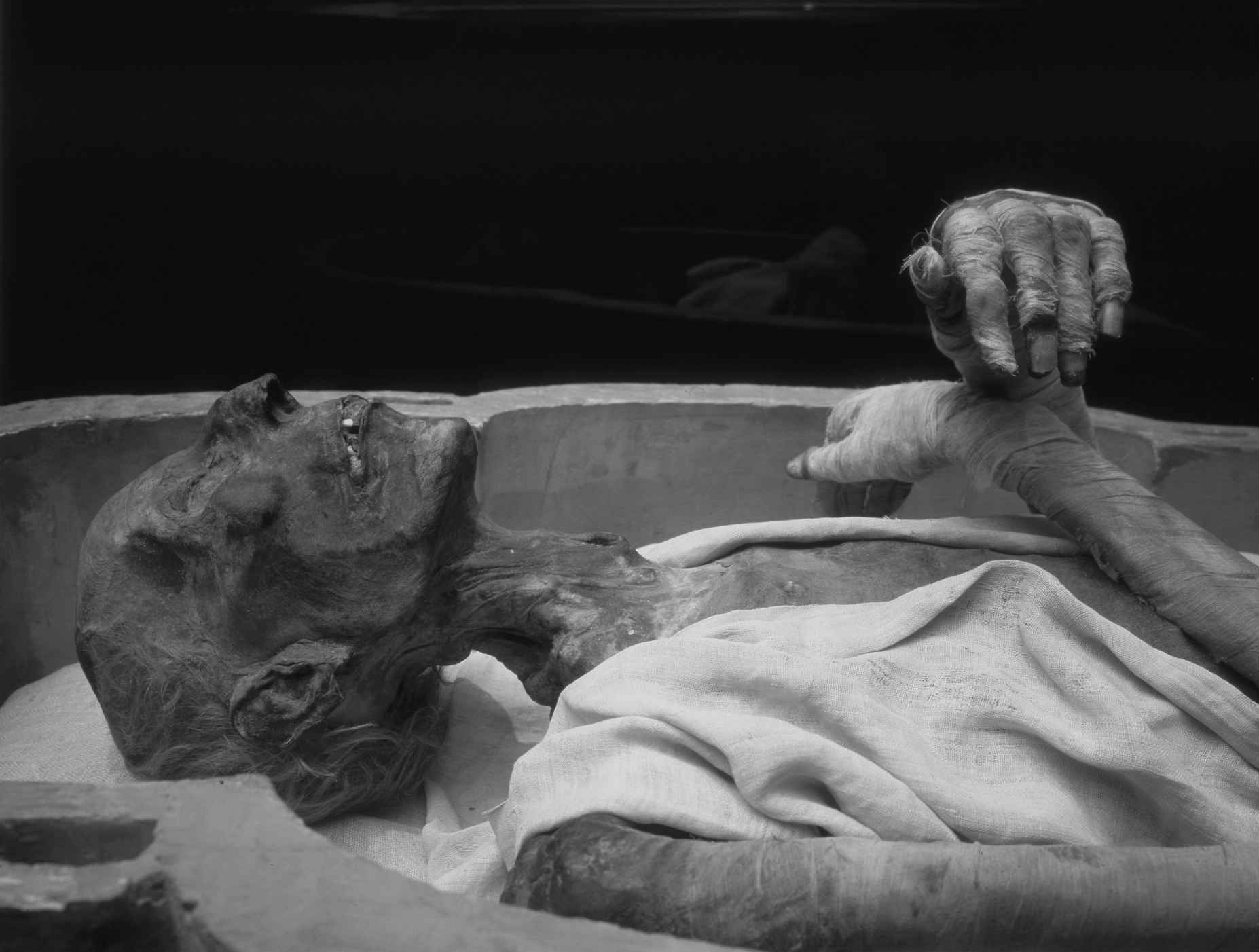
34.2. Mummy of Rameses II. The mummy of Rameses II retains his beaked nose, thanks to its peppercorn stuffing. Egyptian Museum, Cairo. Photo credit Scala/Art Resource, NY
WHEN HE DIED, well into his nineties, Rameses II could claim the second longest reign in Egyptian history. He had left his tracks all across Egypt; his temples to Amun and the rest of the pantheon, his monuments and his statues, his cities and his inscriptions were everywhere. His embalmers had the forethought to stuff his distinctively large nose with peppercorns, so that the tight bandaging of his body didn’t flatten it across his face. And so his personality stands out not only from the countryside of Egypt, but from his mummy as well.14