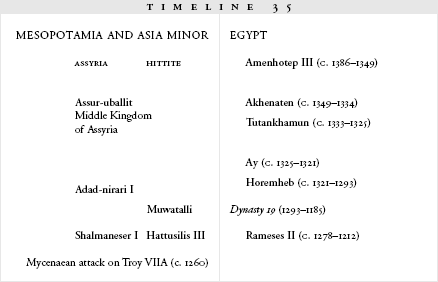
Mycenaeans attack the city of Troy between 1260 and 1230 BC and suffer greatly from their victory
ALL THE WAY OVER on the northwest coast of Asia Minor, the city of Troy stood in a corner of the peninsula that had never been reached by the Hittite kingdom, not even at its greatest.
In the years that Babylon and Assyria, Washukkanni and Hattusas had battled over the right to control the land from the head of the Gulf over to the Mediterranean coast and up almost to the Black Sea, scores of mountain tribes, desert chieftains, and ancient cities had remained independent, outside the control of the grasping kingdoms. Troy was one of those cities. It had been settled almost two thousand years before, and its king had built walls around his tiny village to protect his people from the grasp of the greedy on the outside. Over centuries, the city burned and was rebuilt, grew shabby and was renovated, shrank and then grew again, over and over, producing layer on layer of occupation.
In the days that Rameses II and Hattusilis III negotiated their treaty, Troy—not so far to the west of the thriving Hittite kingdom—was on its seventh incarnation (called by archaeologists “Troy VIIa”).91 It was a wealthy city, without much need of imported food or goods; Troy stood on a plain with plenty of fertile farmland. There were fish in the nearby waters, and sheep in the meadows, and Troy was famous for the herds of horses which ate its surplus grain.1
Sometime between 1260 and 1230 BC, Troy was ravaged by fire and war. Its walls were broken down, and a slaughter took place; human bones lay unburied in the streets.
THE STORY OF the war’s beginning was set down, five hundred years later, in the Iliad.
Peeled away from the skeleton of divine hostilities, the meat of the tale is straightforward enough. Menelaus, king of the Greek city of Sparta, married a princess from Argos, a city which lay north of his own. This princess, Helen, attracted the roving eye of Paris, son of the king of Troy, a brave enough warrior but a relentless womanizer. (This, incidentally, did not boost his reputation for masculinity among his own countrymen, one way in which the Trojans differed from our own time: “Paris, you pretty boy,” his own brother shouts at him, “you woman-struck seducer!”)2 Paris seduced Helen and then carried her off to Troy. Helen’s husband Menelaus, determined to have his revenge, recruited his brother Agamemnon to help him attack Troy.
Agamemnon was the high king of the Greeks (Homer’s name for his own people is the Achaeans), and so called all of the Greek cities to join their forces together and sail in a united fleet towards Troy, to avenge the insult to his brother (the insult to Helen is not so much in view here). They arrived on the shores of Asia Minor but found themselves stymied by the valor of the Trojan soldiers and the height of Troy’s walls. There they sat, besieging the city for ten long years.
The siege is the setting for the central drama of the Iliad, which is the behavior of the great warrior Achilles, who hailed from Thessaly (a mountainous region on the northern Greek peninsula). At the end of the Iliad, we have learned quite a lot about Achilles, but the Greek army is still sitting outside the walls of Troy, and the king of Troy, Priam, is still on his throne. The war itself takes place offstage. By the beginning of the companion epic, the Odyssey, the siege has ended, Troy has been sacked, and the Greeks are on their long way home.
The tale of Troy’s actual fall to the besieging Greek forces is told in pieces by various Greek poets, but appears in its most complete form much later, in the second book of the Aeneid by the Roman poet Virgil:
Broken in war and foiled by fate,
With so many years already slipping away, the Greek staff
Constructed a horse….
It was high as a hill, and its ribs were made from planks of pinewood….
…Choosing warriors by lot they secretly
Put them in on the blind side of the horse, until its vast
And cavernous belly was crammed with a party of armed men.3
When the Greeks noisily and obviously depart, the Trojans—taking the horse as an offering to the Roman war-goddess Minerva—haul it into the city (while ignoring various evil omens). They feast in triumph, fall asleep dead drunk, and the Greek warriors climb out of the horse’s belly.
They broke out over a city drowned in drunken sleep;
They killed the sentries and then threw open the gates, admitting
Their main body, and joined in the pre-arranged plan of attack….
…The city’s on fire; the Greeks are masters here.4
Both Virgil and Homer describe this thirteenth-century war using the language and convention, the armor and weapons, the political problems and heroes, of their own time. But once again a poem preserves the kernel of a historical event. Troy was burned, its people slaughtered or put to flight.
So who actually fought this war against Troy?
The city certainly did not fall during Homer’s lifetime, whenever that was. General scholarly opinion has temporarily put him around 800 BC or so; he may have lived a little earlier, but there is no way that he was alive as far back as 1230 BC, which is the latest possible date that archaeology allows for the burning of Troy VIIa. Homer was telling the story of an older time. The details of the epics show us a writer creating historical fiction. The translator E. V. Rieu points out, for example, that Homer’s Nestor (the king of Pylos, the Mycenaean city credited with sending sixty ships to the anti-Troy alliance) drinks from a cup topped with two doves; an identical cup was found in the ruins of Mycenae.5
By 1260 BC, when the dove-topped cup was in use, the Mycenaean kings of Mycenae, Thebes, Athens, and Pylos had built their cities into small kingdoms, surrounded by walls and connected by chariot-smooth roads. Knossos, down across the Sea of Crete, may have once been governed by a Mycenaean ruler, but by 1350 the city had been finally destroyed altogether.92 The city of Mycenae now claimed the largest territory, with Thebes, Pylos, and Athens not far behind. The king of Pylos ruled over so much land that he divided it into sixteen districts, each with a governor and deputy governor who sent the king a tax of bronze each year.6 These great centers carried on an active trade with the Hittites and Egyptians, neither of which made any effort to conquer the cities on the Greek peninsula. The Hittites were not sailors at all, and although the Egyptians were used to boating on the Nile, they disliked the sea, which they called the “Great Green” and generally avoided.7
What sparked off a battle between the Mycenaean cities and the Trojans isn’t known. The quarrel may indeed have involved a captive princess. The diplomatic marriages taking place all over the ancient world show that a great deal of pride was involved in the delicate negotiations; those who sent princesses were inferior, those who accepted them boasted the greater power.
Herodotus, writing later, also tells the story of Helen’s abduction by the son of Priam. In his Histories, he claims to have heard the tale from an independent source: the Persians, who think that the Greeks overreacted.
Although the Persians regard the abduction of women as a criminal act, they also claim that it is stupid to get worked up about it and to seek revenge for the women once they have been abducted; the sensible course, they say, is to pay no attention to it, because it is obvious that the women must have been willing participants in their own abduction, or else it could never have happened.8
This observation (which could demonstrate a rather charmingly high view of women’s agency, but probably doesn’t) leads Herodotus into an explanation of the ongoing hostility between Greeks and Persians:
[T]he Greeks raised a mighty army because of a woman…and then invaded Asia and destroyed Priam and his forces. Ever since then, the Persians have regarded the Greeks as their enemies….They date their hostility towards Greece from the fall of Ilium [the Greek name for Troy].9
This is another anachronism, as Persia didn’t yet exist during the sacking of Troy VIIa. Still, it shows that the cities of the Greek peninsula and those in Asia Minor had hated each other for a long time. Robert Graves has suggested that the kidnapping, though real, was an act of revenge for a previous Mycenaean raid on Trojan land;10 Helen’s abduction fanned a hostility which had existed for years already.
However it began, the Mycenaeans won the struggle, and Troy fell. But not long afterwards, the Mycenaeans began on a long slide downwards from the height of their glory. The cities shrank; they grew shabbier; they grew less secure.
Possibly this had begun even before the siege. Thucydides tells us that the war lasted for so many years because the Mycenaean attackers didn’t have enough money to supply themselves properly; since they ran out of food, they had to spend part of their time growing food and making piratical raids into the Aegean, rather than fighting nonstop.11
The war with Troy just accelerated the decline. In the Odyssey, we learn that the triumph over Troy was the sort of victory to which the later king Pyrrhus would lend his name: a victory which damaged the winner almost as much as the vanquished. The Odyssey has a mournful tone. In the words of Nestor, king of Pylos, even though the Mycenaeans won, their story is one of sorrow:
This is the story of the woe we endured in that land,
we sons of the Achaeans, unrestrained in fury,
and of all that we bore….
There the best of us were slain…and many other ills
we suffered beside these…
After we had sacked the steep city of Priam,
and had departed in our ships…
even then, Zeus was fashioning for us a ruinous doom.12
The Mycenaean heroes limped home to unsettled households, murdered heirs, thieving nobles, sacked crops, and wives claimed by others. Their arrival brought even more unrest: the “late return” of the heroes home, Thucydides tells us, “caused many revolutions, and factions ensued almost everywhere.”13 The peak of Mycenaean glory had passed and would not come again.