Around 1200 BC, the arya of India spread into the river valleys and plains
LIKE THE SHANG DYNASTY OF CHINA, the rulers of India remain just out of sight beneath the surface of history. Occasionally a face glimmers beneath the ripples, but its features remain indistinct.
Those tribes who referred to themselves as arya had settled along the Indus, south of the mountains, remaining almost entirely in the western part of the continent. They had intermarried, in all likelihood, with the people they found there. They were prospering much more vigorously than their relatives who had gone west to triumph so briefly as the Mitanni. In the three hundred years since their arrival, the infiltrators had adopted lives that were patterned much more after the vanished Harappan culture than after the nomadic, tribal rovings of their distant past. Their wandering ways had begun to fade from memory; the Sanskrit word grama, the name for a settled and walled village, originally meant a wandering wagon-centered clan.1
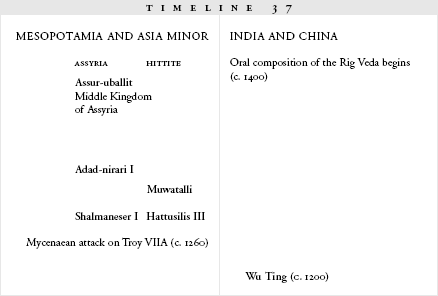
The arya have not left much trace of these lives behind them, but by 1200 or so they had begun to make sense of their new incarnation as a settled people with myths of their own. The earliest collections of Indian hymns, the poetic Rig Veda, were composed in their own tongue. Like most ancient poems, those in the Rig Veda were set down in writing long after they were first told around fires, but they can still give us a glimpse of the world that the arya were building for themselves.94
For one thing, the Rig Veda was devoted almost entirely to explaining the nature and requirements of the Indian gods. Any people with complicated gods who make complicated demands stand in need of priests as well as warlords; they are on the edge of becoming a more complicated society. By the time of the later verses in the Rig Veda, the priests of the arya had become not simply specialists in god-care, but a hereditary class of specialists. Priests fathered sons who were trained to become priests, and who married daughters of other priests. The hymns in the Rig Veda were the first writings of the arya, and the priests their first true aristocracy.
The people who were in the process of becoming Indians were held together by a common philosophy and a common religion, not by political organization or by military might.2 So the Rig Veda tells us a great deal about the worship of the gods, but very little about the spread of the arya across the land that had become their home. The collection is divided into ten cycles, called mandala.3 Each mandala contains hymns in praise of the gods, and chants to be said during sacrifices and other rituals. The Indian gods are nature-gods, as is common to peoples who live in harsh environments and along fierce rivers (the Yahweh of Abraham is a notable exception): Varuna, the sky-god; Ratri, the spirit of the night; Agni, the god of fire; Parjanya, the rain-god who “shatters the trees” and pours down water on cattle, horses, and men as well; Mitra, god of the sun; and Indra, the calmer of chaos and the ruler of the pantheon, he “who made firm the shaking earth, who brought to rest the mountains when they were disturbed…in whose control are horses, villages, and all chariots.”4 (Indra, Varuna, and Mitra, incidentally, appear as witnesses in a treaty between the Mitanni king and Suppiluliuma, the Hittite empire-builder; this shows not only that the Mitanni were arya, but that the arya were worshipping these gods long before they separated and went their different ways to the west and south.)
Books II to VII of the Rig Veda, the oldest of the hymns, give us glimpses of political and military structure through the dim glass of ritual. The fire-god Agni is credited with attacking “walls with his weapons,” which suggests that as the arya flourished and spread, they made war on wooden-walled villages in their path by burning them.5 One hymn mentions a battle between “darkhued” peoples and the arya, a description which scholars seized on, a century ago, as proof that an inferior native people had been wiped out by light-skinned “Aryans.” But the seventh mandala describes a battle among ten arya kings against each other. The arya seem to have fought each other quite as much as they fought the other inhabitants of the river valleys and the plains beyond.
Apparently the years of the first hymns in the Rig Veda were a time in which not only a priest-clan, but also a clan of aristocratic warriors, had begun to form, a hereditary class of ruling chiefs who passed down power from father to son.6 But we can go no further than this; and so far, none of these priests and warrior-chiefs have names.