Between 1212 and 1190 BC, the Assyrians fight with Hittites, Babylonians, and Elamites, while the Nineteenth Dynasty of Egypt collapses
BACK OVER A LITTLE FARTHER to the west, the patchwork Hittite empire was beginning to gape at the seams.
The Egyptian-Hittite treaty was still holding; Egypt governed the Western Semitic lands as far as Kadesh, while the Hittites claimed the cities farther to the north. When Rameses II died, well into his nineties, his elderly son Merneptah succeeded to the throne (he was the thirteenth son of Rameses II, since the tough old man had already outlived his first twelve male offspring).1 At the news of a new pharaoh on the throne, a few of the cities in the Egyptian provinces to the north tried their luck at a revolt, but Egyptian forces marched up and mashed them with little ceremony.2
The Hittites, meanwhile, had been struck by drought. Crops had been ruined, livestock were dying, villagers were tormented by hunger. One of the letters from the Hittite capital down to the Egyptian court suggests that, since the pharaoh has arranged to marry a Hittite princess, he had better come and get her; the Hittite stables had no more grain, and the herds of cattle set aside as her dowry would starve if not fetched right away.3
Hattusilis III had made his son Tudhaliya his Chief of Bodyguards, a position that proved his father’s complete trust in him (not necessarily a given in Hittite royal families).4 When Hattusilis III died, his son became King Tudhaliya IV. He inherited not just the throne, but a famine that was worsening by the year.
Tudhaliya IV sent down to Egypt for food, and Merneptah, now sitting on his father’s throne, honored the alliance; his own inscriptions remark that he sent enough grain “to keep the land alive.”5 A letter from Tudhaliya himself to one of his subject cities, directing it to provide ships to help transport the grain, reveals that a single shipment was 450 tons.6 The Hittite granaries were bare.
A king who has to beg foreign aid simply to keep his people alive is not in a good position, and the Hittites, precariously perched on top of the turning wheel of fortune, were on their way down. A country without grain is a country without money. A country without money inevitably delays paying its soldiers until the last possible moment. Underpaid soldiers are always less disciplined than well-fed and satisfied ones. The Hittite army was ripe for defeat.
Tudhaliya was a competent commander-in-chief and a seasoned warrior who had first gone out fighting in his father’s army at the age of twelve.7 But along with famine and poverty, he also had to worry about his throne. His father had usurped the crown, after all, and the kingdom was full of men with royal blood. “The descendants of Suppiluliuma, the descendants of Mursili, the descendants of Muwatalli, the descendants of Hattusili are numerous!” he complains in one letter.8
To prove his power as rightful king, Tudhaliya IV gave orders for the most massive building program of any Hittite king ever: new shrines; additions to the already-large palace complex; a new suburb of the capital city Hattusas that included twenty-six new temples and doubled the size of the old city.9 This was the sort of project expected of a great king, and may have been in imitation of Rameses II, who had just died. But although the new buildings trumpeted Tudhaliya’s royal authority, they also drained his treasury. In a kingdom already suffering from famine and poverty, Tudhaliya IV was pouring money into construction, and this left him even less royal silver with which to pay his soldiers.
The conquered peoples under Hittite rule clearly saw the army weakening year by year. Not long into his reign, Tudhaliya learned that twenty-two cities along the western edge of his empire had joined together in an alliance against him. He marched west and broke up the coalition, but the vultures were already circling.10
Down to the southeast, the new king of Assyria saw an opportunity to expand. Shalmaneser I had already swallowed the old Mitanni lands. Now his son, Tukulti-Ninurta, launched an attack against the Hittite borders to his west.95
Tudhaliya carried his defense into the enemy’s land, and the two armies met on the plain of Erbila. If the Assyrian account of the battle is to be believed, Tudhaliya was not at all sure that he could win the fight. The Assyrian king wrote in a letter sent to an ally:
Tudhaliya wrote to me, saying, “You have captured merchants who were loyal to me. Come on, let’s fight; I have set out against you for battle.”
I prepared my army and my chariots. But before I could reach his city, Tudhaliya the king of the Hittites sent out a messenger who was holding two tablets with hostile words and one with friendly words. He showed me the two with a hostile challenge first. When my army heard about these words, they were anxious to fight, ready to set out at once. The messenger saw this. So then he gave me the third tablet, which said, “I am not hostile to the king of Assur, my brother. Why should we brothers be at war with each other?”
But I brought my army on. He was stationed with his soldiers in the city Nihrija, so I sent him a message saying, “I’ll besiege the city. If you are truly friendly to me, leave the city at once.” But he did not reply to my message.
So I withdrew my army a little ways back from the city. Then a Hittite deserter fled from Tudhaliya’s army and reached me. He said, “The king may be writing to you evasively, in friendship, but his troops are in battle order; he is ready to march.”
So I called my troops out and marched against him; and I won a great victory.11
Tukulti-Ninurta boasted afterwards that he had taken 28,800 Hittites as prisoners of war, a hugely improbable figure. But he certainly carried off thousands of Hittites and brought them back to Assyria. Settling a conquered people in a foreign land weakened their sense of themselves as a nation; an exiled race was less likely to revolt.
The conquest made enough of a splash in the ancient Near East to figure in the oldest Greek chronicles, where Tukulti-Ninurta (under the Greek name Ninus) appears as the distant ancestor of the ruler of Sardis, all the way over in Asia Minor; this was a distant and distorted reflection of Tukulti-Ninurta’s rampage through Hittite territory.96
Tudhaliya himself retreated to his capital city, abandoning the outskirts of his empire. The Hittite military might was fading rapidly. In a letter sent to the vassal king of Ugarit, Tudhaliya complains that the city has not sent in its quota of soldiers for the Hittite army; is Ugarit arming itself for revolt? Another tablet lists all the ships from the city of Carchemish which are no longer in any shape to sail.12 The edges of Tudhaliya’s kingdom were cracking away.
TUKULTI-NINURTA, meanwhile, went back home to face a new problem to the south.
Babylon had had an ambiguous relationship with Assyria for years. Each city had, at various times, claimed the right to rule the other. Babylon and Assur were not only balanced in strength, but also twins in culture. They had once been part of the same empire, under Hammurabi, and the essentially Babylonian stamp on the whole area remained visible. Assyria and Babylon shared the same gods, albeit with occasionally different names; their gods had the same stories; and the Assyrians used Babylonian cuneiform in their inscriptions and annals.13
This likeness made Assyrian kings generally reluctant to sack and burn Babylon, even when they had the chance. But Tukulti-Ninurta was not much inclined to restraint. He boasted in his inscriptions of the fate of all those who defied him: “I filled the caves and ravines of the mountains with their corpses,” he announces, “I made heaps of their corpses, like grain piled beside their gates; their cities I ravaged, I turned them into ruinous hills.”14
Counting on Tukulti-Ninurta’s preoccupation with the Hittites up north, the king of Babylon tried to seize some of the disputed land between the Assyrian and Babylonian borders. We know almost nothing about this king, Kashtiliash IV, except that he was a poor judge of men; Tukulti-Ninurta marched down and plundered Babylon’s temples. In this he broke a long Assyrian tradition of respect for Babylon’s sacred sites. He even took the images of the gods away, a particularly risky move since it was generally thought that sacrilege of this sort would peeve the Assyrian gods as well. “He removed the great lord Marduk from his dwelling-place,” the Assyrian chronicle of the conquest tells us, “and set him on the road to Assur.”15 And he per sonally confronted the Babylonian king in battle: “In the midst of that battle,” his inscriptions announce, “my hand captured Kashtiliash, I trod on his royal neck with my feet like a footstool…. Sumer and Akkad to its farthest border I brought under my sway. On the lower sea of the rising sun I established the frontier of my land.”16 He then proclaimed himself king of Babylon as well as Assyria. For the second time, the identity between the two kingdoms had been merged into one.
Tukulti-Ninurta marched Kashtiliash back to Assur, naked and in chains, and put Babylon itself under the authority of an Assyrian governor. This extended the border of the Assyrian empire from the northern part of the Western Semitic lands all the way down into the south of Mesopotamia. Tukulti-Ninurta, now the only great king in the entire region, embarked on the usual great king activities. He built new temples, fortified Assur’s city walls, and constructed an entirely new royal mini-city for himself, a little north of the main sprawl of Assur; it had its own water supply and its own prison labor force, and could be run without any provision from the capital itself.
Tukulti-Ninurta claimed that the god Assur had desired him to build a new city “where neither house nor dwelling existed.” But his haste to put himself behind walls and away from the people of Assur hints that all was not well. Babylon itself had been shocked by the plunder of the temples: “He put Babylonians to the sword,” the Babylonian Chronicle says, “the treasure of Babylon he profanely brought out, and he took the great lord Marduk off to Assyria.”17 Nor had the destruction gone over well with the devout in his own land. The Assyrian epic that Tukulti-Ninurta commissioned to celebrate the victory over Babylon has an unmistakably defensive tone; it goes to great lengths to explain that Tukulti-Ninurta really wanted to have peace with Babylon and tried his best to be friends with Kashtiliash, only the Babylonian king insisted on coming into Assyrian territory to thieve and burn, which is why the gods of Babylon deserted the city and left it for punishment to the Assyrians.18 Clearly the great king was under pressure to explain not only why he sacked Babylon, but why he took its sacred images back to his own capital.
The explanation didn’t convince, and Tukulti-Ninurta’s sacrilege brought about his end. The Babylonian Chronicle tells us, with subdued satisfaction, “As for Tukulti-Ninurta, who had brought evil upon Babylon…his son and the nobles of Assyria revolted, and they cast him from his throne [and imprisoned him in his own palace complex]…and then killed him with a sword.”19 He had reigned as great king for thirty-seven years.
After his death, his son took the throne. In an effort to reverse his father’s misdeeds, he sent the statue of Marduk back down to Babylon,20 but this did not console the outraged Babylonians. Babylon rebelled almost at once, its Assyrian governor fled, and another Kassite nobleman seized the throne and declared the city’s freedom from Assyrian domination.
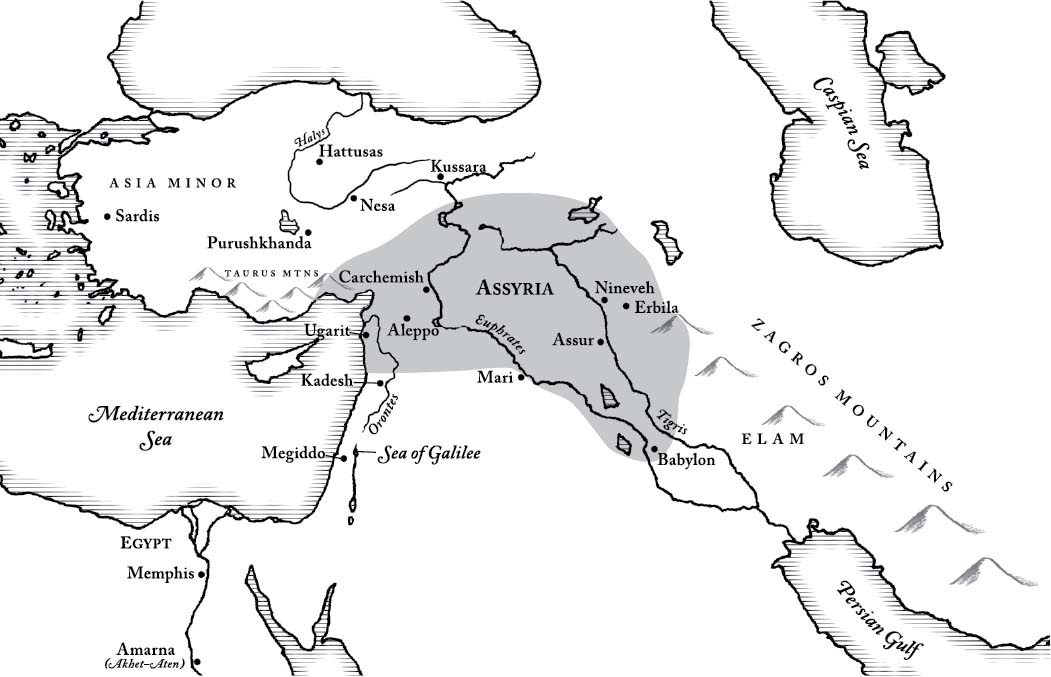
38.1 Tukulti-Ninurta’s Assyria
At this display of Assyrian weakness, the Elamites (who had never really ceased to be a threat) began to prod at the eastern border of Assyrian land. They came as far in as Nippur, and knocked the Assyrian-appointed king of that city off his throne two separate times.21 They also invaded Babylon with enough force to march through the streets, ascend the temple steps, and nab the statue of Marduk (again), which they took off to Susa in victory. (They also took Hammurabi’s law stele, which remained at Susa until it was uncovered by archaeologists a couple of millennia later.) They kidnapped Babylon’s king, as an afterthought, and took him as well. He was less important than either Marduk’s statue or Hammurabi’s laws, and disappears from the historical record at once.
Tukulti-Ninurta’s son, an entirely unimportant Assyrian king named Assurnadin-apli, was helpless in the face of all this tumult and managed to hold onto his throne for only three years. Although we know little about his death, it probably came before its natural time; he was succeeded not by his son, but by his nephew. This nephew held the throne for only six years before losing it to another uncle, who after five years was forcibly removed (and probably murdered) by a usurper whose only right to the throne was that he claimed a distant descent from the great-great-great-uncle of Tukulti-Ninurta.
Over in Babylon, things were not much better. Another family of uncertain descent, the so-called Second Dynasty of Isin, had taken possession of the throne after the Elamite removal of the reigning sovereign; the first four undistinguished kings rose and fell in the space of fifteen years. And up in Hittite territory, Tudhaliya IV died, probably of old age (a rarity at this point). His sons and cousins quarrelled over the Hittite throne and its tiny raggedy remnant of an empire.
Even down in Egypt, the throne was under attack. The elderly Merneptah’s mummy was scarcely interred when the succession suddenly failed; Merneptah’s son and co-regent, Seti II, was temporarily run off his throne by a half-brother and only got it back after a three-year hiatus. He died shortly afterwards and left the crown to his son, who (judging from his mummy) suffered from polio and died young. At this point, the dead young king’s stepmother Twosret tried to seize power, and the king lists trail off into anarchy. The chaos was aggravated by wandering raiders who came down into the Delta, as they generally did when Egypt’s defenses languished. “The land of Egypt was overthrown from without,” a later papyrus reads, “and every man done out of his right…. the land of Egypt was in the hands of chiefs and rulers of towns; each slew his neighbor.”22 The Nineteenth Dynasty had come to an undistinguished end.
The wheel had gone sideways; no one sat on top. After decades of war making, the energy poured into conquest had drained the kingdoms dry.