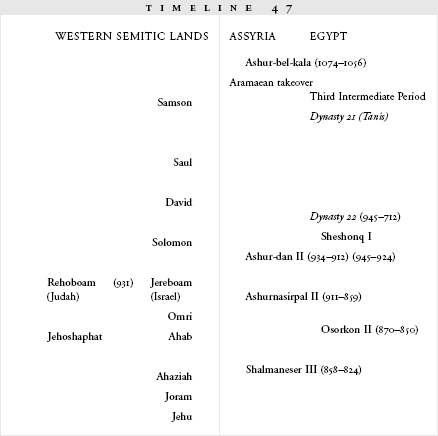
Between 934 and 841 BC, Assyria makes itself a new empire, and the Western Semites begin to lose their independence
THE ARAMAEANS, the tribes whose wandering invasion of Mesopotamia had disrupted business-as-usual in Assyria and Babylonia, had now settled down in a patchwork of tiny independent states. The strongest of these was centered at the city of Damascus, in the middle of the plain that lay across the Euphrates from Assyria. King David had managed to bring the Aramaeans of Damascus at least partly under his control: his chronicler boasts that the Israelite army under David “struck down twenty-two thousand of them,” and afterwards received regular tribute from them.1
During the same years, the Assyrians called the entire area west of the Euphrates “Aram,” a blanket term for the cities governed by Aramaean chiefs, and were almost helpless against them. Not until the reign of David’s grandson Rehoboam and the fracture of Israel into two states did an Assyrian ruler manage to rally his troops and push back against Aramaean encroachment. His name was Ashur-dan II, and he was the first of the great Assyrian kings who would bring Assyria back out of its dark age, into its new and final renaissance.
Ashur-dan’s inscriptions boast that he took vengeance on the wandering peoples who “committed destruction and murder” by burning the Aramaean cities which had been built on land that had once been Assyrian. In fact he came nowhere near re-establishing the boundaries of the old Assyrian empire. He did manage to ring the Assyrian heartland around with his troops, and make it secure; he brought back from the mountains the Assyrian villagers who had been driven from their towns by “want, hunger and famine,” resettling them in their own land.2 But he did not push any farther to the north or the east, where the Aramaeans still held the most power.

47.1 The New Assyrian Empire
And to the south, the ragged remnant of the Babylonian empire kept its independence, such as it was. The Babylonian throne had been claimed by family after family, its royal capital shifting from city to city, and Aramaeans had infiltrated the old Babylonian territory to such an extent that their language, a Western Semitic dialect known as Aramaic, was beginning to replace the ancient Akkadian which had once served Babylonians as a common tongue.3
Not until three generations later did the next great king of Assyria stake his claim to the title. Ashur-dan’s great-grandson Ashurnasirpal II finally made Assyria into an empire again.114 He fought up to the northwest of Nineveh, and made the city his northern base.4 He crossed to the eastern bank of the Tigris and built himself a new capital city on the site of the old village of Caleh: “I have taken it anew as a dwelling,” he announced. “The former city of Caleh, which Shalmaneser, king of Assyria, a prince who preceded me, had built, that city had fallen into decay and lay in ruins, it was turned into a mound and ruin heap. That city I built anew.…I laid out orchards round about it, fruit and wine I offered unto Assur, my lord…. I dug down to the water level…. I built the wall thereof; from its foundation unto its top I built and completed it.”5
Caleh, from now on, would be the center of his government; Assur itself became a purely ceremonial city. In Caleh he built not only office buildings, but a palace decorated with reliefs of the warriors and kings who had surrendered to him; at the doorways to the hall where he received tribute, he set up guardian statues, enormous winged bulls with human heads, their faces an idealized portrait of Ashurnasirpal himself.6 When the palace was finished, Ashurnasirpal threw a huge banquet to celebrate it: his celebratory inscription explains that his guests were fed a thousand oxen, a thousand domestic cattle and sheep, fourteen thousand imported and fattened sheep, a thousand lambs, five hundred game birds, five hundred gazelles, ten thousand fish, ten thousand eggs, ten thousand loaves of bread, ten thousand measures of beer, ten thousand containers of wine, and more. By Ashurnasirpal’s count, there were 69,574 guests at the tables, all celebrating his greatness. At the feast, he publicly claimed the titles “great king, king of the world, the valiant hero who goes forth with the help of Assur; he who has no rival in all four quarters of the world, the exalted shepherd, the powerful torrent that none can withstand…he who has over come all of mankind…whose hand has conquered all lands and taken all mountain ranges.”7
Grandiloquent rhetoric aside, Ashurnasirpal did do one thing his ancestors had not accomplished. He fought his way to the Euphrates and then crossed it. “I crossed the Euphrates at its flood in ships made of skins,” he records. “I marched along the side of Mount Lebanon, and…in the Great Sea I washed my weapons.”8 It was exactly the same gesture of victory that Sargon had made, in the Persian Gulf, so many years before.
This brought him right across the top of the northern border of Israel, which was under the rule of a king named Omri. Omri doesn’t get much play in the biblical account, which is more concerned about his disregard for the laws of God: all we learn from the book of 1 Kings is that Omri seized the throne of the north from another claimant and that he was more evil than any king who came before him.9 But in political terms, Omri was a great warrior and builder (he built Samaria to be the new capital of the north), and the first Israelite king to be mentioned with awe in the inscriptions of another country; the Mesha Inscription, a stone found across the Jordan river in the territory of the tribe known as the Moabites, mourns that Omri “humbled Moab for many years.”10 He was a ruler of enough strength that Ashurnasirpal, who subdued pretty much all of the little states all the way to the coast and even demanded tribute from the Phoenician kings of Tyre and of Sidon, did not venture to attack him.
By now Ashurnasirpal’s territory stretched across to the Euphrates, from there in a narrow band to the Mediterranean coast and down it as far as the port city of Arvad. He never actually claimed rule over either Tyre or Sidon, whose kings were friendly to Israel; nor did he attack Babylonia itself. He did march south down the Euphrates as far as the then-accepted borderline between Assyria and Babylonia, and there he sacked a town on the line in order to terrify the Babylonians (although he did not push farther).
His reputation undoubtedly preceded him. In Ashurnasirpal there appeared, full-blown, the delight in cruelty which tagged at the heels of almost every Assyrian king who followed. “I put up a pillar at the city gate,” Ashurnasirpal explains, recording his dealings with a city which had revolted and killed its Assyrian-appointed governor, “and I skinned the chiefs who revolted against me, and covered the pillar with their skins. I walled up others in the middle of the pillar itself, and some of them I impaled on stakes and arranged them around the pillar. Inside the city, I skinned many more and covered the walls with their skins. As for the royal officials, I cut off their members.”11 He varied this, at other times, by making heaps of cut-off noses and ears, gouging out eyes, and tying heads to vines throughout the gardens of conquered cities like obscene and decaying fruit. “I made one pillar of the living,” he remarks, a particularly nasty Assyrian invention where living prisoners were laid one on top of another and covered with plaster to make a column. “I cut off their ears and their fingers, of many I put out the eyes…. their young men and maidens I burned in the fire.”12
AFTER A TWENTY-FIVE-YEAR REIGN of terror, Ashurnasirpal II died and left the throne to his son Shalmaneser, the third of this name. Shalmaneser III continued the campaign against the Western Semitic lands west of the Euphrates. Like his father, Shalmaneser crossed the Euphrates “at flood” (this seems to have become a point of pride), and advanced “to the shore of the sea of the setting sun,” where “I washed my weapons in the sea.”13 Unlike his father, however, he did not shy away from the northern kingdom of Israel.
Israel, paradoxically, seemed stronger than ever. Omri’s son Ahab had inherited his father’s throne, and—watching the spreading Assyrian threat to his east and north—had negotiated a strategic marriage with the daughter of the Phoenician king of Sidon. This princess, Jezebel, became not just a wife, but his principal queen, which greatly strengthened the Phoenician-Israelite alliance against the Assyrian army.
For all this political savvy, Ahab made several very stupid moves. He showed a shrewd willingness to worship gods other than the God of Israel, including Baal, the chief god of the Phoenicians, and a number of other Western Semitic tribes and cities; this should have won him the friendship not only of Tyre and Byblos, but also the cities that lay between Israel and the advancing Assyrian front. But rather than pacifying his own people by keeping the worship of Yahweh alive as well, he allowed his Phoenician wife to round up and slaughter all the prophets of the God of Abraham. At least a hundred escaped and hid in the mountainous land to the east; from this refuge they became a voice calling the Israelites to rebel against their evil king.
Chief among the prophetic opponents of Ahab was the prophet Elijah, a wild man in animal skins who escaped Jezebel’s attempts to assassinate him and did his best to upset the wicked monarch. In fact he anointed a young Israelite officer named Jehu to be God’s choice as the next king and gave him divine permission to assassinate Ahab, Jezebel, and the entire royal house.
Given this level of hatred among Israelites themselves for their own king (and, even more virulently, for his foreign wife), it isn’t surprising that the Aramaean king of Damascus chose to use this internal unrest as an opportunity to launch his own attack against Israel. He rounded up thirty-two Aramaean warlords, and with this enormous combined force set out to meet the relatively tiny Israelite force: “The Israelites camped opposite them,” the writer of 1 Kings tells us, “like two little flocks of goats, while the Aramaeans covered the countryside.”
Despite the overwhelming odds, the Israelite army, led by Ahab—who, despite his failings in devotion, appears to have been a perfectly competent commander—managed to fight the Aramaeans to a draw. The king of Damascus made a treaty with Ahab, a treaty which kept peace between Aramaeans and Israelites for two kings for three years.
In the third year, Shalmaneser marched against the Israelite border.
Israel was prepared. Ahab led into battle his own Israelite soldiers (including significant cavalry), Phoenician troops from his allies on the coast, and men sent by the king of Damascus, who did not wish to be the next victim of Assyrian expansion. They were joined by Egypt; the fifth pharaoh of the Twenty-Second Dynasty, Osorkon II, apparently feared that Assyria, once it plowed its way through the Western Semitic lands, might march down the Mediterranean into Egypt.
The troops broke against each other at the city of Qarqar in the year 853.
It is difficult to know exactly what happened next. Shalmaneser III claimed to be victorious: “I made the blood of my enemies flow down into the valley and scattered their corpses,” he boasted, on an inscription known as the Monolith Inscription.14 But the Assyrian reliefs depicting the battle show a highly uncommon sight: enemy soldiers charging forwards over the bodies of Assyrian dead.15 Given the usual Assyrian depictions of dead enemies and live warriors, this hints at a much different outcome.
And despite Shalmaneser’s claim, he advanced no farther into the Western Semitic lands during the remaining thirty years of his rule. The Phoenician cities, the Israelite lands, and Damascus all remained free of Assyria’s grasp.
Most likely the battle was a draw, but devastating enough to Assyria that Shalmaneser decided to withdraw. The Western Semitic kings returned to their cities, and the Egyptian soldiers marched back down to their homeland, which promptly fell apart again into civil war; Egypt, preoccupied with internal troubles, disappeared for a few years from the international stage.
Ahab did not stay put, though. Perhaps exalted beyond reason by his successful defense of his country, Ahab decided, just after the battle of Qarqar, that this was an opportune moment to turn against his ally, the king of Damascus. He sent south to Jehoshaphat, the king of Judah, and asked him to travel north and join with him in an attack against the border city of Ramoth-Gilead, which lay just over the Israelite border, in Aramaean land protected by the treaty.
Jehoshaphat, the great-great-grandson of Solomon, ruled a territory which consisted of the large tribe of Judah along with the minute tribe of Benjamin, a land known collectively as “Judah.” He had no enormous military might, but since Ramoth-Gilead lay almost exactly on the north-south border, Jehoshaphat’s alliance would have allowed Ahab to perform a pincer move on the city.
Jehoshaphat agreed to visit Ahab to discuss the matter, but once in Ahab’s court—which, thanks to Jezebel’s imported prophets and court attendants from Tyre, seemed more like a Phoenician than an Israelite court—he grew nervous. The Phoenician advisors, who were also soothsayers and omen-readers, were predicting certain victory against the Aramaeans, but Jehoshaphat asked whether Ahab had considered asking a Hebrew prophet what Yahweh thought about this plan.
“Yes,” Ahab said, “there is one prophet I could call, but I don’t like him; he never says anything good about me.”
Jehoshaphat insisted, and the prophet, Micaiah, was summoned. Asked what he thought, he said, “Attack the Aramaeans and God will give you victory.”
This was a prudent but untruthful answer, and Ahab knew it. He said, “How many times do I need to order you to tell me the truth?” upon which Micaiah remarked that not only would the attack fail, but Ahab himself would be killed.
“See?” Ahab said to Jehoshaphat. “I told you that he never says anything good about me.”
Despite the prophecy, Jehoshaphat agreed to join in the attack. The events that followed suggest that he may have had his own arrangements with the Aramaean government. When the battle commenced, the Aramaean chariot commanders spotted Jehoshaphat’s royal robes and headed directly for him, but when he called out, “I am the king of Judah, not the king of Israel!” they reversed direction and left him alone.16
Ahab, fighting in disguise, was not so lucky. An arrow shot at random from some enemy bow hit him between the joints of his armor, and he died.
Twelve years later, his son Joram tried again to conquer Ramoth-Gilead. Again the Aramaean forces proved too strong for him. Wounded in the unsuccessful battle, he retreated back across the Jordan river to the Israelite city of Jezreel to recover from his wounds. Immediately an Israelite prophet went to find Jehu—the young officer anointed by Elijah to kill off Ahab’s family, almost fifteen years before—to tell him that his time had finally come.
Jehu had been lying low; the prophet finally ran him to earth in, of all places, Ramoth-Gilead itself, which suggests that he had taken refuge with Israel’s enemy. As soon as he heard the news of Joram’s weakness, he hitched up his chariot, slung his bow over his shoulder, and set off hell-bent for Jezreel.
Instead of hiding, as Ahab himself had done during the battle of Ramoth-Gilead, Joram put on his robes, harnessed up his own chariot, and rode out to meet the arriving soldier. Jehu put an arrow through him and continued on to Jezreel.
By the time he reached Jezreel, Jezebel the queen mother—who had apparently travelled to be with her wounded son—had heard of Joram’s death and the approach of his assassin. She put on her own royal robes and waited at a window for his approach. Whether she was preparing to rally the court behind her, or whether she saw her death approaching, is unclear; but as Jehu drew to a halt in front of the royal residence, she leaned out of the window and called, “Are you coming in peace, you murderer of your master?”
Jehu, building on the anti-monarchical sentiment that had arrayed Joram’s own officials behind him, called out for help; and three eunuchs from the queen mother’s own household came up behind the old woman and threw her from the window. She fell to the pavement, and Jehu rode over her body. The half-wild dogs that skulked around every ancient city ate her, all but her hands and feet and her skull.
According to the book of 2 Kings, Jehu wiped out the rest of Ahab’s family and killed Jezebel’s Phoenician prophets.115 These are the only two actions that characterize his reign: but in his days, “the Lord began to reduce the size of Israel.”17 The only defeat recorded is that at the hands of the Aramaean king of Damascus, who abandoned whatever support he had offered Jehu once the man was on Israel’s throne, and took away everything east of the Jordan river.
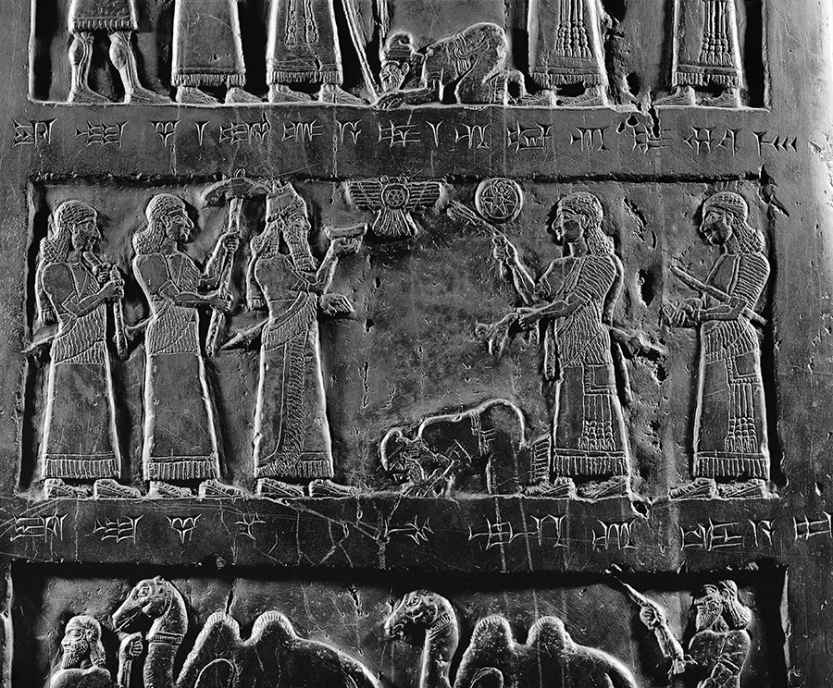
47.1. Black Obelisk. This panel on the basalt victory stele of Shalmaneser III shows Jehu of Israel prostrating himself before the Assyrian king. British Museum, London. Photo credit Erich Lessing/Art Resource, NY
The more serious defeat is not mentioned in the biblical account at all. It is, however, carved into Shalmaneser III’s victory monument, the Black Obelisk. On it, dozens of conquered kings come with tribute for Shalmaneser; on the second panel of one side, Jehu of Israel touches his forehead to the ground before the Assyrian king. Shalmaneser stands looking down at him, his head shielded from the sun by a parasol held over him by an obsequious attendant. Shalmaneser III had marched his army into Israel and had set up an image of himself in Israelite territory; the first Assyrian king to enter Israel, but by no means the last.18
Jehu had lost Ahab’s old allies. The Aramaeans were against him, and the Phoenicians—infuriated by the slaughter of their royal princess Jezebel, her court, the priests who served her gods, and her descendants—were no longer willing to fight on his side.19 Jehu, chosen to purify the house of Israel, had purified it of his allies. He had no choice left but to submit.