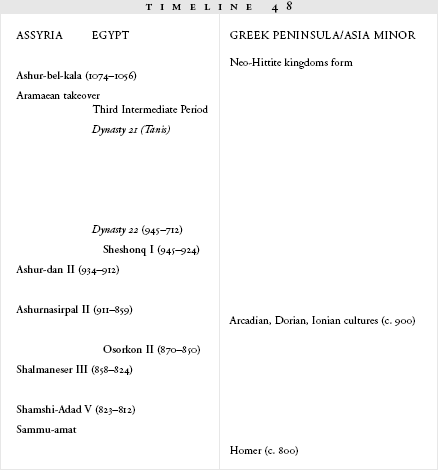
In the fifty years after 850 BC, Assyria attacks its neighbors, while three kinds of Greeks invent a shared past
NOT LONG AFTER JEHU’S SUBMISSION, the old king of Babylon died. His two sons quarrelled over the throne, which gave Shalmaneser of Assyria the perfect chance to attack his southern neighbor.
He declined. In fact, Assyrian soldiers marched down to help the older prince get his throne back. “In my eighth year of reign,” Shalmaneser III’s inscription reads, “there revolted against Marduk-zakir-shumi his younger brother…. To avenge Marduk-zakir-shumi, I marched forth.” At the approach of the Assyrians, the rebellious younger prince escaped, “like a fox, through a hole in the wall” and took off. The Assyrians followed and caught him: “The rebel officers who were with him, I cut down with the sword.” Shalmaneser concludes.1
With the rebellion put down, Shalmaneser visited Babylon with gifts and arranged a match between one of Marduk-zakir-shumi’s daughters and his own second-eldest son. In his own palace, he carved a relief that shows him clasping the hand of Marduk-zakir-shumi, the two kings standing side by side as equal rulers.2
The unwillingness to attack Babylon had nothing to do with weakness; Shalmaneser spent most of his reign in ceaseless campaigning. The kings of the Assyrian renaissance were particularly reluctant to attack the famous old city, and particularly worried about offending Marduk, Babylon’s chief god. Instead, Shalmaneser III bypassed Babylon and sent troops east, northwest, and farther south, where three new peoples would soon be forced to pay tribute to Assyria.
At the head of the Persian Gulf, five Semitic tribes had claimed the land which once had formed the far southern edge of Sumer. The tribe of Bit Amukanni dominated the land near the old Sumerian city of Uruk; Bit-Dakkuri lay a little to the north, closest to Babylon; and the tribe of Bit-Yakin dominated Ur and the marshy land bordering the Gulf itself.3 Two smaller tribes lay under the protection of these three.116Collectively, the Assyrians knew these tribes as the Chaldeans. They paid nominal allegiance to the king of Babylon, but they were only sketchily under any Babylonian control.
After helping Marduk-zakir-shumi get his throne back, Shalmaneser III marched down beneath Babylon’s southern border and compelled tribute from the Chaldean tribes. The tribute was not minor; the Chaldeans sent gold, silver, ivory, and elephant hides, which suggests that they were trading down the Gulf with merchants as far east as India.4 Shalmaneser’s invasion was, theoretically, to help Babylon out, since the Chaldeans had happily joined in the younger brother’s rebellion; but it didn’t do Shalmaneser III any harm either. Respect Babylon he might, but now he controlled its northern and southern borders, which meant that the kingdom’s growth was severely limited.
Then, around 840, Shalmaneser marched north up the Euphrates and turned west to cross over the top of the Aramaean-dominated lands. Here, on the northeast corner of the Mediterranean Sea, lay a little kingdom called Que.
Que was a new country, but it was populated by an old race. Three hundred years earlier, the Hittite capital Hattusas had burned, and the Hittite people had scattered. The center of their old kingdom was occupied by invaders from southern Europe who had crossed over the Bosphorus Strait; settling in Asia Minor, they built themselves a capital city at Gordium and became known as the Phrygians. The Hittites had lost most of their coastline as well. Mycenaeans, driven from their own homes by the Dorian influx, had settled along the western edge of Asia Minor and down along the southern coast as well.
The scattered Hittites regathered themselves on the only land they could still call their own, southeast of their old homeland. Here they worshipped the Hittite gods and lived in tiny independent neo-Hittite kingdoms, centered around walled cities. Carchemish, on the northern Euphrates, was the strongest of these.
Que, another neo-Hittite kingdom, had less military might but lay in a strategic position on the path through the Taurus Mountains, the best gateway into Asia Minor and also the road to the silver mines north of the mountains. Shalmaneser attacked Que, marched into its capital, and claimed the silver mines for himself.5
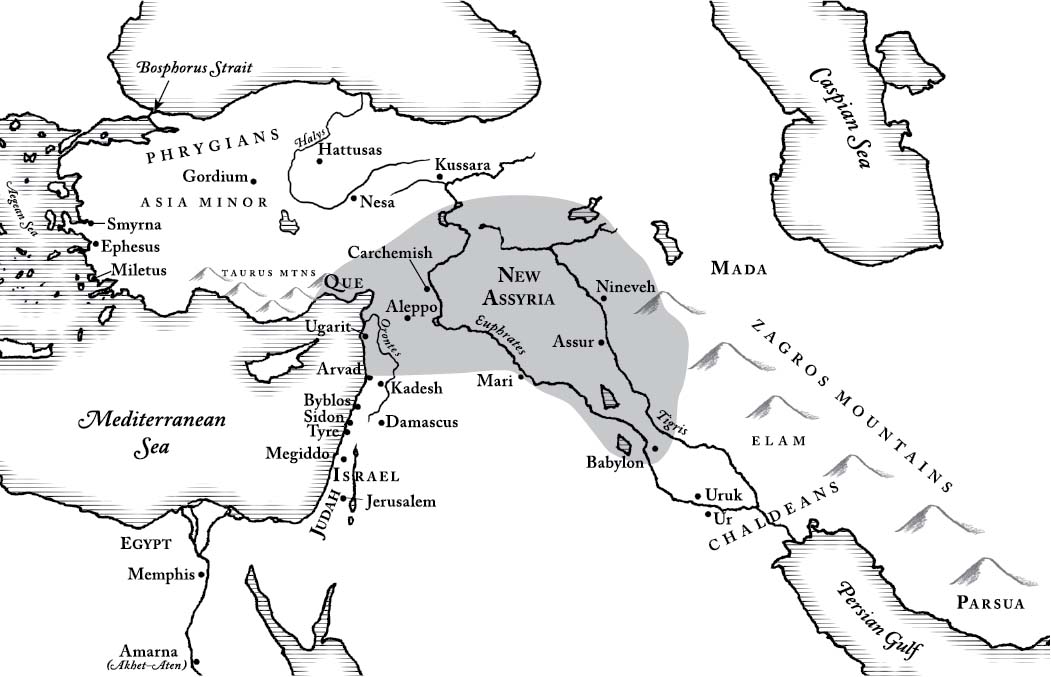
48.1 Shalmaneser’s Enemies
Then he turned east. As always, the Elamites on the other side of the Tigris were a continual threat. The kings of the Elamite cities could see that Assyria was a much greater threat than the relatively small Babylon, and so they tended to ally themselves with the Babylonian kings when there was fighting to be done. Shalmaneser was a friend of Babylon too, but in the ancient Near East, the friend of your friend was more likely to be your enemy than otherwise. An alliance between Babylon and Elam might well threaten Assyrian power.
Shalmaneser did not attempt to add Elam formally to his empire, but he demanded tribute from its cities. A couple of Assyrian raids into Elamite land convinced the cities to pay up. Shalmaneser also strengthened his own position by making a quick journey across the Zagros Mountains in order to subdue the peoples who lived across the northern edge of Elam. As with Babylon, he could now claim to control two of Elam’s borders.
These northern mountain-dwellers had probably divided off, perhaps a thousand years before, from those same wandering peoples who had then gone southeast into India. Shalmaneser’s own annals name two tribes: the Parsua, who were settled just across the Zagros on the western side of Elam, and the Mada, who were still wandering nomadically all along the north.6
Neither the Parsua nor the Mada put up much of a fight against Shalmaneser, and he returned home boasting the allegiance of twenty-seven different mountain chiefs. He put no particular value on this conquest; the Parsua and the Mada were simply buffers against Elamite power. It would be a century or so before their names were given, by the Greeks, their more familiar form: the Persians and the Medes.
SHALMANESER III died in 824, in the middle of a rebellion launched by his own son. On his deathbed, Shalmaneser disinherited his heir and appointed his second son, Shamshi-Adad (husband of the Babylonian princess), in his place. He died before he could finish quelling the revolt; Shamshi-Adad, the fifth of that name, was now officially king of Babylon, but he was outnumbered by his brother’s supporters and had to flee his own country.
It was a huge rebellion, as Shamshi-Adad V’s own accounts reveal:
Where [my brother] Assur-danin-apli, in the time of Shalmaneser, his father, acted wickedly, bringing about sedition, rebellion, and wicked plotting, caused the land to rise in revolt, prepared for war, brought the people of Assyria, north and south, to his side, and made bold speeches, brought the cities into the rebellion and set his face to begin strife and battle…27 cities, along with their fortifications…revolted against Shalmaneser, king of the four regions of the world, my father, and…had gone to the side of Assur-danin-apli.7
The only king who could lend him enough soldiers to meet a challenge of this size was his father-in-law, the king of Babylon. So Shamshi-Adad fled to Babylon and asked Marduk-zakir-shumi for help. The Babylonian king agreed, and supplied troops to help the Assyrian heir retake his own capital city.
But Marduk-zakir-shumi made a ruinous error in judgment. He did not entirely trust his son-in-law, and forced Shamshi-Adad to sign a treaty as a condition of getting those Babylonian troops. The treaty is fragmentary, but it apparently required Shamshi-Adad to acknowledge Babylon’s superiority. The wording did not give Shamshi-Adad the title king, which is granted to Marduk-zakir-shumi alone, and the accompanying oaths were sworn to in front of the Babylonian gods only, with the Assyrian pantheon dismissed.8
Shamshi-Adad signed the treaty, biting back his resentment for the sake of regaining his throne. He took the offered soldiers and mounted an attack against his own cities, winning Assur back by breaking through the walls.
Once Shamshi-Adad V had his throne back, he honored the treaty with Marduk-zakir-shumi. Either he was a man of his word, or he stood in fear of the deities overlooking the agreement. But when Marduk-zakir-shumi died and his son Marduk-balassu-iqbi took the throne in his place, Shamshi-Adad began to plan a campaign that no Assyrian king had undertaken for generations: the invasion of Babylon.
Not too many years after Marduk-balassu-iqbi’s accession, the plans reached fruition. Shamshi-Adad organized his army for a march and headed south—not directly, but rather along the Tigris, in a rather leisurely manner that suggested he wasn’t particularly worried about his brother-in-law managing to prepare much in the way of a fight; he records that he not only sacked a few villages along the way, but also stopped long enough for a lion hunt during which he killed three lions.9
Marduk-balassu-iqbi came up to meet him, fortified with a few Chaldean and Elamite allies. The alliance was shortly trounced, according to Shamshi-Adad’s annals:
He advanced against me offering battle and combat…. With him I fought. His defeat I accomplished. Five thousand of his hordes I cut down, two thousand I captured alive, 100 of his chariots, 200 of his cavalry. His royal tent, his camp bed, I took from him…10
which is to say that the Assyrian soldiers broke all the way through into the center of the Babylonian line. Among the captives marched off to Babylon was the king himself. We have no record of what the queen of Assyria, his sister, said to him when he arrived.
In his place, Shamshi-Adad V installed a puppet-king, a former Babylonian court official who was intended to act as vassal, not king. He was an unprofitable servant who immediately started to plan revolt. Shamshi-Adad V was forced to return after less than a year and take him too as a prisoner to Assyria.11
At this point, Shamshi-Adad V declared himself, in ancient and anachronistic terms, “King of Sumer and Akkad.”12 This was not at all the same thing as calling himself “King of Babylon.” Rather, he was denying that any such entity as Babylon existed; there was only Assyria, the proper guardian of Babylonian culture and the Babylonian gods. His father-in-law’s insult was revenged.
Not long afterwards, Shamshi-Adad, now king of Babylon and Assyria, died young. The year was 811; he had spent just over ten years on his throne, and his son, Adad-nirari III, was still a child. So Shamshi-Adad’s queen, the Babylonian princess Sammu-amat, stepped into the place of power. A woman on the Assyrian throne: it had never been done before, and Sammu-amat knew it. The stele she built for herself is at some pains to link her to every available Assyrian king. She is called not only queen of Shamshi-Adad and mother of Adad-nirari, but also “daughter-in-law of Shalmaneser, king of the four regions.”13
Sammu-amat’s hold on power was so striking that it echoed into the distant historical memory of a people just arriving on the scene. The Greeks remember her, giving her the Greek version of her name, Semiramis. The Greek historian Ctesias says that she was the daughter of a fish-goddess, raised by doves, who married the king of Assyria and gave birth to a son called Ninyas. When her husband died, Semiramis treacherously claimed his throne.117
The ancient story preserves an echo of Adad-nirari’s name in Ninyas, the son of the legendary queen; and it is not the only story to hint that Sammu-amat seized power in a manner not exactly aboveboard. Another Greek historian, Diodorus, tells us Semiramis convinced her husband to give her power just for five days, to see how well she could manage it. When he agreed, she had him executed and seized the crown for good.
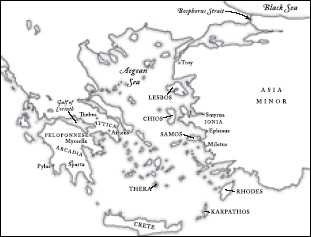
48.2 Mycenaeans, Dorians, and Ionians
BY THIS TIME, the Greek cities had coalesced into three distinct clusters. The Mycenaean cities of the mainland had buckled, three hundred years earlier, in the face of overrunning Dorians. But they had not entirely disappeared. What remnants of Mycenaean civilization survived lay in the area known as Arcadia, in the center of the southern Greek peninsula, the “Peloponnese,” below the arm of water that cut in from the eastern side, nearly dividing it into two (a body of water later known as the Korinthiakos Kolpos, the Gulf of Corinth).
Migrating Mycenaean Greeks, as well as wandering down and bothering Egypt, had also sailed across the Aegean Sea over to the coast of Asia Minor. Here they settled along the shore, in villages that grew into cities: Smyrna, Miletus, Ephesus, and others. The mixture of Mycenaean and Asian language and ways resulted in a distinctive culture which we now call Ionian; the Ionian Greeks then spread back across the nearby islands during the Dorian occupation, occupying the islands of Lesbos, Chios, and Samos, among others, and finally returning to the eastern coast of Greece itself.
Meanwhile the Dorians established their own stronghold on the south and the east of the Peloponnesian peninsula; they also spread down into Crete and as far east as the islands of Rhodes and Karpathos. The Doric dialect was distinct from the mainland Mycenaean version, and both were different from the Ionian dialect.
All three groups were, more or less, of the same race. The Ionians were Mycenaean at the root, and the Mycenaeans and Dorians came from the same Indo-European stock, both of them descended from wanderers who had come south into the Greek peninsula centuries before. Later, the Greeks would account for the similarities by claiming that the Dorians were descended from the sons of Heracles, who had been driven from their homeland in Mycenae by force and then had returned to reclaim their territory.14
But there was still no “Greece” here, only Mycenaeans (“Arcadians,” to distinguish them from their ancestors), Ionians, and Dorians. The Greek peninsula, like the “Western Semitic” lands before the rise of Israelite and Aramaean kingdoms, was a land of independent kings and chiefs.
As the Dorian disruption receded into the distant past, the cities of the Greek peninsula entered into a period of relative peace. During this time, they were more likely to act as allies than as enemies, and to exchange even more of their customs and language.118 Sometime around 800 BC—a very vague and general estimate—this growing sense of a single cultural identity led to the weaving together of a number of different historical traditions (many of them Mycenaean) into two related epic poems which would soon be claimed by the entire peninsula as the heritage of every city on it: the Iliad and the Odyssey.
According to later Greek tradition, the composer of these poems was an Ionian named Homer, who came either from the Asia Minor city of Smyrna, in the heart of the Ionian settlements, or from the island of Chios just off the Ionian coast. There is ongoing debate about who Homer was (or wasn’t); theories encompass everything from a single genius to a whole school of poets writing under a single name. The poems themselves bear the stamp of the oral storyteller: two-word descriptions that occur again and again (wine-dark, swift-footed, fair-cheeked, lovely-haired) and give the poet an immediate way to fill out the rhythm of a spoken line; formal phrases that close off a scene (“so she said in winged words,” “they sat still for a long time and in silence”);15 and the so-called ring compositions, in which the poet gives himself a convenient mental anchor for an episode by beginning in the middle of it, going back to the beginning, and then forwards to the end.119
No one is sure when these chanted or sung tales were set down in writing. During the Greek Dark Age, only the Mycenaeans had preserved any kind of writing at all, and they did very little of it. But no matter when the stories were reduced to writing, they clearly reflect a pre–800 BC world. Not just the Iliad and the Odyssey, but most of Greek mythology is (as classicist Ken Dowden puts it) “written on a Mycenaean geographical map”16 details of armor (a boar’s tusk helmet) and treasure reflect a world before the coming of the Dorians.17 On the other hand, the epics also show a knowledge of overseas settlements unlikely to have been current in the Mycenaean era.18 The language of the epic is itself that of the eighth century. And the name of Priam, king of Troy, belongs to the neo-Hittite language spoken by the inhabitants of Que and other scattered descendants of the Hittite empire.19
The stories of Troy and the heroes who fought against it offered the Dorians and Arcadians and Ionians a mythical shared past. In the Iliad, each city sends its ships instantly in response to Agamemnon’s call, a unity of action that the Greeks never actually managed to achieve. But the story expresses the beginnings of a growing identification between Greek cities that separated them from other peoples.
In the Iliad, for the first time, we come across a word for those who live outside the triple circle of Greeks: Homer calls them barbaro-phonoi, “strange speakers.”20 It was a simple division of all peoples into two, those who spoke a dialect of Greek and those who didn’t.
It was also the seed of an idea which would continue to twine itself, more and more tightly, around the minds of the Greeks. Human nature was binary; it was either Greek or non-Greek, and a man’s identity as Greek was the core of his character.
The strength of this identification had its roots, paradoxically, in the separateness of the Greek cities, back in 800 BC. They had no political unity, no common aim, and not much in the way of shared life. They had different cities, different kings, different landscapes, but they all spoke some variation of Greek. The resemblance of their speech and their imaginary shared past were the threads that held them together.