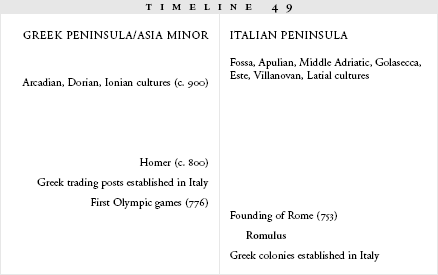
Between 800 and 720 BC, the Olympic Games begin in Greece, while Greek cities and the city of Rome are built in Italy
HOMER’S FLEETS OF SHIPS would have been a familiar sight to any Greek who lived near the water:
Thus o’er the field the moving host appears….
The gathering murmur spreads, their trampling feet
Beat the loose sands, and thicken to the fleet;
With long-resounding cries they urge the train
To fit the ships, and launch into the main.1
Greek merchants sailed across the Aegean Sea from island to island, to the Asia Minor coast, down to Crete, and back up to the mainland. By the time of Homer, ships from Greek cities were also making regular calls at the southern shores of the peninsula to the west, to trade with the peoples there.
Before 1200 BC, when the Mycenaeans were still at the height of their power over to the east, the Italian peninsula120 was populated by widely scattered little settlements that ranged all along the peninsula, from boot-heel to boot-top. Despite the distance between them, they made the same kinds of pots, which suggests that they were all of the same descent. Because so many of the settlements lay along the ridge of the Apennines, archaeologists assign these people to the “Apennine culture.”2
During the Greek Dark Age, the Apennine culture put out branches. Differences began to appear not only in pottery, but in weapons and armor. Iron tools and weapons spread slowly through the peninsula. Population increased; the people of a single settlement now might number in the thousands.3 Before 1200, all of the “Italians” had buried their dead. Now a good number of villages in the north began to burn the bodies instead.121
By the time the Greek ships arrived to trade, the peninsula was home to various customs which archaeologists use to distinguish the early Italians from each other. The villages that still buried their dead fell into three groups: the Fossa, which lay along the lower west coast and down into the toe of the Italian boot; the Apulian, just above the heel; and the Middle Adriatic, along the ridge of the Apennines.4 The northern villagers who now cremated their dead divided into four groups: the Golasecca to the west, who buried chariots and armor with their warriors; the Este to the east, who did beautiful work in bronze; the Villanovan to the south, who not only burned the dead but then buried the ashes in urns; and the Latial, just below the Villanovans, and separated from them by the river Tiber.
The Latial peoples put their ashes not just in urns, but in tiny huts that were replicas of homes for the living, made as dwellings for the dead. Their own huts were simple, their settlements unprotected; the Roman historian Varro tells us that they “knew not the meaning of a wall or gate.” The tiny villages, perched for safety on the tops of hills, were united by their common speech. They spoke an obscure tongue called Latin, one of at least forty different languages and dialects used throughout the peninsula.1225
The Greek ships landed on the southern Italian shores and traded for metal and grain; they also docked at the large southern island later known as Sicily. This successful trade led to the establishment of trading posts where Greek merchants not only docked but also lived, for at least part of the year.6
Around 775, the northwestern Greek city of Chalcis and the eastern city of Eretria sent a joint force of merchants to build a trading post a little farther to the north, on the upper shoreline of the little body of water today known as the Bay of Naples. This trading post was near the Villanovans, whom the Greeks called Tyrrhenians. Soon Greek vases began to appear among the grave goods in Villanovan graves; Greek lines began to appear in the carved reliefs of the Villanovans.
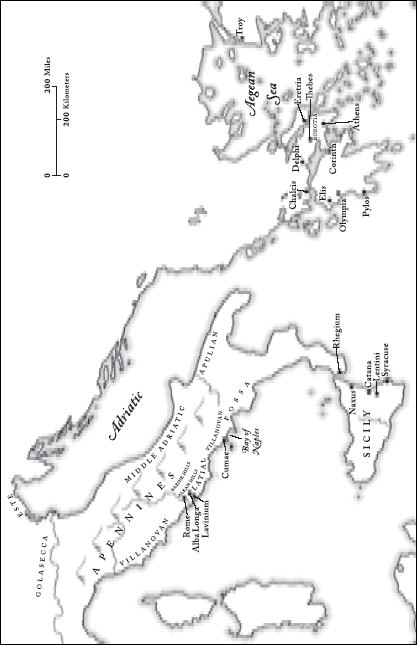
49.1 Italian Peoples and Greek Colonies
Chalcis and Eretria, cooperating for their mutual good, had forged a relationship that went beyond a shared dialect. Right around the same time, the temple of Zeus and Hera123 at the Greek city of Olympia began to grow in size, thanks to pilgrimages made to it by Greeks from much farther away. Farther north, at Delphi, a slightly different kind of shrine—an oracle, where a priest or priestess consulted the gods on behalf of Greeks seeking guidance—also attracted distant visitors. On the island of Delos, the temple of Apollo and the martial goddess Artemis expanded. These sacred sites were rapidly becoming “pan-Hellenic,” belonging not just to the nearest city, but to all speakers of Greek. They gave birth to the first Greek alliances as well. Cities joined together into amphictyonys, associations which shared responsibility for the upkeep of a temple or shrine; the ancient version of a building co-op.
Most remarkably, the Greek cities joined together in a single festival to honor the god Zeus. The first of these festivals was held (traditionally) in 776, not more than a year distant from the joint expedition of Chalcis and Eretria, and the worshippers met at Olympia.
Olympia had been a religious center for centuries, and races of various kinds had long been part of the sacrifices and rituals held there.124 In 776, the king of Elis, a small city just northwest of Olympia, was said to have journeyed to the oracle at Delphi to ask how battles between Greek cities might be brought to an end. The oracle told him to make the games at Olympia into an official festival, during which a truce must be declared. From then on, according to the oldest sources, official games were held at Olympia once every four years. During the games, an Olympic truce was declared throughout the Greek world; it lasted at first for a month, and later was extended to three months so that Greeks from farther away could travel to Olympia and back safely.7
The games themselves never actually brought peace, as Elis’s king had hoped. But they did remind the Greek cities that they were united not only by the same language, but by the worship of the same gods, and that war was not the only possible relation between them.
ACCORDING TO ROMAN LEGEND, in 776 a king named Numitor was ruling over two Latin towns on the Italian peninsula, both of them just south of the Tiber. The first and older town was called Lavinium; the second, planted as a colony when Lavinium became crowded, was called Alba Longa and was built along the ridge of the Alban hills.
Numitor’s wicked younger brother Amulius mounted an attack that forced the king to flee alone into exile, unable to return to his country to protect his family. Amulius then seized the throne, murdered his brother’s sons, and decreed that his brother’s daughter, the princess Rhea Silvia, should be a perpetual virgin, by way of preventing further claims to the throne by Numitor’s grandchildren.
Despite this, she became pregnant; the Roman historian Livy remarks that she claimed to have been raped by the god Mars, and that while “perhaps she believed it, perhaps she was merely hoping by the pretense to palliate her guilt.”8 In any case, her twin boys, once born, were clearly a threat to the usurper’s power, as they were in direct line of inheritance from the murdered king. (They were, the Greek biographer Plutarch adds, “of more than human size and beauty,” which further alarmed Amulius.)9
Amulius ordered his baby grandnephews drowned in the river. As the Tiber was at flood, the servant sent to drop the children into the water dropped them near the bank instead, and went away. Here, according to legend, a she-wolf found them and nursed them, and not long after the king’s herdsman found them and carried them off to his wife to raise.
The herdsman named them Romulus and Remus and raised them to manhood; Plutarch says that Numitor, in exile, sent money for their education. When they had grown, they got rid of their wicked great-uncle, and Numitor reclaimed his kingdom.
With their grandfather back on the throne, the twins—now recognized as the royal heirs—were, as Livy puts it, “suddenly seized by an urge to found a new settlement on the spot where they had been left to drown as infants.”10 The king approved; Alba had grown as large as Lavinium, and a third town was needed. But the sibling rivalry that had erupted between Numitor and Amulius was reborn in Numitor’s grandsons; they could not decide who should be the ultimate ruler in their new settlement, and asked the gods to send them a sign. Things went downhill from there:
For this purpose Romulus took the Palatine hill and Remus the Aventine as their respective stations from which to observe the auspices. Remus, the story goes, was the first to receive a sign—six vultures; and no sooner was this made known to the people than double the number appeared to Romulus. The followers of each promptly saluted their master as king, one side basing its claim upon priority, the other upon number. Angry words ensued, followed all too soon by blows, and in the course of the affray Remus was killed.11
Livy remarks that another, “commoner” tradition holds that Remus mocked his brother’s attempt to build a wall around his new settlement by vaulting over it, and that Romulus killed him in a murderous rage. Either way, the newly built city was named after Romulus, who fortified the Palatine hill and made it the center of his new city of Rome. The year, according to tradition, was 753 BC.
This particular tale is almost entirely smoke and barely even a smoldering of actual fire. Archaeology suggests that settlers did indeed build houses on the site of Rome sometime between 1000 and 800 BC, but Roman writers were magpies, collecting bits of other peoples’ stories for themselves; the story of Romulus and Remus contains a patchwork of parts from older Greek legends, not to mention hints of Sargon and Moses.125 Livy himself, writing around 30 BC, begins his history by remarking, “Events before Rome was born, or thought of, have come to us in old tales with more of the charm of poetry than of a sound historical record.”12
Perhaps the one historical echo we can dimly hear in this story comes through in the repeated struggle of brothers. A thousand years earlier, the struggle of Osiris and Set over Egypt reflected actual battles of succession between blood relatives. In the story of Romulus, we may also see a war between two related peoples. Ancient remains tell us that Rome began as two settlements, one on the Palatine hill, the other on the Esquiline, each hill held by a different Latial tribe.13 Possibly one tribe did come down, like Romulus, from the Alban ridge, perhaps to feed a growing population with grain from the fertile Tiberian plain.
Very likely the other group came from the Sabine hills. According to Livy, once in control of the Palatine hill, Romulus built a big town (“the rapid expansion of the enclosed area was out of proportion to the actual population,” Livy remarks) and was then faced with the problem of filling it with people. He opened the gates to all fugitives and wanderers (Livy, a good republican, has some vested interest in proving that Rome’s founding citizens were a “mob,” as he puts it, who gave the city “the first real addition to the City’s strength, the first step to her future greatness”).14 This filled the walls, but he had a problem: Rome’s greatness “seemed likely to last only for a single generation,” as there were almost no women.
This was aggravated by the tribal equivalent of sibling hatred: the neighboring villages, of the same racial makeup as the settlers at Rome, refused to send wives, since they “despised the new community, and at the same time feared…the growth of this new power in their midst.’”15 So Romulus threw a huge festival for Neptune and invited the neighbors (the Sabines, from the largest nearby town). At the height of the festivities, when the Sabine men were distracted, the Roman men kidnapped all of the young women and carried them off.
The women, according to Livy, “in course of time lost their resentment,” since their new husbands “spoke honeyed words” (one wonders what a female Roman historian might have made of the event), but the Sabine army marched on Rome in revenge and broke into the citadel, driving out the defenders. The Romans, now forced to attack their own city, advanced on the walls; as the two armies clashed, the Sabine champion, a great warrior named Mettius Curtius, gave out a war cry to his own men. “Show them that catching girls is a different matter from fighting against men!” he bellowed, at which point Romulus made straight for him with a band of the strongest Romans behind him, and Mettius Curtius went galloping off in a panic.
A massacre seemed likely to ensue, but the Sabine women now flooded out into the battlefield and put themselves between the warring tribes, begging the armies to cease, as either their husbands or their fathers would die if the battle continued. “The effect of the appeal was immediate and profound,” Livy writes. “Silence fell and not a man moved. A moment later the rival captains stepped forward to conclude a peace. Indeed, they went further: the two states were united under a single government, with Rome as the seat of power.” Romulus, descendent of the kings of Alba Longa and Titus Tatius, king of the Sabines, ruled jointly. (Although not for very long; Tatius was murdered in a riot a few years later, and Romulus “is said to have felt less distress at his death than was strictly proper.”)16
These legends, however Greek-influenced, may well point to a real ancient Rome made up of two hills, one populated by Latins from the Sabine hills and the other by Latins from the Alban hills. More than that, it points to a basic hostility at the very center of Rome’s origins. Like the Upper and Lower Egyptians, these people—of the same basic stock, with similar customs and language and gods—were nevertheless enemies at the core. The Greeks were trying to find common ground; the Latins were refusing to recognize others of their own race. In its most ancient incarnation, the city of Rome had two poles, and its people lived with their backs turned to each other.
ROME WAS not the only city growing on the fertile plains of the peninsula. Greek merchants, firmly rooted into their trading colonies, had proved to the folks back at home that the Italian coast was a good place for Greek colonies. And the Greek cities were under pressure from within. The population was growing (perhaps as much as sixfold, between 800 and 700 BC), and these people needed more: more metal, more stone, more grain, and more pastureland.17
Especially more land. The Greek cities were bounded by natural barriers: mountain ridges, clefts in the rocky land, or ocean. Like the Mesopotamian plain, the Greek peninsula was “circumscribed agricultural land.”126 Land was traditionally divided between the sons of a family equally, meaning that any family’s land shrank inexorably, and faster if more sons were born. There was simply no more land for all of the sons born to each Greek family.
The Greek poet Hesiod, from the region of Boeotia, was born sometime around the mid-eighth century. In his poem Works and Days, he describes his plight: when his father died, the farm should have been divided between himself and his older brother Perses, but apparently Perses thought that this would give him too little land to support himself and his family, and so bribed the judges who were appointed to settle disputes of this kind in order to get the whole thing.
Our inheritance was divided; but there is so much
you grabbed and carried away as a fat bribe
for gift-devouring kings, fools who want to be judges
in this trial.18
This was the secondary, but equally fraught, difficulty faced by the Greek cities; limited resources led to desperate acts, and corruption among the landholders and officials was at plague-level.19
Hesiod longs for a day when men will benefit from their own labor rather than seeing it stolen by the more powerful, when they will
know neither hunger or ruin,
but amid feasts enjoy the yield of their labors.
For them the earth brings forth a rich harvest; and for them
the top of an oak teems with acorns and the middle with bees.
Fleecy sheep are weighed down with wool,
and women bear children who resemble their fathers20
which suggests that the rich were appropriating more than just land.
Hesiod spends dozens of lines explaining that hard workers should get what they deserve, that farmers who plan their crops carefully should reap their own grain, that wages should be paid promptly, and that crooked judges should expect a visitation of divine justice. None of this happened. Nor was it likely to, given the inability of the cities to expand.
Colonization, not reform, was the only solution. Around 740 or so, the leaders of Greek cities began to send out all of those younger brothers to farm new land. The earliest colonists came from the same two cities which had built those initial trading posts in Italy; Chalcis and Eretria sent colonists to the Bay of Naples, where they began to build the new Greek city of Cumae. Around 733, the city of Corinth put its aristocrat Archias at the head of an expedition to Sicily, where he founded a colony called Syracuse; not to be outdone, Chalcis and Eretria built no fewer than four colonies (Naxus, Lentini, Catana, and Rhegium) over the next twenty years. By 700 BC, cities on the southern Italian coast were almost as likely to be Greek as native.