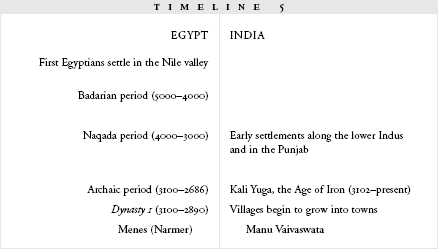
In the Indus river valley, in 3102 BC, northern wanderers settle and build towns
IN THE YEARS when the king of Kish collected tribute from the ships sailing up and down the Euphrates, and when the white walls of Memphis rose at the balanced center of Egypt, the third great civilization of ancient times was still a string of tiny villages on a river plain. There would be no great cities and no empire-building in India for at least six hundred years.
The people who settled along the length of the Indus river were not city-dwellers. Nor were they list-keepers, as the Sumerians were. They did not carve the likeness of their leaders on stone, or set down their achievements on tablets. So we know very little about the first centuries of India.
We can try to mine the Indian epics for clues. Although they were written down very late (thousands, not hundreds, of years after the first settlements), they likely preserve a much older tradition. But even in this tradition, only one king, and one date, stand out with any clarity. In the year 3102, the wise king Manu presided over the beginning of the present age, and his age still has well over four hundred thousand years to go.
LONG BEFORE 3102, shepherds and nomads wandered into India. Some came down from central Asia, through the gap in the northern mountains now called the Khyber Pass. Others may have climbed straight over the Himalaya themselves (the occasional skeleton suggests that this route was as treacherous then as now).
They found both warmth and water on the other side of the mountains. The Himalaya acted as a barrier to frost, so that even in winter the temperature barely dropped below fifty degrees. In summer, the sun lit the Indian countryside into blazing heat. But two great rivers kept the subcontinent from desert barrenness. Melted snow and ice streamed down from the mountains into the Indus, which flowed northwest through India into the Arabian Sea; the mountains also fed the Ganga, which poured down from the Himalayan slopes and into the Bay of Bengal, far on the eastern coast. In the days when the Sahara was green, the Thar desert east of the Indus river was also green, and yet another river, now long dry, ran through it into the Arabian Sea.1
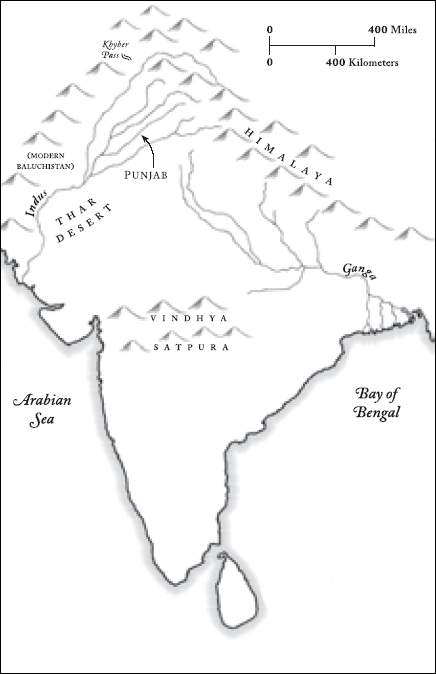
5.1 India
Perhaps two thousand years after crops were first grown in Mesopotamia and Egypt, northern wanderers settled in the hilly land just west of the Indus, today called Baluchistan. Tiny villages spread along the lower Indus river, and along the five branches of its upper end: the Punjab (the panj-ab, the “Five Rivers”). Other villages grew up along the Ganga. Down in the south of India, tools much like those used in southern Africa suggest that a few intrepid souls may have shoved off from the coast of Africa, sailed to India’s southwest shores, and settled there.
But these three areas—the south, the east, and the northwest—were divided from each other by enormous physical barriers. Hundreds of miles of plains and two mountain ranges, the Vindhya and Satpura, separated the north from the peoples of the south, whose known history comes much later. As the weather warmed, a desert three hundred miles wide spread its sands between the Ganga valley and the settlements in the northwest. From the very beginning of Indian history, the peoples of the south, the east, and the northwest lived independent of each other.
The villages near the Indus, in the northwest, grew into towns first.
The earliest houses in the Indus river valley were built on the river plain, perhaps a mile away from the river, well above the line of the flood. Mud bricks would dissolve in river water, and crops would wash away. The first reality of life in the Indus valley—as in Egypt and Sumer—was that water brought both life and death.
Which brings us to the first king of India, Manu Vaivaswata. Before Manu Vaivaswata, so the story goes, six semidivine kings had reigned in India. Each bore the name-title of Manu, and each ruled for a Manwantara, an age longer than four million years.
We are here clearly in the realm of mythology, but according to tradition, myth began to cross history during the reign of the seventh Manu. This Manu, sometimes simply called “Manu” and sometimes known by his full name of Manu Vaivaswata, was washing his hands one morning when a tiny fish came wriggling up to him, begging for protection from the stronger and larger fish who preyed on the weak, as was “the custom of the river.” Manu had pity and saved the fish.
Past danger of being eaten, the fish repaid his kindness by warning him of a coming flood that would sweep away the heavens and the earth. So Manu built a wooden ark and went on board with seven wise sages, known as the Rishis. When the flood subsided, Manu anchored his ship to a far northern mountain, disembarked, and became the first king of historical India; the seven Rishis, meanwhile, became the seven stars of the Big Dipper. The year was 3102.
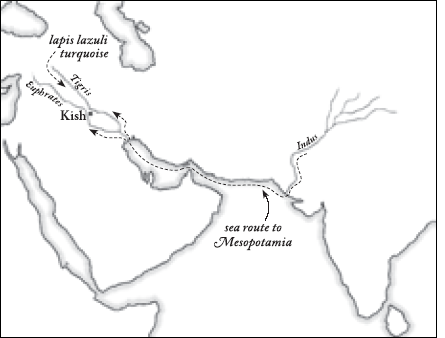
5.2 Indian Trade Routes
For the purposes of reconstructing Indian history, this story is more smoke than fire. Manu Vaivaswata has less claim to actual existence than the Scorpion King of Egypt, even though they seem to occupy the same century, and the oddly precise date 3102 is a result of backfiguring done by literary scholars at least two thousand years later, when the oral traditions began to be set down in writing. But the date itself appears in many histories of India; firm dates in ancient Indian history are hard to come by, so historians who cling to this one do so more from relief than from certainty. (“It is the first credible date in India’s history,” John Keay writes, “and being one of such improbable exactitude, it deserves respect.”)2
The only certainty about 3102 is that, around this date, villages in the Indus valley did indeed start to grow into towns. Two-story houses began to rise; the Indus settlers began to throw pots on wheels and to make tools of copper. They began to cut the forests and bake their clay in kilns. Oven-burned brick, more durable than brick dried in the sun, was less vulnerable to the swirling waters of floods. After 3102, water no longer had quite so destructive a power.
Turquoise and lapis lazuli, brought from the plains north of Mesopotamia, lie in the ruins of the richest houses. The townspeople had left their valley to trade above the Tigris and the Euphrates, with those same merchants who supplied semiprecious stones to the kings of Kish and Nippur and Ur.
But despite the growing prosperity and reach of the Indus towns, the epics of India tell not of advance, but of decline. The flood had washed away the previous age and begun a new one; the age of towns was the Kali Yuga, the Age of Iron. It began when Manu descended from the mountain, and it was an age of wealth and industry. It was also an age in which truthfulness, compassion, charity, and devotion dwindled to a quarter of their previous strength.13 In the Iron Age, the sacred writings warned, leaders would commandeer the goods that belonged to their people, pleading financial need. The strong would take property from the vulnerable, and seize hard-won wealth for themselves. Rich men would abandon their fields and herds and spend their days protecting their money, becoming slaves of their earthly possessions rather than free men who knew how to use the earth.
Given the relatively late date at which these dreadful warnings were put down, they probably reflect the worries of a more mature society—one which already had a large, unproductive bureaucracy draining the national coffers. But the storytellers themselves put the beginnings of this declension all the way back to 3102, the year when villages along the Indus began to grow into towns.
Manu himself, kneeling down by the water that will soon wash away the previous age and bring on the decline of the Kali Yuga, finds himself speaking to a little fish forced to beg for protection from the larger and stronger who prey upon the weak. In India, the journey towards civilization had just begun; but as in Sumer itself, it was a journey which took its people that much farther from paradise.