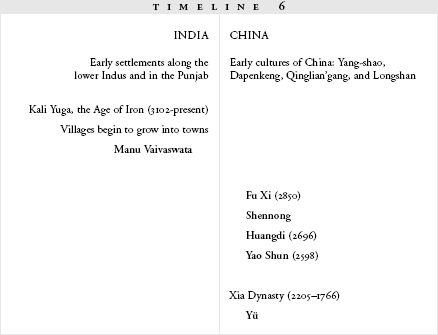
In the Yellow river valley, between 2852 and 2205 BC, the early villages of China acquire kings but reject their heirs
FAR EAST OF MESOPOTAMIA AND INDIA, the familiar pattern repeated itself once more.
This time, settlement began around the Yellow river, which ran east from the high plateau now called Qing Zang Gaoyuan—the Plateau of Tibet—and ended in the Yellow Sea. Farther south, the Yangtze river also ran to the eastern coast.
In the days when the Sahara was green and the Thar desert watered by a river, the wide expanse of land between the two great rivers of China was probably an earth-and-water patchwork of swamps, lakes, and mud. The peninsula of Shandong, between the two rivers, was almost an island. Hunters and gatherers might wander through the marshes, but there was little reason to settle on the water-soaked land.
Then the Sahara warmed; the Nile floods lessened; the river that once watered the Thar Desert disappeared; the braided stream of Mesopotamia slowly became two separate rivers as soil built up between them. Between the two great rivers of China, the land dried.
By 5000 BC, the expanse between the rivers was a wide plain, with forests on its high places. The wanderers had begun to settle, planting rice in the wet ground around the rivers. Houses multiplied and villages grew up. Archaeology reveals the first significant clusters of houses near the Yellow river. Here, settlement slowly became something like a culture: people with the same customs, the same methods of building houses, the same style of pottery, and presumably the same language.
This Yellow river culture, which we now call the Yang-shao, was not the only cluster of settlements in China. On the southeast coast of China, facing the East China Sea, another culture called Dapenkeng appeared; in the Yangtze river valley farther to the south, the Qinglian’gang grew up.1 Beneath the great southern bend of the Yellow river, a fourth cluster of settlements, the Longshan, sprang up. Excavations show Longshan ruins overtop of Yang-shao remains, suggesting that the Longshan may have peacefully overwhelmed at least part of the Yellow river culture.
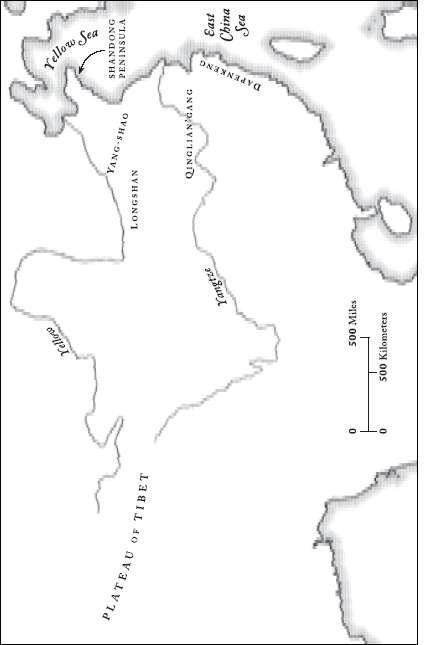
6.1 China’s Early Settlements
We know almost nothing about the lives and customs of any of these four groups of people. All we can do is label them with different names because they have different styles of pottery and different methods of farming and building; a Yang-shao settlement might be surrounded by a ditch, while a Longshan village might be set off from the surrounding waste by a wall of earth. But apart from very general speculations (perhaps the arrangement of a cemetery near a village on the south bank of the Yellow river hints at a very early form of ancestor worship; perhaps the burial of food along with the dead shows belief in a pleasant afterlife), we have no clues: only the stories which claim to tell of China’s beginnings.
Like the stories of the Mahabharata, the stories of early China were set down several thousand years after the times they describe. But insofar as they keep older traditions alive, they tell of a first king who discovered the essential order of all things. His name was Fu Xi.
Sima Qian, the Grand Historian who collected the traditional tales of China into an epic history, tells us that Fu Xi began his rule in 2850. He invented the Eight Trigrams, a pattern of straight and broken lines used for record-keeping, divination, and interpretation of events. As he meditated on the appearance of birds and beasts, Fu Xi
drew directly from his own person,
and indirectly he drew upon external objects.
And so it was that he created the Eight Trigrams
in order to communicate the virtue of divine intelligence
and to classify the phenomenon of all living things.2
The patterns of the Eight Trigrams are modelled after the markings on turtle shells. The first Chinese king didn’t save his people from a flood, receive authority from heaven, or bring two countries into one. No; his great accomplishment was, for the Chinese, far more important. He found a connection between the world and the self, between the patterns of nature and the impulse of the human mind to order everything around it.
IN CHINESE LEGEND, Fu Xi is followed by the second great king, Shennong, who first made a plow from wood and dug in the earth. The Huai-nan Tzu says that he taught people to find the best soil, to sow and grow the five grains that sustain life, to thresh them, and to eat good herbs and avoid the poisonous. The Farmer King was followed by the third great king, perhaps the greatest of all: Huangdi, the Yellow Emperor.14
Huangdi is traditionally thought to have ruled from 2696 to 2598 BC. In his reign, he first conquered his brother, the Flame King, and spread his rule over his brother’s land. Then the southern warleader Chi You, who had been faithful to the Flame King, launched a rebellion against the victorious Yellow Emperor. Chi You was an unpleasant character; he invented war, forged the first metal swords, ate pebbles and stones with his unbreakable teeth, and led an army of evildoers and giants. He charged against the army of Huangdi on a battlefield covered with fog; Huangdi had to use a magic chariot, equipped with a compass, to find his way to the center of the fight (which he won).
This is anachronistic. There were no compasses in China in 2696, magic or otherwise. Nor were there any cities. When Memphis and Kish were flourishing, the Yellow river settlements were still wood-posted, wattle-and-daub clusters surrounded by earthen ditches and walls. The people who lived in these settlements had learned to fish, to plant and harvest grain, and (we assume) to fight against invaders. Huangdi, if he fought for his empire against his brother and his brother’s warleader, won not an empire of thriving cities and merchants, but rural clusters of huts surrounded by rice and millet fields.
But some kind of transition in the structure of Chinese government took place after Huangdi’s conquests. Back in Sumer, the idea of hereditary power was well-established by this time. Apparently, the same issue reared its head in China almost at once. Huangdi, the last of the three great kings, was followed by a king called Yao. Yao, who was filled with wisdom (he is the first of the Three Sage Kings), apparently lived in a China where it was already customary for a king to pass his power to his son. Yao, though, realized that his own son was unworthy to inherit his throne. Instead, he chose as his successor a poor but wise peasant named Shun, who was famous not only for his virtue, but for his dedication to his father. Shun, who became a wise and just king (and the second of the Three Sage Kings), followed his own king’s model; he passed over his son and chose another worthy man, Yü, as his heir. Yü, the third Sage King, is credited with establishing the first dynasty of China, the Xia.
In other words, in China the earliest tales of royal succession show, not a desperate quest for a blood heir, but sons disinherited in favor of virtue. They celebrate kingly power while rejecting too heavy an exercise of it. Authority is all very well, but no man should assume that he’ll automatically be gifted with it because of his birth. Wisdom, not birth, qualifies a man to rule. The people of Kish may have mourned because their king Etana was childless. The towns of the Yellow river valley had no such longing.15